
Horological History · Historical feature
Mantel Clocks: Paris Pendules, Carriage Clocks and the Clock on Every Chimneypiece, 1730–1970
How the clock moved from the wall and the floor to the chimneypiece: gilt-bronze pendules made by teams of Paris specialists, the travelling carriage clock, Connecticut shelf clocks sold by the million, black marble garnitures and the Atmos clock that winds itself from the air — with examples from museums, dealers and auction records, and a guide to dating your own.
Atlas Editorial · · 25 min read
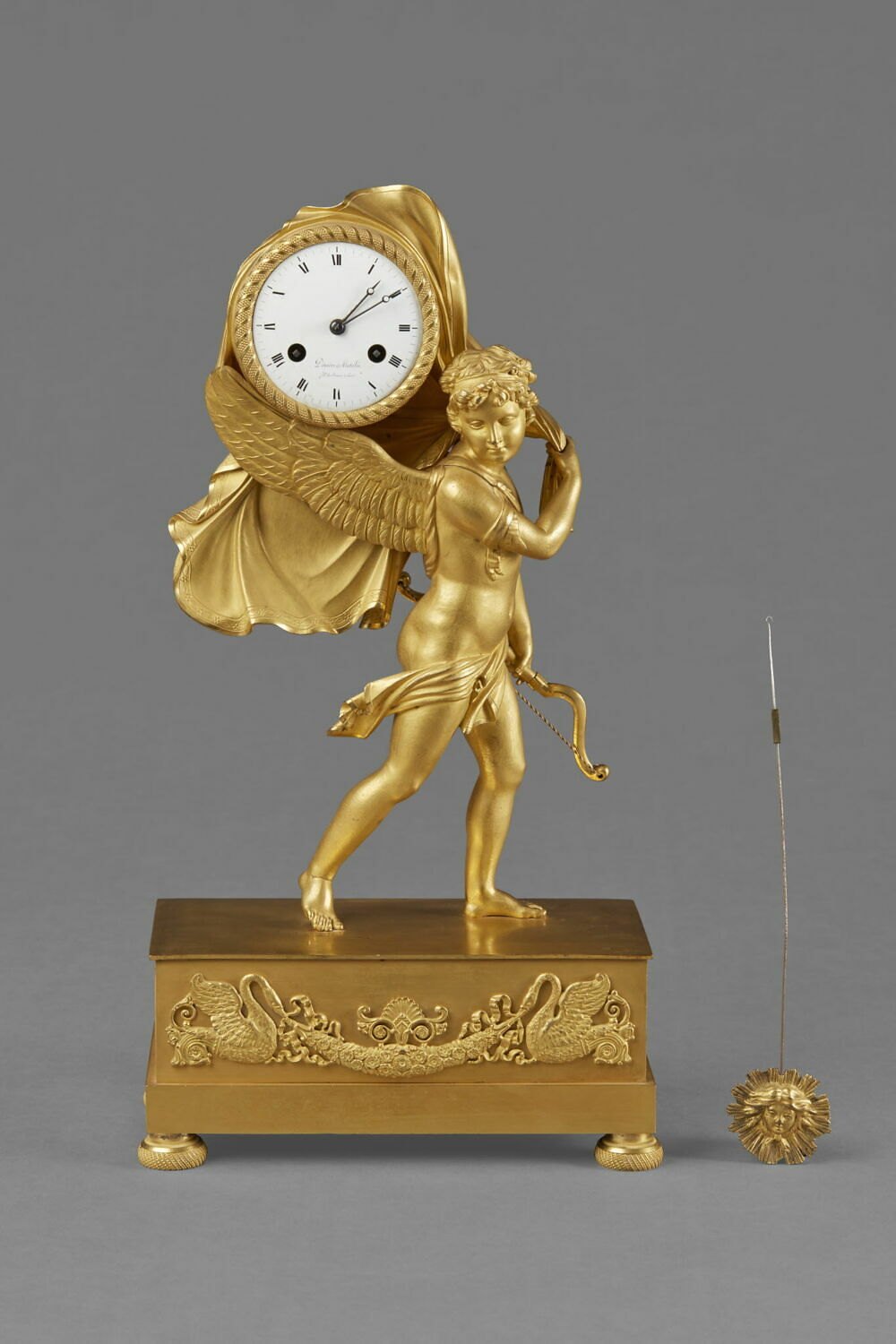
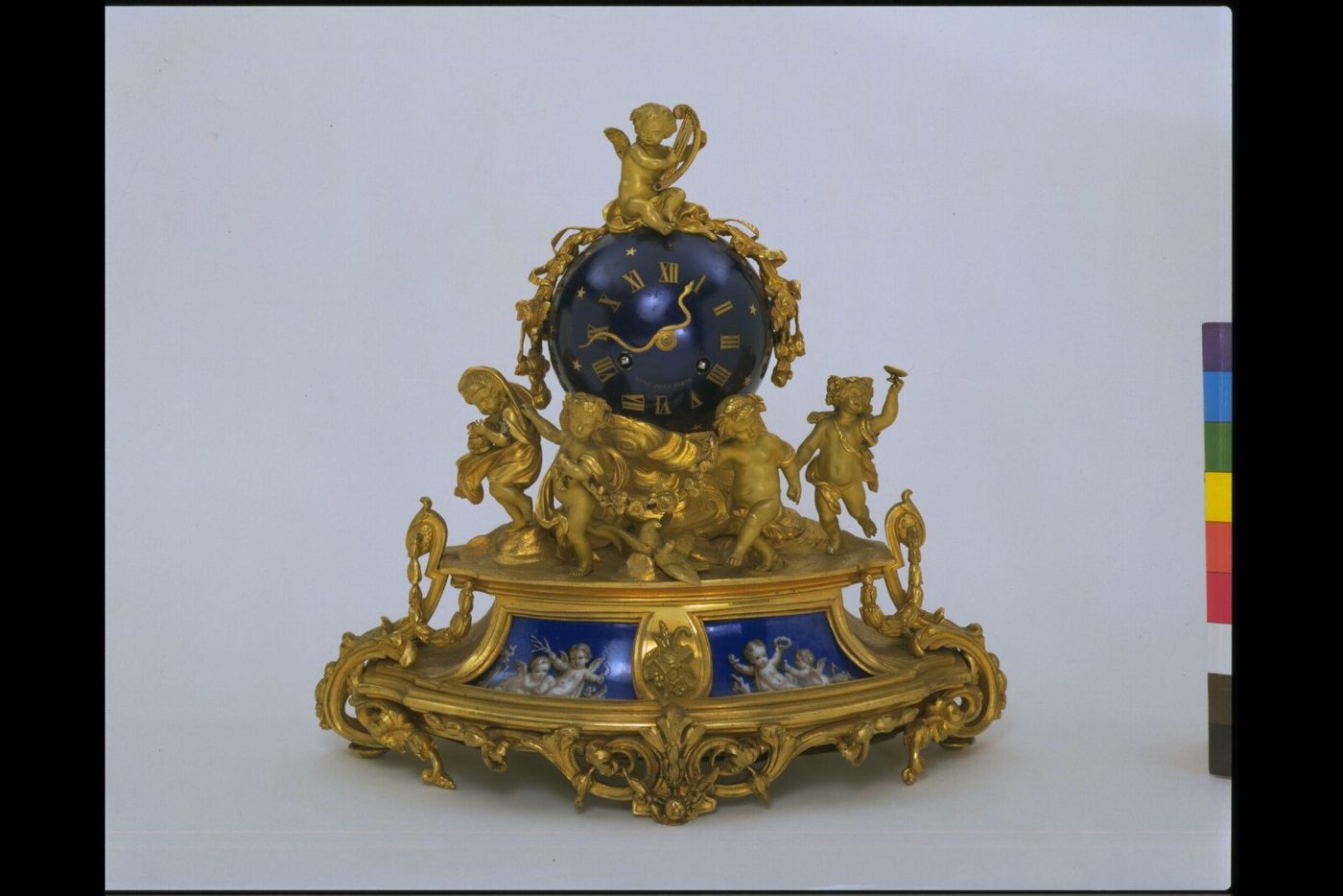
Musée du Louvre, Paris · © GrandPalaisRmn / Musée du Louvre — permission required · source (opens another website in a new tab)
Ask most people to picture an antique clock and they will describe one of two things: a tall clock standing in a hall, or a smaller clock on a mantelpiece, usually with a white enamel dial, often between a pair of vases or candlesticks. The second is by far the more common. From the middle of the eighteenth century to the middle of the twentieth, the mantel clock — the French called it a pendule de cheminée, a chimneypiece clock — was the clock that most households actually owned, looked at and wound.
It is also one of the most varied objects in horology. The same broad type covers a gilt-bronze sculpture made for a French prince, a factory-made shelf clock from Connecticut that cost a few dollars, a brass carriage clock in a leather travelling case and a twentieth-century Atmos clock that has not been wound by hand since it left the factory. This feature follows those branches in turn, using photographs of clocks in the Louvre, the Victoria and Albert Museum, the Metropolitan Museum, Yale University Art Gallery, Royal Museums Greenwich, the Science Museum, Museums Victoria and the records of dealers and auction houses. Facts about individual clocks come from those records; where a museum's dating or attribution is cautious, we have kept its caution.
Paris in the eighteenth century: a clock made by a team
The fashionable Paris pendule was not the work of one maker. The guild system that governed the city's crafts separated the trades: a clockmaker (horloger) made or finished the movement, a founder and chaser (fondeur-ciseleur) cast and chased the bronze case, a gilder gilded it, an enameller painted the dial, and a marble worker supplied the base. Luxury dealers, the marchands-merciers, often brought these pieces together and sold the finished object. The Victoria and Albert Museum's description of a carriage clock by Robert Robin, made in the early 1780s, says exactly this: it has 'all the hallmarks of an object assembled by one of the half dozen exclusive Parisian retailers of this type of luxury goods, a marchand mercier', combining gilt bronze, porcelain plaques, an enamel dial and a movement, 'all of which would have been supplied by separate specialist manufacturers'.
That division of labour explains a puzzle that confuses many owners. The name on the dial is usually the clockmaker or the retailer, not the person who made the case, and the case — the part you actually see — may be by a sculptor or bronze-maker whose name appears nowhere. When a museum attributes a clock to a bronze-maker, the movement is often signed by someone else. The Louvre's vase-shaped clock catalogued under Robert Osmond, a leading bronze-maker, has a movement and dial signed by Dubois.
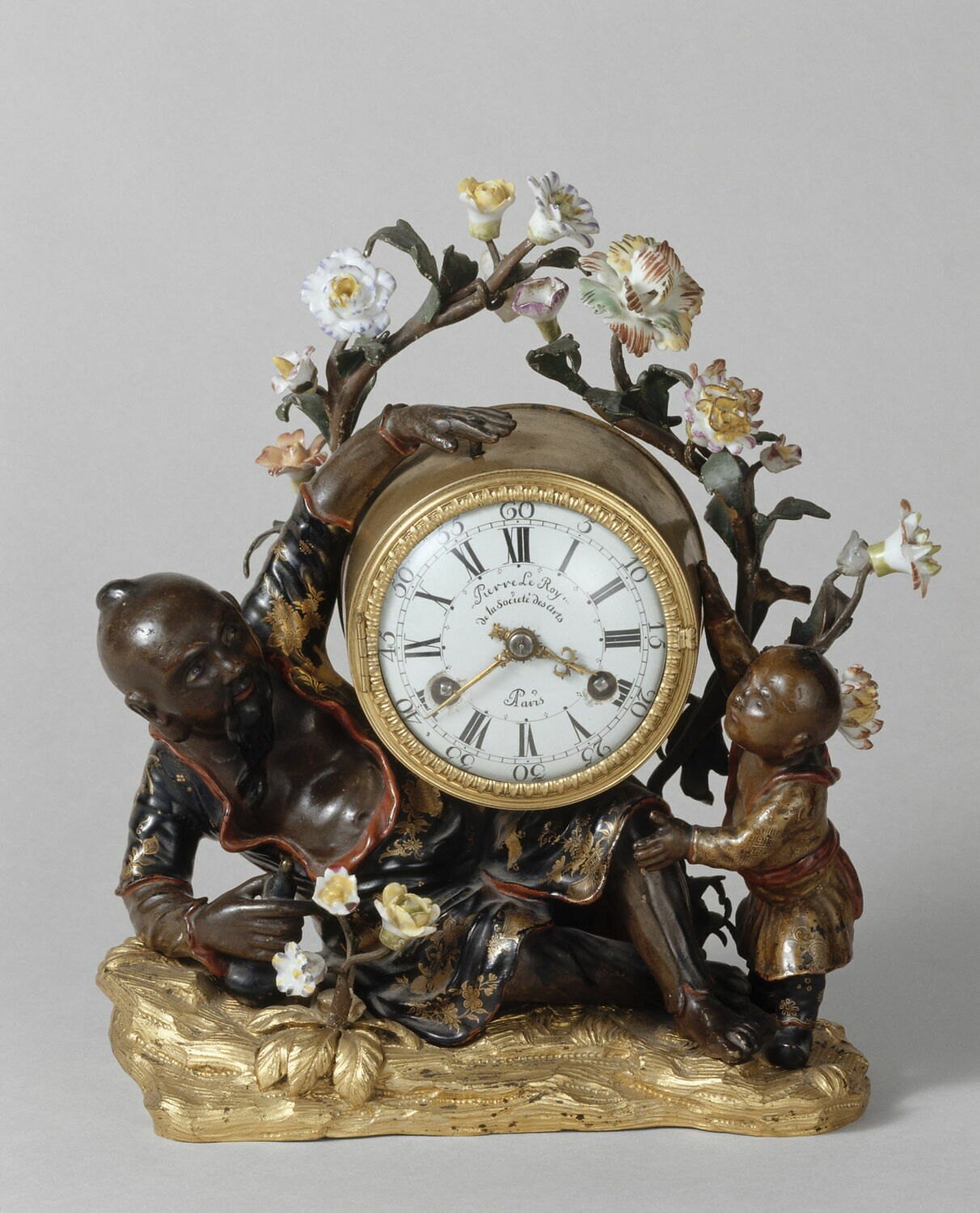
The earliest clock in this group shows the taste of the reign of Louis XV. Pierre Le Roy's clock of about 1735–1745 in the Louvre is a small sculpture: a reclining Chinese figure in black-lacquered bronze holds the dial on his leg while a child stands beside him, and gilt-bronze branches with porcelain flowers rise behind. Chinoiserie, asymmetry and flowers are the marks of the period. The dial is enamel, white with black numerals — a format that would remain standard on French clocks for the next 150 years.
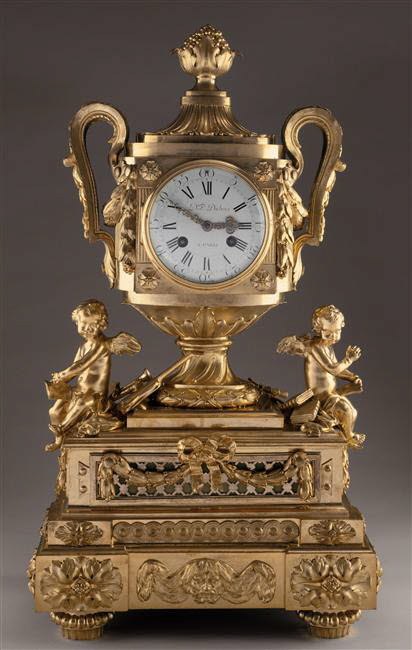
By the 1760s the fashion had turned to the antique. The Osmond clock takes the form of a classical vase on a heavy square base, decorated with laurel, ribbons and rosettes, with two winged cupids seated at its foot among musical and astronomical instruments. The Louvre's clock by Cachard, 'successor of Charles le Roi', of 1765–1770, is a white marble base carrying a dial supported by two gilt-bronze sphinxes, with a female figure and two cupids above. Symmetry, white marble and the motifs of Greek and Roman architecture define the neoclassical clock of the later eighteenth century.
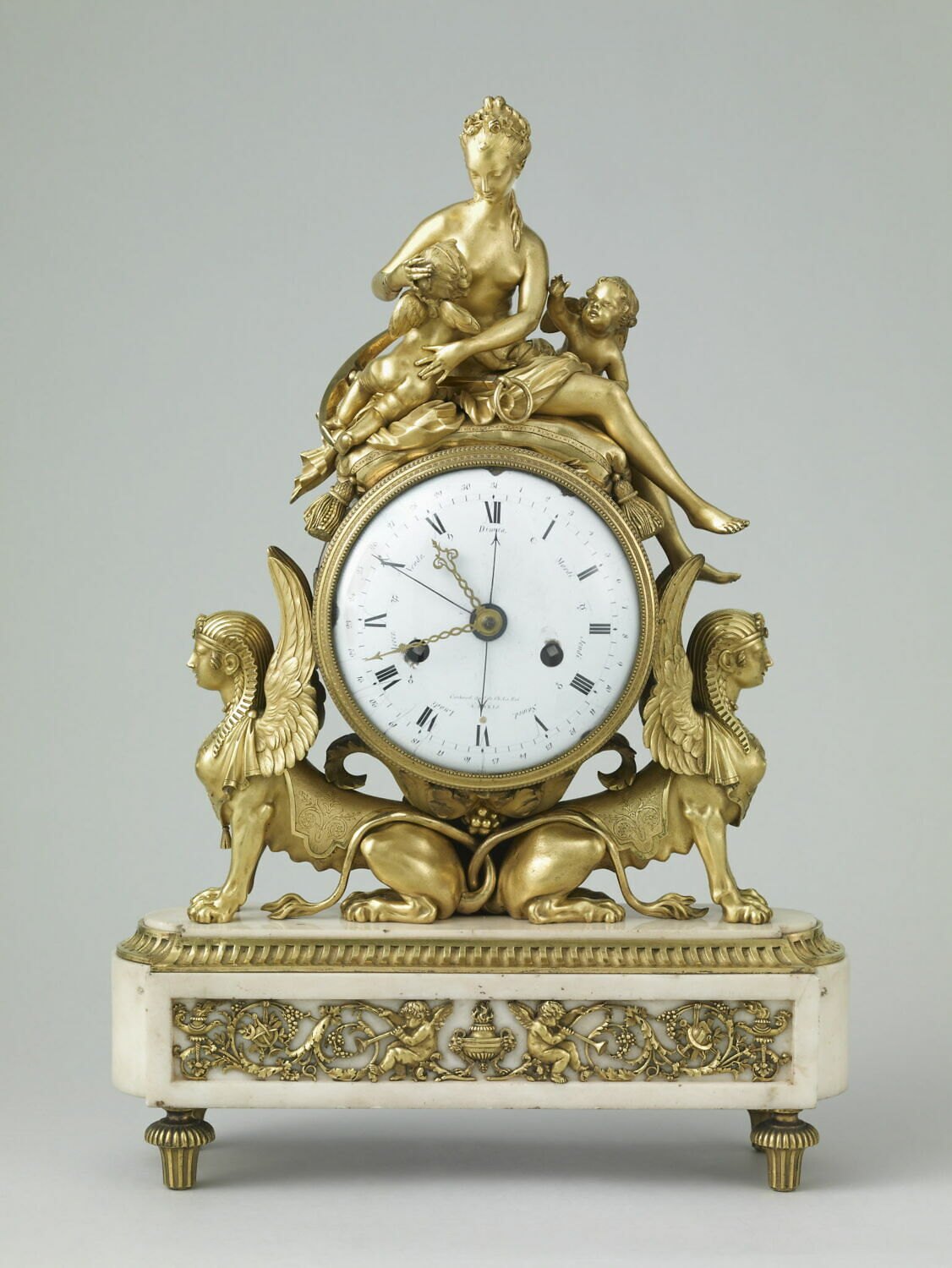
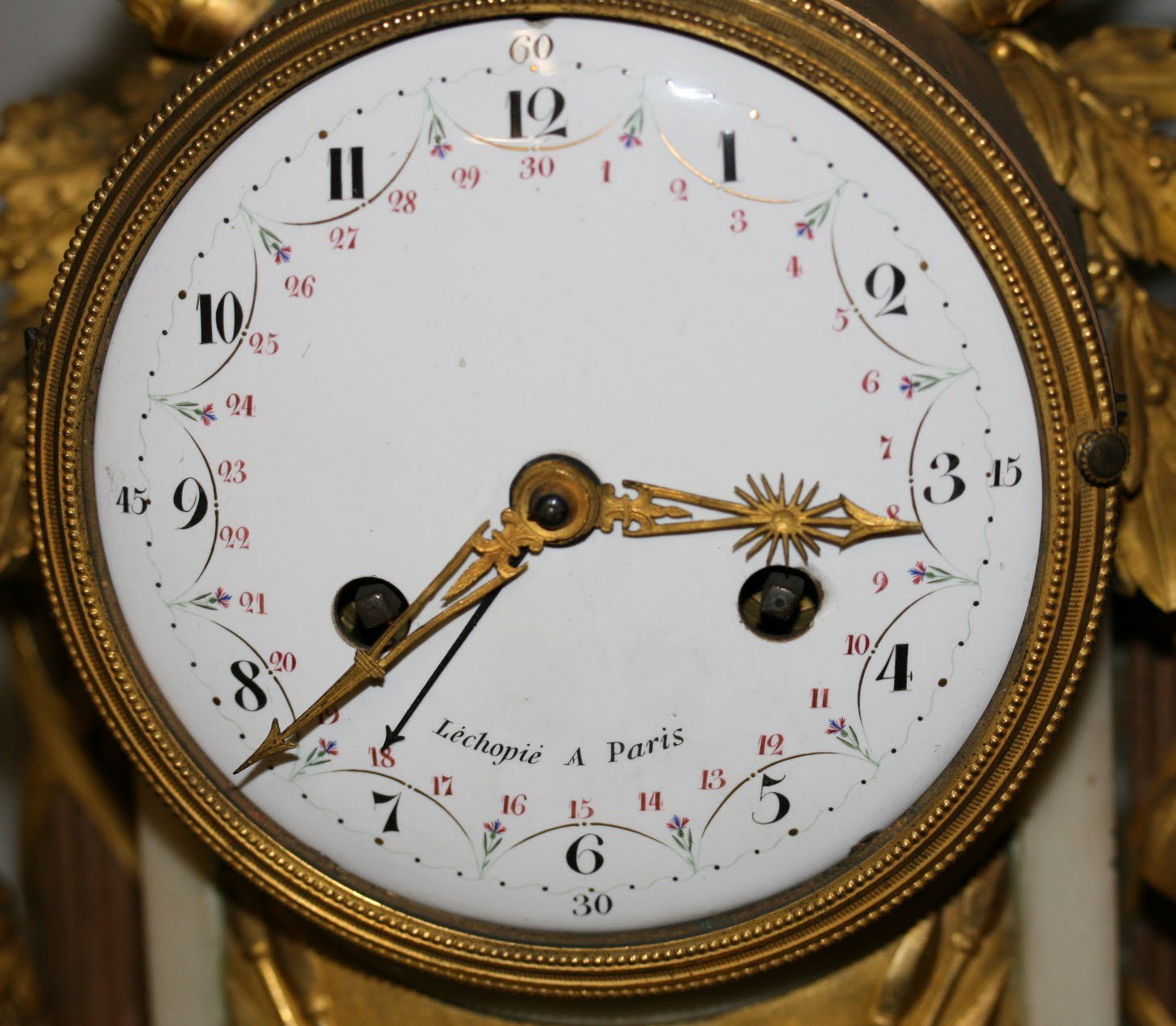
Adam L'Echopier's clock of about 1775–1800, also in the Louvre, combines white marble with chased and gilded bronze, six claw feet, trophies of arms and a cockerel on top. Its dial is worth looking at closely: beside the hour and minute hands it has a third, gilded hand for the day of the month, read against a red ring of numbers. Calendar work of this kind was a modest addition to a Paris movement and is common on good clocks of the period.
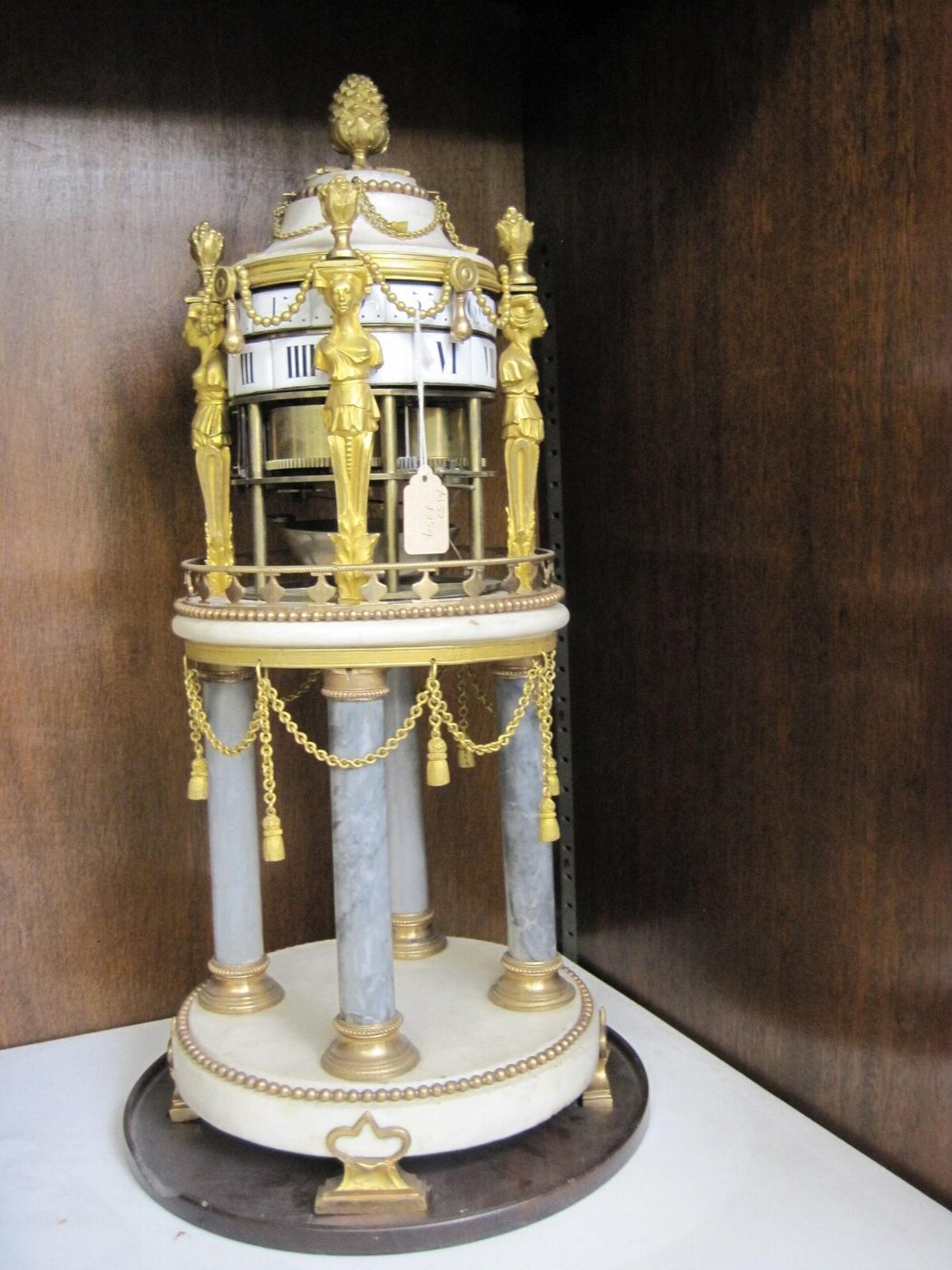
The Victoria and Albert Museum's temple clock by Pierre-Michel Barancourt (1745–1804) takes the classical language one step further: the clock becomes a two-storey building, with grey marble columns, ormolu capitals and a white marble dome carried on the heads of four female figures. Under its glass cover it is as much a piece of architecture as a timekeeper.
Empire and Restoration: the clock as sculpture
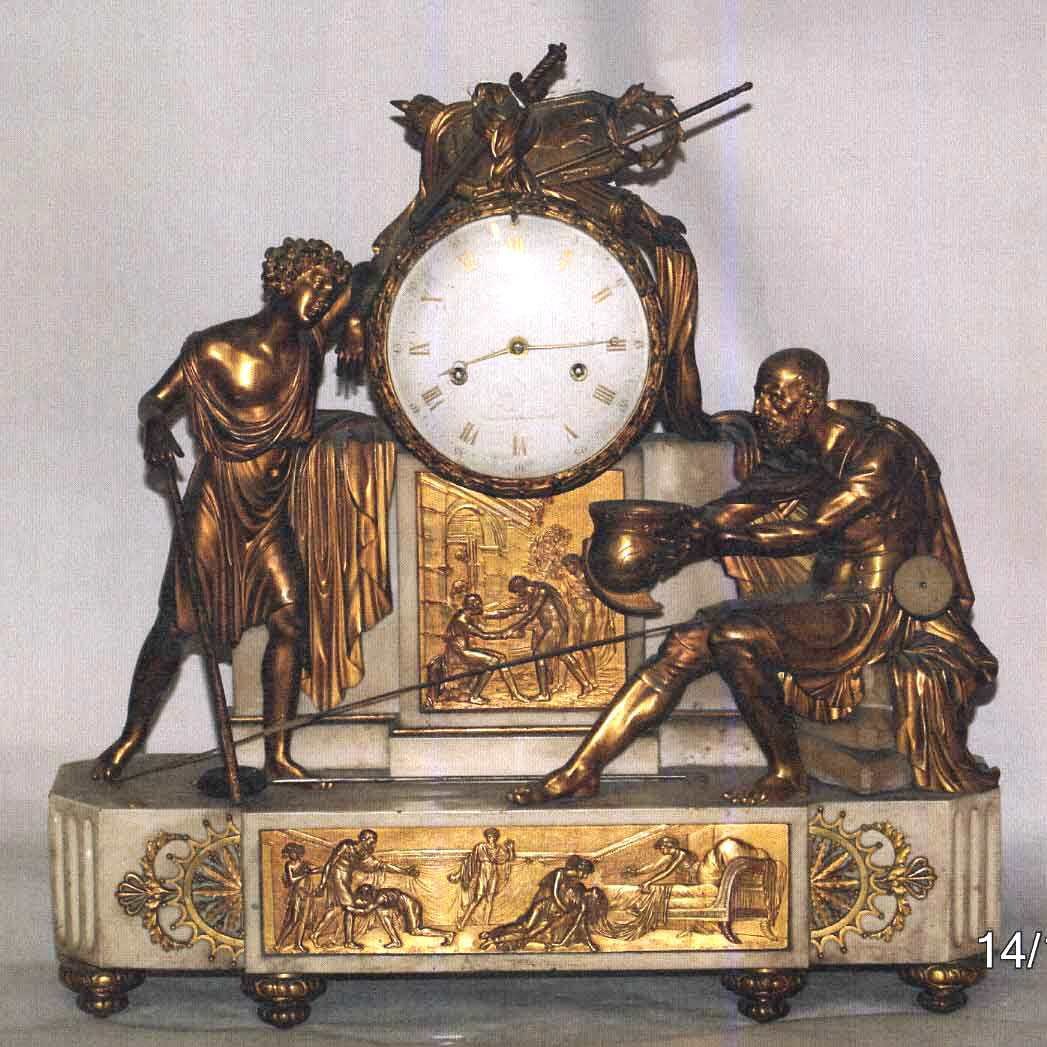
After the Revolution the Paris bronze trade revived quickly, and the clocks of the Directoire, Consulate and Empire (roughly 1795–1815) are some of the most ambitious ever made. Their cases are often figure groups taken from ancient history, mythology or contemporary literature, with the dial set into a plinth, a rock or a column. The Louvre's clock sold under the name of Jean-Antoine Lépine, made between 1800 and 1815, illustrates the story of Belisarius, the Byzantine general said to have been blinded and reduced to begging. The old soldier sits holding out his helmet while a young guide stands beside him; bas-reliefs on the base show further scenes of the story. The enamel dial is signed by the enameller Dubuisson, and the movement is signed 'LEPINE A PARIS N° 4430' — the name of a famous firm, still trading from the place des Victoires.
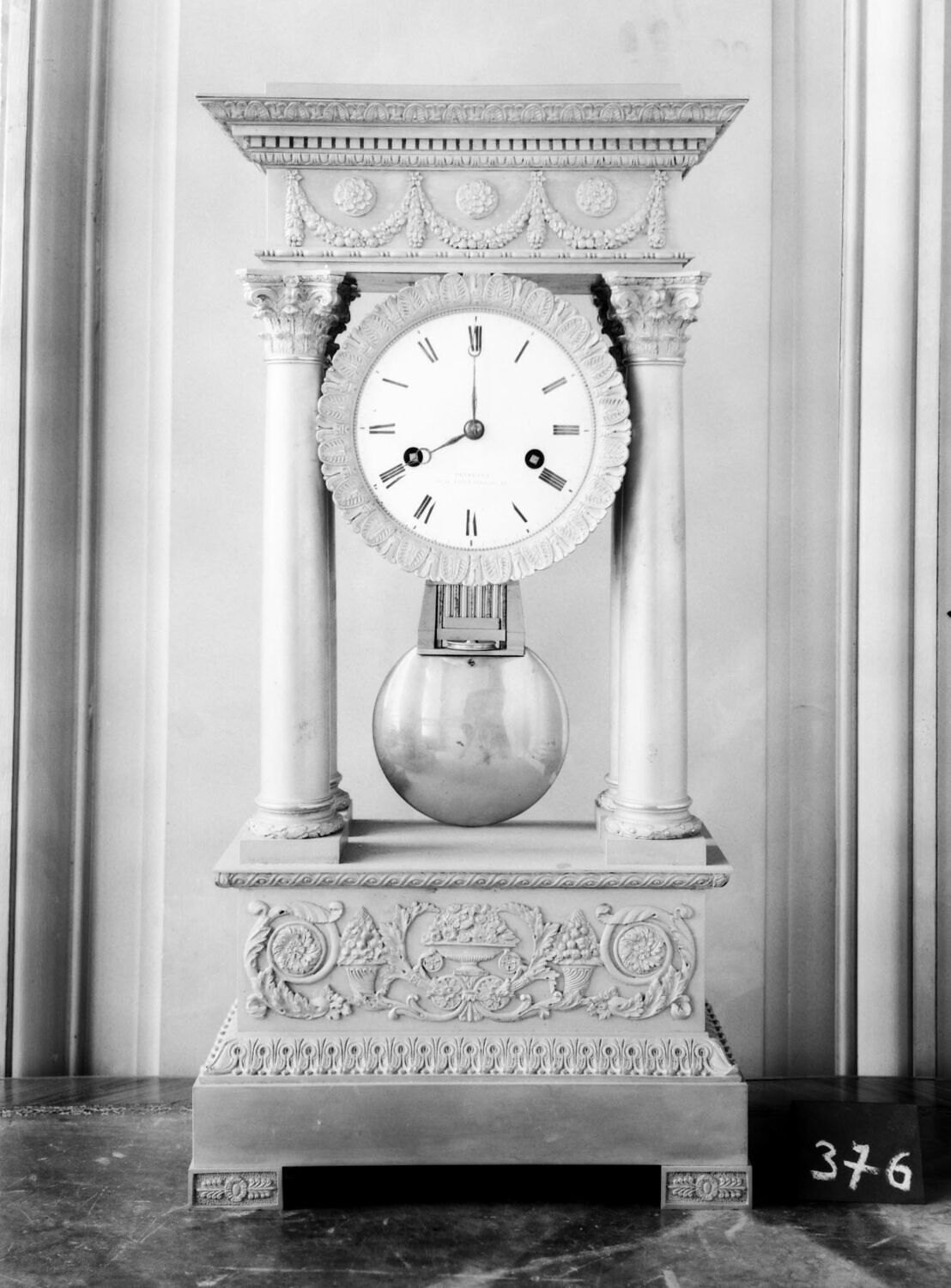
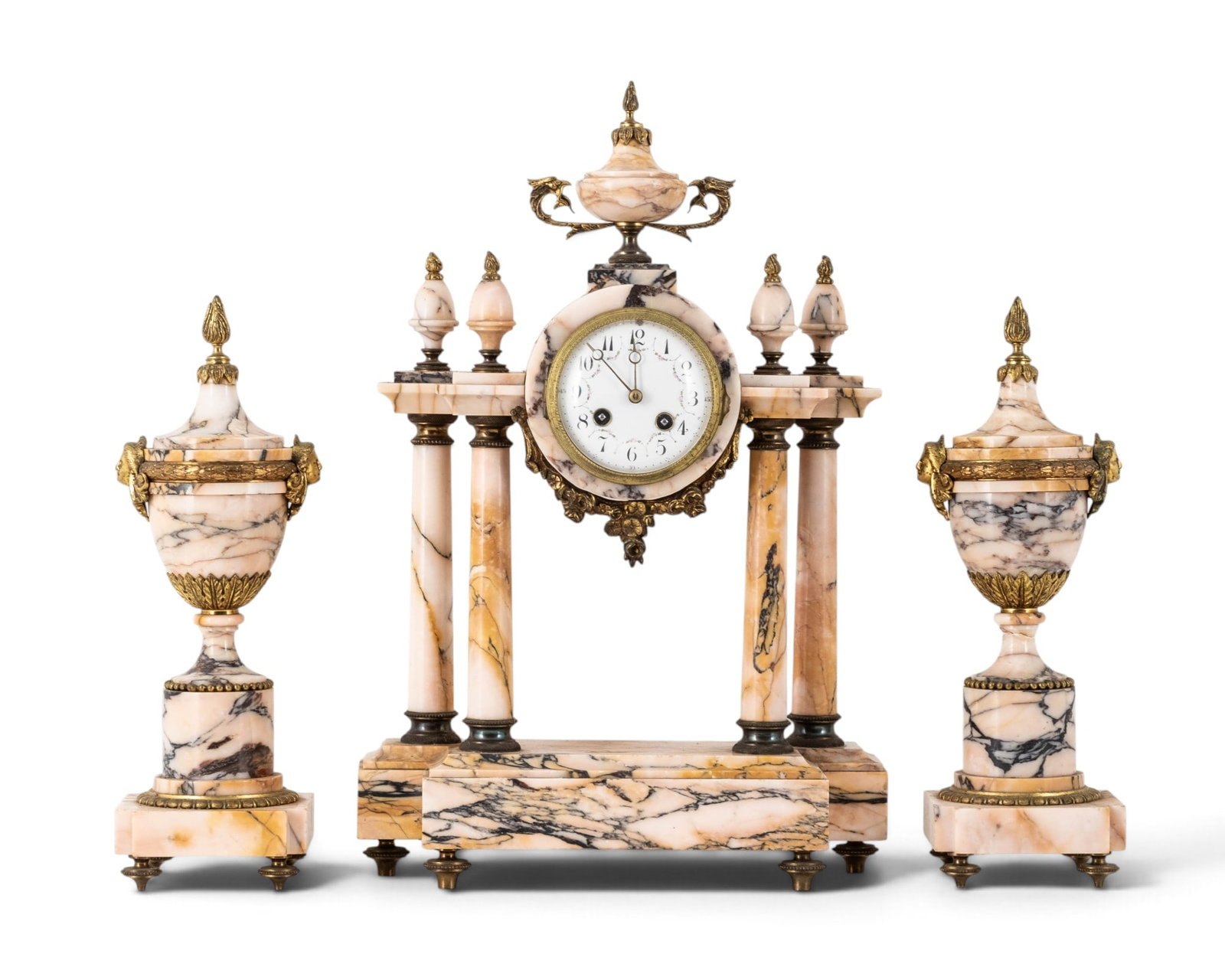
Other Empire clocks reduce the case to architecture. Brisbart's clock of the same years is a portico: four gilt-bronze columns carry an entablature hung with flower garlands, with the round dial suspended beneath. The portico clock — sometimes called a pendule portique — was made in enormous numbers through the nineteenth century, in gilt bronze, in marble, and eventually in cheap spelter, so the form alone dates nothing; the quality of the casting, chasing and gilding does.
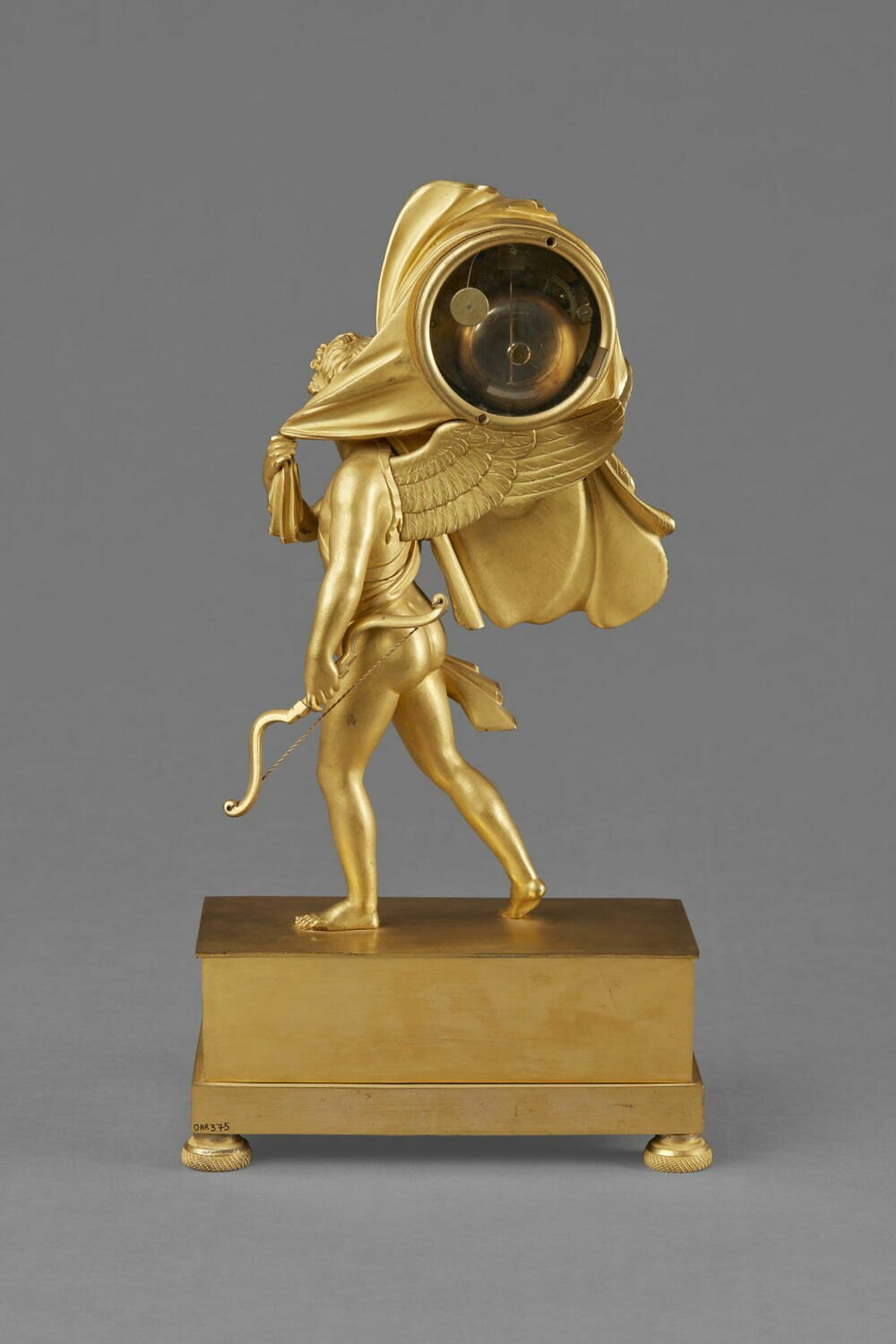
The figure of Love walking forward with the clock drum held up on his wings, in the Louvre, is typical of the Restoration years after 1815. Its dial is signed 'DENIERE ET MATELIN, Fabt de bronze à Paris' — a bronze manufacturer, not a clockmaker. By the early nineteenth century the leading bronze firms were large businesses that bought movements in, cased them and put their own name on the dial. A dial name, in other words, tells you who sold or made the clock as a finished product; it does not prove who made the movement.
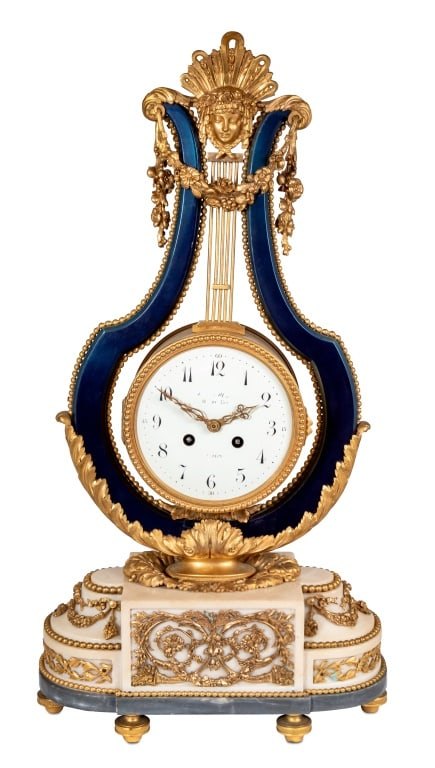
The lyre was another favourite of the years around 1800–1830: the clock drum is held between the arms of a lyre, sometimes with the pendulum swinging as the 'strings'. A Restoration lyre clock of about 1820 in the auction records combines ormolu with marble, a mask and foliate swags at the top and an enamel dial; the cataloguer notes that the dial signature is illegible — a common problem, because enamel dials were cleaned and the painted names wore away.
The Paris movement
Whatever its case, the typical French mantel clock of the nineteenth century has the same kind of works: a small movement with round brass plates, usually about 9 cm across, two spring barrels — one for the going train and one for the striking train — an anchor escapement and a short pendulum. Collectors call it the Paris movement, though most were made in the provinces and only finished in Paris. The Victoria and Albert Museum's description of a clock by Pierre Leurtier, of about 1860, is a good textbook example: 'circular movement plates 9 cm diameter', an anchor escapement, winding holes at IIII and VIII, and a 'small hole for regulation above XII' for a 'regulator of Brocot type'.
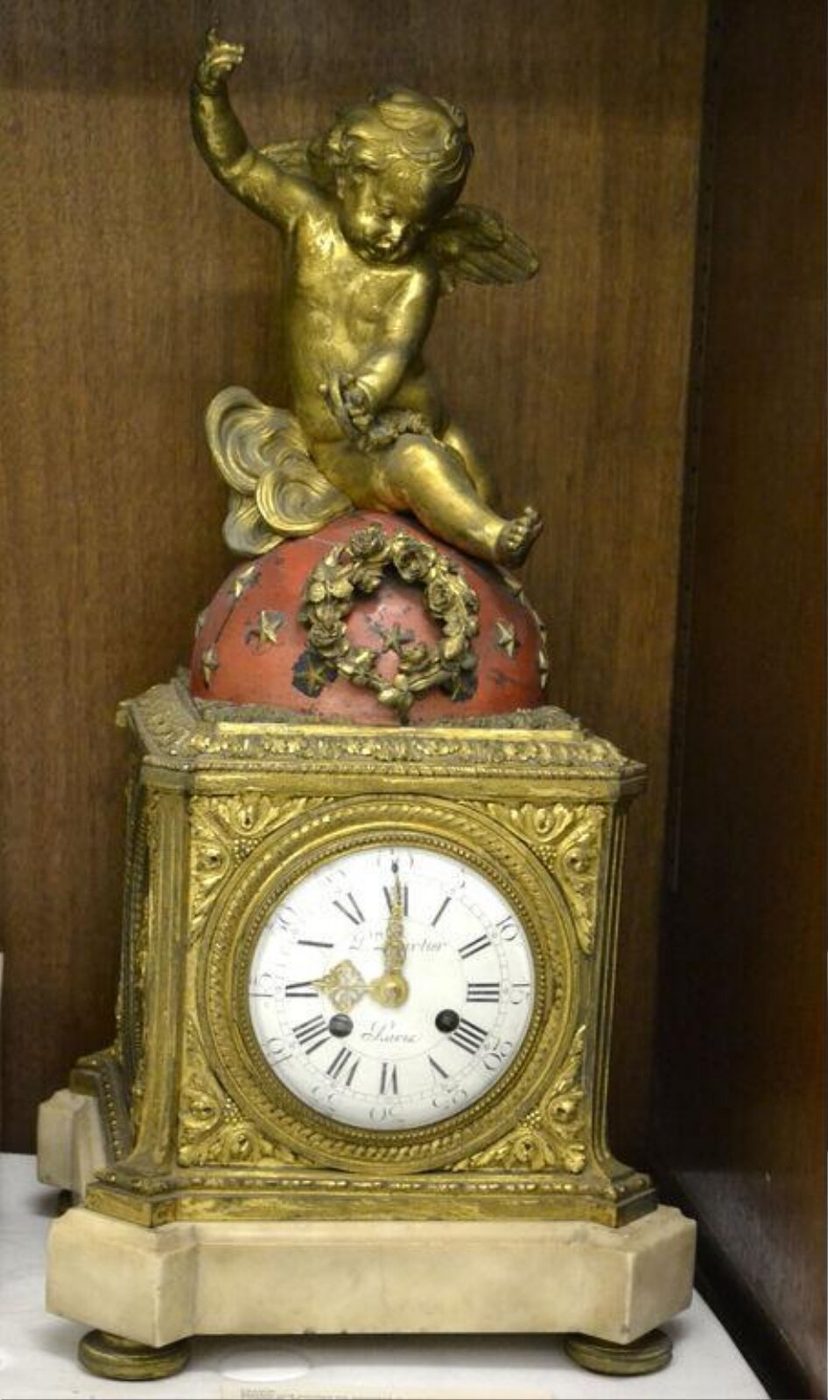
That small hole is the signature of Achille Brocot (1817–1878), a Paris clockmaker whose improvements spread through the whole French trade. His adjustable suspension let the pendulum's effective length be changed with a key from the front of the dial, so the clock could be regulated without turning it round. Brocot is also known for a pin-pallet escapement placed in front of the dial, where its jewelled or steel pallets can be seen working — the 'visible Brocot escapement' found on many marble and four-glass clocks. Earlier Paris clocks hung the pendulum from a loop of silk thread, which is adjusted by winding the thread up or down; if your clock has a small square arbor above XII and no silk, it almost certainly dates from after about 1840.
Most of these movements were made in series by provincial firms. The largest was Japy, founded by Frédéric Japy at Beaucourt near Montbéliard, which mechanised the making of rough movements in the late eighteenth century and became one of the largest clock and watch manufacturers in Europe. Japy and its rivals supplied unfinished movements — blancs roulants — to Paris finishers, who completed, adjusted, cased and signed them. Saint-Nicolas-d'Aliermont in Normandy was the other great centre, particularly for carriage clocks and lever-escapement movements. Museums Victoria holds both kinds: an ormolu clock by Japy Frères of about 1880 with locking-plate (count-wheel) striking, and a movement by Sauteur Frères of Saint-Nicolas-d'Aliermont, dated 1870, with a lever escapement.
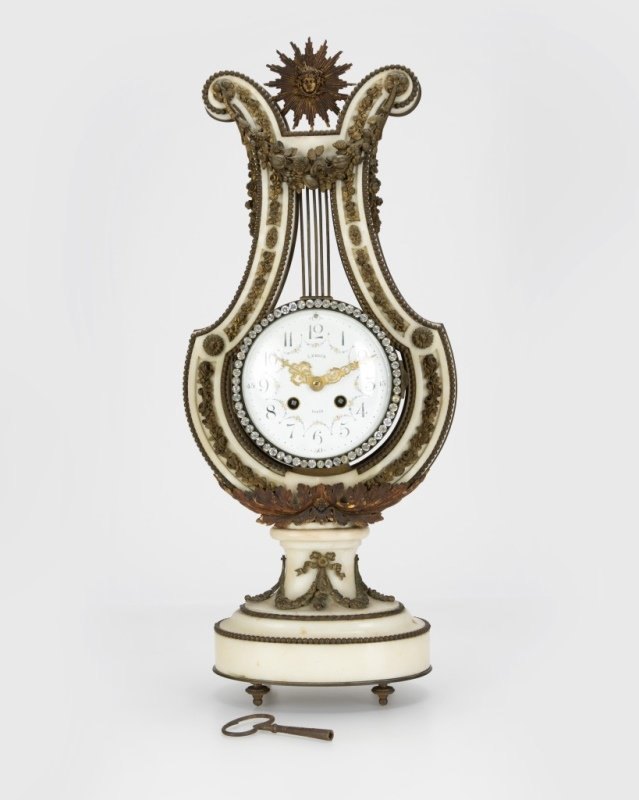
Turn a French clock round and the back plate often tells you who made the movement. A Louis XVI-style lyre clock of about 1900 in the auction records carries the maker's oval stamp, or pastille, 'A.D. Mougin / deux médailles', together with 'Paris' and a serial number, while its dial is signed 'Lenoir / Paris' — the retailer. 'Two medals' refers to awards at earlier exhibitions; firms kept such stamps in use for decades, so a medal is evidence that the clock is later than the award, not that it was made in that year.
| Feature on a French movement | What it suggests | Caution |
|---|---|---|
| Pendulum hung from silk thread | Before about 1840–1850 | Some silk suspensions were later converted; others were refitted with silk |
| Brocot-type regulation (square arbor above XII) | After about 1840; very common after 1860 | Continued into the twentieth century |
| Count wheel (locking plate) on the back plate | Traditional system, common throughout the century | Rack striking also used on better clocks; neither dates a clock alone |
| Visible Brocot escapement on the dial | c. 1850–1910, especially marble and four-glass clocks | Popular for a long period; replacements exist |
| Platform lever escapement | Carriage clocks and portable clocks, from the 1830s onward | Also used in later mantel clocks that must tolerate being moved |
| Maker's stamp and serial number on the back plate | Often datable from published serial lists for large firms | The stamp identifies the movement maker; the dial may carry a retailer |
| Medal stamp (e.g. 'Médaille d'argent') | The exhibition medal predates the clock | Firms used medal stamps for decades after the award |
Garnitures, marble and the Second Empire
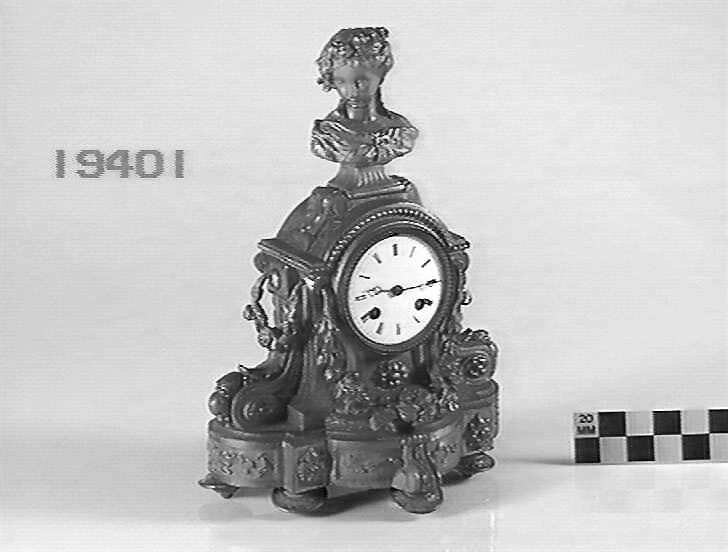
From the mid-nineteenth century the mantel clock became part of a set. A garniture de cheminée consisted of a clock with a matching pair of vases, candelabra or urns to stand either side; Museums Victoria's garniture of the 1880s, ormolu and enamel with a fifteen-day striking movement, is one such set, and the auction records include several more — gilt bronze with candelabra, rouge marble with patinated bronze, slate with red marble, and a portico clock with a matching pair of marble urns. The garniture tells us where the clock stood: at the centre of a symmetrical chimneypiece, the focal point of the drawing room.
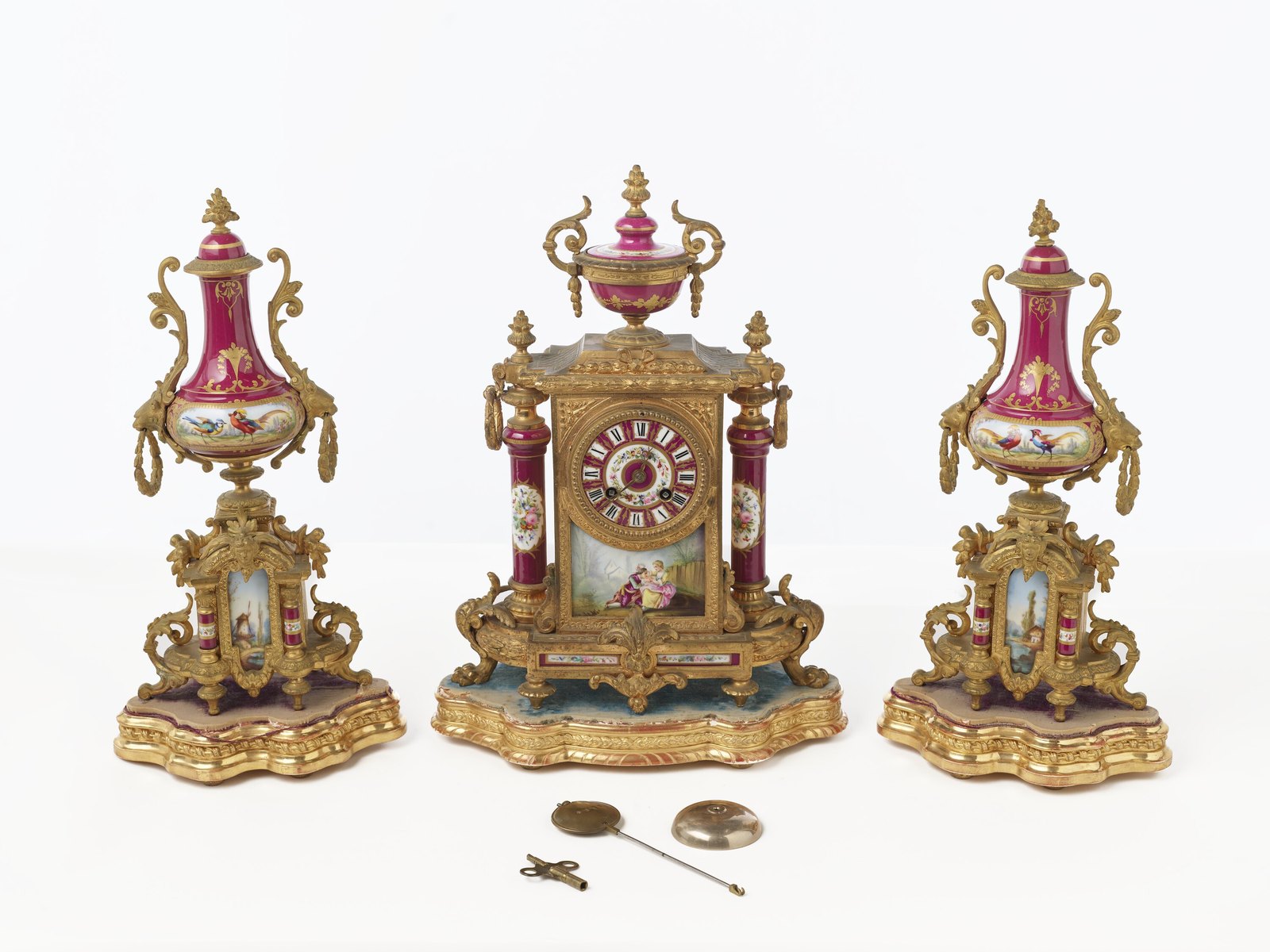
The styles of the Second Empire were revivals. The Victoria and Albert Museum bought a clock by Lévy Frères at the Paris Exhibition of 1855 for £19 4s; its dancing putti represent the four seasons around a blue enamelled globe. The museum's note is a useful guide to the whole period: mid-nineteenth-century France saw 'a neo-rococo style with pronounced curves and a surfeit of ornamental motifs', but it was symmetrical, and 'so lost much of the exuberance of the 18th century original'. Symmetrical rococo is one of the easiest ways to tell a revival clock from the real thing.
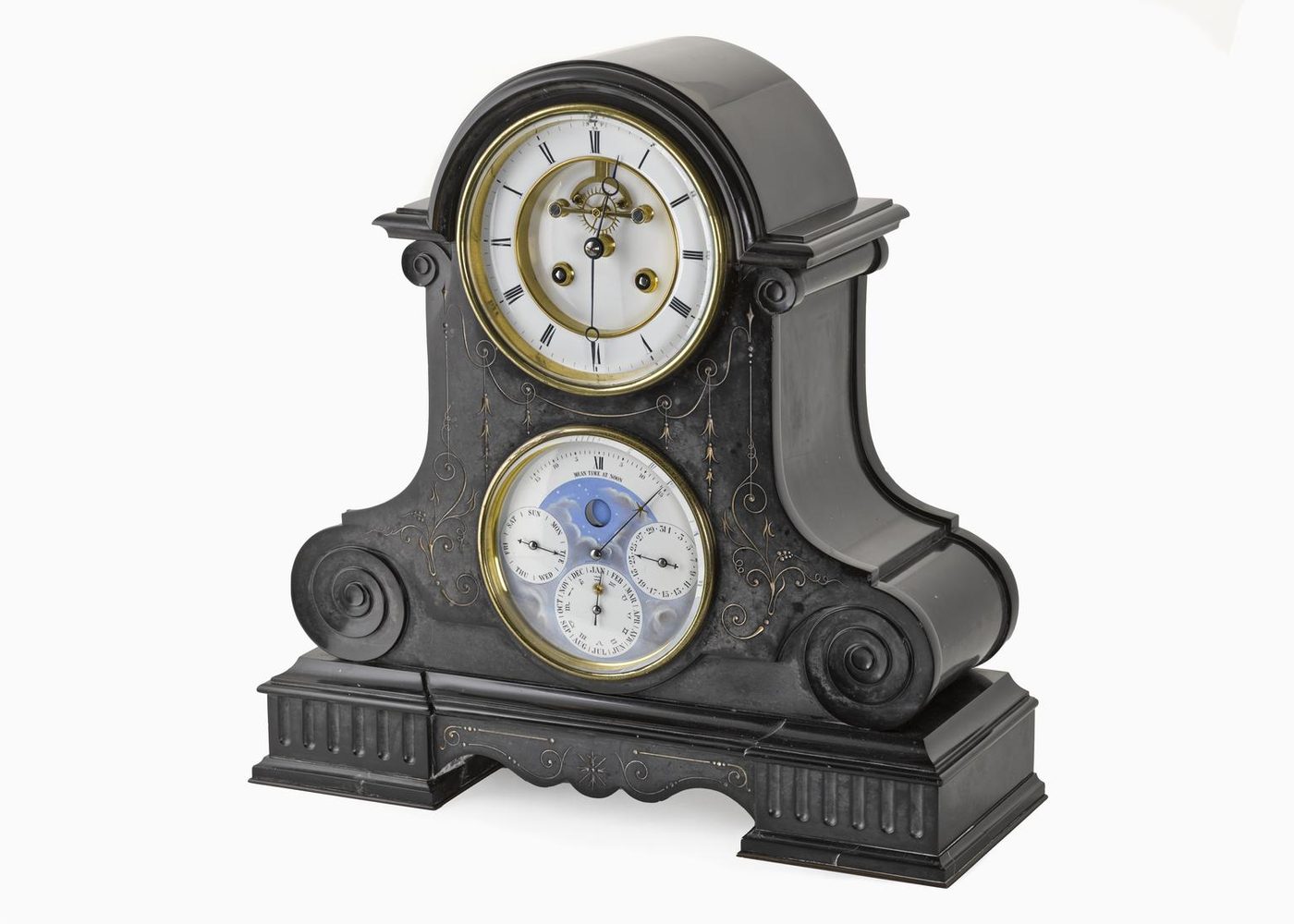
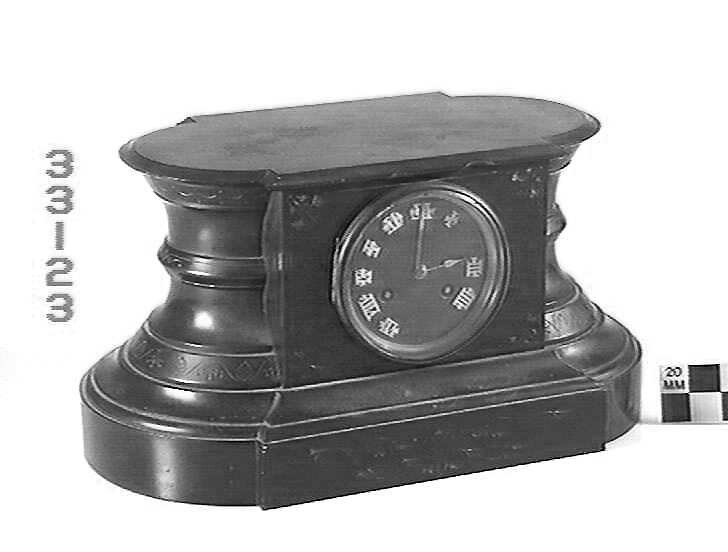
For the middle-class market the most familiar clock of the later nineteenth century was black. Clocks in black Belgian marble or slate, often architectural in shape and inlaid with coloured marble or engraved and gilded lines, were made in very large numbers in France and Belgium from about the 1860s to the First World War, and exported throughout Europe, the British Empire and the Americas. Museums Victoria's black marble clock signed Japy Fils is dated 1855, early for the type. These clocks were relatively inexpensive, dignified and very durable, which is why so many survive; their movements are usually standard Paris movements striking on a coiled gong.
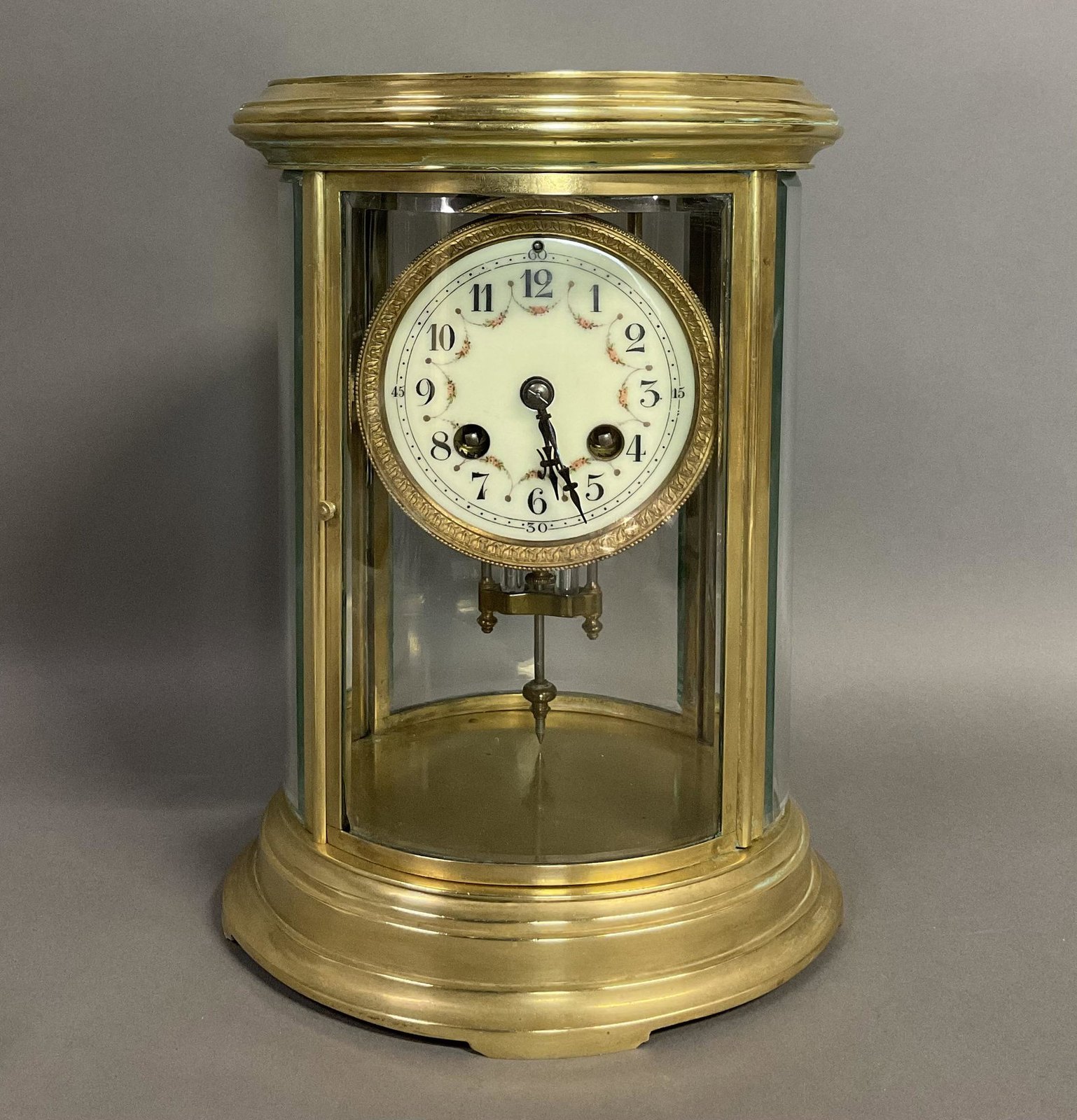
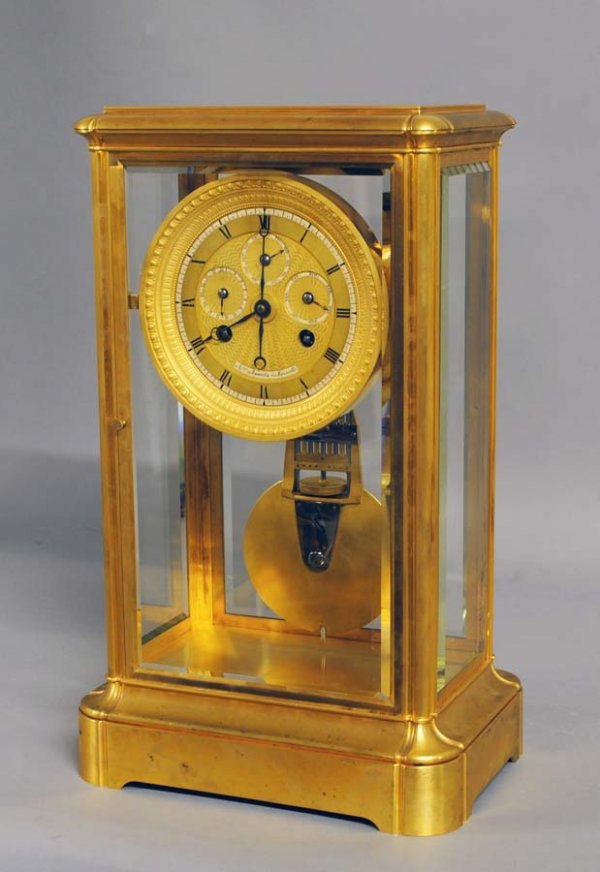
At the top of the market stood the four-glass clock: a gilt-brass case glazed on all four sides, so that the whole movement and pendulum can be seen, often with a visible escapement on the dial and a mercury pendulum — two glass jars of mercury whose expansion with heat offsets the lengthening of the pendulum rod. A four-glass clock by Samuel Marti et Cie of Paris, of about 1900, in the auction records has an oval case with curved bevelled glass, an exposed escapement, an eight-day movement striking the hours and half-hours on a coiled gong and a twin-flask mercury pendulum; its back plate is stamped 'Médaille d'Or Paris'. Another, retailed by Noseda of Marseille, adds month, day and season dials. These clocks look like precision regulators, and the mercury pendulum is a genuine regulator feature, but most were domestic clocks with standard Paris movements.
The carriage clock
The carriage clock is a mantel clock built to travel. Earlier travelling clocks existed — the Robert Robin clock of the early 1780s is catalogued by the V&A as a carriage clock, and Abraham-Louis Breguet made fine travelling clocks around 1800 — but the familiar brass-framed, glass-sided clock with a handle on top is a product of nineteenth-century French industry. Charles Allix's standard history credits Paul Garnier (1801–1869) of Paris with turning it into a standard product from the 1830s, using a simple escapement of his own design; within a few decades firms in Paris and Saint-Nicolas-d'Aliermont were making carriage clocks by the tens of thousands, largely for export.
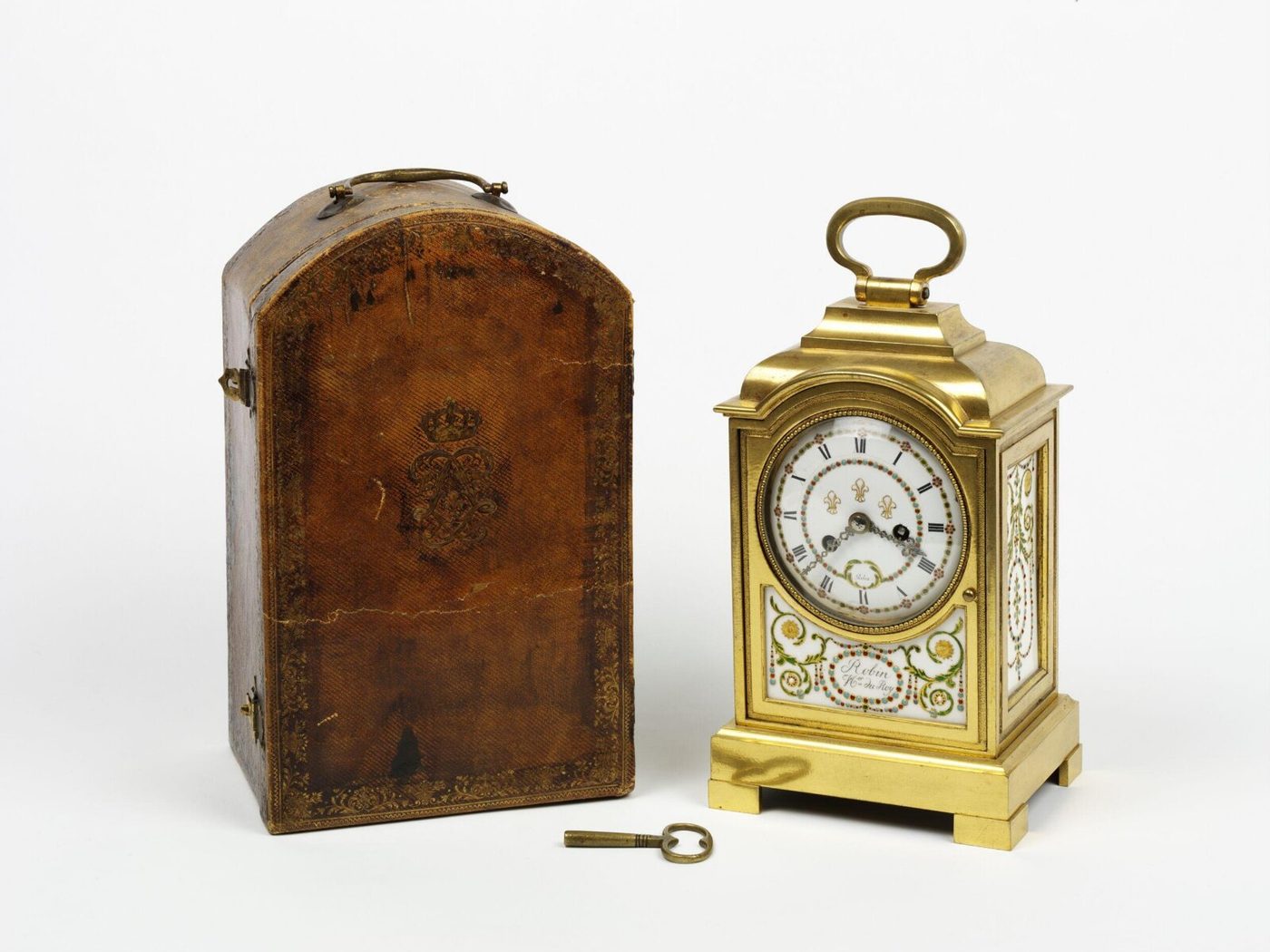
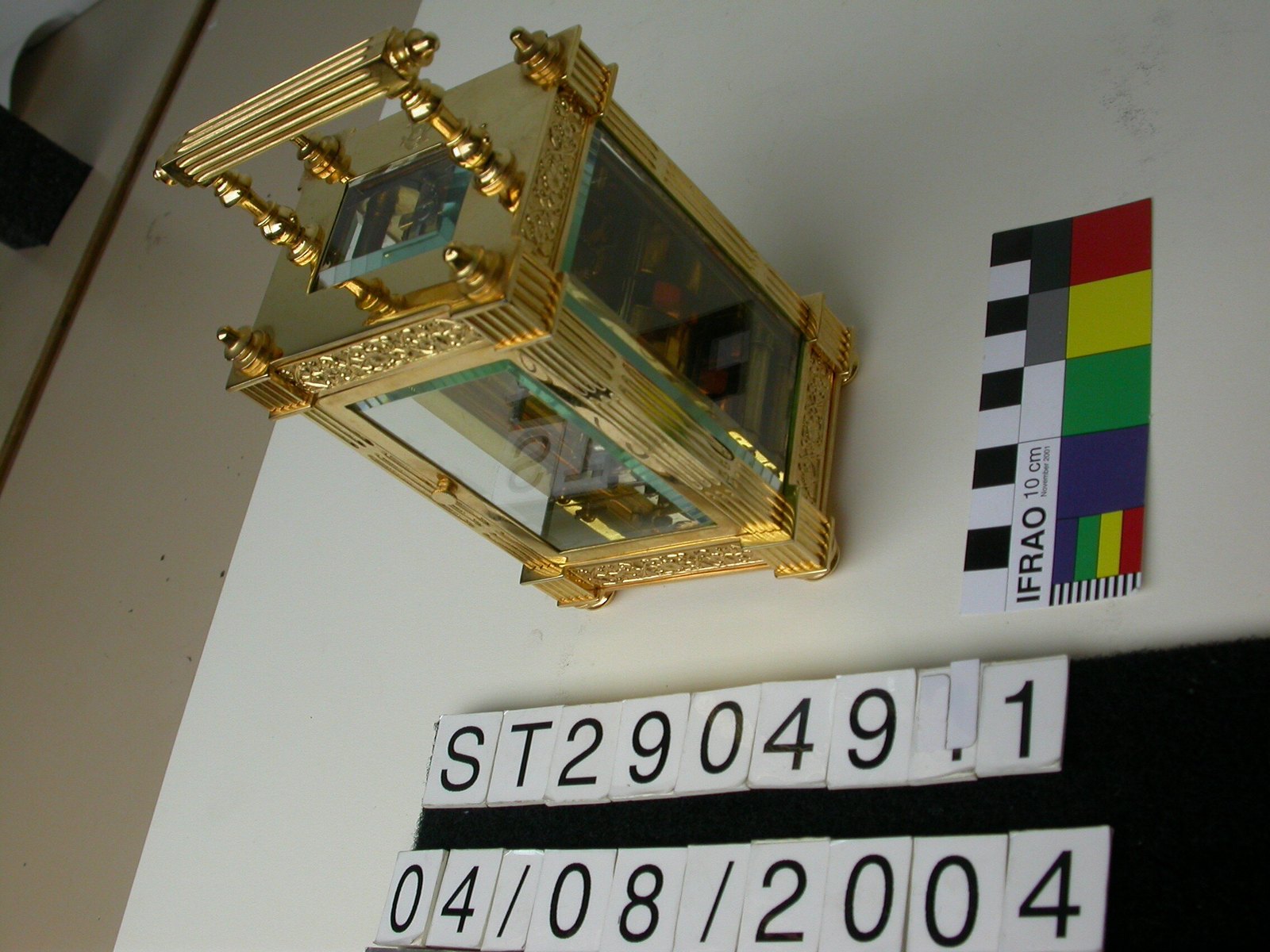
Almost all carriage clocks share the same construction. A rectangular movement with its own going barrel drives a platform escapement — a small balance-and-escapement unit mounted horizontally on top of the movement, where it can be seen through a glass panel in the case top. The balance wheel, unlike a pendulum, does not care whether the clock is level or moving. The cylinder escapement was used on early and cheaper clocks and the lever escapement on most good ones. The Leroy & Fils carriage clock of about 1890 in the Antiquorum archive has 'platform with lever escapement', eight-day duration, hour and half-hour striking on a bell, an alarm on a separate train and a date dial; a clock by Wurtel of Paris of about 1845, in the Science Museum, already combines half-hour striking, alarm and calendar.
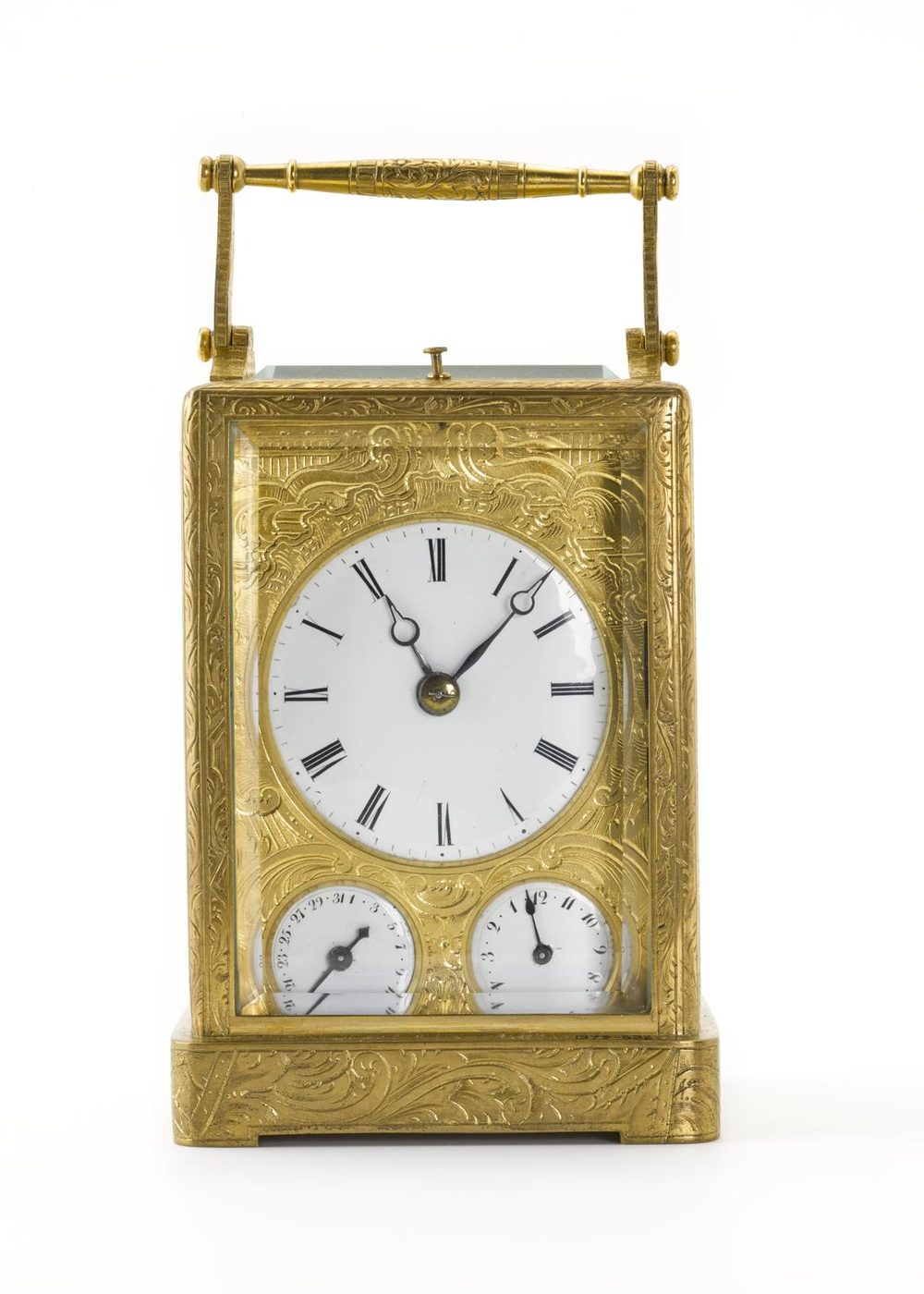
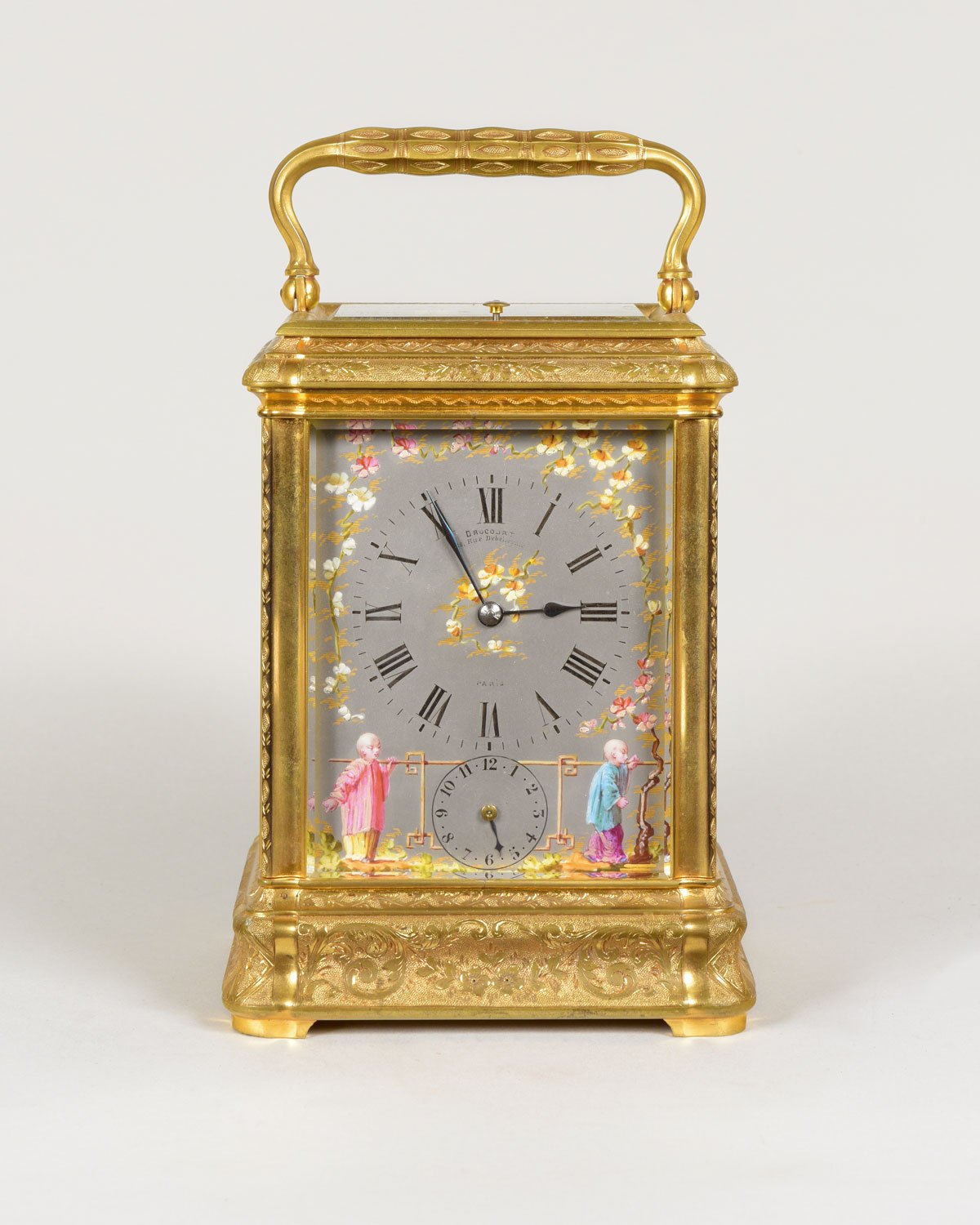
Most of the best carriage clocks were sold abroad. The dealer records for clocks by Drocourt — a Paris firm whose back plates are stamped 'D C' between a small picture of a carriage clock — repeatedly note that a clock 'was made for the English market' or 'the English or American market', and one was 'made for the English market and retailed in Switzerland'. A clock by Drocourt of about 1880 at 28 rue Debelleyme, in a giant gorge case with painted panels of Chinese figures among flowering branches and an alarm dial below the main dial, still has its original Morocco leather travelling case. A Drocourt in the same dealer's stock is engraved '1er Janvier 1877' — a New Year's gift, and one of the few carriage clocks that dates itself.
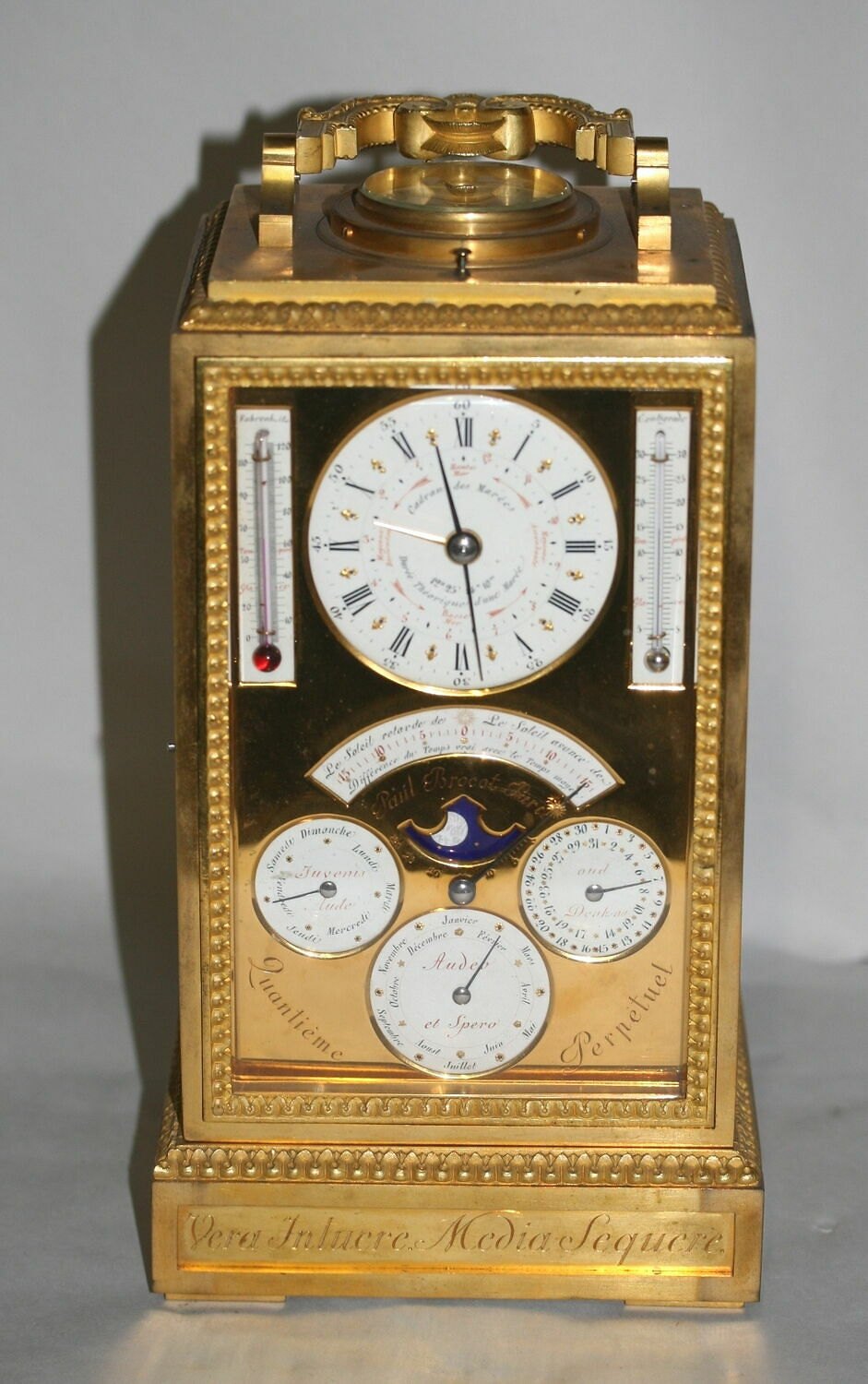
| Case style | Description | Where you will see it |
|---|---|---|
| Obis | Plain one-piece frame with simple mouldings, no columns | Simpler clocks, often from the later nineteenth century |
| Corniche | Cornice mouldings top and bottom, plain uprights; the most common style | Every price level, from the mid-nineteenth century to the twentieth |
| Gorge | Concave ('throat') mouldings, often engraved; a mark of better clocks | Firms such as Drocourt; often with repeat, alarm or grande sonnerie |
| Anglaise | Heavier, rounded corner columns, sometimes with a flat top | Later nineteenth and early twentieth centuries |
| Porcelain or enamel panels | Painted panels set into the sides and dial surround | Luxury clocks; check whether panels are original |
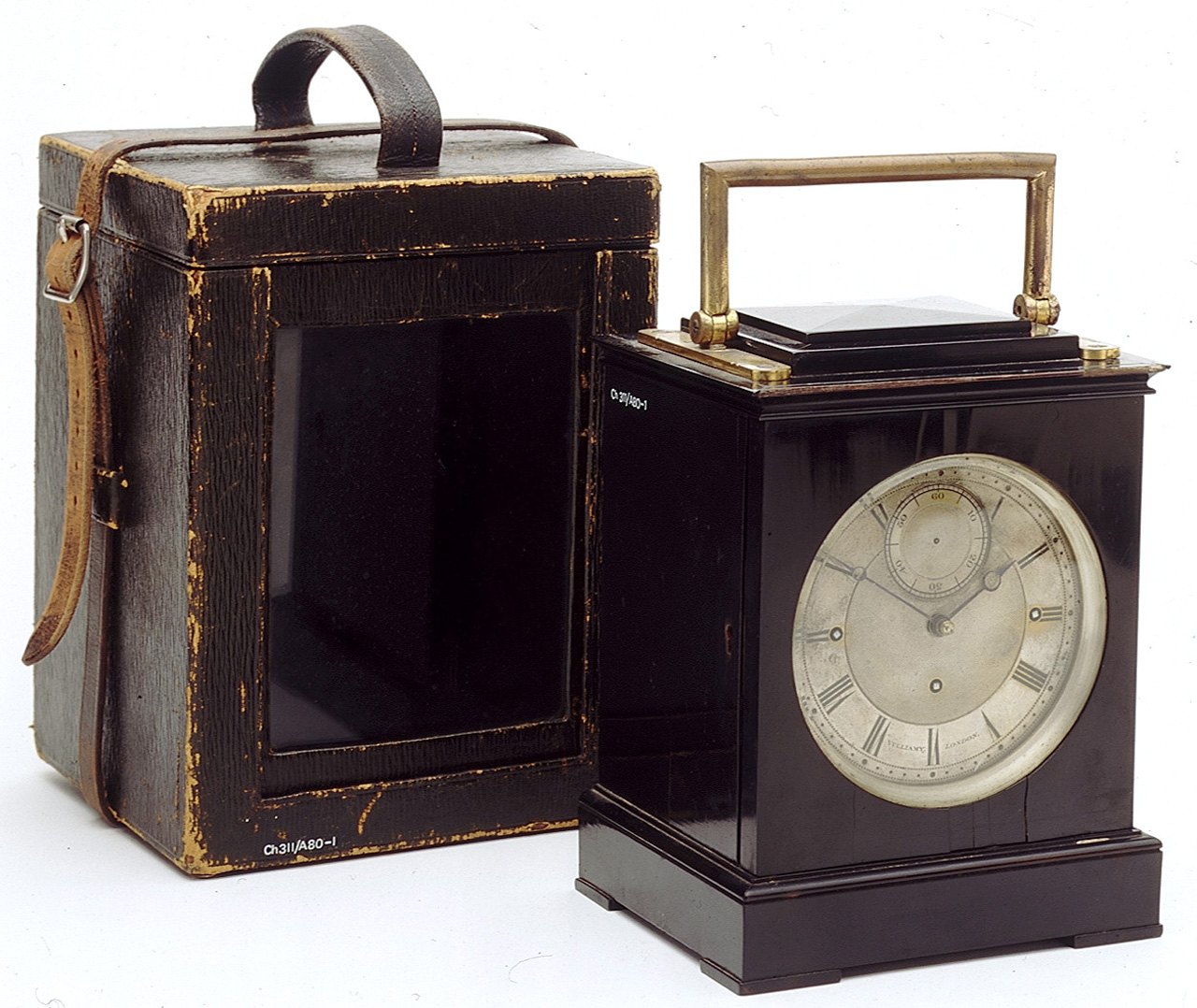
Striking is where carriage clocks become complicated. A simple clock strikes the hours and half-hours; a repeater strikes the last hour again when a button on top is pressed; petite sonnerie strikes the quarters, and grande sonnerie strikes the hour after every quarter. A clock by Henry Capt of about 1890 offers both grande and petite sonnerie with alarm and date, and Drocourt's grande sonnerie clocks of the 1870s strike the quarters on a gong. English makers made carriage clocks too, generally heavier and more expensive. Royal Museums Greenwich's grande sonnerie carriage clock no. 1608 by Vulliamy, of about 1843, has a twin chain fusee movement with a lever platform and strikes the quarters followed by the hour every fifteen minutes, in a velvet-lined leather travelling case with a glazed window for the dial.
America: the shelf clock for every house
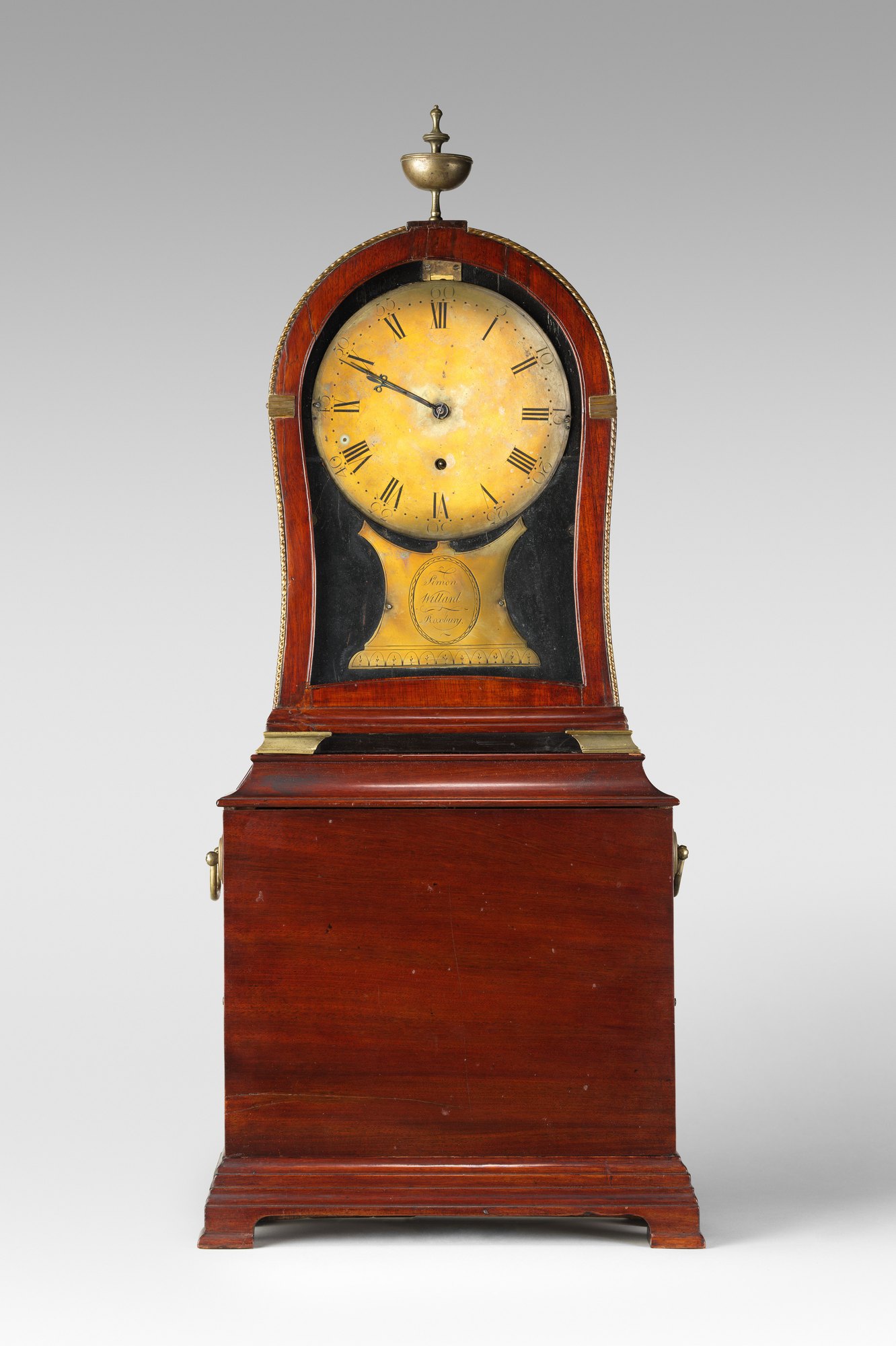
In the United States the shelf clock followed a different path, from luxury to industry. Clocks by Simon and Aaron Willard of Massachusetts and by Levi Hutchins in the 1780s and 1790s, in the Metropolitan Museum and Yale, are fine small clocks in mahogany cases, made by craftsmen for wealthy customers. Yale's description of an Eli Terry shelf clock explains why that changed: before the nineteenth century 'the works in many American clocks were assembled from imported brass parts', and clocks 'were affordable to only an elite few'. In 1816 Terry, a Connecticut inventor, 'received a patent for a shelf clock with less-expensive, locally produced wooden works that revolutionized the clockmaking industry'. He could sell hundreds or thousands of clocks a year, and became, in Yale's words, 'one of the first manufacturers to use mass-production techniques and interchangeable parts in the fabrication of domestic goods'.
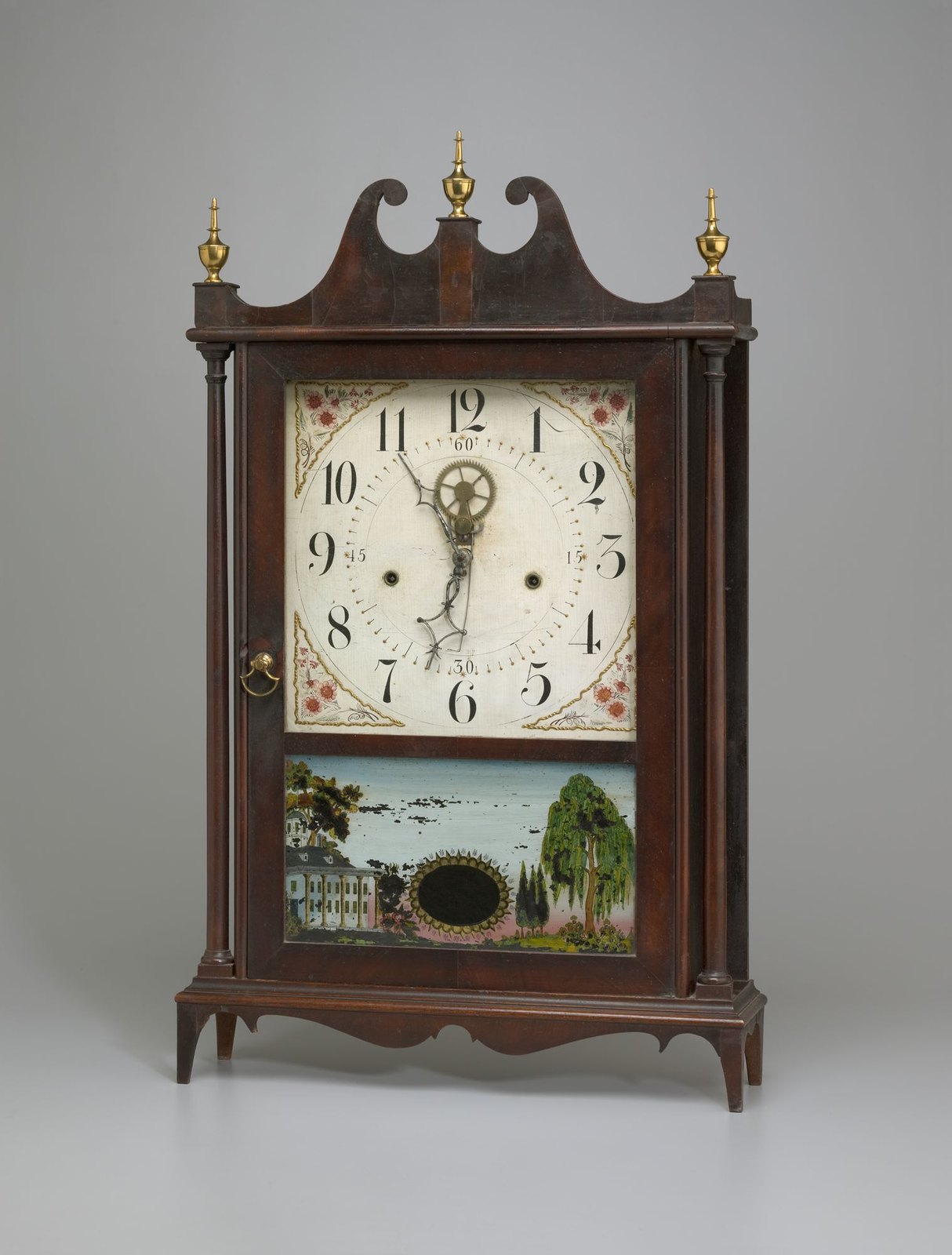
Terry's pillar-and-scroll clock, with its slender columns, scrolled top and painted glass panel, was made by several Connecticut firms; Seth Thomas, who had worked with Terry, made clocks of the same pattern from about 1820, one of which is in the Met. The next step came after the financial crash of 1837. Yale's description of a clock by Jeromes, Gilbert, Grant and Company of 1839–40 explains that Chauncey Jerome 'conceived of an inexpensive thirty-hour clock with brass works', made cheaper by 'punching out the wheels from thinner rolled brass and running the wood for the ogival-moulded cases through a power-operated machine'. The ogee clock, a plain rectangular case with an S-curved moulding and a painted glass tablet, became the most common American clock of the nineteenth century.
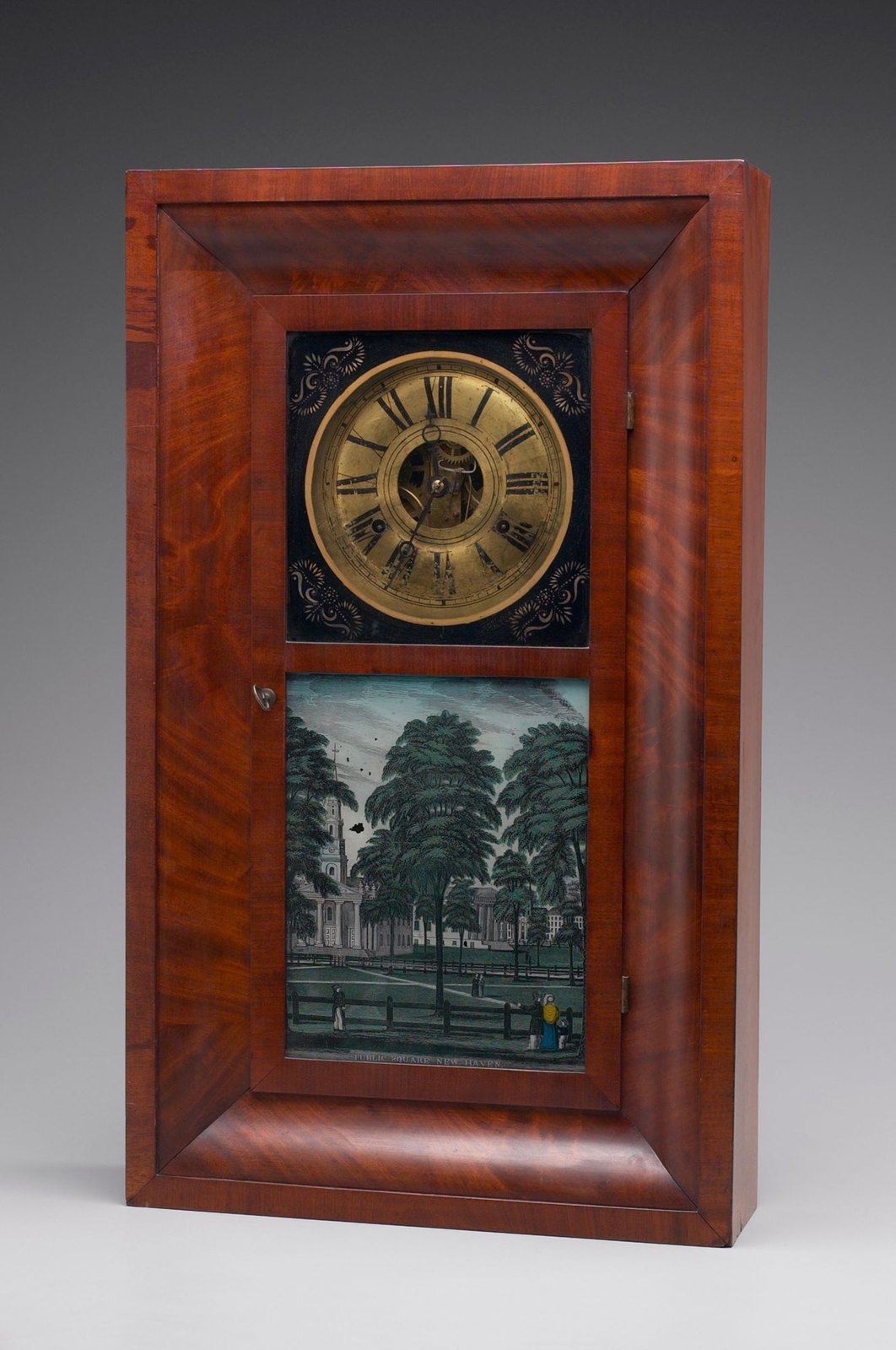
Jerome told the story himself in his History of the American Clock Business for the Past Sixty Years (1860), which is freely available as a public-domain scan. By his account, cheap brass clocks were soon shipped to England, where customs officers, believing them to be undervalued, bought a first consignment at the invoiced price — which only encouraged him to send more. The tale is Jerome's and is told to his own credit, but the trade it describes was real: Connecticut clocks were sold across the world, and Museums Victoria's 'Cottage no. 2 one day time piece alarm' by Jerome & Co. of New Haven, of about 1850, found its way to Australia.
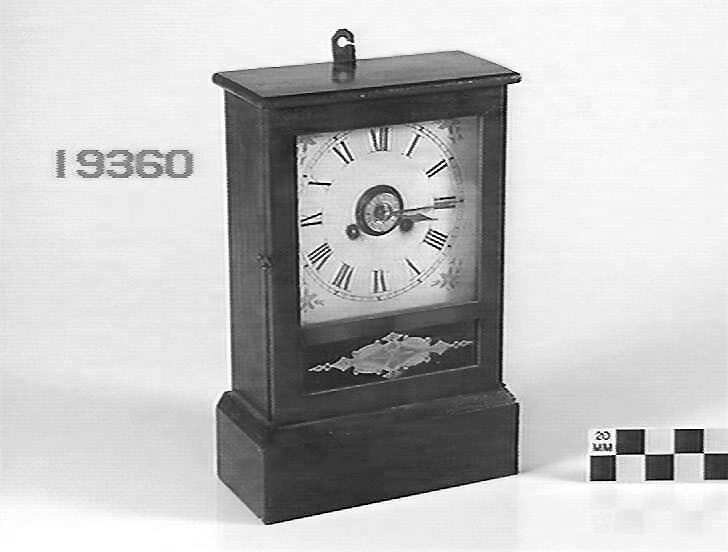
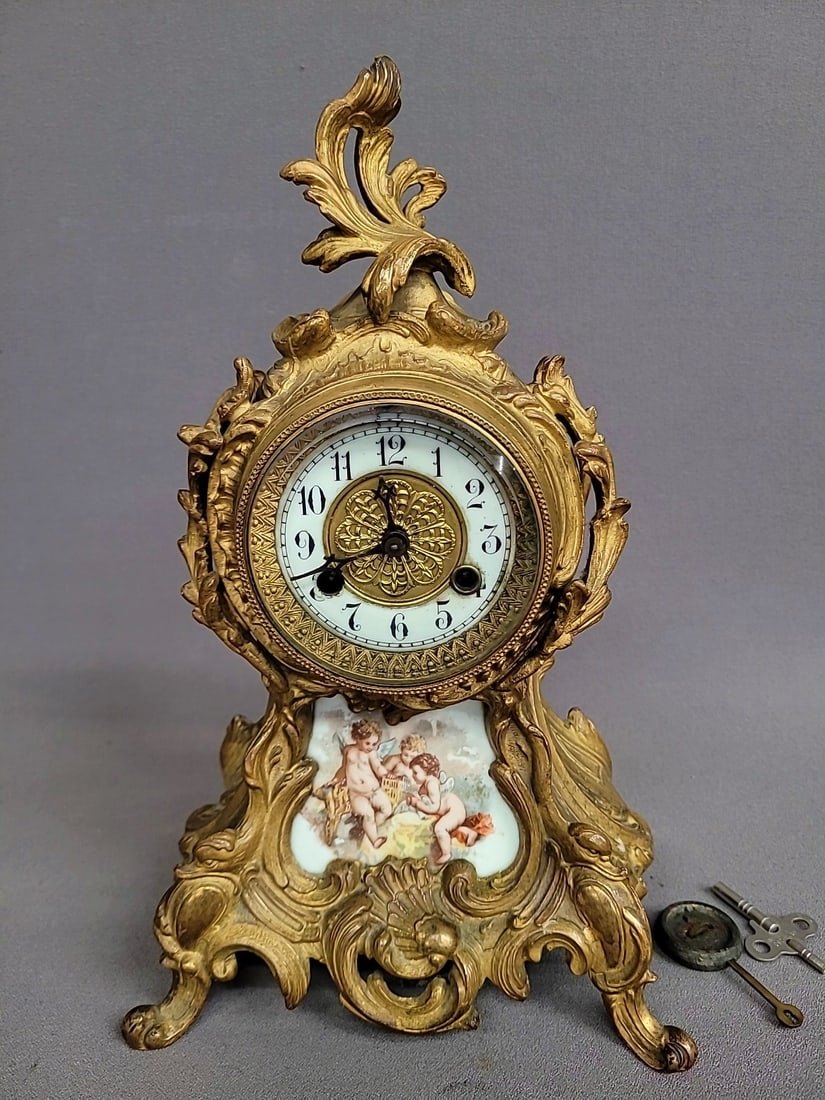
Later American factories imitated the French. Firms such as Ansonia, Waterbury and Seth Thomas made 'French style' clocks in cast metal, iron and marbled wood, sometimes with porcelain panels, at a fraction of the price of imports. One lot in the auction records is described as a 'signed Waterbury Clock Co. bronze French style shelf clock' of the 1890s with a painted porcelain scene of putti; Seth Thomas's 1879 trade catalogue, listed in our library, shows how wide the range had become.
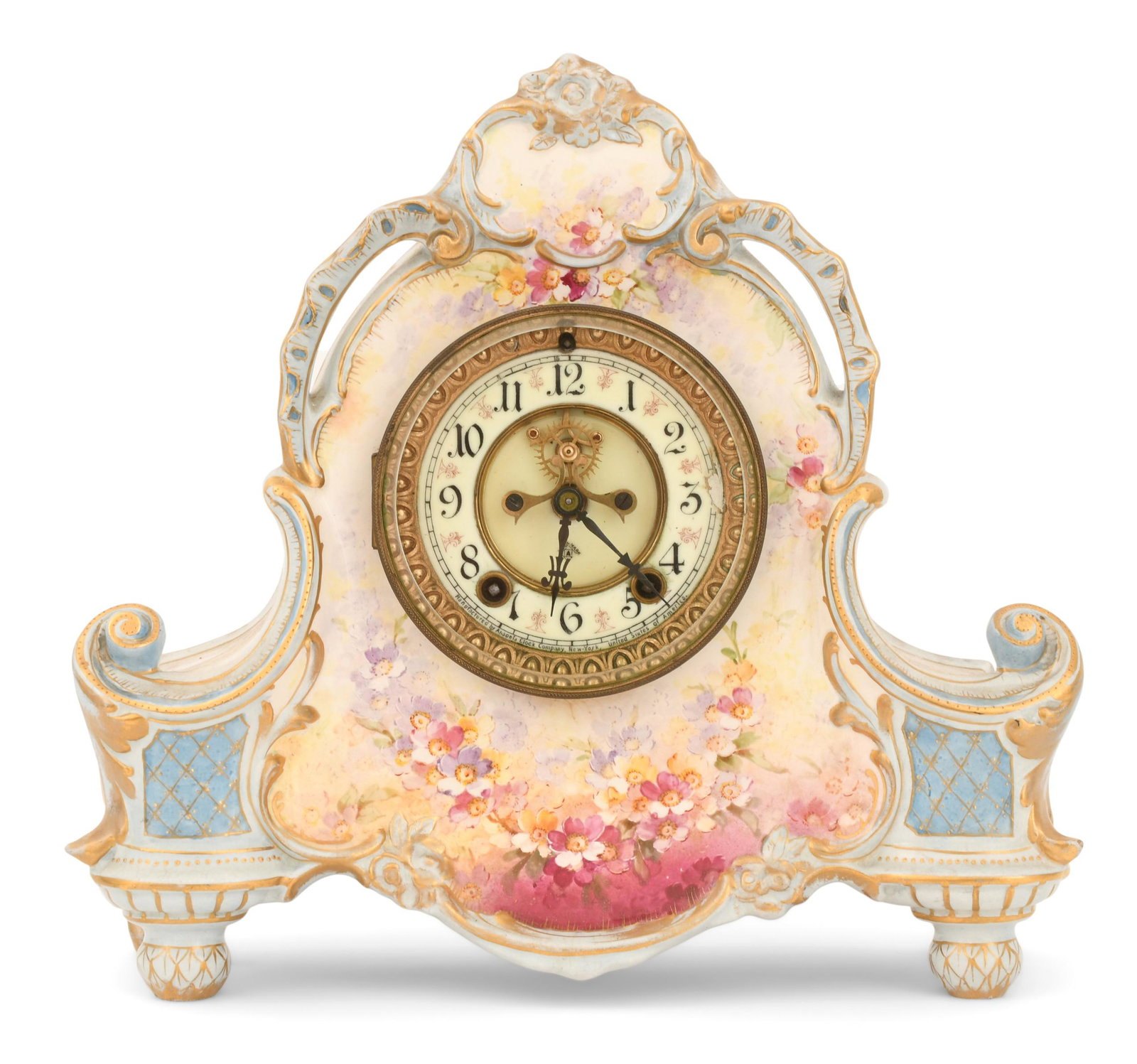
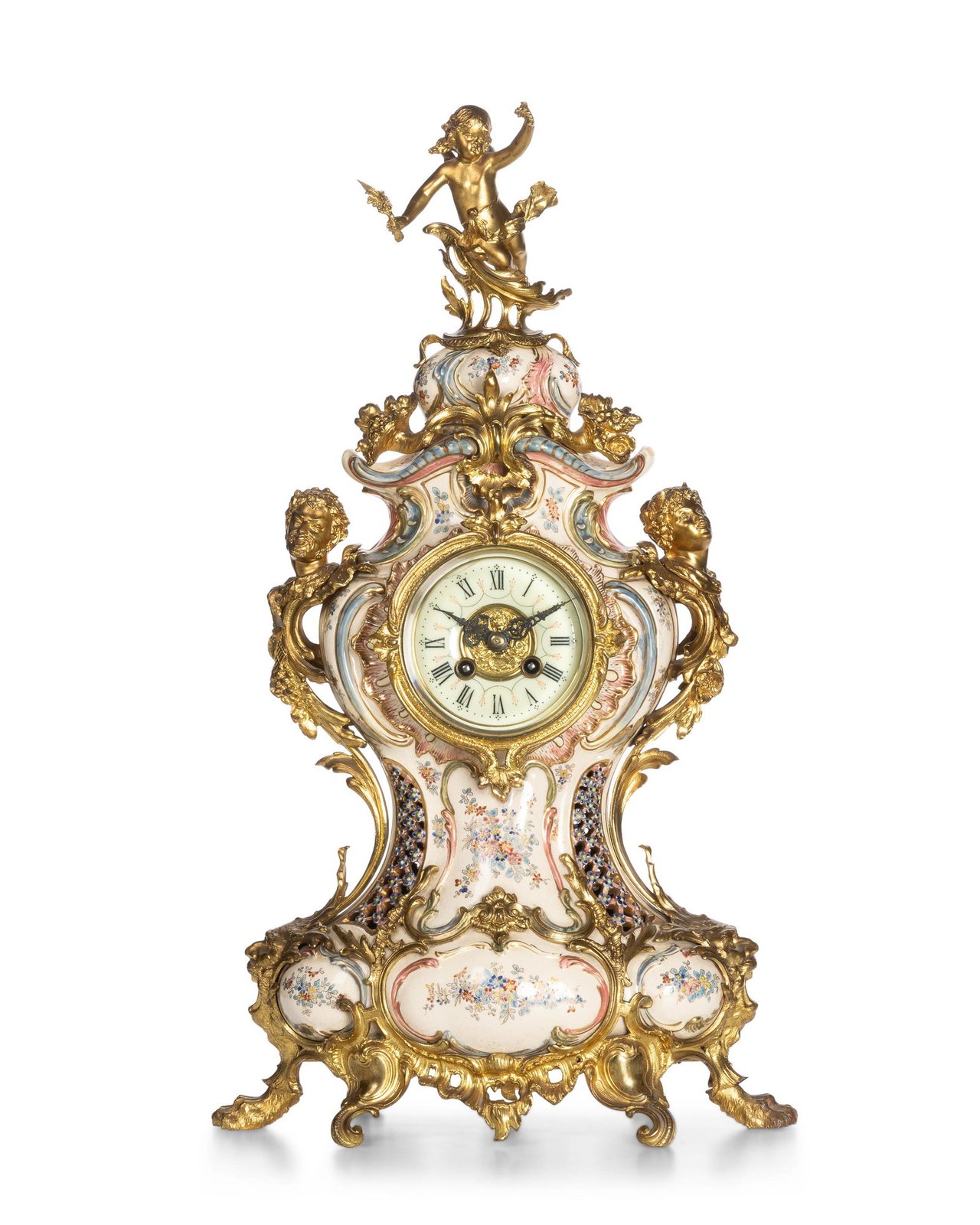
Porcelain cases were another import that American and German factories took up. Ansonia sold clocks in cases made by the German porcelain firm known as Royal Bonn, with model names such as 'La Vera', 'La Rambla' and 'La Manche'; the auction description of a 'La Vera' of about 1905 records an eight-day time-and-strike movement with a Brocot escapement, signed on the movement and the dial. In the Black Forest, the Lenzkirch company put its movements into rococo-style porcelain cases with gilt-bronze mounts for the same market.
The twentieth century: Art Deco and the clock that winds itself
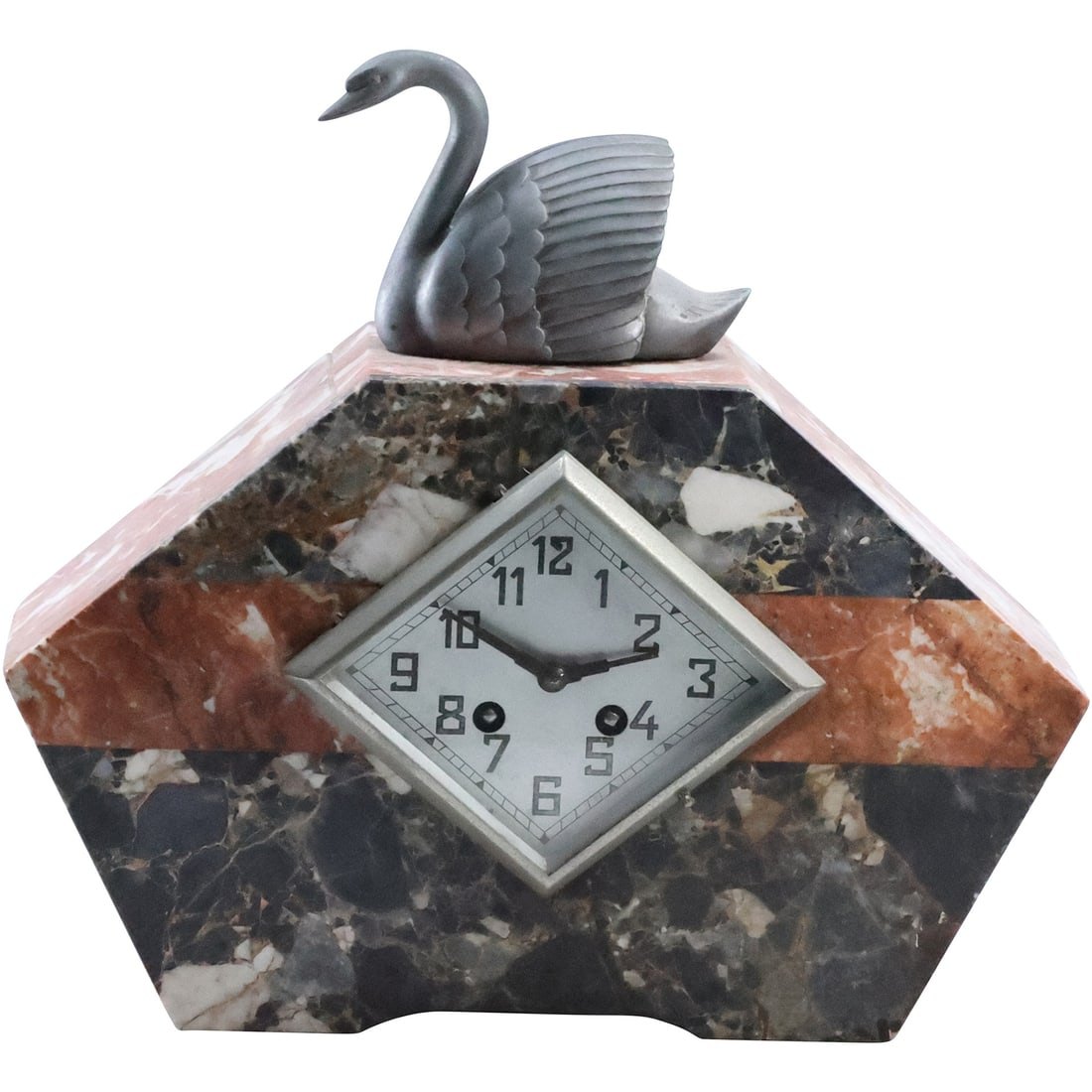
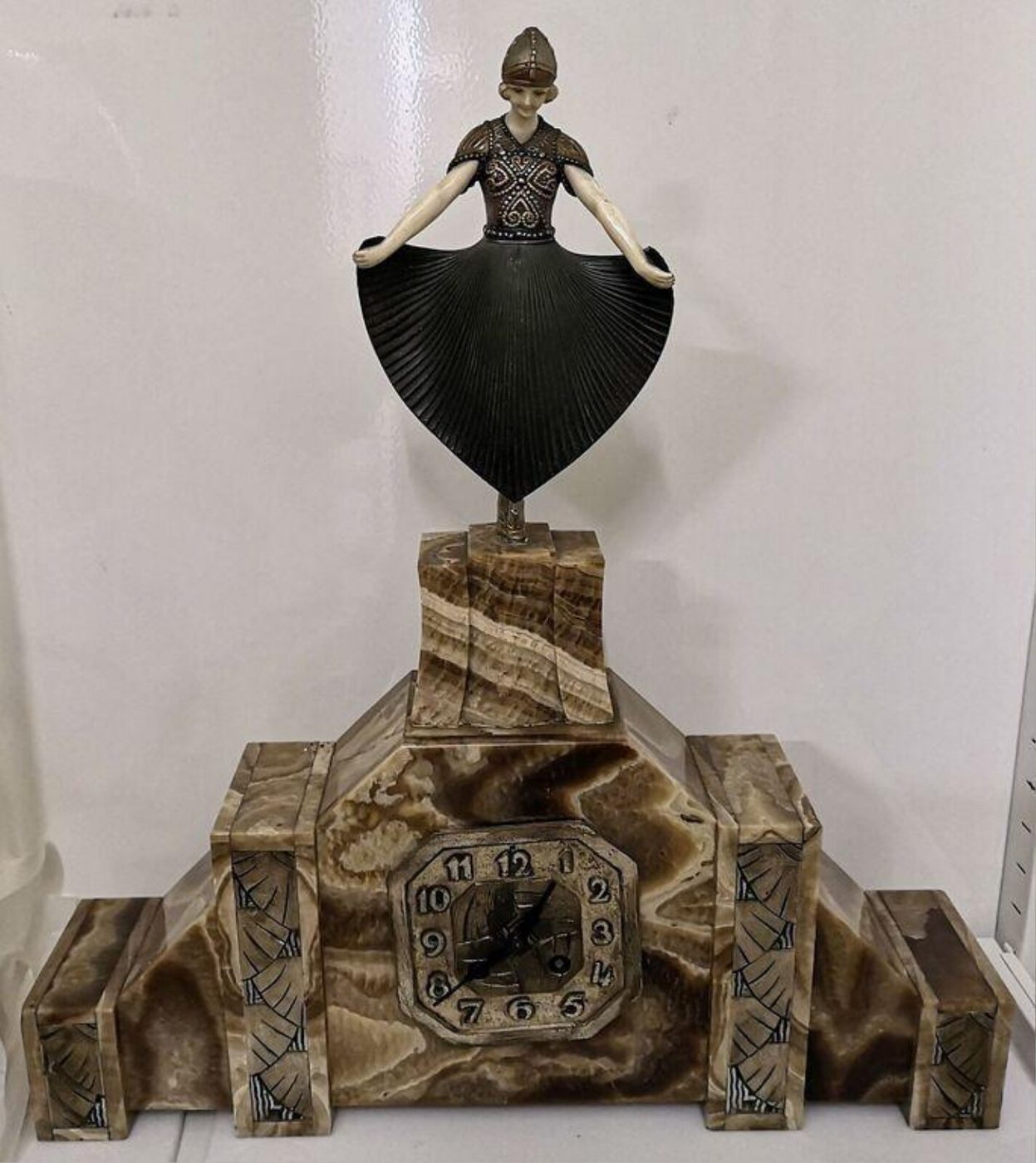
After the First World War the mantel clock simplified. Art Deco designers used coloured marble, onyx and chrome, stepped architectural outlines and bold numerals; Japy, still in business, made clocks like the coloured-marble model with a metal swan of the 1920s in the auction records, and sculptors such as Demétre Chiparus designed bronze and ivory figures for clock cases. Electric clocks, synchronous with the mains, began to replace wound clocks in many homes in the 1930s.
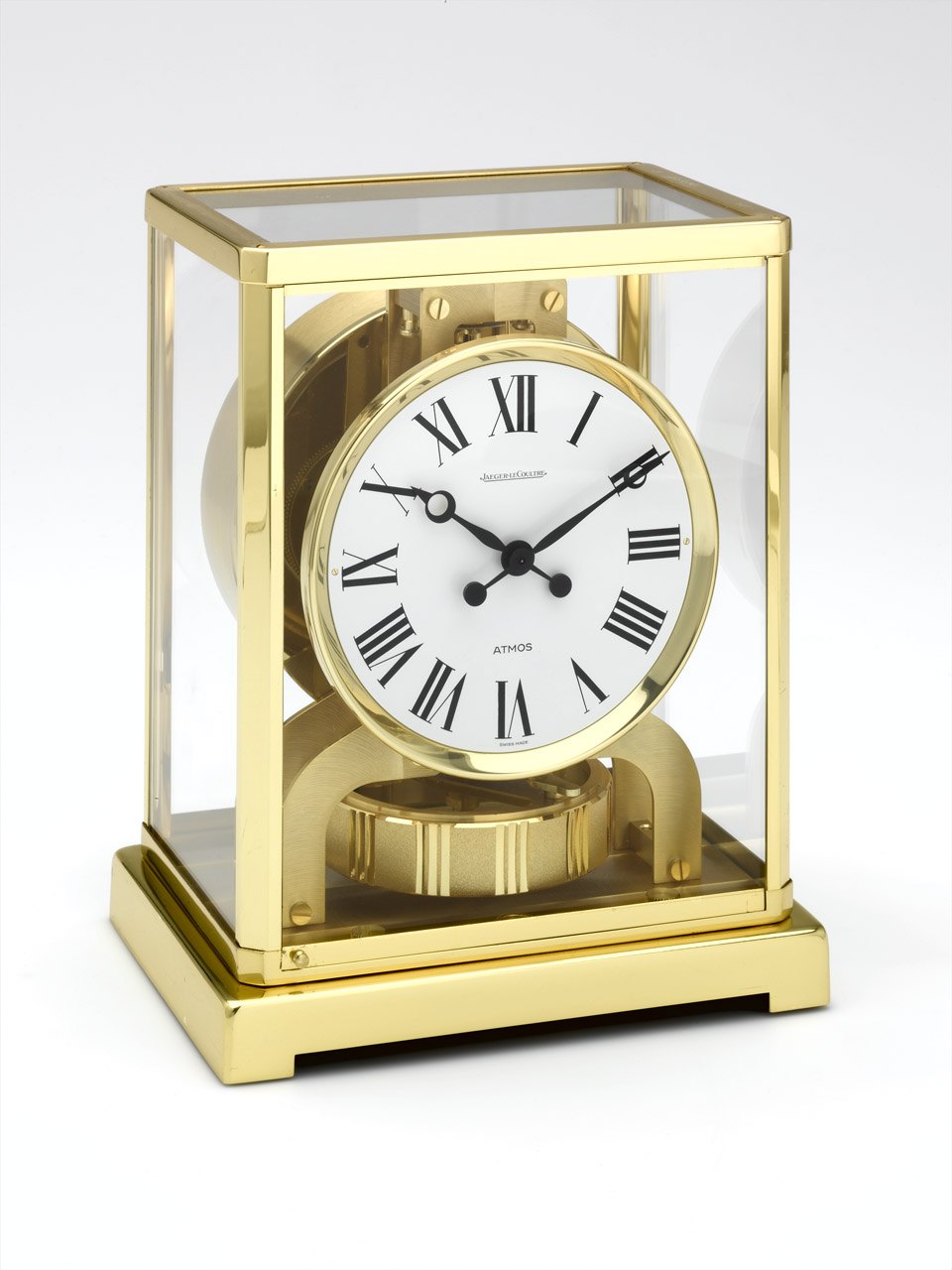
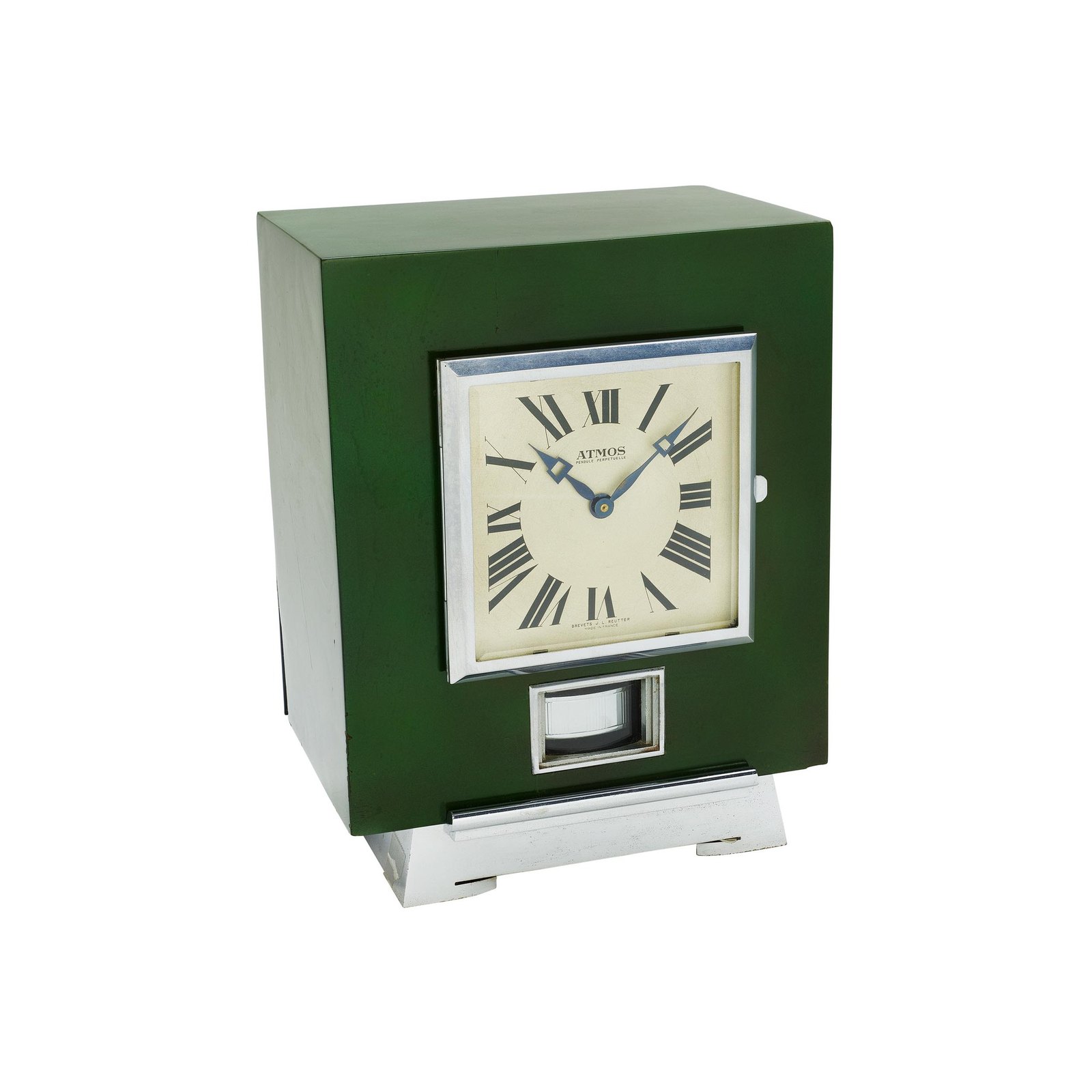
The most famous mantel clock of the century needs no winding at all. Royal Museums Greenwich records that the Atmos clock was 'first developed in 1928 by Neuchâtel engineer Jean-Léon Reutter and introduced into Jaeger-LeCoultre's product range in the early 1930s'. A sealed capsule of gas and liquid at the back of the movement expands and contracts with changes in temperature, winding the mainspring; Museums Victoria's 1953 example notes that 'a change of one degree will wind the clock for two days'. To make that tiny supply of energy last, the Atmos uses a torsion pendulum — a heavy disc hanging from a fine wire that twists one way and then the other — which beats only twice a minute.
How to date and identify a mantel clock
- Look at the case first, but do not trust it alone. Rococo asymmetry suggests about 1730–1770; urns, temples and white marble about 1765–1795; figure groups and porticoes about 1795–1830; symmetrical rococo and heavy ornament the 1850s–1870s; black marble and slate about 1860–1914; stepped outlines and coloured marble the 1920s and 1930s. Every one of these styles was revived later.
- Read the dial, then turn the clock round. The name on the dial may be a clockmaker, a retailer or a bronze firm. The back plate usually carries the movement maker's stamp, a serial number and sometimes exhibition medals; the dealer records cited here identify Drocourt from a 'D C' stamp and a number.
- Check the suspension. Silk thread suggests an earlier clock; a Brocot-type regulator with a square above XII suggests after about 1840.
- Count the winding holes and listen. Two holes mean a striking clock; three usually mean chiming or, on a carriage clock, an alarm or sonnerie train. Most Paris movements run eight days; some run fifteen.
- Look for alterations. Cases and movements were often married later, especially in garnitures; dials were repainted or replaced; electric conversions were common in the twentieth century. Mismatched screw holes and empty fixing points tell their own story.
- Use the catalogue. Search the Atlas collection for the maker's name, the case type or the material and compare your clock with dated examples from museums and auction houses.
| Type | Typical period | Power and escapement | Where made |
|---|---|---|---|
| Paris pendule (gilt bronze, figural) | c. 1730–1870 | Spring barrels; anchor escapement with silk or Brocot suspension | Paris finishing; movements from Paris, Franche-Comté and Normandy |
| Portico and marble clock | c. 1790–1914 | Paris movement, often visible Brocot escapement | France and Belgium; widely exported |
| Carriage clock | c. 1830–1950s | Going barrel; platform lever or cylinder escapement | Paris and Saint-Nicolas-d'Aliermont; also England |
| American shelf clock (wooden works) | c. 1816–1840s | Weights; wooden wheels; anchor escapement | Connecticut |
| American shelf clock (brass) | c. 1838–1930s | Weights or springs; 30-hour or 8-day brass movements | Connecticut and New England |
| Atmos | 1930s onward | Self-winding from temperature changes; torsion pendulum | Switzerland (Jaeger-LeCoultre) |
| Anniversary (400-day) clock | c. 1880–1980s | Spring; torsion pendulum | Mainly Germany |
A clock for the centre of the room
The mantel clock is often dismissed as decoration, and many were bought for the case rather than the movement. That is part of its interest. More than any other clock, it shows how timekeeping was shared out among trades — sculptors, founders, gilders, enamellers, movement makers, finishers and retailers — and how industry spread a luxury object to every class. The Paris pendule, the carriage clock and the Connecticut ogee clock were made in the same decades for very different customers, yet all three put the time at the centre of a room, where the household would see it every day.
For the history of English spring clocks see our feature on the bracket clock; for the clocks that stood in the hall, see the longcase clock; and for the factories of Connecticut and Massachusetts, see the American system of watchmaking. The catalogue contains hundreds more mantel, carriage and shelf clocks from museums, dealers and auction houses, each with its source record.
Sources & further reading
- Dictionnaire des horlogers français — Tardy (Henri Lengellé), Tardy (Paris), 1971–1972.
- Carriage Clocks: Their History and Development — Charles Allix, Antique Collectors' Club (Woodbridge), 1974.
- History of the American Clock Business for the Past Sixty Years, and Life of Chauncey Jerome, Written by Himself — Chauncey Jerome, F. C. Dayton, Jr. (New Haven), 1860.
- Clocks — David Thompson, British Museum Press (London), 2004.
- Old Clocks and Watches and Their Makers — F. J. Britten, B. T. Batsford (London), 1899 (first edition).
- The Modern Clock — Ward L. Goodrich, Hazlitt & Walker (Chicago), 1905.
- Seth Thomas Clocks (trade catalogue) — Seth Thomas Clock Company, Thomaston, Connecticut, 1879.
- Revolution in Time: Clocks and the Making of the Modern World — David S. Landes, Harvard University Press, 1983.