
Clocks · Shelf clock
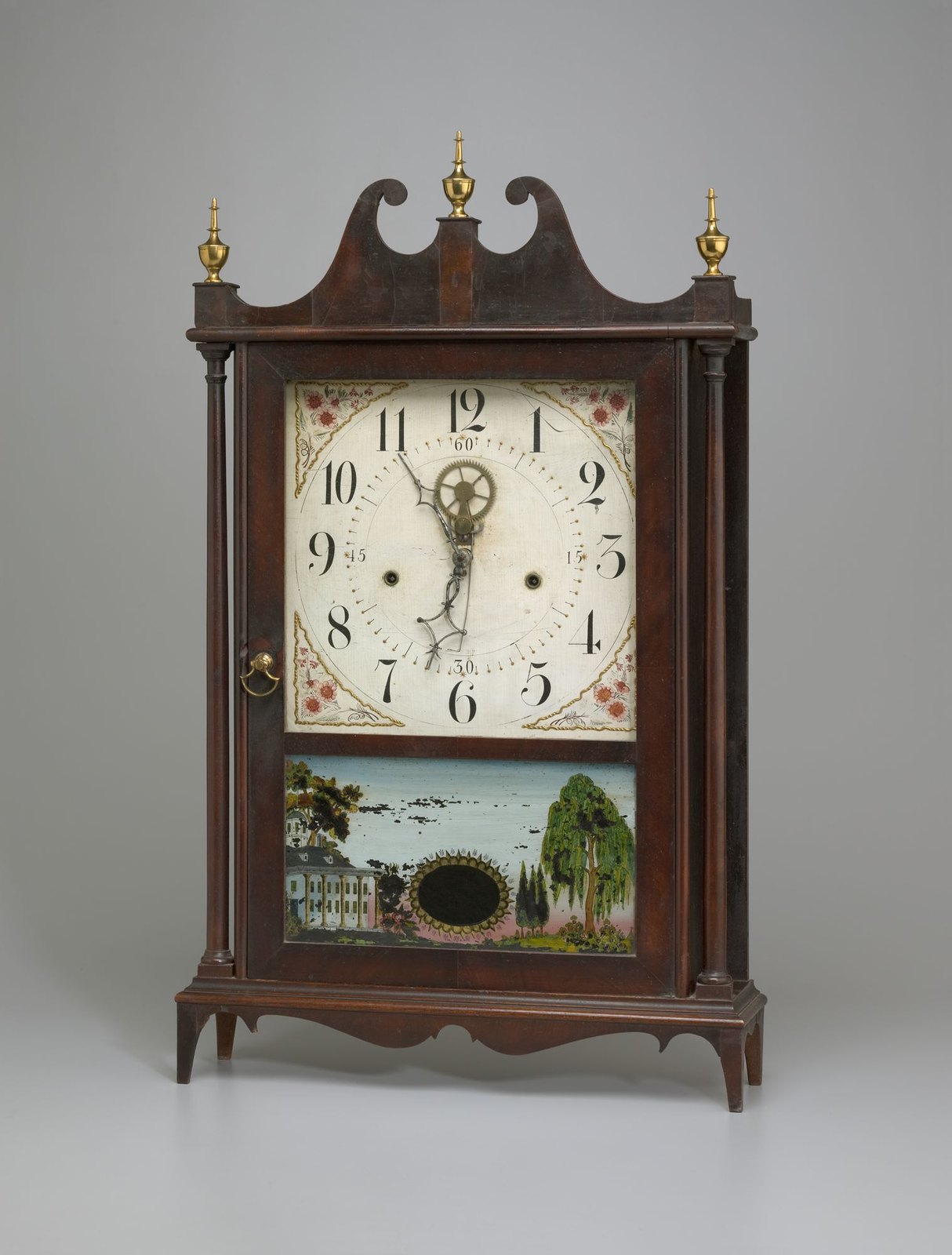
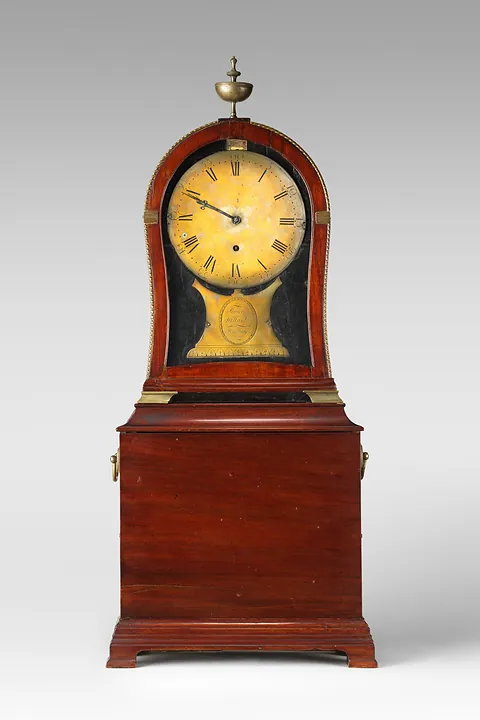
Shelf Clock by Eli Terry
- Maker / attribution
- Eli Terry (maker)
- Date
- 1816–25
- Historical period
- Precision & Scientific Horology (1750 – 1850)
- Country of origin
- United States
- Place
- Plymouth
- Object type
- Shelf clock
- Materials / technique
- mahogany, yellow poplar, cherry, and white oak
- Dimensions
- 28 7/8 × 16 7/8 × 4 1/8 in. (73.3 × 42.9 × 10.5 cm) Dial: 11 1/4 × 13 in. (28.6 × 33 cm) Movement: 6 1/4 × 7 1/2 × 1 13/16 in. (15.9 × 19 × 4.6 cm)
- Holding institution
- Yale University Art Gallery, New Haven
- Accession / object no.
- 1962.31.26
- Credit line
- Bequest of Olive Louise Dann
- Catalogue title (original)
- Shelf Clock (English)
View the source record ↗ (opens another website in a new tab)Suggest a correction
Record summary
Held and catalogued by Yale University Art Gallery, New Haven (object number 1962.31.26), this is a shelf clock by Eli Terry, made in Plymouth, United States, dated 1816–25. The Atlas places it in the Precision & Scientific Horology period (1750 – 1850) of its Clocks collection. Materials and techniques recorded by the source: mahogany, yellow poplar, cherry, and white oak. Recorded dimensions: 28 7/8 × 16 7/8 × 4 1/8 in. (73.3 × 42.9 × 10.5 cm) Dial: 11 1/4 × 13 in. (28.6 × 33 cm) Movement: 6 1/4 × 7 1/2 × 1 13/16 in. (15.9 × 19 × 4.6 cm). The record is illustrated with 1 photograph.
Assembled from the source record's structured fields. Dates and attributions are given as the source states them; where a field is missing the Atlas leaves it blank rather than estimating.
Catalogue description
Catalogue description — Yale University Art Gallery
Before the nineteenth century, the works in many American clocks were assembled from imported brass parts and set into locally made cases. As the products of transatlantic trade and multiple specialist craftsmen, clocks were affordable to only an elite few. In 1816 the Connecticut inventor Eli Terry received a patent for a shelf clock with less-expensive, locally produced wooden works that revolutionized the clockmaking industry. He was able to market hundreds, even thousands, of clocks per year rather than only a few at a time, becoming one of the first manufacturers to use mass-production techniques and interchangeable parts in the fabrication of domestic goods. Shelf clocks were shipped across the United States and became fashionable alternatives to expensive tall case clocks.
Published references — Yale University Art Gallery
Edwin A. Battison and Patricia E. Kane, The American Clock, 1725–1865: The Mabel Brady Garvan and Other Collections at Yale University (Greenwich, Conn.: New York Graphic Society, 1973), 186–189, no. 43, ill. · Elise K. Kenney, ed., Handbook of the Collections: Yale University Art Gallery (New Haven, Conn.: Yale University Art Gallery, 1992), 93, ill. · Carol S. Lawson and Robert F. Lawson, eds., Letting Go: Living without a Net (West Chester, Pa.: Chrysalis Books, 2004), 118–22, ill. · Helen A. Cooper et al., Life, Liberty, and the Pursuit of Happiness: American Art from the Yale University Art Gallery, exh. cat. (New Haven, Conn.: Yale University Art Gallery, 2008), 258, no. 148, ill. · David Jaffee, A New Nation of Goods: The Material Culture of Early America (Philadelphia: University of Pennsylvania Press, 2010), 148, fig. 48
Provenance
Paul N. and Olive L. Dann, New Haven, Conn. Gift in 1962 to Yale University Art Gallery, New Haven, Conn.
Historical context
Precision & Scientific Horology (1750 – 1850)
Harrison solves longitude; Mudge invents the lever; Breguet's Paris workshop defines the modern watch.
The age of the deadbeat escapement, compensated pendulums and observatory regulators. Domestic clocks spread through the middle classes: English longcase and bracket clocks, French gilt-bronze mantel clocks, Viennese Biedermeier wall clocks, Black Forest painted-shield clocks, and the first American shelf clocks.
Read the period in the timelineMore clocks from this periodEarlier: Early Modern Horology
Atlas type guide
Bracket, table and spring-driven clocks
Spring-driven clocks freed timekeeping from the hanging weight. The coiled mainspring, documented from the fifteenth century, made portable table clocks possible; to even out its declining force, makers used the fusee, a conical pulley connected to the barrel by a gut line or chain. Renaissance table clocks from Augsburg and Nuremberg — drum-shaped, square or tower-shaped in gilt brass — were luxury scientific objects, often with astronomical dials and alarms.
After the pendulum, English makers developed the bracket clock: a wooden case with a carrying handle, a short pendulum with a verge escapement, and often repeating work to sound the hours on demand at night. Later examples use the anchor escapement. In the nineteenth century, 'table clock' became a broad term for spring clocks of every nationality.
What to look for
- A fusee in the movement (cone-shaped pulley) and the type of line — gut or chain.
- Verge escapement with a short bob pendulum, often with a decoratively engraved backplate.
- Repeat cords or buttons that make the clock strike again on demand.
- Gilt-brass engraved cases and horizontal dials on Renaissance pieces.
- Case shapes: inverted bell, bell top, break-arch, lancet or balloon.
Dating clues
- Drum and tower table clocks: c. 1520–1650.
- Ebony veneered English bracket clocks with verge escapements: c. 1670–1800.
- Engraved backplates were usual on English clocks until c. 1800, then generally plain.
General guidance written by the Atlas editors about this kind of object. It is not a statement about this particular piece; for that, rely on the source record above and on physical examination.
Related records
Clocks · 1792–93
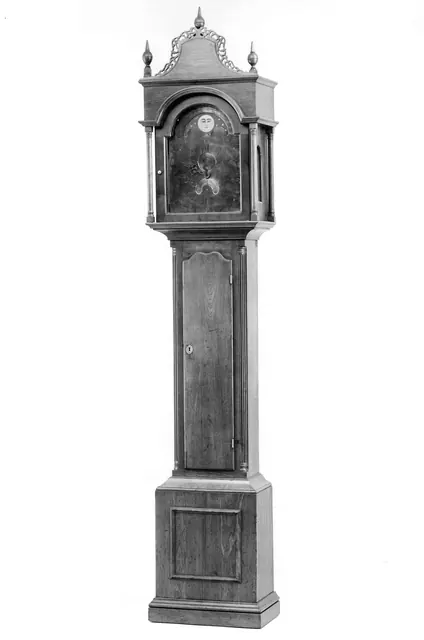
Tall Case Clock by Eli Terry
Yale University Art Gallery, New Haven
Clocks · 1740–60
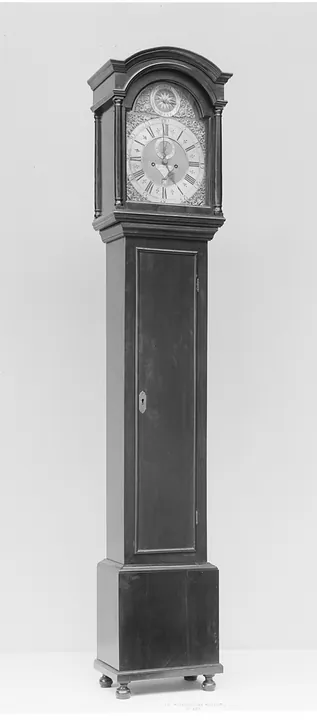
Tall clock by Samuel Bagnall, United States, 1740–60
The Metropolitan Museum of Art, New York
Clocks · 1750–60
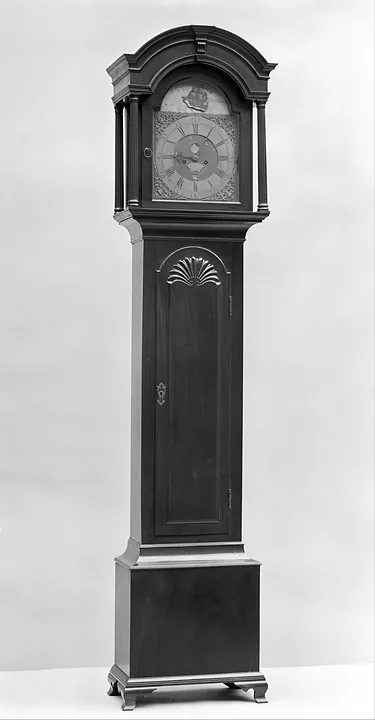
Tall clock by Gawen Brown, United States, 1750–60
The Metropolitan Museum of Art, New York
Clocks · 1765–75
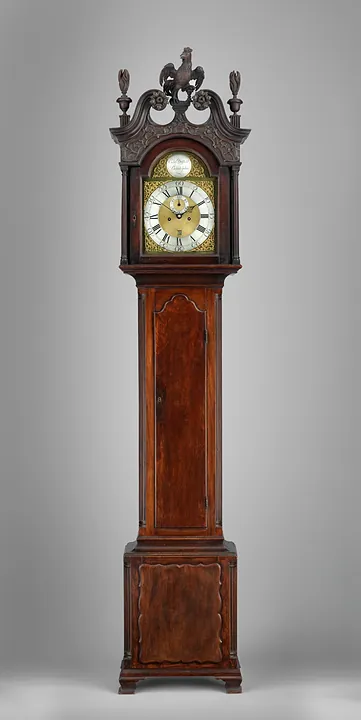
Clock by Edward Duffield, United States, 1765–75
The Metropolitan Museum of Art, New York
Clocks · 1767–71
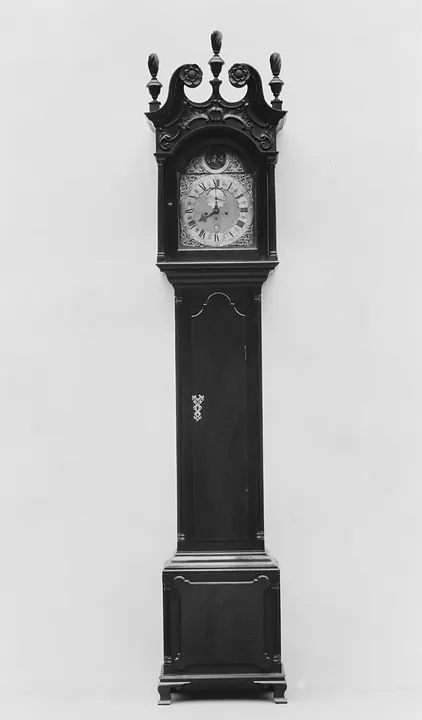
Tall clock by William Huston, United States, 1767–71
The Metropolitan Museum of Art, New York
Clocks · 1769
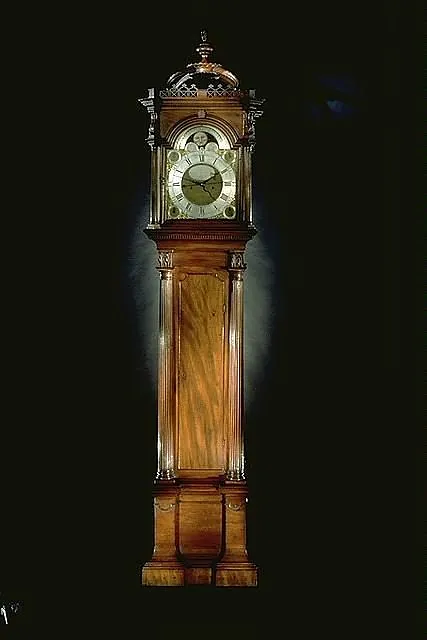
Clock by Joseph Ellicott, United States, 1769
National Museum of American History, Smithsonian Institution, Washington DC
Clocks · 1772
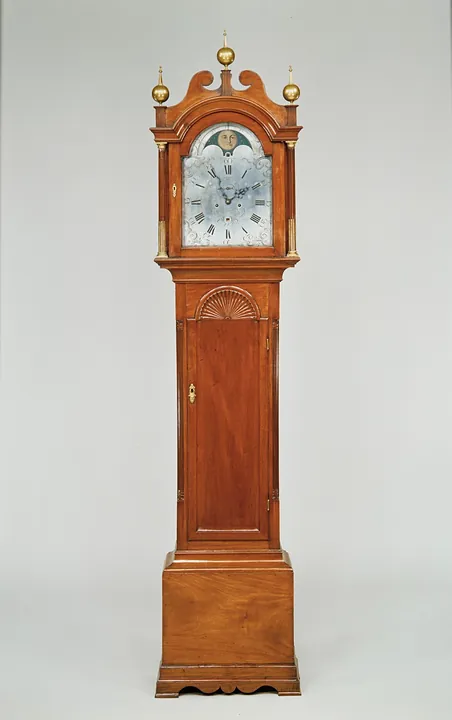
Tall clock by Benjamin Willard, United States, 1772
The Metropolitan Museum of Art, New York
Clocks · 1780–90
"balloon" shelf clock by Simon Willard, United States, 1780–90
The Metropolitan Museum of Art, New York