Clocks · Clock
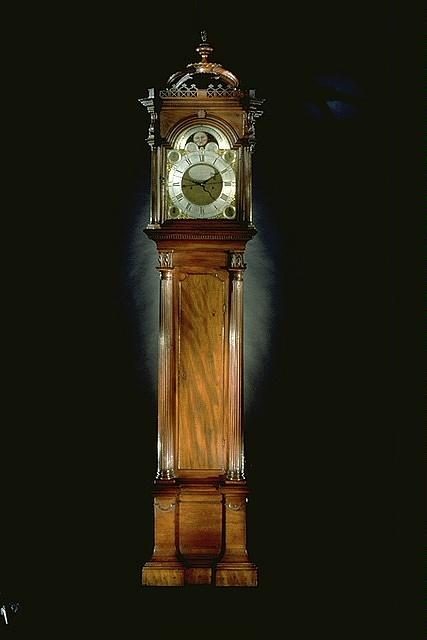
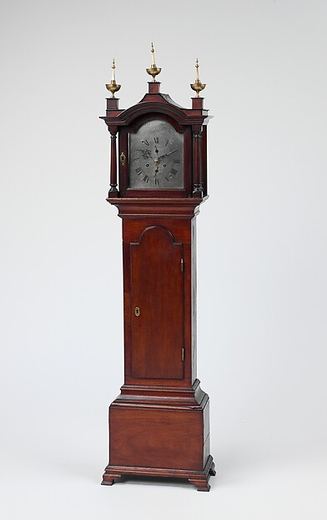
Clock by Ellicott, Joseph, United States, 1769
- Maker / attribution
- Ellicott, Joseph (user)
- Date
- 1769
- Historical period
- Precision & Scientific Horology (1750 – 1850)
- Country of origin
- United States
- Place
- United States: Pennsylvania
- Object type
- Clock
- Dimensions
- wood (overall material); brass (overall material); overall: 116 3/4 in x 22 3/8 in x 22 1/4 in; 296.545 cm x 56.8325 cm x 56.515 cm
- Holding institution
- National Museum of American History, Smithsonian Institution, Washington DC
- Accession / object no.
- 1999.0276.01
- Credit line
- Richard Norton Fryberger, Joan Evans Strehler and Ann McGaffey Cogswell
- Catalogue title (original)
- Tall Case Clock
Record summary
Held and catalogued by National Museum of American History, Smithsonian Institution, Washington DC (object number 1999.0276.01), this is a clock by Ellicott, Joseph, made in United States: Pennsylvania, dated 1769. The Atlas places it in the Precision & Scientific Horology period (1750 – 1850) of its Clocks collection. Recorded dimensions: wood (overall material); brass (overall material); overall: 116 3/4 in x 22 3/8 in x 22 1/4 in; 296.545 cm x 56.8325 cm x 56.515 cm. The record is illustrated with 4 photographs.
Assembled from the source record's structured fields. Dates and attributions are given as the source states them; where a field is missing the Atlas leaves it blank rather than estimating.
Catalogue description
Description
The earliest domestic clocks in the American colonies were English-made "lantern" clocks, with brass gear trains held between pillars. Along with fully furnished "best" beds, looking glasses, sofas, silver, and case furniture, such clocks were the household objects consistently assigned the highest monetary value in inventories of possessions.
Description
By the 18th century, the most common style of domestic clock came to look more like a piece of household furniture. A wooden case enclosed the movement, weights, and pendulum. Through a glass window the dial was visible.
Description
In 1769, Pennsylvania clockmaker and millwright Joseph Ellicott completed this complicated tall case clock. On three separate dials, it tells the time and shows the phases of the moon; depicts on an orrery the motions of the sun, moon, and planets; and plays selected twenty-four musical tunes on the hour.
Description
The musical dial on the Ellicott clock allows the listener to choose from twelve pairs of tunes. Each pair includes a short tune and a long one. On the hour only the short tune plays, but every third hour, both play. During a tune, automaton figures at the top of the dial appear to tap their feet in time to the music, and a small dog between them jumps up and down.
Description
Joseph Ellicott moved from the Philadelphia area to Maryland in 1772 and, with his brothers Andrew and John, set up a flour-milling operation in what is now Ellicott City. The clock was a centerpiece in Ellicott family homes for generations.
Description
Who else owned clocks in early America? Clock owners, like the American colonists themselves, were not a homogeneous group. Where a person lived influenced the probability of owning a timepiece. In 1774, for example, New Englanders and Middle Atlantic colonials were equally likely to own a timepiece. In those regions, roughly 13 or 14 adults out of 100 had a clock in their possessions when they died. Among Southern colonists at that time, only about 6 in 100 had a clock.
Historical context
Precision & Scientific Horology (1750 – 1850)
Harrison solves longitude; Mudge invents the lever; Breguet's Paris workshop defines the modern watch.
The age of the deadbeat escapement, compensated pendulums and observatory regulators. Domestic clocks spread through the middle classes: English longcase and bracket clocks, French gilt-bronze mantel clocks, Viennese Biedermeier wall clocks, Black Forest painted-shield clocks, and the first American shelf clocks.
Read the period in the timelineMore clocks from this periodEarlier: Early Modern Horology
Atlas type guide
Longcase (tall-case or grandfather) clocks
The longcase clock was born from two seventeenth-century innovations: Christiaan Huygens's pendulum (1656–57) and the anchor escapement (c. 1670). A long seconds pendulum, nearly a metre long, swings with a small arc, and enclosing it together with the driving weights in a tall wooden case protected the mechanism and created a new piece of furniture. London makers such as Ahasuerus Fromanteel, Thomas Tompion and Joseph Knibb set the pattern.
By the eighteenth century longcase clocks were made throughout Britain, the Netherlands, Scandinavia (the Swedish Mora clock), France (the Comtoise from the Franche-Comté), Germany and colonial America. Eight-day movements with two weights became standard in better clocks; thirty-hour clocks with one weight and a rope or chain were cheaper alternatives.
What to look for
- Winding holes in the dial: two (eight-day, going and striking) or none (thirty-hour, pulled up by a chain).
- Brass dials with applied chapter rings (earlier) versus painted iron 'white' dials (after c. 1770 in Britain).
- Moon-phase arches, date apertures, seconds dials and maker's name on the dial.
- Case woods and style: ebonised, walnut marquetry, lacquer, oak or mahogany; regional styles from London, Lancashire, Scotland or America.
- Whether the movement and dial match the case — 'marriages' are common.
Dating clues
- Square brass dials suggest c. 1670–1720; arched brass dials c. 1715–1790.
- Painted (white) dials were made by Birmingham dial-makers from about 1772.
- Comtoise clocks with repoussé pendulums are mostly nineteenth century.
General guidance written by the Atlas editors about this kind of object. It is not a statement about this particular piece; for that, rely on the source record above and on physical examination.
Related records
Clocks · 1740–60
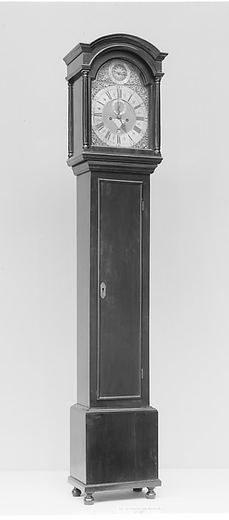
Tall clock by Samuel Bagnall, United States, 1740–60
The Metropolitan Museum of Art, New York
Clocks · 1750–60
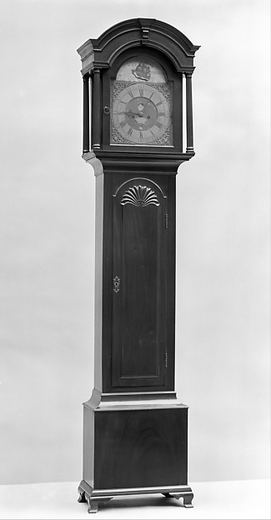
Tall clock by Gawen Brown, United States, 1750–60
The Metropolitan Museum of Art, New York
Clocks · 1765–75
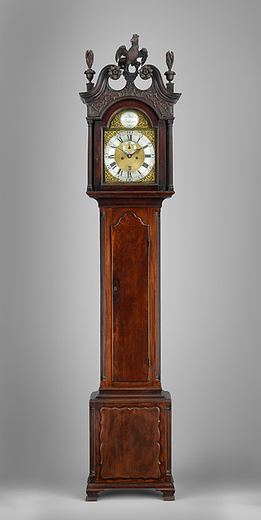
Clock by Edward Duffield, United States, 1765–75
The Metropolitan Museum of Art, New York
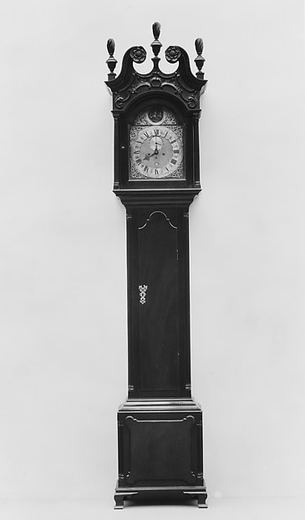
Clocks · 1767–71
Tall clock by William Huston, United States, 1767–71
The Metropolitan Museum of Art, New York
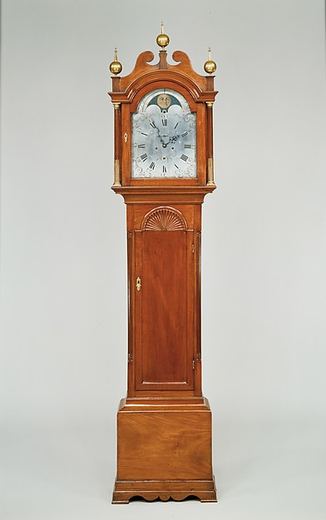
Clocks · 1772
Tall clock by Benjamin Willard, United States, 1772
The Metropolitan Museum of Art, New York
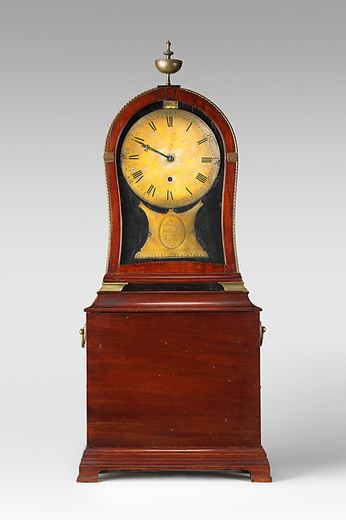
Clocks · 1780–90
"balloon" shelf clock by Simon Willard, United States, 1780–90
The Metropolitan Museum of Art, New York
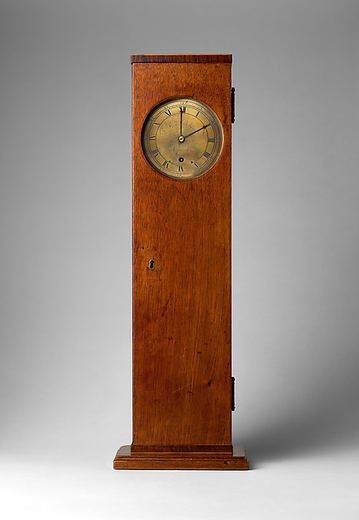
Clocks · ca. 1786
Shelf clock by Levi Hutchins, United States, ca. 1786
The Metropolitan Museum of Art, New York
Clocks · 1785–90
Clock by Caleb Leach, United States, 1785–90
The Metropolitan Museum of Art, New York