Clocks · Clock
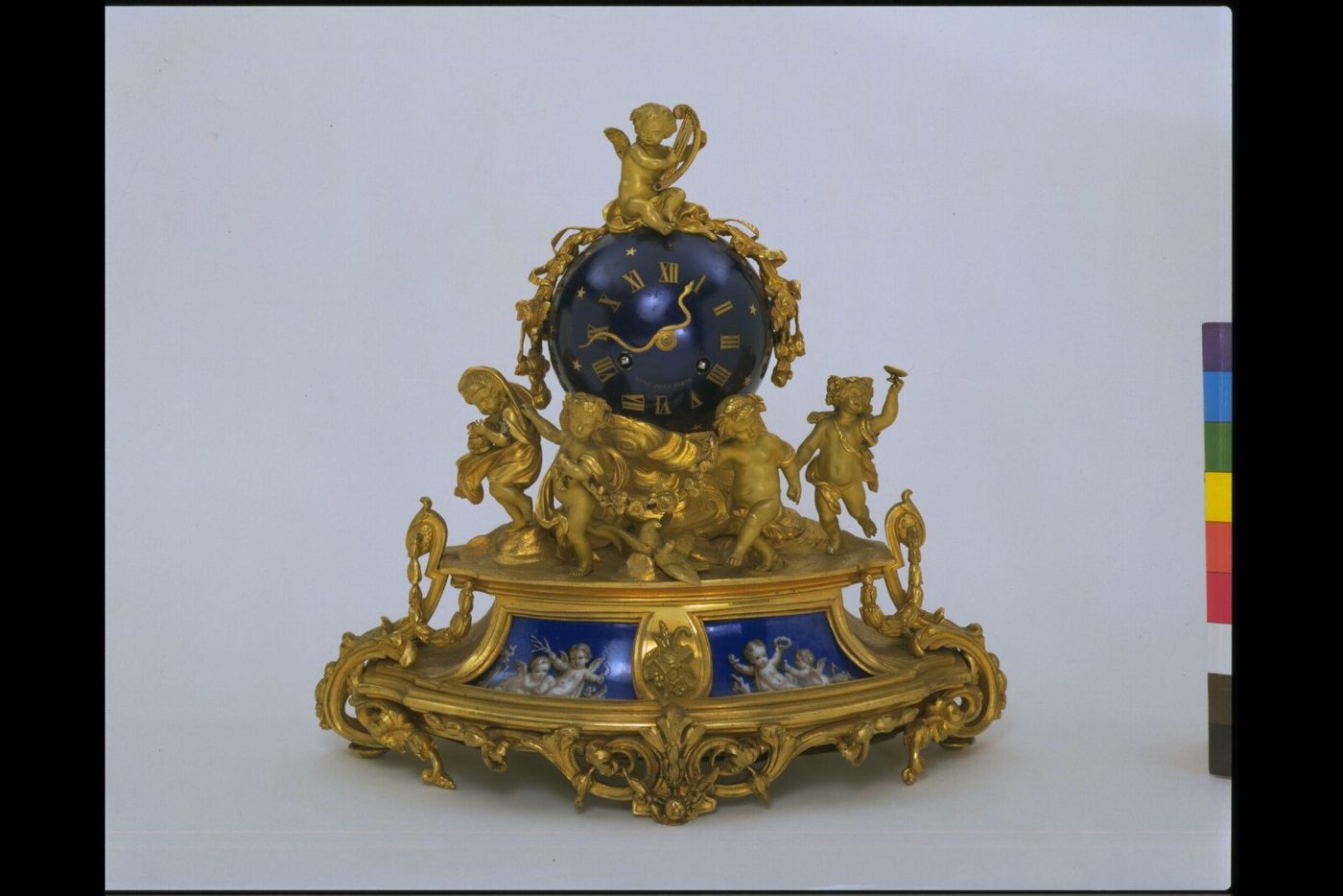
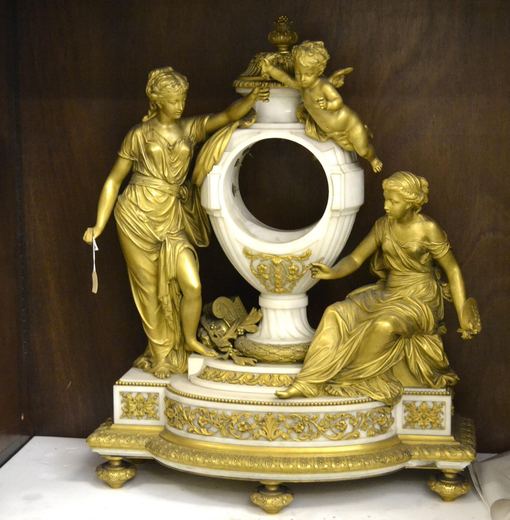
Ormolu and ename clockl, Paris, ca.1855, made by Lévy Frères.
- Maker / attribution
- Lévy Frères; Levy Frères (maker)
- Date
- ca. 1855
- Historical period
- Industrial Revolution (1850 – 1900)
- Country of origin
- France
- Place
- Paris
- Object type
- Clock
- Materials / technique
- Ormolu and enamel
- Dimensions
- Height: 11.75 in; Width: 12 in
- Holding institution
- Victoria and Albert Museum, London
- Accession / object no.
- 2650-1856
- Credit line
- Bought at the Paris International Exhibition in 1855
Record summary
Held and catalogued by Victoria and Albert Museum, London (object number 2650-1856), this is a clock by Lévy Frères, made in Paris, France, dated ca. 1855. The Atlas places it in the Industrial Revolution period (1850 – 1900) of its Clocks collection. Materials and techniques recorded by the source: Ormolu and enamel. Recorded dimensions: Height: 11.75 in; Width: 12 in. The record is illustrated with 1 photograph.
Assembled from the source record's structured fields. Dates and attributions are given as the source states them; where a field is missing the Atlas leaves it blank rather than estimating.
Catalogue description
V&A — Summary
This clock was bought at the Paris Exhibition of 1855 for £19 4s 0d. The dancing putti represent the four seasons. In the mid 19th century France saw the emergence of a neo-rococo style with pronounced curves and a surfeit of ornamental motifs. This new rococo style was however symmetrical and so lost much of the exuberance of the 18th century original.
V&A — Physical description
Case of ormolu and enamel, the upper part in the form of a globe enamelled in blue with Roman numerals in gold, surmounted by a winged putto playing the harp with swags on either side; the centre of the dial bears the signature LEVY FRES A PARIS. In front of the globe, four ormolu statuettes of putti represent The Seasons. They are supported by an oval tiered plinth, shaped, moulded and chased, with applied ormolu mounts including central wheatsheafs at the back and front and swags of husks at the side, the plinth is supported by elaborate scrolled feet. The sloping front is inset with two scenes enamelled in blue and white of putti representing Winter and Spring. DIAL consists of gilt Roman numerals I to XII which are applied to the front curved surface of the globe. The hour and minute hands are gilt and formed as the head and tail of a serpent. The winding holes are inside IIII and VIII; the small square for regulation is above the XII. MOVEMENT: The circular movement plates 7.6 cm diameter; the backplate is signed 'Levy Frères à Paris' and bears the punched number 308. The going and striking trains are each powered by a going barrel. The going train to the right has an internal Brocot escapement, steel pallets and an escape whelle of 36T. The Pendulum of overall length 17.8 cm with steel rod screed into a lenticular brass-covered lead bob 3.8 cm diameter, punched with the number 308. Brocot type regulator. The Rack striking tain, gives also a single stroke at the half-hours, sounding on a bell mounted inside the back plate.
V&A — Historical context
The clock was designed for display on a mantelpiece
V&A — Object history
This clock was bought at the Paris 1855 Exhibition for £19 4s 0d.
V&A gallery label
Clock About 1855 Shown at the International Exhibition, Paris, 1855 In the middle of the 19th century the newly revived Rococo style became highly popular throughout Europe. This new Rococo style was, however, symmetrical and so lost much of the fantasy of the 18th-century original, with its asymmetric scrolls and flowers. Here, the dancing putti represent the Four Seasons. France, Paris; manufactured by Lévy Frères Gilded bronze, with enamel Bought at the exhibition for £19 4s
V&A gallery label
Gallery 101, Nineteenth Century Europe 16 Clock About 1855 Shown at the International Exhibition, Paris, 1855 In the middle of the 19th century the newly revived Rococo style became highly popular throughout Europe. This new Rococo style was, however, symmetrical and so lost much of the fantasy of the 18th-century original, with its asymmetric scrolls and flowers. Here, the dancing putti represent the Four Seasons. France, Paris; manufactured by Lévy Frères Gilded bronze, with enamel Bought at the exhibition for £19 4s Museum no. 2650-1856
V&A gallery label
CLOCK Manufacturers: Lévy Frères Paris: about 1855 Gilt bronze and enamel This clock was bought at the Paris 1855 Exhibition for £19 4s. The dancing putti represent the seasons.
Inscriptions & marks
LEVY FRES A PARIS
Historical context
Industrial Revolution (1850 – 1900)
American interchangeable-parts manufacture; railroad time standards; Swiss and German factory systems.
Factory production transformed the clock into an everyday object. American makers (Seth Thomas, Ansonia, Waterbury) and German factories (Junghans, Gustav Becker, Lenzkirch) sold millions of shelf, wall and alarm clocks worldwide; France produced standardised Paris movements and carriage clocks; electric time distribution began.
Read the period in the timelineMore clocks from this periodEarlier: Precision & Scientific Horology
Atlas type guide
Domestic clocks
A clock combines four systems: a source of power (falling weight, coiled spring, or later electricity), a gear train that divides time, an escapement and oscillator that regulate it (foliot, pendulum or balance), and an indicating system of dial and hands or a bell. Its history runs from the large iron weight-driven clocks of the late thirteenth century to Renaissance spring-driven table clocks, the pendulum revolution of 1656, the factory clocks of the nineteenth century and electric and quartz clocks of the twentieth.
Domestic clocks also reflect regional furniture and decorative traditions — English longcase and bracket clocks, French pendules, Viennese regulators, Black Forest and American shelf clocks — and therefore record changing tastes as much as technical progress.
What to look for
- How the clock is powered: weights, spring barrel, fusee, electric coil.
- The oscillator: foliot, short pendulum, long seconds pendulum or balance.
- Whether it strikes: hour only (count wheel) or hours and quarters (rack striking).
- The maker or retailer's name on dial and movement, and any factory trademarks.
- Signs of alteration — replaced dials, converted escapements, 'married' cases.
Dating clues
- Before 1656 clocks used foliots or balances; after, most domestic clocks have pendulums.
- Anchor escapements spread after c. 1670; minute hands became common at the same time.
- Factory production in America and Germany transformed prices after c. 1840.
General guidance written by the Atlas editors about this kind of object. It is not a statement about this particular piece; for that, rely on the source record above and on physical examination.
Related records
Clocks · 1801-1900
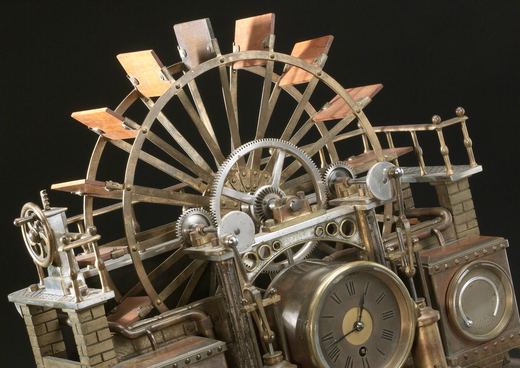
Clock (French) symbolising motive power, gilt bronze finish, with two keys, 1801-1900
Science Museum Group, London
Clocks · 1840-1878
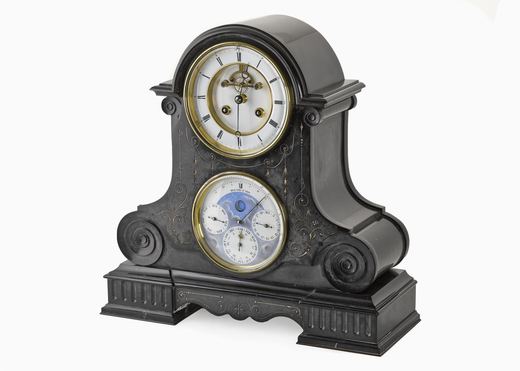
Mantel clock by Brocot, A., France, 1840-1878
Science Museum Group, London
Clocks · 1850
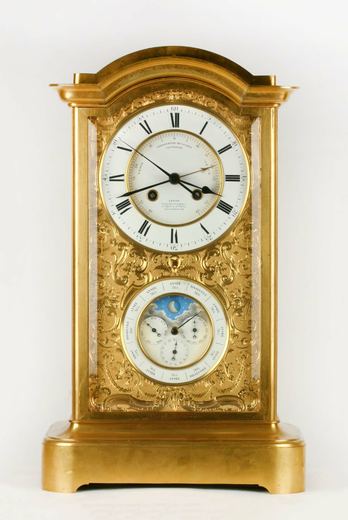
Table clock, France, 1850
German Clock Museum
Clocks · 1850
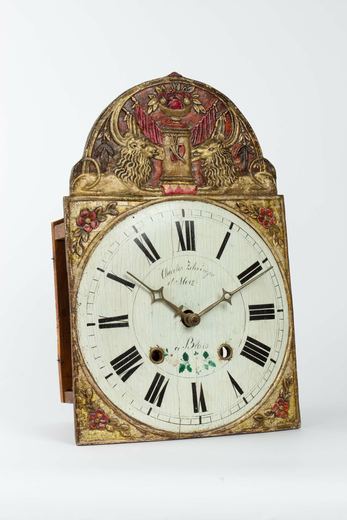
Wall clock by Charles et Merz Zehringer, France, 1850
German Clock Museum
Clocks · ca. 1860
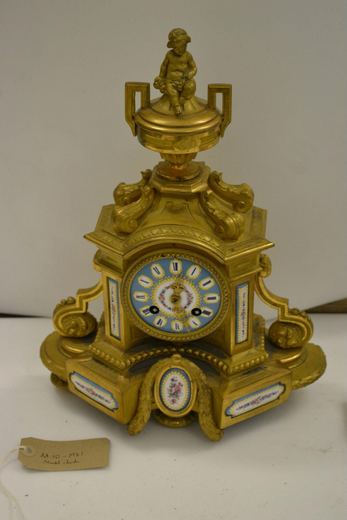
Mantle clock, French, ca. 1860
Victoria and Albert Museum, London
Clocks · ca. 1860
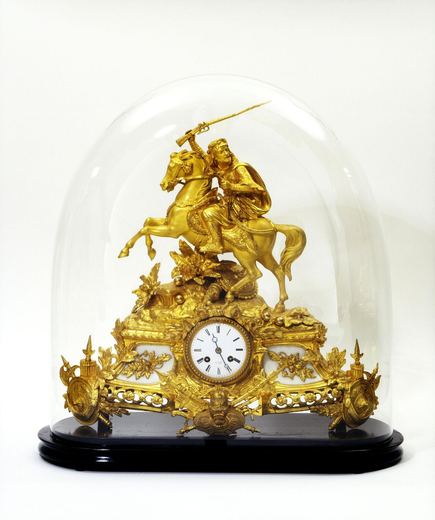
[*] French Clock under glass dome
Victoria and Albert Museum, London
Clocks · ca. 1860
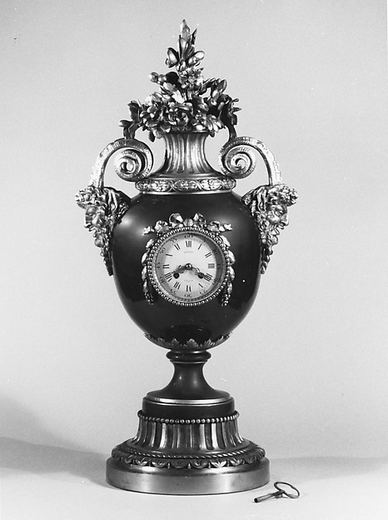
Clock by Auguste-Emile Rinquet-Leprince, France, ca. 1860
The Metropolitan Museum of Art, New York
Clocks · 1860-1870
Clock by Raingo Frères, France, 1860-1870
Victoria and Albert Museum, London