Clocks · Clock
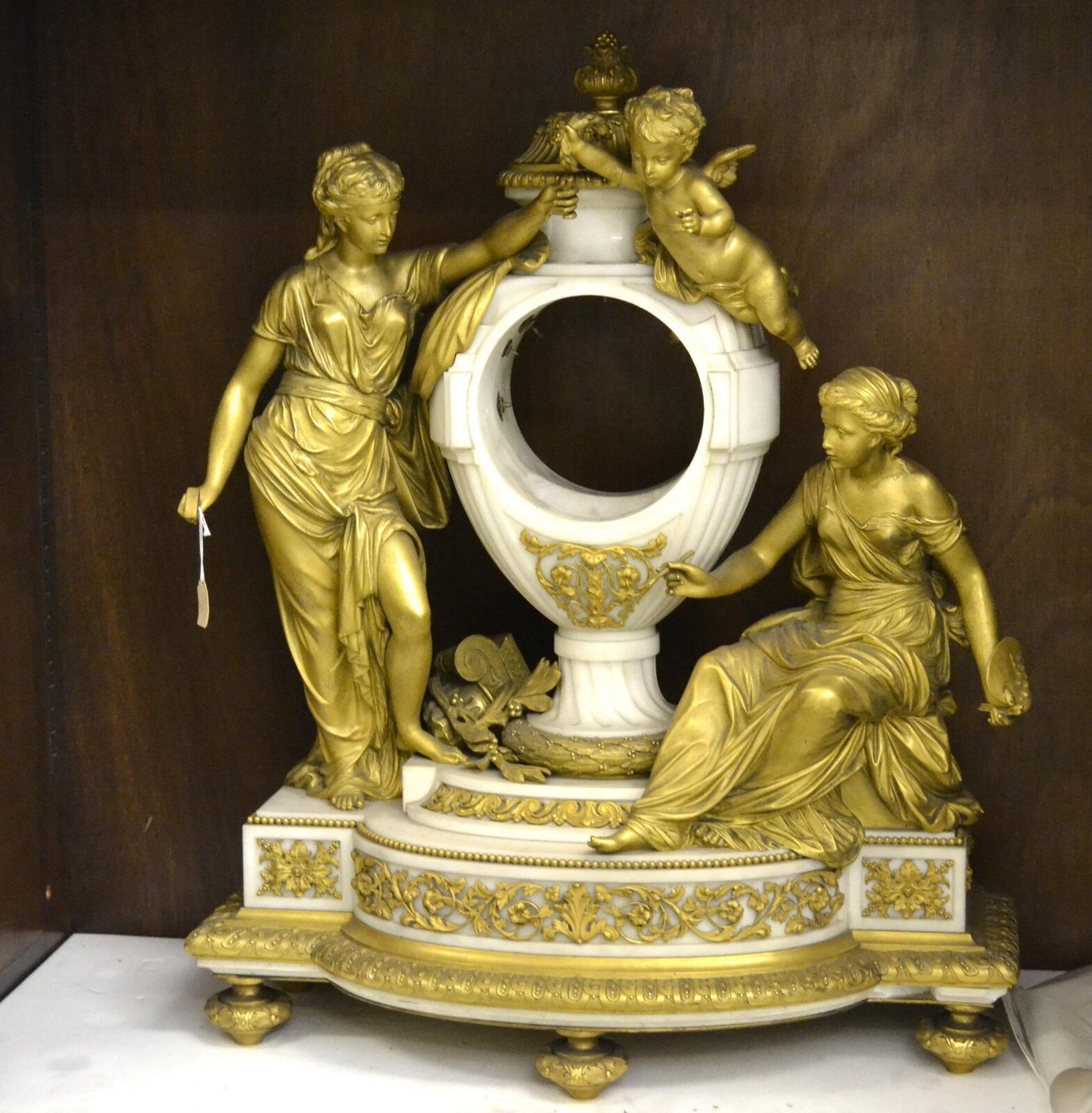
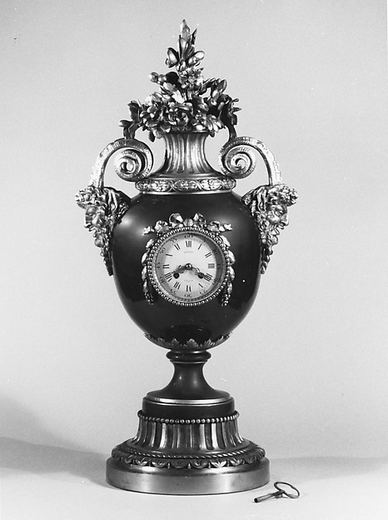
Clock by Raingo Frères, France, 1860-1870
- Maker / attribution
- Raingo Frères
- Date
- 1860-1870
- Historical period
- Industrial Revolution (1850 – 1900)
- Country of origin
- France
- Place
- Paris
- Object type
- Clock
- Materials / technique
- White marble, ormolu, steel and brass
- Dimensions
- Height: 29 in (clock); Height: 36.05 in (Candelabrum); Width: 23.05 in
- Holding institution
- Victoria and Albert Museum, London
- Accession / object no.
- 660:1 to 4-1901
- Credit line
- Given by Sir Edwin Durning Lawrence Bart
Record summary
Held and catalogued by Victoria and Albert Museum, London (object number 660:1 to 4-1901), this is a clock by Raingo Frères, made in Paris, France, dated 1860-1870. The Atlas places it in the Industrial Revolution period (1850 – 1900) of its Clocks collection. Materials and techniques recorded by the source: White marble, ormolu, steel and brass. Recorded dimensions: Height: 29 in (clock); Height: 36.05 in (Candelabrum); Width: 23.05 in. The record is illustrated with 2 photographs.
Assembled from the source record's structured fields. Dates and attributions are given as the source states them; where a field is missing the Atlas leaves it blank rather than estimating.
Catalogue description
V&A — Summary
A garniture of a mantel clock and pair of candelabra of white marble and ormolu. The clock dial is placed in an urn flanked by female figures representing Painting and Sculpture. The candelabra consist of urns supported by putti. The combination of white marble and sculptural ornament in ormolu is characteristic of the furnishing bronzes in the neo-classical style produced by this renowned firm of Paris bronziers in the second quarter of the nineteenth century. Supplied by Raingo Frères, Paris, circa 1865.
V&A — Physical description
The clock is in the form of a fluted urn standing on a pedestal with rounded front; a cupid holding a wreath hovers over the upper part of the urn, on one side of which a female figure representing Painting is seated, while on the other another female figure representing Sculpture stands with an Ionic capital and a branch of laurel at her feet. The pedestal rests on enriched knob feet. The white enamel dial is 15.6 cm diameter, with an outer ring of minutes numbered at intervals of five and a set of Roman numerals in blue representing the hours. The winding-holes are inside IIII and VIII. There is a regulation hole pirecing the numeral 60. The dial is signed RAINGO FRES PARIS. The hands are pierced, engraved and gilt. The chased bezel is 16.6 cm diameter with a domed glass cover. The movement plates are 11.1 cm diameter, the backplate is stamped in a circular recess 'RAINGO FRERES PARIS' with punched numbers 910 and 46. There are two going barrels; a going train to the right, with internal Brocot escapement, steel pallets, escape wheel of 42T, the pallets spanning 12T. The pendulum measures 13.7 cm overall length with steel rod and brass-covered lead bob 7.6 cm diameter; 1.6 cms thick., bevelled all round, flat at front and back and numbered 910 and 46. The Brocot regulator has a top pinion stamped 'BROCOT PROPTE'. The striking train of rack type to left gives a single stroke at the half-hours. There is a brass key for the clock. Each candelabrum consists of an urn supported by two boys standing on a pedestal rounded in front and behind; from the top of the urn eleven branches for candles spring from a group of acanthus leaves.
V&A — Historical context
Created for display on a mantelpiece
V&A — Object history
The clock and candelabra were given by Sir Edwin Durning-Lawrence Bart in 1901. When acquired by the South Kensington Museum part of the mount of the pedestal was detached and repaired by the museum's Work Room.
Inscriptions & marks
RAINGO FRERES PARIS; Raingo Fres Paris; BROCOT PROPTE
Historical context
Industrial Revolution (1850 – 1900)
American interchangeable-parts manufacture; railroad time standards; Swiss and German factory systems.
Factory production transformed the clock into an everyday object. American makers (Seth Thomas, Ansonia, Waterbury) and German factories (Junghans, Gustav Becker, Lenzkirch) sold millions of shelf, wall and alarm clocks worldwide; France produced standardised Paris movements and carriage clocks; electric time distribution began.
Read the period in the timelineMore clocks from this periodEarlier: Precision & Scientific Horology
Atlas type guide
Domestic clocks
A clock combines four systems: a source of power (falling weight, coiled spring, or later electricity), a gear train that divides time, an escapement and oscillator that regulate it (foliot, pendulum or balance), and an indicating system of dial and hands or a bell. Its history runs from the large iron weight-driven clocks of the late thirteenth century to Renaissance spring-driven table clocks, the pendulum revolution of 1656, the factory clocks of the nineteenth century and electric and quartz clocks of the twentieth.
Domestic clocks also reflect regional furniture and decorative traditions — English longcase and bracket clocks, French pendules, Viennese regulators, Black Forest and American shelf clocks — and therefore record changing tastes as much as technical progress.
What to look for
- How the clock is powered: weights, spring barrel, fusee, electric coil.
- The oscillator: foliot, short pendulum, long seconds pendulum or balance.
- Whether it strikes: hour only (count wheel) or hours and quarters (rack striking).
- The maker or retailer's name on dial and movement, and any factory trademarks.
- Signs of alteration — replaced dials, converted escapements, 'married' cases.
Dating clues
- Before 1656 clocks used foliots or balances; after, most domestic clocks have pendulums.
- Anchor escapements spread after c. 1670; minute hands became common at the same time.
- Factory production in America and Germany transformed prices after c. 1840.
General guidance written by the Atlas editors about this kind of object. It is not a statement about this particular piece; for that, rely on the source record above and on physical examination.
Related records
Clocks · 1801-1900
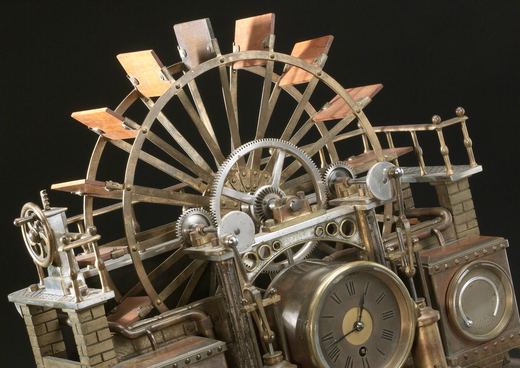
Clock (French) symbolising motive power, gilt bronze finish, with two keys, 1801-1900
Science Museum Group, London
Clocks · 1840-1878
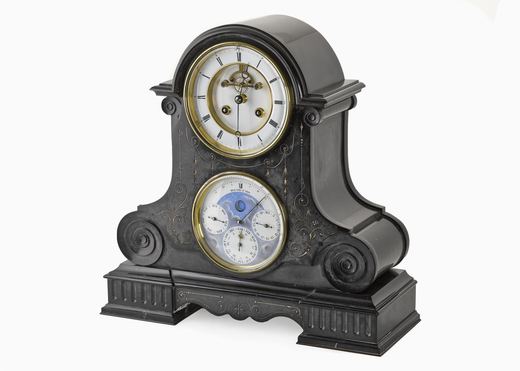
Mantel clock by Brocot, A., France, 1840-1878
Science Museum Group, London
Clocks · ca. 1855
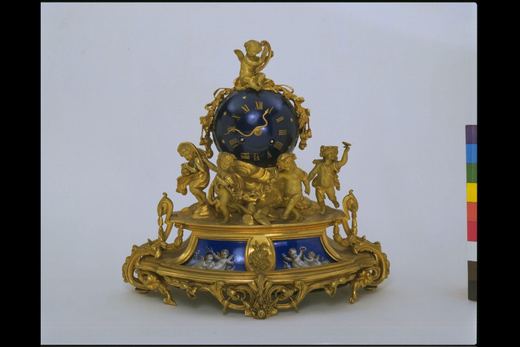
Ormolu and ename clockl, Paris, ca.1855, made by Lévy Frères.
Victoria and Albert Museum, London
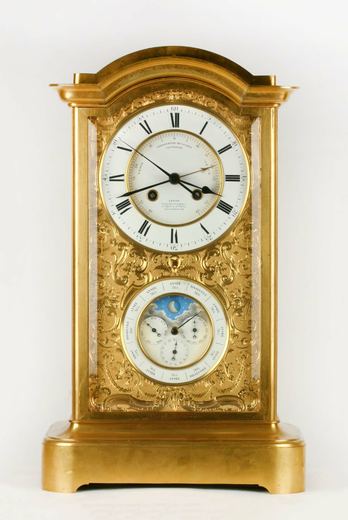
Clocks · 1850
Table clock, France, 1850
German Clock Museum
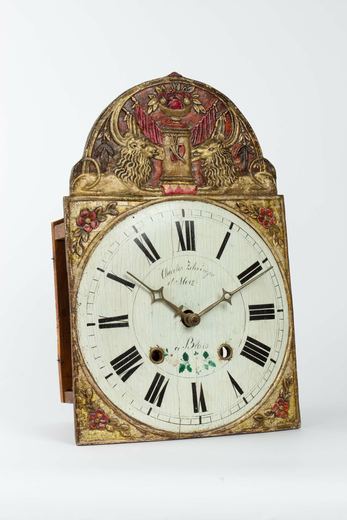
Clocks · 1850
Wall clock by Charles et Merz Zehringer, France, 1850
German Clock Museum
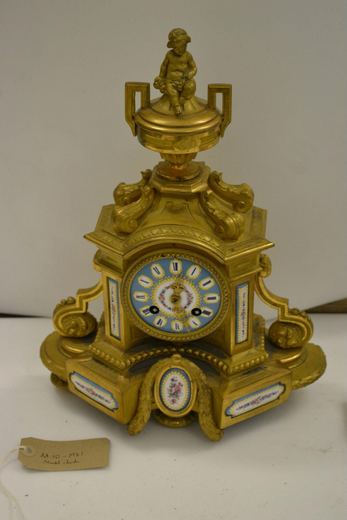
Clocks · ca. 1860
Mantle clock, French, ca. 1860
Victoria and Albert Museum, London
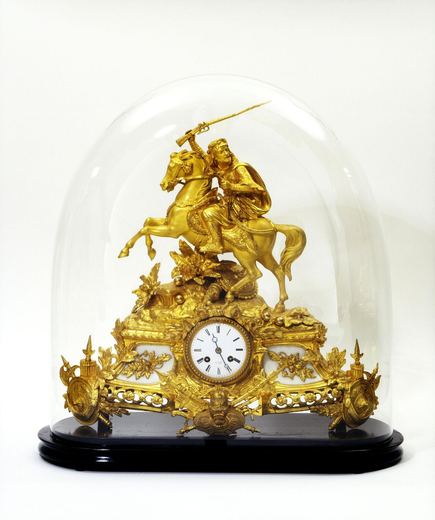
Clocks · ca. 1860
[*] French Clock under glass dome
Victoria and Albert Museum, London
Clocks · ca. 1860
Clock by Auguste-Emile Rinquet-Leprince, France, ca. 1860
The Metropolitan Museum of Art, New York