
Clocks · Atmos clock
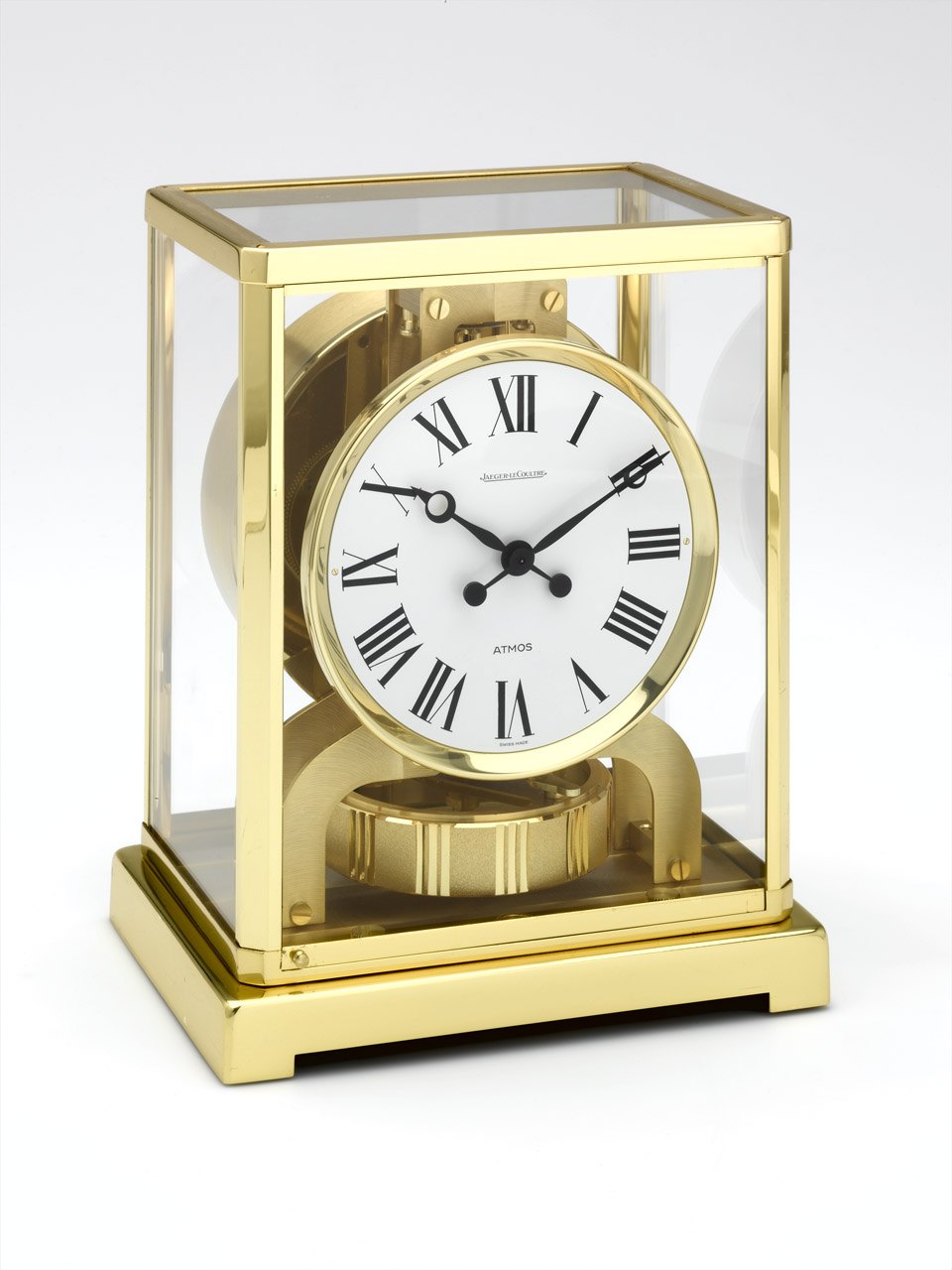
Atmos clock no. 437226 by Jaeger-Le-Coultre
- Maker / attribution
- Jaeger-Le-Coultre (maker)
- Date
- 1976
- Historical period
- Quartz Revolution (1969 – 1990)
- Country of origin
- Unrecorded in source
- Object type
- Atmos clock
- Materials / technique
- metal; glass; plastic
- Dimensions
- Overall: 225 x 180 x 135 mm
- Holding institution
- Royal Museums Greenwich
- Accession / object no.
- ZAA0189
- Credit line
- National Maritime Museum, Greenwich, London
- Catalogue title (original)
- Serial number: 437226 (English)
View the source record ↗ (opens another website in a new tab)Suggest a correction
Record summary
Held and catalogued by Royal Museums Greenwich (object number ZAA0189), this is an atmos clock by Jaeger-Le-Coultre, dated 1976. The Atlas places it in the Quartz Revolution period (1969 – 1990) of its Clocks collection. Materials and techniques recorded by the source: metal; glass; plastic. Recorded dimensions: Overall: 225 x 180 x 135 mm. The record is illustrated with 2 photographs.
Assembled from the source record's structured fields. Dates and attributions are given as the source states them; where a field is missing the Atlas leaves it blank rather than estimating.
Catalogue description
Catalogue description — Royal Museums Greenwich
Brass-cased model 5800 'Atmos Classic' clock, serial number 437226. Jaeger-Le Coultre's famous 'Atmos' clock was first developed in 1928 by Neuchâtel engineer Jean-Léon Reutter and introduced into Jaeger-Le Coultre's product range in the early 1930s. It is a torsional (twisting) pendulum clock with ‘detached lever’ dead-beat escapement. The clock is automatically wound without any intervention by the owner. Changes in air temperature and pressure cause a liquid- and vapour-filled chamber at the back of the movement to expand and contract, winding the clock's mainspring. A change in temperature of 1° can provide enough power to run the clock for two days, and the mainspring has enough power in reserve to run the clock for a year. Energy is conserved by the very slow-moving twisting pendulum which 'beats' only twice per minute. The movement is so slow and the parts so finely finished that no oil is needed. Atmos clocks are frequently given as official gifts by the Swiss Government to famous and important visitors, including John F. Kennedy, Winston Churchill, Charles de Gaulle, Charlie Chaplin and Pope John-Paul II.
Historical context
Quartz Revolution (1969 – 1990)
Seiko's Astron begins mass quartz timekeeping; traditional industries contract sharply.
Quartz movements and digital displays made accurate clocks cheap and ubiquitous after the early 1970s. LED and LCD clocks, clock radios and radio-controlled clocks appeared, while traditional mechanical clockmaking contracted sharply in Germany, France and Britain.
Read the period in the timelineMore clocks from this periodEarlier: Modern Mechanical Horology
Atlas type guide
Domestic clocks
A clock combines four systems: a source of power (falling weight, coiled spring, or later electricity), a gear train that divides time, an escapement and oscillator that regulate it (foliot, pendulum or balance), and an indicating system of dial and hands or a bell. Its history runs from the large iron weight-driven clocks of the late thirteenth century to Renaissance spring-driven table clocks, the pendulum revolution of 1656, the factory clocks of the nineteenth century and electric and quartz clocks of the twentieth.
Domestic clocks also reflect regional furniture and decorative traditions — English longcase and bracket clocks, French pendules, Viennese regulators, Black Forest and American shelf clocks — and therefore record changing tastes as much as technical progress.
What to look for
- How the clock is powered: weights, spring barrel, fusee, electric coil.
- The oscillator: foliot, short pendulum, long seconds pendulum or balance.
- Whether it strikes: hour only (count wheel) or hours and quarters (rack striking).
- The maker or retailer's name on dial and movement, and any factory trademarks.
- Signs of alteration — replaced dials, converted escapements, 'married' cases.
Dating clues
- Before 1656 clocks used foliots or balances; after, most domestic clocks have pendulums.
- Anchor escapements spread after c. 1670; minute hands became common at the same time.
- Factory production in America and Germany transformed prices after c. 1840.
General guidance written by the Atlas editors about this kind of object. It is not a statement about this particular piece; for that, rely on the source record above and on physical examination.
Related records
Clocks · late 20th century
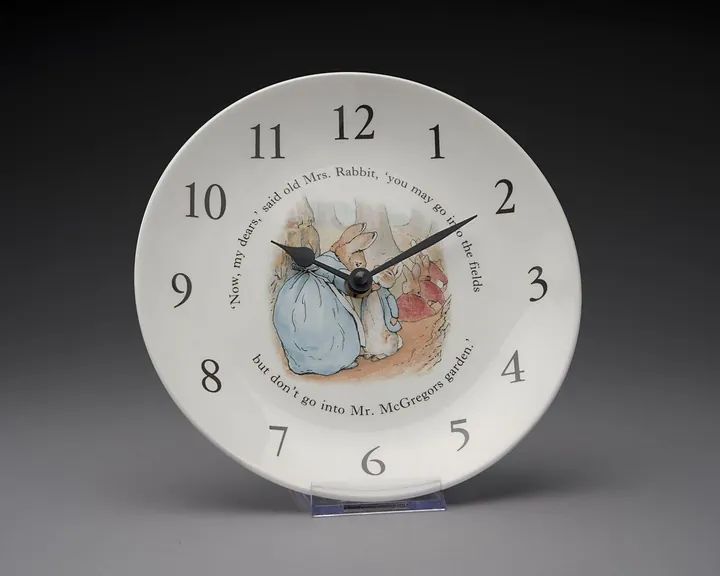
Clock, 'Peter Rabbit', Queen's ware, transfer printing, Josiah Wedgwood and Sons, Barlaston, late 20th century (V&A WE.17466-2014)
Victoria and Albert Museum, London
Clocks · late 20th century
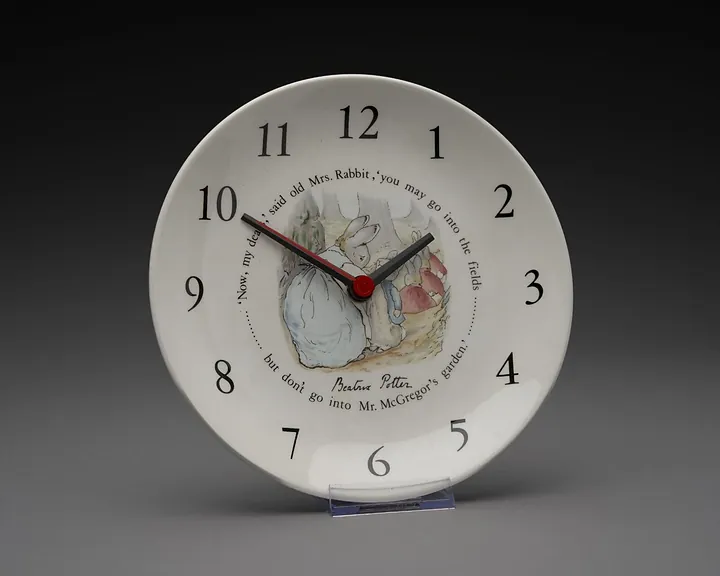
Clock, 'Peter Rabbit', Queen's ware, transfer printing, Josiah Wedgwood and Sons, Barlaston, late 20th century (V&A WE.18029-2014)
Victoria and Albert Museum, London
Clocks · late 20th century
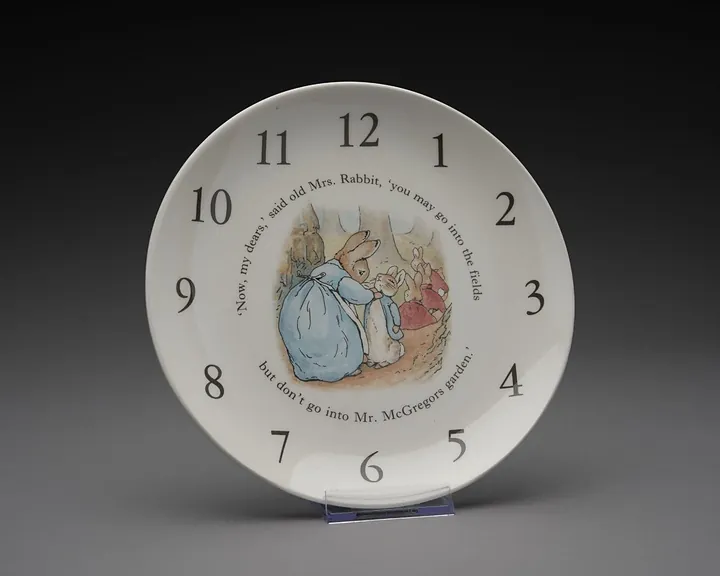
Clock, 'Peter Rabbit', glazed earthenware, transfer printing, Josiah Wedgwood and Sons, Barlaston, late 20th century
Victoria and Albert Museum, London
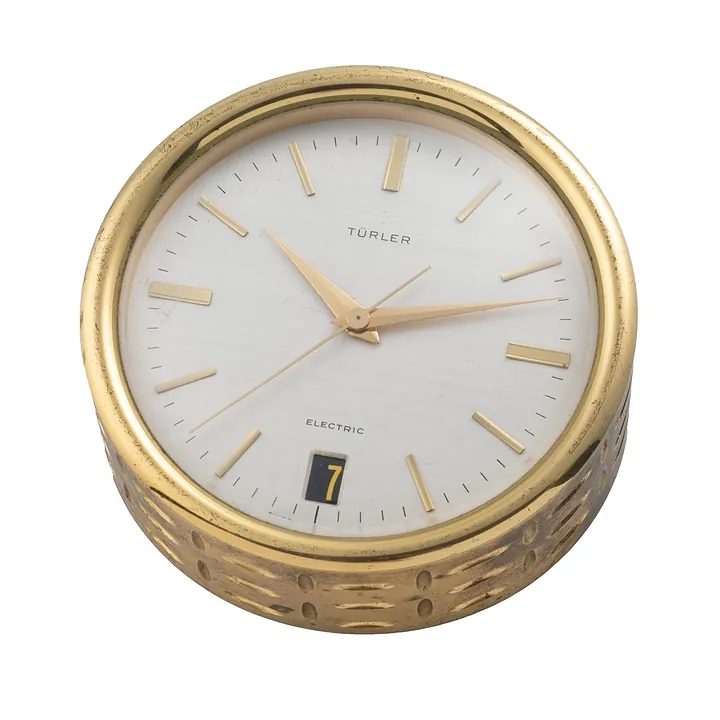
Clocks · c. 1960-1970s
Anonymous clock, c. 1960-1970s
Antiquorum auction archive, Geneva
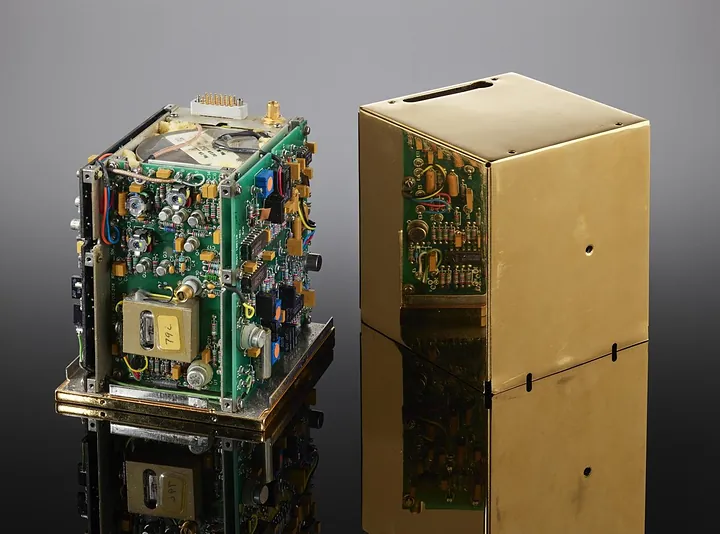
Clocks · 1960–1996
Electric clock by Efratom GmbH, Germany, 1960–1996
Science Museum Group, London
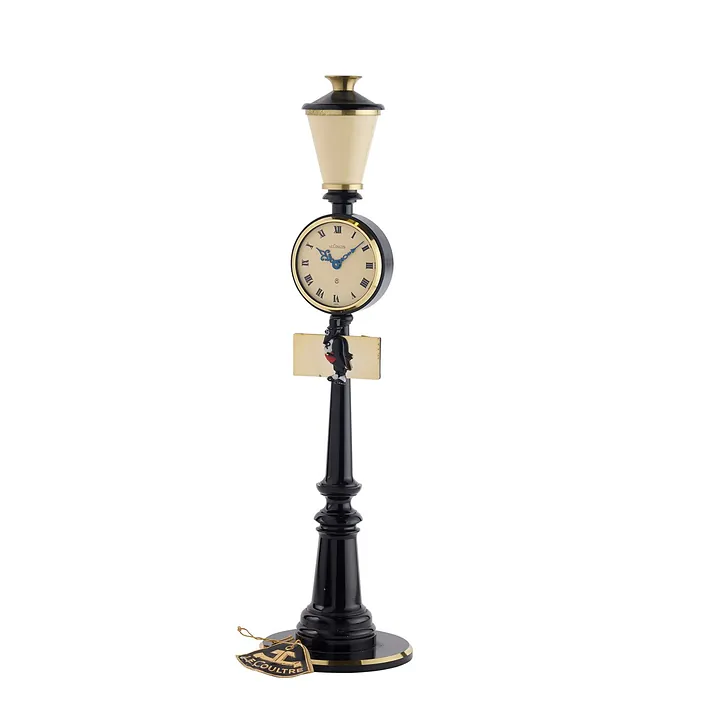
Clocks · c. 1960-1970s
Lecoultre Street Light Lamp, ref. 397, c. 1960-1970s
Antiquorum auction archive, Geneva
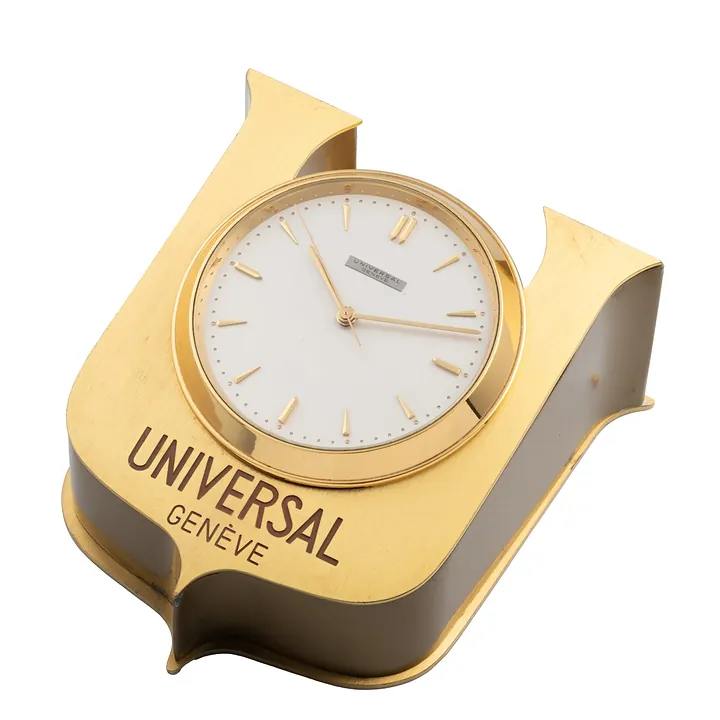
Clocks · c. 1960-1970s
Universal Genève clock, ref. 999.116.01, c. 1960-1970s
Antiquorum auction archive, Geneva
Clocks · 1964–1988
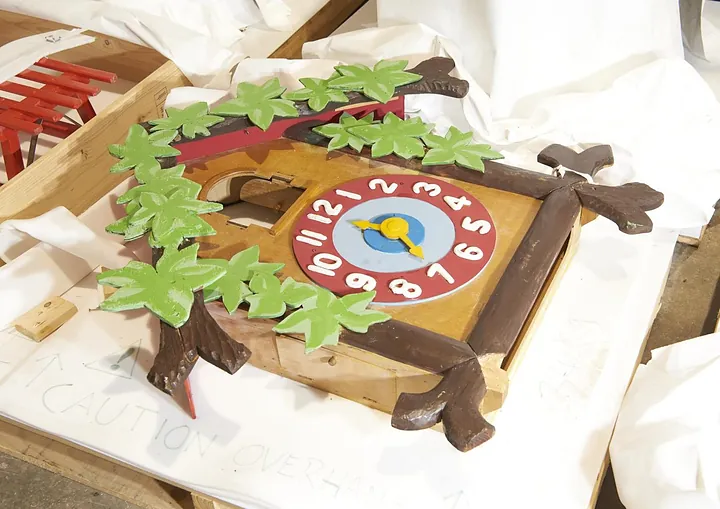
The clock from BBC children's television series 'Playschool', c 1977
Science Museum Group, London