
Beginner · Lesson 3 of 10 · 14 min read
Reading a movement: plates, bridges, jewels and winding
A practical tour of what you see when you open a watch: the mainplate and bridges, the train, the balance cock, the jewels and the winding work — and what each tells a researcher.
By the end of this lesson you will be able to:
- Identify the mainplate, bridges and balance cock
- Explain what jewels do and why jewel counts changed
- Distinguish key winding from keyless winding
Opening the case back of a watch reveals the movement. At first sight it can look like a jumble of brass and steel, but its layout follows a logic that has changed surprisingly little since the eighteenth century. Learning to read it is the first step in identifying, dating and describing a watch.
The frame: mainplate, pillars and bridges
Every movement has a frame that holds the wheels' pivots in alignment. In older English and Continental watches this is a full-plate construction: two round plates held apart by pillars, with the wheels sandwiched between. From the late eighteenth century, French makers — Jean-Antoine Lépine is the name most associated with the change — replaced the upper plate with separate bars or bridges, allowing thinner watches. Most modern movements use a mainplate (on the dial side) and a set of bridges.
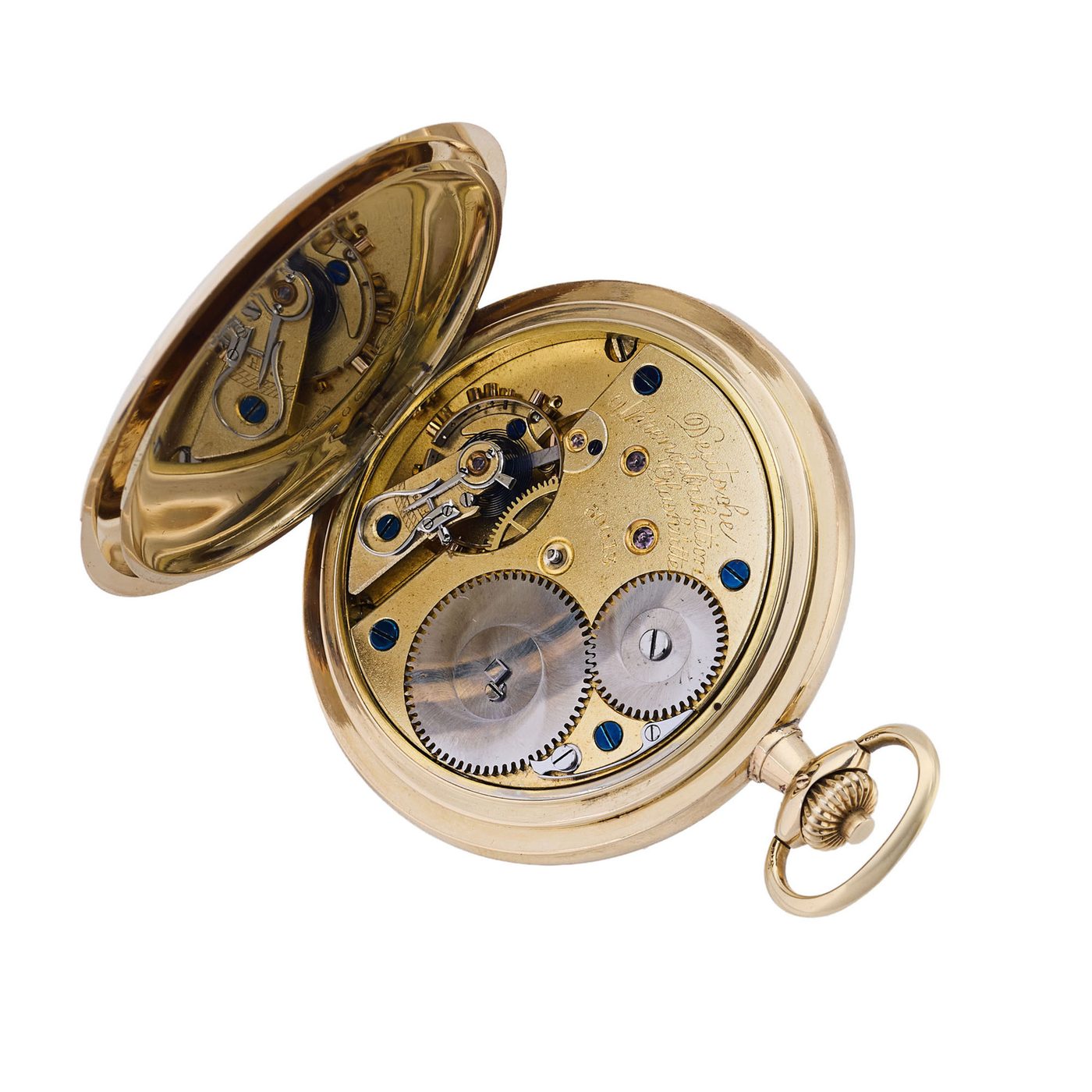
The balance cock
The balance is usually mounted under its own small bridge, the balance cock. On eighteenth-century English watches the cock was often a large, pierced and engraved table — a favourite of collectors, and sometimes removed and sold separately as jewellery. The cock frequently carries the regulator, an index that changes the effective length of the balance spring to make the watch run faster or slower.
Jewels
Jewels are bearings made of hard stone — originally natural ruby or sapphire, and since the early twentieth century almost always synthetic corundum. They reduce friction and wear where steel pivots turn. The technique of piercing jewels for watch bearings was introduced in London in the early 1700s by Nicolas Fatio de Duillier with Peter and Jacob Debaufre. For much of the nineteenth and twentieth centuries a 'fully jewelled' lever watch had about 15 to 17 jewels; higher counts can be meaningful (cap jewels, automatic winding) or purely promotional.
Winding and setting
Until the mid-nineteenth century most watches were wound and set with a separate key, through holes in the dial or case back. Keyless (stem) winding — using a crown on the pendant — was developed in several forms in the 1830s–40s; Adrien Philippe's 1845 system, later used by Patek Philippe, was among the most influential. By the 1880s keyless watches were common, though cheaper key-wound watches continued to be made for some years.
| Feature | What it suggests | Caution |
|---|---|---|
| Full plate with pierced balance cock and fusee chain | English or Continental work, c. 1700–1850 | Some English makers kept this style late in the 19th century |
| Bars or bridges, no fusee | French or Swiss influence, from the late 18th century | Very common in later Swiss watches of all qualities |
| Keyless winding with crown | Generally after c. 1850 | Early keyless systems exist from the 1830s–40s |
| Lever escapement, 15–17 jewels | Good-quality watch, late 19th–20th century | Count the jewels yourself |
| Rotor over the movement | Self-winding wristwatch, generally after c. 1930 | Earlier self-winding systems exist (pedometer weights, 18th century) |
Signatures and numbers
Most movements carry a name and a serial number, usually on the top plate or a bridge. The name may belong to the maker, the retailer or a finisher, and the number may be the movement maker's, the retailer's, or neither. Record exactly what is engraved, in what position, and how — the evidence is the inscription itself, not the assumption made from it.
- Photograph the movement straight on and at an angle.
- Transcribe every signature and number exactly.
- Note the frame type, the escapement and the winding system.
- Only then compare with reference works.
Practise
Open the movement anatomy explorer →
See it in the collection
Look at watch movements in the catalogue →
Check your understanding
Lesson quiz
0 of 4 answered