
Beginner · Lesson 4 of 10 · 13 min read
Mechanical, electric and quartz: how timekeeping went electronic
From battery electric clocks and tuning-fork watches to the quartz crystal oscillating at 32,768 Hz — and why mechanical watches survived the quartz revolution.
By the end of this lesson you will be able to:
- Explain how a quartz watch keeps time
- Place electric, tuning-fork and quartz timekeepers in sequence
- Compare typical accuracy of mechanical and quartz watches
For three centuries, the best timekeepers were mechanical. In the twentieth century three electrical technologies overtook them: electrically maintained pendulums, tuning forks and quartz crystals. Each kept the logic of oscillator-plus-counter, but replaced springs, wheels or both with electricity.
Electric clocks
Nineteenth-century inventors, among them Alexander Bain, used electricity to impulse pendulums and to drive networks of 'slave' dials from a single master clock. In the twentieth century the free-pendulum clock of William Hamilton Shortt (1920s) — a master pendulum that did almost no work, synchronised with a slave clock — became the most accurate mechanical timekeeper in observatories, until quartz replaced it.
Tuning-fork watches
Bulova's Accutron, introduced in 1960 and based on work by the Swiss engineer Max Hetzel, replaced the balance with a small tuning fork vibrating at 360 Hz, kept in motion by a transistor circuit. A tiny pawl on the fork drove an index wheel with very fine teeth. The result was a famous hum and an accuracy, guaranteed at about a minute a month, far beyond ordinary mechanical watches.
Quartz
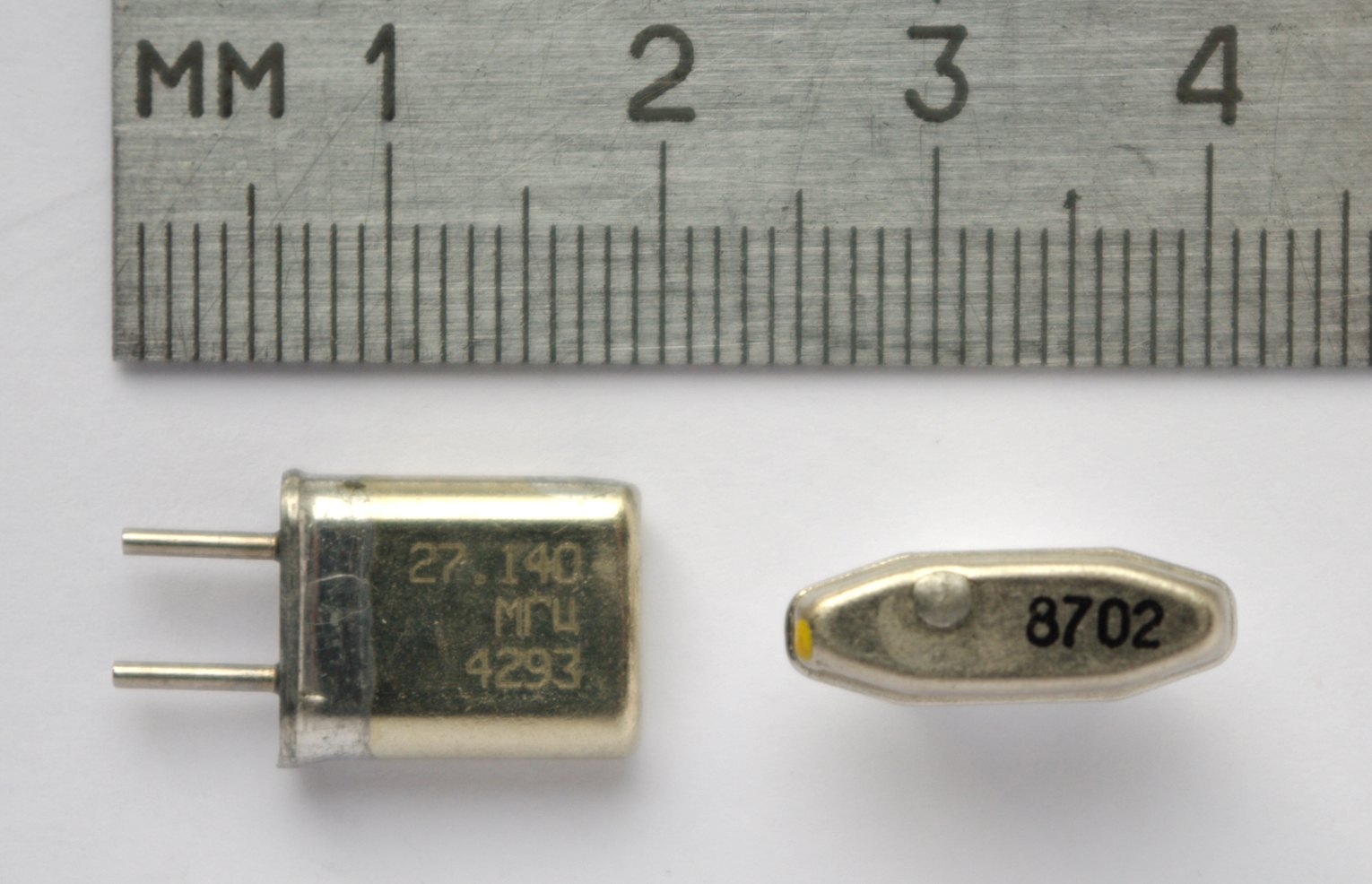
Quartz is piezoelectric: squeezed, it produces a voltage; given a voltage, it flexes. Cut to the right shape, a quartz crystal vibrates at a very stable frequency when driven by an electronic circuit. Laboratory quartz clocks appeared in the late 1920s. In a watch, a tiny tuning-fork-shaped crystal usually vibrates at 32,768 Hz — 2 to the power of 15 — so that a chain of fifteen divide-by-two circuits produces exactly one pulse per second to drive a stepping motor or a digital display.
Seiko's Quartz Astron, sold in Tokyo on 25 December 1969, was the first quartz wristwatch on the market. Swiss and American prototypes followed closely, and within fifteen years quartz movements had become cheap enough to transform the industry, closing many traditional factories in what the Swiss call the 'quartz crisis'.
| Type | Typical rate | Notes |
|---|---|---|
| Good mechanical watch | A few seconds to tens of seconds per day | Depends on position, temperature, state of wind and service |
| Certified chronometer (mechanical) | −4 to +6 s/day in testing | COSC / ISO 3159 test criteria for mechanical movements |
| Tuning-fork watch (Accutron 214) | About 1 minute per month | Manufacturer's guarantee |
| Ordinary quartz watch | About ±15 s per month | Much better in thermocompensated or radio-controlled models |
- Electric clocks: electricity maintains a pendulum or distributes time to slave dials.
- Tuning fork: a 360 Hz fork replaces the balance (Accutron, 1960).
- Quartz: a 32,768 Hz crystal and electronic divider (Astron, 1969).
- Atomic: caesium-133 defines the SI second (since 1967); radio-controlled clocks receive it.
Inside a quartz watch
A typical quartz watch has a tiny tuning-fork-shaped crystal that vibrates 32,768 times a second. That number is 2 to the power of 15, so fifteen halving stages in the circuit produce exactly one pulse a second. Each pulse turns a stepping motor, usually of the Lavet type, which moves the seconds hand on. A battery generally lasts about two to five years; the commonest causes of failure are battery leakage and dirt in the small gear train.
From battery to LED and LCD
The Hamilton Electric 500 of 1957 was the first battery-powered wristwatch, still using a balance but impulsed by a coil. Quartz followed in 1969, the Swiss Beta 21 movement in 1970, the Hamilton Pulsar light-emitting-diode watch in 1972 and Seiko's six-digit liquid-crystal display in 1973. These early electronic watches are now collected as milestones in their own right.
- Check for battery leakage: corrosion can destroy a module.
- Ask whether the movement or module is the original type; replacement parts for early models are scarce.
- On early digital watches, check that every segment of the display works.
Practise
Read the quartz and atomic entries in the glossary →
See it in the collection
See quartz-era objects →
Check your understanding
Lesson quiz
0 of 4 answered