
Beginner · Lesson 1 of 10 · 12 min read
The four parts of every mechanical timekeeper
A church turret clock, a Georgian pocket watch and a modern automatic wristwatch all solve the same problem with the same four building blocks: power, transmission, regulation and display.
By the end of this lesson you will be able to:
- Name the four functional groups of a mechanical clock or watch
- Explain why an escapement is needed at all
- Trace the path of energy from the power source to the hands
It is easy to be overwhelmed by the sheer number of parts in a watch movement — a simple hand-wound calibre has well over a hundred, a grand complication more than a thousand. The good news is that every mechanical timekeeper, from the iron-framed turret clocks of the fourteenth century to a modern automatic chronograph, is organised around the same four jobs. Once you can recognise them, any movement becomes readable.
1. A store of energy
A clock or watch needs a supply of energy that can be released slowly over hours or days. In clocks this is usually a falling weight on a cord or chain, or a coiled steel mainspring. Weights give a steady, unchanging force but need height and a stable position, which is why they suit longcase, wall and turret clocks. A spring is compact and works in any position, which made portable clocks and watches possible from the fifteenth century onwards — but its force falls as it unwinds, a problem that shaped centuries of design (see the lesson on constant force).
2. A train of wheels
The energy store turns far too slowly and with far too much force to drive the hands directly. A gear train — a series of large wheels driving small pinions — steps the speed up and the force down. In a typical watch the barrel drives the centre wheel (which turns once an hour and carries the minute hand), then the third wheel, the fourth wheel (often turning once a minute and carrying the seconds hand) and finally the escape wheel. The ratios of the train decide how long the watch runs on one winding and how fast the escape wheel turns.
3. A regulator: oscillator plus escapement
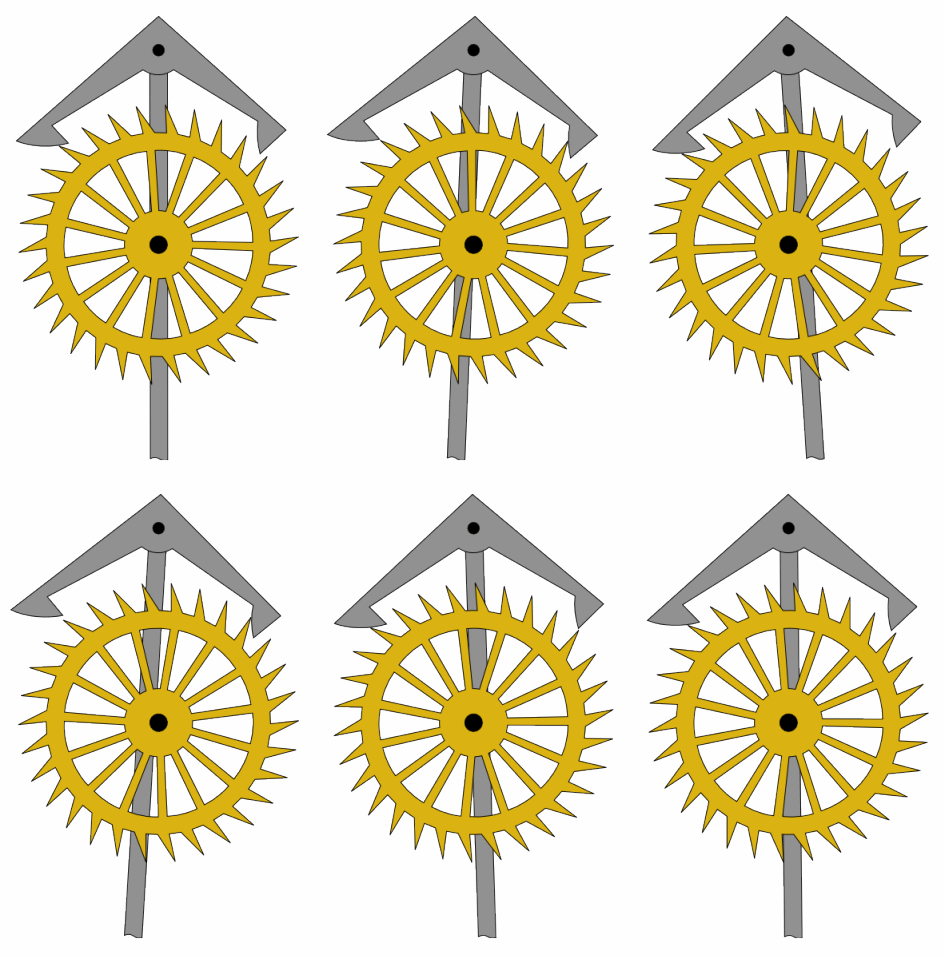
Left to itself, a wound spring would spin the train in a fraction of a second. Something must hold the train back and let it advance only in small, equal steps. That is the job of the escapement, working together with an oscillator — a pendulum in most clocks, a balance wheel in watches and portable clocks, or a foliot in the earliest mechanical clocks. The oscillator swings back and forth at a (nearly) constant rate; the escapement locks the train, releases it by one tooth on each swing, and gives the oscillator a small push (the impulse) to keep it going.
This two-way relationship is the heart of horology. The train feeds energy to the oscillator through the escapement; the oscillator, in return, decides how fast the train may move. The better the oscillator is isolated from variations in that energy, the better the timekeeping — which is why so much of horological history is the story of better escapements.
4. A display
Finally, the motion of the train must be shown. Most timepieces use a dial with hands; the motion work, a small set of wheels under the dial, gives the 12-to-1 reduction between the minute hand and the hour hand. Some of the earliest public clocks had no dial at all and simply struck a bell, and many later clocks combine a dial with striking or chiming. Digital displays, jump hours and retrograde hands are all alternative ways of showing the same information.
| Function | Turret clock (c. 1400) | Pocket watch (c. 1780) | Automatic wristwatch (c. 2000) |
|---|---|---|---|
| Energy | Falling weight on a rope | Mainspring in a barrel, often with a fusee | Mainspring wound by a rotor |
| Transmission | Wrought-iron wheels and lantern pinions | Brass wheels, steel pinions | Brass wheels, steel pinions, jewelled pivots |
| Regulation | Verge and foliot | Verge or cylinder with balance and hairspring | Lever escapement with balance and hairspring |
| Display | Bell, later a single hour hand | Enamel dial, hour and minute hands | Hours, minutes, centre seconds, date |
Putting it together
- Find the energy: look for the weight, or for the barrel — usually the largest wheel in a watch.
- Follow the train: from the barrel, each wheel drives the pinion of the next.
- Find the regulator: the escape wheel is the last wheel of the train; next to it is the escapement and the oscillator.
- Find the display: hands on the front, with the motion work hidden beneath the dial.
Everything else in a movement — keyless winding, shock protection, calendars, chronographs, striking — is added on to these four core systems. Keep them in mind as you work through the rest of the Academy.
Practise
Try the gear-train calculator in the Lab →
See it in the collection
See movements in the catalogue →
Check your understanding
Lesson quiz
0 of 4 answered