
Beginner · Lesson 2 of 10 · 15 min read
Oscillators: pendulums, balances and beats
Why a swinging weight or a spring-loaded wheel keeps time, how Huygens transformed both in the 1650s–70s, and how to read beat rates such as 18,000 or 28,800 vibrations per hour.
By the end of this lesson you will be able to:
- Explain why a pendulum's period depends on its length
- Describe the role of the balance spring
- Convert between vibrations per hour and hertz
An oscillator is anything that repeats a motion at a regular rate. The first mechanical clocks used a foliot or balance with no spring of its own: it swung only because the escapement pushed it back and forth, so its rate depended heavily on the driving force. The decisive improvement came when horologists harnessed oscillators with a natural period of their own — the pendulum and the sprung balance.
The pendulum
Galileo Galilei studied the regular swing of pendulums and, late in life, sketched a pendulum-controlled escapement, but the first working pendulum clock was designed by the Dutch scientist Christiaan Huygens in 1656 and built under his 1657 patent by the Hague clockmaker Salomon Coster. Within a few years pendulum clocks had improved typical clock accuracy from perhaps a quarter of an hour a day to a minute or less.
For small swings, a simple pendulum's period depends almost only on its length and on the strength of gravity: T = 2π√(L/g). A pendulum that takes one second for each swing (two seconds for a full there-and-back cycle) is just under a metre long — about 0.994 m — and became the classic 'seconds pendulum' of longcase clocks and observatory regulators.
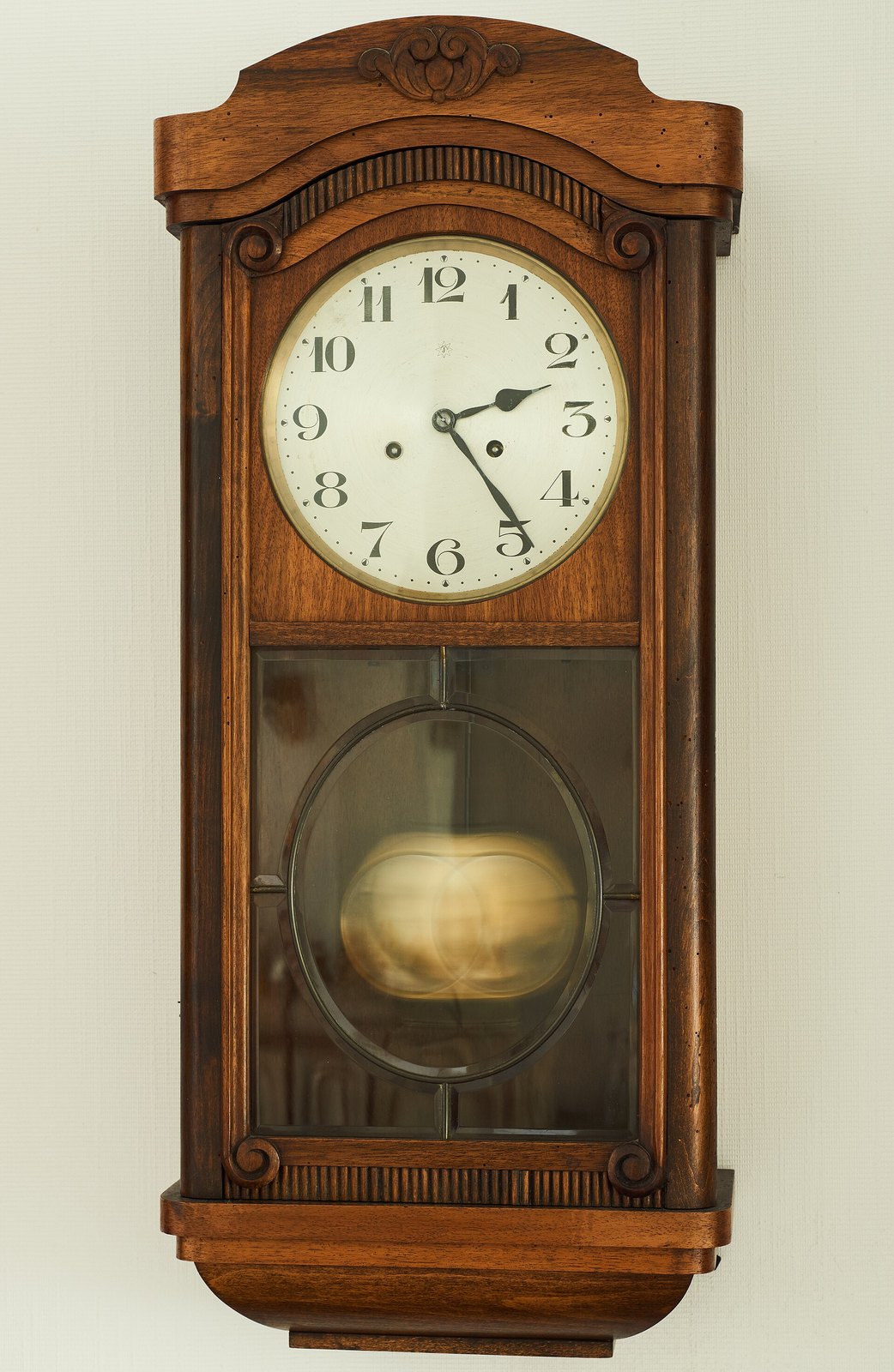
Two complications matter in practice. First, real pendulums are not perfectly isochronous: wide swings take slightly longer than narrow ones (circular error), which is one reason precision clocks keep the arc small. Second, metal rods expand with heat, lengthening the pendulum and slowing the clock. George Graham's mercury pendulum (1720s) and John Harrison's gridiron pendulum (1720s) were the classic solutions, later replaced in precision clocks by Invar rods.
The balance and balance spring
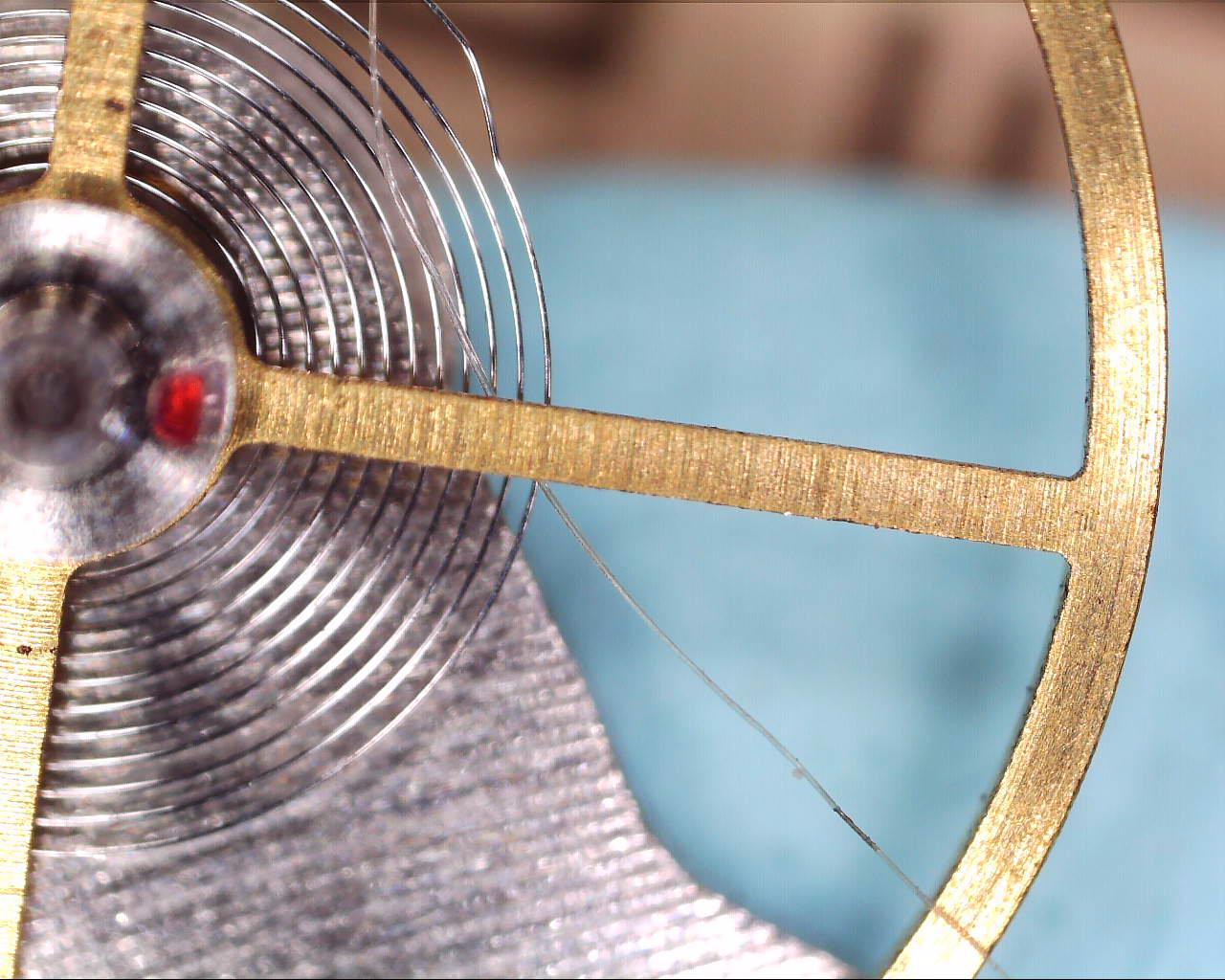
A pendulum needs a fixed, upright position, so it is useless in a pocket. A balance — a wheel that rotates back and forth — can work in any position, but without a spring it has no natural period. In 1675 Huygens published the spiral balance spring (hairspring), which gives the balance a restoring force and a natural rhythm. Robert Hooke disputed priority, and the two men's claims are still debated; what is certain is that within a few years English and French watchmakers adopted the spring, and watch errors fell from many minutes a day to a few.
Beats, vibrations and hertz
Watch rates are usually given in vibrations (also called beats or half-oscillations) per hour. Each swing in one direction is one vibration; a full oscillation is two. Dividing vibrations per hour by 7,200 gives the frequency in hertz.
| Vibrations per hour | Beats per second | Frequency | Typical use |
|---|---|---|---|
| 14,400 | 4 | 2 Hz | Many 18th- and 19th-century watches, some clocks |
| 18,000 | 5 | 2.5 Hz | Most watches until the 1960s |
| 21,600 | 6 | 3 Hz | Many mid-century and modern calibres |
| 28,800 | 8 | 4 Hz | Most modern Swiss automatic calibres |
| 36,000 | 10 | 5 Hz | High-beat calibres such as the Zenith El Primero |
A faster balance is less disturbed by shocks and changes of position, which helps accuracy, but it uses more energy and increases wear — a trade-off that every movement designer must weigh.
- Pendulum: period set by length and gravity; needs to be upright and still.
- Balance with spring: period set by the balance's inertia and the spring's stiffness; works in any position.
- Both: the escapement only tops up their energy — the less it interferes, the better the timekeeping.
Practise
Experiment with the pendulum and balance simulators →
See it in the collection
Browse pendulum clocks →
Check your understanding
Lesson quiz
0 of 5 answered