
Intermediate · Lesson 4 of 7 · 15 min read
Accuracy and error: temperature, position and isochronism
Why watches gain and lose, how horologists measured and corrected errors, and what a 'chronometer' certificate actually means.
By the end of this lesson you will be able to:
- Name the main sources of timekeeping error
- Explain the compensation balance and Guillaume's alloys
- Interpret rate, amplitude and beat error
A timekeeper is only as good as its oscillator's stability. Any influence that changes the oscillator's period — heat, position, force, magnetism, wear — shows up as a gain or loss. Horology's great precision makers spent their careers identifying these influences and neutralising them one by one.
Temperature
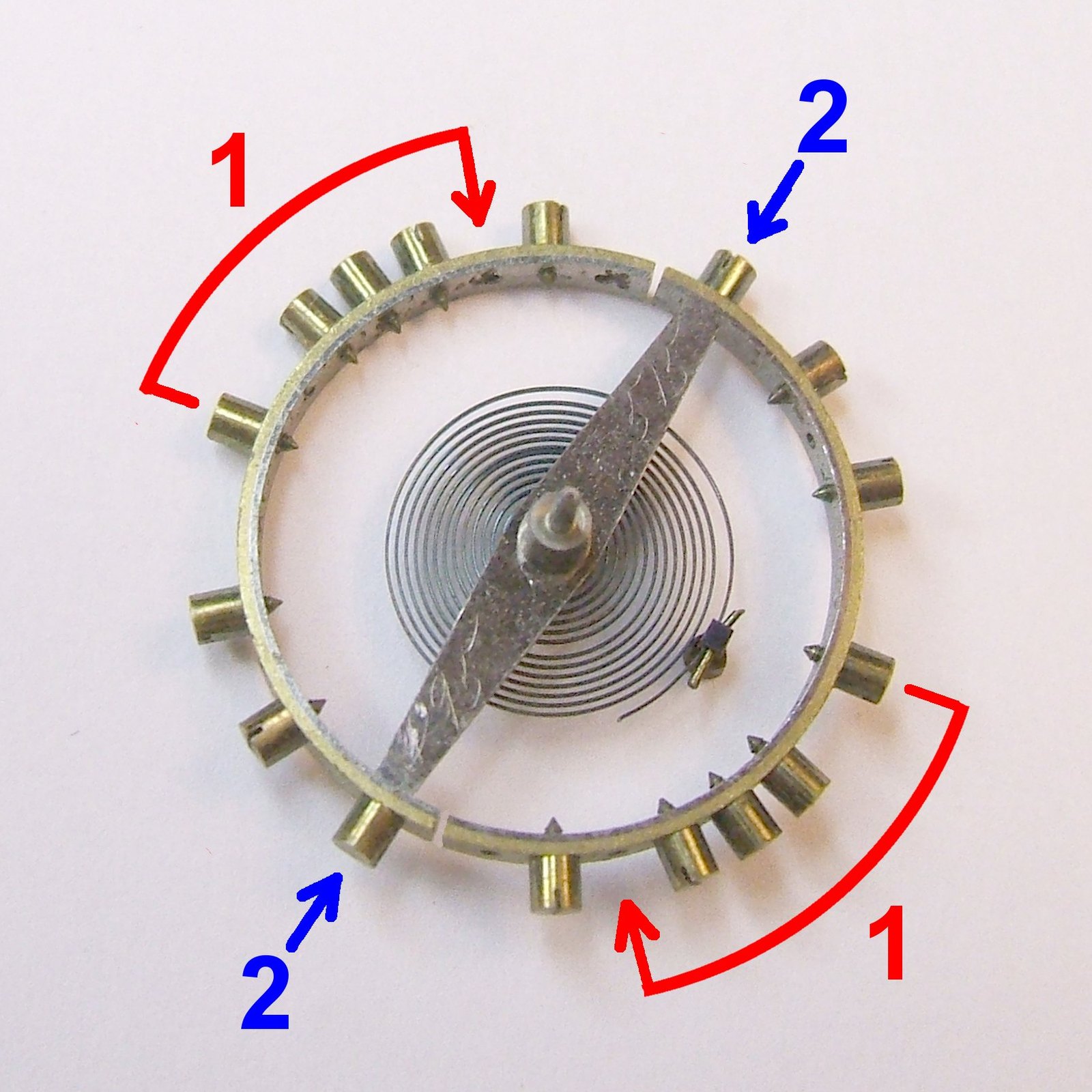
Heat lengthens pendulum rods, enlarges balances and weakens balance springs; all make a timekeeper run slow. For pendulums, Graham's mercury and Harrison's gridiron compensated by expanding upwards as the rod expanded downwards. For balances, the bimetallic cut compensation balance — brass and steel rims that curl inwards when warm — was developed by Arnold and Earnshaw in the late eighteenth century. In 1896 Charles-Édouard Guillaume discovered Invar, a nickel-steel with almost no expansion, followed by Elinvar, whose elasticity barely changes with temperature; he received the Nobel Prize in Physics in 1920.
Position
A balance whose weight is not perfectly centred (out of poise) behaves differently depending on whether the watch is lying flat or hanging. Fine watches are 'adjusted to positions' — commonly five: dial up, dial down and three vertical positions. The tourbillon was one answer; careful poising and better springs are the usual one.
Isochronism
An ideal oscillator keeps the same period whether its swing is wide or narrow. A balance spring alone does not quite do this. Breguet's overcoil (raising the last turn of the spring) and the terminal curves worked out mathematically by Édouard Phillips in the 1860s help the spring breathe concentrically and improve isochronism.
| Measure | Meaning | Typical healthy value |
|---|---|---|
| Rate | Seconds gained or lost per day | Within a few seconds for a fine watch |
| Amplitude | How far the balance swings, in degrees | Often around 270–310° dial-up when fully wound |
| Beat error | Asymmetry between the two halves of each swing, in ms | Ideally below about 1 ms |
Testing and certificates
From the nineteenth century, observatories in Neuchâtel, Geneva, Kew and elsewhere ran timing trials and published results, creating a competitive culture of precision. Today the Swiss COSC tests movements over fifteen days in five positions and three temperatures; a mechanical movement that passes, with an average daily rate between −4 and +6 seconds, may be called a chronometer.
Magnetism
A steel balance spring that becomes magnetised — near a loudspeaker, an electric motor or a magnetic clasp — sticks to itself, and the watch suddenly gains minutes a day. Watchmakers can demagnetise it in seconds. Manufacturers responded in two ways: soft-iron inner cases that screen the movement, as in the IWC Ingenieur (1955) and the Rolex Milgauss (1956), and non-magnetic materials, from the Nivarox balance-spring alloys of the 1930s to silicon balance springs introduced in the 2000s.
Measuring rate, amplitude and beat
A timing machine listens to the ticks through a microphone. It reports the rate in seconds per day; the amplitude, the angle of the balance's swing, calculated from the time between the escapement's noises and the lift angle the user enters; and the beat error in milliseconds, the difference between the two halves of the swing. A healthy modern lever watch, fully wound and dial up, typically shows an amplitude of around 270–310 degrees; a low amplitude often means the watch needs cleaning and oiling.
Steady rate matters more than zero rate
A watch that gains exactly five seconds every day is easy to correct; one that gains five seconds one day and loses five the next is not. That is why chronometer standards judge the stability of the rate as well as its size. The Swiss COSC test, for example, runs movements for fifteen days in five positions and three temperatures and requires an average daily rate within −4 to +6 seconds for movements of 20 mm and more.
- Keep a watch wound: amplitude falls as the mainspring runs down.
- Note its position overnight; lying dial up or crown down can offset a gain or loss.
- Avoid strong magnets and shocks.
- Have it serviced when the rate becomes erratic: old oil is a common cause.
Practise
Work through the rate and beat calculators →
See it in the collection
Explore precision-era objects →
Check your understanding
Lesson quiz
0 of 4 answered