
Intermediate · Lesson 6 of 7 · 15 min read
Striking and repeating: how clocks and watches sound the time
Before most people owned a timepiece they could read, they heard the time. This lesson explains count-wheel and rack striking, chimes, grande and petite sonnerie, and the repeating watch that strikes the time on demand.
By the end of this lesson you will be able to:
- Explain the difference between count-wheel and rack striking
- Describe quarter chimes and the Westminster chime
- Distinguish grande sonnerie, petite sonnerie and repeaters
- Identify striking work in photographs and catalogue descriptions
The earliest mechanical clocks in medieval Europe were as much about sound as sight. Many had no dial at all: their purpose was to ring a bell at the hours so that a monastery, a town or a cathedral could keep its timetable. Striking — sounding the hours automatically — remained one of the main jobs of clocks for centuries, and the mechanisms that do it are some of the most ingenious in horology.
The striking train
A striking clock has two (or more) trains of wheels. The going train keeps time; the striking train, with its own weight or spring, lifts and drops a hammer onto a bell or gong. Normally the striking train is locked. Once an hour a pin on the going train lifts a lever that releases it; the train runs, the hammer strikes, and a counting device decides when to lock it again after the right number of blows.
The count wheel (locking plate)
The older counting device is the count wheel, a disc with notches around its edge spaced to match the numbers 1 to 12. A detent rides on the rim and drops into the next notch when the right number has been struck. A clock striking the hours gives 78 blows in twelve hours (1 + 2 + … + 12), so the wheel is divided accordingly. The weakness is that the count wheel works in sequence: if the hands are moved without letting the clock strike, it falls out of step and strikes the wrong hour until corrected.
Rack striking
Rack striking, introduced in England in the 1670s and usually credited to Edward Barlow, counts from the time itself. A stepped cam, the snail, turns with the hour hand. When the clock is released, a toothed rack falls until its tail meets the snail; the deeper the step, the further the rack falls and the more teeth it must be gathered back, one per blow. The clock therefore always strikes the hour shown by the hands, and the mechanism can be made to repeat on demand. Rack striking became standard in English clocks and was essential for repeating work.
| Count wheel | Rack and snail | |
|---|---|---|
| Counts from | Its own notched sequence | A snail turning with the hour hand |
| If the hands are moved | Can strike the wrong hour until corrected | Always strikes the hour shown |
| Can repeat on demand | No | Yes |
| Typical use | Early clocks, many French and American clocks | English bracket and longcase clocks from the late 17th century; repeaters |
Quarters and chimes
Quarter-striking clocks add a third train that sounds the quarters, either as a sequence of blows (ting-tang on two bells) or as a tune on several bells. The most famous quarter chime was composed in 1793 for the church of Great St Mary in Cambridge and adopted for the Great Clock of Westminster in 1859; it is now known worldwide as the Westminster chime. Musical and chiming clocks with eight bells or more were made in large numbers in eighteenth-century London and in Black Forest and American factories later.
Grande and petite sonnerie
In continental terminology, a clock or watch in grande sonnerie strikes the quarters and repeats the hour at every quarter, so you know the full time every fifteen minutes. In petite sonnerie it strikes the hour only at the hour and the quarters alone at the quarters. Grande sonnerie uses a great deal of energy, and in a watch it is among the most demanding complications to make; many have a switch to choose between grande, petite and silence.
Repeating watches and clocks
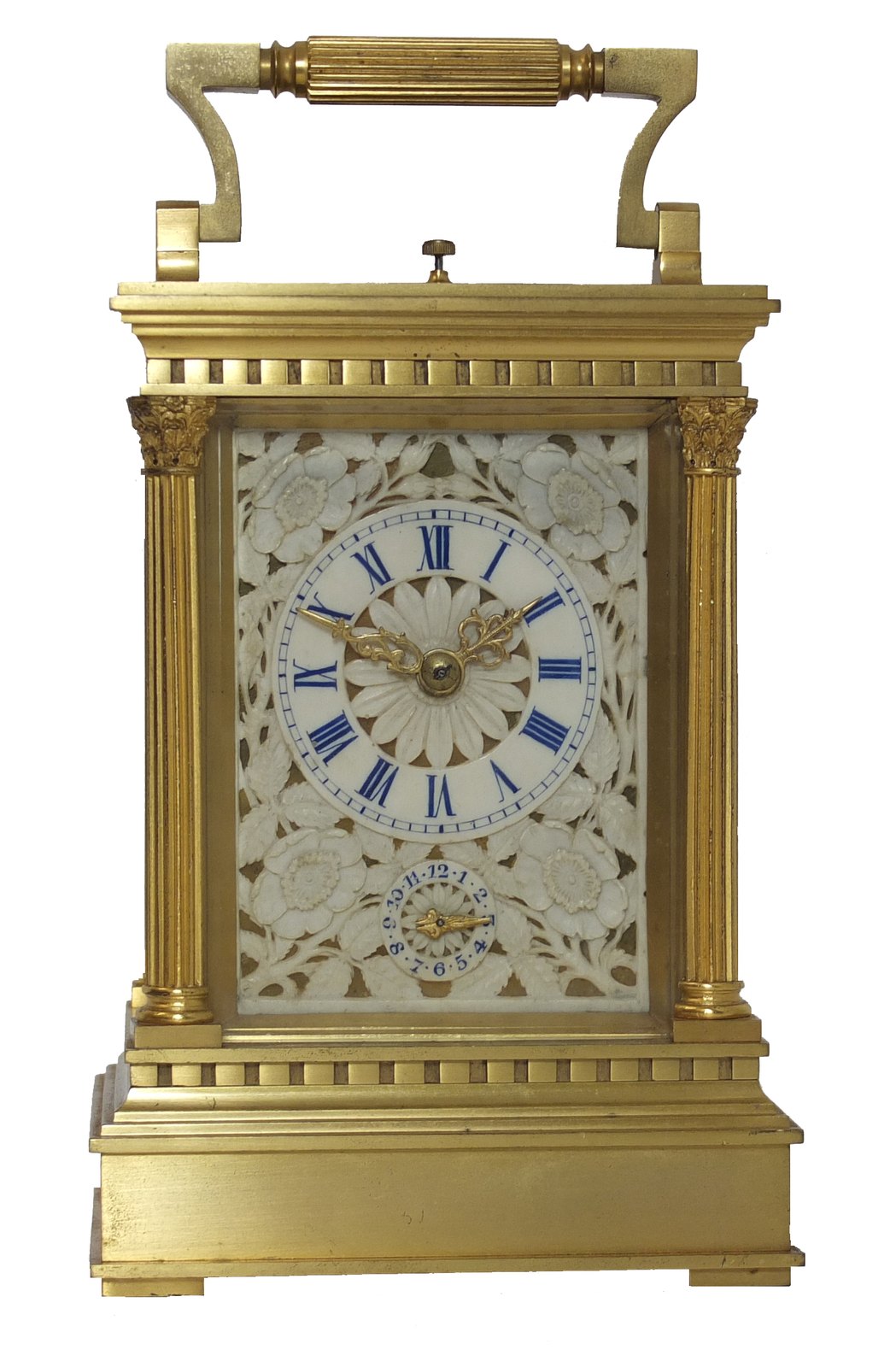
A repeater strikes the time only when asked — by pulling a cord on a clock, or by pressing a pendant or sliding a bolt on a watch. In the 1680s both Edward Barlow and Daniel Quare made repeating watches; when Barlow sought a patent in 1687, Quare demonstrated his own, simpler version to King James II and the Privy Council, and the patent was refused. Early repeaters struck the hours and quarters on a bell inside the case. Quarter repeaters were followed by half-quarter, five-minute and, from the later eighteenth century, minute repeaters, though minute repeaters remained rare until the nineteenth century. Coiled wire gongs, which allowed much thinner cases than bells, came into use in the late eighteenth century and are often credited to Breguet.
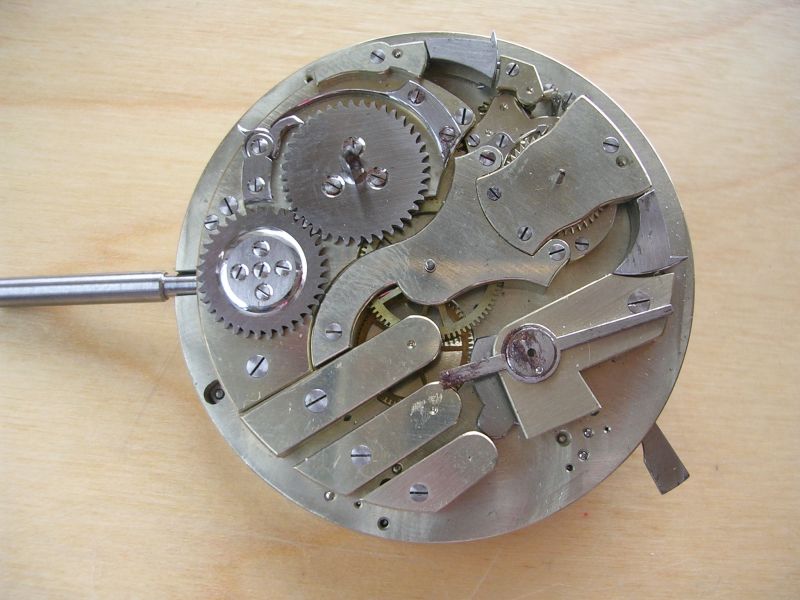
A minute repeater strikes in three groups: hours on a low gong, quarters as double blows on both gongs (high-low), then the minutes past the last quarter on a high gong. At 10:49 it strikes ten low blows, three double blows and four high blows. A governor — a small fan or a silent centrifugal regulator — keeps the striking at an even pace. The mechanism has to 'read' the hands at the moment it is set off, using snails for the hours, quarters and minutes, and an 'all-or-nothing' piece prevents it striking a wrong time if the slide is not pushed fully home.
- A striking clock has a separate striking train with its own power.
- Count wheels strike in sequence; rack striking counts from a snail on the hour wheel.
- Grande sonnerie repeats the hour at every quarter; petite sonnerie does not.
- Repeaters strike only on demand; minute repeaters use three groups of blows.
- In a catalogue, look for words such as 'strike/silent', 'pull repeat', 'quarter repeating' and 'à toc' (dumb repeating).
Practise
Hear a minute repeater in the Lab →
See it in the collection
Find repeating watches in the catalogue →
Check your understanding
Lesson quiz
0 of 4 answered