
Intermediate · Lesson 2 of 7 · 14 min read
Power and constant force: mainsprings, fusees and remontoires
A spring gives less force as it runs down. Horologists answered with the fusee, stopwork, maintaining power and the remontoire — each a different way of feeding the escapement evenly.
By the end of this lesson you will be able to:
- Explain why mainspring torque varies
- Describe how a fusee equalises force
- Distinguish maintaining power from a remontoire
A mainspring stores energy by being coiled tightly inside a barrel. Fully wound, it pushes hard; nearly run down, it pushes weakly. Because early escapements passed this variation straight to the oscillator, a watch tended to run fast when freshly wound and slow later in the day. Much of early horological ingenuity went into evening out that force.
The fusee
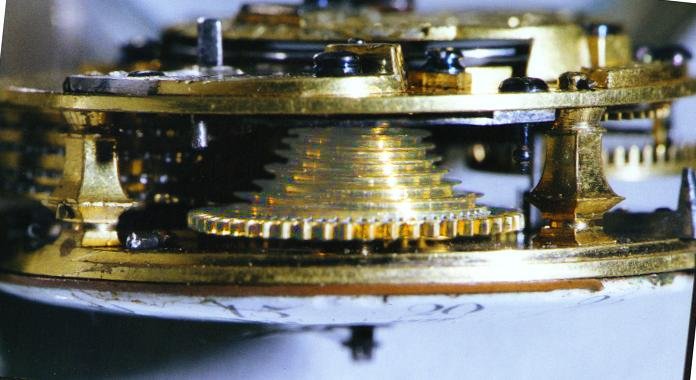
The fusee is a cone-shaped pulley with a spiral groove, linked to the mainspring barrel by a gut line or, from the seventeenth century, a fine steel chain. When the spring is fully wound, the chain pulls on the narrow end of the cone (small leverage); as the spring weakens, it pulls on progressively wider parts (more leverage). The result is a nearly constant torque at the train. Fusees appear in illustrations and clocks from the fifteenth century and remained standard in English watches and marine chronometers well into the nineteenth century.
The going barrel and stopwork
The alternative is to let the barrel itself drive the train — the going barrel — and to use only the middle, most even part of the spring's range. Stopwork, such as the Maltese-cross or 'Geneva stop', prevents the spring being wound fully or run completely down. As escapements became less sensitive to force (the lever in particular), and as springs improved, the going barrel replaced the fusee in most watches.
Maintaining power
While a fusee clock or watch is being wound, the driving force is removed, and the timepiece can stop or even run backwards. Maintaining power keeps the train driven during winding. John Harrison's 'going ratchet', an auxiliary spring that takes over for the few moments of winding, became standard in English fusee watches, chronometers and regulators.
The remontoire
A remontoire goes further: the mainspring or weight rewinds a small secondary spring (or lifts a small weight) at regular intervals, and only that secondary source drives the escapement. Whatever happens upstream, the escapement sees the same small, rewound force. Remontoires appear in turret clocks, precision clocks and a few watches; Harrison used one in his marine timekeepers.
| Solution | Principle | Typical use |
|---|---|---|
| Fusee | Variable leverage compensates falling spring torque | Verge watches, English lever watches, marine chronometers |
| Stopwork | Uses only the middle part of the spring's range | Going-barrel watches and clocks |
| Maintaining power | Keeps the train driven during winding | Fusee watches, chronometers, regulators |
| Remontoire | Rewinds a small secondary spring that drives the escapement | Turret clocks, precision clocks, some fine watches |
| Detached escapement | Makes the oscillator less sensitive to force | Lever watches |
Power reserve and winding
Most mechanical wristwatches run for about 40 to 80 hours on a full wind, and many pocket watches for about a day and a half, which is why they were wound every day. An up-and-down indicator shows how much power is left. Self-winding, usually attributed to Abraham-Louis Perrelet in the 1770s for pocket watches, uses a weight that swings as the wearer moves; John Harwood's wristwatch system of the 1920s and the later full rotor made it practical for everyday wear.
Weights and maintaining power in clocks
A falling weight gives almost perfectly constant force, so weight-driven clocks did not need a fusee; their difficulties were friction, thickening oil and the moment of winding. Huygens's endless cord drove the clock during winding, and English regulators used bolt-and-shutter maintaining power, in which raising a shutter to reach the winding square also sets a small spring pushing on the train.
| Timepiece | Usual running time |
|---|---|
| Thirty-hour longcase clock | About a day (wound daily) |
| Eight-day longcase or bracket clock | About a week |
| Key-wound pocket watch | About 30–36 hours |
| Modern mechanical wristwatch | About 40–80 hours |
| Eight-day watch movements | About eight days |
Check your understanding
Lesson quiz
0 of 4 answered