
Component
Stopwork (Geneva stop)
Also known as: Maltese cross · Malteserkreuz · Croix de Malte
How it works
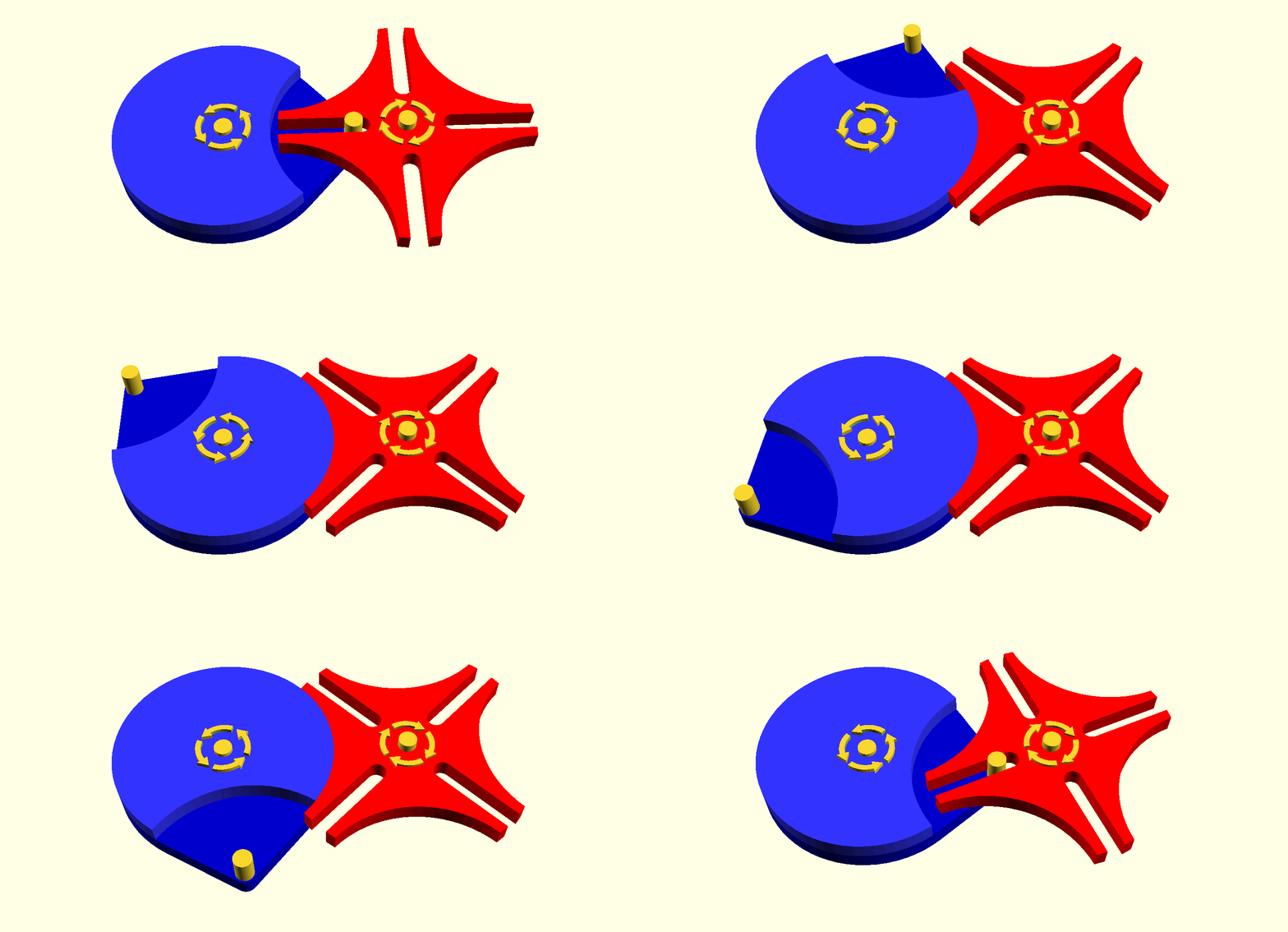
A finger on the barrel arbor engages a star wheel shaped like a Maltese cross, allowing only a fixed number of turns before the cross locks. It limits winding to the middle, most even part of the mainspring's range.
Why it was invented
It prevents over-winding and avoids the extremes of torque at the start and end of the spring's run.
- Invented
- 17th century
- Credited to
- No single inventor documented
- Historical period
- Early Modern Horology
History and development
Geneva-style stopwork was common on 18th- and 19th-century going-barrel watches and survives in some modern high-grade movements; the cross motif later became the emblem of Vacheron Constantin.
A typical Geneva stop has a finger wheel with a single tooth fixed to the barrel arbor and a star wheel with four open slots and one closed arm on the barrel. Each turn of the arbor moves the star on by one slot; when the closed arm comes round the finger can go no further, so the mainspring can be wound only by a set number of turns — usually about four — and is stopped again before it runs right down.
Stopwork became less necessary as mainsprings improved and as going barrels replaced the fusee. In self-winding watches its job is done differently: the mainspring is attached to a slipping bridle that slides round the barrel wall when the spring is fully wound, so the rotor can keep turning without damage. The same intermittent-motion geometry, known to engineers as the Geneva drive, later advanced the film in cinema projectors.
The Maltese cross became Vacheron Constantin's trade mark in 1880, a reminder of how familiar the part was to Geneva watchmakers.
How to recognise it
- A small five-armed star wheel (the 'Maltese cross') and a one-fingered wheel on the barrel cover or arbor, visible on the barrel of many 18th- and 19th-century going-barrel watches.
- Fusee watches stop differently: a hinged stop iron on the top plate catches a hook on the fusee when it is fully wound.
Names in other languages
| English | Français | Deutsch | Italiano | Español |
|---|---|---|---|---|
| Stopwork | Arrêtage | Stellung (Malteserkreuz) | — | — |
From the Atlas glossary; French and German follow trade usage, Italian and Spanish await specialist review.
Related mechanisms
Further reading
In the Academy
- Power and constant force: mainsprings, fusees and remontoires
14 min · A spring gives less force as it runs down. Horologists answered with the fusee, stopwork, maintaining power and the remontoire — each a different way of feeding the escapement evenly.