
Intermediate · Lesson 3 of 7 · 16 min read
Complications: chronographs, repeaters, calendars and tourbillons
Anything a watch does beyond telling hours, minutes and seconds is a complication. This lesson explains the main families and the history of the most famous ones.
By the end of this lesson you will be able to:
- Define a complication
- Explain how a chronograph, a repeater and a perpetual calendar work in outline
- Separate the tourbillon's purpose from its reputation
Watchmakers call any function beyond the basic display of time a complication. Some are practical (a date, an alarm, a chronograph); others are feats of miniaturisation (a minute repeater or a perpetual calendar). Together they mark the great divide between ordinary and exceptional watches.
Timing: chronographs
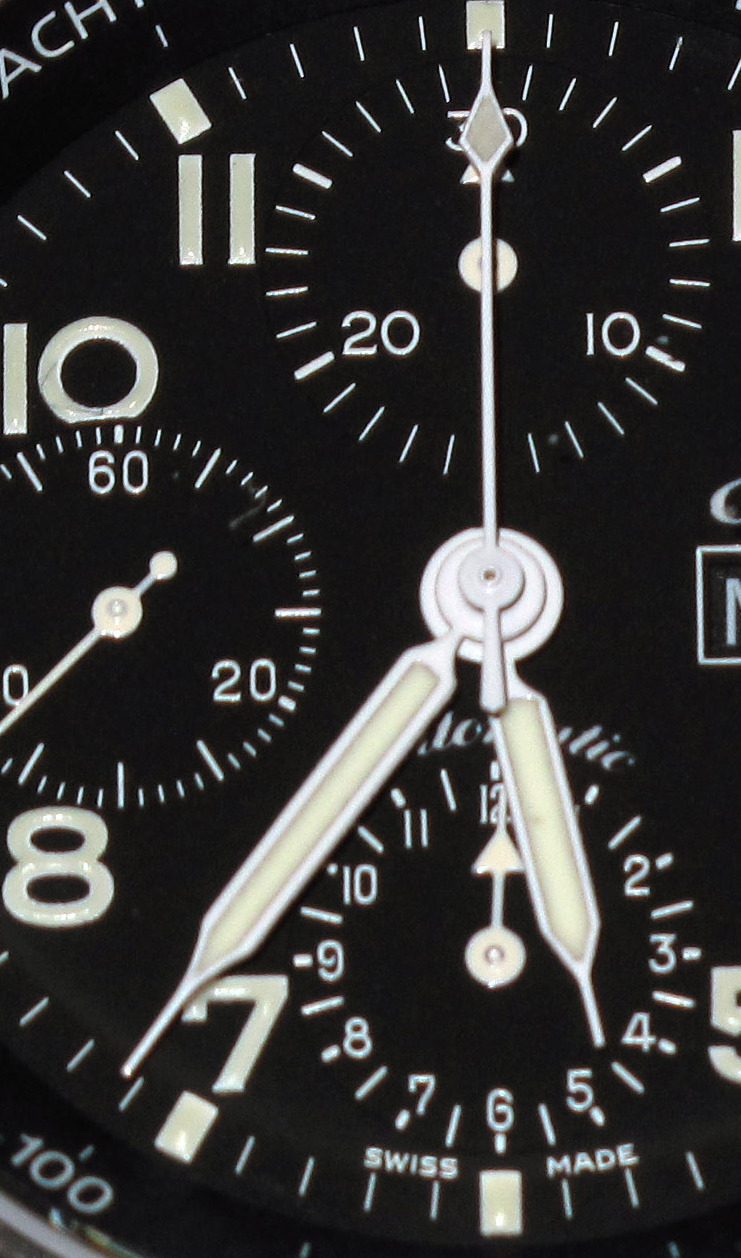
A chronograph is a watch with a seconds hand that can be started, stopped and returned to zero independently of the time display. Its history runs from Louis Moinet's 1816 'compteur de tierces', through Nicolas Rieussec's inking timer of 1821, to the return-to-zero heart cam patented by Adolphe Nicole in 1844. Column wheels or cams coordinate the start, stop and reset functions; split-seconds (rattrapante) versions add a second hand for timing intervals.
Sound: repeaters and striking
Before electric light, telling the time in the dark was a real problem. Repeating mechanisms strike the time on demand. Edward Barlow and Daniel Quare developed repeating watches in London in the 1680s; Quare received a patent in 1687. Quarter repeaters strike hours and quarters; minute repeaters add the minutes. Grande and petite sonneries strike automatically as a clock does.
Calendars and astronomy
A simple calendar must be corrected at the end of short months. An annual calendar handles 30- and 31-day months; a perpetual calendar also handles February and leap years, usually with a four-year cam. Thomas Mudge made a pocket watch with a perpetual calendar in 1762, often cited as the first. Moon phases, equation of time and astronomical indications continue a tradition that goes back to medieval astronomical clocks.
| Complication | What it shows or does | Notes |
|---|---|---|
| Chronograph | Stop-watch function | Column wheel or cam control |
| Split-seconds | Two superposed timing hands | Times intermediate intervals |
| Minute repeater | Strikes hours, quarters and minutes on demand | Among the hardest to adjust |
| Annual calendar | Date, month; corrects 30/31-day months | Needs one correction a year |
| Perpetual calendar | Date including leap years | Programmed by a four-year cam |
| Moon phase | Lunar cycle | A simple 59-tooth wheel drifts by about one day every 2.6 years |
| Tourbillon | Rotating escapement carriage | Averages vertical positional errors |
The tourbillon
Abraham-Louis Breguet patented the tourbillon in Paris in 1801. The escapement and balance are mounted in a carriage that rotates, usually once a minute, so that errors caused by the balance's poise in vertical positions are averaged out. In a pocket watch, which hangs mostly vertical, this was a genuine advantage; in a wristwatch that moves constantly, its benefit is debated, and today it is valued mainly as a demonstration of skill.
How a minute repeater speaks
Pressing the slide on the case band winds a separate spring that drives the striking. A minute repeater sounds the hours on a low note, the quarters as paired high-low notes and the remaining minutes on a high note. At 3:47 it plays three low notes, three pairs for the three quarters, and two high notes. The first repeaters struck small bells; from the late eighteenth century coiled steel gongs, which take less space, became standard.
Reading a perpetual calendar
Most perpetual calendars use a cam or program wheel that turns once every four years, with notches of different depths for months of 28, 29, 30 and 31 days. Because the Gregorian calendar skips the leap year in century years not divisible by 400, most perpetual calendars will need a correction on 1 March 2100. Moon-phase displays use a wheel of 59 teeth driven once a day, showing two lunations of about 29.5 days each and drifting by about a day in two and a half years; finer trains are accurate to a day in more than a century.
- Ask for the service history: complicated watches are expensive to restore.
- Test every function with the seller, slowly.
- Do not change the date on many calendar watches between about 9 pm and 3 am, when the date-change works are engaged.
- Check that sub-dials and hands are original and match the movement's calibre.
Check your understanding
Lesson quiz
0 of 4 answered