
Intermediate · Lesson 1 of 7 · 18 min read
Escapements explained: from the verge to the detached lever
The escapement is the most studied mechanism in horology. This lesson follows its main families in roughly historical order and explains what each one improved.
By the end of this lesson you will be able to:
- Describe the difference between recoil, frictional-rest and detached escapements
- Place the verge, anchor, deadbeat, cylinder, duplex, lever and detent escapements in sequence
- Recognise the escapement in an object from photographs
An escapement does two things: it locks the train and releases it in equal steps, and it gives the oscillator a push on each step. How well it does these jobs — and how much it disturbs the oscillator while doing them — largely decides how good a timekeeper is. Horologists sort escapements into three broad families.
| Family | What happens between impulses | Examples |
|---|---|---|
| Recoil | The escape wheel is pushed backwards slightly by the oscillator | Verge, anchor |
| Frictional rest | A tooth rests on a surface of the pallet or cylinder, adding friction | Deadbeat, cylinder, duplex |
| Detached | The oscillator swings freely for most of its arc | Lever, detent (chronometer) |
The verge (c. late 13th century onwards)
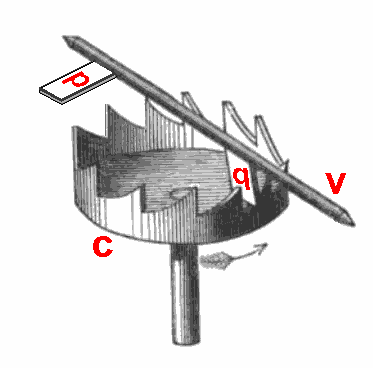
The oldest mechanical escapement uses a crown-shaped escape wheel and a vertical arbor — the verge — carrying two pallets at an angle. Combined first with a foliot and later with a balance or short pendulum, it powered European clocks for more than three centuries and most watches until the early nineteenth century. Its oscillator is never free, and it recoils on every swing, so its rate depends strongly on the driving force — the reason so many verge watches have a fusee.
The anchor (c. 1670)
The anchor escapement, usually credited to Robert Hooke or the London clockmaker William Clement around 1670, lets a pendulum swing through a small arc. That made long pendulums practical and, with them, the longcase clock. It still recoils, but much less disturbs a long, heavy pendulum.
The deadbeat (c. 1715)
George Graham reshaped the anchor's pallets so that the escape wheel stops dead instead of recoiling. The deadbeat became the standard escapement for precision regulators for two centuries.
Cylinder and duplex (18th century)
Watchmakers wanted a flatter, more accurate alternative to the verge. The cylinder escapement, developed by Thomas Tompion and perfected by George Graham in the 1720s, lets escape-wheel teeth rest on a half-cut cylinder on the balance staff. It allowed thin watches and was used in huge numbers in cheaper Swiss watches into the twentieth century. The duplex, popular in fine English watches in the early nineteenth century, gives impulse once per oscillation and can perform well but is delicate.
The detached lever (c. 1755 onwards)
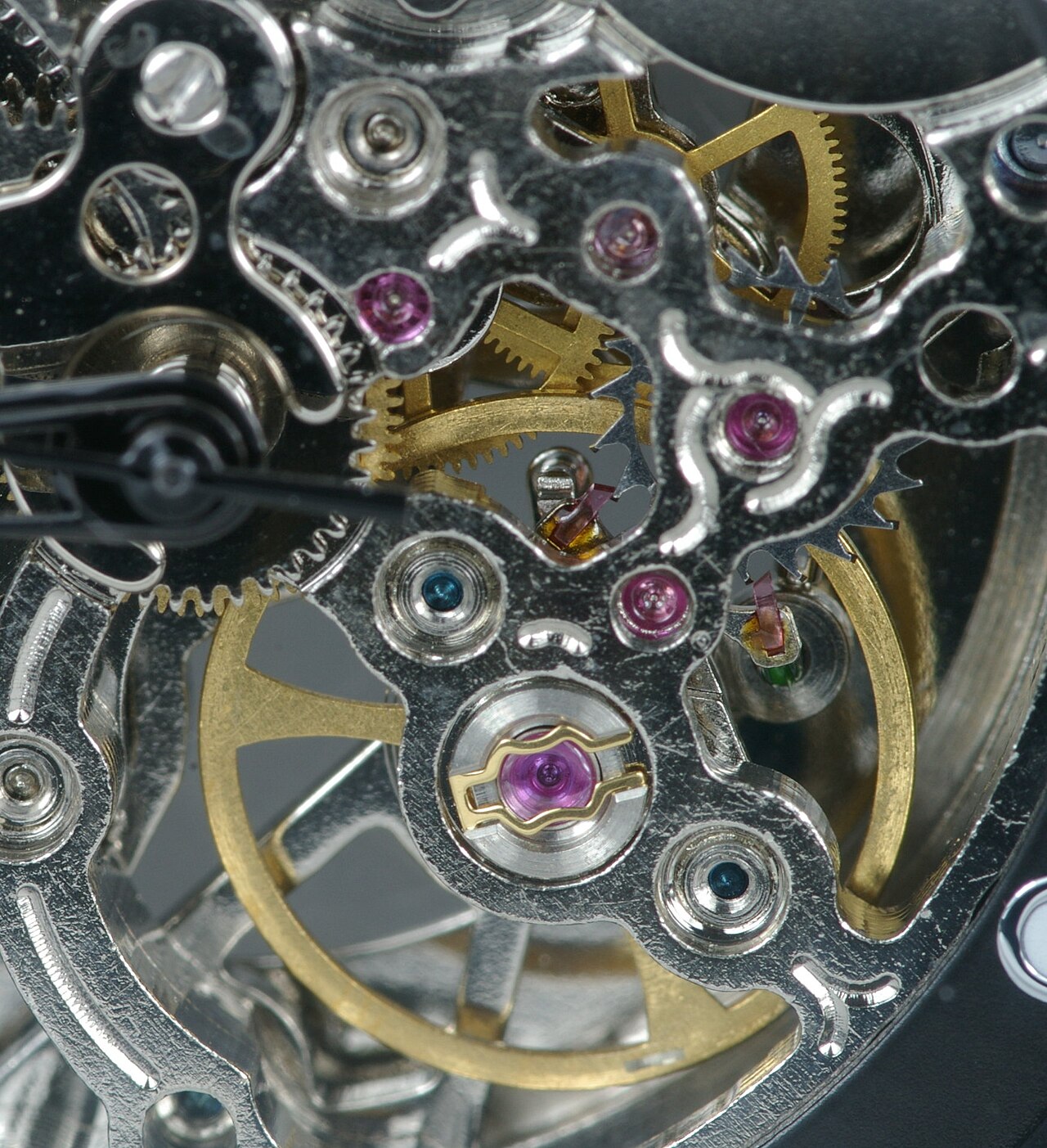
Thomas Mudge's detached lever escapement, invented in the mid-1750s, separates the balance from the train for most of its swing. A pivoted lever (the pallet fork) is unlocked by a jewel on the balance, receives impulse from the escape wheel, passes it on, and then is held safely against a banking while the balance swings freely. Refined by Breguet, by English makers and above all by the Swiss in the nineteenth century, it became the standard escapement of the modern watch.
The detent or chronometer escapement
Developed in France by Pierre Le Roy and in England by John Arnold and Thomas Earnshaw in the late eighteenth century, the detent escapement gives impulse directly to the balance once per oscillation and needs no oil on its impulse surfaces. It was the escapement of the marine chronometer, but it can set (stop) if jolted, which kept it out of ordinary watches.
- Recoil escapements are robust but sensitive to driving force.
- Frictional-rest escapements are thin and accurate but wear.
- Detached escapements free the oscillator and dominate precision timekeeping.
Practise
Compare escapements side by side →
See it in the collection
Find verge watches in the catalogue →
Check your understanding
Lesson quiz
0 of 5 answered