
Horological History · Historical feature
The English Pocket Watch, 1650–1900: Pair Cases, Verge to Lever, and the Trade Behind the Name
For a century after the balance spring, London set the standard for the pocket watch. How the English watch changed — from single-hand verge watches in leather pair cases to fusee levers made for railway staff — and how to read the case, dial and movement of one, with examples from seven collections.
Atlas Editorial · · 19 min read

Unknown author · Public domain · source (opens another website in a new tab)
Open the outer case of an English watch made around 1700 and you find a second case inside it, plain and close-fitting, with the movement hinged into it. Lift the movement out and the back plate is crowded with engraving: a pierced and chased balance cock spreading across half the plate, the maker's name and town in flowing script, a serial number, and below the cock the edge of a small silver disc for adjusting the balance spring. Turn the watch over and the dial is silver or gold, its hour numerals raised on a matted ground, with two hands of blued steel — the hour hand ending in a shape like a beetle, the minute hand a plain 'poker'. Almost every one of these features tells you something about when and where the watch was made.
From the 1670s to the late eighteenth century, London watchmaking led Europe. The reasons were partly technical — English makers adopted the balance spring quickly and refined it, and they controlled the secret of jewelled bearings for decades — and partly commercial: a large, organised trade of specialist outworkers allowed a named master to sign watches whose parts came from dozens of hands. In the nineteenth century the same organisation became a weakness, as Swiss and American factories outproduced it. This feature follows the English watch through that arc using objects in the Atlas catalogue, and sets out the clues that help a reader date one. Where a record's own information is incomplete or inconsistent, that is noted; the catalogue entries carry the full source text and links back to each holding institution.
Before the balance spring
The earliest English watches followed German and French models closely. Their movements were regulated by a balance without a spring, checked by a verge escapement, and their accuracy was poor: errors of a quarter of an hour or more in a day were usual, which is why they carried only an hour hand. Edward East, who was among the founding members of the Clockmakers' Company in 1631 and worked for Charles I, is a good representative of this generation. His watch in the Science Museum Group collection, dated 1650 and formerly no. 29 in the Clockmakers' Museum, belongs to the period when a watch was a jewel and a status object first and a timekeeper second.
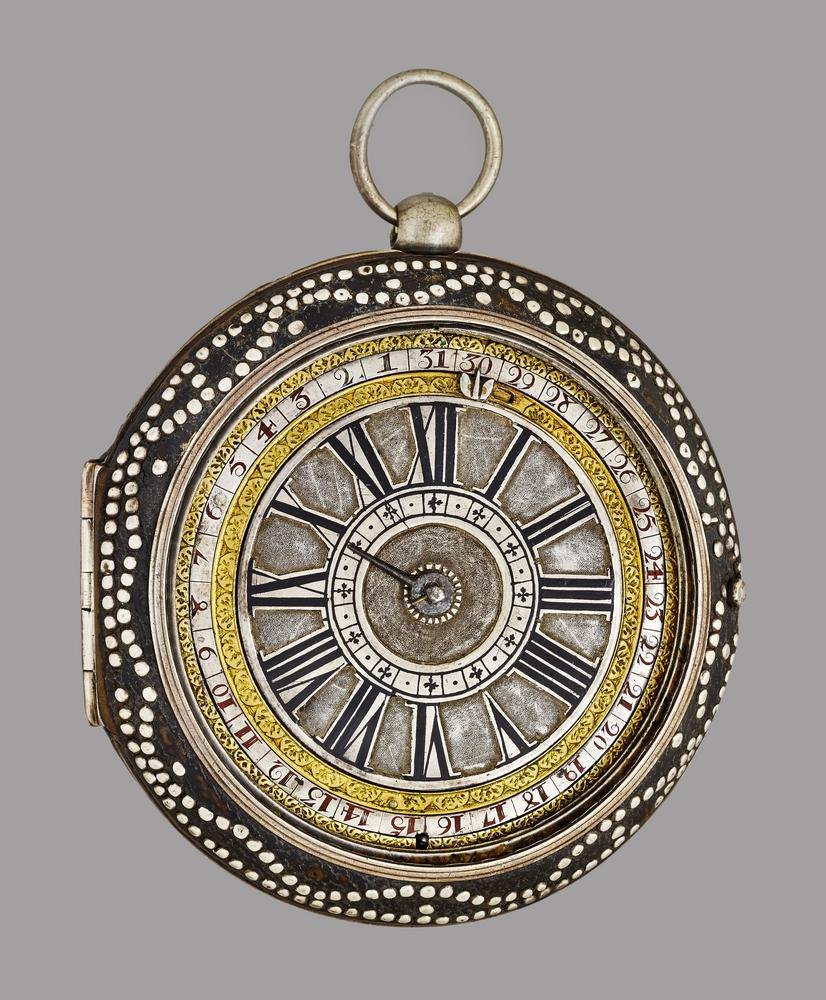
A watch by Benjamin Wolverston of the Poultry in the City of London, dated by the British Museum to 1660–1670, shows what a well-made London watch of the 1660s looked like. It has a plain silver inner case and an outer case of leather-covered brass decorated with silver piqué — small silver pins hammered into the leather in a floral pattern. The gilt-brass dial plate carries a riveted silver champlevé dial with Roman hours and a quarter circle, but no minutes: this is a single-hand watch, read to the nearest quarter of an hour. A rotating ring around the dial shows the date. The museum notes that Wolverston became free of the Clockmakers' Company in March 1656.
1675: the balance spring
In 1675 Christiaan Huygens announced a spiral spring attached to the balance, which gave the balance a natural period of oscillation in the way gravity gives one to a pendulum. Robert Hooke claimed that he had had the idea first, and Thomas Tompion made watches to Hooke's designs as part of that dispute. Whoever deserves the credit, the effect was immediate. A spring-controlled balance could keep time to within a few minutes a day, and within a few years English watches were fitted with minute hands and their dials were redesigned around them. The spiral balance spring is still the regulator of almost every mechanical watch made today.
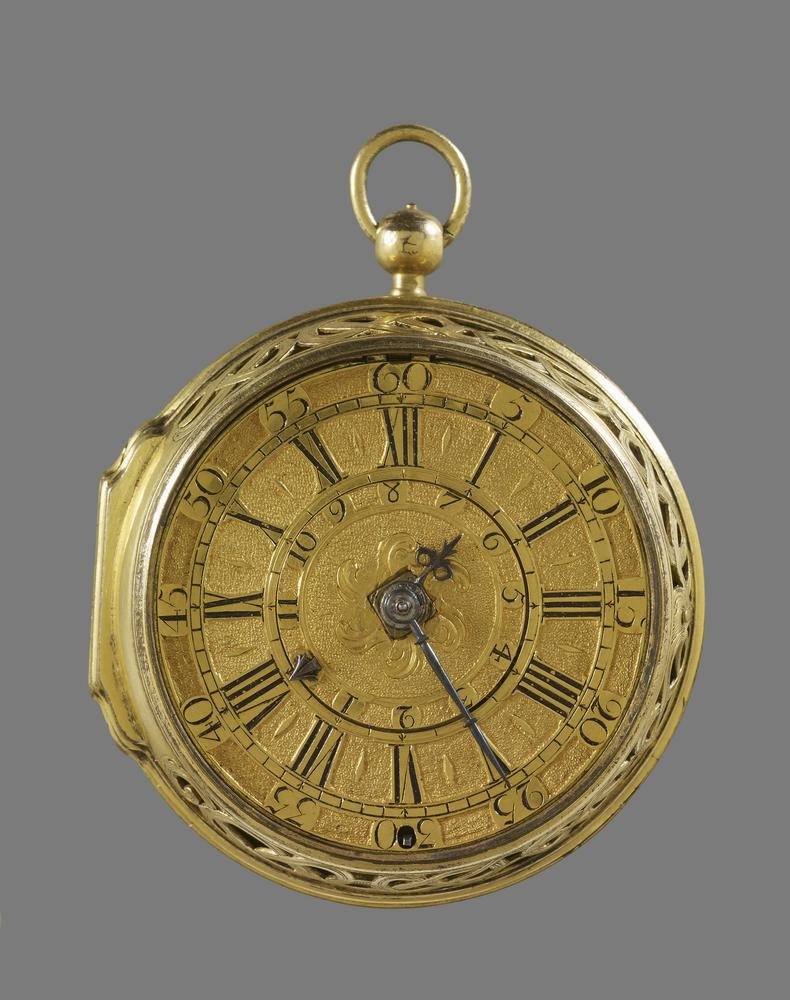
The change was so decisive that owners had older watches converted. A watch movement by Thomas Tompion in the British Museum, made in 1676–1680, shows how much a watch could be altered. According to the museum's record, the verge, balance spring, regulator and balance cock are all later, as are the gold champlevé dial, the pierced and engraved gilt case and the leather outer case. Only the movement's core survives from Tompion's workshop. A reader looking at such a watch is looking at two or three periods at once, and must date each part separately.
The pair case
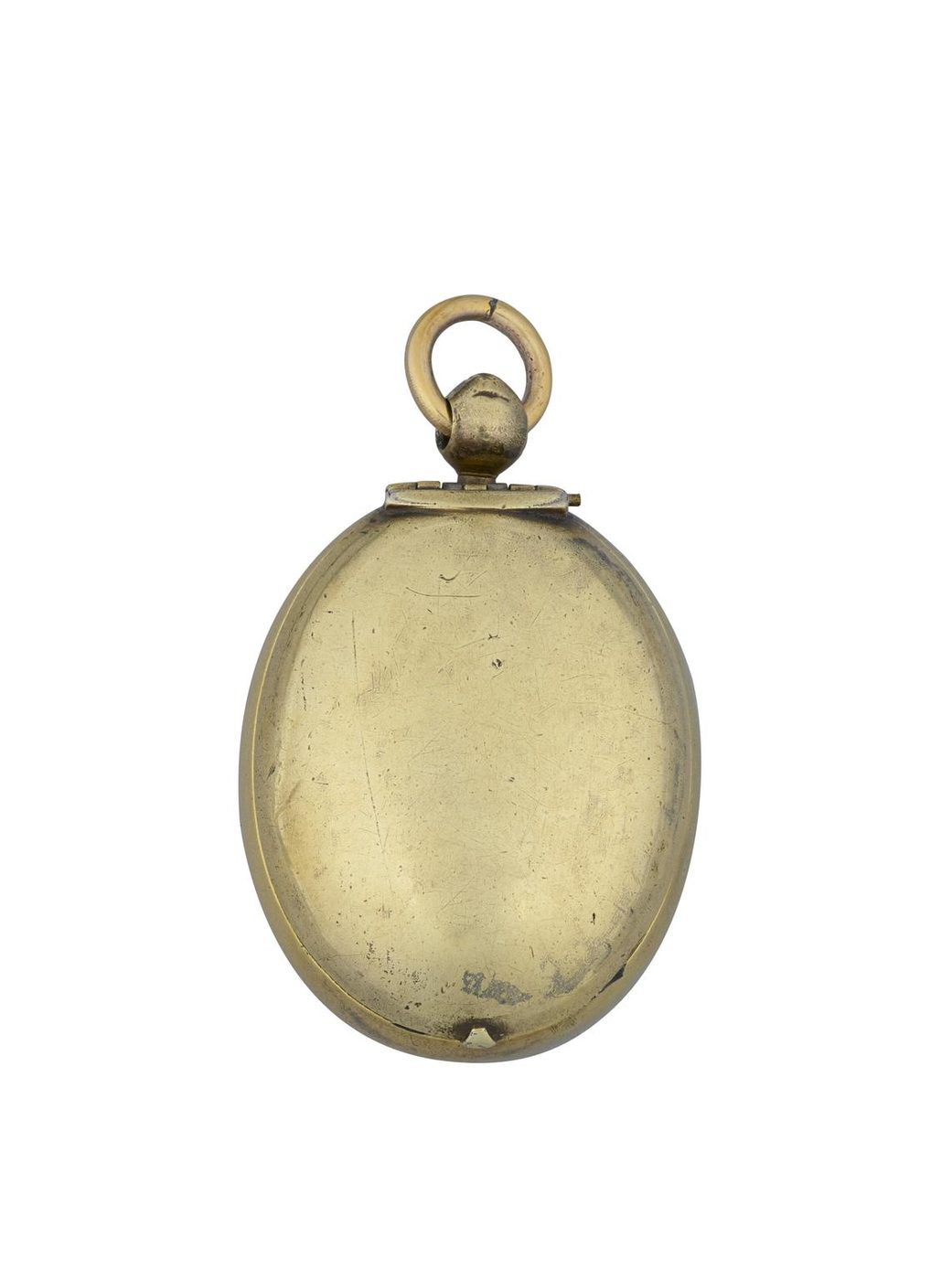
The pair case is the most recognisable feature of the English watch from the late seventeenth century to the early nineteenth. The movement sits in a plain inner case, usually of silver or gold, with a glazed hinged bezel and a hole in the back for the winding key. The outer case is a loose cover that protects the inner case and carries the decoration. Plain outer cases of silver or gold were usual; for richer or more fashionable watches the outer case could be covered in leather, shagreen (ray or shark skin) or tortoiseshell, often pinned with gold or silver piqué, or worked in repoussé — metal embossed from behind with figures and scenes.
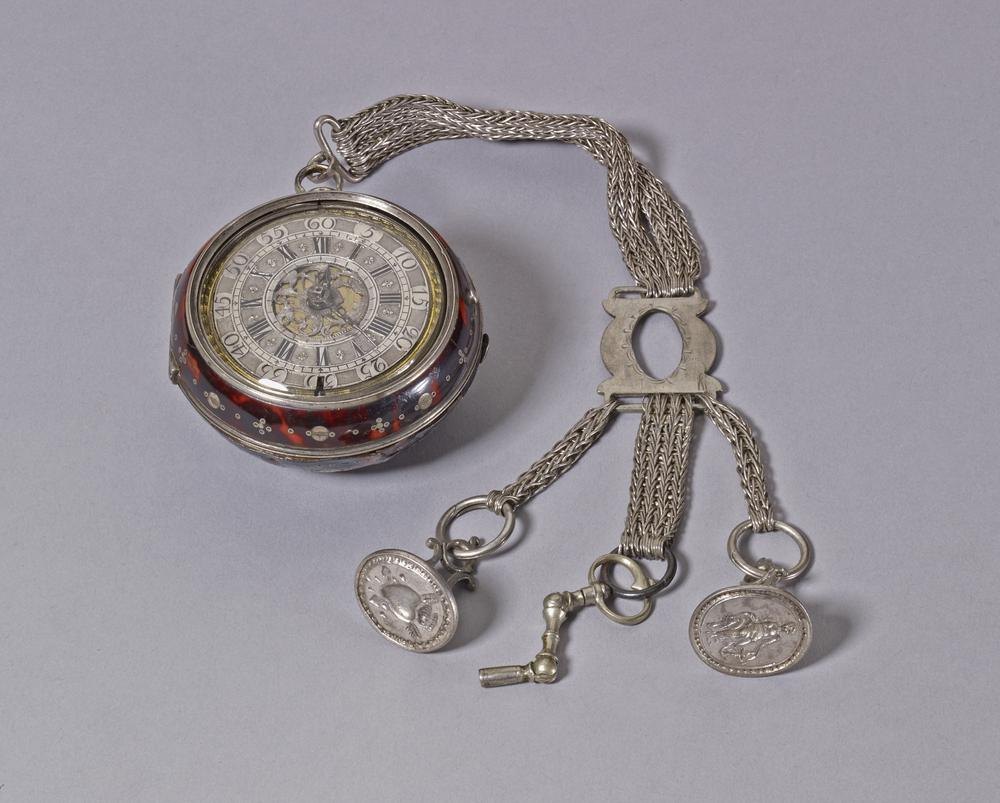
A watch by Charles Gretton in the British Museum, with a silver inner case and a tortoiseshell-covered outer case with silver piqué work, still has its silver chatelaine, two silver seals and a crank winding key. The record dates it 1672–1675, while the text from David Thompson's British Museum catalogue Watches (2008) quoted in the record dates it c. 1675–80; both are given here. Gretton became a freeman of the Clockmakers' Company in 1672 and served as Master in 1700; his apprentices included Henry Sully, who later worked in France on marine timekeepers.
| Outer case | Typical period in English watches | What to look for |
|---|---|---|
| Leather over brass with piqué | c. 1660–1720 | Small pins in floral or geometric patterns; leather often worn at the edges |
| Shagreen or tortoiseshell with piqué | c. 1670–1800 | Ray skin (granular, often dyed green) or tortoiseshell over a metal shell |
| Plain silver or gold | Throughout | Hallmarks inside the outer case; the commonest pair case |
| Repoussé gold or silver | c. 1720–1780 | Embossed classical or allegorical scenes, often signed by a specialist chaser |
| Single case, engine-turned | c. 1790 onward | Pair case abandoned; machine-turned patterns on gold |
| Hunter and half-hunter | 19th century | Hinged front cover over the glass; a half-hunter has a window to read the hands |
Quare, repeating watches and the London lead
By the 1680s London makers were adding complications to the new spring-regulated watch. The most prized was the repeating watch, which sounded the hours and quarters on a bell when the owner pressed a button or the pendant — useful in the dark, before matches made it easy to see a dial. The Victoria and Albert Museum's record of a quarter-repeating watch by Daniel Quare, made around 1700, explains that Quare was at the forefront of the repeating watch in the 1680s and that in 1687 he obtained a patent for his repeating work after a dispute with Edward Barlow, decided by James II. The silver inner and outer cases of the V&A watch are pierced so that the bell can be heard.
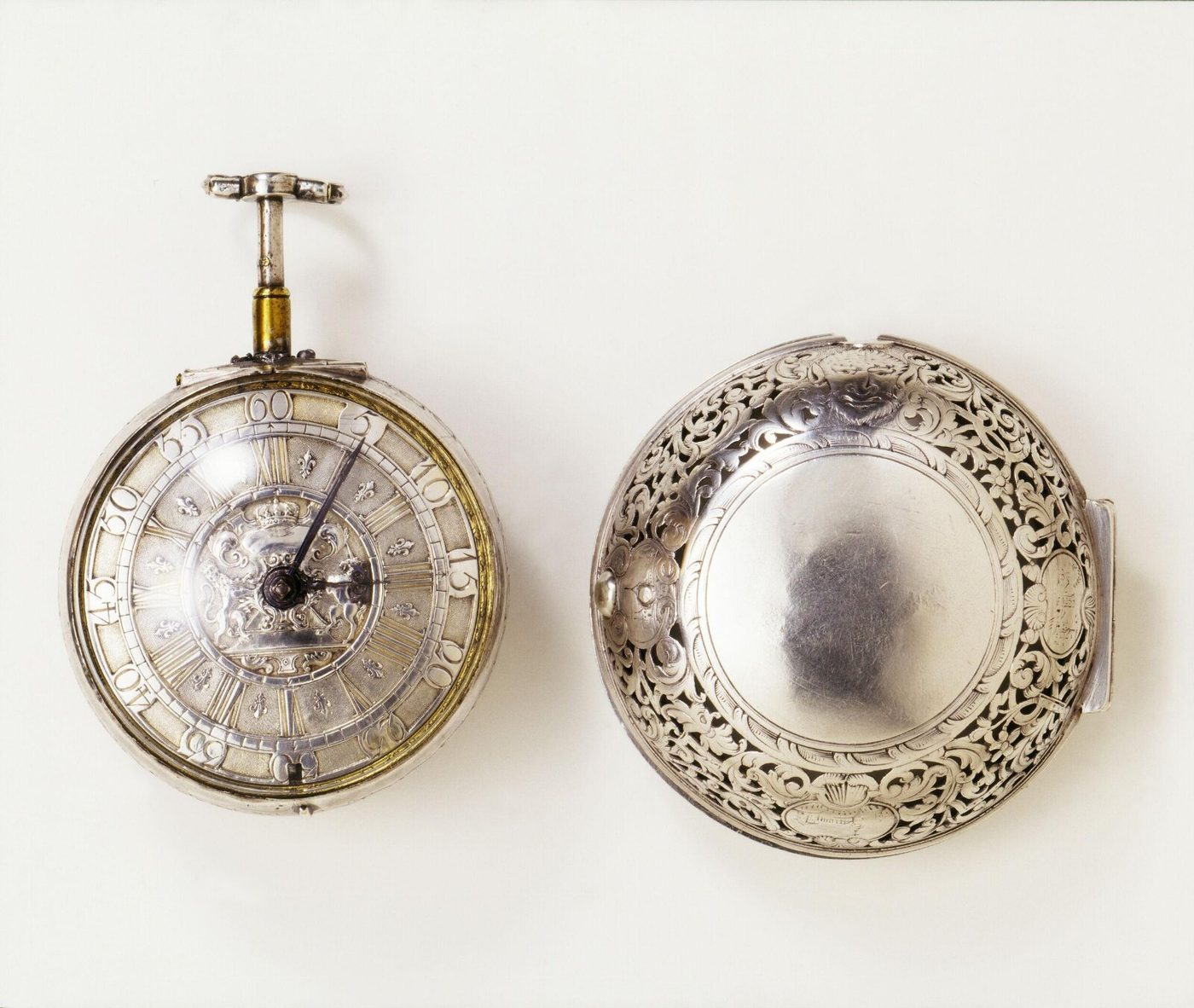
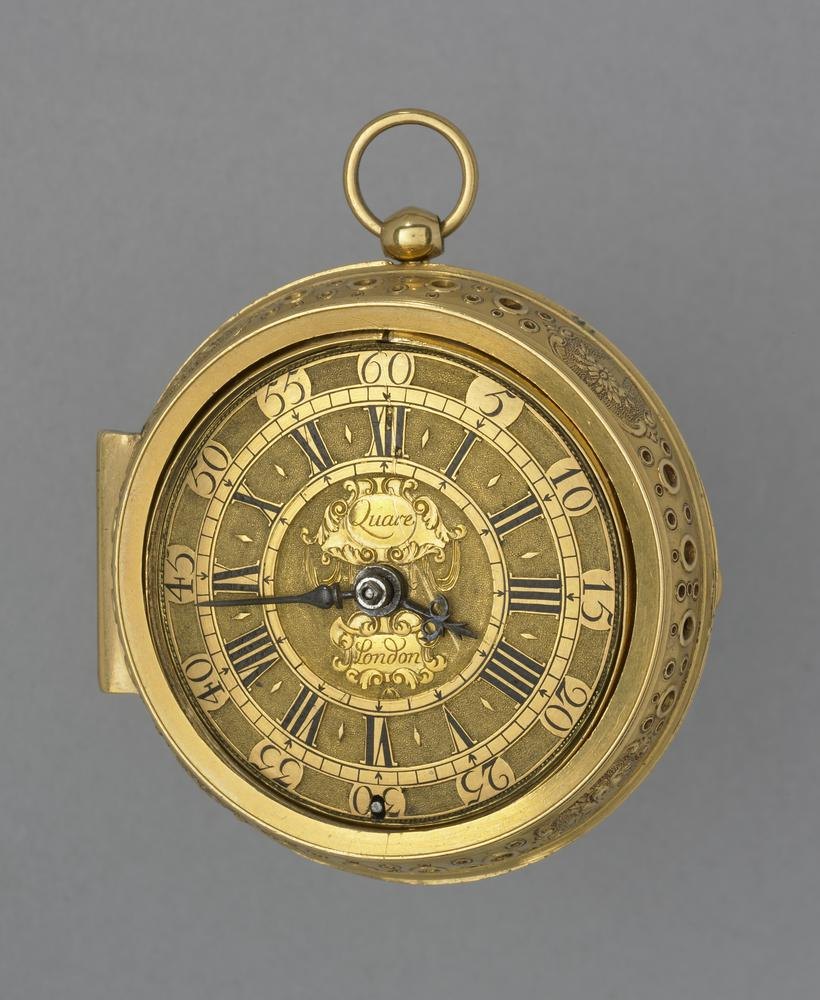
A repeating watch sounds the time on demand. A clock-watch strikes the hours automatically as they pass, like a clock. The British Museum holds a gold pair-cased verge clock-watch by Quare dated 1693, signed 'D. Quare London 0233', its gold cases pierced and engraved, the outer embossed with a coat of arms. The cases were made by William Jaques. Thompson's text, quoted in the record, makes a point that applies to almost every signed English watch: Quare 'doubtless relied on other craftsmen to supply his materials'. The name on the plate is the name of the master who took responsibility for the watch and sold it, not necessarily the person who made each part.
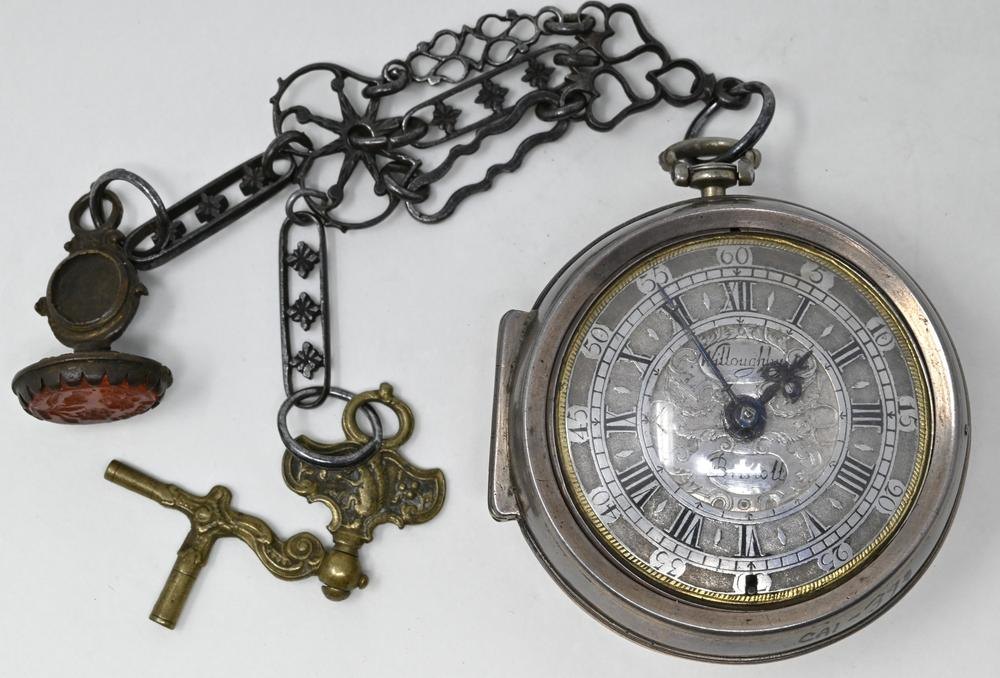
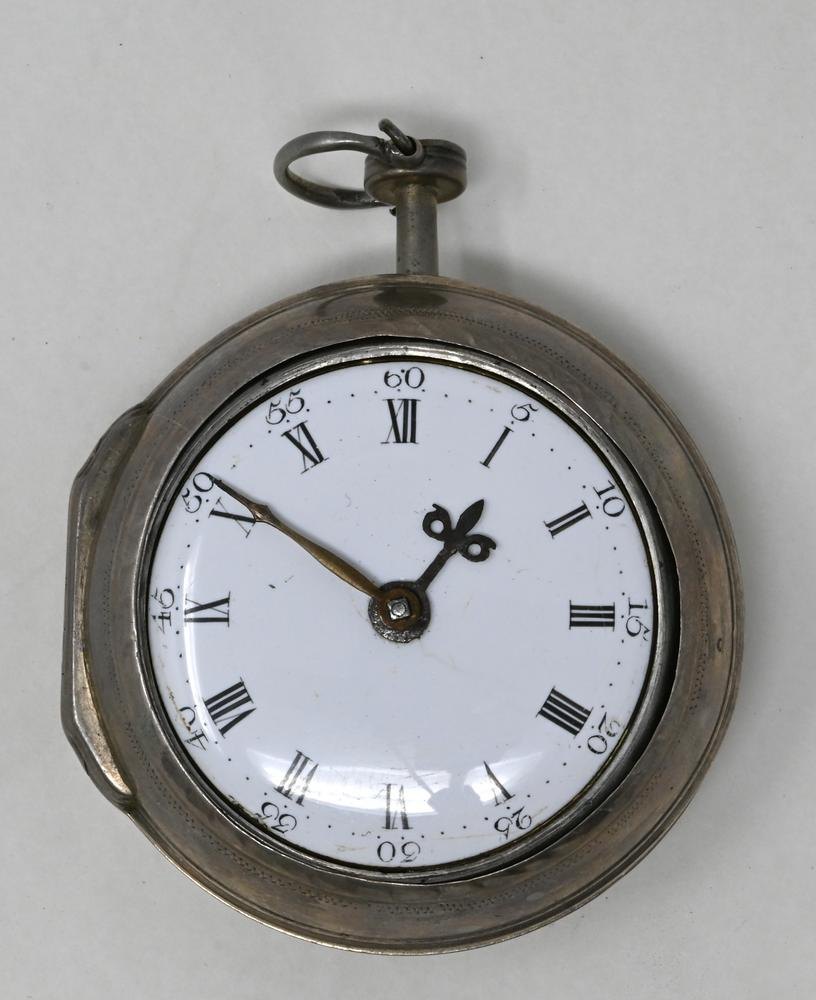
London watches were not only made in London. A silver pair-cased verge watch signed by Ben Willoughby of Bristol, dated 1700–1710, has a silver champlevé dial, blued steel beetle-and-poker hands and its original fob chain, seal and cranked brass key — the complete set of things a man carried with his watch. Provincial makers bought movements and parts from the same supply networks as London masters, and the best provincial work is hard to tell from London work without the signature.
Enamel, gold and an international trade
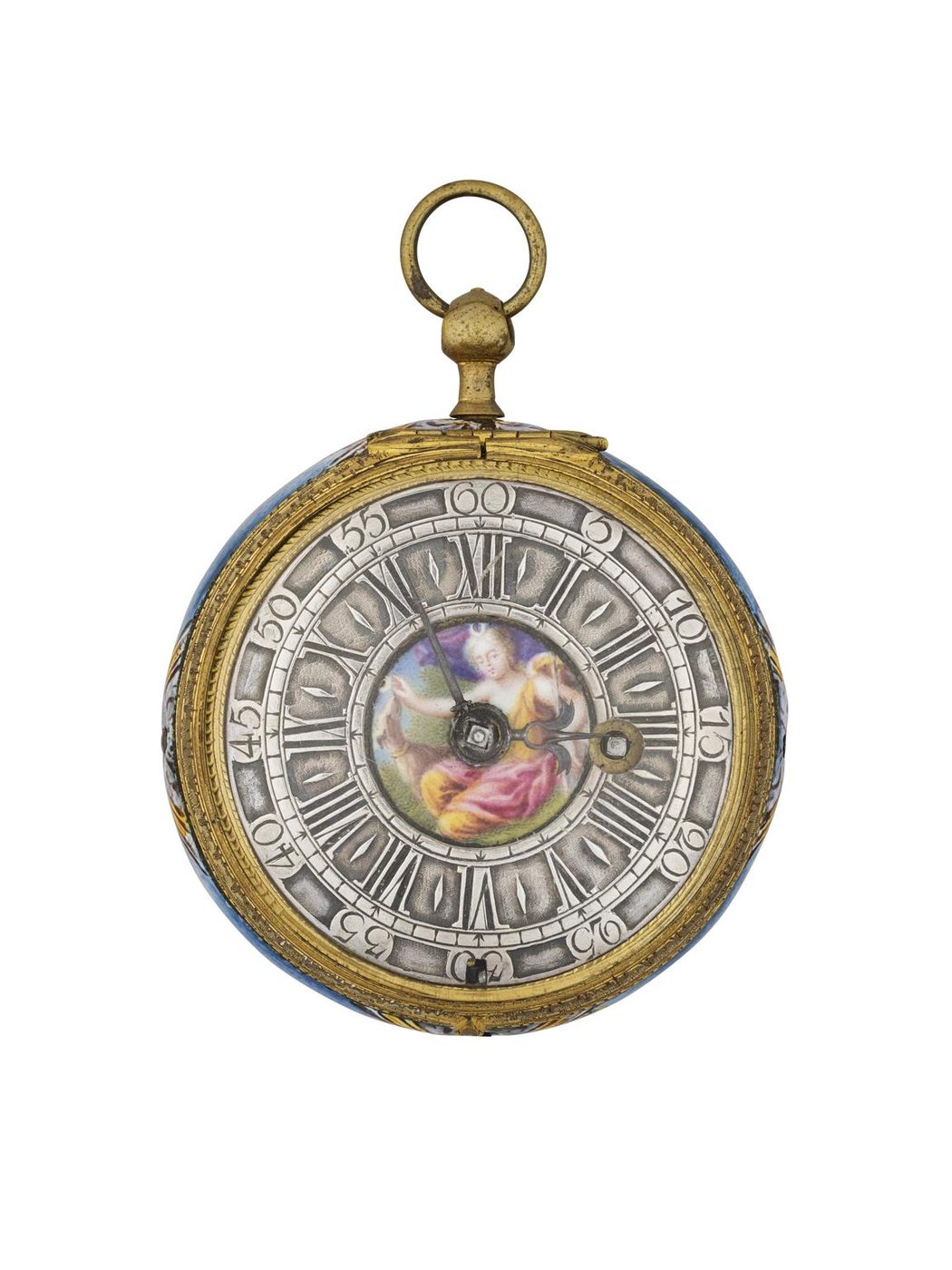
English watches were sold across Europe and beyond, and English makers bought from abroad too. A watch by Daniel Quare in the Science Museum Group collection, dated 1712, has an enamel case by the Huaud family of Geneva, whose painted enamel cases were used by watchmakers all over Europe. A watch by Thomas Windmills in the Metropolitan Museum, of about 1710, combines silver and enamel. These are reminders that the 'English watch' was a product of a European trade, finished and signed in London.
By the middle of the eighteenth century, the leading London names included John Ellicott, clockmaker to George III and a Fellow of the Royal Society. A gold watch in the V&A, signed 'Jno. Ellicott, London, 3719' and dated about 1753, has a pierced and engraved inner case with the casemaker's mark 'JB' (John Beesley). Another Ellicott watch in the Metropolitan Museum, of about 1760, is cased in pinchbeck — a copper-zinc alloy that looks like gold, named after the London clockmaker Christopher Pinchbeck — with tortoiseshell and enamel.
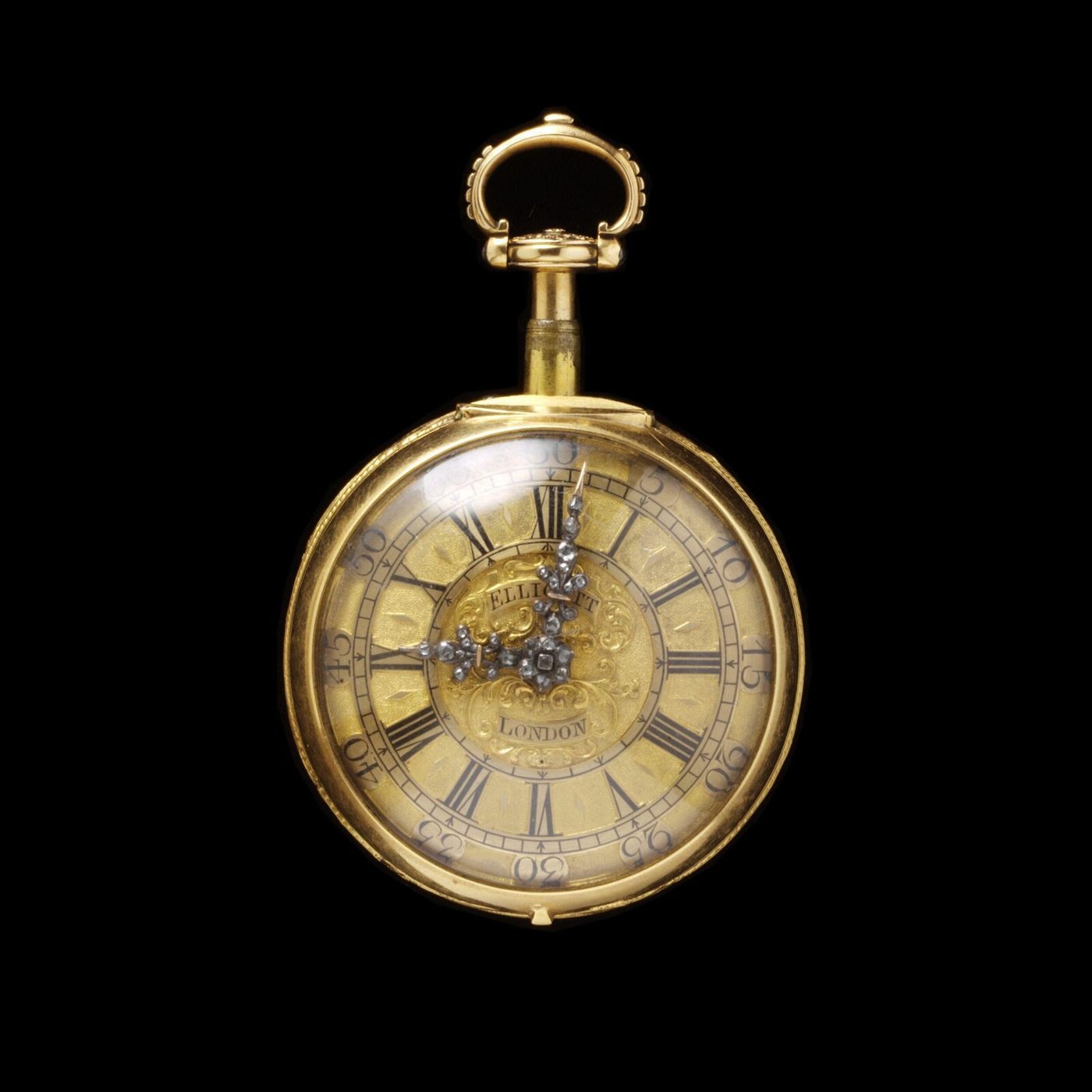
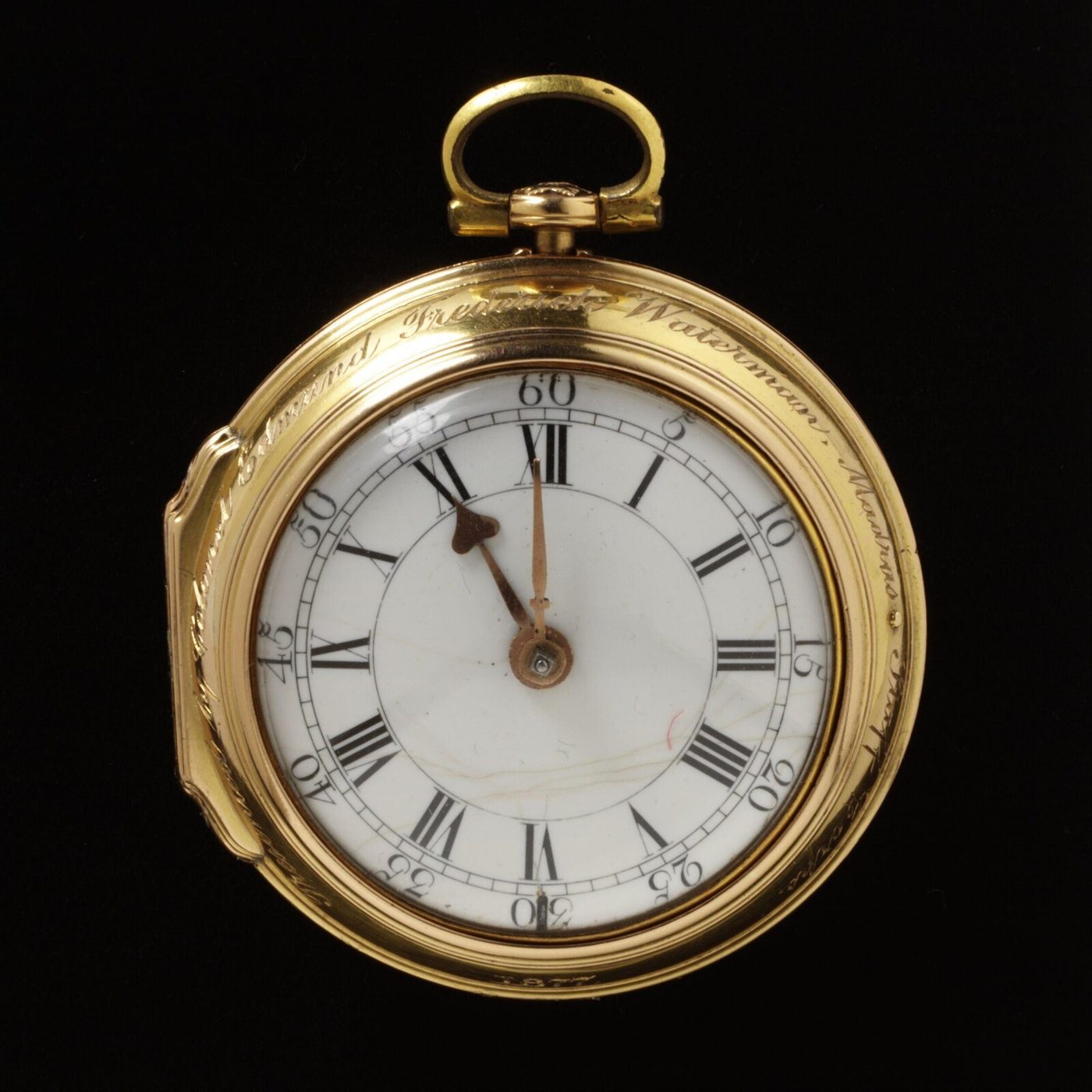
Watches travelled with their owners, and some acquired stories along the way that are hard to check. The V&A holds a gold pair-cased verge watch by Ellicott, movement no. 6154, its case hallmarked in London for 1768–69 with the mark of Thomas Layton. It was taken from the treasury of Tipu Sultan at Seringapatam in 1799, and an engraved inscription on the back says it was found on Tipu's body. The museum's own label adds that the inscription 'may be an invention'. Provenance engraved on an object is part of its history, but it is not proof.
Escapements: verge, cylinder, lever, duplex and detent
The verge escapement, inherited from medieval clocks, remained the escapement of the ordinary English watch until well into the nineteenth century. It is robust and easy to make, but it is never free of the train: the escape wheel pushes on the balance throughout its swing, so the watch's rate changes as the mainspring runs down. English makers compensated with the fusee, a cone-shaped pulley connected to the mainspring barrel by a fine chain, which evens out the force of the spring as it unwinds. The fusee stayed in English watches long after Swiss makers abandoned it, and a fusee is one of the strongest indications that a nineteenth-century watch is English.
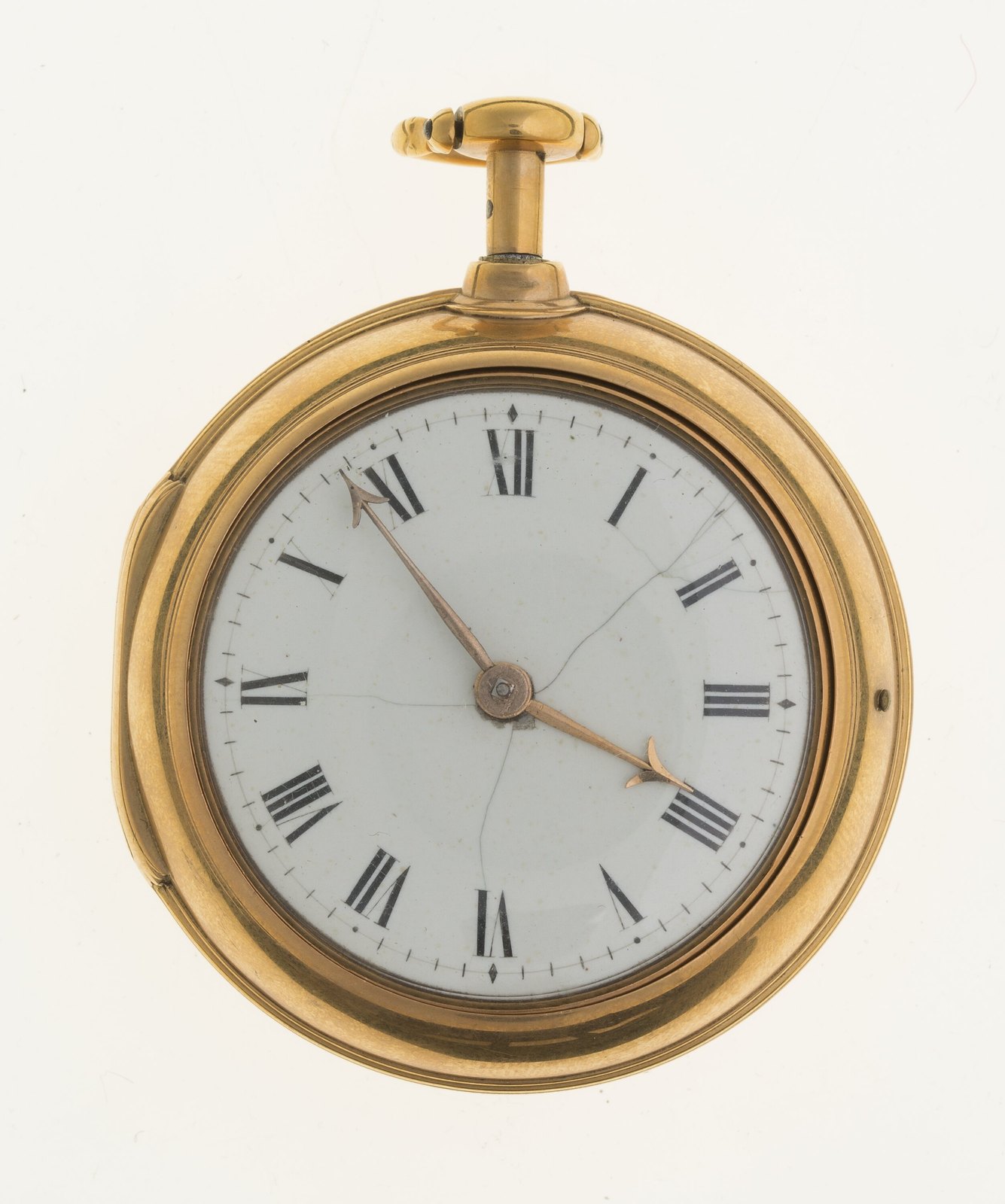
Better escapements followed. George Graham developed the cylinder escapement in the 1720s; it is quieter and flatter than the verge and gives more consistent timekeeping, and Graham, Ellicott and Mudge all used it. A gold pair-cased repeating watch by Thomas Mudge and William Dutton in Museums Victoria, no. 943, made around 1770, has a cylinder escapement, a fusee and chain, and a diamond end jewel; its outer case carries a London hallmark for 1798, nearly thirty years after the movement — another case of a later case.
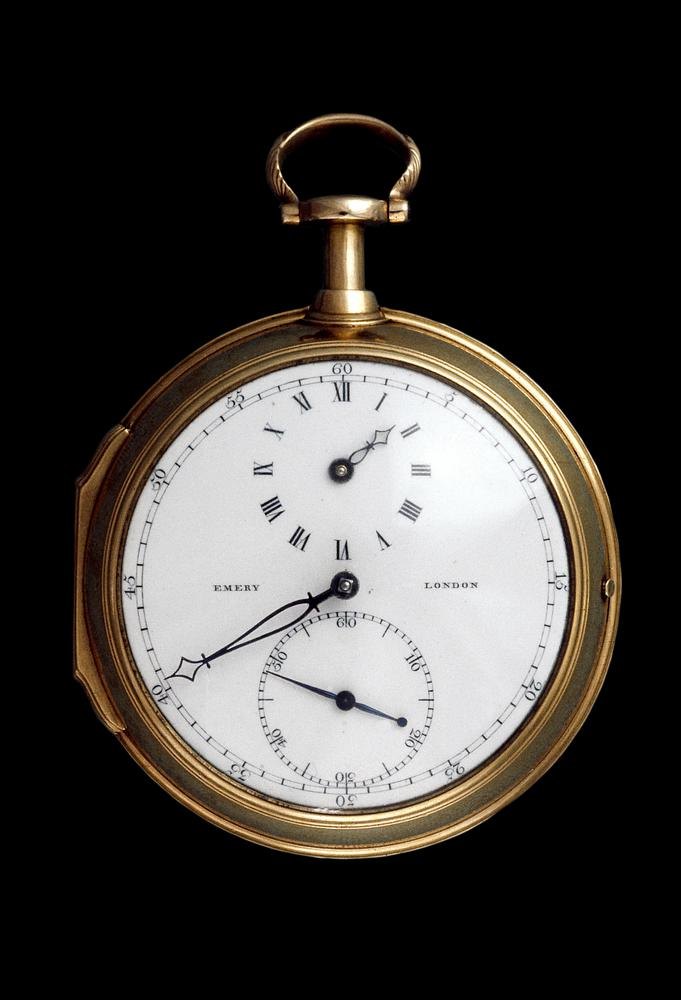
Mudge's most important invention was the detached lever escapement. As the British Museum's record of a watch by Josiah Emery explains, Mudge first used it in an experimental clock around 1750, and his first watch with it was made for Queen Charlotte in 1769 and delivered in 1770. In a detached escapement the balance swings freely for most of its arc and touches the escapement only briefly at the centre, which makes it much less sensitive to changes in driving force. Emery, a Swiss-born maker working at Charing Cross, was one of the few to take it up in the 1780s; the British Museum's gold watch by him, dated 1786, has a full-plate movement with fusee, lever escapement and compensated balance.
The lever became the standard English escapement only after a detour through Liverpool. In 1791 Peter Litherland of Liverpool patented the rack lever, in which a toothed rack on the lever engages a pinion on the balance staff. It is not detached — the balance and lever are always in mesh — but it was robust and easy to make in quantity, and Liverpool makers produced it in large numbers in the early nineteenth century. Litherland's firm continued as Litherland, Davies & Co.; a gold watch in the V&A is signed by them, numbered 8463, with a cast and chased gold case by Thomas Helsby. The record gives Chester hallmarks for 1815–16 in one field and for 1837–38 in another, so the case date should be treated as unresolved. Liverpool cases were usually assayed at Chester.
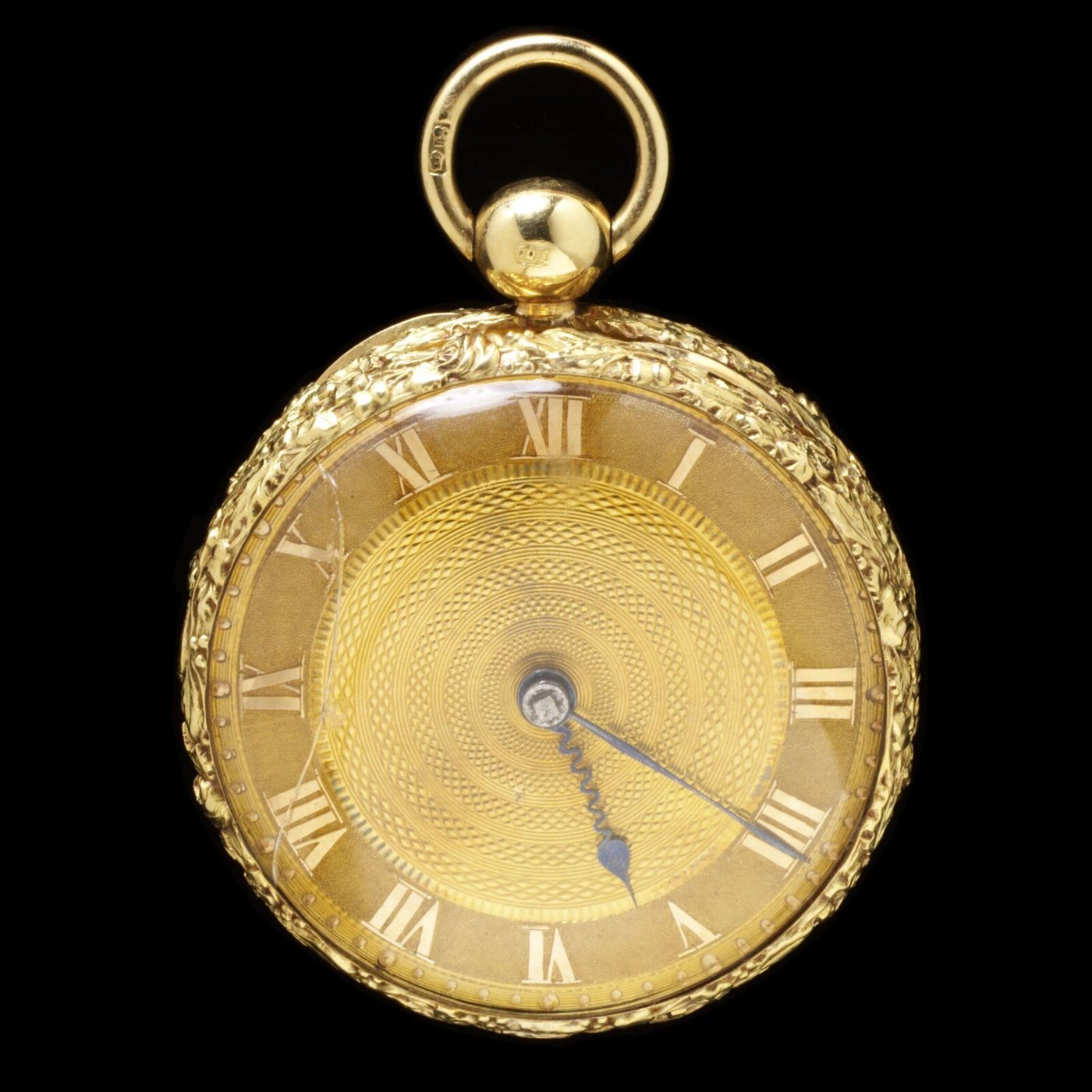
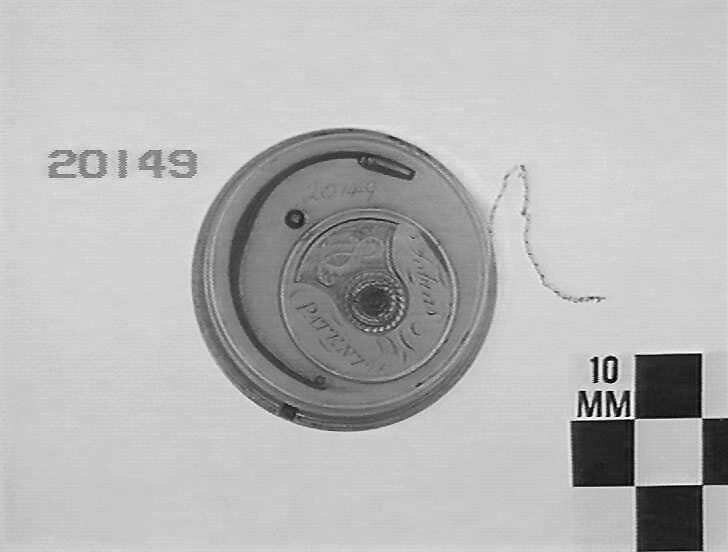
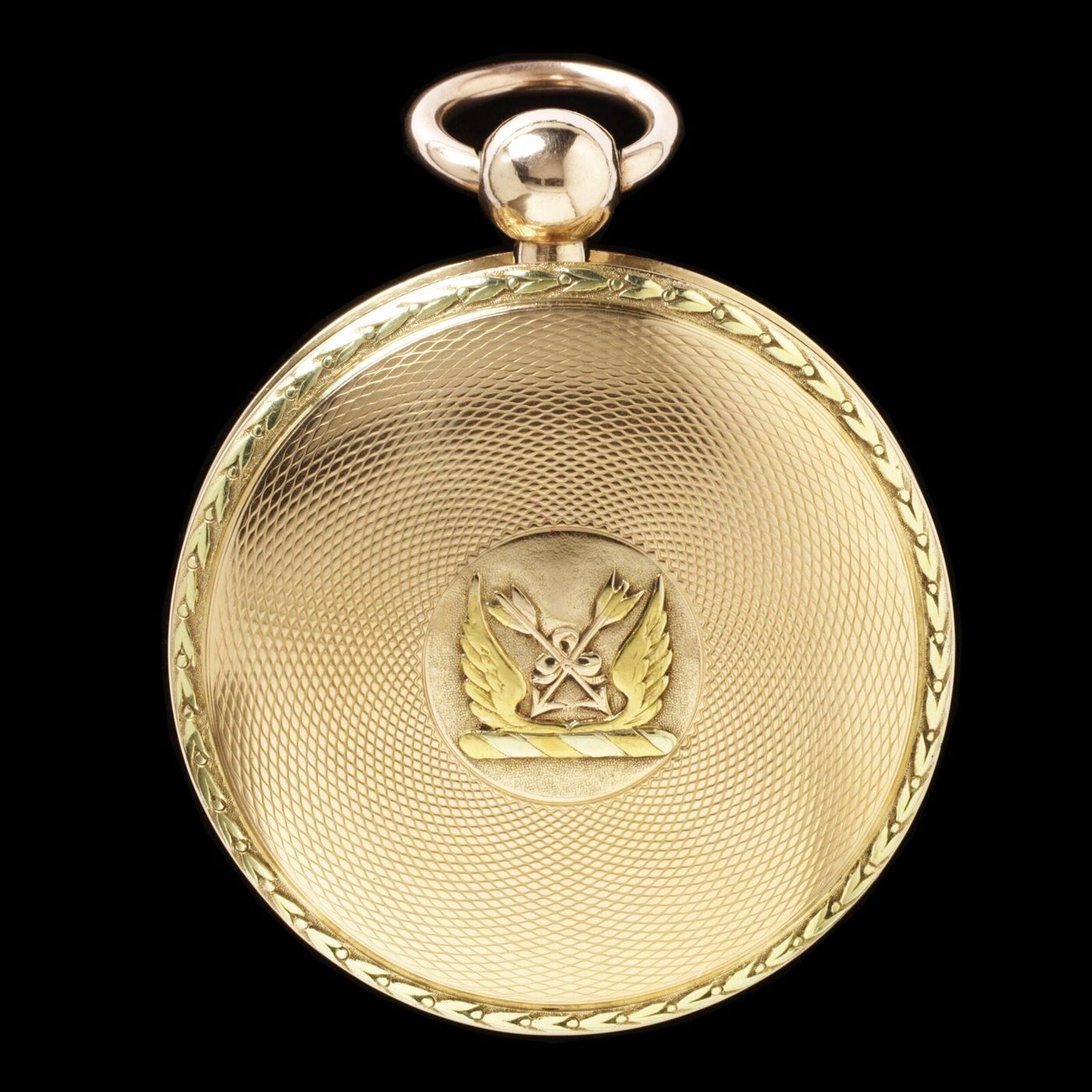
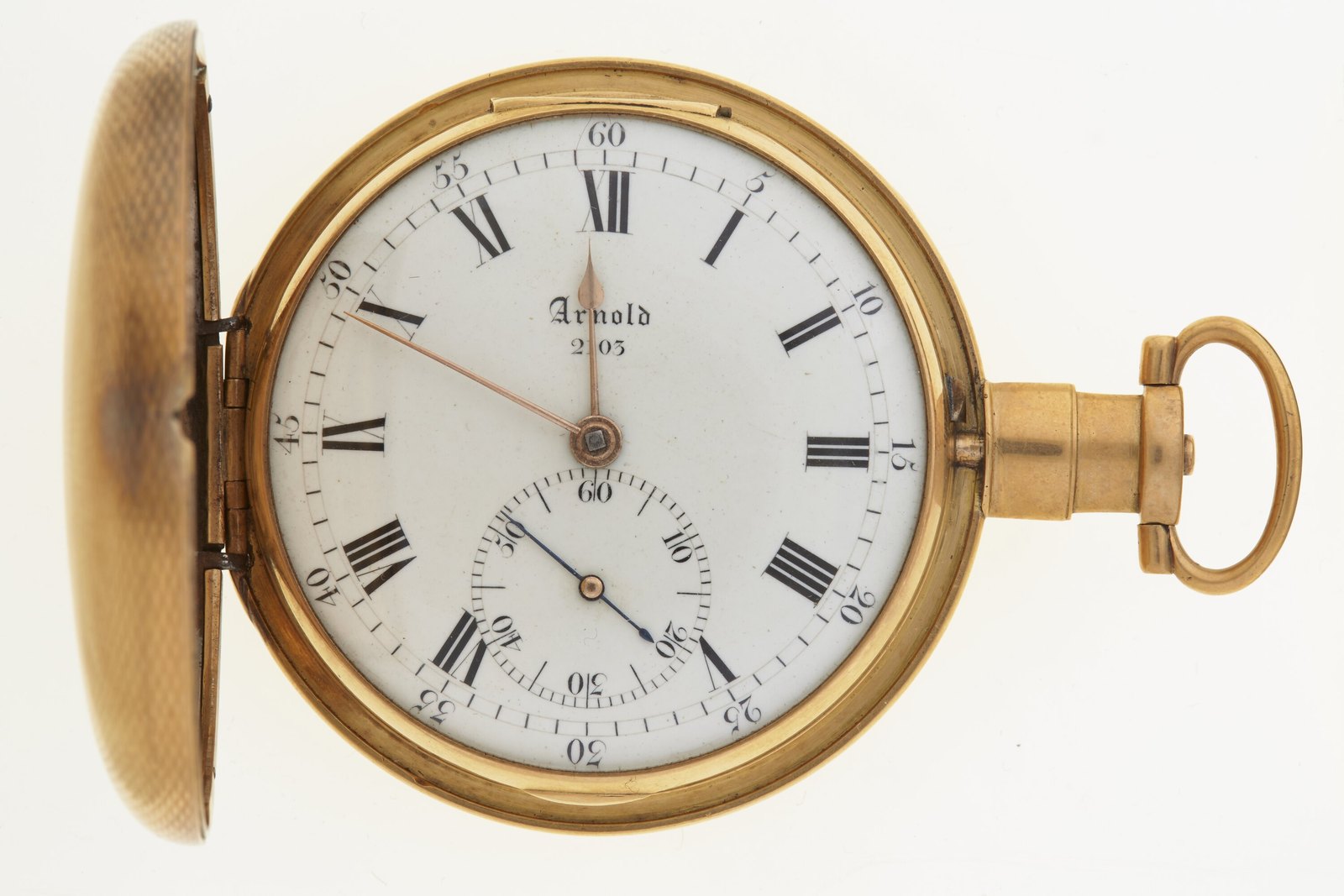
Two other escapements belong to the top of the English trade around 1800. The duplex, with its two sets of teeth on one escape wheel, gives excellent timekeeping when well made and was used in fine London watches from the 1780s to the mid-nineteenth century. A watch by Smith & Asprey of Bruton Street, in a varicoloured, engine-turned and chased gold case of 1811–12, has a duplex movement — though the V&A notes that the movement is contemporary with the case but not original to it. The spring detent or chronometer escapement, developed for marine chronometers by John Arnold and Thomas Earnshaw in the 1780s, was also fitted to pocket chronometers for owners who needed the best possible rate. A gold hunter-cased pocket chronometer by John Roger Arnold, no. 2103, in Museums Victoria, dates from about 1815.
| Escapement | Introduced (England) | Main use in English watches | Detached? |
|---|---|---|---|
| Verge | Inherited from clocks | Ordinary watches to the 1830s and later | No |
| Cylinder | George Graham, 1720s | Fine watches, mid-18th century | No (frictional rest) |
| Detached lever | Thomas Mudge, 1750s; first watch 1769–70 | A few fine watches from the 1780s; standard from the 1820s–30s | Yes |
| Rack lever | Peter Litherland, Liverpool, patent 1791 | Liverpool and London watches, c. 1795–1830 | No |
| Duplex | Developed in England from the 1780s | Fine London watches, c. 1790–1850 | No (frictional rest) |
| Spring detent (chronometer) | Arnold and Earnshaw, 1780s | Pocket chronometers and deck watches | Yes |
Dials, hands and hallmarks: dating an English watch
Nearly every part of an English watch carries some dating information, and the useful habit is to collect all of it and see whether it agrees. The case is often the easiest part to date, because most gold and silver watch cases made in Britain from the eighteenth century onward carry hallmarks (some early cases are unmarked). A hallmark gives the assay office (a leopard's head for London, three wheatsheaves and a sword for Chester, an anchor for Birmingham), a date letter that changed every year, a standard mark for the metal and the sponsor's mark of the casemaker. The date letter dates the case, not the movement. As the Mudge and Dutton watch shows, a movement can be decades older than its case.
- Dial: champlevé metal dials with raised numerals are typical of c. 1680–1750; white enamel dials became usual in England from the mid-eighteenth century and almost universal by 1800.
- Hands: blued steel beetle-and-poker hands are typical of c. 1690–1760; pierced gold hands and the plain 'spade' hands of the later eighteenth century followed, then Breguet-style moon hands from about 1800.
- Balance cock: wide, pierced and engraved cocks with a large foot are early; smaller cocks with a solid foot and the regulator dial set into the plate are later. A diamond endstone suggests a good-quality watch from the mid-eighteenth century onward.
- Pillars: tulip, Egyptian and baluster pillars are late seventeenth to mid-eighteenth century; plain round pillars are later.
- Signature and number: check the maker in a directory such as Baillie's Watchmakers and Clockmakers of the World. A famous name on a cheap movement, or a number far outside the maker's known range, needs caution.
- Watch papers: printed paper discs placed in the outer case by the seller or repairer can give a town, a name and sometimes repair dates.
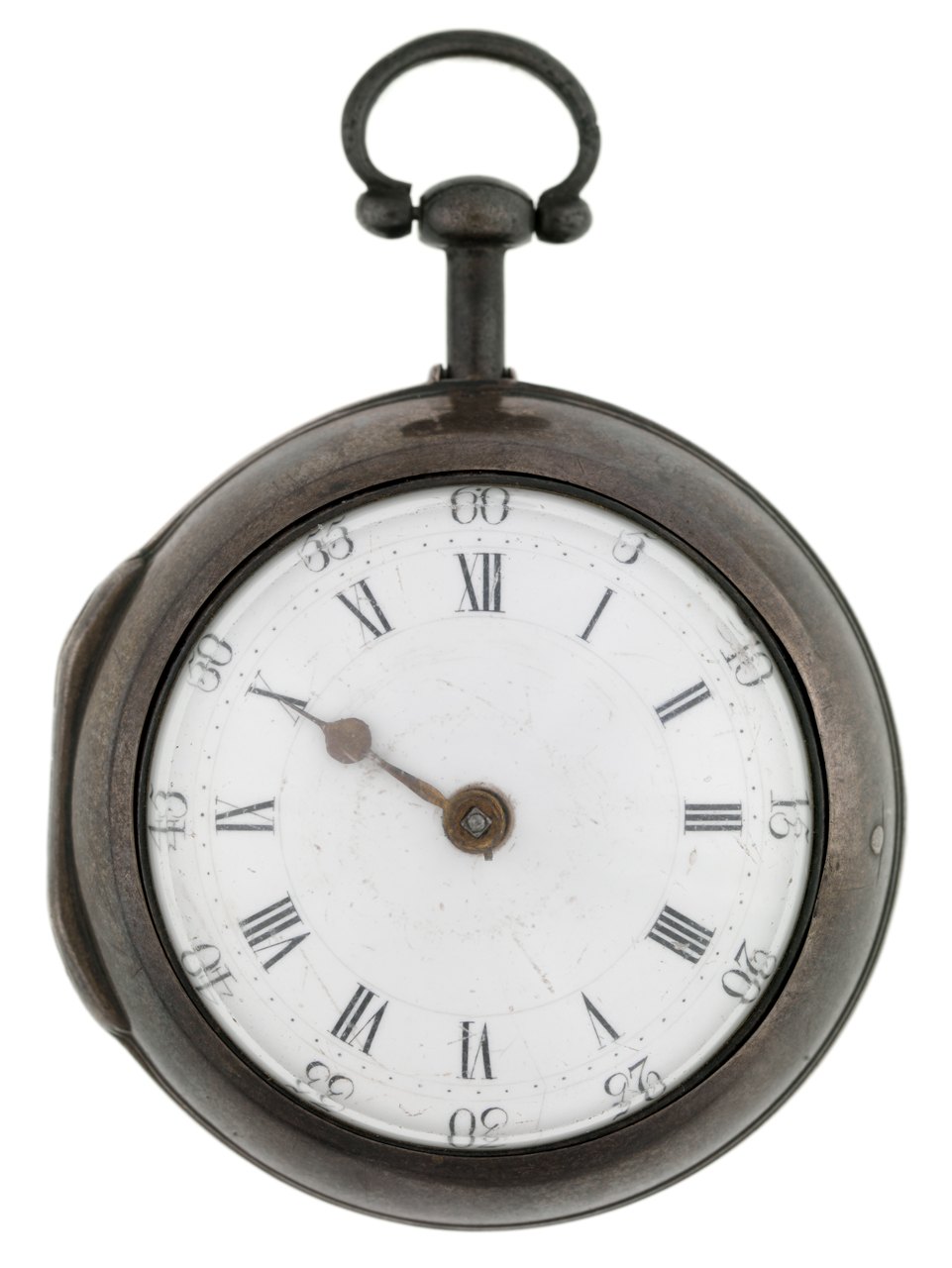
An ordinary watch of the late eighteenth century shows what most people actually carried. A silver pair-cased verge watch in the British Museum signed by D. Edmunds, its case of 1780 marked 'SP', has a white enamel dial and a verge escapement — a plain, serviceable watch of the kind made by the thousand. Its hands are not original, which is common: hands bent or broke easily and were replaced by any repairer.
Prescot, Clerkenwell and Coventry: the organisation of the trade
An English watch passed through many hands. Around Prescot in south-west Lancashire, workshops made movements 'in the rough' — plates, pillars, wheels and pinions — and sent them to finishers in London, Liverpool, Coventry and elsewhere. Specialist trades supplied springs, fusee chains, dials, hands, cases, engraving and gilding; fusee chains, for example, were made in large numbers at Christchurch in Dorset from the late eighteenth century. In London the trade concentrated in Clerkenwell. The finisher assembled, adjusted and signed the watch, or sold it to a retailer whose name went on the dial and plate.
This system produced excellent watches but resisted mechanisation. While Swiss makers moved to lighter bar movements without a fusee, and American factories after the 1850s made interchangeable parts by machine, the English trade kept the fusee and the full or three-quarter plate, and kept to key winding long after keyless winding was available. Ironically, one of the important keyless patents was English: Adolphe Nicole, a Swiss maker working in London, patented a keyless winding system in 1844.
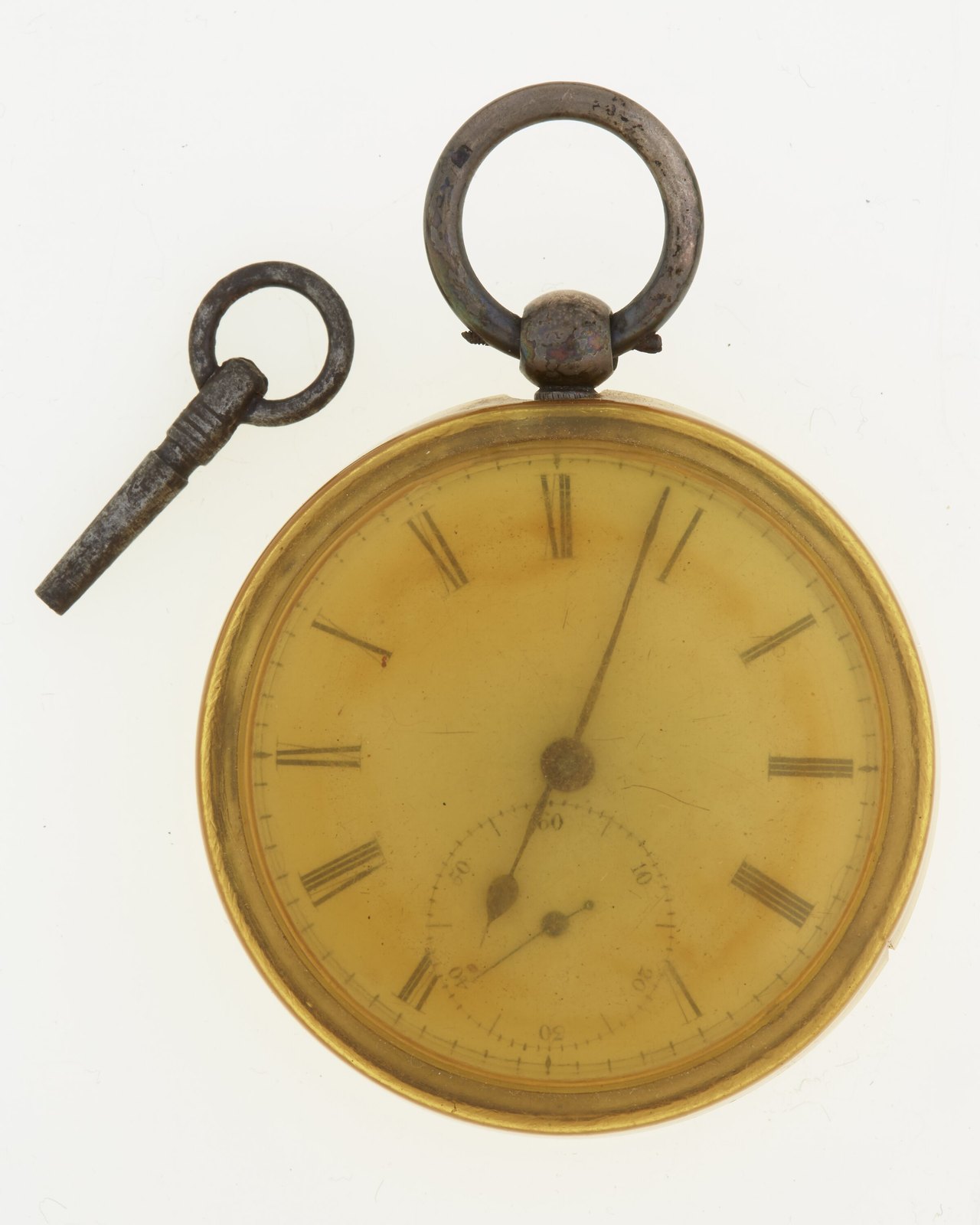
Liverpool's Robert Roskell was one of the largest producers of the early nineteenth century. A lever watch signed by him in Museums Victoria, no. 38724, is dated to about 1823 by its movement, but its case dates from 1850–51 — the watch was recased, perhaps after the original case wore out or was sold. A gold hunter by Rotherhams, presented in Ballarat in 1865, has an embossed case, a matt gold dial, a lever escapement and a fusee and chain: by the 1860s the fusee lever had become the standard English watch.
Railway watches and the end of the English trade
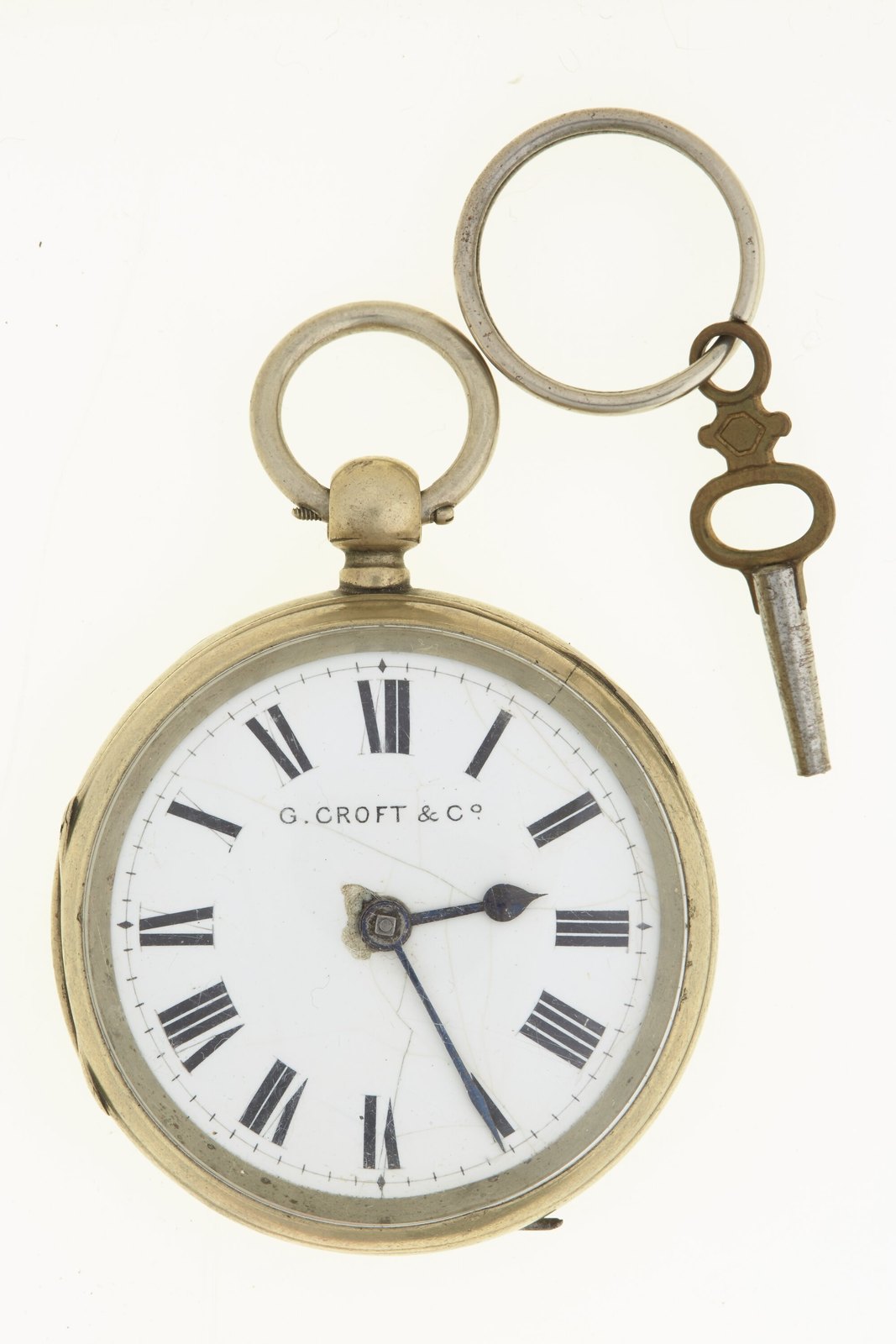
Railways created a demand for reliable, standardised watches in large numbers. A key-wound lever watch in a German silver case by G. Croft & Co. of Coventry and London, made about 1880, was, according to its donor, one of the first watches issued to staff of the Victorian Railways in Australia. It shows the English watch at its most practical: an open face, a plain white enamel dial with Roman numerals, a lever escapement and a key.
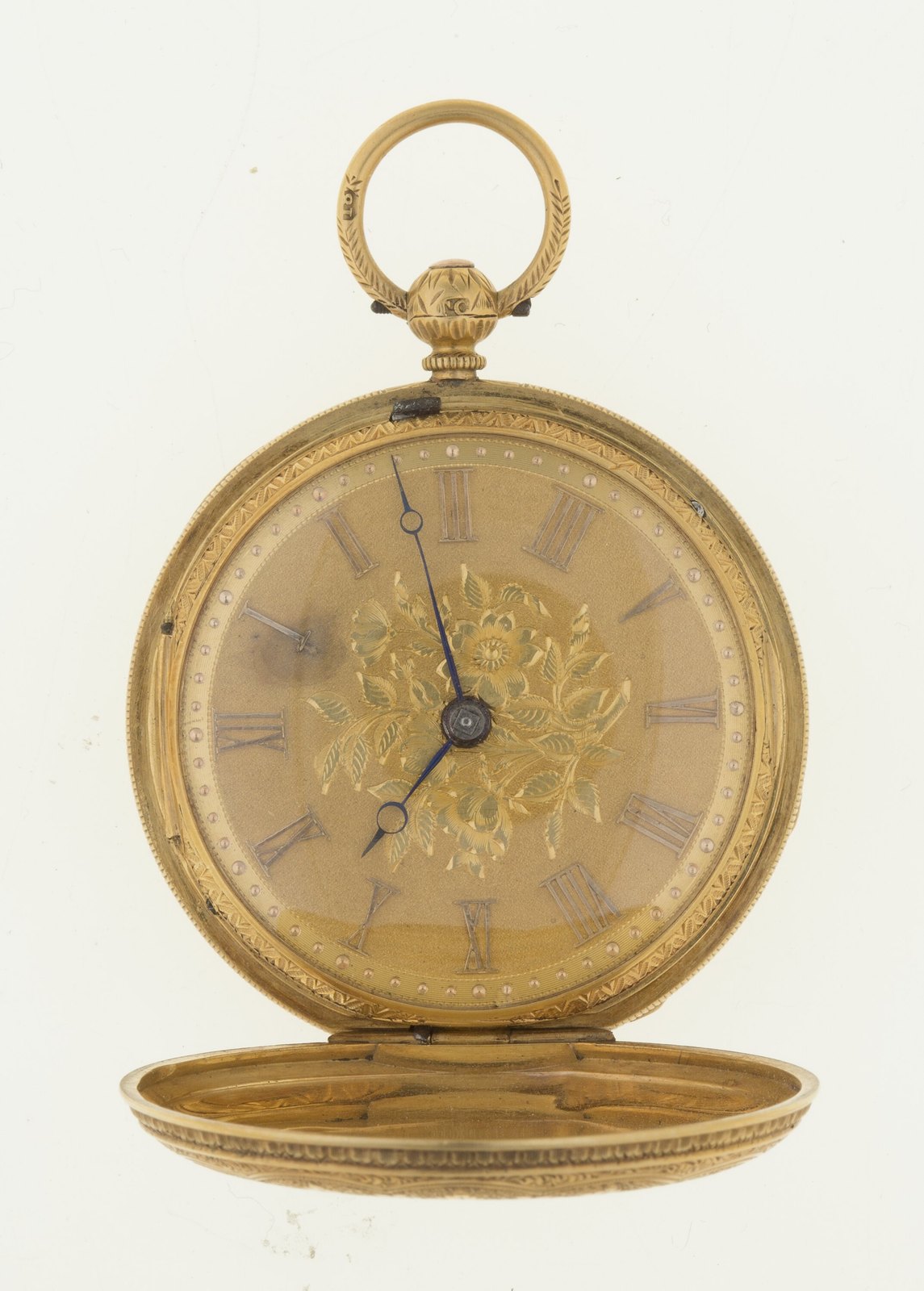
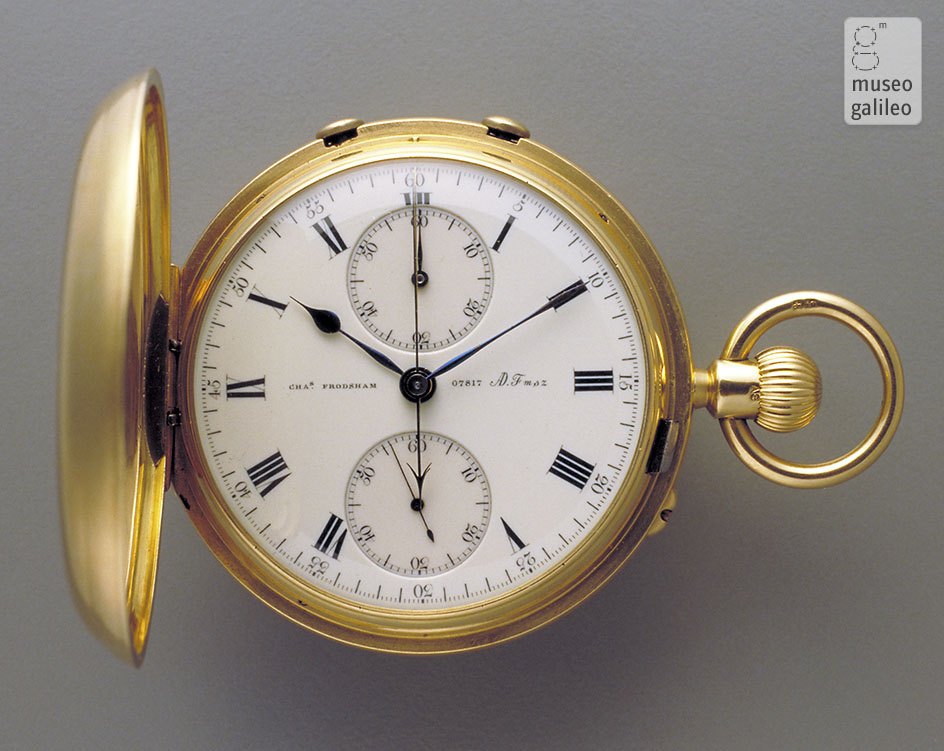
In the last decades of the century, some English makers tried factory production. The Lancashire Watch Company at Prescot, founded in 1889, set out to make complete watches by machine in the district that had supplied movements for two centuries; it closed in 1910. Coventry firms such as Rotherhams made machine-assisted watches. At the top of the market, London makers such as Charles Frodsham continued to make watches of the finest quality: a gold hunter of 1900 by Frodsham in the Museo Galileo has a three-quarter-plate movement, a lever escapement and a chronograph. The museum notes that the letters 'AD.Fmsz' on the dial are a cryptogram the firm adopted in 1850.
By then the volume market belonged to Switzerland and the United States. The English trade did not disappear — fine English watches, chronometers and deck watches were made into the twentieth century — but the system that had made London the centre of the watch world in 1700 could not compete with factories by 1900.
Checklist: reading an English pocket watch
- Look at the case: is it a pair case, a single case or a hunter? Find the hallmarks inside the case and lid, read the assay office and date letter, and note the casemaker's mark.
- Look at the dial and hands: champlevé or enamel? Single hand or two? Do the hands match the dial's period?
- Open the movement: verge (crown wheel visible under the balance cock), cylinder, lever or duplex? Is there a fusee and chain? Is the plate full, three-quarter or bar?
- Read the signature, town and number, and check the maker in a directory. Remember that the name may be the finisher's or the retailer's.
- Compare the evidence. If the case is much later than the movement, or the style of the dial does not fit the movement, the watch has probably been recased or altered.
- Record uncertainty. 'Movement c. 1770, case hallmarked 1798' is more useful than a single date that hides the difference.
Every record cited here links back to the institution that holds the object, and the catalogue pages give the full source descriptions, dimensions and inscriptions. The Atlas follows those records closely; where they disagree with each other or with published catalogues, both readings are shown.
Sources & further reading
- Watches — David Thompson, British Museum Press (London), 2008.
- Old Clocks and Watches and Their Makers — F. J. Britten, B. T. Batsford (London), 1899 (first edition).
- Watchmakers and Clockmakers of the World — G. H. Baillie, N.A.G. Press (London), 1929 (first edition).
- A History of Watches and Other Timekeepers — James F. Kendal, London, 1892.
- A Treatise on Watch-Work, Past and Present — Rev. H. L. Nelthropp, E. & F. N. Spon (London), 1873.
- Catalogue of Historical and Antique Watches from the Collection of Mr. Evan Roberts, Manchester — American Waltham Watch Company (exhibitor), Chicago, 1893.
- Watch and Clock Making — David Glasgow, Cassell & Company (London), 1885.
- Revolution in Time: Clocks and the Making of the Modern World — David S. Landes, Harvard University Press, 1983.