
Pocket Watches · Clock-watch
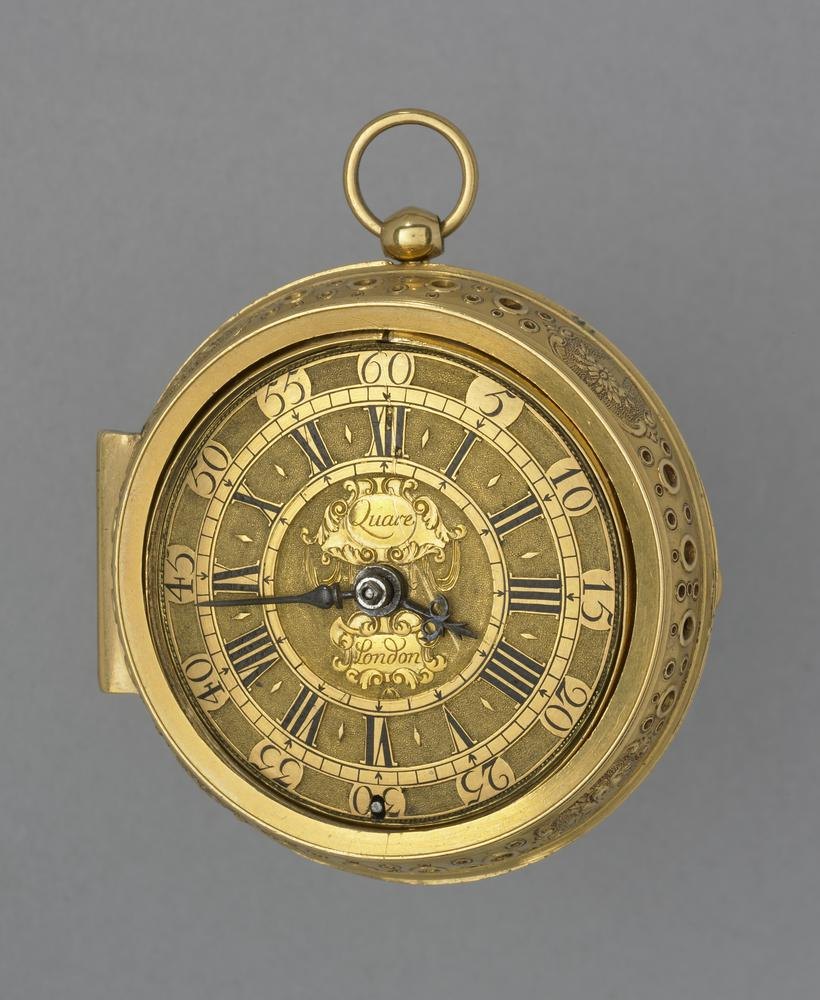
Gold pair-cased verge clock-watch
- Maker / attribution
- Daniel Quare (Made by); William Jaques (Case made by)
- Date
- 1693
- Historical period
- Early Modern Horology (1600 – 1750)
- Country of origin
- England
- Place
- London (England)
- Object type
- Clock-watch
- Dimensions
- Diameter: 52.70 millimetres (outer case)
- Holding institution
- British Museum
- Accession / object no.
- 1958,1201.231
- Credit line
- British Museum, London
- Catalogue title (original)
- Gold pair-cased verge clock-watch (English)
View the source record ↗ (opens another website in a new tab)Suggest a correction
Record summary
Held and catalogued by British Museum (object number 1958,1201.231), this is a clock-watch by Daniel Quare, made in London (England), dated 1693. The Atlas places it in the Early Modern Horology period (1600 – 1750) of its Pocket Watches collection. Recorded dimensions: Diameter: 52.70 millimetres (outer case). The record is illustrated with 4 photographs.
Assembled from the source record's structured fields. Dates and attributions are given as the source states them; where a field is missing the Atlas leaves it blank rather than estimating.
Catalogue description
Description — British Museum
Verge escapement. Gold champlevé dial. Blued-steel beetle and poker hands. Gold pair cases; pierced and engraved, outer embossed and with a shield of arms and crest.
Curator's comments — British Museum
Text from 'Watches', by David Thompson, London, 2008, p. 56-57. Daniel Quare GOLD PAIR-CASED VERGE CLOCK-WATCH LONDON, 1693 SIGNED: 'D. Quare London 0233' The celebrated London watchmaker Daniel Quare was a Quaker, born in Somerset, who became a Brother in the Clockmakers' Company in London in 1671, later serving as Master of the Company in 1708. Around 1715 he went into partnership with one of his former apprentices Stephen Horseman, and, following Quare's death in 1724, Horseman carried on the business until he was declared bankrupt in 1733. Quare's reputation was built on fine clocks and watches as well as a series of high-quality barometers, of which several survive. This does not mean that Quare made all the pieces himself. Like so many makers of the time he doubtless relied on other craftsmen to supply his materials. It is known, for instance, that he used the expertise of Joseph Williamson to produce a number of sophisticated longcase clocks with equation of time indication. Quare was not only involved in horological pursuits; as well as owning land, he had a half share in the trade of the East Country Company with a fellow watchmaker, Francis Stamper, and also had land interests with the Quaker community in America. This typical example of Quare watchwork shows why London was beginning to lead the world in watchmaking towards the end of the seventeenth century. Clock-watches, which automatically strike the hour like a clock, had existed since the early years of the watch in the first quarter of the sixteenth century. However, in London, following the introduction of the balance spring, their popularity seems to have been in decline. The quality of this watch is self-evident, with a finely pierced and engraved balance cock and tulip-form movement pillars. To control the striking, there is a small silver count wheel, which measures out the blows struck by a hammer on the bell housed inside the back of the inner case. The finely fashioned gold dial matches the gold pair-cases made for Quare by William Jaques, whose mark, 'WI', appears in both cases. Jaques was one of the leading casemakers in London at the end of the seventeenth century, and ran one of the more prolific workshops of the time, making cases not only for Quare but also for many other makers, including Joseph Windmills, Simon Decharmes and John Bushman. Born around 1665, in 1679 Jaques was apprenticed in the Clockmakers' Company, first to John Wright and then to Nathaniel Delander. In 1687 Jaques became a Freeman in the Clockmakers' Company and went on to serve as Master of the Company in 1716. His address was Angel Court, Snow Hill. When he died in 1719, the business was carried on by his widow, Sarah, who went into partnership with the casemaker John Lee, one of Jaques's former apprentices. The cases of this watch show the high-quality workmanship of William Jaques and his workshop. To allow the sound of the bell to escape, the outer case bezel is pierced with a series of graded roundels which alternate with baskets of flowers. The decoration of the case band echoes this design, and carries four portrait busts, two of them possibly of King William III and Queen Mary. The inner case is finely pierced with foliate scrolls, strapwork and birds and, in the middle of the back, a shield of arms: 'vairé argent and sable, a fesse gules, crest: a stump of a tree proper raguly argent. 'These are the arms of the Bracebridge family, of Atherstone Hall in Warwickshire, but also with branches in Lincolnshire and Suffolk. However, the style of the shield suggests that the arms 'were probably engraved at a later date and are not those of the first owner. Another clue to the history of the watch is a scratched inscription under the bell, which reads 'T. Dutton, Walsall Dec. 1830'. This suggests that the watch was repaired by Thomas Dutton, a clock- and watchmaker who was married in Walsall, Staffordshire, in 1815 and worked there until 1865.
Inscriptions & marks
signature; D.Quare. London o; 233 [back-plate]; inscription; Quare; London [dial]; hallmark; London 1693 [inner case]; casemaker's mark; W I [inner and outer cases]
Provenance
Previous owner/ex-collection:, Courtenay Adrian Ilbert; Acquired 1958
Historical context
Early Modern Horology (1600 – 1750)
Huygens' pendulum and balance spring transform accuracy; English makers develop the anchor and deadbeat escapements.
The balance spring (c. 1675) improved watches dramatically and introduced the minute hand. English pair-cased verge watches with pierced balance cocks and French oignons were typical; enamel painting at Blois and Geneva, and the repeating watch (1680s), made watches objects of great refinement.
Read the period in the timelineMore pocket watches from this periodEarlier: Renaissance Horology
Atlas type guide
Early spring-driven watches
Portable spring-driven timepieces appeared in southern Germany, France and Italy in the early sixteenth century; Peter Henlein of Nuremberg is traditionally credited, although the historical record is complex. These early watches were worn as pendants or carried, had iron or brass movements with a verge escapement and a foliot or small balance, and used a stackfreed or fusee to equalise spring force. They indicated hours only and were notoriously inaccurate.
From the later sixteenth century watches were made in Blois, Paris, Geneva, London and Augsburg in oval, octagonal, cruciform, skull and other 'form' cases of rock crystal, gilt brass, silver and enamel. They were jewellery and status objects as much as timekeepers.
What to look for
- A single hour hand and often a touch-pin hour ring for feeling the time.
- Stackfreed (a cam and spring) instead of a fusee on German watches.
- Pierced and engraved cocks over the balance, fine gut fusee lines.
- Rock-crystal, enamelled or engraved form cases.
Dating clues
- Drum-shaped German watches: c. 1530–1580.
- Oval and form watches: c. 1580–1650.
- Before c. 1675 there is no balance spring; watches can vary by many minutes a day.
General guidance written by the Atlas editors about this kind of object. It is not a statement about this particular piece; for that, rely on the source record above and on physical examination.
Read next:FuseeFoliotThe Melanchthon watch
Related records
Movements & Components · 1700
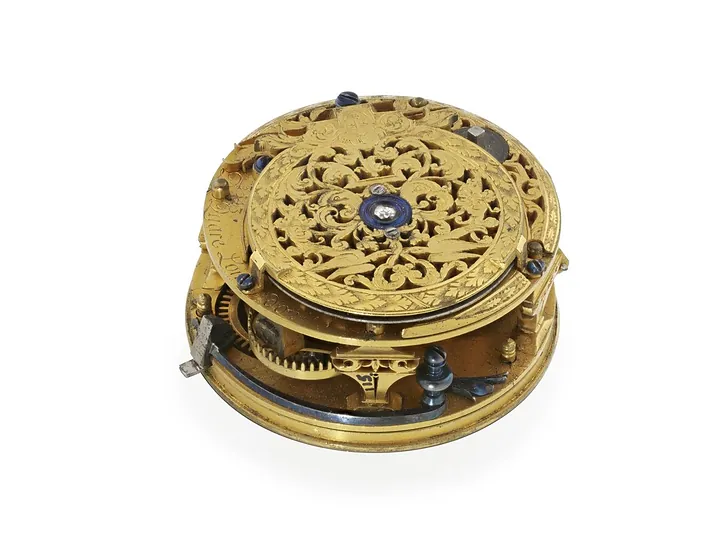
Watch movement by Daniel Quare, England, 1700
Science Museum Group, London
Pocket Watches · c. 1700
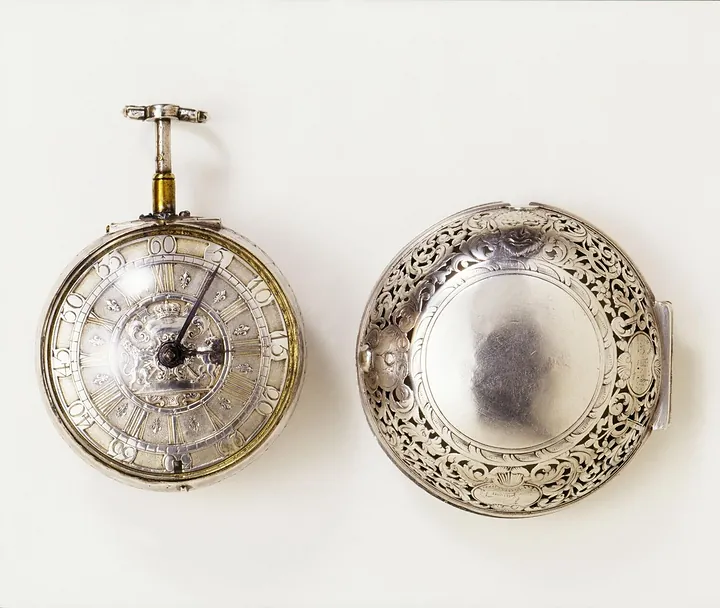
Watch by Daniel Quare, England, c. 1700
Victoria and Albert Museum, London
Pocket Watches · 1710
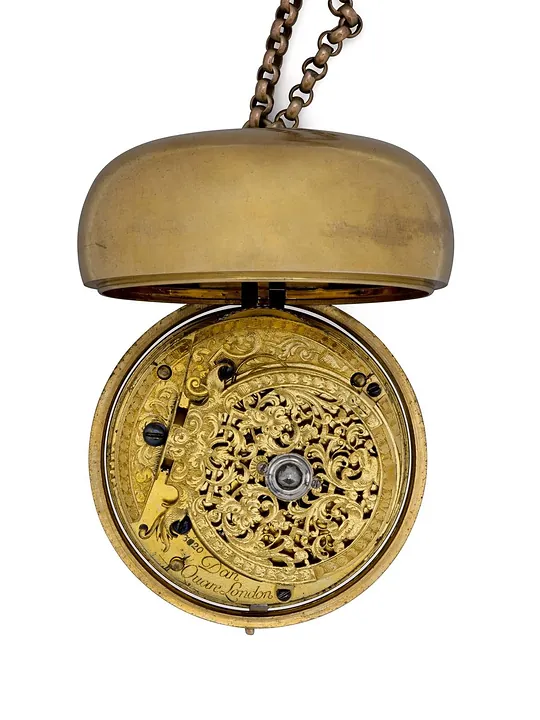
Pocket watch by Daniel Quare, England, 1710
Science Museum Group, London
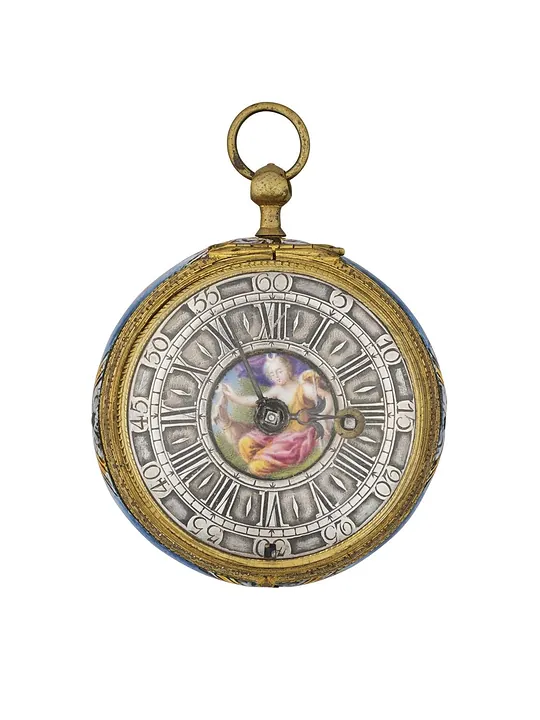
Pocket Watches · 1712
Pocket watch by Daniel Quare and Huaud Frères, England, 1712
Science Museum Group, London
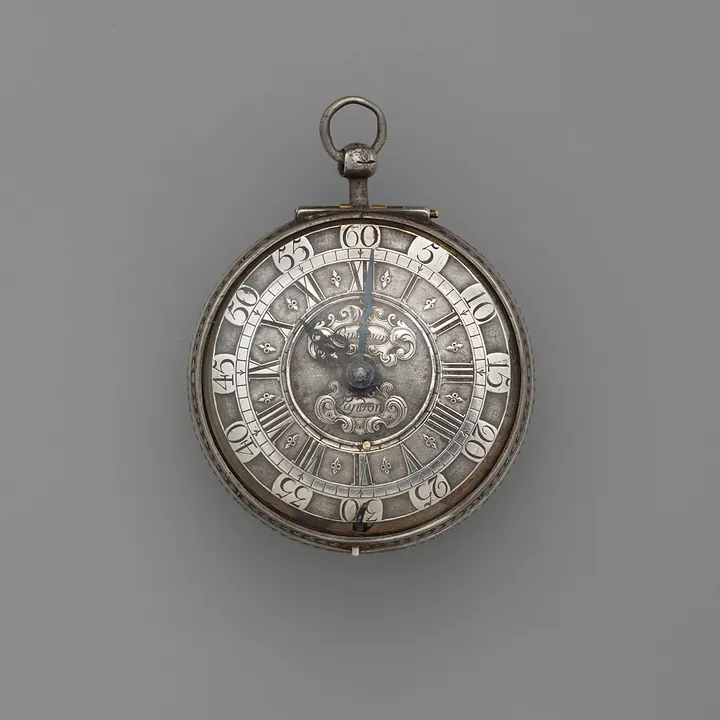
Pocket Watches · 17th century
Watch by John Bushman, England, 17th century
The Metropolitan Museum of Art, New York
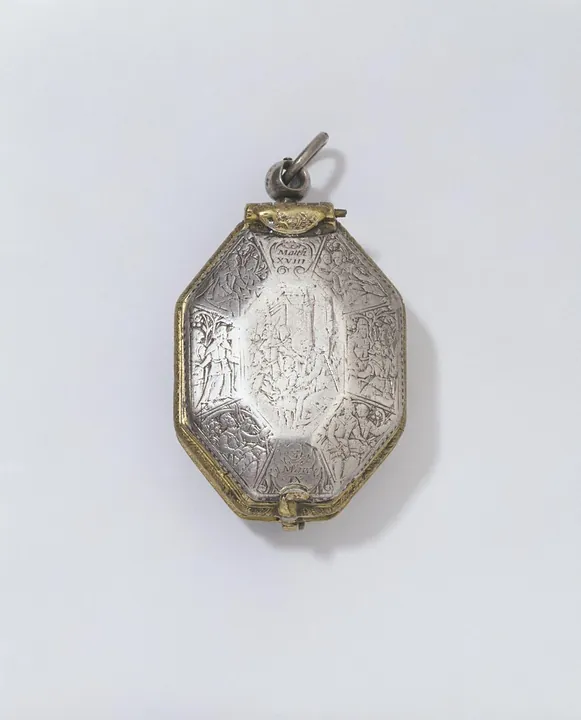
Pocket Watches · c. 1610-1620
Case and dial of engraved silver and gilt brass. English, about 1640.
Victoria and Albert Museum, London
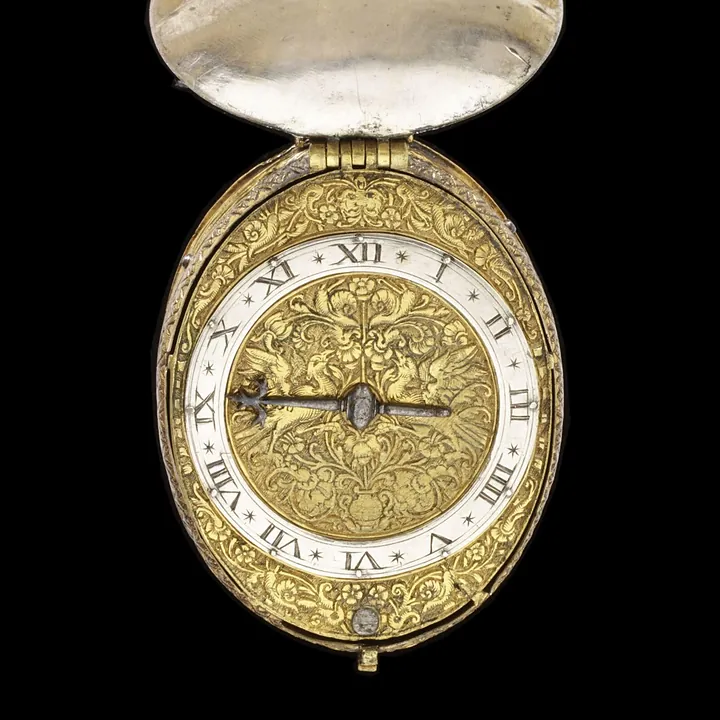
Pocket Watches · c. 1610
Watch by N. Ridgdale, England, c. 1610
Victoria and Albert Museum, London
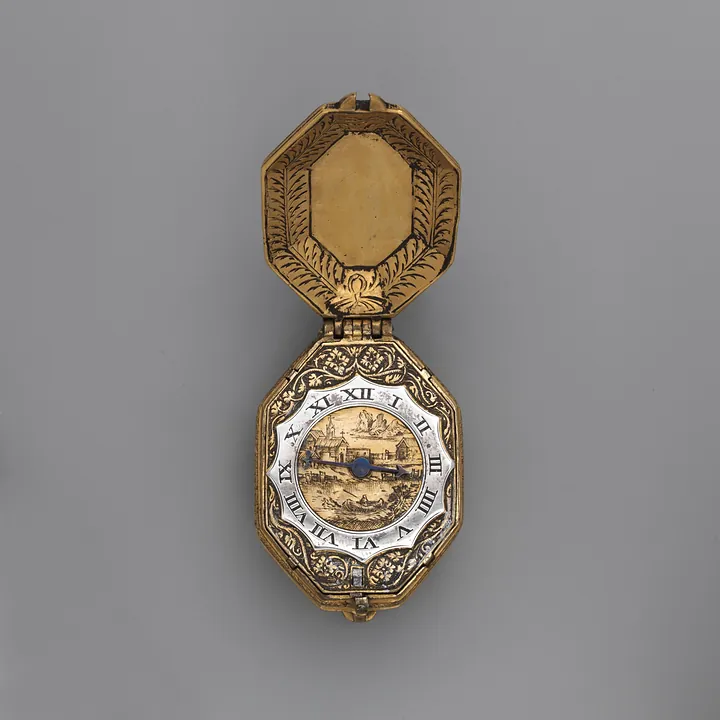
Pocket Watches · c. 1620–25
Watch by Isaac Symms, England, c. 1620–25
The Metropolitan Museum of Art, New York