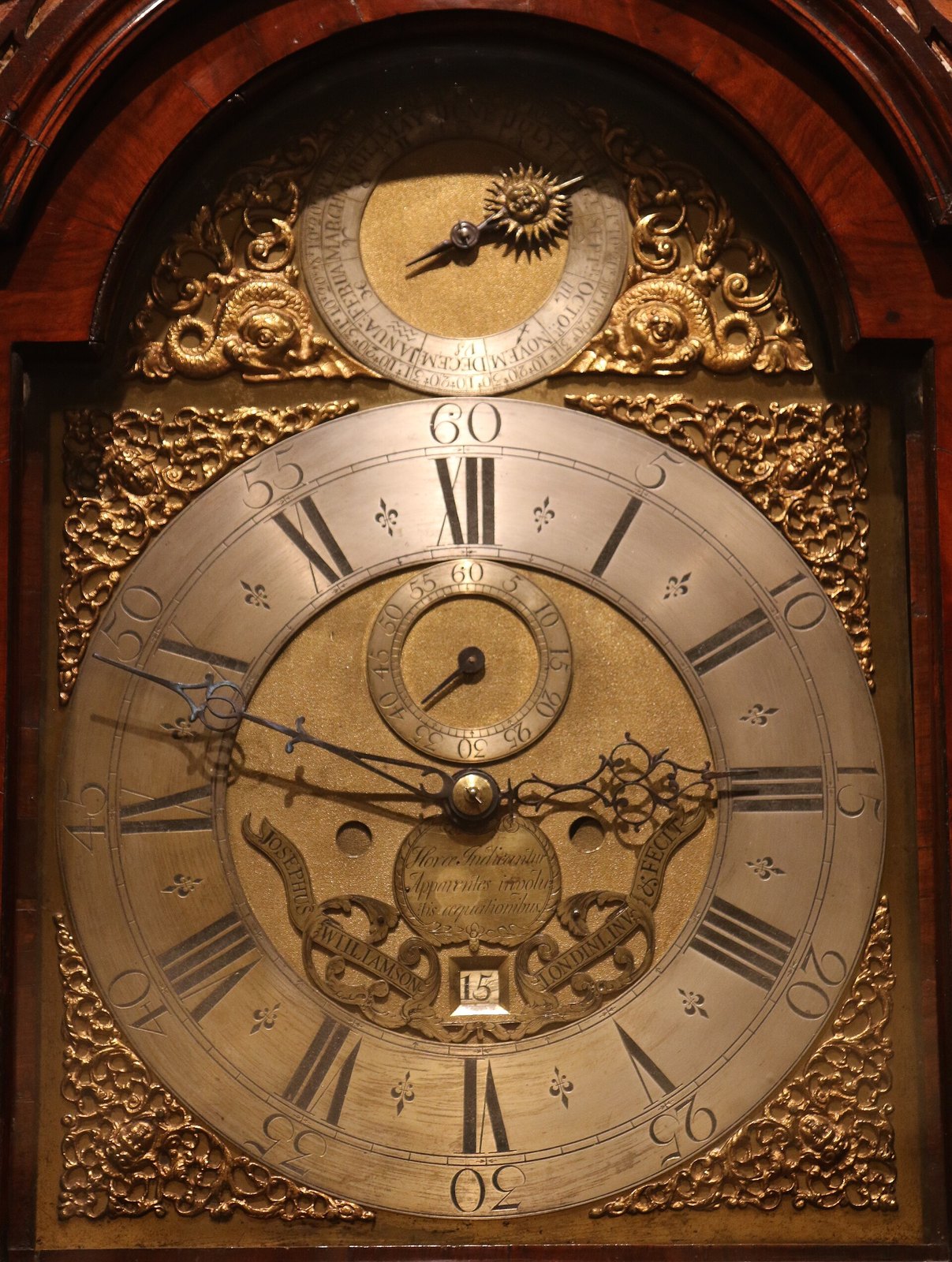
Complication
Equation of time
Also known as: Équation du temps · Zeitgleichung
How it works
A kidney-shaped cam turning once a year moves a hand or sector that shows the difference between mean time (as kept by a clock) and apparent solar time (as shown by a sundial). Running-equation displays add the correction to a second minute hand.
Why it was invented
When clocks became more regular than the sun, users needed to set them from sundials and to reconcile 'clock time' with 'sun time'.
- Invented
- c. 1695–1720
- Credited to
- Associated with Daniel Quare, Thomas Tompion and Joseph Williamson
- Historical period
- Early Modern Horology
- Range
- ≈ −14 min 15 s (Feb) to +16 min 25 s (Nov)
- Zero crossings
- Mid-April, mid-June, early September, late December
History and development
Equation clocks were made in London around 1695–1720; Joseph Williamson claimed in 1719 to have made equation work for the Spanish court. The difference reaches about −14 minutes in February and +16 minutes in early November.
Related mechanisms
In the catalogue
Open in the catalogue →
Clocks · ca.1720
Longcase clock by William Halstead, England, ca.1720
Victoria and Albert Museum, London
Instruments · 1801-1850
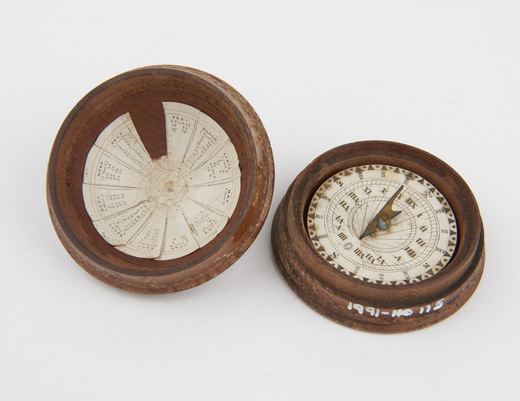
Horizonal magnetic sundial in wooden case with equation of time table in the lid, glass cover missing. English first half of the 19th century
Science Museum Group, London
Records are linked when the holding institution's description names this mechanism; check each source record for confirmation.