Clocks · Longcase clock
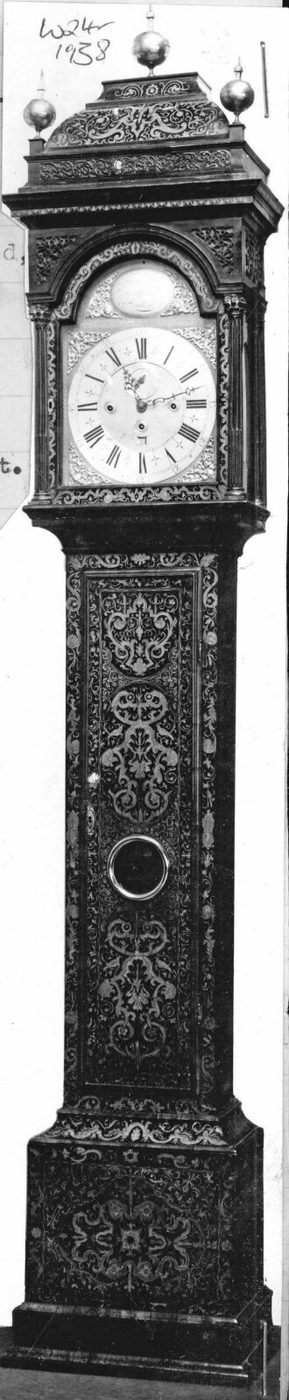
Longcase clock by William Halstead, England, ca.1720
- Maker / attribution
- William Halstead (made)
- Date
- ca.1720
- Historical period
- Early Modern Horology (1600 – 1750)
- Country of origin
- England
- Place
- London
- Object type
- Longcase clock
- Materials / technique
- Oak, veneered with walnut, inlaid with rosewood, sycamore, pear and walnut
- Dimensions
- Height: 291.5 cm; Width: 58 cm; Depth: 31 cm; Weight: 8.5 kg (W.24:4-1938 weight 10/10/2025 NH); Weight: 7.15 kg (W.24:3 weight 10/10/2025 NH); Weight: 6.3 kg (W.24:2 weight 10/10/2025 NH)
- Holding institution
- Victoria and Albert Museum, London
- Accession / object no.
- W.24:1 to 8-1938
- Credit line
- Bequeathed by Mrs A. Anderson as a memorial to her husband and his family, formerly of Swinethwaite Hall, Wensleydale, Yorkshire
Record summary
Held and catalogued by Victoria and Albert Museum, London (object number W.24:1 to 8-1938), this is a longcase clock by William Halstead, made in London, England, dated ca.1720. The Atlas places it in the Early Modern Horology period (1600 – 1750) of its Clocks collection. Materials and techniques recorded by the source: Oak, veneered with walnut, inlaid with rosewood, sycamore, pear and walnut. Recorded dimensions: Height: 291.5 cm; Width: 58 cm; Depth: 31 cm; Weight: 8.5 kg (W.24:4-1938 weight 10/10/2025 NH); Weight: 7.15 kg (W.24:3 weight 10/10/2025 NH); Weight: 6.3 kg (W.24:2 weight 10/10/2025 NH). The record is illustrated with 4 photographs.
Assembled from the source record's structured fields. Dates and attributions are given as the source states them; where a field is missing the Atlas leaves it blank rather than estimating.
Catalogue description
V&A — Summary
William Halstead was apprenticed to his mother, Dorothy, and became a member of the Clockmaker’s company in 1715. The seaweed marquetry on the case of this clock is extremely elaborate; even the gaps between the three oval panels on the clock door are decorated with more marquetry. The dome above the clock face, in which the maker’s name is inscribed, marks this as one of the later pieces in this row, as it came into fashion after around 1700. They had originally been introduced to accommodate a calendar or an equation of time register. In some cases, such as this one, however, they were just used for decoration. This clock also possesses three winding holes, unlike most of the other clocks to be seen here. The mechanism has been extensively repaired. The pendulum suspension is new, and the pallets have been reshaped.
V&A — Physical description
Dial: Break arch dial, the arch a separate entity from the 14 inch square dial, joined by two strips at back, fixed by rivets. Attached to front plate by four dial feet, pinned to movement. Both parts of dial bordered by wheatear engraving, resulting in a double engraved border between top of the square portion and bottom of arch. A small margin of plain, polished brass between the wheatear border and dial plate edge is visible along top edge of square part of dial but absent from bottom of break arch. The square portion with matted dial centre, ringed winding holes and seconds aperture. Rectangular calendar aperture behind which is silvered calendar ring. Twin cherubs with crown spandrels screwed to corners of dial plate, silvered chapter ring and subsidiary seconds ring pinned at the back of dial plate. Narrow minute divisions are set in from edge of chapter ring by reasonably broad scale having Arabic five minute numerals and half quarter arrow head marks. Roman hour numerals and quarter hour divisions with half hour arrow head marks. Seconds ring, with broad Arabic five seconds numerals, occupies much of upper dial space between inside of chapter ring and top of hour hand. In the arch, a silvered plaque, itself bordered by wheatear engraving and flanked by dolphin spandrels, bears the engraved signature William Halstead London . Hands: Steel hands, minute hand missing and seconds hand with tail. Movement: 8 day brass and steel weight driven, three train movement. Hour striking on bell controlled by inside locking plate and quarter chiming on six bells controlled by a countwheel mounted externally to front plate. Going train with recoil anchor escapement embracing 8½ teeth. Five pillar movement, the pillars having fins and a turned groove in the centre of each knop. One inside pillar has been filed down to allow space for a modification to the train. In general, arbors swell towards centres, collets (where used) of semi-circular section, pinion heads short and distinct. Exceptions include the quarter chiming pin arbor, which is parallel, its corresponding collet, which is of a two section profile, and both fly arbors, which are centrally grooved for the fly spring. All these pinions also have longitudinal groves extending into the arbor beyond the pinion head. Where visible without dismantling, train gear wheels have scribe lines, one line immediately below teeth, the other at base of semi-circular crossings. Lines absent on escape wheel. Backcock with one set of steady pins finished flush, screw holes oval shaped. Back plate with plugged holes and surplus steady pin holes. Vacant holes present elsewhere on front and back plates. Outsides of plates with a circular finish. Description and notes by Francis Brodie, c. 2008 Case: The tall case is surmounted by a hood with an arched top to the door, with, above, a stepped, domed cresting, topped with three brass ball-and-shaft finials. The hood has openwork fret spandrels, the Corinthian pillars flanking the door with brass bases and capitals. The door to the base is fitted with a circular observation disc in a brass frame. The case is decorated all over with scrolling marquetry, including addorsed birds, the whole arranged symmetrically,with narrower bands of marquetry framing the elements of the case.
V&A — Object history
Given by Mrs A Anderson [RP 1829/38] Comments: Dial: When studied closely, it will be seen that the break arch dial is made from two pieces, a detail not unknown in early versions. However, in this example, the join has resulted in the unusual double wheatear engraved border along the base of the arch; normally, where present, this border would be single. It would appear, therefore that the dial started out square and was converted to break arch. At what date this was carried out is uncertain but the style of the wheatear engraving is similar on both square and arch portions. The back of the dial plates do differ slightly in appearance, the arch piece being slightly more porous and redder than the square piece. The square dial portion may be dated to the early years of the 18th century owing to its size — twelve inches superseding lesser sizes by ca.1700 — design of spandrels, the proportions of the chapter ring, and the widening of the Arabic minutes scale. Turning to the break arch, few tended to appear before 1715 (although notable exceptions exist), the design only becoming established by the first quarter of the 18th century. It is therefore possible that in this example, the break arch was added at about the time the dial was originally made. The dolphin type spandrels seen in the arch started to appear around 1715. The alternative is that the arch was added later so that the clock could be fitted up to a suitable case. However, the case appears to be early 18th century whilst the two dial plate borders appear to have been engraved in a very similar style. On the other hand the double wheatear border is unusual and inside the case, supplementary pieces have been added to the chops on which the seatboard locates, sometimes an indication of a 'marriage'. Movement: Its details are consistent with the dating of the square dial in for example the profiles of pillars, pinion heads and collets, the scribe lines on the wheel faces and the locking plate controlled striking and chiming work. Additionally, some parts of the steel work exhibit vestiges of decoration: the striking levers and the barrel clicks end in carved semi-circles. In later work, such details would have been absent. Some modifications have occurred to the escapement and this would account for one of the pillars being reduced, whilst the broad pallet frame with a shallow drop to the arms is more typical of 19th and 20th century work. Further evidence for such alterations is found in modifications to backcock and backplate. Vacant holes in the front plate result most likely from a redundant front support for the quarter bell nest standard, whilst the unused threaded hole in the backplate is probably that of missing case fixing bracket. Finally, the shape of the flies indicates probable later replacements. Description and notes by Francis Brodie, c. 2008 Notes on file record that the clock was repaired by Mr Gildersleve 6 July 1972. He noted: 'Bad condition - Pallets re-shaped, cleaned - escape wheel tued & general overhaul'. An earlier note of 20 April 1972 had noted: 'Previously repaired but pendulum suspension broken when movement was removed by conservation dept. to repair case. New suspension made. £1'
V&A gallery label
EIGHT-DAY LONGCASE CLOCK Marquetry of walnut, rosewood, sycamore and pear, oak carcase with a walnut veneer Signed 'William Halstead, London', made about 1720 Bequeathed by Mrs A. Anderson as a memorial to her husband and his family formerly of Swinethwaite Hall, Wensleydale, Yorkshire, in 1938 Museum number: W.24-1938 William Halstead was apprenticed to his mother, Dorothy, in 1706 and became a member of the Clockmaker's Company in 1715. The arabesque marquetry on the case of this clock is extremely elaborate; larger scale orname with birds in oval panels on the clock door are set in a filed of smaller scale marquetry. The break arch above the clock face became fashionable after around 1700. It was originally introduced to accommodate a calendar or an equation of time register. In this case it is just a decorative feature and may be a later alteration. The weight-driven three-train movement has hour striking on a bell controlled by an inside locking plate and quarter chiming on six bells controlled by a countwheel mounted externally to the front plate. [Label for the clock store, Blythe House, 1990s]
Inscriptions & marks
William Halstead London
Historical context
Early Modern Horology (1600 – 1750)
Huygens' pendulum and balance spring transform accuracy; English makers develop the anchor and deadbeat escapements.
Huygens's pendulum (1656–57) improved clock accuracy from about a quarter of an hour to under a minute a day. The anchor escapement (c. 1670) and the long seconds pendulum created the longcase clock; London makers such as Fromanteel, Knibb, Tompion and Quare led European clockmaking, and French makers created the Boulle pendule.
Read the period in the timelineMore clocks from this periodEarlier: Renaissance Horology
Atlas type guide
Longcase (tall-case or grandfather) clocks
The longcase clock was born from two seventeenth-century innovations: Christiaan Huygens's pendulum (1656–57) and the anchor escapement (c. 1670). A long seconds pendulum, nearly a metre long, swings with a small arc, and enclosing it together with the driving weights in a tall wooden case protected the mechanism and created a new piece of furniture. London makers such as Ahasuerus Fromanteel, Thomas Tompion and Joseph Knibb set the pattern.
By the eighteenth century longcase clocks were made throughout Britain, the Netherlands, Scandinavia (the Swedish Mora clock), France (the Comtoise from the Franche-Comté), Germany and colonial America. Eight-day movements with two weights became standard in better clocks; thirty-hour clocks with one weight and a rope or chain were cheaper alternatives.
What to look for
- Winding holes in the dial: two (eight-day, going and striking) or none (thirty-hour, pulled up by a chain).
- Brass dials with applied chapter rings (earlier) versus painted iron 'white' dials (after c. 1770 in Britain).
- Moon-phase arches, date apertures, seconds dials and maker's name on the dial.
- Case woods and style: ebonised, walnut marquetry, lacquer, oak or mahogany; regional styles from London, Lancashire, Scotland or America.
- Whether the movement and dial match the case — 'marriages' are common.
Dating clues
- Square brass dials suggest c. 1670–1720; arched brass dials c. 1715–1790.
- Painted (white) dials were made by Birmingham dial-makers from about 1772.
- Comtoise clocks with repoussé pendulums are mostly nineteenth century.
General guidance written by the Atlas editors about this kind of object. It is not a statement about this particular piece; for that, rely on the source record above and on physical examination.
Read next:Anchor escapement
Related records
Clocks · 1598-1603
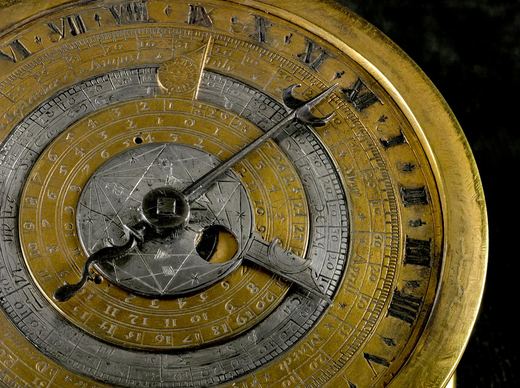
Circular table-clock with calendrical and lunar indications made by Nicholas Vallin in London between 1598 and 1603.
Science Museum Group, London
Clocks · 1611
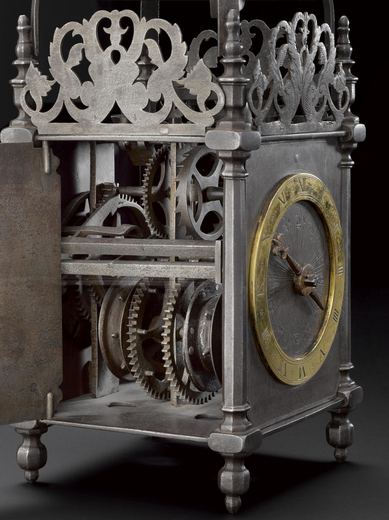
English iron lantern clock, with wheel balance, by John Holloway, Market Lavington, Wiltshire, England, 1611.
Science Museum Group, London
Clocks · 1630
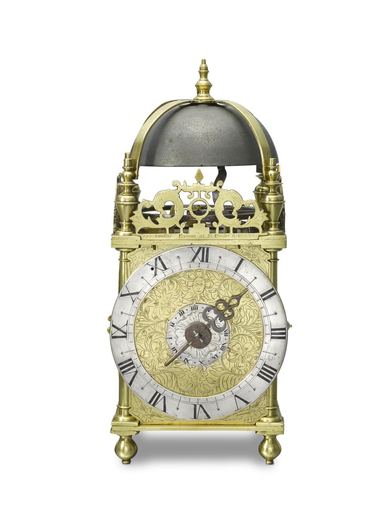
Lantern clock by Forman, Francis, England, 1630
Science Museum Group, London
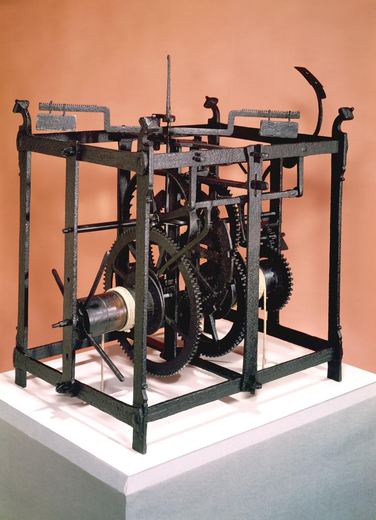
Clocks · 1632-1640
Turret clock, England, 1632-1640
Science Museum Group, London
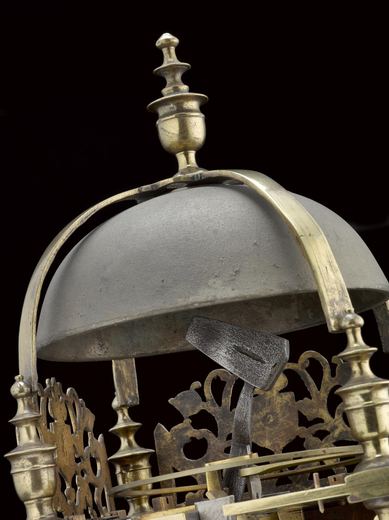
Clocks · 1645-1655
Balance-wheel brass lantern clock, with two driving weights and one counterweight, by Thomas Knifton, Cross Keys, Lothbury, London, England, 1645-1655.
Science Museum Group, London
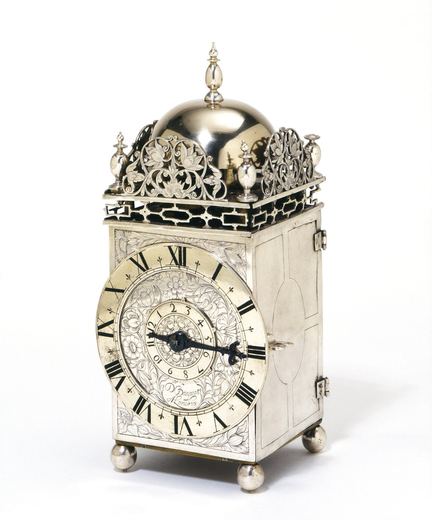
Clocks · ca. 1650
Lantern alarm clock, silver, by David Bouquet, circa 1650
Victoria and Albert Museum, London
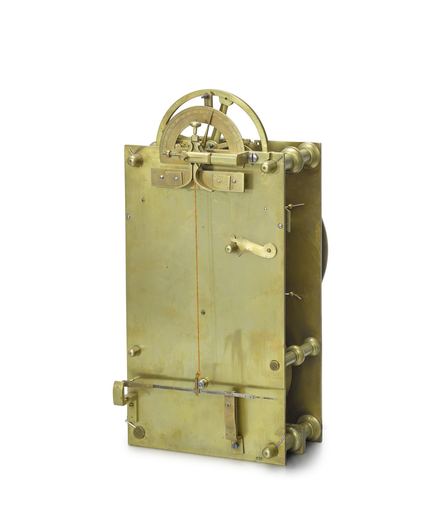
Clocks · 1650-1660
Lantern clock by Closon, Peter, England, 1650-1660
Science Museum Group, London
Clocks · ca. 1660
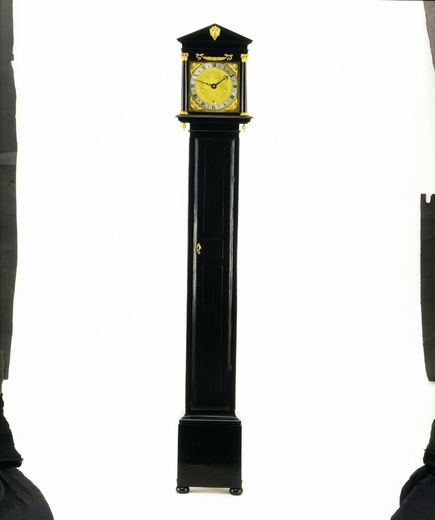
Longcase clock, ca. 1660, English, made by Ahasuerus Fromanteel
Victoria and Albert Museum, London