Clocks · Longcase clock
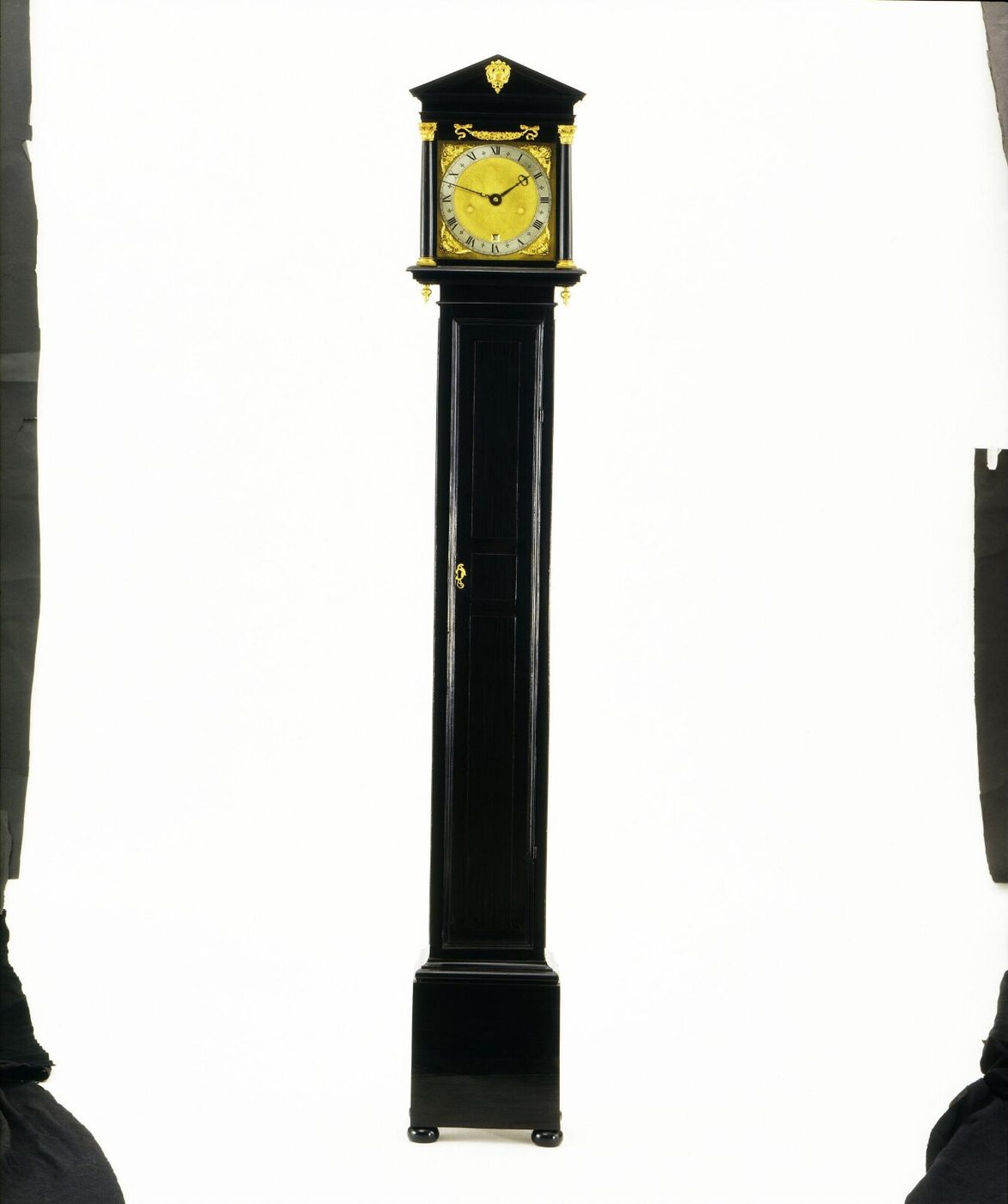
Longcase clock, ca. 1660, English, made by Ahasuerus Fromanteel
- Maker / attribution
- Ahasuerus Fromanteel (maker)
- Date
- ca. 1660
- Historical period
- Early Modern Horology (1600 – 1750)
- Country of origin
- England
- Place
- London
- Object type
- Longcase clock
- Materials / technique
- Oak, with veneer of ebony and stained hardwood, and gilt-bronze mounts
- Dimensions
- Height: 189.3 cm; Width: 31.8 cm; Depth: 19.8 cm; Height: 27 cm (base); Weight: 5.45 kg (w.10:2 Brass weight 10/10/2025 NH); Weight: 5.2 kg (w.10:3 Brass weight 10/10/2025 NH)
- Holding institution
- Victoria and Albert Museum, London
- Accession / object no.
- W.10:1 to 6-1963
- Credit line
- Given by Brigadier W. E. Clark CMG, DSO through Art Fund
Record summary
Held and catalogued by Victoria and Albert Museum, London (object number W.10:1 to 6-1963), this is a longcase clock by Ahasuerus Fromanteel, made in London, England, dated ca. 1660. The Atlas places it in the Early Modern Horology period (1600 – 1750) of its Clocks collection. Materials and techniques recorded by the source: Oak, with veneer of ebony and stained hardwood, and gilt-bronze mounts. Recorded dimensions: Height: 189.3 cm; Width: 31.8 cm; Depth: 19.8 cm; Height: 27 cm (base); Weight: 5.45 kg (w.10:2 Brass weight 10/10/2025 NH); Weight: 5.2 kg (w.10:3 Brass weight 10/10/2025 NH). The record is illustrated with 4 photographs.
Assembled from the source record's structured fields. Dates and attributions are given as the source states them; where a field is missing the Atlas leaves it blank rather than estimating.
Catalogue description
V&A — Summary
Object Type This clock is housed in a long case veneered with ebony on oak. The lift-up hood is glazed on three sides. At the corners it has attached Corinthian columns with gilt-bronze bases and capitals. They support a pediment with a gilt-bronze cartouche and laurel swags. The acorn finials beneath the front columns on the hood suggest that the clock was originally designed to be hung on a wall, but was later adapted as a long-case clock. The present pendulum is only 7 inches long. People There were three clockmakers with the name of Ahasuerus Fromanteel working in London from 1630 onwards. This is probably the work of the second, who became a Freeman of the Clockmakers' Company in 1655. His family were of Flemish origin and had settled in East Anglia in the 16th century. Design & Designing Ahasuerus Fromanteel introduced the use of the pendulum for clockwork to Britain. He learned of the development through his son John, who worked for eight months in 1657-1658 with the clockmaker Salomon Coster in The Hague. Coster had obtained the rights for the pendulum from Huygens.
V&A — Physical description
This clock is housed in a long case veneered with ebony on oak. The lift-up hood is glazed on three sides. At the corners it has attached Corinthian columns with gilt-bronze bases and capitals. They support a pediment with a gilt-bronze cartouche and laurel swags. The acorn finials beneath the front columns on the hood suggest that the clock was originally designed to be hung on a wall, but was later adapted as a long-case clock. The present pendulum is only 7 inches long. One key. Two weights: lead with brass case, each marked 5.2kg (diameter: 7cm, height excl. ring: 13.5cm) Condition: the cartouche described as a modern replica on file note.
V&A — Historical context
In October and November 1658 an advertisement appeared in the Mercurius Politicus and the Commonwealth Mercury (both published in London) which read,' There is lately a way found out for making Clocks that go exact and keep equaller time than any now made without this Regulater (examined and proved before his Highness the Lord Protector, by such Doctors whose knowledge and learning is without exception) and are not subject to alter by change of weather, as others are, and may be made to go a week, or a moneth, or a year, with once winding up, as well as those that are wound up every day, and keep time well; and is very excellent for all House Clocks that go either with Springs or Waights; And also Steeple Clocks that are most subject to differ by change of weather. Made by Ahasuerus Fromanteel, who made the first that were in ENGLAND. You may have them at his house, on the Bank-side in MOSSES-ALLEY, SOUTHWARK, and at the sign of the Maremaid in LOTHBURY, near BARTHOLOMEW LANE end LONDON'. Quoted in R.A. Lee 'The Knibb Family...' (1964), p.12
V&A — Object history
Given by Brigadier W E Clark, C.M.G., D.S.O. through the National Art-Collection Fund RF 63/1987 Conservation history Restored by Danial [sic] Parkes c1953 (See ref below to Ronald Lee) June 1972: Mr Gildersleve treated the clock - cleaned; general overhaul. Striking fly repaired, crown wheel pivot repolished, strike lifting lever repaired. The clock was displayed running from December 2001 to c.2010 Notes from R.P. 63/1987 29 July 1963 letter, Mallet to Molesworth The clock is to be sent to the V & A from Mallet Minute paper (undated & unsigned) Refers to this "not too undesirable bequest…an early Fromanteel clock showing the first development of the long case clock" 19 September 1963 letter, Ronald Lee to Hayward (attached) reports "this type of clock exists in such small numbers that this acquisition…(is) one of importance". The clock had passed through his hands ten years earlier and he recalls certain repairs & replacements and some details of provenance. He agrees with the possibility of its having started out as a hanging clock. This letter appears to be a response to an enquiry but no such enquiry is on file in the R.P. "It must be ten years ago since the clock passed through my hands and I must come and see it some time to refresh my memory. I do recall that the verge escapement was replaced and the hole in the dial where a sunk seconds -Indicator had been cut was filled in and matted over. A very difficult job but very well executed by Danial Parkes. The inverted finials under the hood were replaced, some other mounts and the plinth added. This plinth was, of course, a mistake and it should have bun feet. The clock belonged to an old Jersey family who moved to South Africa. When they arrived in South Africa they disliked the country and sold up everything except the clock. They returned to Jersey bringing the clock with them and having arrived they then put it in a sale. A curious thing to have done after taking the bother of bringing it back, but this enabled me to buy it. I agree the possibility of its having started life as a hanging clock, but contemporarily altered. I would say that the escutcheon is correct and of a design used by the Fromanteels."
V&A gallery label
British Galleries: Christiaan Huygens (1629-1695) invented the pendulum in 1657 in The Netherlands, as a device to make clocks more accurate. By 1658 Ahasuerus Fromanteel was advertising clocks with the new mechanism in London. As a short, bob pendulum was used, the clock case could be made either square to hang on the wall, or long to enclose weights that hung down. Long cases quickly became popular.
Historical context
Early Modern Horology (1600 – 1750)
Huygens' pendulum and balance spring transform accuracy; English makers develop the anchor and deadbeat escapements.
Huygens's pendulum (1656–57) improved clock accuracy from about a quarter of an hour to under a minute a day. The anchor escapement (c. 1670) and the long seconds pendulum created the longcase clock; London makers such as Fromanteel, Knibb, Tompion and Quare led European clockmaking, and French makers created the Boulle pendule.
Read the period in the timelineMore clocks from this periodEarlier: Renaissance Horology
Atlas type guide
Longcase (tall-case or grandfather) clocks
The longcase clock was born from two seventeenth-century innovations: Christiaan Huygens's pendulum (1656–57) and the anchor escapement (c. 1670). A long seconds pendulum, nearly a metre long, swings with a small arc, and enclosing it together with the driving weights in a tall wooden case protected the mechanism and created a new piece of furniture. London makers such as Ahasuerus Fromanteel, Thomas Tompion and Joseph Knibb set the pattern.
By the eighteenth century longcase clocks were made throughout Britain, the Netherlands, Scandinavia (the Swedish Mora clock), France (the Comtoise from the Franche-Comté), Germany and colonial America. Eight-day movements with two weights became standard in better clocks; thirty-hour clocks with one weight and a rope or chain were cheaper alternatives.
What to look for
- Winding holes in the dial: two (eight-day, going and striking) or none (thirty-hour, pulled up by a chain).
- Brass dials with applied chapter rings (earlier) versus painted iron 'white' dials (after c. 1770 in Britain).
- Moon-phase arches, date apertures, seconds dials and maker's name on the dial.
- Case woods and style: ebonised, walnut marquetry, lacquer, oak or mahogany; regional styles from London, Lancashire, Scotland or America.
- Whether the movement and dial match the case — 'marriages' are common.
Dating clues
- Square brass dials suggest c. 1670–1720; arched brass dials c. 1715–1790.
- Painted (white) dials were made by Birmingham dial-makers from about 1772.
- Comtoise clocks with repoussé pendulums are mostly nineteenth century.
General guidance written by the Atlas editors about this kind of object. It is not a statement about this particular piece; for that, rely on the source record above and on physical examination.
Related records
Clocks · 1660-1665
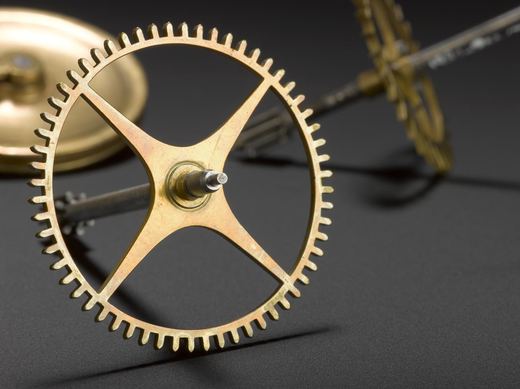
Brass anchor escape wheel from long-case clock made by Ahasuerus Fromanteel, London, 1660-1665..
Science Museum Group, London
Clocks · 1660–1665
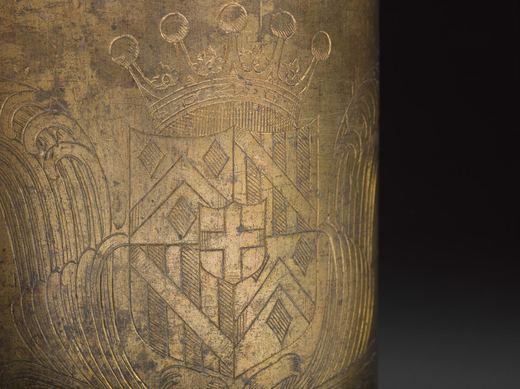
Long-case clock made by Ahasuerus Fromanteel, London, 1660-1665. In ebony case, with pendulum and box of parts.
Science Museum Group, London
Movements & Components · 1685
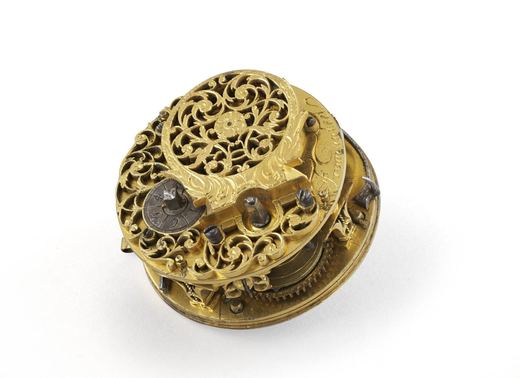
Watch movement by Fromanteel, Ahasuerus, Netherlands, 1685
Science Museum Group, London
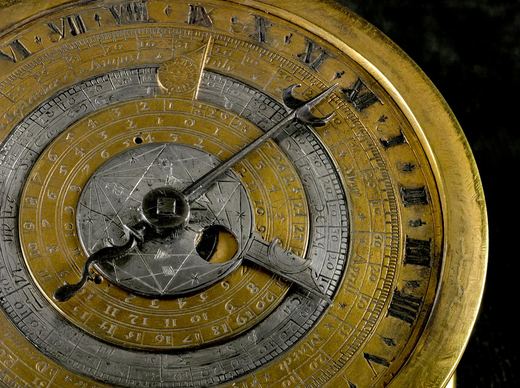
Clocks · 1598-1603
Circular table-clock with calendrical and lunar indications made by Nicholas Vallin in London between 1598 and 1603.
Science Museum Group, London
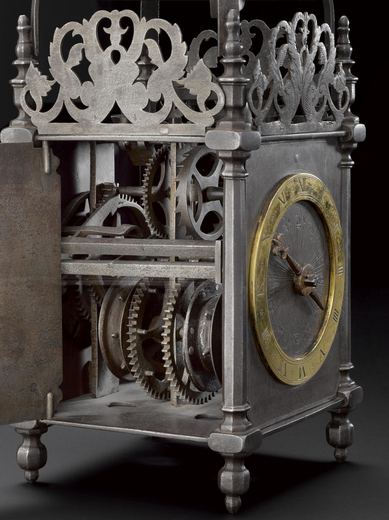
Clocks · 1611
English iron lantern clock, with wheel balance, by John Holloway, Market Lavington, Wiltshire, England, 1611.
Science Museum Group, London
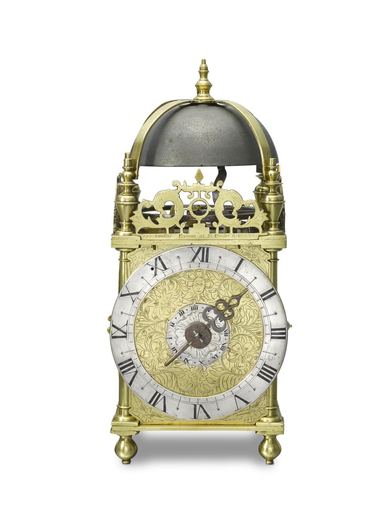
Clocks · 1630
Lantern clock by Forman, Francis, England, 1630
Science Museum Group, London
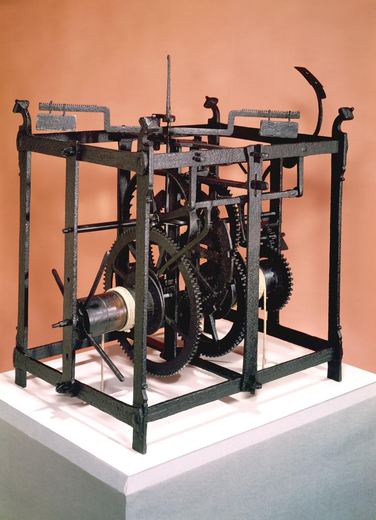
Clocks · 1632-1640
Turret clock, England, 1632-1640
Science Museum Group, London
Clocks · 1645-1655
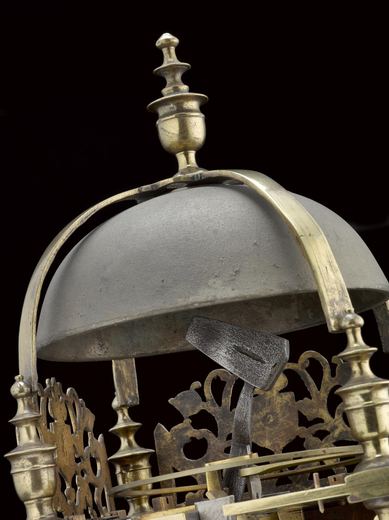
Balance-wheel brass lantern clock, with two driving weights and one counterweight, by Thomas Knifton, Cross Keys, Lothbury, London, England, 1645-1655.
Science Museum Group, London