
Pocket Watches · Watch
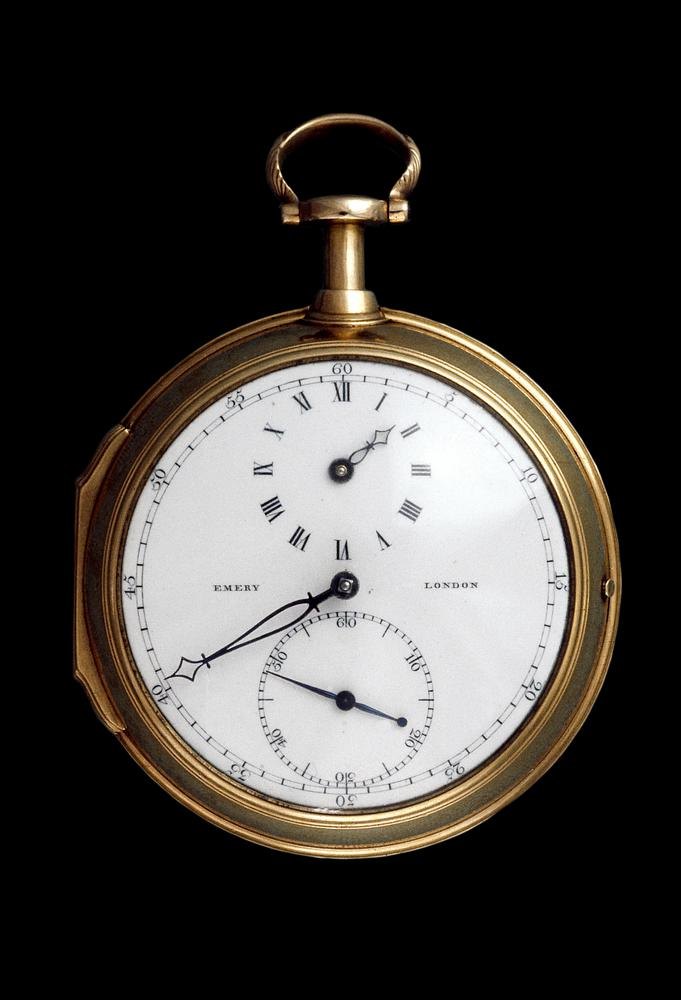
Watch by Josiah Emery
- Maker / attribution
- Josiah Emery (Made by); Valentine Walker (Case made by)
- Date
- 1786 (case)
- Historical period
- Precision & Scientific Horology (1750 – 1850)
- Country of origin
- England
- Place
- London (England) (Charing Cross)
- Object type
- Watch
- Dimensions
- Diameter: 55.80 millimetres (case)
- Holding institution
- British Museum
- Accession / object no.
- 1958,1201.1645
- Credit line
- British Museum, London
- Catalogue title (original)
- Watch by Josiah Emery (English)
View the source record ↗ (opens another website in a new tab)Suggest a correction
Record summary
Held and catalogued by British Museum (object number 1958,1201.1645), this is a watch by Josiah Emery, made in London (England) (Charing Cross), dated 1786 (case). The Atlas places it in the Precision & Scientific Horology period (1750 – 1850) of its Pocket Watches collection. Recorded dimensions: Diameter: 55.80 millimetres (case). The record is illustrated with 6 photographs.
Assembled from the source record's structured fields. Dates and attributions are given as the source states them; where a field is missing the Atlas leaves it blank rather than estimating.
Catalogue description
Description — British Museum
Watch. Full-plate movement with fusee Lever escapement; compensated balance. White enamel dial, gold hands. Gold case.
Curator's comments — British Museum
From the Burney Newspaper collection on line The arrangement of the dial on this 1786 watch corresponds the lost watch advertised in 1792 'The World', newspaper advertisement 14 December 1792 cites a twenty guinea reward for a lost 'large single case gold watch which opens at the bottom and winds up through the cap; with two small circles in the dial for hours and seconds and the larger one for minutes from the centre. Maker's name Josiah Emery No.898 Also a gold wire chain to it, with a gold seal, engraved with the signs of the Zodiac. Whoever brings the above to Mr.Josiah Emery, Watchmaker, Cockspur Street, Charing Cross, shall receive Twenty Guineas reward.' This indicates the high value of a gold watch bearing Emery's name during his life time. View more about curator's comments Text from 'Watches', by David Thompson, London, 2008, p. 98-99. Josiah Emery GOLD CASED WATCH WITH DETACHED LEVER ESCAPEMENT LONDON, 1786 SIGNED: 'Josiah Emery, Charing Cross, London 1089' Thomas Mudge's pioneering work in the 1750s and 1760s created a new type of escapement for portable timekeepers: the detached lever escapement.… His first example was incorporated into an experimental bracket clock that he made around 1750. His first watch with such an escapement was made for Queen Charlotte in 1769, and delivered some time in 1770. Mudge's escapement was in some ways based on George Graham's dead-beat escapement for clocks, but placed a lever between the escape wheel and the balance that would lock and unlock as well as imparting impulse to the balance. This would finally allow the oscillating balance to swing unencumbered except when it was acting with the lever to carry out the three functions, hence the name detached. However, Mudge's original concept was a complicated one, difficult to replicate, and it was not until the late 1770s/early 1780s that the escapement was developed by, among others, Josiah Emery. He employed a highly skilled escapement maker, Richard Pendleton, and the result of their combined efforts was a series of pocket watches incorporating Emery's escapement. Josiah Emery had come to London from his native Switzerland probably in the 1750s and established himself as a watchmaker in Warwick Street, 'Opposite Hedge Lane', in Soho. The son of Jacques Emery and Susanne-Marie Gammeter, he was baptized at Etagnieres near Chardonne on 11 November 1725. In adult life, his reputation as a watchmaker quickly grew and thus it is perhaps not surprising that he should gain the attention of Mudge's patron and supporter Count Maurice von Brühl, who would spur Emery on to develop Mudge's escapement. On the matter, Emery said: "About seventeen or eighteen years ago Count Bruhl repeatedly urged me to make him a watch upon an escapement Mr. Mudge had invented. I for a long time successively answered that Mr Mudge was the properist person for such an undertaking; for to own the truth, I doubted whether it would be possible to ever make a common sized pocket watch with an escapement on so large a scale. But the Count not contented with my repeated refusal, at last prevailed upon me. It was then he brought me a large frame, like a clock escapement, but at the same time he gave me no rules concerning it, nor any of the smallest hint of the construction of Mr Mudge's watch; nor did I ever see the said watch till many years after (for the Queen had it) and his Majesty himself did me the honor to shew it to me." Between 1782 and 1786 Emery produced a series of lever escapement watches, at least thirty-eight of which were made. This particular example is signed 'Josiah Emery, Charing Cross, London 1089' on the movement. The 18-carat-gold case is hallmarked 'London 1786' and bears the mark, 'VW', of the casemaker Valentine Walker. The white enamel dial is of the so-called 'regulator' type. The minutes are marked around the outside and there are separate subsidiary dials, for hours above the centre, and for seconds below. The movement is characteristic of Emery's watches, with finely gilded plates and a decoratively engraved bridge on the back plate for the balance. The balance is of a type designed by John Arnold and commonly known as the 'double S', referring to the two S-shaped bimetallic compensation devices attached to the balance arms, designed to obviate timekeeping errors caused by changes in temperature. View more about curator's comments Comment from Richard Good, Catalogue of Watches in the British Museum. Vol. V (Unpublished manuscript) Made by Josiah Emery London, 1786 Gold cased stop-watch with an early lever escapement Signature: On the back plate and repeated on the dust cover 'Josiah Emery Charing Cross London 1089'. Across the centre of the dial 'EMERY LONDON'. Case: Gold consular case with the London hallmark for 1786, the casemaker's mark VW (1) and a duty mark. The seven-knuckle book hinge combined for both front and back of the case which is without springs. A chased stirrup pendant. The centre of the back has a chased medallion with a crest, almost erased.(2) Dial & Hands: The flat, regulator style dial is retained by two dog screws set in the ends of the feet. The hands are of blued steel, the minute hand in the centre with the hour hand above and the seconds hand below. The hands are of an unusual design. Dial-Plate: Held by three screws under the dial, and the movement retained in its case by three dog screws in the dial plate. Dust-cap: A gilded brass dust-cap attached by bayonet lugs to pieces on the inside of the case. Made in two parts, a deep-sided drum with one end open, the other raised over the balance cock, and with three holes drilled in it; one for the dust tube around the winding square, the other two for pegs on the back plate of the watch to prevent the drum from turning. The other part of the dust cap is a moulded ring adjusted to turn free through a short angle on the drum. It carries the bayonet fixing to retain the cover on pegs set in the edge of the case. Movement E.
Inscriptions & marks
signature; Josiah Emery, Charing Cross, London. 1089.; hallmark; London 1786. [case]; casemaker's mark; V.W
Provenance
Previous owner/ex-collection:, Courtenay Adrian Ilbert, Previous owner/ex-collection:, Prince Augustus Frederick, Duke of Sussex; Acquired 1958
Historical context
Precision & Scientific Horology (1750 – 1850)
Harrison solves longitude; Mudge invents the lever; Breguet's Paris workshop defines the modern watch.
From 1750 to 1850 the watch became a precision instrument. Mudge's lever escapement, the cylinder escapement, Lépine's thin bar calibre, Breguet's innovations (overcoil, tourbillon, perpétuelle) and the pocket chronometer of Arnold and Earnshaw all date from this period, while verge watches remained common in cheaper production.
Read the period in the timelineMore pocket watches from this periodEarlier: Early Modern Horology
Atlas type guide
Pocket watches
The pocket watch was the dominant personal timekeeper from the late seventeenth century until the First World War. Its development tracks the history of the escapement: verge watches with fusees until the late eighteenth century; Thomas Mudge's lever escapement (c. 1755) and the cylinder escapement popularised by George Graham and later by Swiss makers; and the Swiss and English lever watches of the nineteenth century. Lépine's bar-bridge calibre and keyless winding made watches thinner and easier to use.
Industrialisation transformed the trade: American factories such as Waltham (from 1850) and Elgin produced interchangeable parts by machine, and Swiss makers responded with their own mechanisation after the 1876 Philadelphia Exhibition. By 1900 a reliable watch was affordable to millions; the finest makers continued to produce complications and precision watches.
What to look for
- The escapement: verge (crown wheel), cylinder, duplex, English or Swiss lever.
- Key winding (a square arbor in dial or back) or keyless crown winding.
- Signatures and serial numbers on the movement, dial and inside case back.
- Hallmarks, case maker's marks and gold or silver standards stamped in the case.
- Dial material: enamel, silver, gold, later printed metal.
Dating clues
- Verge watches dominate before c. 1800; cylinder watches c. 1770–1900; lever watches after c. 1820.
- Keyless winding: increasingly common after c. 1860.
- Manufacturer serial number lists exist for Waltham, Elgin, Longines, Omega, Patek Philippe and others.
General guidance written by the Atlas editors about this kind of object. It is not a statement about this particular piece; for that, rely on the source record above and on physical examination.
Read next:Verge escapementIdentification Centre
Related records
Movements & Components · 1792
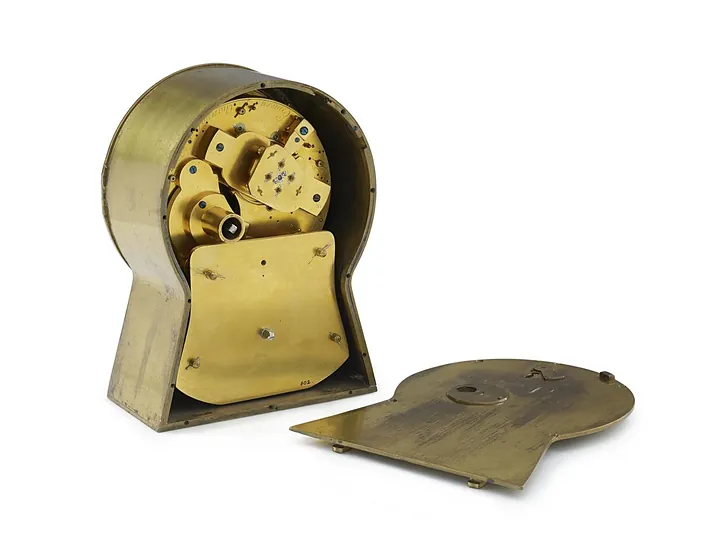
Escapement model by Josiah Emery, England, 1792
Science Museum Group, London
Movements & Components · c. 1780
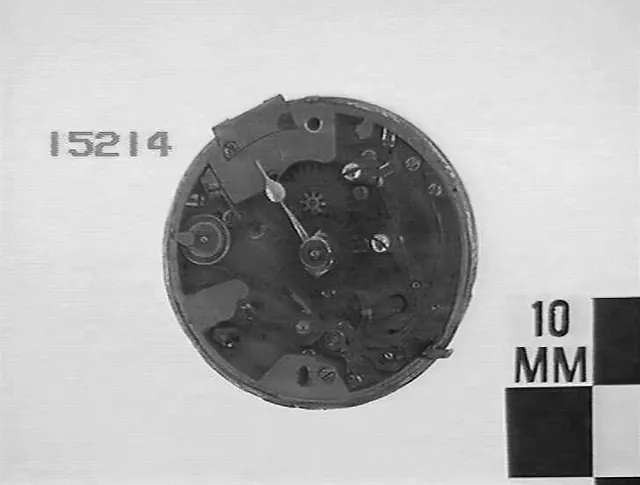
Pocket Watch Movement - Josiah Emery, London, c. 1780
Museums Victoria, Melbourne
Pocket Watches · c. 1780
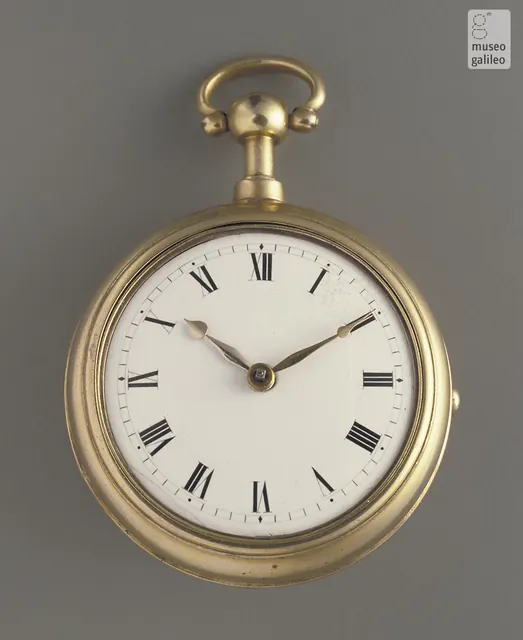
Double-case watch by Josiah Emery, England, c. 1780
Museo Galileo, Florence
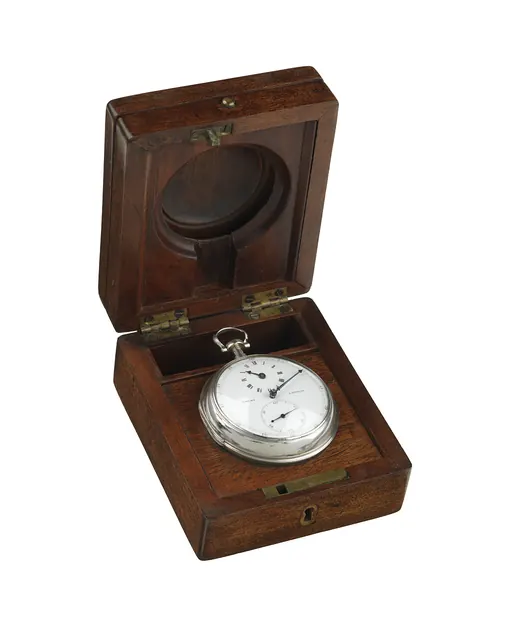
Pocket Watches · c. 1792
Pocket watch no. 1350 by Josiah Emery
Royal Museums Greenwich
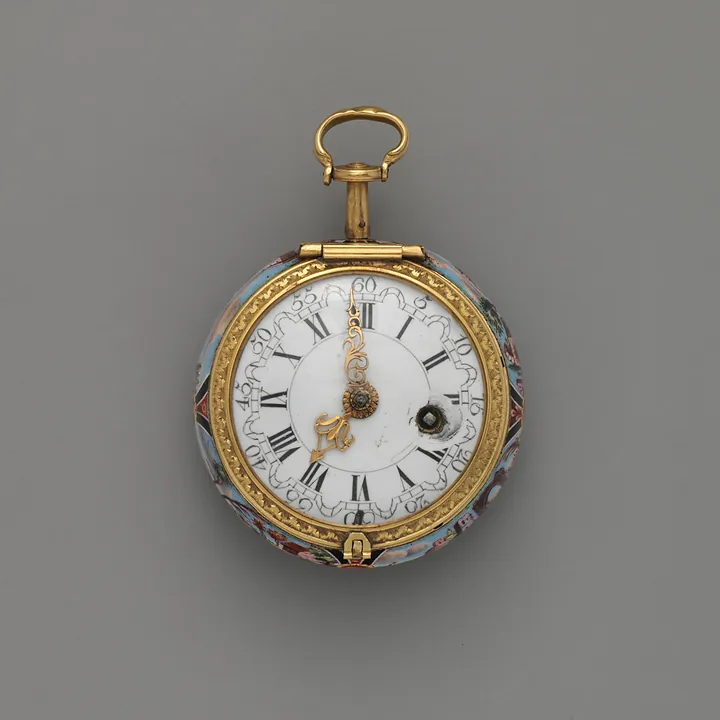
Pocket Watches · c. 1740–60
Watch by Charles Cabrier II, England, c. 1740–60 (The Met 17.190.1458)
The Metropolitan Museum of Art, New York
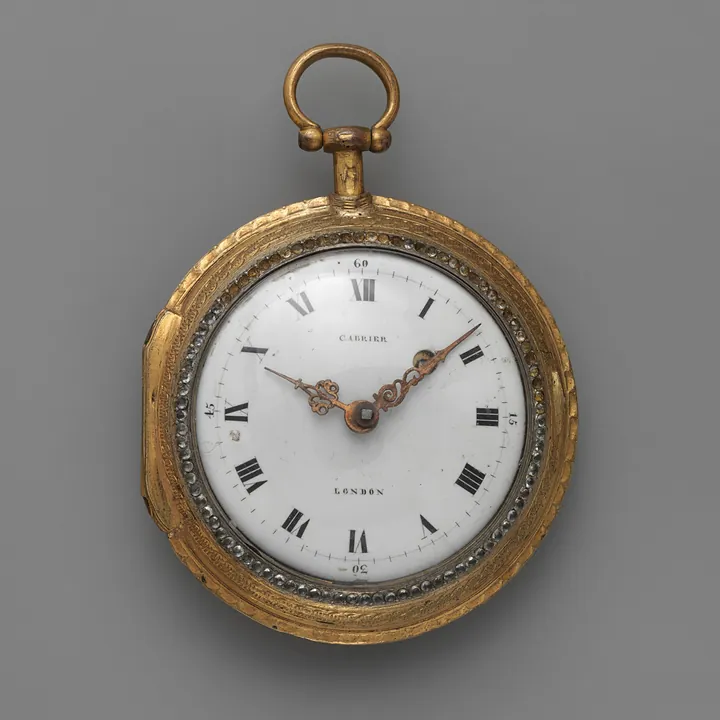
Pocket Watches · c. 1740–60
Watch by Charles Cabrier II, England, c. 1740–60 (The Met 17.190.1461)
The Metropolitan Museum of Art, New York
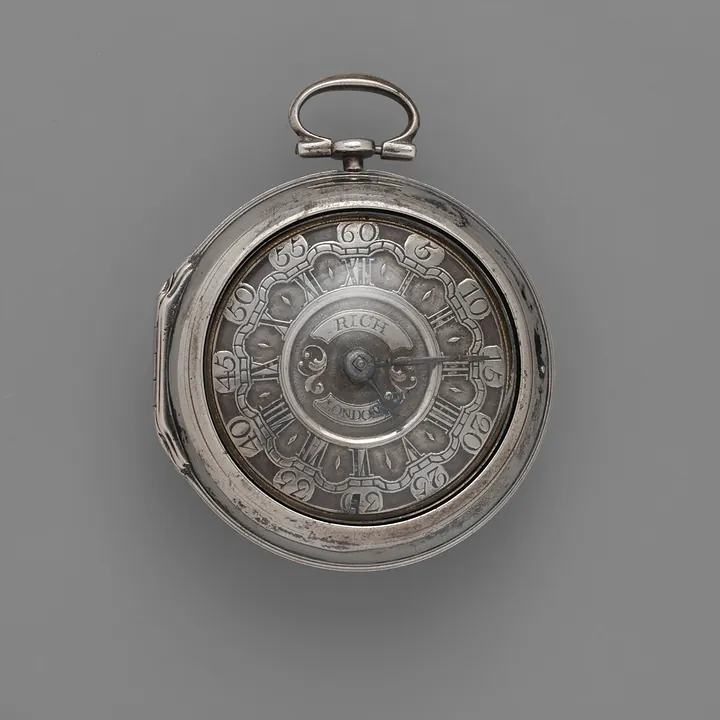
Pocket Watches · c. 1751–52
Watch by John Rich, England, c. 1751–52
The Metropolitan Museum of Art, New York
Pocket Watches · c. 1753
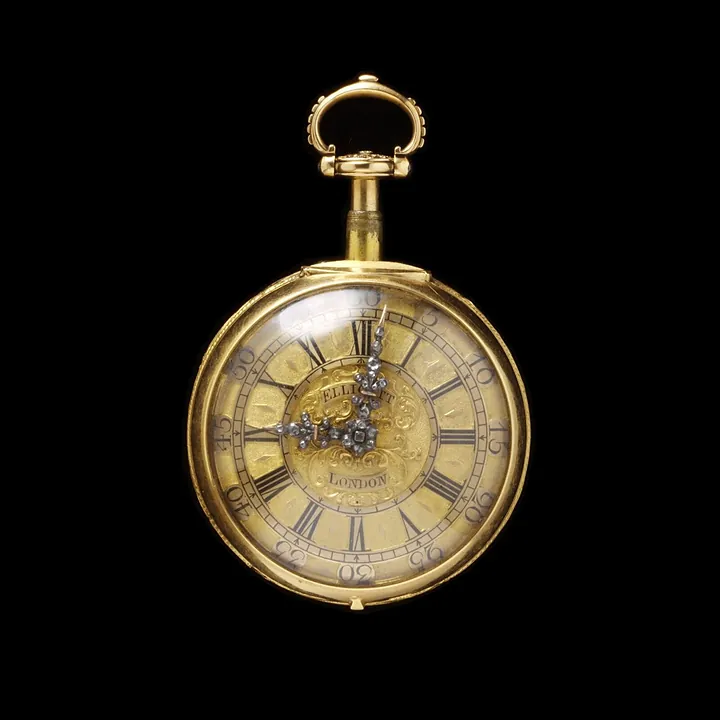
Gold watch, signed 'Jno. Ellicott, London, 3719', the inner case pierced and engraved, with a casemaker's mark 'JB', London, about 1753
Victoria and Albert Museum, London