
Horological History · Historical feature
The Grandfather Clock: A History of the English Longcase Clock, 1658–1850
The grandfather clock began as the English longcase. Within a generation of the pendulum's arrival in London, English makers had turned a laboratory novelty into the most accurate domestic clock in the world — and then into a piece of furniture made in almost every market town. How to read the case, the dial and the movement of a longcase clock, with examples from five museum collections.
Atlas Editorial · · 17 min read
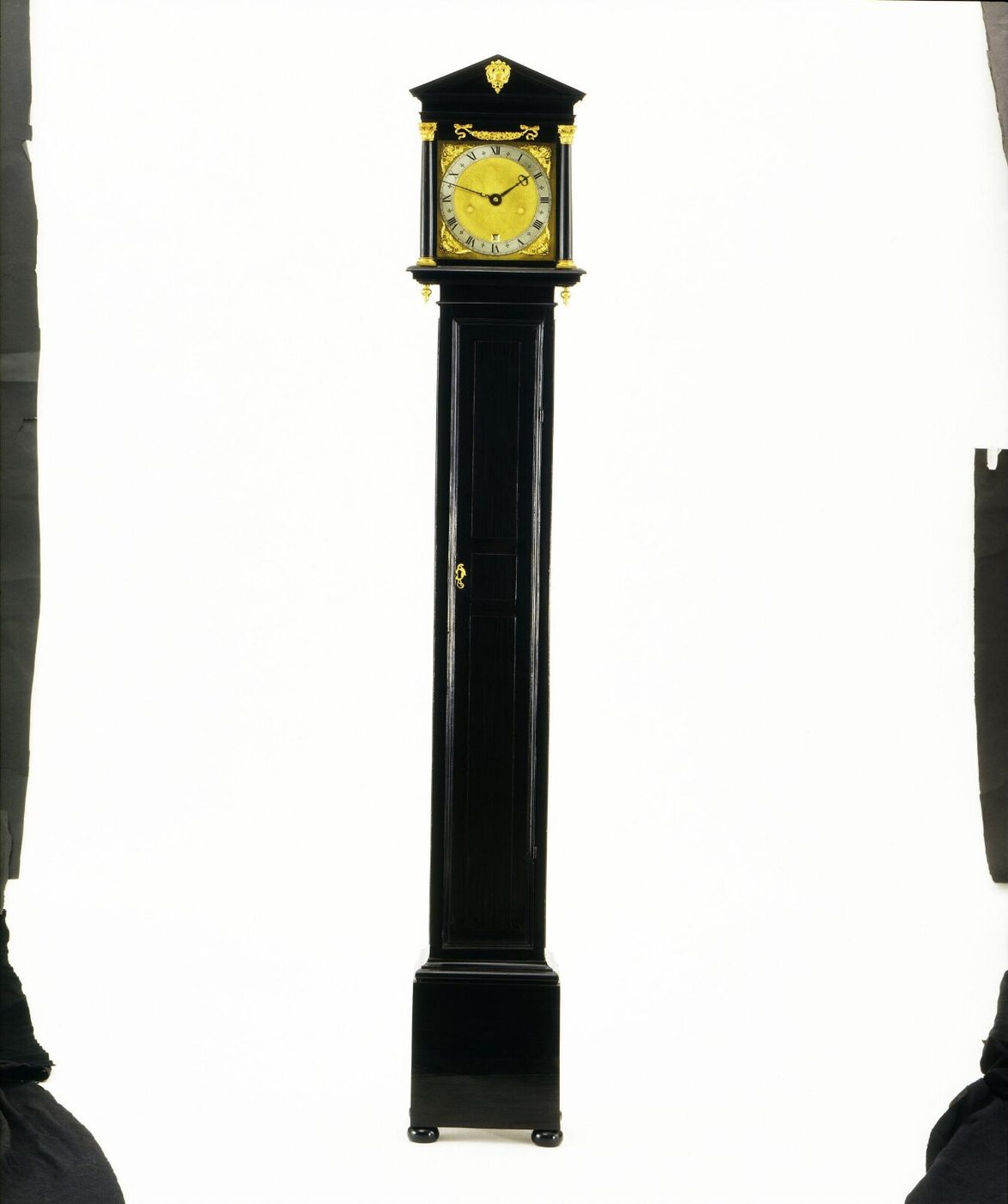
Victoria and Albert Museum, London · © Victoria and Albert Museum (non-commercial terms) — permission review · source (opens another website in a new tab)
In the autumn of 1658 a short advertisement appeared in two London newsletters, the Mercurius Politicus and the Commonwealth Mercury. It announced that 'there is lately a way found out for making Clocks that go exact and keep equaller time than any now made without this Regulater', that the new clocks had been 'examined and proved before his Highness the Lord Protector', and that they could be had from Ahasuerus Fromanteel at his house on the Bankside in Southwark. The 'regulater' was the pendulum, adapted to clockwork by the Dutch mathematician Christiaan Huygens two years earlier. The Victoria and Albert Museum quotes the advertisement in its record of an early Fromanteel clock, and it marks the moment the pendulum clock arrived in England.
What followed was one of the fastest transformations in the history of any craft. Within twenty years London makers had paired the pendulum with a new escapement, lengthened it to beat seconds, enclosed it in a tall wooden case, and were producing clocks that kept time to within a few seconds a day — good enough for the new Royal Observatory at Greenwich to use them to test whether the Earth turned at a constant rate. Within a century the same form had spread from the capital to provincial workshops from Cornwall to Cumbria, where it became the clock of the prosperous farmhouse as much as the town house. This feature traces that story through objects in the Atlas catalogue, and sets out the clues — case, dial, movement — that let a reader place a longcase clock in its period.
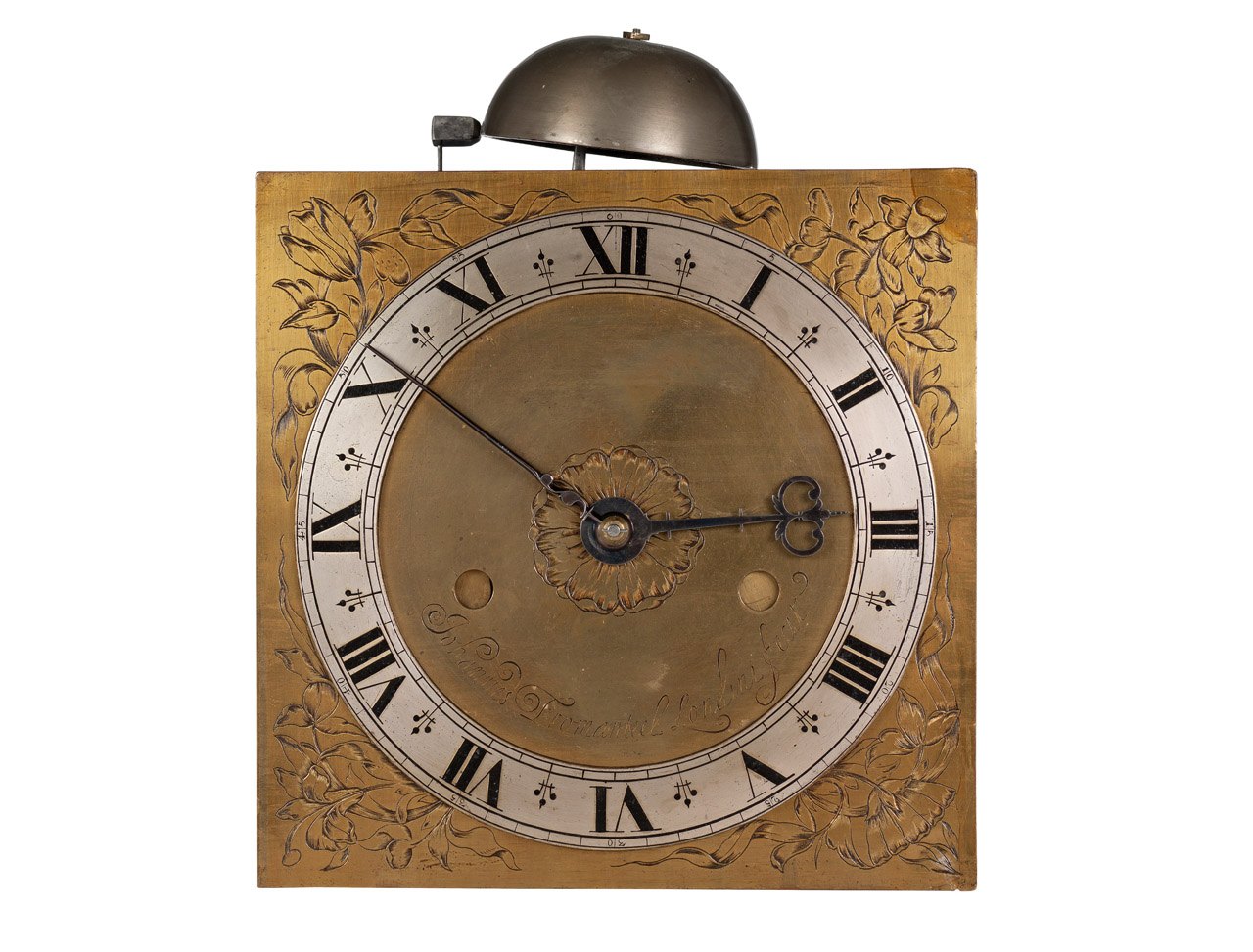
From The Hague to Southwark: the pendulum arrives
Huygens worked out how to control a clock with a pendulum in 1656 and obtained a privilege for it from the States General of the Netherlands in June 1657; the clockmaker Salomon Coster of The Hague made clocks under that privilege. Huygens's later treatise Horologium Oscillatorium (1673) set out the mathematics of the swinging pendulum in full. The Fromanteels, a family of Flemish descent working in London, moved quickly: a contract of September 1657 records John Fromanteel, son of Ahasuerus, going to work with Coster, and the London advertisement followed a year later. Their early pendulum clocks were spring-driven table clocks and weight-driven clocks hung on the wall or housed in narrow wooden cases, all with the verge escapement inherited from earlier clocks and a short pendulum.
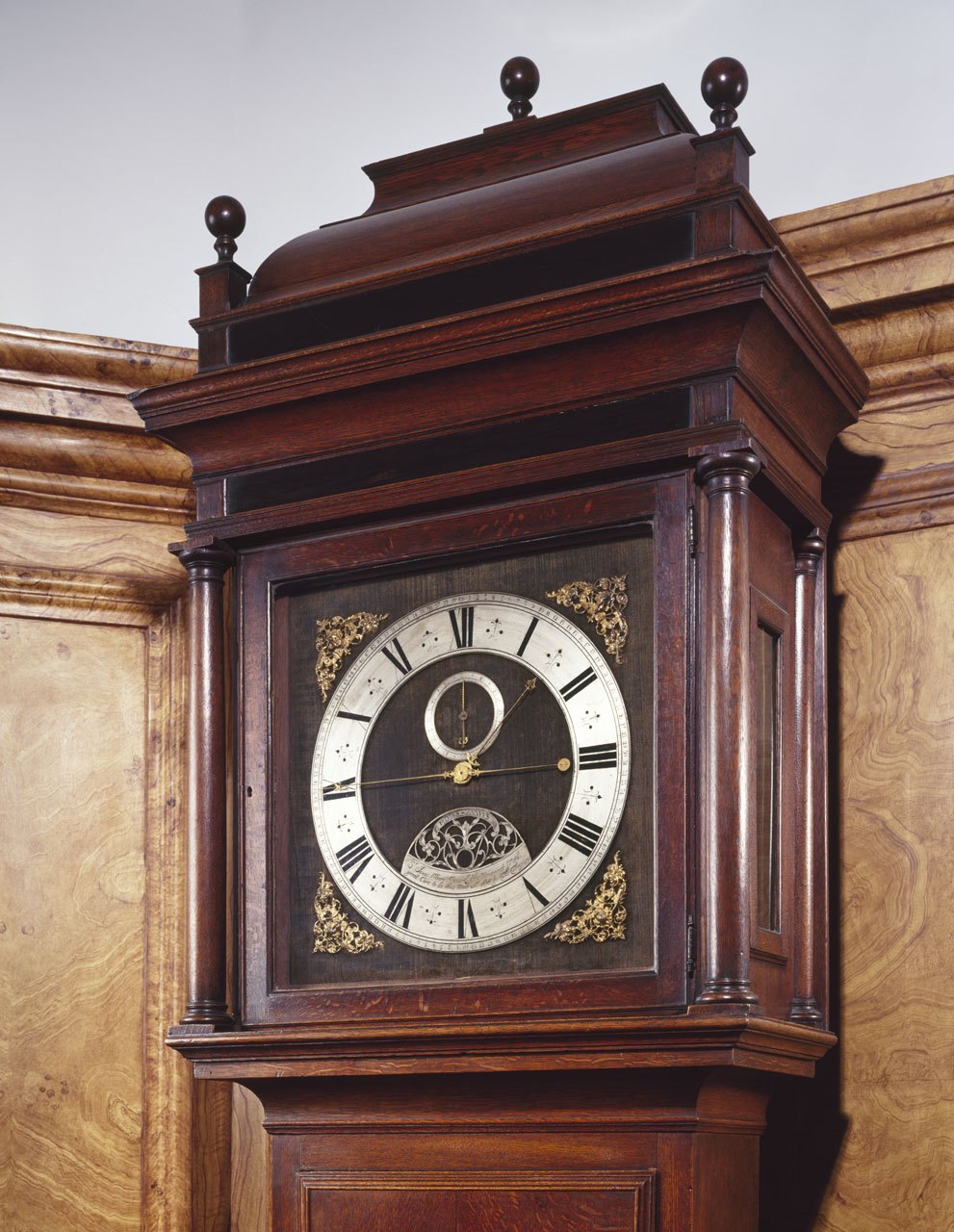
The V&A's Fromanteel shows how fluid the early forms were. Its ebony-veneered oak case has a lift-up hood glazed on three sides, with Corinthian columns and gilt-bronze mounts that make the hood a small classical temple. But the museum notes that the acorn finials beneath the front columns suggest the clock was first designed to hang on a wall and was only later adapted as a longcase, and that its present pendulum is only seven inches long. It also records that there were three clockmakers named Ahasuerus Fromanteel working in London from 1630 onwards, and that this clock is probably the work of the second, who became a freeman of the Clockmakers' Company in 1655. Even a single signature, in other words, needs careful reading.
The anchor escapement and the seconds pendulum
The verge escapement demanded a wide swing — often tens of degrees — and a wide-swinging pendulum loses the steady timing that makes it valuable. Around 1670 a new escapement appeared in England: a steel anchor whose two pallets engage an escape wheel lying in the same plane as the clock's other wheels. It let the pendulum swing through only a few degrees, and so made a long pendulum practical. Who invented it is disputed. The scientist Robert Hooke and the London clockmaker William Clement have both been credited, and the earliest surviving example is often said to be the turret clock Clement made for King's College, Cambridge, in 1671. The Atlas records the dispute rather than resolving it.
A pendulum beating seconds needs to be about 39 inches long, too long to hang exposed in a room and too delicate to leave unprotected. The tall wooden case — trunk, hood and base — was the answer. It protected the pendulum and the weights, held the clock steady against a wall and gave the dial a place at eye level. By the 1680s the 'long-case' clock with an anchor escapement, a seconds pendulum and an eight-day movement had become the standard form of the high-quality English domestic clock.
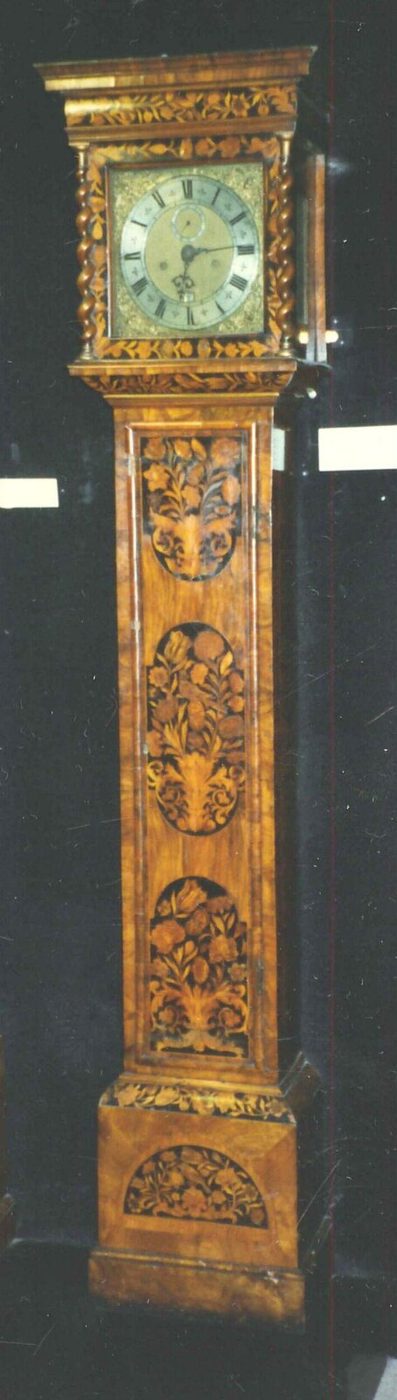
The V&A's Clement clock is a good example of how museums handle the problem. Its catalogue says Clement was among the first to use the anchor escapement, then cautions that the anchor in this particular movement may be a later replacement. Escapements were often converted: many early verge clocks were later given anchors and long pendulums to bring them up to date, and some have since been converted back. A reader looking at a seventeenth-century clock should never assume that the escapement it has now is the one it left the workshop with.
London's golden age: Knibb, Tompion, Quare and Graham
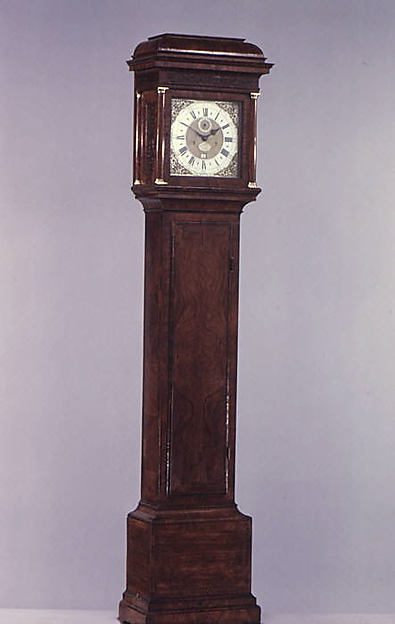
The decades between about 1675 and 1730 are often called the golden age of English clockmaking, and its makers are still the most sought-after names in the field. Joseph Knibb, from a family of clockmakers who worked in Oxford and later London, is associated with fine walnut-cased clocks and with experiments such as 'Roman striking', which used two bells to sound the hours in a form of Roman numerals and so saved power. The Metropolitan Museum's Knibb longcase of about 1680–85 has a calendar, one of the many extra indications that buyers were beginning to expect.
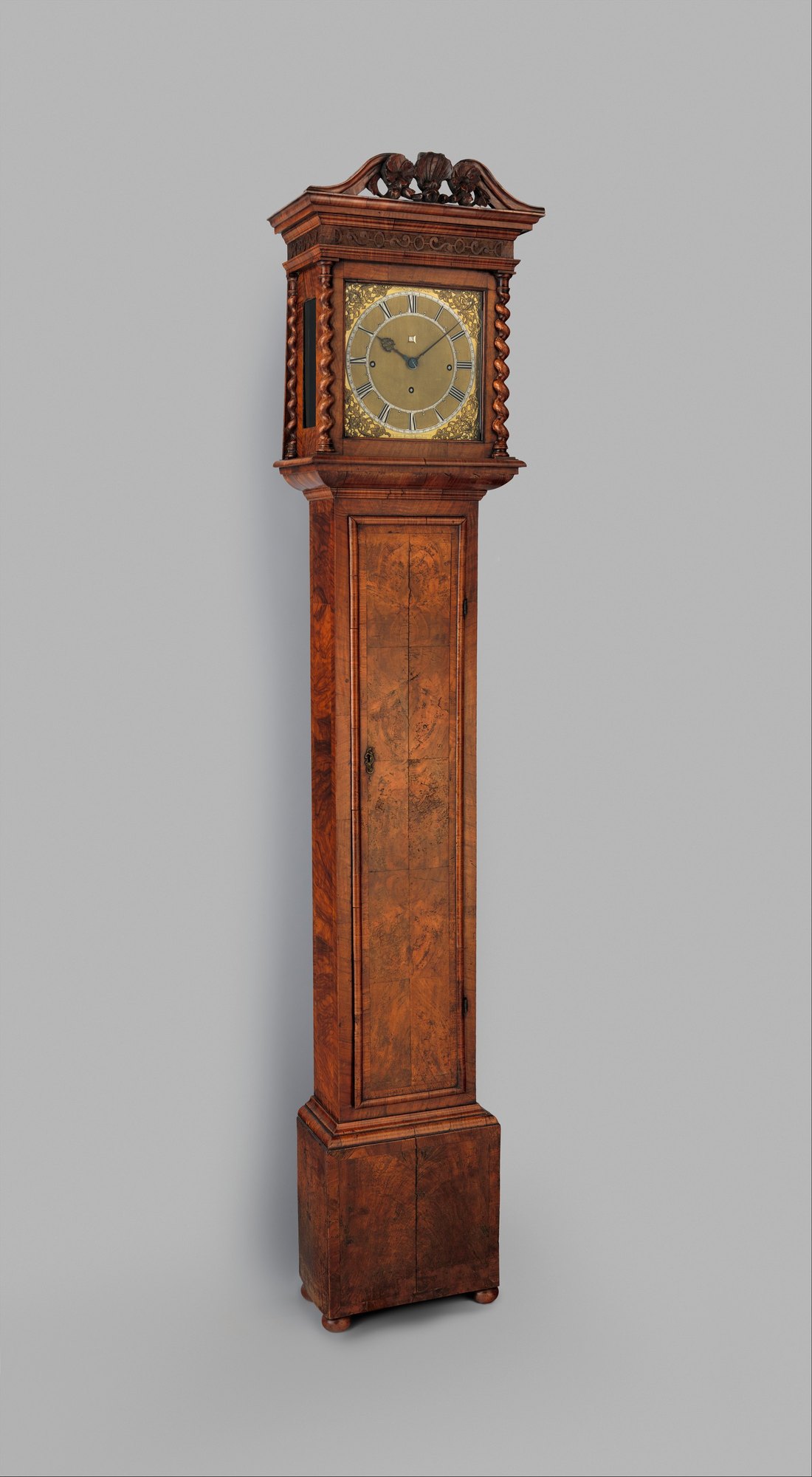
Thomas Tompion, who became a brother of the Clockmakers' Company in 1671, worked with Robert Hooke and supplied the two clocks that the patron Sir Jonas Moore commissioned for the new Royal Observatory at Greenwich in 1676. Royal Museums Greenwich, which holds one of them, records that it was year-going — it ran for a year at one winding — and that it was originally fitted with a pendulum about 13 feet long, hung behind the wainscot of the Great Room. With these clocks the first Astronomer Royal, John Flamsteed, was able to show that the Earth's rotation is constant, a result the museum describes as fundamental to the Observatory's work on longitude.
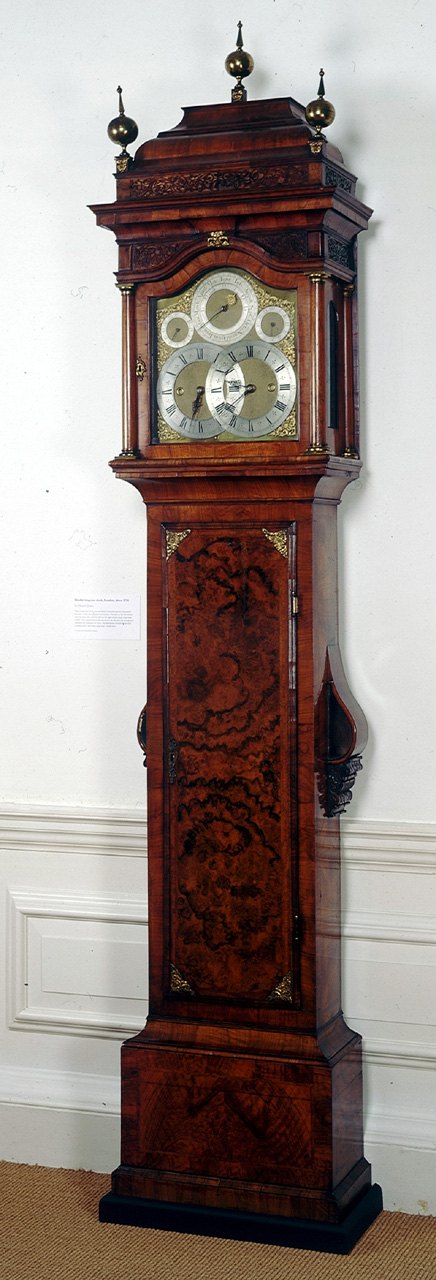
Daniel Quare, a Quaker who worked in London from the 1670s, is best known for repeating watches and for equation clocks, which show the difference between the uneven time of the Sun and the steady time of a clock. Royal Museums Greenwich holds a remarkable double longcase clock that the Royal Hospital for Seamen at Greenwich bought from him in 1716 for its Council Room. It has two separate pendulum-controlled movements: one dial shows sidereal (star) time, the other mean solar time, and a central dial shows the day, the month and the equation of time. The museum notes that the hospital did not pay the £70 until 1718, owing to its initial dissatisfaction with the clock's performance, and that only three clocks of the kind are known to exist.
George Graham, Tompion's partner and successor, made the two improvements that defined the precision pendulum clock for the next century and a half. The deadbeat escapement, which he introduced around 1715, removed the small backward 'recoil' of the anchor so that the seconds hand stops dead at each beat, and the mercury pendulum, which he described in the 1720s, used a jar of mercury to cancel the effect of temperature on the pendulum's length. Both were first adopted in observatory regulators; in domestic clocks the recoil anchor remained the norm for most of the eighteenth century.
| Date | Development | What to look for |
|---|---|---|
| 1656–58 | Huygens applies the pendulum to clocks; the Fromanteels advertise pendulum clocks in London | Short pendulum, verge escapement, narrow ebonised architectural case |
| c. 1670 | Anchor escapement appears in England (Hooke or Clement; disputed) | Anchor pallets in the plane of the wheels; long pendulum swinging a few degrees |
| 1670s–80s | Seconds pendulum and eight-day movement become standard in London work | Two winding holes; seconds dial below twelve |
| 1676 | Tompion's year-going clocks for the Royal Observatory | Long-duration movements; very long pendulums in observatory use |
| c. 1676 onwards | Rack striking, often credited to Edward Barlow, joins the older count wheel | Rack and snail behind the dial versus a notched count wheel on the back plate |
| c. 1715 | Graham's deadbeat escapement; break-arch dials appear | Seconds hand that stops dead; a semicircular arch above the square dial |
| 1720s | Graham's mercury pendulum | Jar of mercury as the bob; mostly in regulators |
| 1772 | White painted iron dials advertised in Birmingham | Painted dial with a 'false plate' behind it; common in provincial clocks |
| 1876 | Henry Clay Work's song 'My Grandfather's Clock' popularises 'grandfather clock' | A name, not a technical term; museums continue to say 'longcase' |
Reading the case: ebony, walnut, lacquer, mahogany
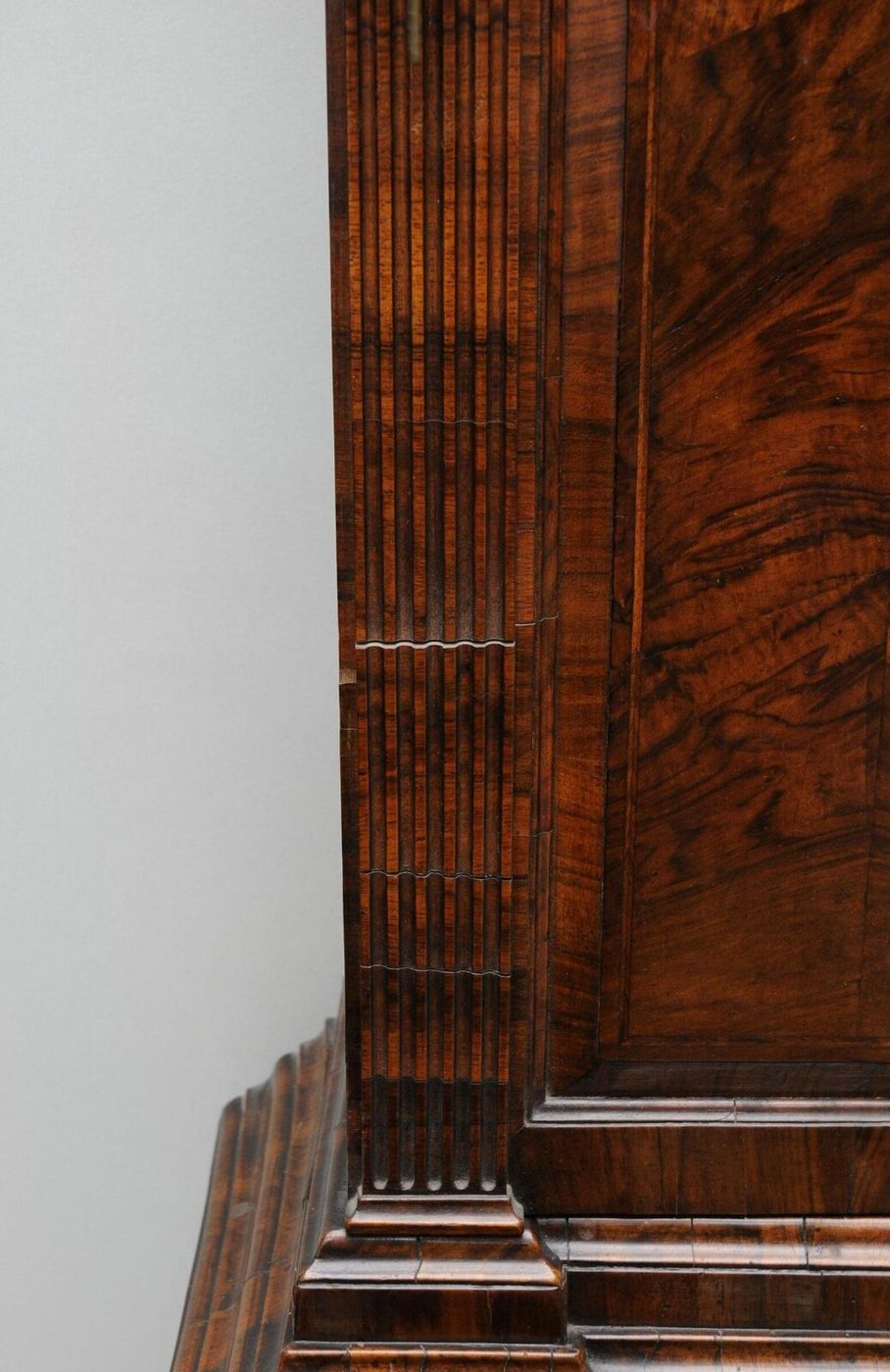
For most visitors the case is the first thing they see, and it is often the quickest guide to date — with the important warning that cases were frequently replaced, altered or 'married' to a different movement. The earliest London cases of the 1660s and 1670s are narrow and architectural, veneered in ebony or ebonised fruitwood, with classical columns and pediments. From the late 1670s walnut took over, laid as figured veneer on an oak carcase and, from the 1680s, decorated with floral marquetry in other woods, sometimes compared with Dutch work. Around 1700 a finer, scrolling 'seaweed' marquetry became fashionable.
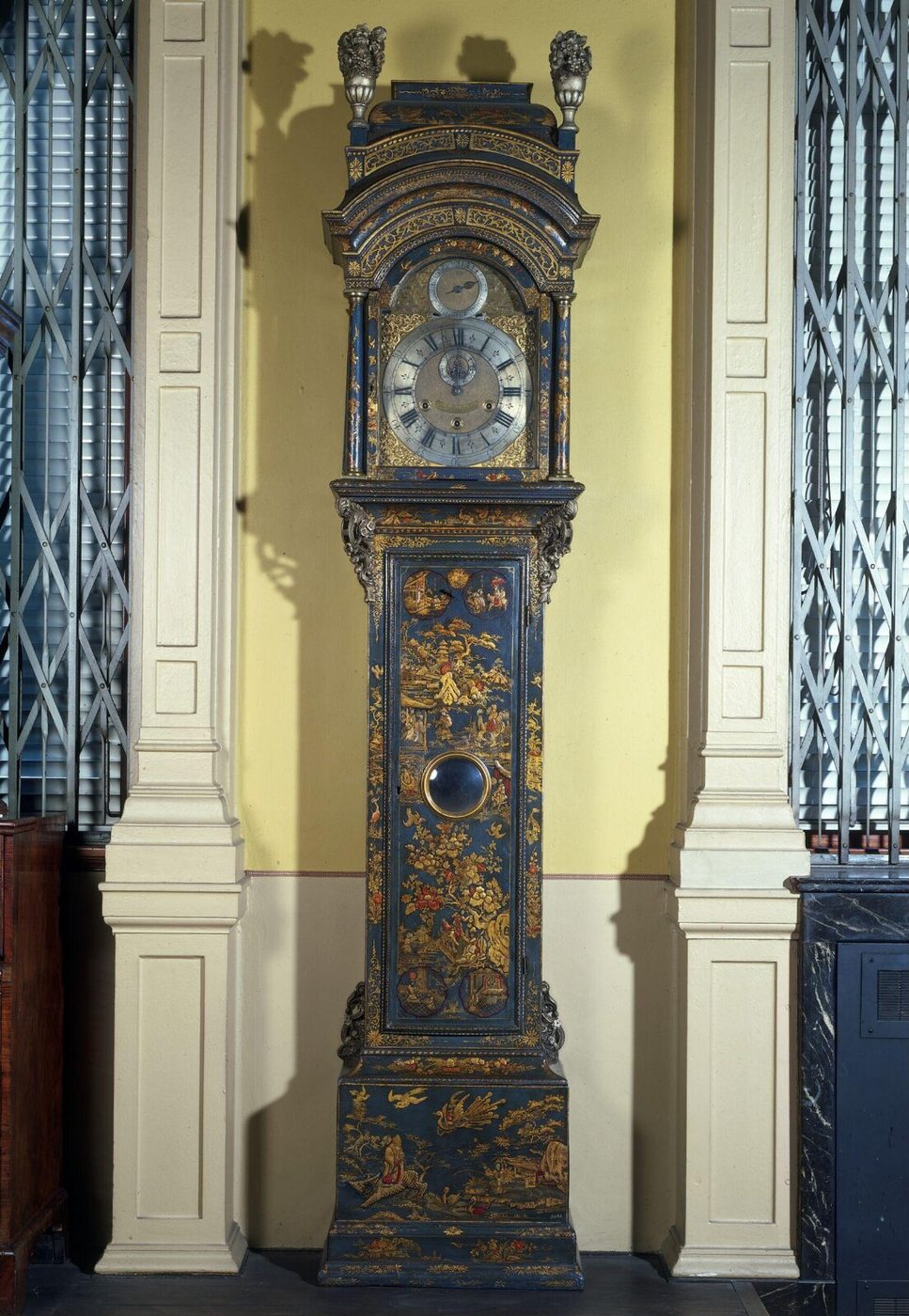
From about 1700 to the middle of the century, japanned cases offered an imitation of costly East Asian lacquer. The V&A's quarter-chiming month-going clock signed 'Markwick, Londini', of about 1725, is a fine example: its pine case is painted in red and gold on a peacock-blue ground with Chinese figures, vases and flowering shrubs. The museum explains that japanning built up coats of coloured varnish over a gesso base, sometimes in relief, and that the tall flat surfaces of a longcase were an ideal field for it. Its notes also date the case partly by its caddy top rather than a later pagoda top, and by details of the dial such as half-quarter marks and ringed winding holes.
Mahogany became the fashionable cabinet wood in England from the 1730s and dominated longcase clocks for the rest of the eighteenth century, in London and in the provinces alike. Regional styles developed: the broad, elaborate cases of Lancashire and the north-west, the slimmer cases of the south, and plain oak cases for country clocks wherever they were made. The V&A's astronomical longcase by John Benson of Whitehaven, of about 1760, has a mahogany case that the museum calls a restrained example of the Lancashire Chippendale style, inspired by a plate in Thomas Chippendale's Director.
| Period | Typical case | Typical dial |
|---|---|---|
| c. 1660–1675 | Narrow ebony or ebonised architectural case; lift-up hood | Small square brass dial, about 8–9 inches; single or narrow chapter ring |
| c. 1675–1700 | Walnut veneer, then floral marquetry; slide-forward hood | 10–11 inch square brass dial; cherub or foliage spandrels; seconds dial |
| c. 1700–1730 | Seaweed marquetry, burr walnut, japanning; caddy tops | 12 inch square dial; break-arch appears c. 1715 |
| c. 1730–1800 | Mahogany; pagoda and swan-neck pediments; regional styles | Break-arch brass dial, often with moon or strike/silent in the arch; later one-piece silvered dials |
| c. 1772–1850 | Mahogany and oak; broad northern cases | White painted iron dial with painted corners and arch scenes |
Reading the dial
The dial is the second great clue. Early dials are square brass plates with a separate silvered chapter ring carrying the hours and, outside it, the minutes. Cast brass spandrels fill the four corners: winged cherub heads in the late seventeenth century, more elaborate figures and rococo scrolls later. Many early provincial clocks have a single hour hand and a chapter ring divided only into quarter-hours, since minute-level precision was neither possible nor needed in a thirty-hour country clock.
From about 1715 the break-arch dial added a semicircular arch above the square, which makers used for a nameplate, a strike/silent lever, a moon-phase disc or a rocking figure. The V&A's clock by Richard Peyton of Gloucester, of about 1750, has a break-arch brass dial with a silvered chapter ring, engraved leaf half-hour markers, a seconds ring below twelve and a calendar aperture above six. Benson of Whitehaven took the arch further: the museum records a twenty-four-hour chapter ring traversed daily by a gilt figure of the Sun, showing sunrise, sunset and the Sun's amplitude, with the phases of the Moon on an inner dial.
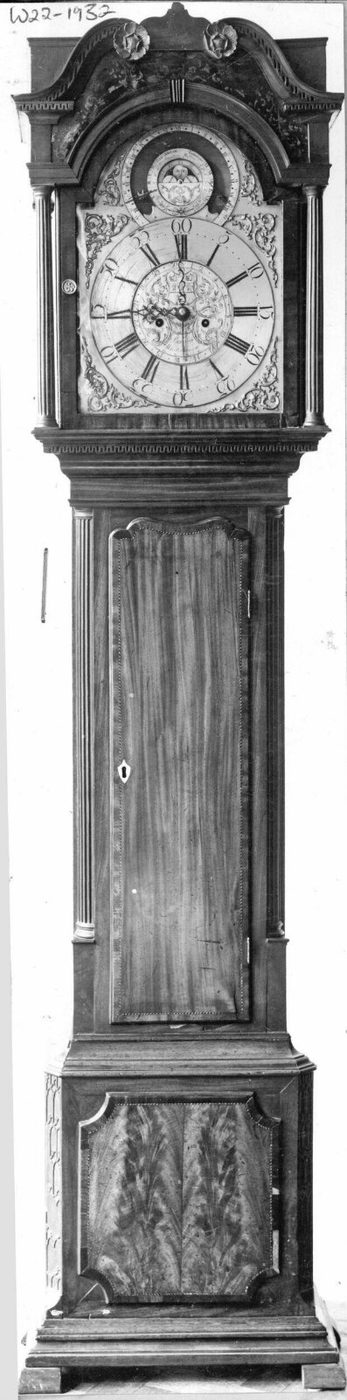
The white painted dial, introduced by Birmingham dial makers in the early 1770s, transformed the provincial longcase. A japanned iron dial was cheaper than an engraved and silvered brass one, could be bought ready-painted with floral corners or an arch scene, and was fixed to the movement with an intermediate 'false plate'. Benson's own career shows the shift: the V&A notes that he was still working in Whitehaven in 1782, when he advertised white painted dials. By the early nineteenth century painted dials were the norm in country clocks, and their arch scenes — landscapes, ships, biblical subjects, the four seasons — are a delightful field of study in themselves.
Inside: duration, striking and the escapement
Most longcase clocks fall into two families. Thirty-hour clocks, wound daily, often use a single weight hung on an endless rope or chain that drives both the going and striking trains — an arrangement associated with Huygens — and are typical of country makers. Eight-day clocks have separate trains and weights for going and striking and are wound with a key. London makers also built month-going and, rarely, year-going clocks for wealthy patrons and observatories; the Markwick clock at the V&A runs for a month and has three trains for going, striking and quarter chimes.
Striking was originally controlled by a count wheel (also called a locking plate), a notched wheel that lets the hammer strike the right number of blows in sequence. Rack striking, often credited to the clergyman Edward Barlow around 1676, measures the hour from a stepped cam, the snail, so that the clock can repeat the last hour on demand and never gets out of step with the hands. The V&A's notes on the Peyton clock treat its count wheel, along with the shape of its collets and arbors, as earlier features in a clock dated about 1750 — a reminder that provincial makers often kept older methods long after London had moved on. The museum also records that its escape wheel and arbor may have been replaced, and a repairer's mark of 1916 scratched on the front plate.
- Recoil anchor escapement: standard in domestic longcase clocks from the 1670s to the end of the form.
- Deadbeat escapement: Graham's refinement of about 1715, used in regulators and in some fine domestic clocks.
- Bolt-and-shutter maintaining power: early London clocks often have shutters over the winding holes that must be opened before winding, engaging a spring that keeps the clock going while it is wound.
- Moon-phase work: a disc in the arch painted with two moons and usually cut with 118 teeth, advanced one tooth every twelve hours, so that each painted moon completes its cycle in 29½ days.
- Automata and musical work: rocking ships, figures and tune-playing barrels appear in the arch from the mid-eighteenth century.
Curiosities and commissions
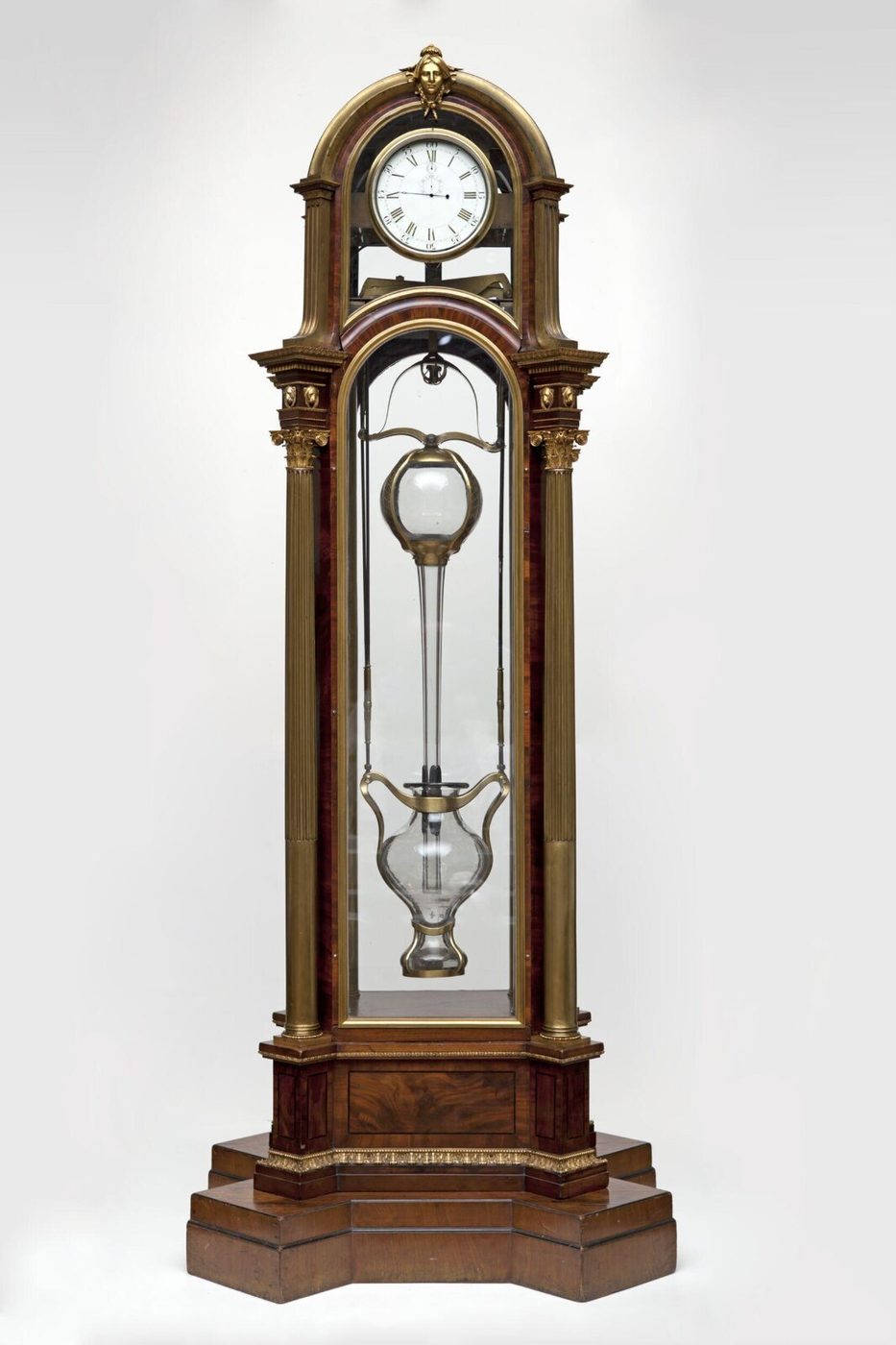
The longcase form also carried some of the century's most ambitious experiments. James Cox, a London goldsmith and maker of automata for markets in India, China and Russia, built a clock with his chief mechanic, John Joseph Merlin, in the 1760s that used changes in atmospheric pressure acting on two jars of mercury to keep itself wound. The V&A describes it as generally recognised as the first successful attempt in England to produce a 'perpetual motion' clock. The museum records that it was shown in Cox's own museum of automata at Charing Cross from 1768 to 1774, and later in Thomas Week's Royal Mechanical Museum in London until 1837.
The provincial longcase and the industrial town
By the end of the eighteenth century the longcase clock was made, or at least finished and signed, in hundreds of towns and villages. Many provincial 'makers' bought movements, dials and even cases from specialist suppliers and assembled and sold the finished clock under their own name — a practice that does not diminish the clocks but does mean that a provincial signature identifies a seller as often as a maker. Two clocks in the Science Museum Group collection show how the form carried the history of industrial Britain.
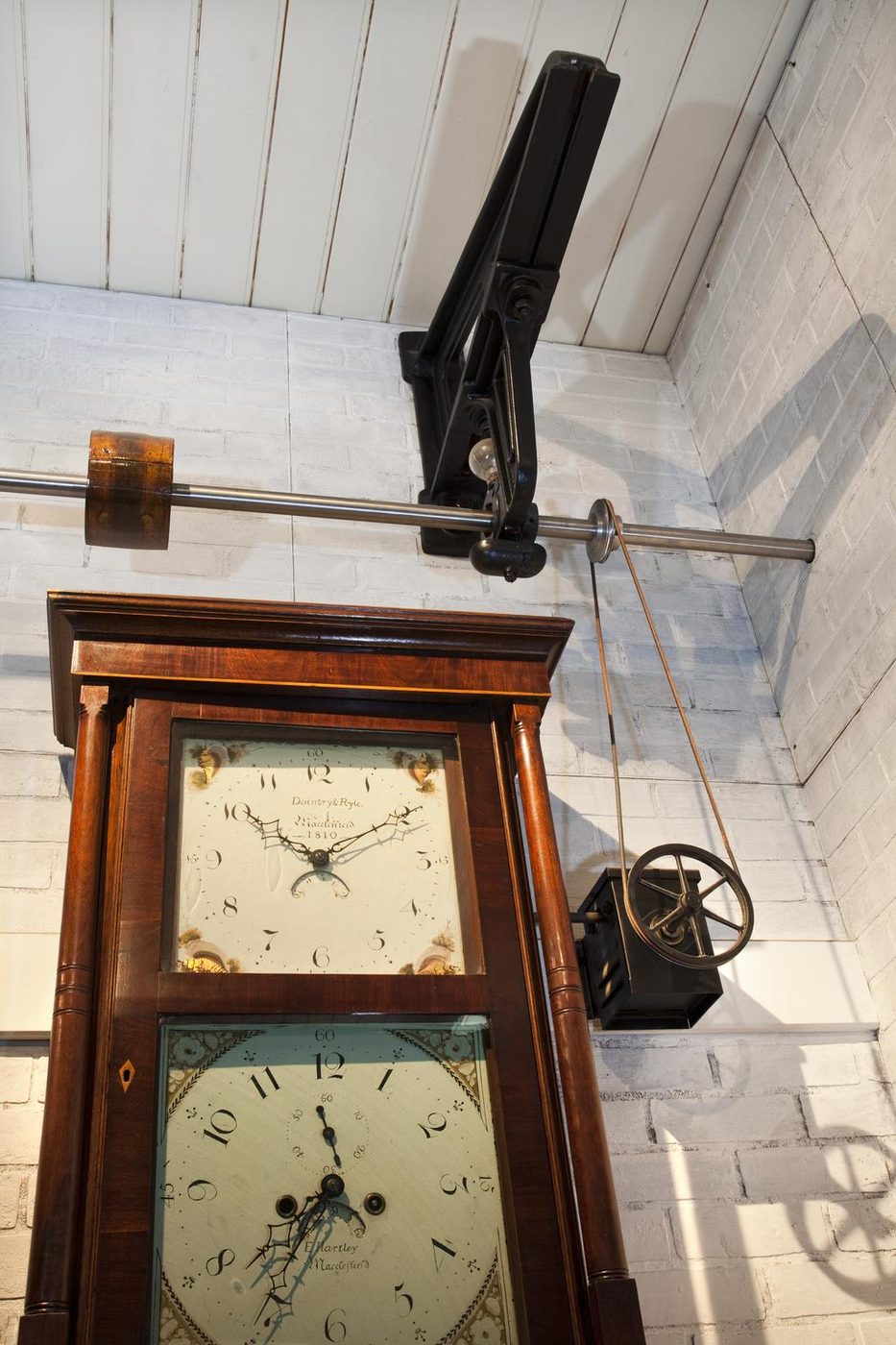
A double-dialled clock signed by E. Hartley, dated by the museum to 1800–1820, came from the Park Green silk mill in Macclesfield, where it was installed in 1810 for the mill owners Michael Daintry and John Ryle. The lower dial showed the real time; the upper showed 'mill time', driven by the mill's machinery, so that if the machines slowed, the working day lengthened. The museum uses the clock to illustrate how factory owners sought to control time to protect productivity and profit.
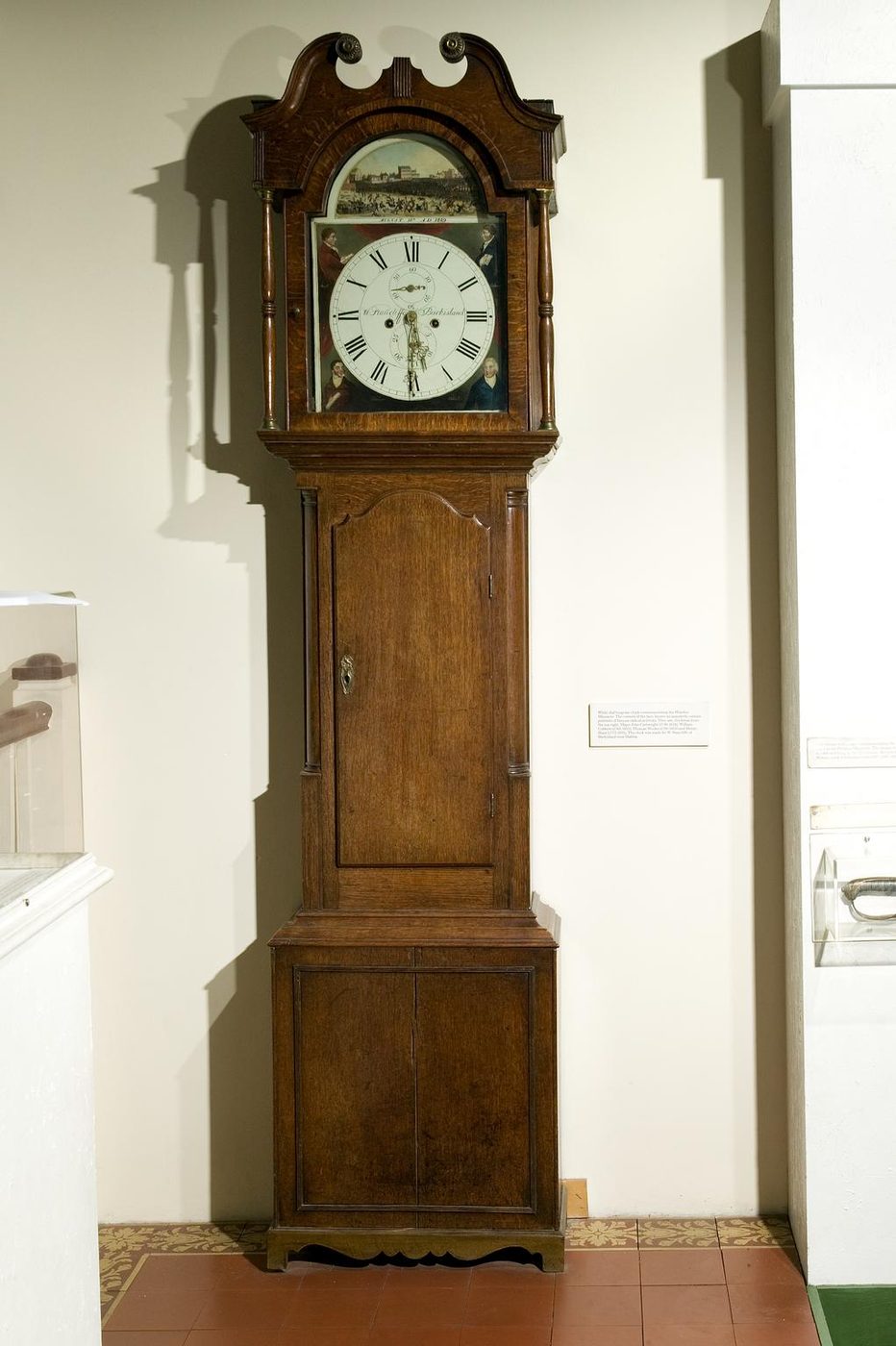
A generation later, W. Stancliffe of Barkisland, near Halifax, made a longcase clock commemorating the Peterloo Massacre of 1819, when cavalry charged a crowd gathered for parliamentary reform in Manchester. The museum records that the scene in the arch is based on an engraving published in the Manchester Observer in October 1819, that the dial's corners carry portraits of the radicals Major John Cartwright, William Cobbett, Thomas Wooler and Henry Hunt, and that the Stancliffe family had made clocks in Barkisland since the mid-1700s. A painted dial could be a political statement.
Decline and afterlife
From the 1840s inexpensive clocks from Connecticut factories, and later from the Black Forest, undercut the hand-assembled English longcase, and the form slowly retreated to the luxury trade and the reproduction market. Its popular name came late: Henry Clay Work's American song 'My Grandfather's Clock' of 1876 made 'grandfather clock' the everyday term in English, though museums and specialists still prefer 'longcase'. Today the longcase is one of the most collected and most frequently restored of all clocks — which is exactly why the questions raised in this feature matter.
Further reading
For the pendulum itself, Huygens's Horologium Oscillatorium (1673) remains the founding text. John Smith's Horological Disquisitions (1694) and William Derham's The Artificial Clock-Maker (1696) show how English clockmakers and their customers thought about the new clocks in the generation after Fromanteel. F. J. Britten's Old Clocks and Watches and Their Makers (first edition 1899) and Herbert Cescinsky and Malcolm Webster's English Domestic Clocks (1913) were the first systematic studies of the longcase and are still valuable for their illustrations, although later research has corrected many of their dates and attributions.
Sources & further reading
- Horologium Oscillatorium — Christiaan Huygens, F. Muguet (Paris), 1673.
- Horological Disquisitions concerning the Nature of Time — John Smith (clockmaker), London, 1694.
- The Artificial Clock-Maker — William Derham, James Knapton (London), 1696.
- Old Clocks and Watches and Their Makers — F. J. Britten, B. T. Batsford (London), 1899 (first edition).
- English Domestic Clocks — Herbert Cescinsky and Malcolm R. Webster, George Routledge & Sons (London), 1913.
- Curiosities of Clocks and Watches from the Earliest Times — Edward J. Wood, Richard Bentley (London), 1866.
- Time & Timekeepers — Willis I. Milham, Macmillan (New York), 1923.