Clocks · Longcase clock
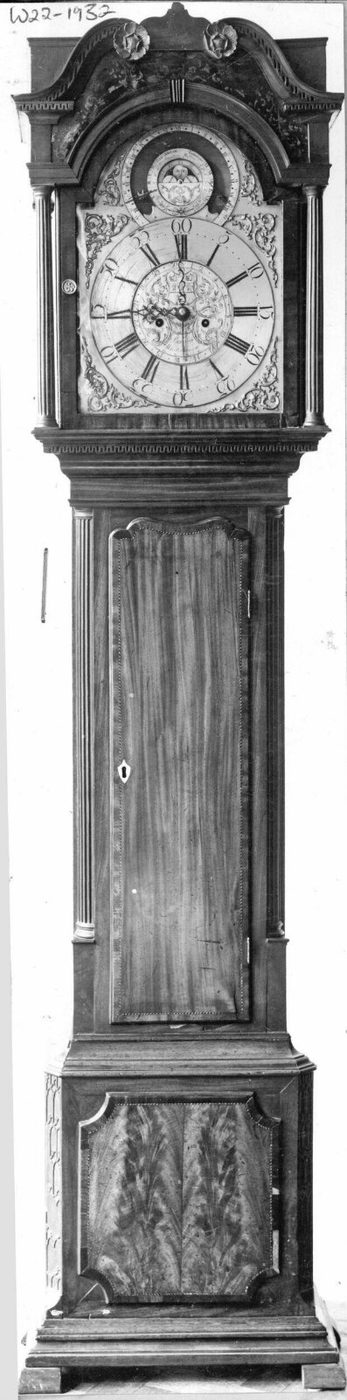
Mahogany astronomical long case clock, made by John Benson, Whitehaven, Cumbria, about 1760
- Maker / attribution
- John Benson (made)
- Date
- 1760
- Historical period
- Precision & Scientific Horology (1750 – 1850)
- Country of origin
- Unrecorded in source
- Place
- Whitehaven
- Object type
- Longcase clock
- Materials / technique
- mahogany, brass and steel movement
- Dimensions
- Height: 233 cm (approx); Width: 55 cm (approx); Depth: 28 cm (approx); Weight: 5.35 kg (w.22:4 Lead weight 10/10/2025 NH); Weight: 5.35 kg (w.22:5 Lead weight 10/10/2025 NH)
- Holding institution
- Victoria and Albert Museum, London
- Accession / object no.
- W.22:1 to 3-1932
- Credit line
- Given by Robert Shaw
Record summary
Held and catalogued by Victoria and Albert Museum, London (object number W.22:1 to 3-1932), this is a longcase clock by John Benson, made in Whitehaven, dated 1760. The Atlas places it in the Precision & Scientific Horology period (1750 – 1850) of its Clocks collection. Materials and techniques recorded by the source: mahogany, brass and steel movement. Recorded dimensions: Height: 233 cm (approx); Width: 55 cm (approx); Depth: 28 cm (approx); Weight: 5.35 kg (w.22:4 Lead weight 10/10/2025 NH); Weight: 5.35 kg (w.22:5 Lead weight 10/10/2025 NH). The record is illustrated with 3 photographs.
Assembled from the source record's structured fields. Dates and attributions are given as the source states them; where a field is missing the Atlas leaves it blank rather than estimating.
Catalogue description
V&A — Summary
An interesting example of a sophisticated clock by a regional maker. Little is known of Benson, although he was still working in Whitehaven in 1782 when he advertised white painted dials. The coat of arms on the dial are those of the Hudson family of Preston, Lancashire. The case is a restrained example of the Lancashire Chippendale style, inspired by Plate CLXIH from Thomas Chippendale’s Director. The dial arch has the major portion of a twenty-four hour chapter ring which is traversed daily by a gilt effigy of the sun, and shows sunrise, sunset and the sun’s amplitude. The inner dial shows the phases of the moon. The brass and steel weight-driven movement has a rack striking on a bell.
V&A — Physical description
Dial: Break arch brass dial. Silvered chapter ring with Roman hour numerals, Arabic numerals in multiples of five the two separated by engraved dots representing each minute. Immediately within the chapter ring, the silvered and engraved dial centre carries a narrow band engraved with Arabic numbers for the date, which is registered by a central steel hand concentric with the steel hour and minute hands. Other engraving in the dial centre includes boar's heads, lions rampant and a helmet (upper portion) with the maker's name Benson, Whitehaven decoratively detailed around the winding holes (lower portion). There are four cast brass corner spandrels of Rococo style on the main dial and two part spandrels of similar design in the arch, which carries lunar and solar indications. The back of the dial plate has eight cut outs behind the chapter ring. Movement: Brass and steel weight driven two-train movement with rack striking on bell. The locking for the striking is achieved by an inside lever mounted on a common arbor with rack hook arresting a pin on the warning wheel at the requisite point. Four pillars of bulbous profile, but of rectangular profile at the swellings, with a pronounced groove in the middle of the centre swelling. Pinned to the front plate, riveted to the back. The outside front plate retains circular scribe lines to indicate the layout of the wheelwork. Train wheels are attached to their arbors with ‘T’ shaped collets, a portion which extends beyond the wheel face opposite to the main collet. Both winding barrels are have smooth, brass surfaces (i.e. devoid of the mostly standard grooves which serve to guide the weight lines). The back cock is devoid of steady pins. The central calendar hand is carried on a ratchet wheel, which is operated once a day by the 24-hour wheel. The back of this wheel engages a 5-toothed wheel, which is located on an upward running arbor, terminating in a worm wheel. This meshes with a 73-toothed wheel, which carries on its face an eccentric post with a roller to reduce friction. From the gearing (above), it will be seen that the post rotates once per year. This post drives a sliding arrangement of pivoted levers on the back of dial arch, such that they rise and fall rather in the manner of semaphore arms during the course of a revolution of this wheel (duration once a year). The front of the arms carries shutters thus indicating times of sunrise and sunset throughout the year on the front of the dial. Another vertically disposed arbor drives the moon work off the minute pinion of the motion work (mounted on the front plate). Description and notes by Francis Brodie, c. 2008
V&A — Object history
Astronomical long case clock, English 1760, by Benson of/and Whitehaven (arms on dial are probably of Hudson of Preston, Lancs) - Gift of Robert N Shaw, formerly in the collection of his father W Norman Shaw Notes from R.P. 3082 5 March 1932 letter, R N Shaw to the V & A offers 10 clocks as a gift 11 March 1932, minute paper by H C Smith reports on his inspection of the clocks at 6 Ellerdale Road, Frognal, Hampstead (former home of W Norman Shaw, built by him). Shaw's collection of clocks was sold by Christie's in 1913; those being offered now were kept by the family. He describes the clock by Benson, of Whitehaven, as "mahogany case of architectural design of about 1760, with scroll pediment, canted corners with fluted pilasters, and fretwork on the base. It has a good movement as well as a good case, and would be acceptable". 22 March 1932, minute paper notes condition of the clock on arrival at V & A as "cracked, chipped, portions missing". 4 August 1932 letter, Dr F A B Ward (Science Museum) to Clifford-Smith explains the figures on the clock. (see attached) Remarks: The cutaway sections on the back of the dial are commonly found on longcase dials from the north and especially the northwest of England. The smooth (ungrooved) barrels can be found quite frequently on Irish clocks. However, I recently saw an eight-day English longcase clock also from Whitehaven with smooth barrels; possibly this is a local feature, or possibly Benson bought his movements from one supplier. The motion work to the dials in the arch is a form of complication sometimes seen on longcase clocks to add interest to an otherwise standard clock. The various arbors and gears have been added onto the front of the clock movement, i.e. the basic movement is relatively standard. The scribe lines for the layout of the wheelwork on the front plate is always of interest. It has been thought that such marking out is indicative of individual work, rather than the purchase of an off-the-shelf movement. I would refer you to Tom Robinson “The Longcase Clock”, 1995, Antique Collectors Club pp304—3071. Robinson believes that Benson was inspired by Gandy of Cockermouth. Note that the Gandy clock also has smooth barrels, and, from the illustration, the wheel collets and pillars are not so different from the Benson. In passing, John Benson of Whitehaven also happened to advertise white painted dials in 1782. Description and notes by Francis Brodie, c. 2008
V&A gallery label
ASTRONOMICAL LONG-CASE CLOCK ENGLISH; about 1760 By Benson of Whitehaven. The arms on the dial are probably those of Hudson of Preston, Lancs.
Historical context
Precision & Scientific Horology (1750 – 1850)
Harrison solves longitude; Mudge invents the lever; Breguet's Paris workshop defines the modern watch.
The age of the deadbeat escapement, compensated pendulums and observatory regulators. Domestic clocks spread through the middle classes: English longcase and bracket clocks, French gilt-bronze mantel clocks, Viennese Biedermeier wall clocks, Black Forest painted-shield clocks, and the first American shelf clocks.
Read the period in the timelineMore clocks from this periodEarlier: Early Modern Horology
Atlas type guide
Longcase (tall-case or grandfather) clocks
The longcase clock was born from two seventeenth-century innovations: Christiaan Huygens's pendulum (1656–57) and the anchor escapement (c. 1670). A long seconds pendulum, nearly a metre long, swings with a small arc, and enclosing it together with the driving weights in a tall wooden case protected the mechanism and created a new piece of furniture. London makers such as Ahasuerus Fromanteel, Thomas Tompion and Joseph Knibb set the pattern.
By the eighteenth century longcase clocks were made throughout Britain, the Netherlands, Scandinavia (the Swedish Mora clock), France (the Comtoise from the Franche-Comté), Germany and colonial America. Eight-day movements with two weights became standard in better clocks; thirty-hour clocks with one weight and a rope or chain were cheaper alternatives.
What to look for
- Winding holes in the dial: two (eight-day, going and striking) or none (thirty-hour, pulled up by a chain).
- Brass dials with applied chapter rings (earlier) versus painted iron 'white' dials (after c. 1770 in Britain).
- Moon-phase arches, date apertures, seconds dials and maker's name on the dial.
- Case woods and style: ebonised, walnut marquetry, lacquer, oak or mahogany; regional styles from London, Lancashire, Scotland or America.
- Whether the movement and dial match the case — 'marriages' are common.
Dating clues
- Square brass dials suggest c. 1670–1720; arched brass dials c. 1715–1790.
- Painted (white) dials were made by Birmingham dial-makers from about 1772.
- Comtoise clocks with repoussé pendulums are mostly nineteenth century.
General guidance written by the Atlas editors about this kind of object. It is not a statement about this particular piece; for that, rely on the source record above and on physical examination.
Related records
Clocks · 1701-1799
Alarm clock, Austria, 1701-1799
Science Museum Group, London
Clocks · 1711–1827
Longcase clock by David Roentgen ( - ), England, 1711–1827
Badisches Landesmuseum Karlsruhe
Clocks · 1723–1811
Table clock by Louis Montjoye, France, 1723–1811
Badisches Landesmuseum Karlsruhe
Clocks · 1738–1814
Table clock by Jean Simon Bourdier, France, 1738–1814
Badisches Landesmuseum Karlsruhe
Clocks · 1740-1760
Longcase clock, English, 1740-1760, japanned wood, John Ellicott
Victoria and Albert Museum, London
Clocks · 1740–60
Tall clock by Samuel Bagnall, United States, 1740–60
The Metropolitan Museum of Art, New York
Clocks · 1750-1800
Bracket clock in metal case with scroll handles and flamed-shaped top signed by Pierre Seignoret, Clockmaket to the the Comte d'Artois
Victoria and Albert Museum, London
Clocks · 1750
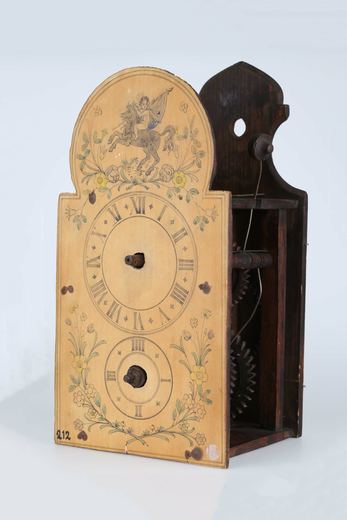
Clock by Georg Gfell, Germany, 1750
German Clock Museum