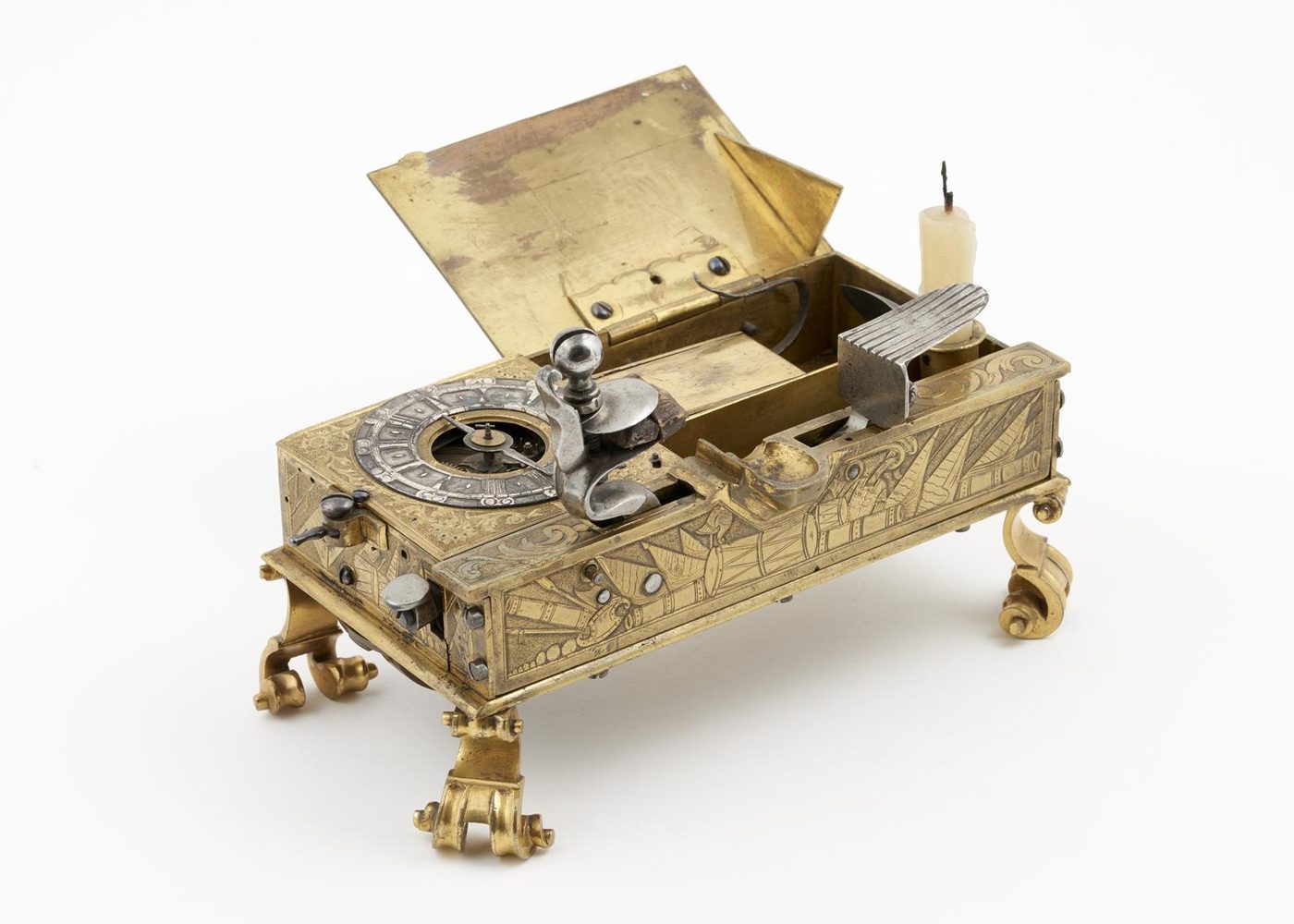
Clocks · Alarm clock with tinder lighter
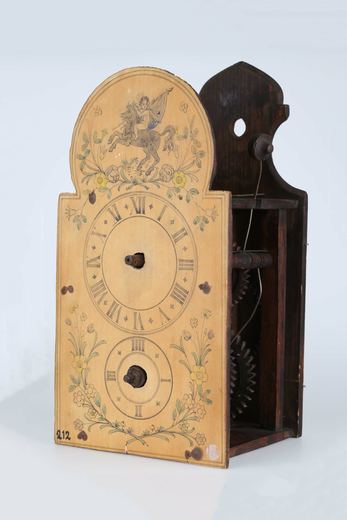
Alarm clock, Austria, 1701-1799
- Maker / attribution
- Unrecorded in source
- Date
- 1701-1799
- Historical period
- Precision & Scientific Horology (1750 – 1850)
- Country of origin
- Austria
- Place
- Vienna, Wien, Austria, Vienna
- Object type
- Alarm clock with tinder lighter
- Dimensions
- overall: 190.5 mm
- Holding institution
- Science Museum Group, London
- Accession / object no.
- 1937-682/1124
- Credit line
- Wilkinson Sword Ltd.
- Catalogue title (original)
- Tinder-pistol combined with alarm clock, Austria
Record summary
Held and catalogued by Science Museum Group, London (object number 1937-682/1124), this is an alarm clock with tinder lighter, made in Vienna, Wien, Austria, Vienna, dated 1701-1799. The Atlas places it in the Precision & Scientific Horology period (1750 – 1850) of its Clocks collection. Recorded dimensions: overall: 190.5 mm. The record is illustrated with 1 photograph.
Assembled from the source record's structured fields. Dates and attributions are given as the source states them; where a field is missing the Atlas leaves it blank rather than estimating.
Catalogue description
Science Museum Group description
Humans have throughout history used different techniques and tools to create life-sustaining fires. Tinder pistols are a more expensive version of one of the oldest and most widespread methods using tinder, flint, and steel. Traditionally, sharp-edged flints are struck against a fire striker, which causes hot, oxidising metal particles to split off and ignite tinder. Tinder is a fine material with the ability to combust quickly and often consists of amadou made from fungus, plant fibres, or artificial materials like paper strips and petroleum. Tinder pistols, which were mostly found in European upper- and middle-class homes, have flintlock mechanisms. These mechanisms, also commonly used in rifles and pistols, work by pulling a trigger that strikes a steel frizzen, which subsequently creates a spark to ignite tinder. This model conveniently combines a fire-making tool with an alarm clock. When the alarm goes off, the trigger is released, and a candle is lit! This object is part of the Bryant and May fire-making collection, which used to be displayed in a private museum within the Bryant and May match-making factory’s offices. The collection comprises around 1200 objects, dating from the Stone Age to the early 20th century that illustrate the variety of tools and techniques humans across the world have used to create fires. The collection was mostly acquired by the ornithologist and fire-making enthusiast Edward Bidwell and cared for by the collector Miller Christy. Bidwell collected between the late 19th and early 20th century – when Britain's colonial power was at its peak. Tracing the objects’ provenance is therefore difficult and part of the long and problematic history of colonial exploitation.
Historical context
Precision & Scientific Horology (1750 – 1850)
Harrison solves longitude; Mudge invents the lever; Breguet's Paris workshop defines the modern watch.
The age of the deadbeat escapement, compensated pendulums and observatory regulators. Domestic clocks spread through the middle classes: English longcase and bracket clocks, French gilt-bronze mantel clocks, Viennese Biedermeier wall clocks, Black Forest painted-shield clocks, and the first American shelf clocks.
Read the period in the timelineMore clocks from this periodEarlier: Early Modern Horology
Atlas type guide
Alarm clocks
Alarm work is among the oldest clock functions: monastic clocks woke monks for night prayers, and Renaissance table clocks often carried an alarm disc set by a pin. A separate spring or weight is released at the set time and drives a hammer against a bell. Some early alarms also lit a candle by striking a flint — the 'tinder pistol' alarm.
The cheap, mass-produced alarm clock arrived in the second half of the nineteenth century. American firms such as Seth Thomas and Westclox (the 'Big Ben' of 1910) and German makers such as Junghans and Kienzle made millions of drum-shaped alarms with pin-pallet escapements. Electric, quartz and digital alarm clocks followed in the twentieth century.
What to look for
- A separate alarm-setting dial or disc and an extra winding key.
- Twin bells on top (common after c. 1920) or a bell enclosed in the base.
- Pin-pallet escapements in inexpensive factory alarms.
- Trademarks and patent dates on dial or back.
Dating clues
- Renaissance alarm table clocks: sixteenth to seventeenth centuries.
- Drum alarm clocks: from the 1870s.
- Luminous dials with radium paint: c. 1910–1960.
General guidance written by the Atlas editors about this kind of object. It is not a statement about this particular piece; for that, rely on the source record above and on physical examination.
Related records
Clocks · 1814–1837
Table clock, Austria, 1814–1837
Treasury of Zwettl Abbey
Clocks · 1711–1827
Longcase clock by David Roentgen ( - ), England, 1711–1827
Badisches Landesmuseum Karlsruhe
Clocks · 1723–1811
Table clock by Louis Montjoye, France, 1723–1811
Badisches Landesmuseum Karlsruhe
Clocks · 1738–1814
Table clock by Jean Simon Bourdier, France, 1738–1814
Badisches Landesmuseum Karlsruhe
Clocks · 1740-1760
Longcase clock, English, 1740-1760, japanned wood, John Ellicott
Victoria and Albert Museum, London
Clocks · 1740–60
Tall clock by Samuel Bagnall, United States, 1740–60
The Metropolitan Museum of Art, New York
Clocks · 1750-1800
Bracket clock in metal case with scroll handles and flamed-shaped top signed by Pierre Seignoret, Clockmaket to the the Comte d'Artois
Victoria and Albert Museum, London
Clocks · 1750
Clock by Georg Gfell, Germany, 1750
German Clock Museum