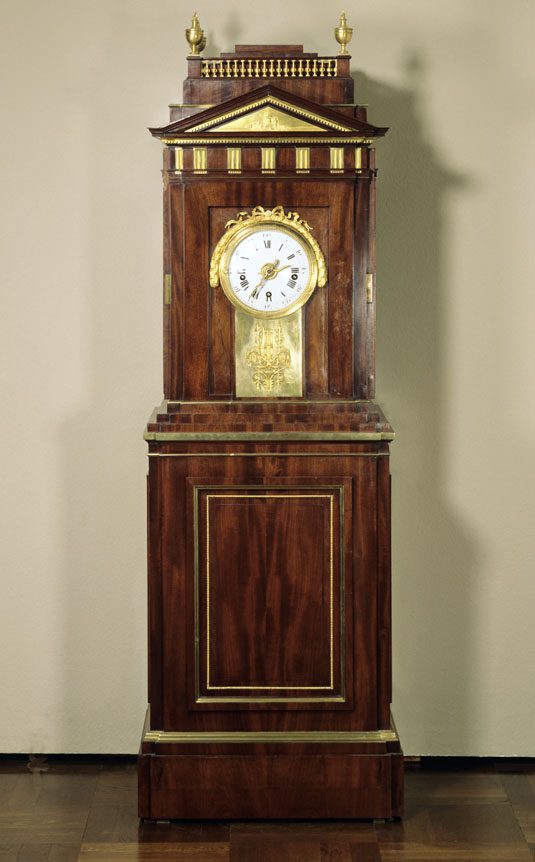
Clocks · Longcase clock
Longcase clock by David Roentgen ( - ), England, 1711–1827
- Maker / attribution
- David Roentgen ( - ) (creator); Peter Kinzing IV. (creator); Gebrüder Weil (Neuwied) (creator)
- Date
- 1711–1827
- Historical period
- Precision & Scientific Horology (1750 – 1850)
- Country of origin
- England
- Place
- Karlsruhe
- Object type
- Longcase clock
- Holding institution
- Badisches Landesmuseum Karlsruhe
- Accession / object no.
- item_CWGQWWCNQEVBNUACRKER3ZJKKXPBU7DU
- Catalogue title (original)
- Standuhr "Apollo" (German)
Record summary
Held and catalogued by Badisches Landesmuseum Karlsruhe (object number item_CWGQWWCNQEVBNUACRKER3ZJKKXPBU7DU), this is a longcase clock by David Roentgen ( - ), made in Karlsruhe, England, dated 1711–1827. The Atlas places it in the Precision & Scientific Horology period (1750 – 1850) of its Clocks collection. The record is illustrated with 1 photograph.
Assembled from the source record's structured fields. Dates and attributions are given as the source states them; where a field is missing the Atlas leaves it blank rather than estimating.
Catalogue description
Catalogue description from Badisches Landesmuseum Karlsruhe (German)
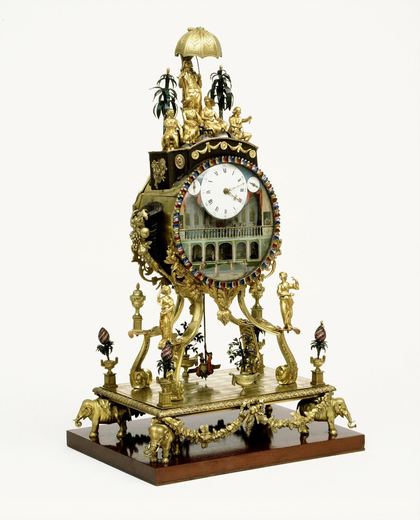
Das Gehäuse dieser Standuhr wurde von Abraham Roentgen (1711-1793) gefertigt. Die Uhr imitiert den Giebel eines antiken Tempels, das gravierte Giebelbild zeigt Putti mit Büchern und einer Rechentafel. Der Sockel dazwischen verkündet: "Algebra, Artis, Aritmetica". Dies lässt vermuten, dass die Uhr wohl für ein Studierzimmer bestimmt war. Eine Balustrade mit flammenden Urnen auf den Ecken bekrönt die Uhr. Das emaillierte und mit Lorbeer umkränzte Zifferblatt zeigt die Stunden in römischen, die Minuten in arabischen Zahlen, mit einer Schlange und Stab als Zeiger. Darunter befindet sich eine Metallplatte mit einer Lyra im Bandwerk. Die an der Antike angelehnten kantigen Formen erlaubten eine rationale Vorfertigung des Möbels - entgegen den geschwungenen Linien des Rokoko. Der Korpus erscheint als Grundmodul, das Roentgen in Serie bauen ließ, wovon etwa 19 ähnliche Exemplare dieses Uhrentyps in verschiedenen Sammlungen sprechen.Die Uhr ist mit einem achttägige Gehwerk ausgestattet und schlägt stündlich. Zur vollen Stunde, alle drei Stunden oder durch Ziehen an einer Schnur ertönt eine Melodie. Die Uhr hat sechs Spielwalzen mit drei Kompositionen von Christoph Willibald Gluck (1714-1787), die seine Vorliebe für antike Mythen zeigen: Das Duett "Ah, mon ami" aus Iphigénie en Tauride (1779) sowie aus Armide (1777) "Jamais dans ces beaux lieux" und "Jeunes Coeurs, tout vous est favorable". Diese Titel verstärken die antiken Zitate im Möbeldekor Roentgens. Die Uhr belegt zum einen, dass für Musikwerke auf jeweils aktuelle Komponisten zurückgegriffen wurde und diese selbst Stücke für solche Uhren schufen (Händel, Haydn, Beethoven). Zum anderen, dass bereits in den 1780er Jahre das Kunsthandwerk antike Formen aufgriff, bevor Directoire und Empire in Mode kamen.1750 gründete Abraham Roentgen (1711-1793) eine Kunstschreinerei in Neuwied. In England hatte er neue Betriebsstrukturen erfahren: Möbel wurden nicht mehr auf Bestellung, sondern auf Vorrat gefertigt. Er rationalisierte ebenso Arbeitsprozesse, etwa mit „Baukastensystemen“. Dennoch wurde jedes Möbel im Dekor als Einzelstück ausgearbeitet. Heimische Hölzer bildeten den Grundkorpus, den wertvolle Furniere sowie Einlagen aus Elfenbein, Perlmutt, Schildpatt oder feuervergoldete Beschläge verkleideten. Roentgens Sohn David (1743-1807) erweiterte die Werkstatt und gründete Filialen in St. Petersburg, Brüssel, Paris und Berlin, um internationale Aufträge erfüllen zu können. Auch richtete man an mehreren Ortten Möbellager als „showroom“ ein. In der Hochphase besaß der Betrieb etwa 80 Mitarbeiter und mehrere spezialisierte Subunternehmer, der den europäischen Hochadel belieferte. Gern kooperierte Roentgen z. B. seit 1762 mit dem Uhrmacher Peter Kinzig IV (1745-1816) und den Orgelbauern Johann Christian (1758-1827) und Johann Wilhelm Weil (1756-1813), um Möbel attraktiver zu gestalten. Solches betraf besonders Standuhren oder Schreibtische sowie „Kabinettschränke“, die man mit Uhren sowie Spielwerken koppelte.Ab 1783 wurde Katherina II. von Russland eine Hauptkundin Roentgens, Das erste Stück für sie war der „Apolloschreibtisch“ mit Musikwerk. Es spielte unter anderem den „Reigen seliger Geister“ aus „Orpheus und Eurydike“ von Willibald Gluck. Balustraden mit Vasen aus Messing bekrönten nebst der Figur eines Apollon das Objekt. Dieses Design für die prominente Kundin wurde zum Produktschlager Roentgens. Zur schleichenden Rezession der Luxusmöbel aus Neuwied führte die Französische Revolution 1789.
Shown in the original language of the source catalogue. An editor-reviewed English translation has not yet been published; we do not publish machine translations as authoritative text.
Historical context
Precision & Scientific Horology (1750 – 1850)
Harrison solves longitude; Mudge invents the lever; Breguet's Paris workshop defines the modern watch.
The age of the deadbeat escapement, compensated pendulums and observatory regulators. Domestic clocks spread through the middle classes: English longcase and bracket clocks, French gilt-bronze mantel clocks, Viennese Biedermeier wall clocks, Black Forest painted-shield clocks, and the first American shelf clocks.
Read the period in the timelineMore clocks from this periodEarlier: Early Modern Horology
Atlas type guide
Longcase (tall-case or grandfather) clocks
The longcase clock was born from two seventeenth-century innovations: Christiaan Huygens's pendulum (1656–57) and the anchor escapement (c. 1670). A long seconds pendulum, nearly a metre long, swings with a small arc, and enclosing it together with the driving weights in a tall wooden case protected the mechanism and created a new piece of furniture. London makers such as Ahasuerus Fromanteel, Thomas Tompion and Joseph Knibb set the pattern.
By the eighteenth century longcase clocks were made throughout Britain, the Netherlands, Scandinavia (the Swedish Mora clock), France (the Comtoise from the Franche-Comté), Germany and colonial America. Eight-day movements with two weights became standard in better clocks; thirty-hour clocks with one weight and a rope or chain were cheaper alternatives.
What to look for
- Winding holes in the dial: two (eight-day, going and striking) or none (thirty-hour, pulled up by a chain).
- Brass dials with applied chapter rings (earlier) versus painted iron 'white' dials (after c. 1770 in Britain).
- Moon-phase arches, date apertures, seconds dials and maker's name on the dial.
- Case woods and style: ebonised, walnut marquetry, lacquer, oak or mahogany; regional styles from London, Lancashire, Scotland or America.
- Whether the movement and dial match the case — 'marriages' are common.
Dating clues
- Square brass dials suggest c. 1670–1720; arched brass dials c. 1715–1790.
- Painted (white) dials were made by Birmingham dial-makers from about 1772.
- Comtoise clocks with repoussé pendulums are mostly nineteenth century.
General guidance written by the Atlas editors about this kind of object. It is not a statement about this particular piece; for that, rely on the source record above and on physical examination.
Related records
Clocks · 1740-1760
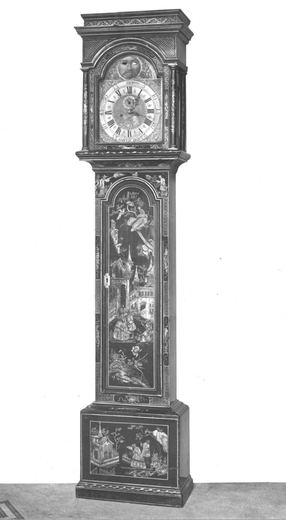
Longcase clock, English, 1740-1760, japanned wood, John Ellicott
Victoria and Albert Museum, London
Clocks · 1751
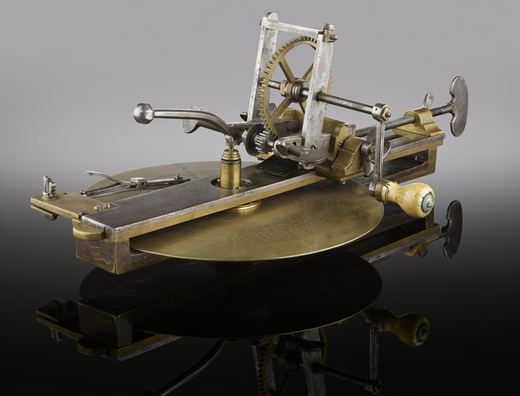
Large wheel engine, signed and dated "John Tipping, Whildon Green, 1751".
Science Museum Group, London
Clocks · ca. 1760
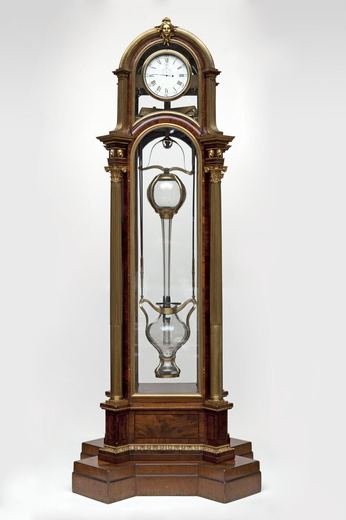
Longcase clock by James Cox, England, ca. 1760
Victoria and Albert Museum, London
Clocks · 1766
Clock by Cumming, Alexander, England, 1766
Science Museum Group, London
Clocks · 1768-1769
Regulator clock by Shelton, John, England, 1768-1769
Science Museum Group, London
Clocks · ca. 1775
Longcase clock, England, ca. 1775
Victoria and Albert Museum, London
Clocks · ca. 1780
Bracket clock of ebony, with face of West Midlands enamel painted in black and crimson, made by James Tregent, London, England, about 1780
Victoria and Albert Museum, London
Clocks · ca. 1780
Carpenter clock, automaton clock made for the Chinese market
Victoria and Albert Museum, London