Clocks · Longcase clock
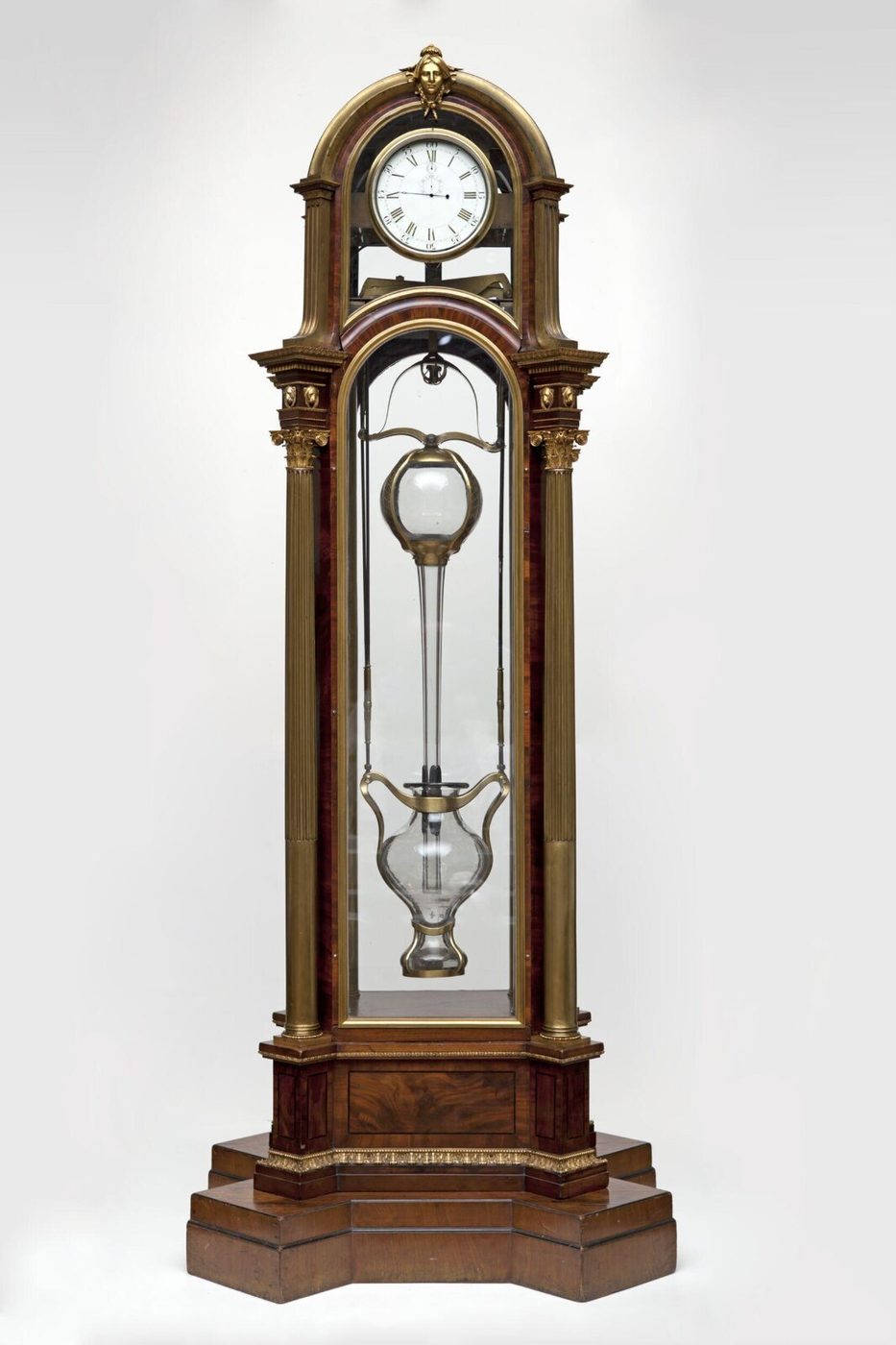
Longcase clock by James Cox, England, ca. 1760
- Maker / attribution
- James Cox (made); Thomas Weeks
- Date
- ca. 1760
- Historical period
- Precision & Scientific Horology (1750 – 1850)
- Country of origin
- England
- Place
- London
- Object type
- Longcase clock
- Materials / technique
- mahogany, ormolu, glass, brass, enamel
- Dimensions
- Height: 258 cm; Width: 104 cm; Depth: 84.5 cm
- Holding institution
- Victoria and Albert Museum, London
- Accession / object no.
- W.20:1 to 3-1961
- Credit line
- Purchased with Art Fund support
Record summary
Held and catalogued by Victoria and Albert Museum, London (object number W.20:1 to 3-1961), this is a longcase clock by James Cox, made in London, England, dated ca. 1760. The Atlas places it in the Precision & Scientific Horology period (1750 – 1850) of its Clocks collection. Materials and techniques recorded by the source: mahogany, ormolu, glass, brass, enamel. Recorded dimensions: Height: 258 cm; Width: 104 cm; Depth: 84.5 cm. The record is illustrated with 4 photographs.
Assembled from the source record's structured fields. Dates and attributions are given as the source states them; where a field is missing the Atlas leaves it blank rather than estimating.
Catalogue description
V&A — Summary
Designed as an object of curiosity and wonder, James Cox's clock has had a long history of public display. From 1768 to 1774 it was exhibited in Cox's own museum of automata in Charing Cross, London. The museum was dispersed by lottery in 1775, and by 1796 the clock was on display in Thomas Week's Royal Mechanical Museum in Titchbourne Street, London. It remained there until 1837. The clock's mechanism used the difference in atmospheric pressure between two jars of mercury to achieve a perpetual motion. This required at least one hundred and fifty pounds (about 68 kg) of mercury. The clock is generally recognised as the first successful attempt to produce a perpetual motion clock in England. After seeing it in Cox's museum, the astronomer James Ferguson described it as "the most ingenious piece of mechanism I ever saw in my life".
V&A — Physical description
Long case clock with mahogany case with ormolu mounts, and glass sides to allow maximum view of the mechanism. The clock is contained in a large mahogany case that is glazed on all four sides. The case divides into two sections: in the upper quarter the dial and movement are held under a hood; the bottom three-quarters of the case house the mechanism. The base of the case is formed as a rectangular plinth. Each of the case’s four main panels of glass finishes in a curved arch below the dial. The top of the hood is also arched. The hood is glazed on all four sides. The four projecting corners of the case are adorned with brass Corinthian columns. These columns are topped with gilded brass mounts of lion’s heads. Around the bottom of the case is a gilded brass frieze. The heads of the hood arches at front and rear are mounted with female masks in gilded brass. The clock’s movement sits behind a white enamel dial. The movement can be seen through the glass panel at the rear of the hood. The movement has a dead-beat escapement and a bar-balance beating 30 to the minute. This is driven by a weight which hangs on an endless loop of chain. The movement’s weight is wound using energy from the barometer in the lower part of the case. The barometer tube and bowl are suspended from opposite ends of rocking levers. As atmospheric pressure changes, mercury moves between these vessels. This causes the barometer tube to rise and fall. The barometer tube is connected, via a rod, to a set of wheels that power the clock’s movement. The barometer keeps the clock going continuously. The barometer bowl is held in place by curved brass straps. The straps on either side of the bowl are engraved respectively ‘Weeks’s Rl. Museum’ and ‘London 1806’.
V&A — Object history
Made by James Cox and his chief mechanic, Joseph Merlin, in the 1760s. James Cox worked largely as a jeweller and goldsmith, and was most famous for his production of automata. Working from London premises on Shoe Lane, he developed a large export trade in automata in the 1760s, designing elaborate pieces for sale to India, China and Russia. John Joseph Merlin came to England from Belgium in 1760, having already trained as a mechanic. Merlin appears to have worked as Cox’s principal mechanic from the 1760s until around 1772. Describing himself in patent applications as a mathematical instrument maker, Merlin most likely worked for Cox building the mechanisms for complex automata, as well being a clock- and watch-maker. The clock was first recorded in an edition of the catalogue of Cox's Mechanical Museum dated 1773 (Guildhall Library, Pam 6546, no.47). In January 1774 it was inspected by James Ferguson, a lecturer in natural philosophy, who described it as ' [...] the most ingenious piece of mechanism I ever saw in my life.' A description of the clock also appears in the 'Annual Register' for 1774 (vol. 17, p. 248). From 1768 to 1774 the clock was exhibited in Cox's own museum of automata in Charing Cross, London. The museum was dispersed by lottery in 1775, and by 1796 the clock was on display in Thomas Weeks's Royal Mechanical Museum in Titchbourne Street, London. It remained there until 1837. There is a gap in the history of the clock between 1937 and 1898. In 1898 it was exhibited at the Clerkenwell Institute, recorded as the property of W.F.B. Massey-Mainwaring. In 1921 the clock was bought by a Mr. R.G. Carruthers in Edinburgh and placed by him on loan in the Laing Gallery, Newcastle on Tyne. It was sold by auction in London and bought by Messrs Blairman. The clock was bought by the V&A from Blairman and Sons in 1961, with the assistance of the National Art Collections Fund. A number of changes appear to have been made to the clock during its history. A 1796 engraving of the clock, produced in connection with Cox’s Lottery, shows it without the lion’s head paterae now seen below the hood. In the engraving, the clock is also shown with an elaborate mount on the top of the hood, where the female masks now sit. When the clock was acquired by the V&A it was topped with a gilded brass eagle. The vase that currently sits on top of the hood was made to correspond to a vase seen in the engraving.
V&A gallery label
‘Perpetual motion’ clock About 1765 James Cox (about 1723–1800) and John Joseph Merlin (1735–1803) England (London) Case: solid and veneered mahogany with glass Mounts: gilded brass or bronze Purchased with the assistance of the Art Fund Museum no. W.20-1961 In the 18th century, with the widespread interest in science, furniture sometimes incorporated elaborate mechanisms. This clock was the work of James Cox, a jeweller who exported automata to India and China. A star exhibit in his ‘Mechanical Museum’, it was celebrated as the first clock powered by ‘perpetual motion’. The mechanism does not need winding because it works likes a barometer, moving mercury between two large glass jars and translating the movement to the dial via a series of wheels.
V&A gallery label
This clock was made as a scientific curiosity. Exhibited from 1768-1774 in John Cox’s popular Mechanical Museum at Charing Cross, it was widely advertised as the only working example of ‘perpetual motion’. The clock’s movement does not need winding, as it is powered by a large barometer-like mechanism in the case. Designed by John Cox and the engineer John Joseph Merlin, the clock’s display of a scientific system is typical of the late 18th century fascination with the spectacle of science.
Historical context
Precision & Scientific Horology (1750 – 1850)
Harrison solves longitude; Mudge invents the lever; Breguet's Paris workshop defines the modern watch.
The age of the deadbeat escapement, compensated pendulums and observatory regulators. Domestic clocks spread through the middle classes: English longcase and bracket clocks, French gilt-bronze mantel clocks, Viennese Biedermeier wall clocks, Black Forest painted-shield clocks, and the first American shelf clocks.
Read the period in the timelineMore clocks from this periodEarlier: Early Modern Horology
Atlas type guide
Longcase (tall-case or grandfather) clocks
The longcase clock was born from two seventeenth-century innovations: Christiaan Huygens's pendulum (1656–57) and the anchor escapement (c. 1670). A long seconds pendulum, nearly a metre long, swings with a small arc, and enclosing it together with the driving weights in a tall wooden case protected the mechanism and created a new piece of furniture. London makers such as Ahasuerus Fromanteel, Thomas Tompion and Joseph Knibb set the pattern.
By the eighteenth century longcase clocks were made throughout Britain, the Netherlands, Scandinavia (the Swedish Mora clock), France (the Comtoise from the Franche-Comté), Germany and colonial America. Eight-day movements with two weights became standard in better clocks; thirty-hour clocks with one weight and a rope or chain were cheaper alternatives.
What to look for
- Winding holes in the dial: two (eight-day, going and striking) or none (thirty-hour, pulled up by a chain).
- Brass dials with applied chapter rings (earlier) versus painted iron 'white' dials (after c. 1770 in Britain).
- Moon-phase arches, date apertures, seconds dials and maker's name on the dial.
- Case woods and style: ebonised, walnut marquetry, lacquer, oak or mahogany; regional styles from London, Lancashire, Scotland or America.
- Whether the movement and dial match the case — 'marriages' are common.
Dating clues
- Square brass dials suggest c. 1670–1720; arched brass dials c. 1715–1790.
- Painted (white) dials were made by Birmingham dial-makers from about 1772.
- Comtoise clocks with repoussé pendulums are mostly nineteenth century.
General guidance written by the Atlas editors about this kind of object. It is not a statement about this particular piece; for that, rely on the source record above and on physical examination.
Related records
Clocks · 1711–1827
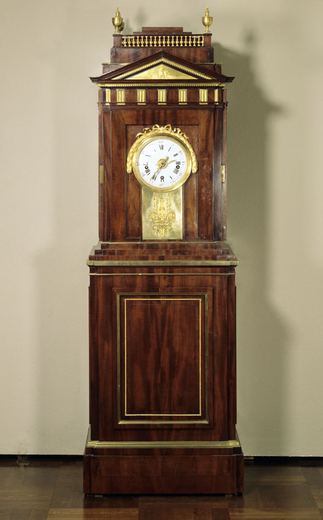
Longcase clock by David Roentgen ( - ), England, 1711–1827
Badisches Landesmuseum Karlsruhe
Clocks · 1740-1760
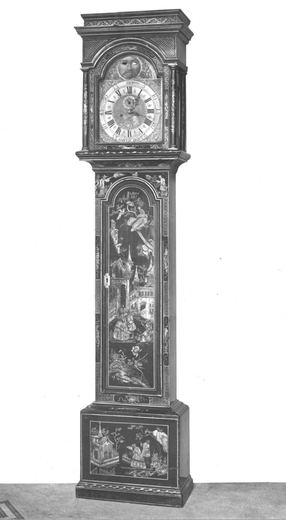
Longcase clock, English, 1740-1760, japanned wood, John Ellicott
Victoria and Albert Museum, London
Clocks · 1751
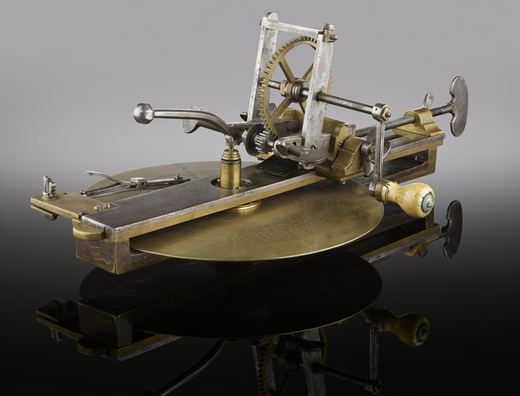
Large wheel engine, signed and dated "John Tipping, Whildon Green, 1751".
Science Museum Group, London
Clocks · 1766
Clock by Cumming, Alexander, England, 1766
Science Museum Group, London
Clocks · 1768-1769
Regulator clock by Shelton, John, England, 1768-1769
Science Museum Group, London
Clocks · ca. 1775
Longcase clock, England, ca. 1775
Victoria and Albert Museum, London
Clocks · ca. 1780
Bracket clock of ebony, with face of West Midlands enamel painted in black and crimson, made by James Tregent, London, England, about 1780
Victoria and Albert Museum, London
Clocks · ca. 1780
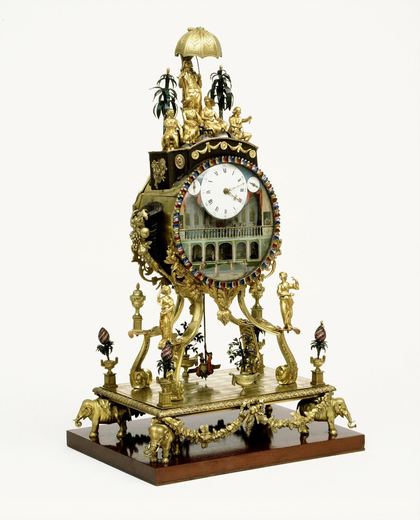
Carpenter clock, automaton clock made for the Chinese market
Victoria and Albert Museum, London