Clocks · Longcase clock
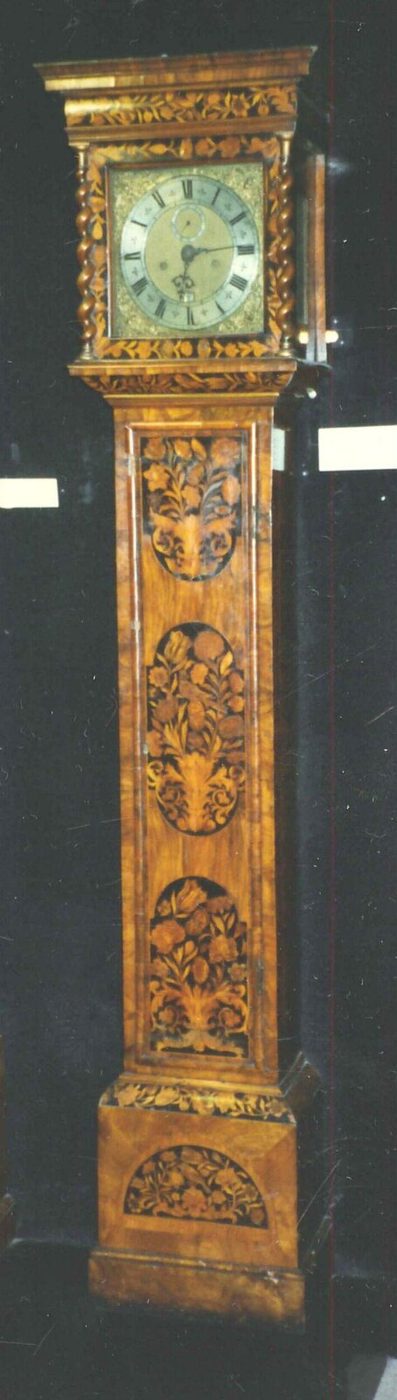
LONG CASE CLOCK Marquetry of walnut and other woods Inscribed ‘William Clement, London’, made about 1685
- Maker / attribution
- William Clement (made)
- Date
- c.1685
- Historical period
- Early Modern Horology (1600 – 1750)
- Country of origin
- England
- Place
- London
- Object type
- Longcase clock
- Materials / technique
- wood with walnut marquetry; brass and steel movement
- Dimensions
- Height: 200 cm; Width: 45 cm; Depth: 26.5 cm; Weight: 5.65 kg (w.41:4 weight 10/10/2025 NH)
- Holding institution
- Victoria and Albert Museum, London
- Accession / object no.
- W.41:1 to 4-1928
- Credit line
- Bequeathed by Major J H Selwyn Payne
Record summary
Held and catalogued by Victoria and Albert Museum, London (object number W.41:1 to 4-1928), this is a longcase clock by William Clement, made in London, England, dated c.1685. The Atlas places it in the Early Modern Horology period (1600 – 1750) of its Clocks collection. Materials and techniques recorded by the source: wood with walnut marquetry; brass and steel movement. Recorded dimensions: Height: 200 cm; Width: 45 cm; Depth: 26.5 cm; Weight: 5.65 kg (w.41:4 weight 10/10/2025 NH). The record is illustrated with 4 photographs.
Assembled from the source record's structured fields. Dates and attributions are given as the source states them; where a field is missing the Atlas leaves it blank rather than estimating.
Catalogue description
V&A — Summary
William Clement (1638-1704) was a leading London clockmaker of the late 17th century. Born at Rotherhithe, he initially made anchors for local shipbuilders. He turned to clockmaking when he moved to Southwark and eventually became Master of the Clockmakers Company in 1694; he joined as a brother in 1677. Clement was one of the earliest makers to apply the anchor escapement to clockwork, thus making the long pendulum practicable. The case is of oak veneered with walnut and the floral marquetry on the hood, the door and on the base is possibly inspired by Dutch marquetry. The mechanism is weight-driven and has an anchor escapement, which may be a later replacement. This is significant as Clement is one of three possible contenders, with the scientist Robert Hooke and the clockmaker Joseph Knibb, for the invention of the anchor escapement. Clement’s claim to this invention is surprising given his origins as an anchor smith and blacksmith. The hour striking on a single bell is controlled by an externally mounted count wheel.
V&A — Physical description
Dial: 10 inch square brass dial with leaf pattern engraving at the sides and top. The bottom, below the chapter ring engraved Wm Clement Londini fecit . Silvered chapter ring with Roman hour numerals, arrowhead half-hour divisions. The minute chapter has divisions for each minute and Arabic numerals in every five. The inner portion of the chapter ring is engraved with hour and half-hour divisions. Separate, silvered subsidiary seconds ring below twelve with Arabic numbers in multiples of fives but with 48 divisions. The main body of the dial has a matted centre with matted winding hole shutters with an engraved pattern, around the chamfered square calendar aperture located above six. The date is indicated by Arabic numerals engraved on a silvered disc carried behind the dial. The dial corners have cast brass, cherub head form spandrels. The dial feet are attached to the front plate of the movement with latched. Shaped steel hands. Movement: Brass and steel weight driven two-train movement, of month duration with count wheel (or locking plate) striking on bell, regulated by a long pendulum of one and a quarter second period. The count wheel with concentric lines turned on it, is located outside on the back plate. Six pillars of the finned form are riveted to the back plate and latched to the front. Going train with intermediate wheel, striking train with striking pin wheel carrying a large number of pins; the hoop wheel with two spaces for locking. Maintaining power is applied to the teeth of the centre wheel, the driving spring for this attached to the inside front plate. Where present, wheel collets tend to be half round in profile; arbors are non-parallel in section, tending to fatten towards their centres. Anchor recoil escapement. The back cock has thin chops through which the suspension spring passes. Above this, mounted on a shaped bracket, is an adjuster, having a square section hook connected via a vertical screw thread to an engraved adjustment wheel. Description and notes by Francis Brodie, c. 2008
V&A — Object history
Long case clock bequeathed by Major J H Selwyn Payne deceased Notes from R.P. 28-4956 16 May 1928 report, Oliver Brackett "The clock is @ 1689 with oval panels of floral marquetry on the door. The dial is signed 'Wm.Clement (Londini Fecit)' - - a maker to whom Britten gives some space. The decoration on the base is peculiar consisting of a semi-circular panel of marquetry. The clock….(is) consistent with the period and acceptable". 18 May 1928 minute, H Clifford Smith concludes that the inlay is in some respects unusual and the clock is a fine example of the period of Wm & Mary. 22 May 1928 letter, from Payne's solicitors explains that Payne, formerly of Badgworth Court in the County Gloucester was a Major late in his Majesty's Army. (N.B. - not from R.P.) A note in the registered description of this object includes information re. William Clement "admitted to the Clock Makers Co. 1677. Applied to clocks the anchor escapement invented by Dr Hooke about 1676 - see Britten's Old Clocks & Watches - Master of the Company 1674. In 1684 William Clement, presumably his son, was apprenticed to him. Notes from R.P. 3310-18 Oak case with walnut & floral marquetry, signed on face Wm. Clement Londini Fecit Wm. Clement of London was admitted to the Clockmakers Company in 1677 and made master in 1694. Remarks: Nice details on some parts of the steelwork, such as striking levers, springs. The escape wheel appears slightly different in colour and crispness than the rest of the train; the leaves of the pinion extend into the arbor, not seen on the other arbors (except the fourth), suggesting the entire replacement of this component. Fourth arbor (Going side) likewise with leaves cut into the arbor. Front plate with three holes for the pallet arbor (now located in the uppermost). Below the upper hole is a bushed, vacant hole and below this a plugged hole. The three holes now planted in line with a fine, vertically-scratched scribe line on the outside front plate. Back cock likewise has three pivot holes, two redundant. This component is of a fabricated construction having the chops sub-assembly attached the main body, whilst the inside has a rectangular space above those three pivot holes. The pendulum adjustment has the appearance of an English Spring (bracket) clock crown wheel, without the teeth. The engraved number ‘8’ appears contemporary with the clock, whilst the ‘5’ appears later. The fly has a rectangular, eighteenth century appearance with the friction spring across the brass. One night have expected to see an end-mounted friction spring and a less rectangular shape to the fly. The present spring for the maintaining power is a curly affair. On the front plate, just below the Going side barrel pivot hole is a plugged hole (perhaps two?), presumably the original site for the spring. The large bell has a later appearance. A repairer's mark is scratched on the outside front plate: “T B a b o”? “T” or “F 2 85” “8” Three crossings of the minute wheel have been filled at a later stage. Depending on sources, variously Clement, Hooke or Knibb have been attributed with inventing the anchor escapement for clocks. Certainly, Clement is regarded as one of the earliest makers to apply this escapement to clockwork, making the long pendulum practicable. The anchor escapement would allow a pendulum to swing through an arc of a few degrees, or less, unlike the verge escapement which typically requires the pendulum to swing through some 45 degrees, making the use of a long pendulum difficult. Description and notes by Francis Brodie, c. 2008
Historical context
Early Modern Horology (1600 – 1750)
Huygens' pendulum and balance spring transform accuracy; English makers develop the anchor and deadbeat escapements.
Huygens's pendulum (1656–57) improved clock accuracy from about a quarter of an hour to under a minute a day. The anchor escapement (c. 1670) and the long seconds pendulum created the longcase clock; London makers such as Fromanteel, Knibb, Tompion and Quare led European clockmaking, and French makers created the Boulle pendule.
Read the period in the timelineMore clocks from this periodEarlier: Renaissance Horology
Atlas type guide
Longcase (tall-case or grandfather) clocks
The longcase clock was born from two seventeenth-century innovations: Christiaan Huygens's pendulum (1656–57) and the anchor escapement (c. 1670). A long seconds pendulum, nearly a metre long, swings with a small arc, and enclosing it together with the driving weights in a tall wooden case protected the mechanism and created a new piece of furniture. London makers such as Ahasuerus Fromanteel, Thomas Tompion and Joseph Knibb set the pattern.
By the eighteenth century longcase clocks were made throughout Britain, the Netherlands, Scandinavia (the Swedish Mora clock), France (the Comtoise from the Franche-Comté), Germany and colonial America. Eight-day movements with two weights became standard in better clocks; thirty-hour clocks with one weight and a rope or chain were cheaper alternatives.
What to look for
- Winding holes in the dial: two (eight-day, going and striking) or none (thirty-hour, pulled up by a chain).
- Brass dials with applied chapter rings (earlier) versus painted iron 'white' dials (after c. 1770 in Britain).
- Moon-phase arches, date apertures, seconds dials and maker's name on the dial.
- Case woods and style: ebonised, walnut marquetry, lacquer, oak or mahogany; regional styles from London, Lancashire, Scotland or America.
- Whether the movement and dial match the case — 'marriages' are common.
Dating clues
- Square brass dials suggest c. 1670–1720; arched brass dials c. 1715–1790.
- Painted (white) dials were made by Birmingham dial-makers from about 1772.
- Comtoise clocks with repoussé pendulums are mostly nineteenth century.
General guidance written by the Atlas editors about this kind of object. It is not a statement about this particular piece; for that, rely on the source record above and on physical examination.
Read next:Anchor escapement
Related records
Clocks · c.1690
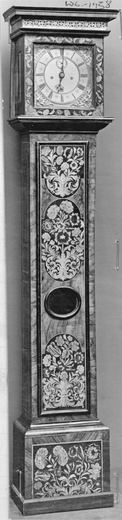
LONG CASE CLOCK Marquetry of walnut and other woods Made by William Clement, London, about 1690
Victoria and Albert Museum, London
Clocks · 1598-1603
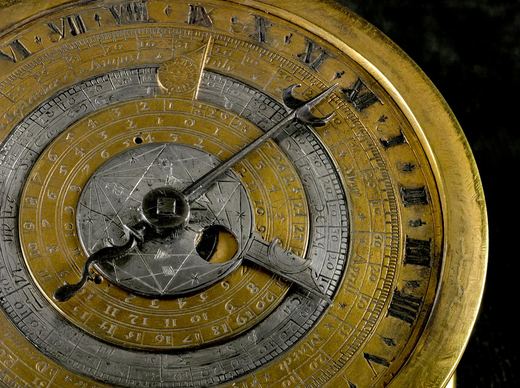
Circular table-clock with calendrical and lunar indications made by Nicholas Vallin in London between 1598 and 1603.
Science Museum Group, London
Clocks · 1611
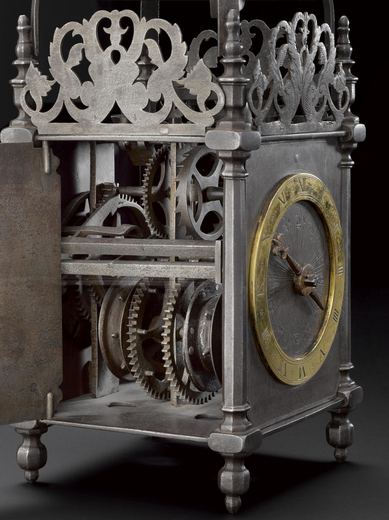
English iron lantern clock, with wheel balance, by John Holloway, Market Lavington, Wiltshire, England, 1611.
Science Museum Group, London
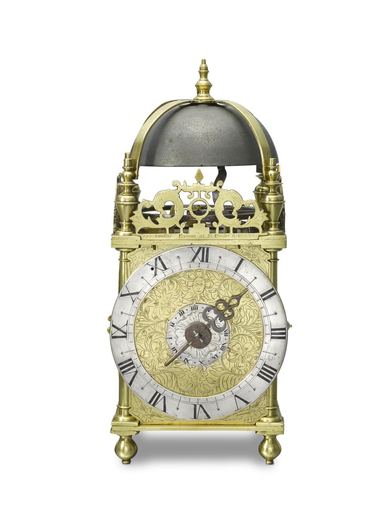
Clocks · 1630
Lantern clock by Forman, Francis, England, 1630
Science Museum Group, London
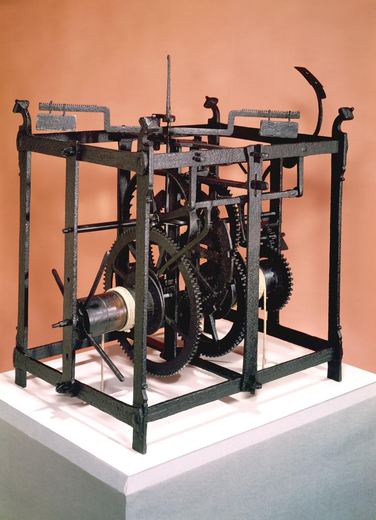
Clocks · 1632-1640
Turret clock, England, 1632-1640
Science Museum Group, London
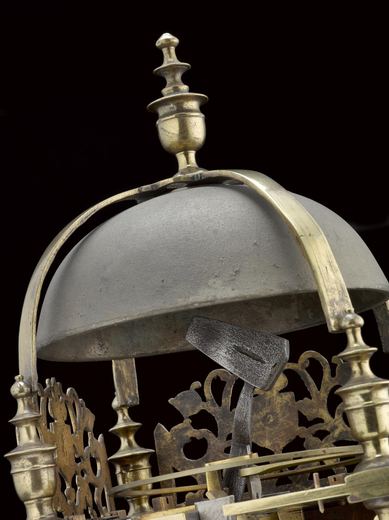
Clocks · 1645-1655
Balance-wheel brass lantern clock, with two driving weights and one counterweight, by Thomas Knifton, Cross Keys, Lothbury, London, England, 1645-1655.
Science Museum Group, London
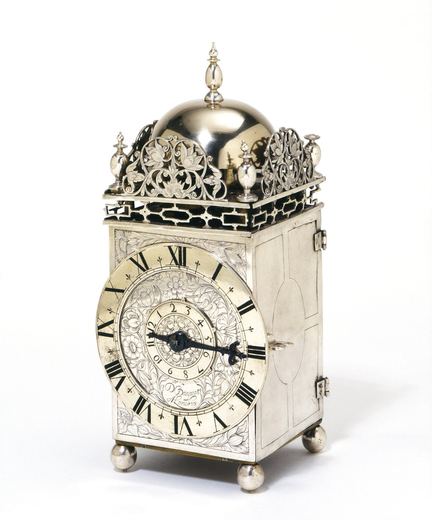
Clocks · ca. 1650
Lantern alarm clock, silver, by David Bouquet, circa 1650
Victoria and Albert Museum, London
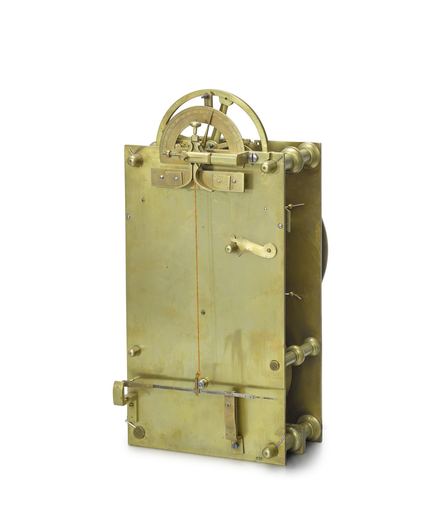
Clocks · 1650-1660
Lantern clock by Closon, Peter, England, 1650-1660
Science Museum Group, London