Clocks · Longcase clock
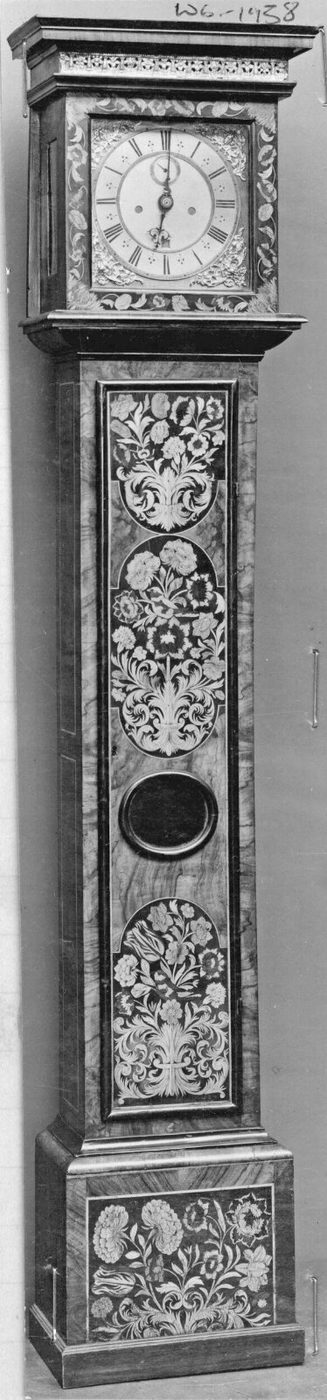
LONG CASE CLOCK Marquetry of walnut and other woods Made by William Clement, London, about 1690
- Maker / attribution
- William Clement (made)
- Date
- c.1690
- Historical period
- Early Modern Horology (1600 – 1750)
- Country of origin
- England
- Place
- London
- Object type
- Longcase clock
- Materials / technique
- brass, walnut, oak
- Dimensions
- Height: 196 cm; Width: 43.2 cm; Depth: 26.7 cm; Weight: 4.7 kg (w.6:6 Brass weight 10/10/2025 NH); Weight: 9.75 kg (w.6:7 Lead weight 10/10/2025 NH); Weight: 11.45 kg (w.6:8 Lead weight 10/10/2025 NH); Weight: 3.3 kg (w.6:9 Brass weight 10/10/2025 NH)
- Holding institution
- Victoria and Albert Museum, London
- Accession / object no.
- W.6:1-1938
- Credit line
- Bequeathed by Mr E.H.A.C. Wells
Record summary
Held and catalogued by Victoria and Albert Museum, London (object number W.6:1-1938), this is a longcase clock by William Clement, made in London, England, dated c.1690. The Atlas places it in the Early Modern Horology period (1600 – 1750) of its Clocks collection. Materials and techniques recorded by the source: brass, walnut, oak. Recorded dimensions: Height: 196 cm; Width: 43.2 cm; Depth: 26.7 cm; Weight: 4.7 kg (w.6:6 Brass weight 10/10/2025 NH); Weight: 9.75 kg (w.6:7 Lead weight 10/10/2025 NH); Weight: 11.45 kg (w.6:8 Lead weight 10/10/2025 NH); Weight: 3.3 kg (w.6:9 Brass weight 10/10/2025 NH). The record is illustrated with 4 photographs.
Assembled from the source record's structured fields. Dates and attributions are given as the source states them; where a field is missing the Atlas leaves it blank rather than estimating.
Catalogue description
V&A — Summary
William Clement (1638-1704) was a leading London clockmaker of the late 17th century. Born at Rotherhithe, he initially made anchors for the local shipbuilders. He turned to clockmaking when he moved to Southwark and eventually became Master of the London Clockmakers Company in 1694, having become a member in 1677. Clement was one of the earliest makers to apply the anchor escapement to clockwork, thus making the long pendulum practicable. The relatively small size of this clock marks it out as an earlier piece, as does the fact that the winding holes on the dial are not ringed and the second dial is narrow and small. The gilt brass openwork on the hood above the dial is quite unusual and it is possible that this was attached to the clock rather than the usual piece of wood engraving to save time during the clock’s construction, or that it was added later as restoration. The case itself is of oak veneered with walnut and the decorative marquetry panels around the dial, on the clock door and on the clock base show bouquets of flowers, a feature possibly taken from Dutch marquetry. The mechanism is weight-driven and has an anchor escapement.
V&A — Physical description
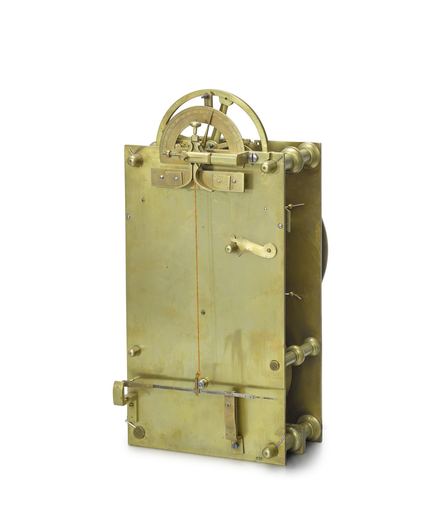
Dial: Ten inch square. Brass dial plate with matted centre, calendar aperture behind which is calendar ring. Plain winding holes, with matted shutters concealing winding squares. Winged cherubs head spandrels are screwed to corners of the dial plate and whilst of the same design, the one mounted by I and II is significantly different in detail. The chapter ring and subsidiary seconds ring pinned at back of dial plate. Minute band at outer edge of chapter ring. Arabic five minute numerals, double figures being split either side of stroke; '5' is placed to one side of stroke. Dots at five minute intervals also present in minute band. Roman hour numerals, quarter hour divisions with half hour marks of trident design with dots. Top of seconds ring cuts a small way into inside of chapter ring below XII; its diameter is such to allow a portion of matted dial centre to be visible between bottom of ring and central aperture of dial. Scale is of elongated strokes at five second intervals and Arabic numerals split as above each ten seconds. The signature William Clement London engraved into dial plate below VI. Dial is attached to movement front plate by four dial feet and latches. Hands: Blued steel the minute particularly carved and detailed. Movement: 8-day, brass and steel, weight driven two train movement with anchor recoil escapement. Hour striking on bell controlled by countwheel mounted external to the back plate on an extension of the first arbor. Barrels mounted well up plate, resulting in tall appearance. Six pillar movement, each pillar having fins and semi-circular central knop, being riveted to the backplate, latched to the front. Layout scribe lines present on outside front plate. Bolt and shutter maintaining power acts on centre wheel teeth; operating spring spiral shaped. Collets where used to mount wheels of semi-circular profile. Pinion leaf roots of the fly extend a short way beyond head into arbor. Friction spring is end mounted but a small hole is visible in one brass fly vane. Plugged holes evident adjacent to fly pivot holes in both plates. Anchor escapement embracing 7½ teeth of escape wheel has well defined pads and comparatively short drop to arms. Escape pinion has the extended marks similar to those on fly arbor. Further plugged holes on front plate by current pallet arbor pivot hole. Back cock made up in two parts: i) the suspension block with a fold of brass and erratically cut slot, and ii) the main body. First part is slightly redder in colour than second. Small detailing of some components including: click tails, locking plate detent, bottom of hammer, maintaining power spring and click spring feet. Seatboard is atypical (recent replacement). Description and notes by Francis Brodie, c. 2008
V&A — Object history
Bequeathed by EHAC Wells (RP 982/38) Lent to the National Maritime Museum Greenwich, RF 59/2679 Dial: The combination of size, plain winding holes with matted shutters, layout of minute divisions and signature in the dial plate are indicators of work ca.1685. It is worth noting the similarity of the hands of this example and those of W.41-1928, noting the centres of both hour hands and detailing on minute hands. Compare also the small dots in the quarter hour ring beneath each half hour mark on W.41-1928 with the five-minute dots on this example. Hands: The minute especially is detailed in a manner that would not persist much after the date of the clock. Movement: The anchor escapement would appear to be a replacement, judging by its style. This is of some significance since William Clement is one of three possible contenders to the claim of inventor of the anchor escapement. An anchor more representative of the late 17th century might have had slender arms with a noticeable drop to small pads. That some alteration to the escapement has occurred is evident by the presence of plugged holes in the front plate adjacent to the current pallet arbor pivot hole, and it is possible that that modifications to the backcock may in some way be linked. Likewise it would seem that the fly arbor has been altered but this is of lesser significance. In other details the movement is of the later 17th century, for example the shape of the pillars and semi-circular collets. The outside countwheel is more typical of ‘early’ work, as is the presence of the maintaining power. A hang over from short pendulum clocks, maintaining power was still fitted to early long pendulum clocks with the recoil escapement at this date, but as it would have involved some extra effort to make without much advantage to the operation of the clock, it tended not to survive the 17th century (maintaining power was fitted after this period but usually for a special reason, for example in precision work). Other details which went the same way are the small decorative embellishments found on those components mentioned above. Their presence is a sign of quality work, as are the six pillars and dial feet all attached with latches. Finally, the relatively tall appearance of the movement is thought to have arisen from the desire to conceal dial feet rivets behind a relatively narrow chapter ring. Record: William Clement was a brother of the Clockmakers' Company in 1677, Warden in 1690, Renter Warden 1691, Upper Warden 1692 and Master 1694 ("Freemen of the Worshipful Company of Clockmakers", 1984, Pub. G. Daniels). Possibly invented the anchor escapement ca.1670—1 thus enabling the use of the more accurate long pendulum in clocks ("The Life of William Clement", Antiquarian Horology, Vol. 3, No. 12, Sept. 1962, pp354-356). Some doubt exists as to this claim, other contenders being the scientist Robert Hooke, or the clockmaker Joseph Knibb (T.0. Robinson, "The Longcase Clock", 1995, Antique Collectors’ Club, Woodbridge). William Clement was born in Rotherhithe 1638/9 and became an anchorsmith and blacksmith, but questions remain as to why such an individual would invent the anchor escapement. This and other reasons cast doubt on the place of Clement in horological history ("The Life of William Clement", Antiquarian Horology, Vol. 3, No. 12, Sept. 1962, pp354-356). Description and notes by Francis Brodie, c. 2008
V&A gallery label
Blythe Road store label: LONG CASE CLOCK Marquetry of walnut and other woods Inscribed ‘William Clement, London’, made about 1685 Bequeathed by Mr. E H A C Wells Museum number W.6-1938 William Clement (1638-1704) was a leading London clockmaker of the late 17th century. Born at Rotherhithe, he initially made anchors for local shipbuilders. He tumed to clockmaking when he moved to Southwark and eventually became Master of the Clockmakers Company in 1694; he joined as a brother in 1677. Clement was one of the earliest makers to apply the anchor escapement to clockwork, thus making the long pendulum practicable. The case is of oak veneered with walnut and the floral marquetry on the hood, the door and on the base is possibly inspired by Dutch marquetry. The mechanism is weight-driven and has an anchor escapement, which may be a later replacement. This is significant as Clement is one of three possible contenders, with the scientist Robert Hooke and the clockmaker Joseph Knibb, for the invention of the anchor escapement. Clement’s claim to this invention is surprising given his origins as an anchor smith and blacksmith. The hour striking on a single bell is controlled by an externally mounted count wheel.
Historical context
Early Modern Horology (1600 – 1750)
Huygens' pendulum and balance spring transform accuracy; English makers develop the anchor and deadbeat escapements.
Huygens's pendulum (1656–57) improved clock accuracy from about a quarter of an hour to under a minute a day. The anchor escapement (c. 1670) and the long seconds pendulum created the longcase clock; London makers such as Fromanteel, Knibb, Tompion and Quare led European clockmaking, and French makers created the Boulle pendule.
Read the period in the timelineMore clocks from this periodEarlier: Renaissance Horology
Atlas type guide
Longcase (tall-case or grandfather) clocks
The longcase clock was born from two seventeenth-century innovations: Christiaan Huygens's pendulum (1656–57) and the anchor escapement (c. 1670). A long seconds pendulum, nearly a metre long, swings with a small arc, and enclosing it together with the driving weights in a tall wooden case protected the mechanism and created a new piece of furniture. London makers such as Ahasuerus Fromanteel, Thomas Tompion and Joseph Knibb set the pattern.
By the eighteenth century longcase clocks were made throughout Britain, the Netherlands, Scandinavia (the Swedish Mora clock), France (the Comtoise from the Franche-Comté), Germany and colonial America. Eight-day movements with two weights became standard in better clocks; thirty-hour clocks with one weight and a rope or chain were cheaper alternatives.
What to look for
- Winding holes in the dial: two (eight-day, going and striking) or none (thirty-hour, pulled up by a chain).
- Brass dials with applied chapter rings (earlier) versus painted iron 'white' dials (after c. 1770 in Britain).
- Moon-phase arches, date apertures, seconds dials and maker's name on the dial.
- Case woods and style: ebonised, walnut marquetry, lacquer, oak or mahogany; regional styles from London, Lancashire, Scotland or America.
- Whether the movement and dial match the case — 'marriages' are common.
Dating clues
- Square brass dials suggest c. 1670–1720; arched brass dials c. 1715–1790.
- Painted (white) dials were made by Birmingham dial-makers from about 1772.
- Comtoise clocks with repoussé pendulums are mostly nineteenth century.
General guidance written by the Atlas editors about this kind of object. It is not a statement about this particular piece; for that, rely on the source record above and on physical examination.
Read next:Anchor escapement
Related records
Clocks · c.1685
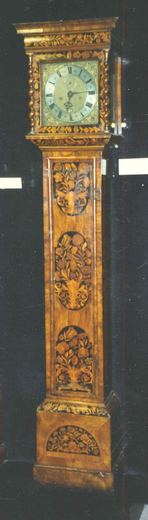
LONG CASE CLOCK Marquetry of walnut and other woods Inscribed ‘William Clement, London’, made about 1685
Victoria and Albert Museum, London
Clocks · 1598-1603
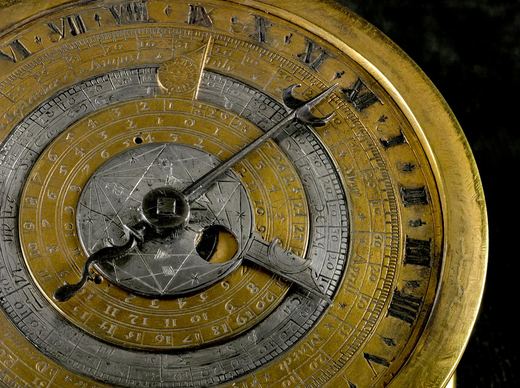
Circular table-clock with calendrical and lunar indications made by Nicholas Vallin in London between 1598 and 1603.
Science Museum Group, London
Clocks · 1611
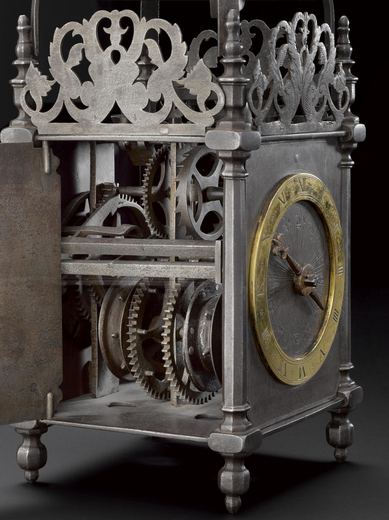
English iron lantern clock, with wheel balance, by John Holloway, Market Lavington, Wiltshire, England, 1611.
Science Museum Group, London
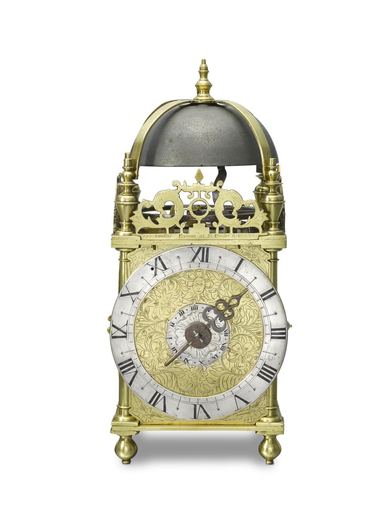
Clocks · 1630
Lantern clock by Forman, Francis, England, 1630
Science Museum Group, London
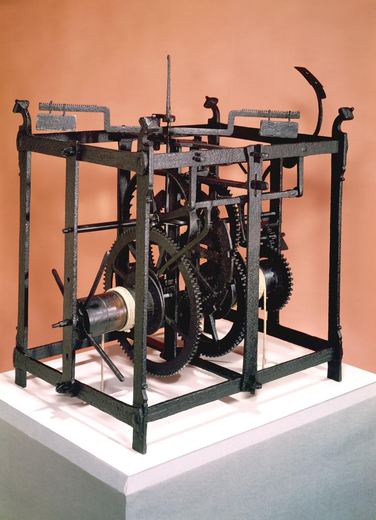
Clocks · 1632-1640
Turret clock, England, 1632-1640
Science Museum Group, London
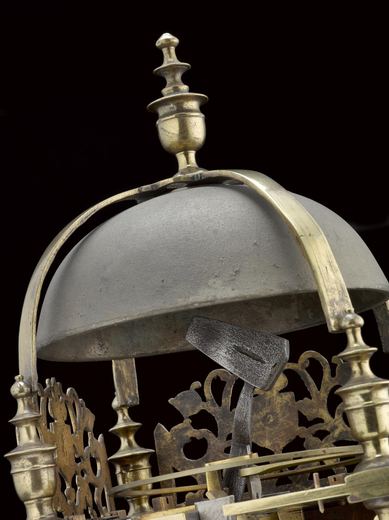
Clocks · 1645-1655
Balance-wheel brass lantern clock, with two driving weights and one counterweight, by Thomas Knifton, Cross Keys, Lothbury, London, England, 1645-1655.
Science Museum Group, London
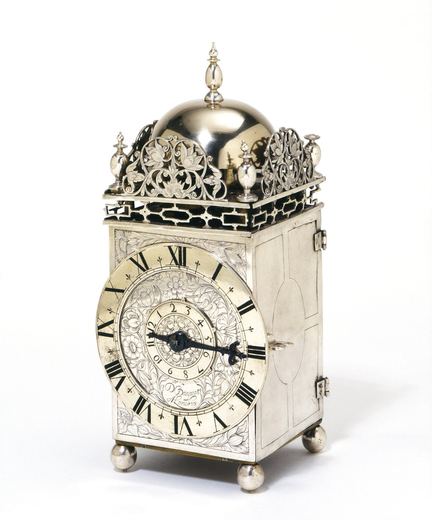
Clocks · ca. 1650
Lantern alarm clock, silver, by David Bouquet, circa 1650
Victoria and Albert Museum, London
Clocks · 1650-1660
Lantern clock by Closon, Peter, England, 1650-1660
Science Museum Group, London