
Horological History · Historical feature
The English Bracket Clock, 1660–1880: Ebony, Basket Tops and the Clock That Moved From Room to Room
The spring-driven table clock was the portable companion of the longcase. How English makers turned the short pendulum into a household and export classic — repeating at night, chiming tunes for Ottoman buyers, and finally keeping observatory time on a desk — with examples from seven collections.
Atlas Editorial · · 13 min read
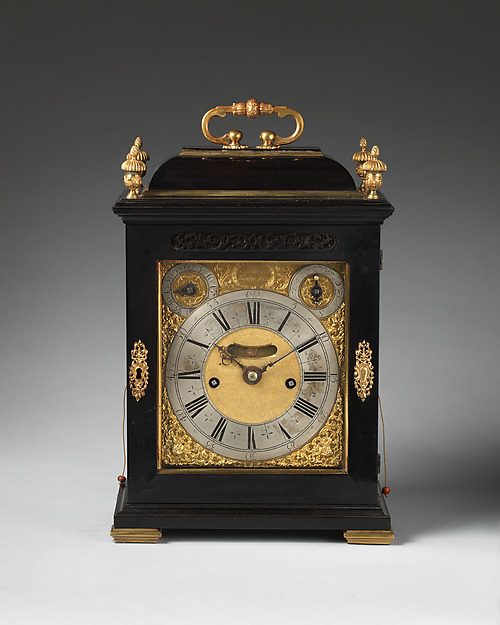
The Metropolitan Museum of Art, New York · CC0 1.0 (Met Open Access) · source (opens another website in a new tab)
The Victoria and Albert Museum's label for a bracket clock by Thomas Tompion explains the type in a sentence: 'This type of clock has a short pendulum that makes it small enough to sit on a shelf, or bracket.' The name is slightly misleading. Some bracket clocks did stand on wall brackets, sometimes supplied by the clockmaker to match the case, but most had no fixed place at all. They were carried by a handle on top from the dining room to the bedroom, wound once a week, and set down wherever the household needed to know the time. Collectors and museums also call them table clocks or spring clocks, and the three terms are used interchangeably here.
Where the longcase clock was a piece of architecture, the bracket clock was a piece of furniture that could move. That shaped everything about it: a spring rather than weights to drive it, a fusee to even out the spring's force, a short pendulum that tolerated being moved and set down slightly out of level, and a case designed to be seen from all sides. Within those constraints English makers produced some of the most refined domestic clocks of the seventeenth and eighteenth centuries, and a great many for export. This feature follows the type through objects in the Atlas catalogue, from the 1660s to the 1880s.
From the Hague to London: the short pendulum
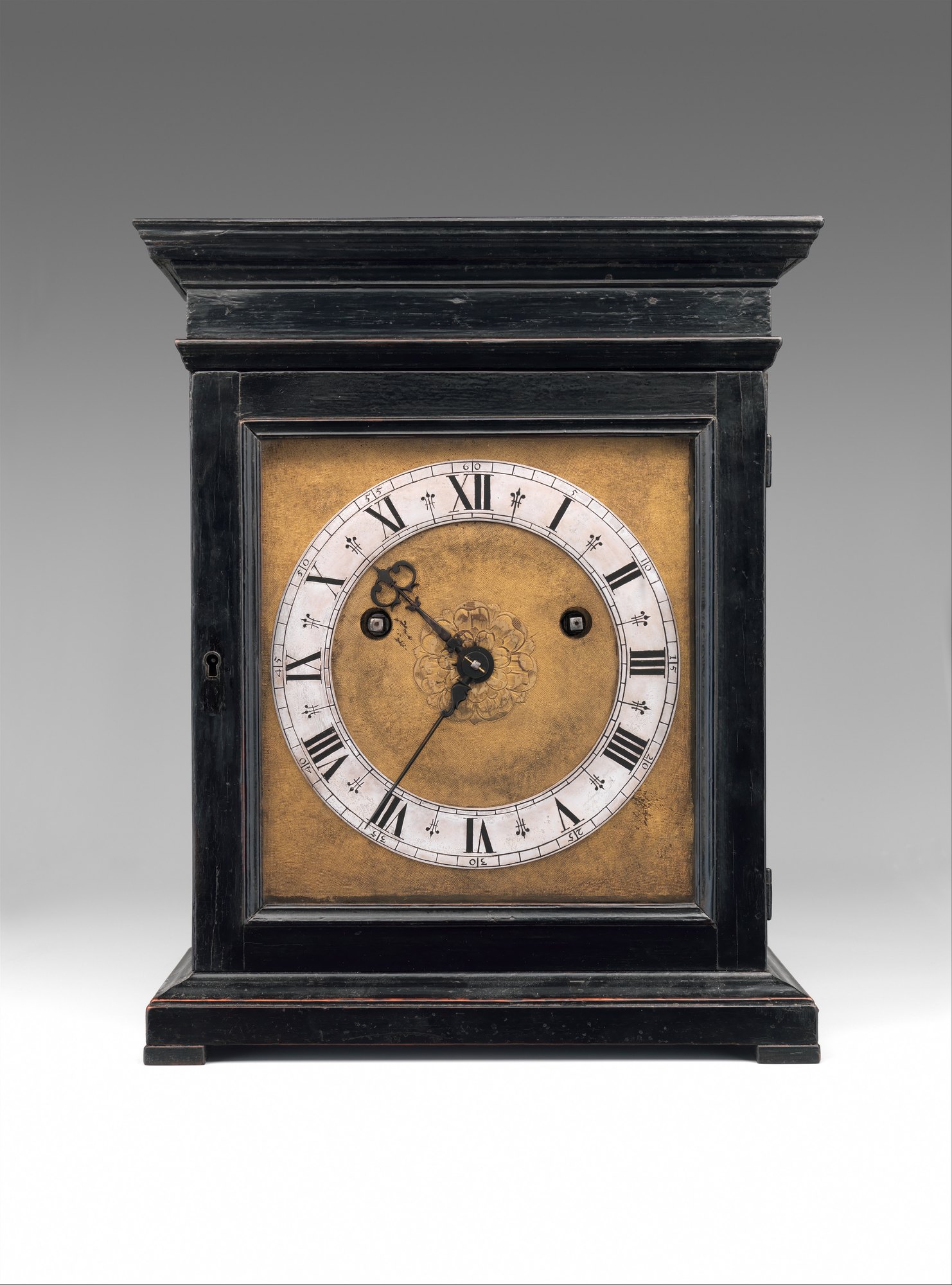
The pendulum was applied to clockwork by Christiaan Huygens in 1656, and the first pendulum clocks were made under licence by Salomon Coster in The Hague in 1657. The London connection was immediate. In 1657 John Fromanteel, son of the London clockmaker Ahasuerus Fromanteel, went to work with Coster, and in 1658 the Fromanteels advertised pendulum clocks in London. The earliest English pendulum clocks are small spring-driven 'box' clocks in the Dutch manner: an architectural case of ebony or ebonised wood with a pediment top, a gilt-brass dial plate and a short pendulum swinging behind the movement.
A table or bracket clock by Edward East in the Metropolitan Museum, of about 1665, is a fine example of this first generation. Its case is ebonised fruitwood and rosewood with ebony mouldings, 37 cm high, with a gilded brass and silver dial. East, one of the first members of the Clockmakers' Company, had a long career that spanned the Civil War and the Restoration.
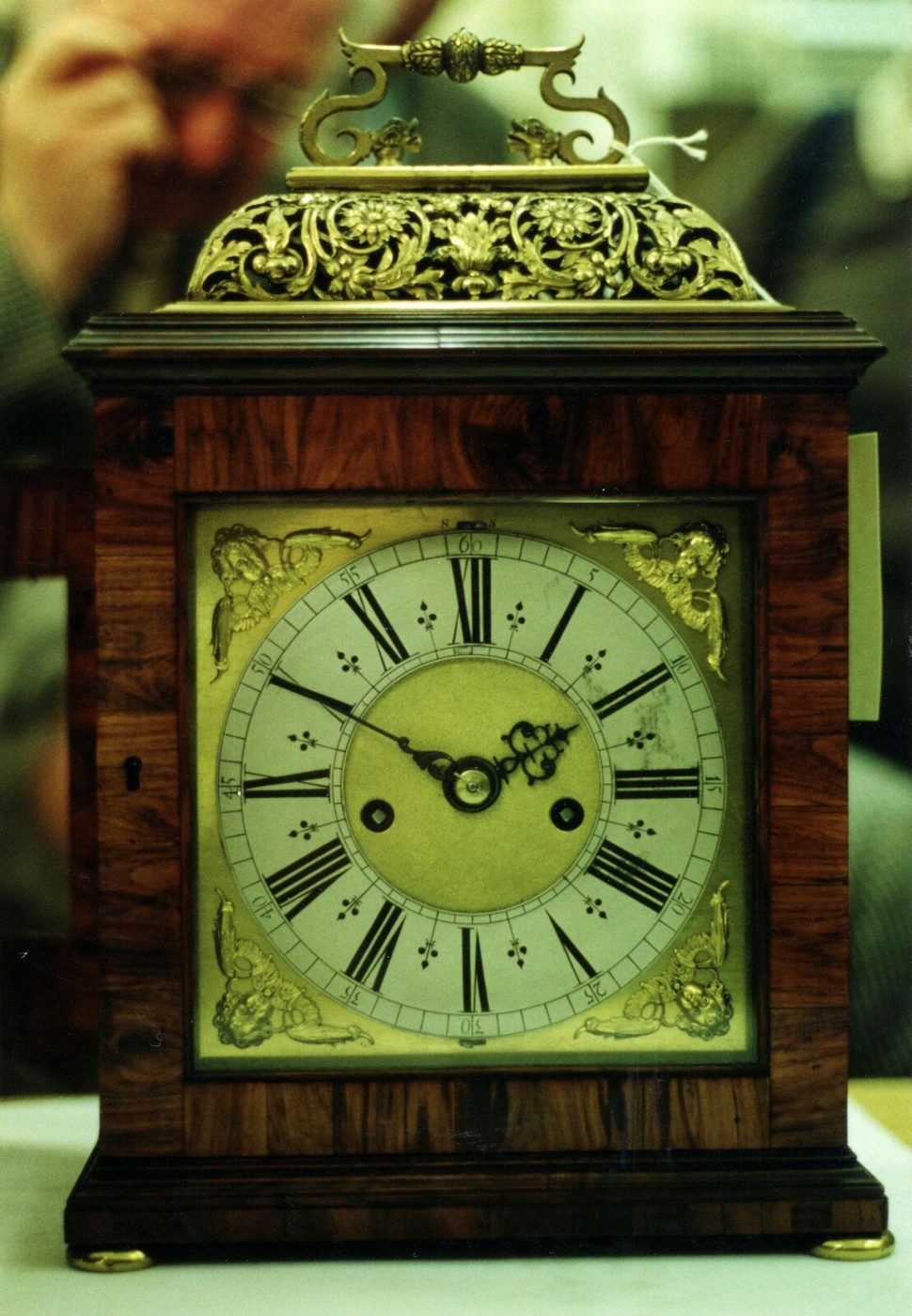
By the 1680s the form had changed. The pediment gave way to a domed or 'basket' top of pierced gilt metal, the case acquired a carrying handle, and glazed side panels let the owner see the movement. The V&A's bracket clock of about 1685 inscribed 'Johannes Fromanteel Londini fecit' has a case veneered with kingwood — an unusual choice, the museum notes, at a time when ebony was the rule — a pierced gilt basket top that lets the bell be heard, and glazed rectangular side panels. The museum's text connects the spread of such clocks to the growth of disposable income in London after the plague and fire of the 1660s.
Tompion, Quare and the repeating table clock
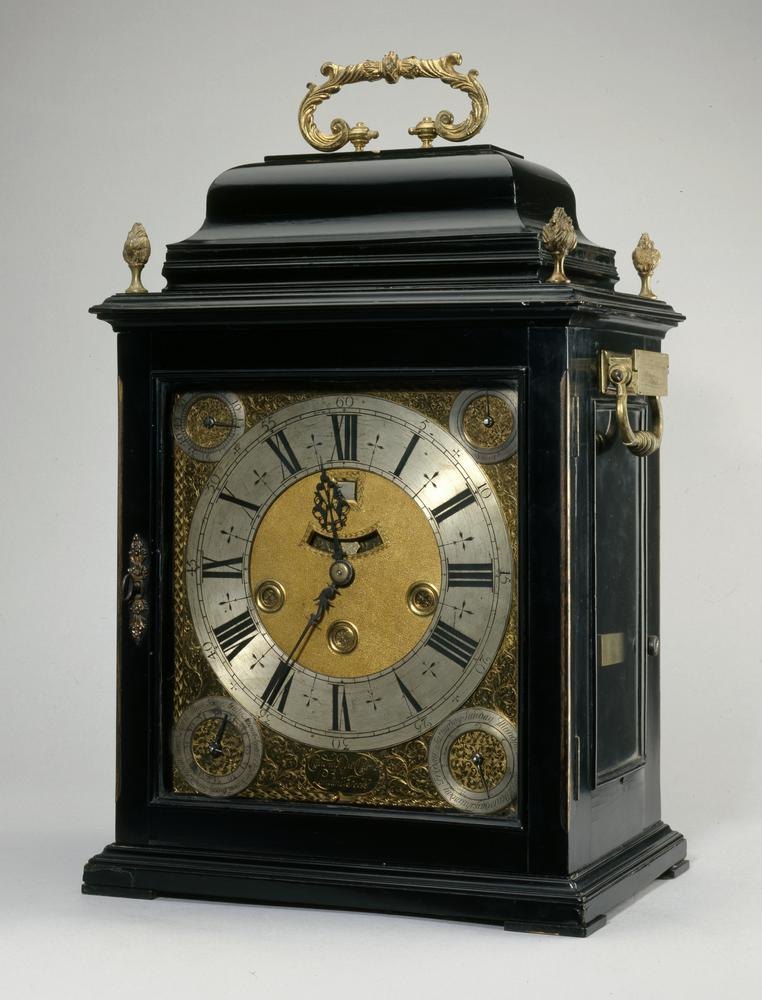
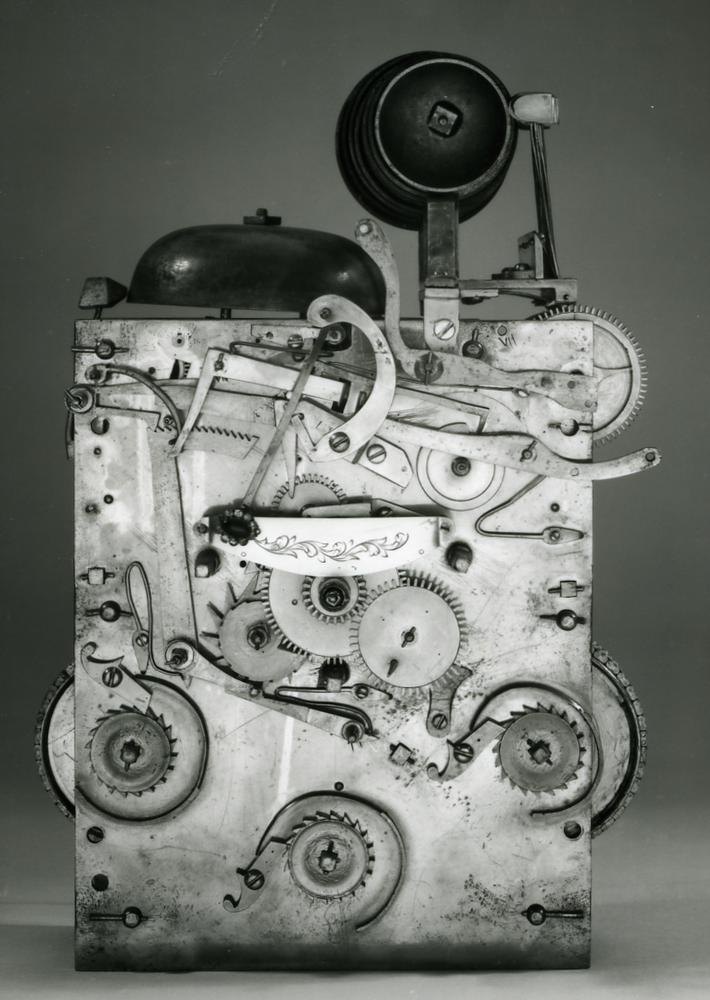
The finest English bracket clocks of the late seventeenth century came from the same workshops as the finest watches. A bracket clock by Thomas Tompion in the V&A, numbered 35, is dated around 1690 from the sequence of numbers that Tompion put on most of his clocks — a sequence that specialists have used to date his work. The museum records that the movement has a large spring, a fusee and a pendulum, and a repeating mechanism: if cords attached to two short arms at the back of the clock are pulled, the hours and quarters are struck on two bells of different pitch. The oak case is veneered in ebony of unusual quality, with gilt-bronze mounts.
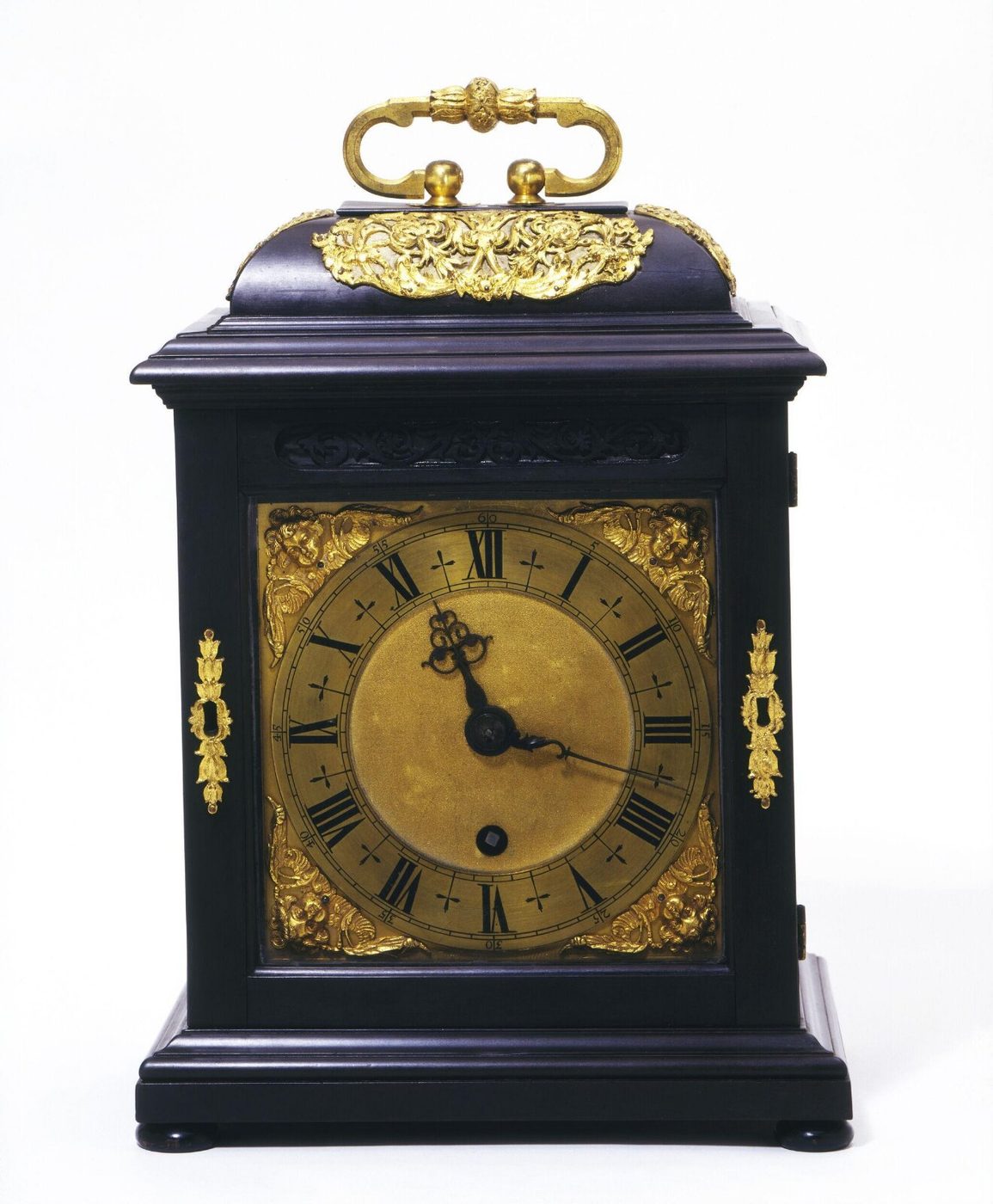
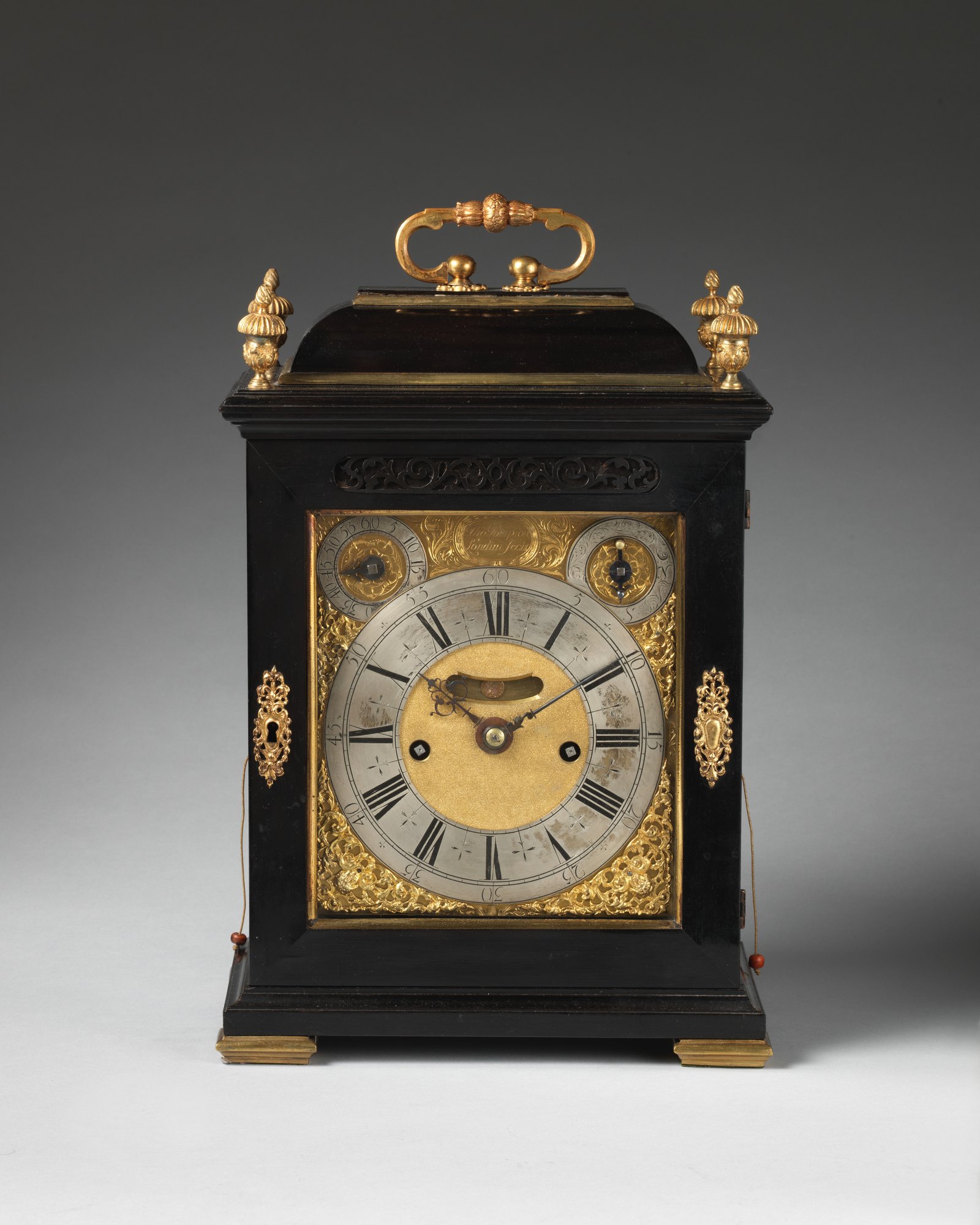
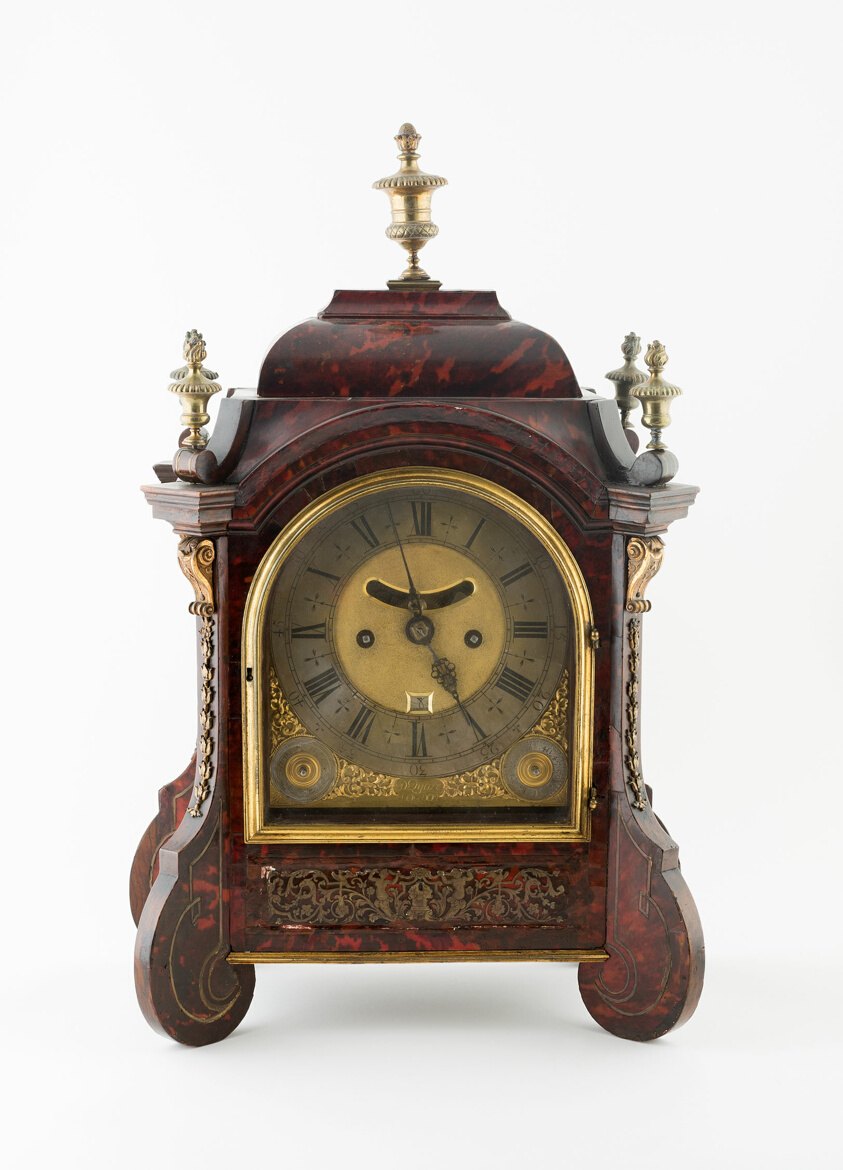
Repeating mattered because these clocks often stood by the bed. In a room lit only by a fire or a candle, an owner who woke at night could pull a cord and hear the last hour and quarter struck again, without striking a light. Pull repeating became a standard feature of good English bracket clocks for most of the eighteenth century. The Metropolitan Museum's Tompion of about 1696, in an ebony-veneered oak case with gilded and silvered brass fittings, and Daniel Quare's bracket clock of 1695 in the Art Institute of Chicago, in a case with tortoiseshell, silver and gilt bronze, show how far the decoration of the case could go at the top of the market.
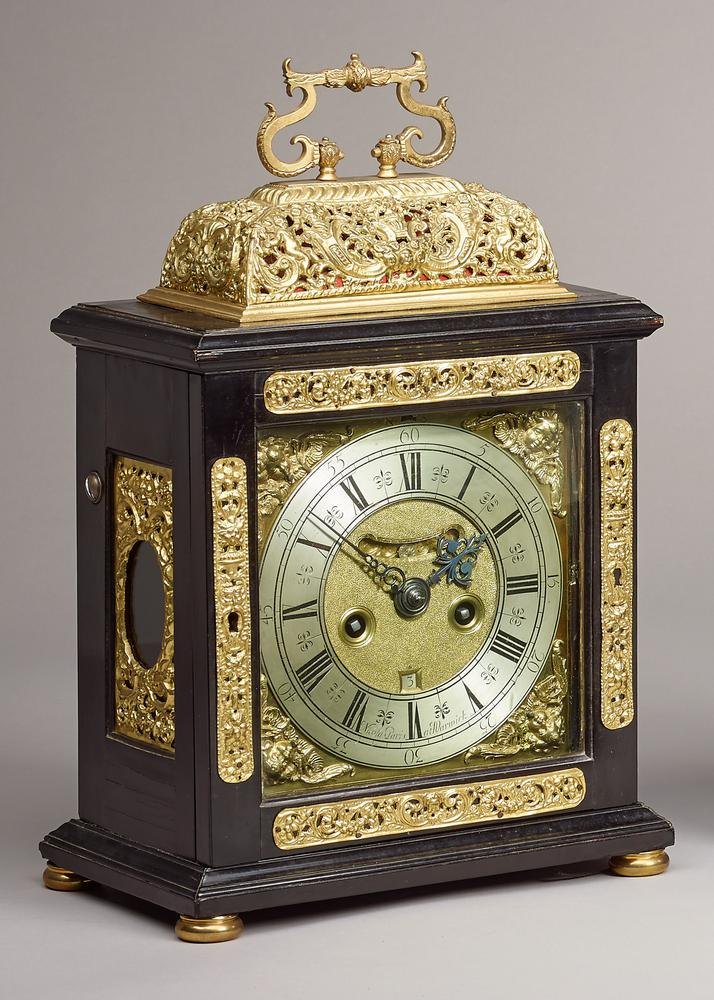
London did not have a monopoly. A table clock by Nicolas Paris of Warwick, of about 1700, in the British Museum, has an eight-day, two-train fusee movement with striking and pull-quarter chiming repeat, a verge escapement with a short bob pendulum, a gilded repoussé basket top, and an ebonised fruitwood case on an oak carcass — all the features of a fashionable London clock. The museum's record describes Paris as a member of a family of blacksmiths and clockmakers, recorded in Warwick from 1670, who looked after the clocks of Stoneleigh Abbey between 1684 and 1703.
Walnut, Huguenots and the arched dial
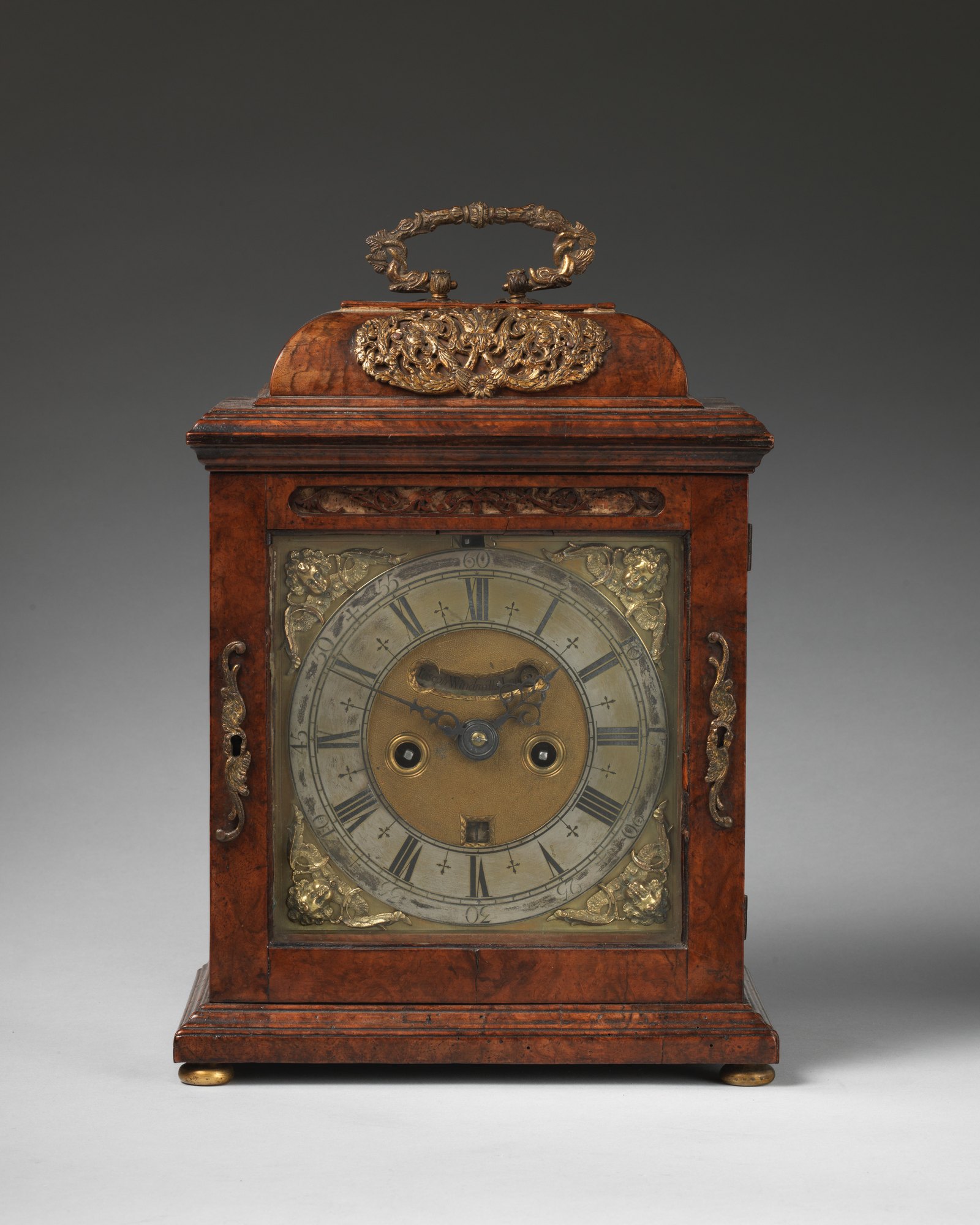
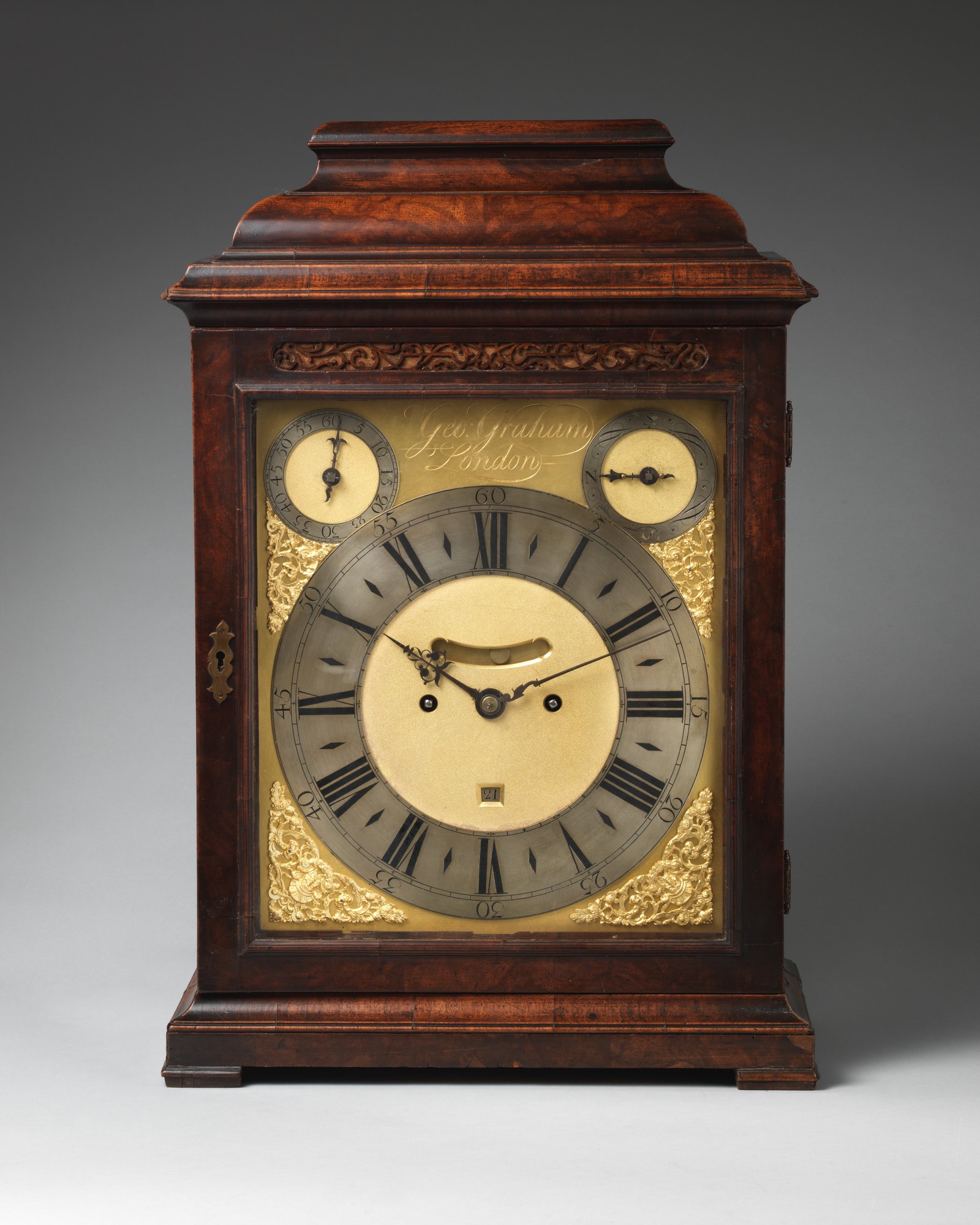
Ebony and ebonised cases dominated, but walnut was used too. The Met's table clock by Joseph Windmills, of about 1700, is in walnut and walnut veneer with gilt-bronze mounts. Twenty years later a clock by George Graham, Tompion's successor, has a walnut-veneered oak case and a gilded and silvered dial; at 62 cm it is noticeably taller than the clocks of the 1690s, and its proportions point towards the arched-dial clocks of the following decades.
The London trade was also shaped by immigration. After Louis XIV revoked the Edict of Nantes in 1685, many Protestant Huguenot craftsmen left France; David Thompson's British Museum catalogue Clocks, quoted in the museum's record, estimates that 20,000 to 25,000 Huguenots lived in the London area by 1700. Among them was Claude Duchesne, who left Paris and became a free brother of the Clockmakers' Company in 1693. His large ebonised quarter-chiming clock in the British Museum has a month-going movement, pull repeat, day and month calendars, a strike-silent dial and a rise-and-fall regulation dial in the arch. The museum's record dates it 1715–1725 in one field, while the Thompson text it quotes dates it 1704; both are given here.
| Feature | Typical period | Notes |
|---|---|---|
| Architectural case with pediment | c. 1658–1675 | Dutch-influenced; ebony or ebonised; small square dial |
| Domed or basket top, carrying handle | c. 1675–1720 | Pierced gilt metal 'basket' or 'double basket'; later solid domes |
| Square dial with cherub spandrels | c. 1670–1720 | Cast brass corner ornaments; the type of spandrel helps date the dial |
| Arched dial | c. 1715 onward | Arch holds a strike-silent dial, a calendar, a maker's boss or a regulation dial |
| Bell top and inverted bell top | c. 1730–1800 | Concave-convex top mouldings in ebonised wood or mahogany |
| Painted or enamel dial | c. 1760 onward | Circular enamel or painted iron dials; common by 1800 |
| Regency rosewood, brass inlay, lancet or chamfer top | c. 1800–1840 | Rosewood and mahogany; anchor escapements become usual |
| Victorian chiming bracket clock | c. 1850–1900 | Large, often ebonised or oak, chiming on gongs or bells |
Japanning, music and export
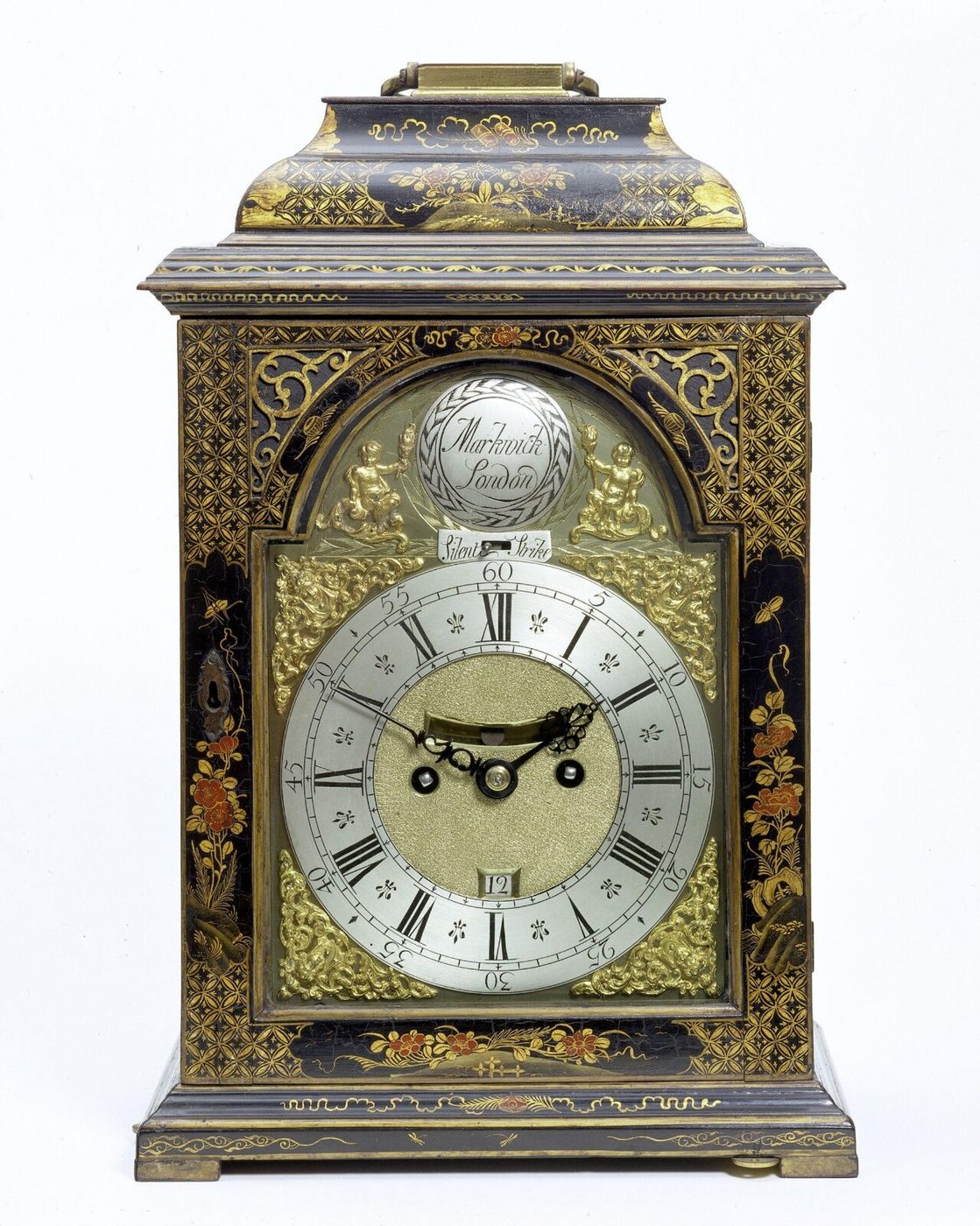
From the early eighteenth century English cases were also decorated with japanning — a European imitation of East Asian lacquer, painted and gilded on a black or coloured ground. The V&A's bracket clock by James Markwick the Younger, of about 1730, has a case decorated with chinoiserie diaper patterns and floral ornament in red and gold on black, an arched dial with a silvered hour ring and a day-of-the-month aperture, and a back plate and pendulum engraved with scrollwork. The museum records that Markwick became free of the Clockmakers' Company in 1692 and Master in 1720.
English bracket clocks were exported in large numbers, above all to the Ottoman Empire, where English and Dutch makers supplied clocks with Turkish numerals, and to China through the East India Company. A bracket clock by George Clarke in the British Museum, made around 1760–1770, has a three-train musical movement playing two tunes on nine bells, a dial with Turkish numerals, ormolu plaques and a green lacquer case. The museum adds a warning that applies to many export clocks: the case is of poor quality, has been altered to fit the dial, and was probably 'married' to the movement and dial rather than made for them.
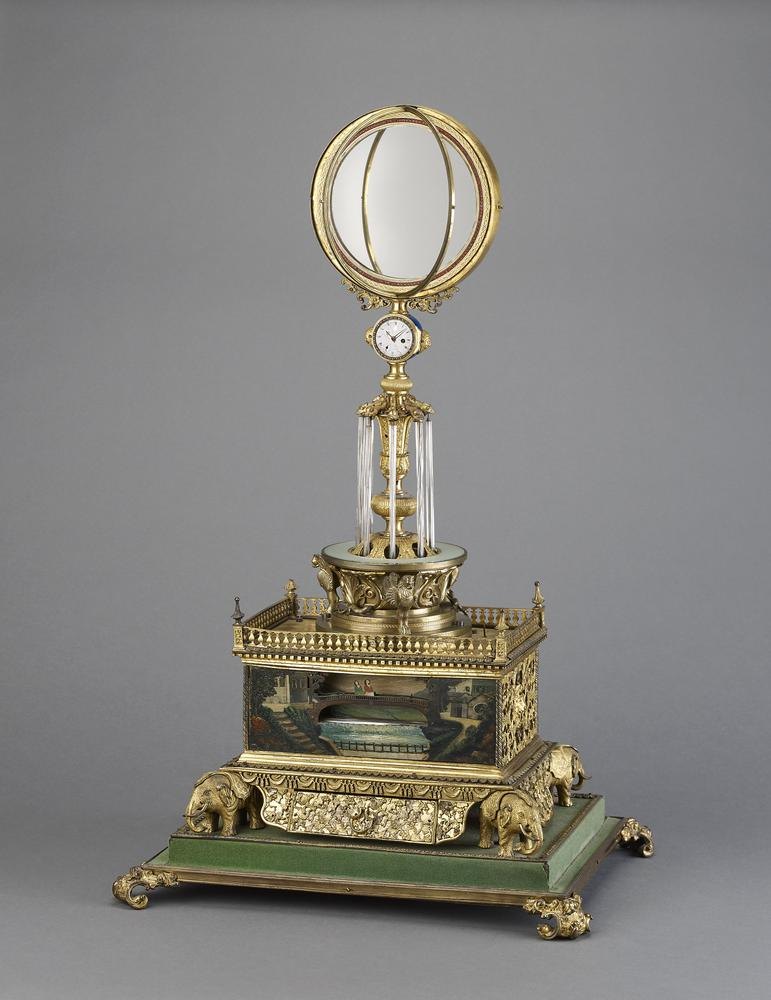
Automata and music reached their peak in clocks made for export and for showrooms. An automaton table clock of 1780–1790 in the British Museum, associated with William Barker, has a musical and mechanical movement driving a painted 'willow-pattern' river scene with figures crossing a bridge, surmounted by a model garden fountain with turning glass columns representing water, and a small watch set into the top. Such clocks were made for spectacle as much as timekeeping.
The household clock in the eighteenth century
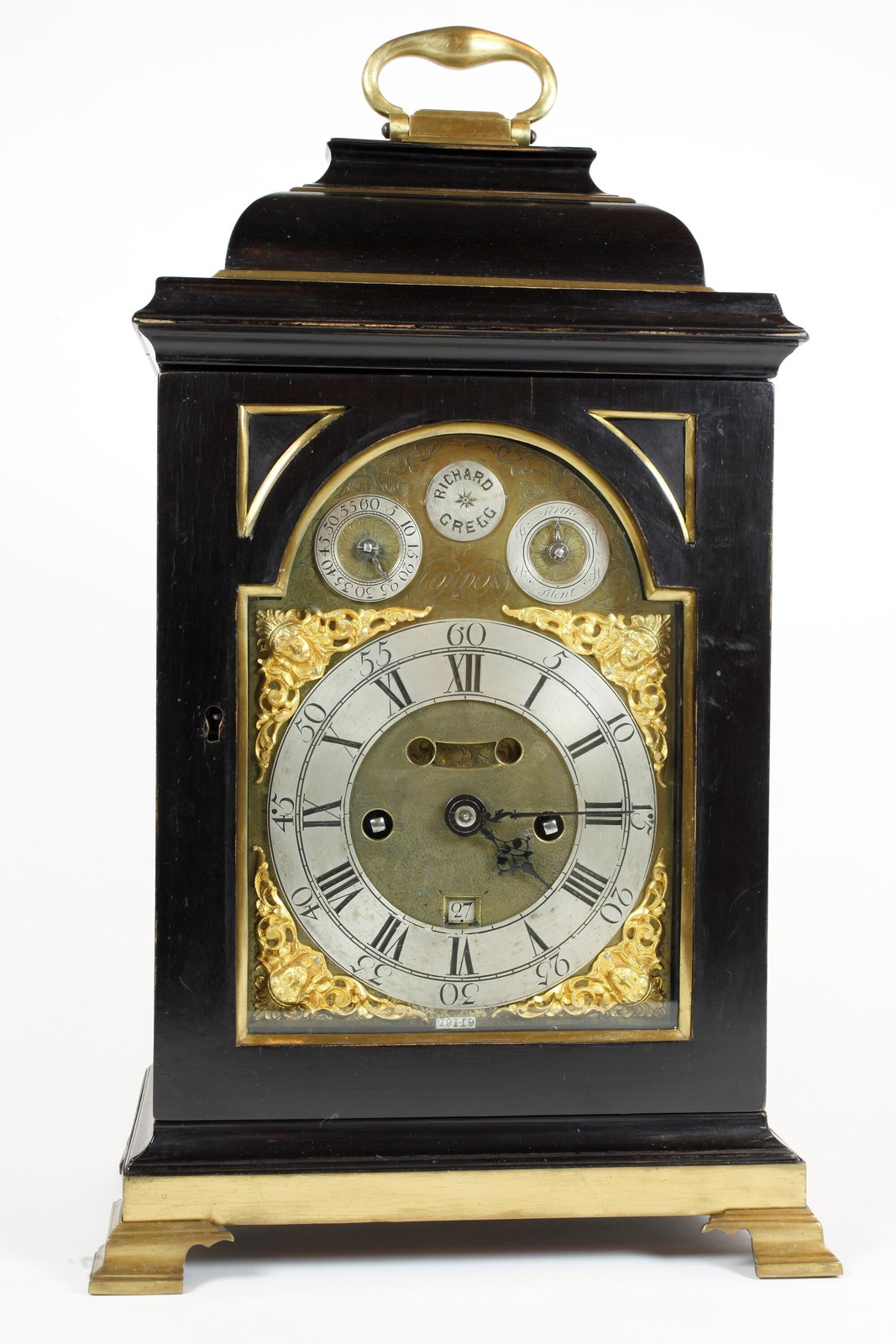
Away from the top of the market, the bracket clock became a standard fitting of the comfortable household. A bracket clock by Richard Gregg of London, about 1750, now in Museums Victoria, is an eight-day striking clock in a black case with glass doors and sides, a brass handle and gilt feet. Its dial has two subsidiary dials in the arch — one to select chiming, the other strike or silent — a date ring and a 'dummy pendulum' aperture showing a false bob that moves with the real pendulum behind, so that the owner can see that the clock is going. It has a verge escapement, two fusees and a repeat.
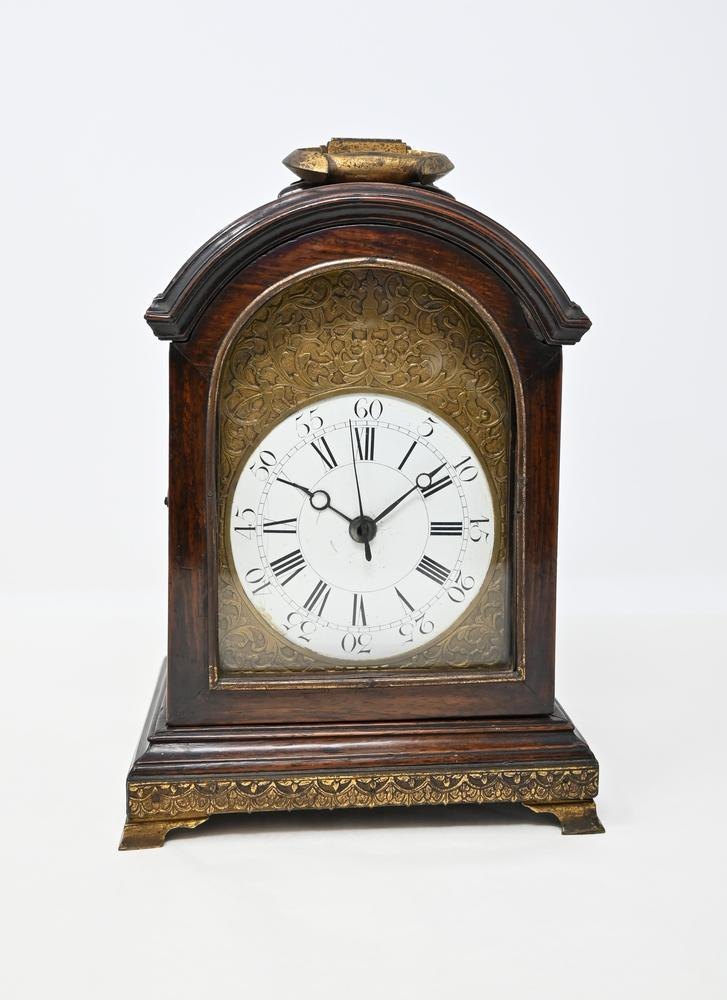
From the 1760s circular white enamel or painted dials appear on smaller clocks. A small rosewood bracket clock of 1760–1770 in the British Museum has an eight-day verge movement with strike, a circular white enamel dial and a centre-seconds hand. By the 1790s painted iron break-arch dials were widely used; the British Museum's record of an eight-day quarter-striking table clock of 1790–1800 notes that the hour and date numerals and other parts of its painted dial have been repainted — a common restoration that changes how a dial looks without changing its date.
Precision on the table: regulators, remontoires and gravity escapements
At the end of the eighteenth century a few makers turned the table clock into a precision instrument. The British Museum holds an eight-day bracket timepiece in a satinwood case by William Nicholson of London, dated 1797, with a gravity escapement and centre seconds. Thompson's text in the record explains the principle: in a gravity escapement the pendulum is impulsed by weighted arms that always fall through the same distance, so every impulse is equal regardless of the force of the train. The first was invented by Alexander Cumming in 1774, followed closely by Thomas Mudge's version and others.
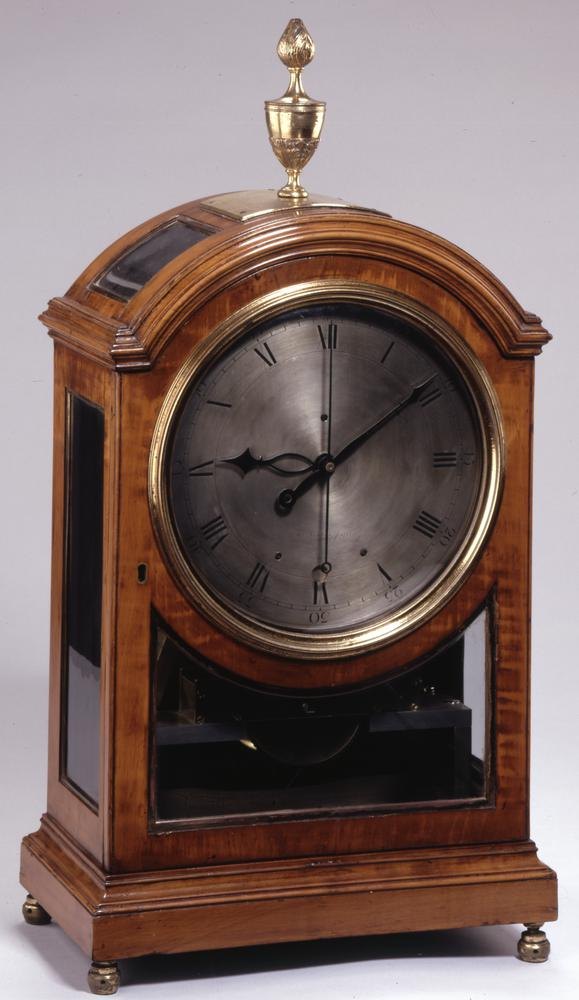
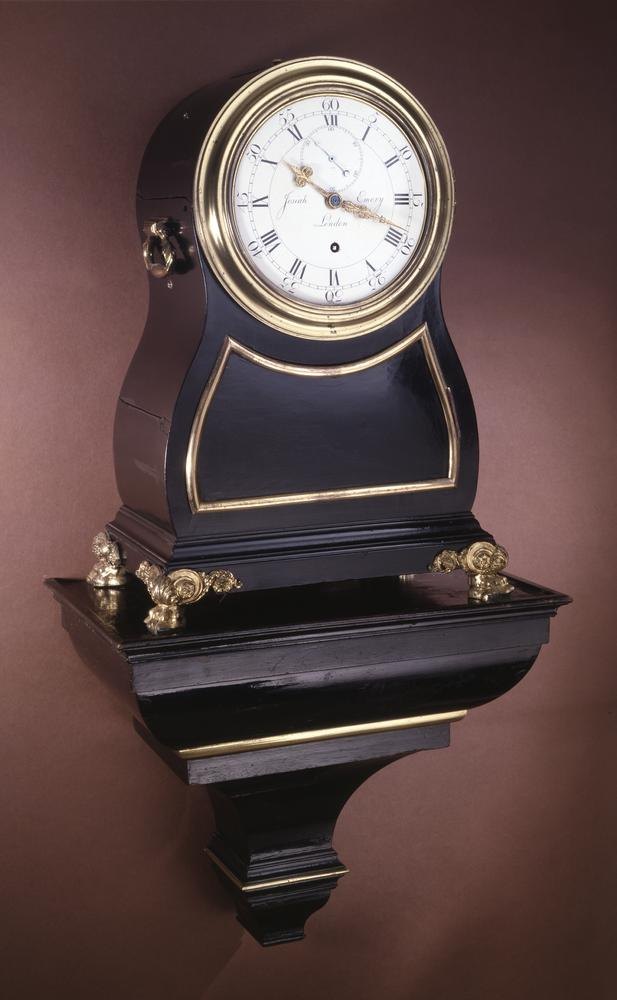
Two other British Museum clocks from 1805–1815 show the same ambition. A bracket clock by Josiah Emery has what the museum calls a 'curious frictionless dead beat escapement', a circular white enamel dial with a centre-seconds hand and an ebonised case with brass mouldings and paw feet; it was published in Antiquarian Horology in 1980 as a precision clock. A mahogany bracket clock by Paul Magnier is an eight-day timepiece with a remontoire, which rewinds a small spring or weight at short intervals so that the escapement receives a nearly constant force.
The nineteenth century: carriage clocks and the Victorian chiming clock
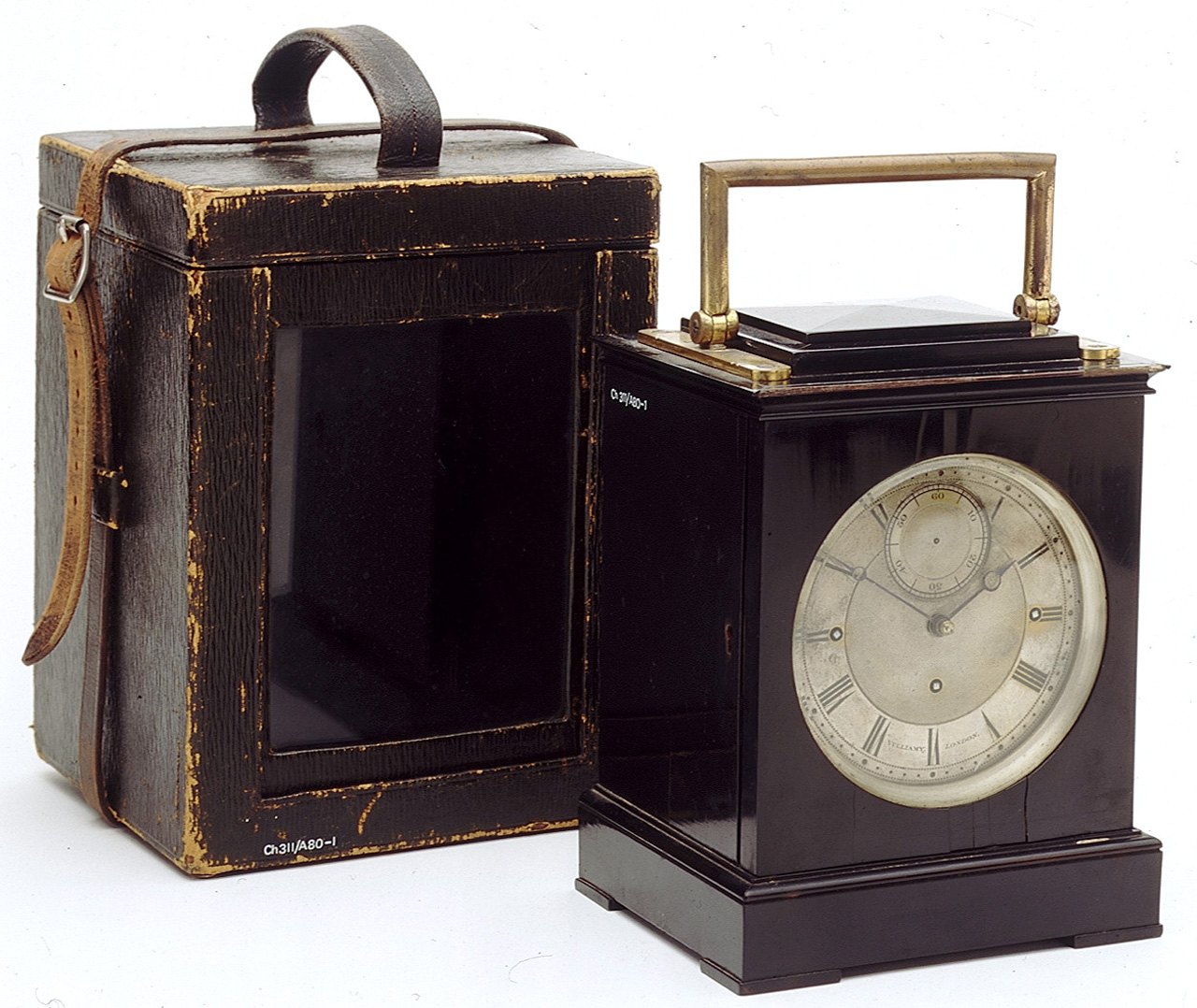
Travelling clocks had existed since the sixteenth century, but the nineteenth century made the carriage clock a distinct type, dominated in volume by French makers. English carriage clocks were fewer and expensive. Royal Museums Greenwich holds a grande sonnerie carriage clock, no. 1608, by Vulliamy of London, made around 1843: its twin chain-fusee movement has a lever platform escapement and strikes the quarters followed by the hour every fifteen minutes, and it is kept in a velvet-lined, leather-bound travelling case with a window to see the dial.
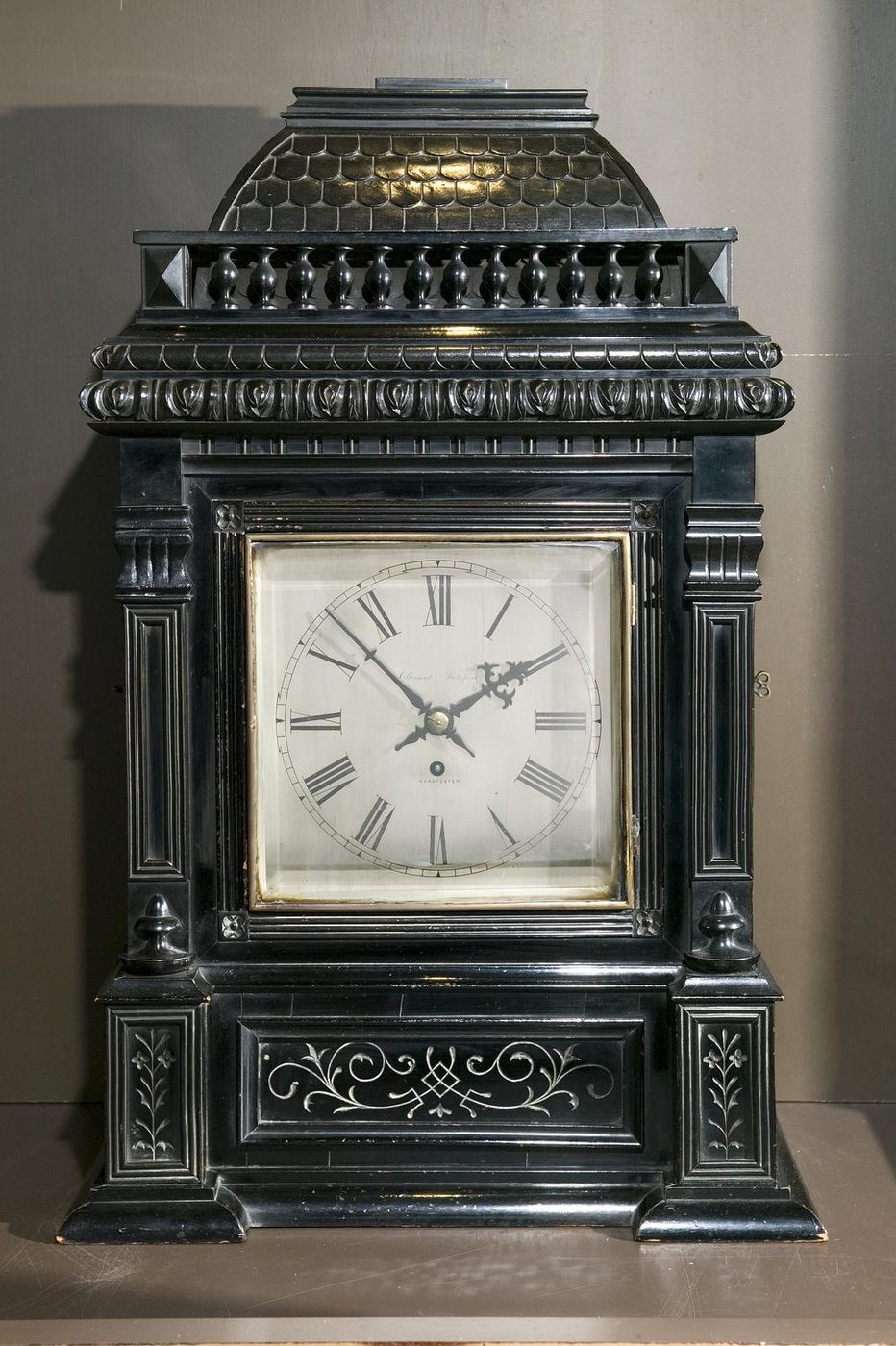
Bracket clocks did not disappear. The Victorian chiming bracket clock — large, often ebonised, with three trains and a choice of chimes on bells or gongs — was a fixture of clubs, offices and prosperous homes. The Science Museum Group holds an ebonised bracket or table clock made by Ollivant & Botsford of Manchester around 1880 for the Manchester Reform Club, and a bracket clock by Dutton and Company dated 1874. By then factory-made French and German clocks were cheaper, and the English bracket clock had become a premium product for institutions and the well-off.
Checklist: examining a bracket clock
- Start with the case: ebony or ebonised, walnut, japanned, mahogany or rosewood? Note the shape of the top (pediment, basket, dome, bell, inverted bell, lancet, chamfer).
- Look at the dial: square or arched, brass with spandrels or painted/enamel? What is in the arch — strike-silent, calendar, regulation, a maker's name boss?
- Remove the back door and look at the back plate: is it engraved? Signed? Does the signature match the dial?
- Identify the escapement: a verge with a short bob pendulum, or an anchor? Look for signs of conversion such as plugged holes or a newer pendulum and cock.
- Count the trains and listen: timepiece only, striking, quarter-chiming, musical? Is there a pull or button repeat?
- Check whether case, dial and movement belong together, and record what does not.
- Pull repeat: a cord or lever that makes the clock strike the last hour and quarter again on demand.
- Strike-silent: a subsidiary dial or lever that stops the striking, often at night.
- Rise and fall: a dial that raises or lowers the pendulum's suspension to regulate the clock without stopping it.
- Dummy pendulum: a false bob visible in an aperture in the dial, moving with the real pendulum.
- Basket top: a pierced and chased gilt-metal top, often over the bell.
All the clocks in this feature link to their catalogue records, which carry the full source descriptions, dimensions and links to the institutions that hold them. Where a record dates an object differently from a published catalogue, or describes later alterations, the Atlas reports both rather than choosing between them.
Sources & further reading
- Clocks — David Thompson, British Museum Press (London), 2004.
- Old Clocks and Watches and Their Makers — F. J. Britten, B. T. Batsford (London), 1899 (first edition).
- English Domestic Clocks — Herbert Cescinsky and Malcolm R. Webster, George Routledge & Sons (London), 1913.
- The Artificial Clock-Maker — William Derham, James Knapton (London), 1696.
- Curiosities of Clocks and Watches from the Earliest Times — Edward J. Wood, Richard Bentley (London), 1866.
- Watchmakers and Clockmakers of the World — G. H. Baillie, N.A.G. Press (London), 1929 (first edition).
- European Clocks and Watches in the Near East — Otto Kurz, Warburg Institute / Brill, 1975.