
Clocks · Bracket clock
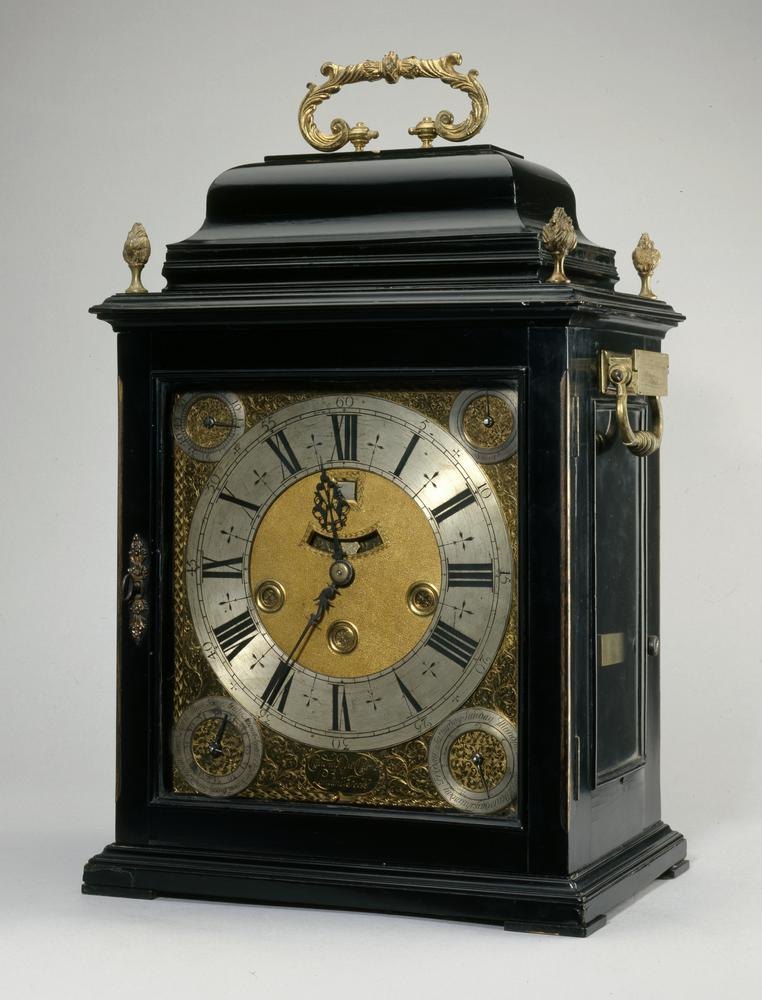
Large ebonised bracket clock
- Maker / attribution
- Claude Duchesne (Made by)
- Date
- 1715–1725
- Historical period
- Early Modern Horology (1600 – 1750)
- Country of origin
- England
- Place
- London (England)
- Object type
- Bracket clock
- Materials / technique
- metal, wood
- Dimensions
- Height: 57 centimetres Weight: 19.60 kilograms Width: 35.50 centimetres Depth: 25 centimetres
- Holding institution
- British Museum
- Accession / object no.
- 1958,1006.2192
- Credit line
- British Museum, London
- Catalogue title (original)
- Large ebonised bracket clock (English)
View the source record ↗ (opens another website in a new tab)Suggest a correction
Record summary
Held and catalogued by British Museum (object number 1958,1006.2192), this is a bracket clock by Claude Duchesne, made in London (England), dated 1715–1725. The Atlas places it in the Early Modern Horology period (1600 – 1750) of its Clocks collection. Materials and techniques recorded by the source: metal, wood. Recorded dimensions: Height: 57 centimetres Weight: 19.60 kilograms Width: 35.50 centimetres Depth: 25 centimetres. The record is illustrated with 6 photographs.
Assembled from the source record's structured fields. Dates and attributions are given as the source states them; where a field is missing the Atlas leaves it blank rather than estimating.
Catalogue description
Description — British Museum
Large ebonised bracket clock; month chiming; quarter-strike with verge escapement and pull repeat; silvered-metal chapter-ring; day and month calendars; 'strike-silent' and rise and fall dials with calendar aperture; enclosed in ebonised case with moulded borders and domed hood; surmounted by ormolu flaming finials and scroll and foliage carrying handle. Train-counts: Going. Gt wheel 72 2nd wheel 64/12 Centre wheel 84/8 Contrate wheel 72/6 Crown wheel 25/6 Motion work. Canon pinion 36 Minute wheel 36 Minute pinion 6 Hour wheel 72 A pinion of 16 on hour wheel drives wheel of 32 which drives another of 32, then a third of 32 which carries a pin to index the 7-tooth star wheel one tooth per day. Striking. Gt wheel 72 2nd wheel 78/18 Pin wheel 72/8 4th wheel 60/8 Warning wheel 48/6 Fly 6 Quarter striking. Gt wheel 72 2nd wheel 80/12 Barrel 72/10 Pin wheel 60/6 Warning 60/6 Fly 10 Repeat train. Gt wheel 72 2nd wheel 48/6 Pin wheel 54/6 Fly 6.
Curator's comments — British Museum
Text from 'Clocks', by David Thompson, London, 2004, p. 98. Claude Duchesne Quarter-chiming table clock London, 1704 Height 51 cm, width 35.5 cm, depth 25 cm The Revocation of the Edict of Nantes by Louis XIV in 1685 caused a massive influx of Huguenot emigrants from France into England. As a religiously tolerant country, with pre-existing Huguenot communities, England was a natural sanctuary for those fleeing persecution in France. It is estimated that by 1700 the Huguenot population in the London area alone numbered between 20,000 and 25,000. Claude Duchesne was one of those who left Paris to start a new life in London. He was made a Free Brother in the Clockmakers' Company in 1693 and lived in Long Acre in the parish of St Anne's, in Soho. There is also a recorded clock which is signed giving the address as 'Dean Street Soho'. Duchesne is thought to have lived until about 1730 and is known to have had at least one son, Antoine, who became a Freeman in the Goldsmiths' Company. This austere ebony-veneered clock is not typical of the Huguenot style of 1700, when many clocks had either silver mounts or pierced gilt-metal single and double basket tops. Here the treatment is one of restraint, in a style which remained popular amongst English customers until well into the eighteenth century, with only the handle, four flame finials at the top and two vertical gilt-wood strips down the front and back doors. The dial is less restrained, having a dial-plate finely engraved with a border of wheat ears enclosing arabesque foliate scrolls around the outside of the chapter ring. There are four subsidiary dials and an aperture. Top left is a 'rise-and-fall' dial calibrated 5-60 for regulating the clock. In the upper right corner is a strike/silent dial. Bottom left is a month dial with the months named and depicted by their ruling planetary sign and with the number of days in the month. The bottom right-hand dial is engraved with the days of the week. In the middle, above the chapter ring, is a small rectangular aperture through which can be seen the date. Below this is an aperture revealing a small mock-pendulum, used to start the clock without the need to turn it round to gain access from the back. Finally, at the very bottom is a lever which activates shutters that cover the winding squares. The clock is signed on the dial 'Claudius Du Chesne Londini Fecit' and inside the back plate is a faint, scratched inscription, 'Le 13 May 1704 Claudius Duchesne Londini Fecit'. The clock chimes the quarters on ten bells, has a pull-quarter repeat which sounds on four more bells and strikes the hours on a single low-pitched bell. The one-month, spring-driven movement has fusees and a verge escapement controlled by a pendulum. The movement back plate is even more sumptuously engraved than the dial, with copious foliate scrolling and two winged trumpeters flanking a central cartouche in which there is a depiction of 'David with the Head of Goliath'. Ilbert Collection.
Inscriptions & marks
signature; Claudius Du Chesne, Londini, fecit [dial]
Provenance
Previous owner/ex-collection:, Courtenay Adrian Ilbert; Donated by:, Gilbert Edgar
Historical context
Early Modern Horology (1600 – 1750)
Huygens' pendulum and balance spring transform accuracy; English makers develop the anchor and deadbeat escapements.
Huygens's pendulum (1656–57) improved clock accuracy from about a quarter of an hour to under a minute a day. The anchor escapement (c. 1670) and the long seconds pendulum created the longcase clock; London makers such as Fromanteel, Knibb, Tompion and Quare led European clockmaking, and French makers created the Boulle pendule.
Read the period in the timelineMore clocks from this periodEarlier: Renaissance Horology
Atlas type guide
Bracket, table and spring-driven clocks
Spring-driven clocks freed timekeeping from the hanging weight. The coiled mainspring, documented from the fifteenth century, made portable table clocks possible; to even out its declining force, makers used the fusee, a conical pulley connected to the barrel by a gut line or chain. Renaissance table clocks from Augsburg and Nuremberg — drum-shaped, square or tower-shaped in gilt brass — were luxury scientific objects, often with astronomical dials and alarms.
After the pendulum, English makers developed the bracket clock: a wooden case with a carrying handle, a short pendulum with a verge escapement, and often repeating work to sound the hours on demand at night. Later examples use the anchor escapement. In the nineteenth century, 'table clock' became a broad term for spring clocks of every nationality.
What to look for
- A fusee in the movement (cone-shaped pulley) and the type of line — gut or chain.
- Verge escapement with a short bob pendulum, often with a decoratively engraved backplate.
- Repeat cords or buttons that make the clock strike again on demand.
- Gilt-brass engraved cases and horizontal dials on Renaissance pieces.
- Case shapes: inverted bell, bell top, break-arch, lancet or balloon.
Dating clues
- Drum and tower table clocks: c. 1520–1650.
- Ebony veneered English bracket clocks with verge escapements: c. 1670–1800.
- Engraved backplates were usual on English clocks until c. 1800, then generally plain.
General guidance written by the Atlas editors about this kind of object. It is not a statement about this particular piece; for that, rely on the source record above and on physical examination.
Read next:Anchor (recoil) escapement
Related records
Clocks · 1598–1603
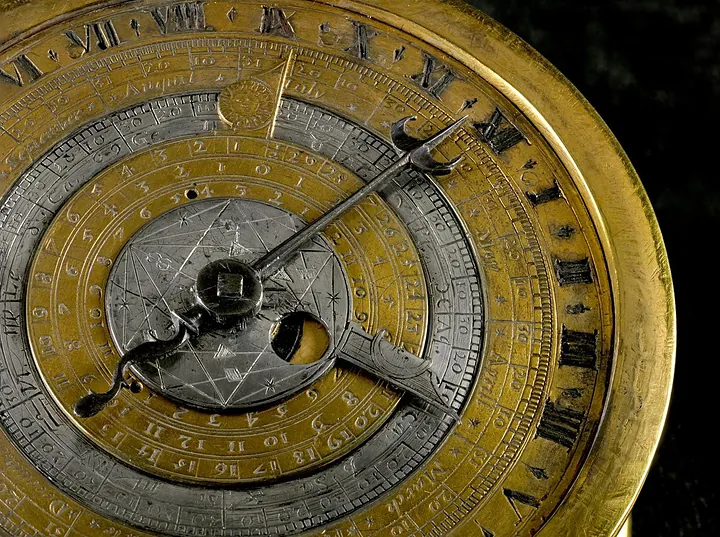
Circular table-clock with calendrical and lunar indications made by Nicholas Vallin in London between 1598 and 1603.
Science Museum Group, London
Clocks · 1611
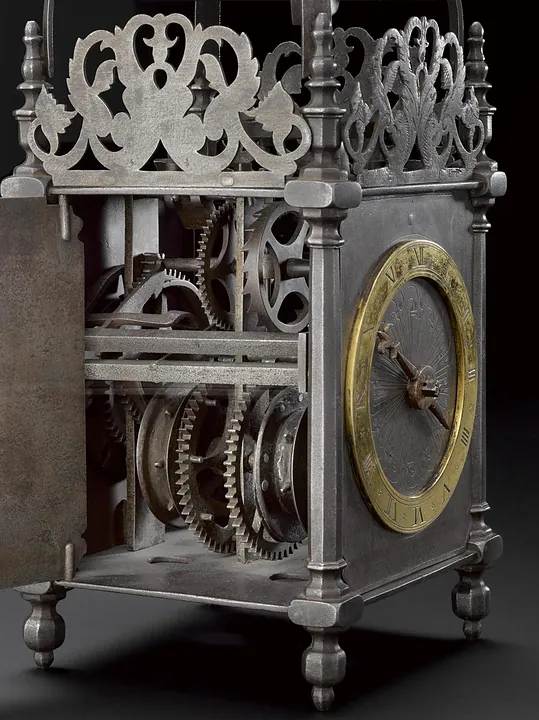
English iron lantern clock, with wheel balance, by John Holloway, Market Lavington, Wiltshire, England, 1611.
Science Museum Group, London
Clocks · 1630
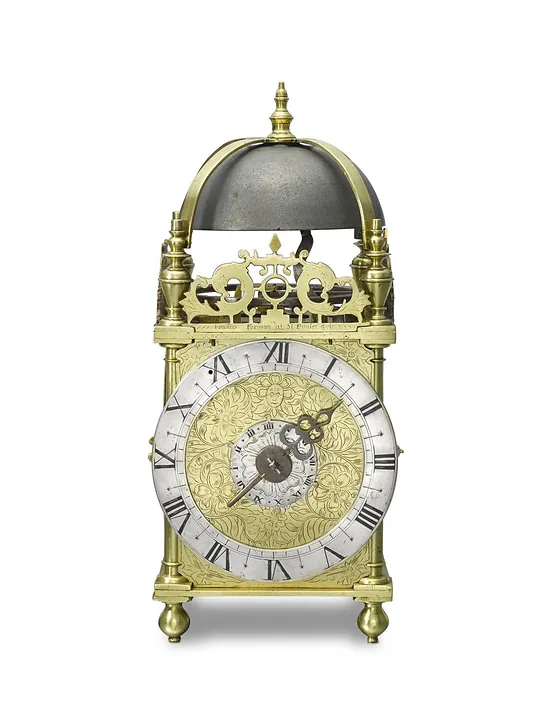
Lantern clock by Francis Forman, England, 1630
Science Museum Group, London
Clocks · 1632–1640
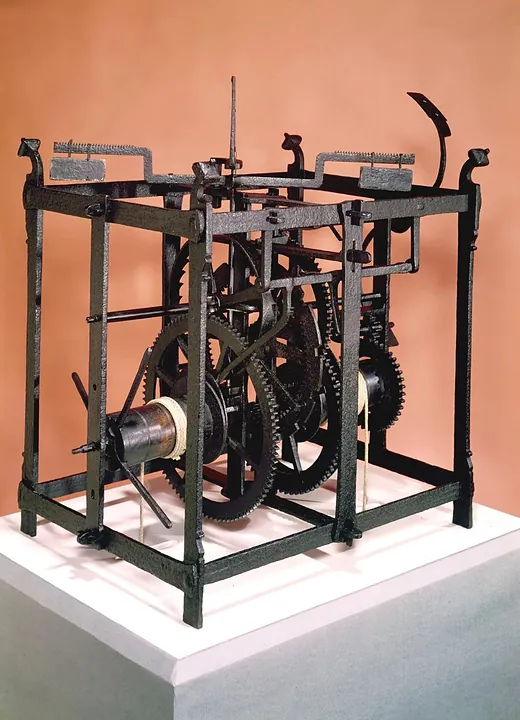
Turret clock, England, 1632–1640
Science Museum Group, London
Clocks · 1645–1655
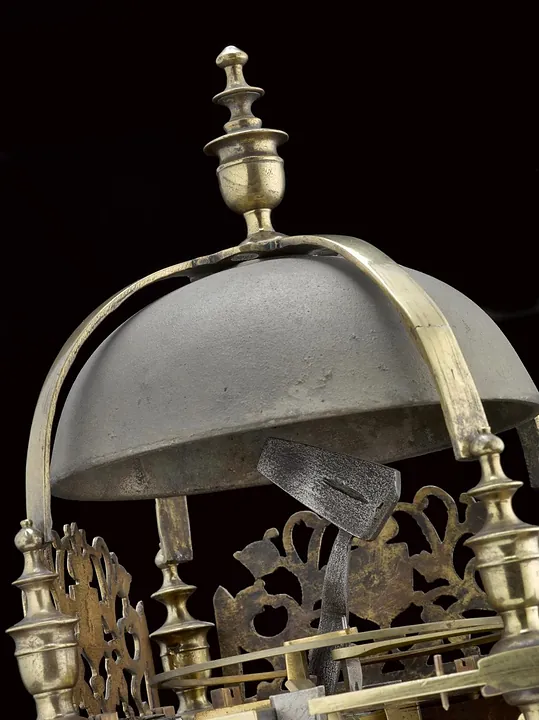
Balance-wheel brass lantern clock, with two driving weights and one counterweight, by Thomas Knifton, Cross Keys, Lothbury, London, England, 1645–1655.
Science Museum Group, London
Clocks · c. 1650
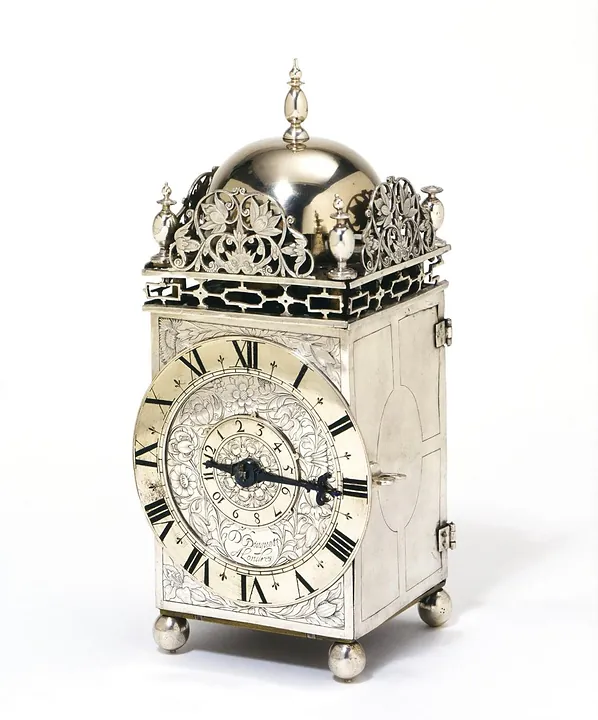
Lantern alarm clock, silver, by David Bouquet, circa 1650
Victoria and Albert Museum, London
Clocks · 1650–1660
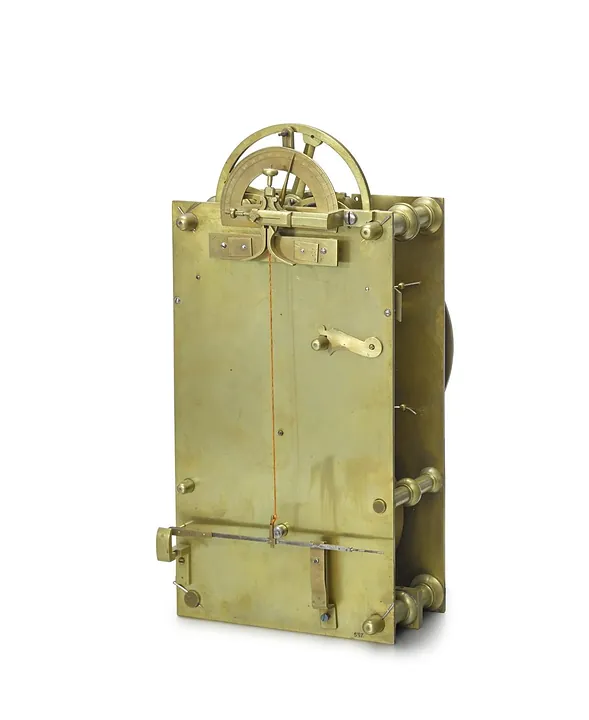
Lantern clock by Peter Closon, England, 1650–1660
Science Museum Group, London
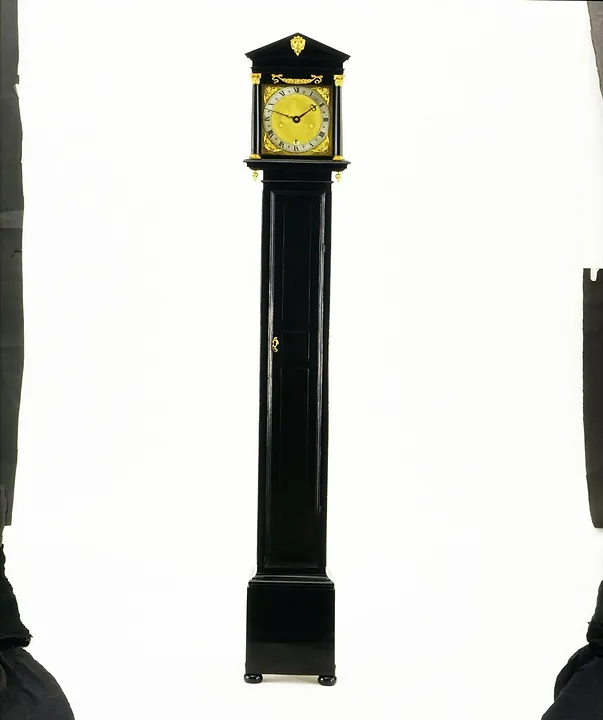
Clocks · c. 1660
Longcase clock, c. 1660, English, made by Ahasuerus Fromanteel
Victoria and Albert Museum, London