Clocks · Bracket clock
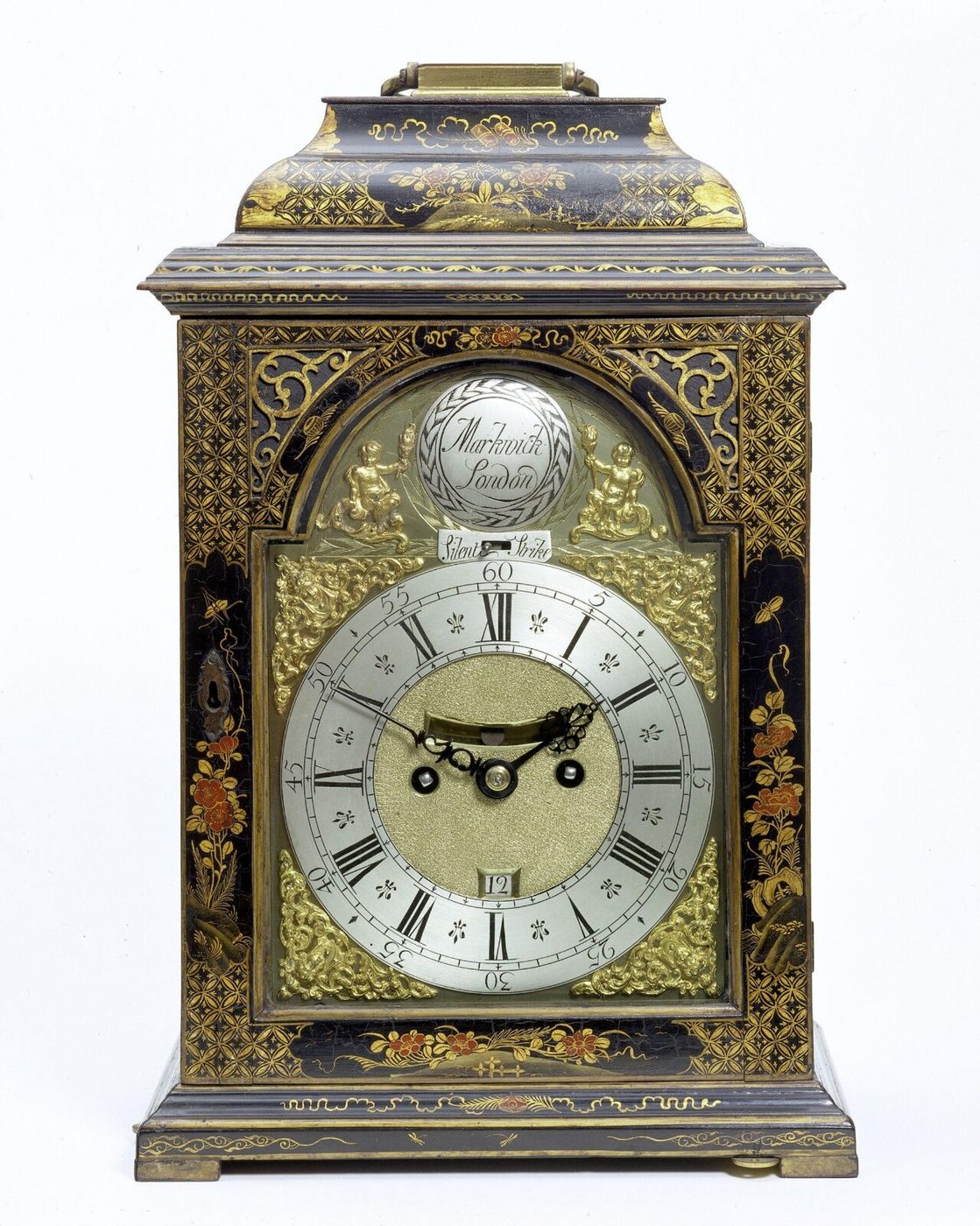
Bracket clock, English, ca. 1730, made by James Markwick the Younger
- Maker / attribution
- James (the younger) Markwick (maker)
- Date
- ca. 1730
- Historical period
- Early Modern Horology (1600 – 1750)
- Country of origin
- England
- Place
- London
- Object type
- Bracket clock
- Materials / technique
- Case of wood, with japanned (painted) decoration
- Dimensions
- Height: 45.6 cm; Width: 26.6 cm; Depth: 17.2 cm
- Holding institution
- Victoria and Albert Museum, London
- Accession / object no.
- W.7:1 to 4-1944
- Credit line
- Bequeathed by Mr William T. Johnson
Record summary
Held and catalogued by Victoria and Albert Museum, London (object number W.7:1 to 4-1944), this is a bracket clock by James (the younger) Markwick, made in London, England, dated ca. 1730. The Atlas places it in the Early Modern Horology period (1600 – 1750) of its Clocks collection. Materials and techniques recorded by the source: Case of wood, with japanned (painted) decoration. Recorded dimensions: Height: 45.6 cm; Width: 26.6 cm; Depth: 17.2 cm. The record is illustrated with 4 photographs.
Assembled from the source record's structured fields. Dates and attributions are given as the source states them; where a field is missing the Atlas leaves it blank rather than estimating.
Catalogue description
V&A — Summary
Object Type Bracket clocks appeared in the second half of the 17th century, following the invention of the pendulum in 1657. Their name implies that such clocks stood on brackets, and sometimes matching brackets were supplied by the clock maker. More often, however, these clocks had no fixed position and were moved from one place to another. People Both the clock and its movement are signed by James Markwick the Younger. Markwick was admitted to the Freedom of the Clockmakers' Company in 1692 and became a Master in 1720. His father, James Markwick, was also a clockmaker (see museum no. 1148-1893). Trading During the first half of the 18th century a thriving trade in clocks developed between England and Turkey, and also Spain. Clocks made for the Turkish market were often engraved with Arabic numerals. Their cases were usually japanned and fitted with brass or silver mounts (see also museum no. 365-1897). Sealing-wax red, which was an English speciality, appears to have been a popular colour. Combined with gold, it evoked a sense of luxury and exoticism. Perhaps it was this that so appealed to the Turkish and Spanish markets. Design & Designing The case decoration is typical of the Chinoiserie style, which imitated or evoked Chinese art. The cloudbands on the top and base, and the rocks, flowers and dragonflies to the left and right of the dial, are all features of Chinoiserie design, while the gold diaper pattern, brass scrollwork and torch-bearing cherubs are European motifs.
V&A — Physical description
Bracket clock in a wooden case with chinoiserie decoration. The arched dial has a silvered hour-circle, hands of pierced steel and a day-of-the-month aperture; the spandrel ornament of brass in a design of masks surrounded by scrollwork. The back-plate is engraved with scrollwork, and the pendulum is engraved with a floral design. On a convex silvered disc is engraved 'Tarkwick London' and on either side are cherubs holding torches of brass. In the spandrels of the arched door and at the side below the top are panels of pierced fretwork decoration. The case is decorated with diaper patterns and floral ornament in red and gold on a black ground.
V&A — Object history
Made in London by James Markwick the Younger (active 1720); signed 'Markwick, London' on the arched dial
V&A gallery label
British Galleries: The cabinet-makers who specialised in making clock cases were often conservative in their design. Although this clock was made at a time when Palladianism was dominant, it was decorated in a style first fashionable in the late 17th century. It is japanned (painted) in imitation of Chinese lacquer decoration.
Inscriptions & marks
'Markwick, London'
Historical context
Early Modern Horology (1600 – 1750)
Huygens' pendulum and balance spring transform accuracy; English makers develop the anchor and deadbeat escapements.
Huygens's pendulum (1656–57) improved clock accuracy from about a quarter of an hour to under a minute a day. The anchor escapement (c. 1670) and the long seconds pendulum created the longcase clock; London makers such as Fromanteel, Knibb, Tompion and Quare led European clockmaking, and French makers created the Boulle pendule.
Read the period in the timelineMore clocks from this periodEarlier: Renaissance Horology
Atlas type guide
Bracket, table and spring-driven clocks
Spring-driven clocks freed timekeeping from the hanging weight. The coiled mainspring, documented from the fifteenth century, made portable table clocks possible; to even out its declining force, makers used the fusee, a conical pulley connected to the barrel by a gut line or chain. Renaissance table clocks from Augsburg and Nuremberg — drum-shaped, square or tower-shaped in gilt brass — were luxury scientific objects, often with astronomical dials and alarms.
After the pendulum, English makers developed the bracket clock: a wooden case with a carrying handle, a short pendulum with a verge escapement, and often repeating work to sound the hours on demand at night. Later examples use the anchor escapement. In the nineteenth century, 'table clock' became a broad term for spring clocks of every nationality.
What to look for
- A fusee in the movement (cone-shaped pulley) and the type of line — gut or chain.
- Verge escapement with a short bob pendulum, often with a decoratively engraved backplate.
- Repeat cords or buttons that make the clock strike again on demand.
- Gilt-brass engraved cases and horizontal dials on Renaissance pieces.
- Case shapes: inverted bell, bell top, break-arch, lancet or balloon.
Dating clues
- Drum and tower table clocks: c. 1520–1650.
- Ebony veneered English bracket clocks with verge escapements: c. 1670–1800.
- Engraved backplates were usual on English clocks until c. 1800, then generally plain.
General guidance written by the Atlas editors about this kind of object. It is not a statement about this particular piece; for that, rely on the source record above and on physical examination.
Related records
Clocks · ca.1725
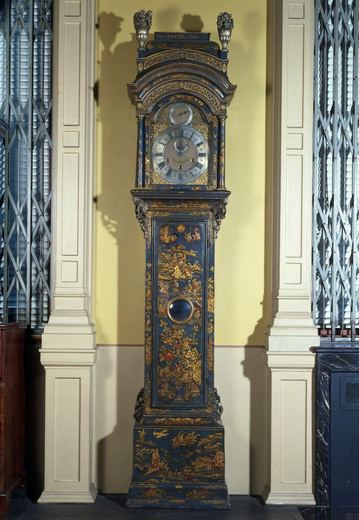
QUARTER CHIMING MONTH-GOING LONG CASE CLOCK Japanned, pine carcase Inscribed 'Markwick, Londini', made in about 1725
Victoria and Albert Museum, London
Clocks · 1598-1603
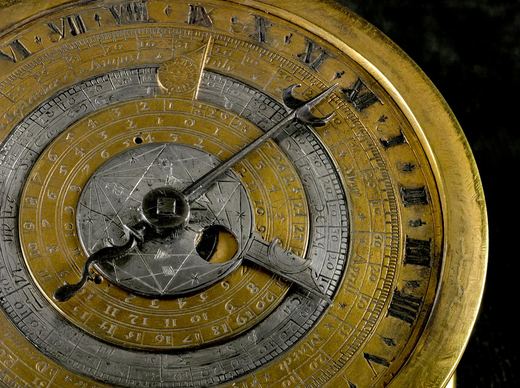
Circular table-clock with calendrical and lunar indications made by Nicholas Vallin in London between 1598 and 1603.
Science Museum Group, London
Clocks · 1611
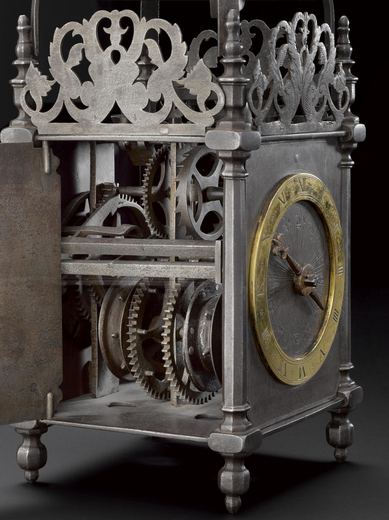
English iron lantern clock, with wheel balance, by John Holloway, Market Lavington, Wiltshire, England, 1611.
Science Museum Group, London
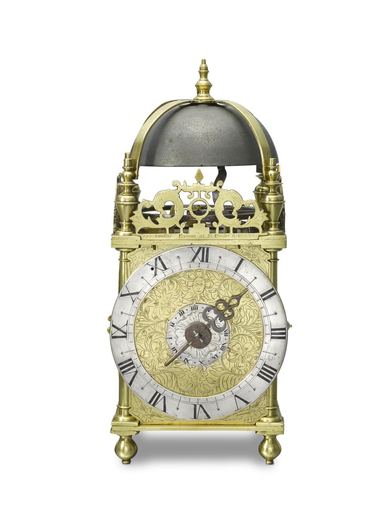
Clocks · 1630
Lantern clock by Forman, Francis, England, 1630
Science Museum Group, London
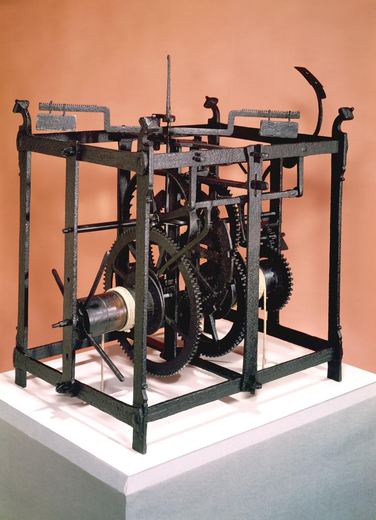
Clocks · 1632-1640
Turret clock, England, 1632-1640
Science Museum Group, London
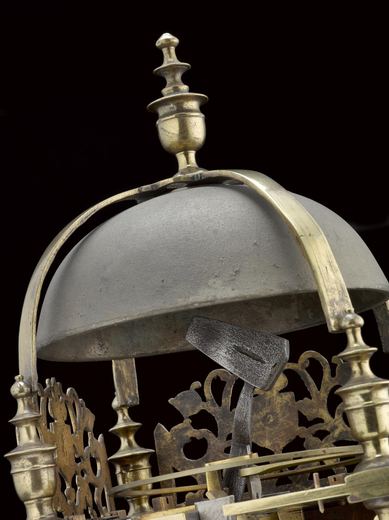
Clocks · 1645-1655
Balance-wheel brass lantern clock, with two driving weights and one counterweight, by Thomas Knifton, Cross Keys, Lothbury, London, England, 1645-1655.
Science Museum Group, London
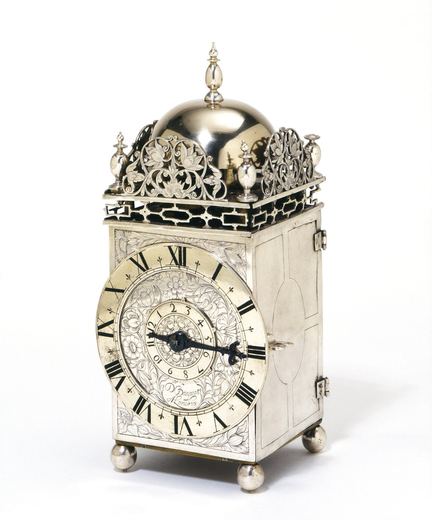
Clocks · ca. 1650
Lantern alarm clock, silver, by David Bouquet, circa 1650
Victoria and Albert Museum, London
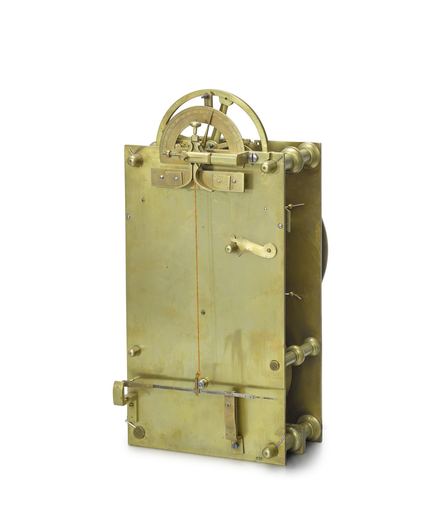
Clocks · 1650-1660
Lantern clock by Closon, Peter, England, 1650-1660
Science Museum Group, London