
Clocks · Clock
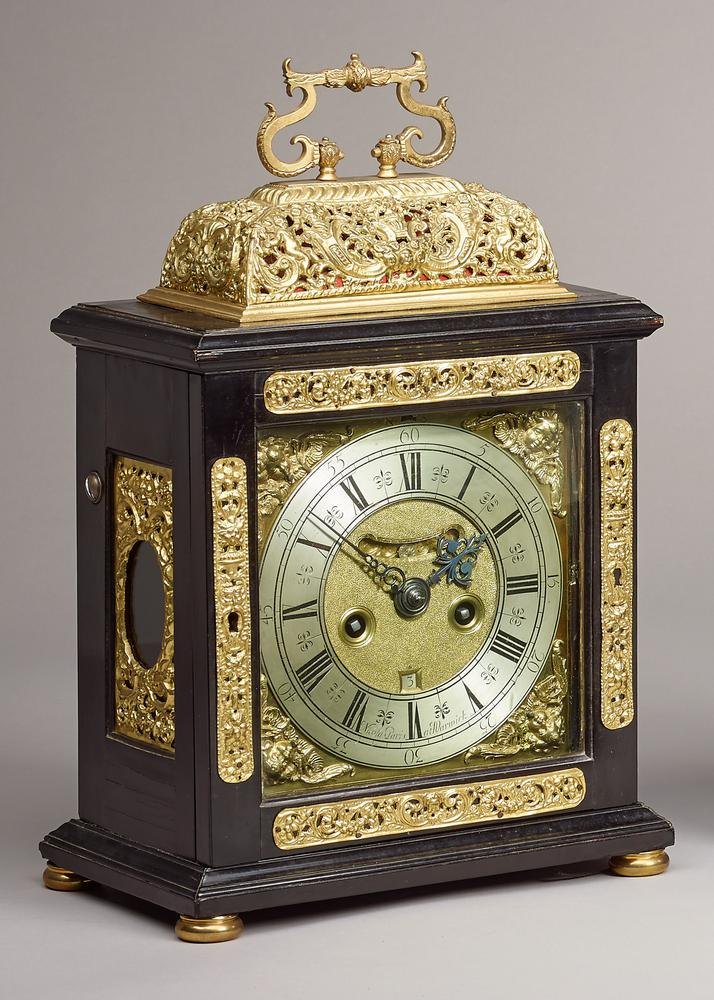
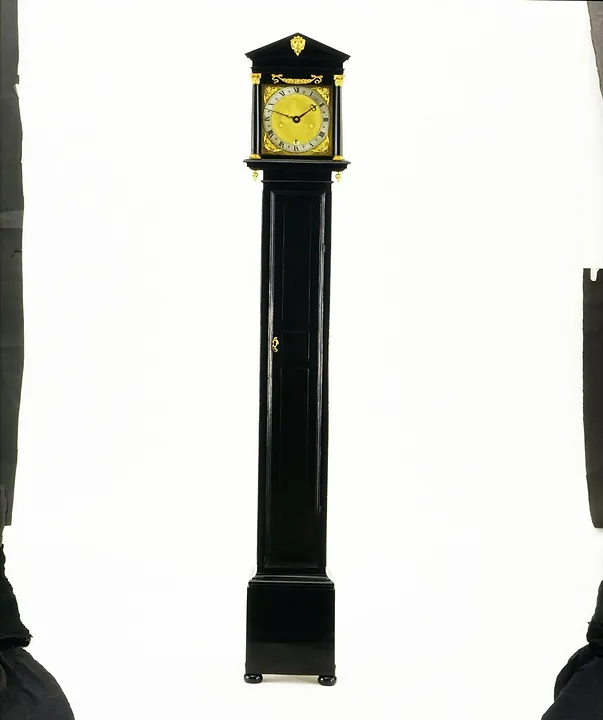
Table clock with pull-quarter chiming repeat in ebonized case with basket top
- Maker / attribution
- Nicolas Paris (Made by)
- Date
- c. 1700
- Historical period
- Early Modern Horology (1600 – 1750)
- Country of origin
- England
- Place
- Warwick (Warwickshire) (Clock likely sourced from London)
- Object type
- Clock
- Materials / technique
- oak, brass, steel, wax, gold
- Dimensions
- Height: 41 centimetres Weight: 8 kilograms Width: 27 centimetres Depth: 17 centimetres
- Holding institution
- British Museum
- Accession / object no.
- 2018,8027.10
- Credit line
- British Museum, London
- Catalogue title (original)
- Table clock with pull-quarter chiming repeat in ebonized case with basket top (English)
View the source record ↗ (opens another website in a new tab)Suggest a correction
Record summary
Held and catalogued by British Museum (object number 2018,8027.10), this is a clock by Nicolas Paris, made in Warwick (Warwickshire) (Clock likely sourced from London), England, dated c. 1700. The Atlas places it in the Early Modern Horology period (1600 – 1750) of its Clocks collection. Materials and techniques recorded by the source: oak, brass, steel, wax, gold. Recorded dimensions: Height: 41 centimetres Weight: 8 kilograms Width: 27 centimetres Depth: 17 centimetres. The record is illustrated with 4 photographs.
Assembled from the source record's structured fields. Dates and attributions are given as the source states them; where a field is missing the Atlas leaves it blank rather than estimating.
Catalogue description
Description — British Museum
Table clock with pull-quarter chiming repeat in ebonized case with basket top. Movement 8-day duration two train fusee movement with striking and pull-quarter chiming repeat. Verge escapement with short bob pendulum. Engraved back plate, not signed. Dial Gilded brass square dial plate with matting, dummy pendulum and date within the silvered brass chapter with ring. Dummy pendulum aperture is decorated. Four good cast brass putti spandrels. Blue steel relief hands. Strike-silent lever above chapter ring. Case Ebonized fruitwood veneer on oak carcass. Gilded repoussé brass basket top, side frets over glass and mounts on front door. Gilded brass feet.
Curator's comments — British Museum
Nicolas Paris was first recorded in Warwick in 1670 when he was paid for repair to St Mary's church clock and paid 2 shillings for his seat in the church 'for a place in a little seate joyning to the pillar where the pulpit standeth'. He paid hearth tax in 1670,1671.1673,1674 His relative Samuel Paris (possibly his brother) is recorded in Warwick from 1674, and Samuel also repaired local turret clocks. Samuel outlived Nicolas and died three years later in 1719. Between 1684 and 1703 Nicolas Paris charged Thomas Leigh, 2nd Baron of Stoneleigh Abbey, Warwickshire. 'For Keeping the clock in order' 10 shillings. Nicolas and his wife Mary had six children; three sons Nicholas, born 1681. John born 1685 and Thomas born 1688 survived childhood and assisted with the family business. In 1704 Nicolas Paris occupied seats in St Mary's Church in the 11th pew of the middle aisle and in 1711 'seats for life in 9th pew on north side of middle aisle' In 1684 Nicolas and Samuel both became freeman of the Blacksmiths of Warwick. There is a London-styke lantern clock, circa 1675 and an eight day longcase clock signed by Nicolas Paris in Warwick Market Hall Museum.Paris would have bought the clock castings from London and then assembled, finished and engraved his name as supplier in his Warwick workshops. The museum also acquired in 1981 two firearms signed 'Nicolas Paris of Warwick': a six-barrelled flintlock gun, circa 1690 and a breech-loading flintlock sporting gun circa 1700 For an account of the Paris family see W.A.Seaby, Curator of the Warwick Museum, The Paris Family of Warwick, 1981 Bill Seaby quotes regular payments to Nicolas Paris for repairs to turret clocks, household clocks, guns, locks, keys, water pumps, fire engines, the chancel screen of St Mary's, the railings to the Leicester tomb, iron gates at Stoneleigh (which still exist), bells, gilding of the1450 Richard Beauchamp monument and enamelling. In the correspondence with his patron Sir Richard Dugdale, Nicolas Paris points out that he has been seriously ill, on more than one occasion from the poisonous vapours given off in the gilding process which used a mercury amalgam. 'It hath cost me allmost my life twise about the doing of it as the Doctors will aferme, and it hath cost me more money out of pocket than I have received' https:///www.brianloomes.com/collecting/paris/index.html Collecting Antique Clocks: Nicolas Paris of Warwick and his lantern clocks. Saunders, 2005, pp.323-5.
Inscriptions & marks
signature; Chapter ring; English; Alphabetic; Nicola Paris atWarwick
Provenance
Bequeathed by:, Eric Lloyd
Historical context
Early Modern Horology (1600 – 1750)
Huygens' pendulum and balance spring transform accuracy; English makers develop the anchor and deadbeat escapements.
Huygens's pendulum (1656–57) improved clock accuracy from about a quarter of an hour to under a minute a day. The anchor escapement (c. 1670) and the long seconds pendulum created the longcase clock; London makers such as Fromanteel, Knibb, Tompion and Quare led European clockmaking, and French makers created the Boulle pendule.
Read the period in the timelineMore clocks from this periodEarlier: Renaissance Horology
Atlas type guide
Bracket, table and spring-driven clocks
Spring-driven clocks freed timekeeping from the hanging weight. The coiled mainspring, documented from the fifteenth century, made portable table clocks possible; to even out its declining force, makers used the fusee, a conical pulley connected to the barrel by a gut line or chain. Renaissance table clocks from Augsburg and Nuremberg — drum-shaped, square or tower-shaped in gilt brass — were luxury scientific objects, often with astronomical dials and alarms.
After the pendulum, English makers developed the bracket clock: a wooden case with a carrying handle, a short pendulum with a verge escapement, and often repeating work to sound the hours on demand at night. Later examples use the anchor escapement. In the nineteenth century, 'table clock' became a broad term for spring clocks of every nationality.
What to look for
- A fusee in the movement (cone-shaped pulley) and the type of line — gut or chain.
- Verge escapement with a short bob pendulum, often with a decoratively engraved backplate.
- Repeat cords or buttons that make the clock strike again on demand.
- Gilt-brass engraved cases and horizontal dials on Renaissance pieces.
- Case shapes: inverted bell, bell top, break-arch, lancet or balloon.
Dating clues
- Drum and tower table clocks: c. 1520–1650.
- Ebony veneered English bracket clocks with verge escapements: c. 1670–1800.
- Engraved backplates were usual on English clocks until c. 1800, then generally plain.
General guidance written by the Atlas editors about this kind of object. It is not a statement about this particular piece; for that, rely on the source record above and on physical examination.
Read next:Anchor (recoil) escapement
Related records
Clocks · 1598–1603
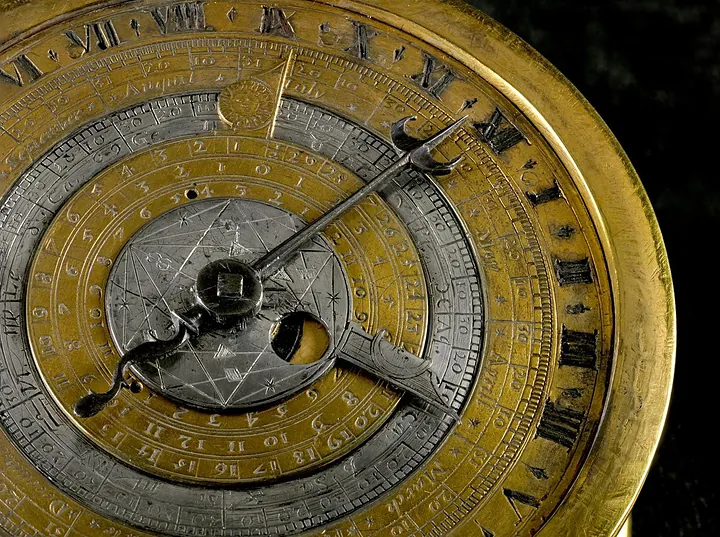
Circular table-clock with calendrical and lunar indications made by Nicholas Vallin in London between 1598 and 1603.
Science Museum Group, London
Clocks · 1611
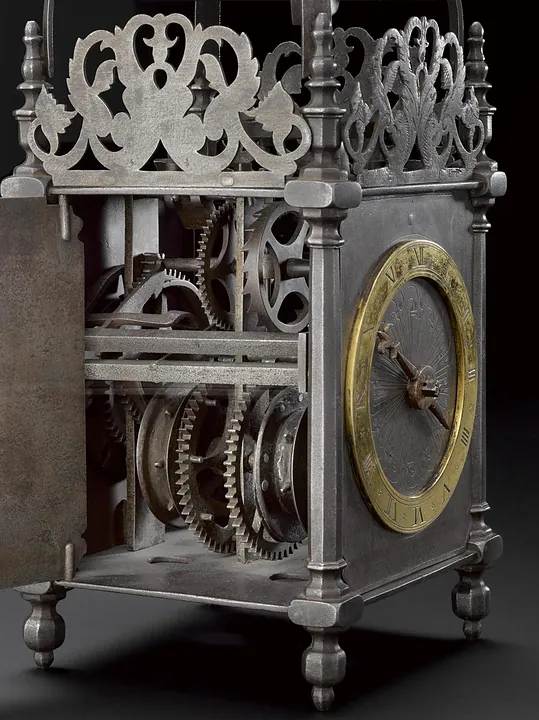
English iron lantern clock, with wheel balance, by John Holloway, Market Lavington, Wiltshire, England, 1611.
Science Museum Group, London
Clocks · 1630
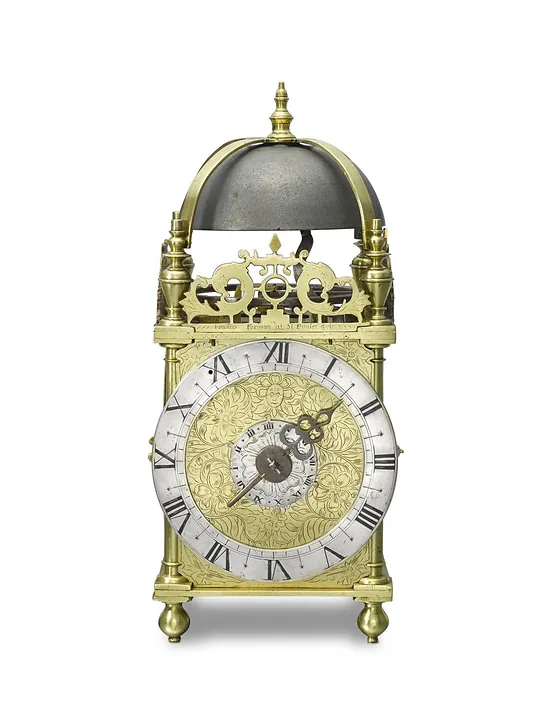
Lantern clock by Francis Forman, England, 1630
Science Museum Group, London
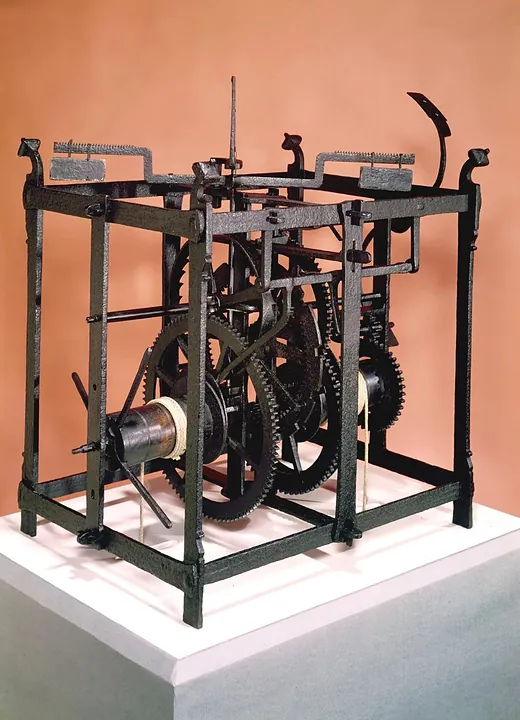
Clocks · 1632–1640
Turret clock, England, 1632–1640
Science Museum Group, London
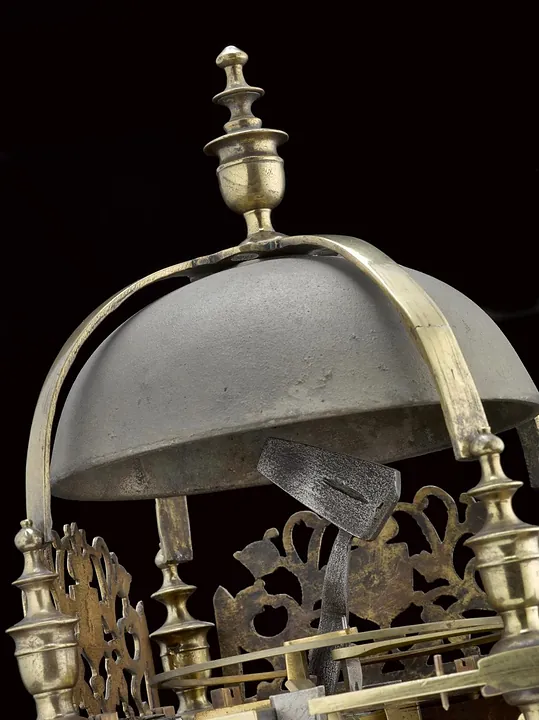
Clocks · 1645–1655
Balance-wheel brass lantern clock, with two driving weights and one counterweight, by Thomas Knifton, Cross Keys, Lothbury, London, England, 1645–1655.
Science Museum Group, London
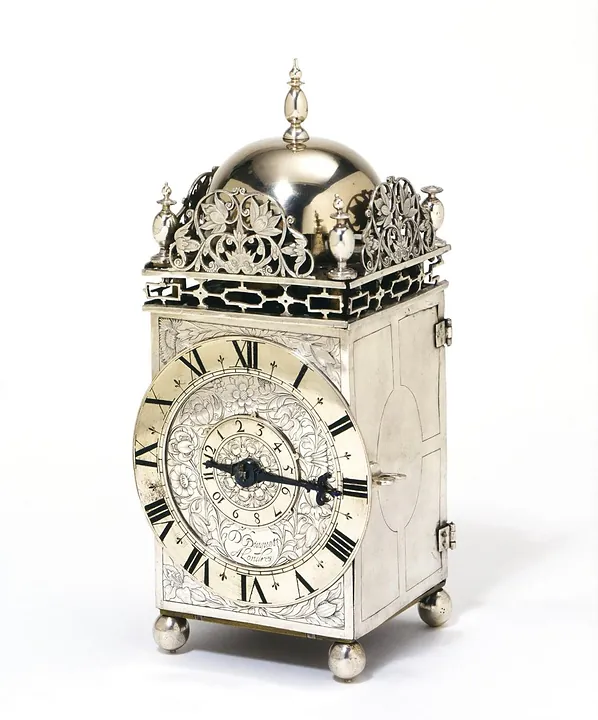
Clocks · c. 1650
Lantern alarm clock, silver, by David Bouquet, circa 1650
Victoria and Albert Museum, London
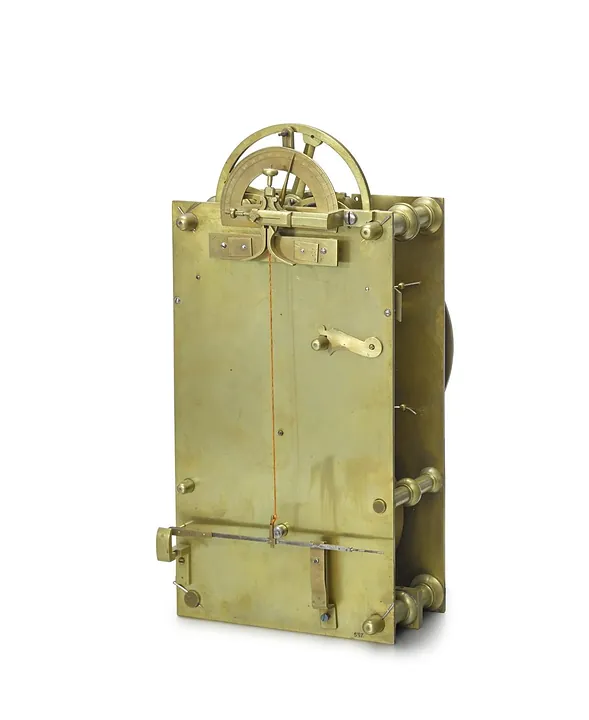
Clocks · 1650–1660
Lantern clock by Peter Closon, England, 1650–1660
Science Museum Group, London
Clocks · c. 1660
Longcase clock, c. 1660, English, made by Ahasuerus Fromanteel
Victoria and Albert Museum, London