
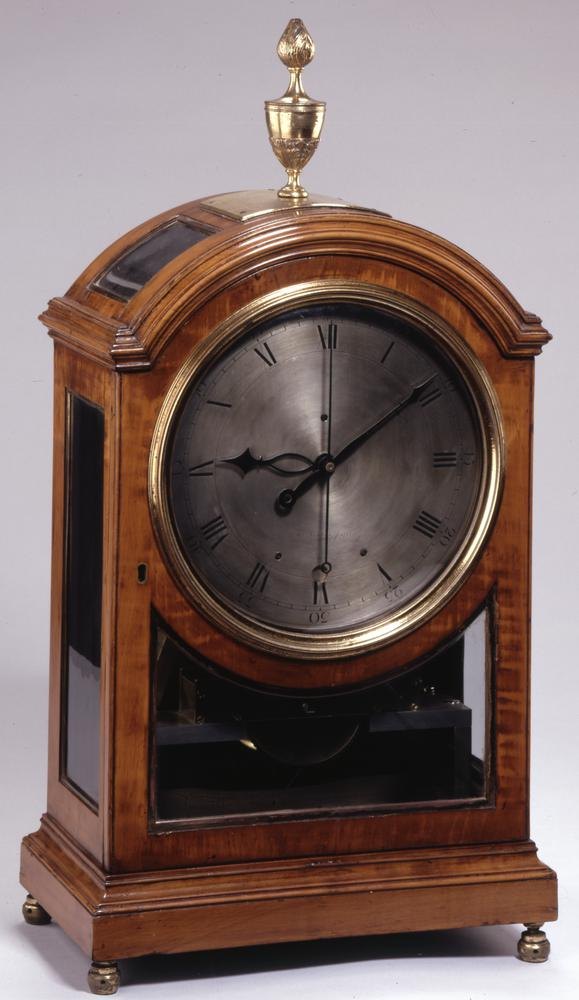
Clocks · Bracket clock
Satinwood cased eight-day bracket timepiece with gravity escapement and centre-seconds
- Maker / attribution
- William Nicholson (Made by)
- Date
- 1797
- Historical period
- Precision & Scientific Horology (1750 – 1850)
- Country of origin
- England
- Place
- London (England)
- Object type
- Bracket clock
- Materials / technique
- brass, satinwood
- Dimensions
- Height: 60 centimetres Width: 30.75 centimetres Depth: 17.30 centimetres
- Holding institution
- British Museum
- Accession / object no.
- 1958,1006.1925
- Credit line
- British Museum, London
- Catalogue title (original)
- Satinwood cased eight-day bracket timepiece with gravity escapement and centre-seconds (English)
View the source record ↗ (opens another website in a new tab)Suggest a correction
Record summary
Held and catalogued by British Museum (object number 1958,1006.1925), this is a bracket clock by William Nicholson, made in London (England), dated 1797. The Atlas places it in the Precision & Scientific Horology period (1750 – 1850) of its Clocks collection. Materials and techniques recorded by the source: brass, satinwood. Recorded dimensions: Height: 60 centimetres Width: 30.75 centimetres Depth: 17.30 centimetres. The record is illustrated with 6 photographs.
Assembled from the source record's structured fields. Dates and attributions are given as the source states them; where a field is missing the Atlas leaves it blank rather than estimating.
Catalogue description
Description — British Museum
Bracket timepiece; eight-day; gravity escapement; round silvered-metal dial with centre-seconds; satinwood case with moulded arched hood; glazed panels to front and sides surmounted by brass flaming vase finials. Train-count: Gt wheel 180 2nd wheel 144/12 3rd wheel 144/12 4th wheel 60/12 Escape wheel 10/10 Motion work. 2nd whl pinion 24 driving Min whl pinion 48 driven Minute wheel 120 Minute pinion 32 Hour wheel 80 Canon pinion 25.
Curator's comments — British Museum
Text from 'Clocks', by David Thompson, London, 2004, p. 126. William Nicholson Table regulator London, 1797 Height 57 cm, width 30.75 cm, depth 17.3 cm The first gravity escapement was invented by Alexander Cumming (1732-1814) in 1774. This revolutionary escapement for precision regulators is based on the principle of using weighted arms which always fall through the same distance to impulse the pendulum. Consequently, every impulse given is equal in magnitude, giving a more constant rate of oscillation. Cumming's escapement was followed very shortly by Thomas Mudge's, and then a number of other important makers, amongst them William Harvey, introduced their own versions. The advantage of these escapements is that the impulse to the pendulum is constant and not affected by the variations in power from the driving force. Little is known of William Nicholson who was born in 1753 and lived and worked in London until his death in 1815. This clock, signed on the dial 'Wm Nicholson f. 1797', is a unique piece with Nicholson's own form of gravity escapement invented in 1784. Interestingly, however, he may have involved the clock and watchmaker William Hardy in its production because Hardy's name and address are scratched on the back of the dial 'Harday Copice Row' (Hardy's address was 28 Coppice Row, Clerkenwell). The spring-driven movement has Harrison's form of maintaining power to keep the clock going during winding. The clock is unusual in appearance in that the movement is mounted on a massive steel block to provide stability and the pendulum is not suspended from the back of the movement. Instead, two substantial gilded supports rise up from the base and meet at the top to provide a suspensions point for the pendulum. At the top of the supports is Nicholson's unusual form of temperature compensation: a bimetallic block which, as temperature changes, alters its shape to raise or lower the top suspension block and in so doing changes the effective length of the pendulum suspension spring. Another unusual feature is the coiled wire spring which is placed around the pendulum bob to secure it when the clock is being moved. The elegant satinwood-veneered case has glazed panels at the top, sides and front which reveal the movement from all sides. The case stands on four turned feet and is surmounted by a large urn and flame finial with acanthus decoration. The clock is an interesting example of a rather unassuming case which in reality conceals a movement of a most unusual and interesting design. Ilbert Collection.
Inscriptions & marks
signature; Wm.Nicholson, f.1797 [dial]; repair mark; Harday copis Row [reverse of dial]; repair mark; C H Hobson MAR 1938 [reverse of dial]; signature; bottom centre of front plate; Thos Thompson; 's' of Thos is superscript
Provenance
Previous owner/ex-collection:, Courtenay Adrian Ilbert; Donated by:, Gilbert Edgar; Acquired 1958
Historical context
Precision & Scientific Horology (1750 – 1850)
Harrison solves longitude; Mudge invents the lever; Breguet's Paris workshop defines the modern watch.
The age of the deadbeat escapement, compensated pendulums and observatory regulators. Domestic clocks spread through the middle classes: English longcase and bracket clocks, French gilt-bronze mantel clocks, Viennese Biedermeier wall clocks, Black Forest painted-shield clocks, and the first American shelf clocks.
Read the period in the timelineMore clocks from this periodEarlier: Early Modern Horology
Atlas type guide
Bracket, table and spring-driven clocks
Spring-driven clocks freed timekeeping from the hanging weight. The coiled mainspring, documented from the fifteenth century, made portable table clocks possible; to even out its declining force, makers used the fusee, a conical pulley connected to the barrel by a gut line or chain. Renaissance table clocks from Augsburg and Nuremberg — drum-shaped, square or tower-shaped in gilt brass — were luxury scientific objects, often with astronomical dials and alarms.
After the pendulum, English makers developed the bracket clock: a wooden case with a carrying handle, a short pendulum with a verge escapement, and often repeating work to sound the hours on demand at night. Later examples use the anchor escapement. In the nineteenth century, 'table clock' became a broad term for spring clocks of every nationality.
What to look for
- A fusee in the movement (cone-shaped pulley) and the type of line — gut or chain.
- Verge escapement with a short bob pendulum, often with a decoratively engraved backplate.
- Repeat cords or buttons that make the clock strike again on demand.
- Gilt-brass engraved cases and horizontal dials on Renaissance pieces.
- Case shapes: inverted bell, bell top, break-arch, lancet or balloon.
Dating clues
- Drum and tower table clocks: c. 1520–1650.
- Ebony veneered English bracket clocks with verge escapements: c. 1670–1800.
- Engraved backplates were usual on English clocks until c. 1800, then generally plain.
General guidance written by the Atlas editors about this kind of object. It is not a statement about this particular piece; for that, rely on the source record above and on physical examination.
Related records
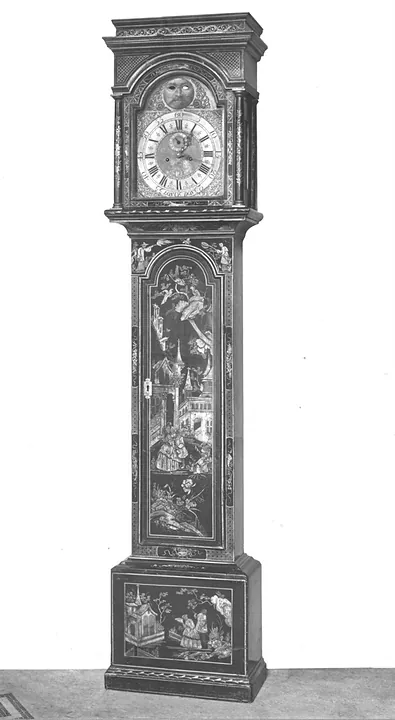
Clocks · 1740–1760
Longcase clock, English, 1740–1760, japanned wood, John Ellicott
Victoria and Albert Museum, London
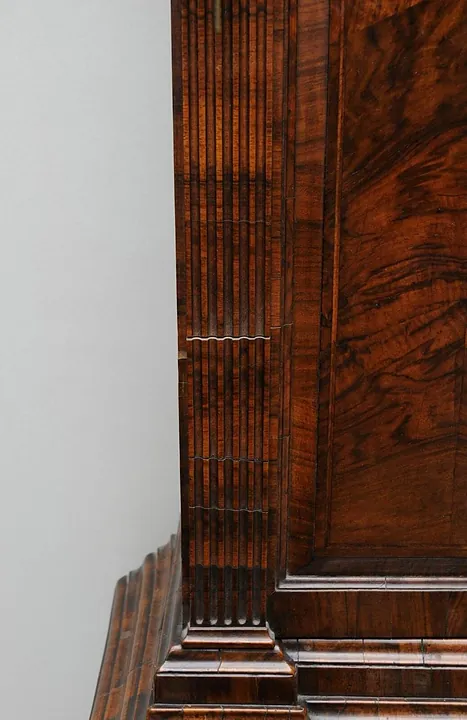
Clocks · c.1750
Long-case clock, English, ca. 1750, by Richard Peyton of Gloucester
Victoria and Albert Museum, London
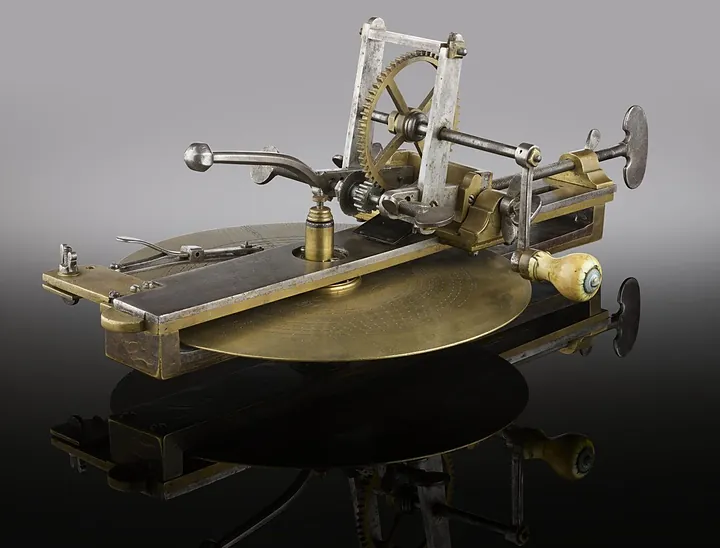
Clocks · 1751
Large wheel engine, signed and dated "John Tipping, Whildon Green, 1751".
Science Museum Group, London
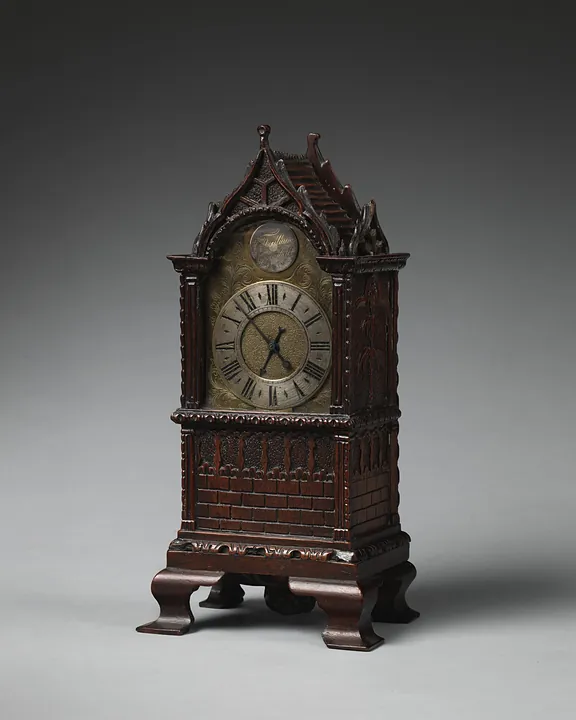
Clocks · 1755
Bracket clock by John Fordham, England, 1755
The Metropolitan Museum of Art, New York
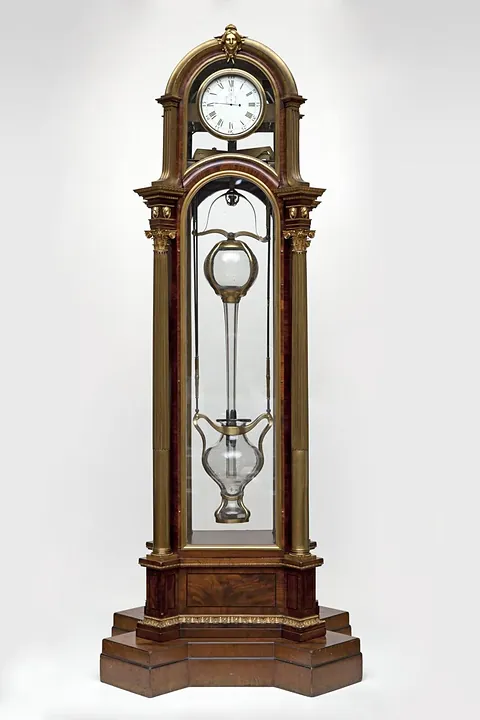
Clocks · c. 1760
Longcase clock by James Cox, England, c. 1760
Victoria and Albert Museum, London
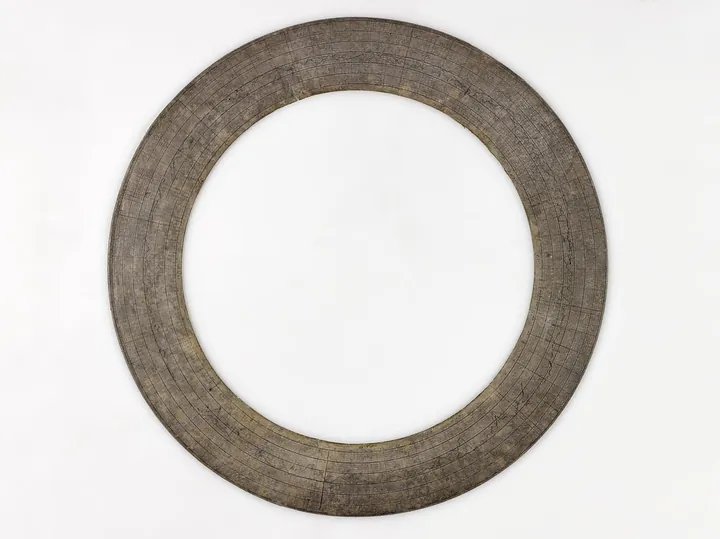
Clocks · 1766
Clock by Alexander Cumming, England, 1766
Science Museum Group, London
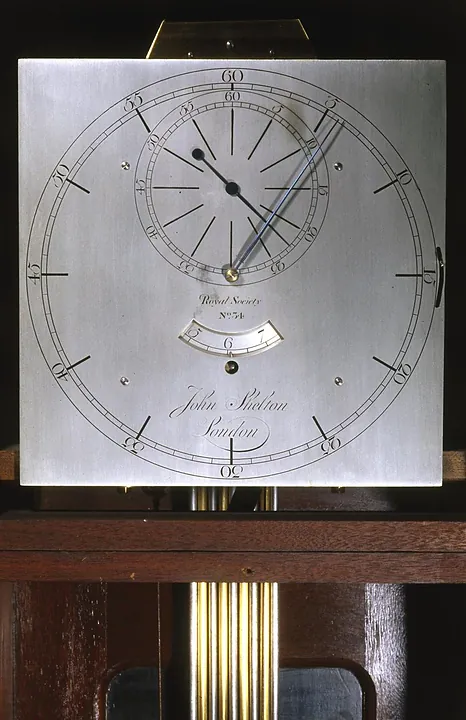
Clocks · 1768–1769
Regulator clock by John Shelton, England, 1768–1769
Science Museum Group, London
Clocks · c. 1775
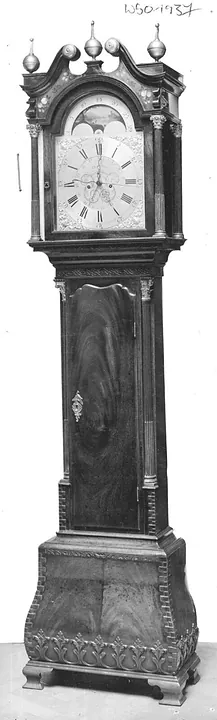
Longcase clock, England, c. 1775
Victoria and Albert Museum, London