Skip to content

Watchmaking Industry · Historical feature

Patek Philippe: A History in Objects, from Patek, Czapek & Cie to the Calatrava, the Nautilus and the Grand Complications

How a Geneva workshop founded in 1839 by two Polish émigrés became the most collected name in watchmaking — told through twenty watches in museum, auction and dealer records, from a Patek & Co. watch of the 1840s and Victorian minute repeaters to the Calatrava of 1932, the quartz Beta 21, the Nautilus, the 150th-anniversary watches of 1989 and the complications of the 2000s.

Atlas Editorial · · 11 min read
Patek Philippe: A History in Objects, from Patek, Czapek & Cie to the Calatrava, the Nautilus and the Grand Complications

Somlo Antiques (dealer), London · © Somlo Antiques — dealer photographs; permission required · source (opens another website in a new tab)

No watchmaker is collected as intensely as Patek Philippe. Its watches set auction records, its archives are consulted like a public register, and its name is used as shorthand for the best that mechanical watchmaking can do. Yet the firm began modestly, as one of dozens of small Geneva workshops finishing and selling watches in the 1830s, and for most of its history it made far fewer watches each year than the large Swiss manufactures. Its reputation rests on a long record of complicated watches, on a few designs that became classics, and on continuity: it has been independent throughout, and owned by one family since 1932.

This feature follows that history through watches in the Atlas catalogue — around 390 Patek Philippe pocket watches and wristwatches from museum collections, the Antiquorum auction archive and dealers in London, Copenhagen, New York, Los Angeles and elsewhere. Facts about each watch come from the record of the institution or dealer that described it, and are attributed where they are the dealer's own account.

Two Polish émigrés and a French inventor, 1839–1851

Antoni Patek was a Polish cavalry officer who, like many of his compatriots, left Poland after the failed rising of 1830–1831 against Russian rule and settled in Geneva. There, in 1839, he founded a watch business with another Pole, the watchmaker Franciszek Czapek. Patek, Czapek & Cie sold finely cased watches, many with enamelled and engraved decoration, and many of its early customers were fellow Poles.

In 1844, at the Paris industrial exhibition, Patek met Adrien Philippe, a French watchmaker who had devised a way to wind a watch and set its hands from the crown, without a key. Czapek left the partnership in 1845, Philippe joined as technical director, and the firm became Patek & Cie; from 1851 it was Patek Philippe & Cie. Philippe's keyless system, patented in 1845, gave the firm a technical identity at the moment when keyless watches were becoming practical.
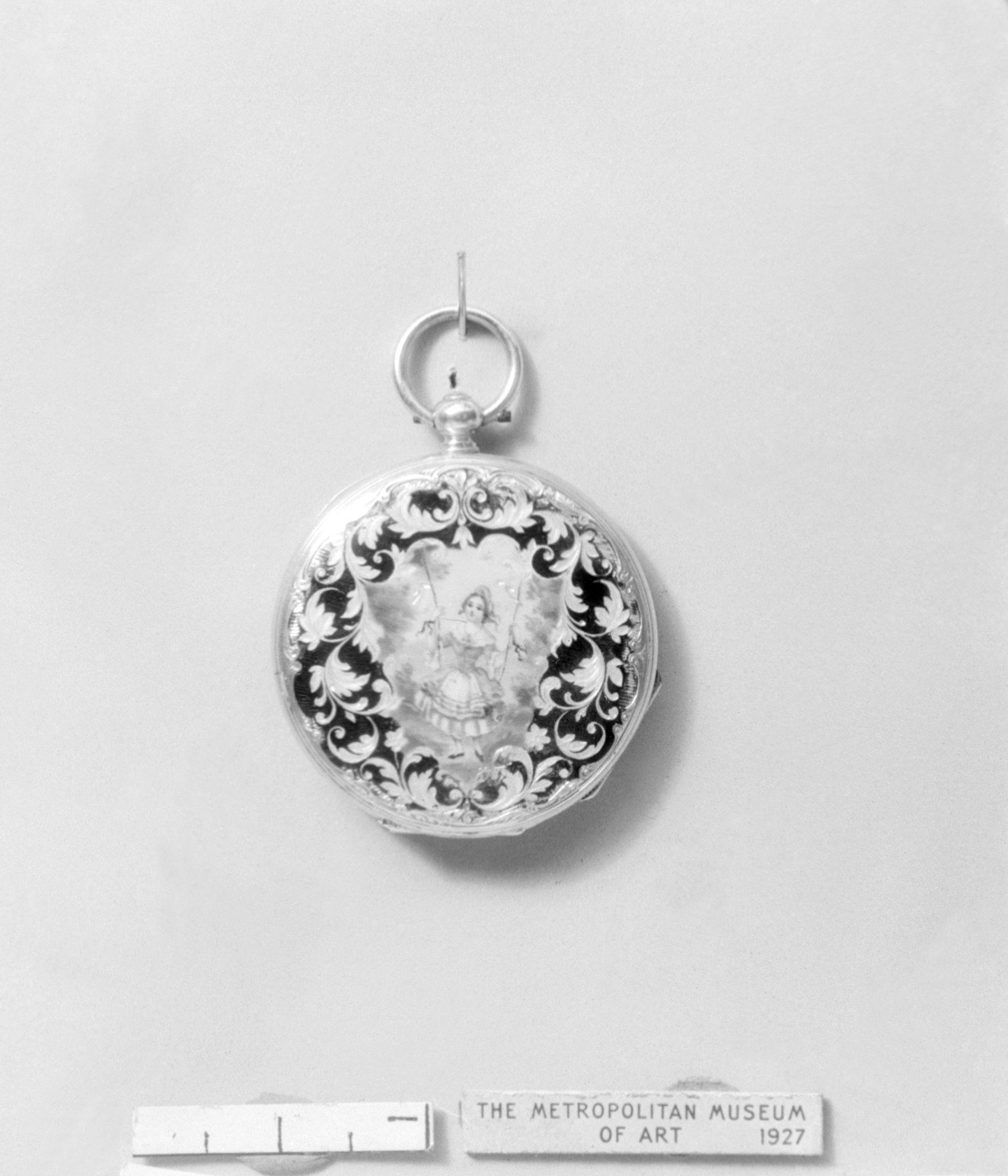
A watch signed Patek & Co., Switzerland, 1845–1851 (Metropolitan Museum of Art) — from the short period between Czapek's departure and the adoption of the name Patek Philippe.
A watch signed Patek & Co., Switzerland, 1845–1851 (Metropolitan Museum of Art) — from the short period between Czapek's departure and the adoption of the name Patek Philippe. — Watch by Patek & Co., Switzerland, 1845–51, The Metropolitan Museum of Art, New York. The Metropolitan Museum of Art, Open Access. CC0 1.0 (Met Open Access). Source record (opens another website in a new tab)
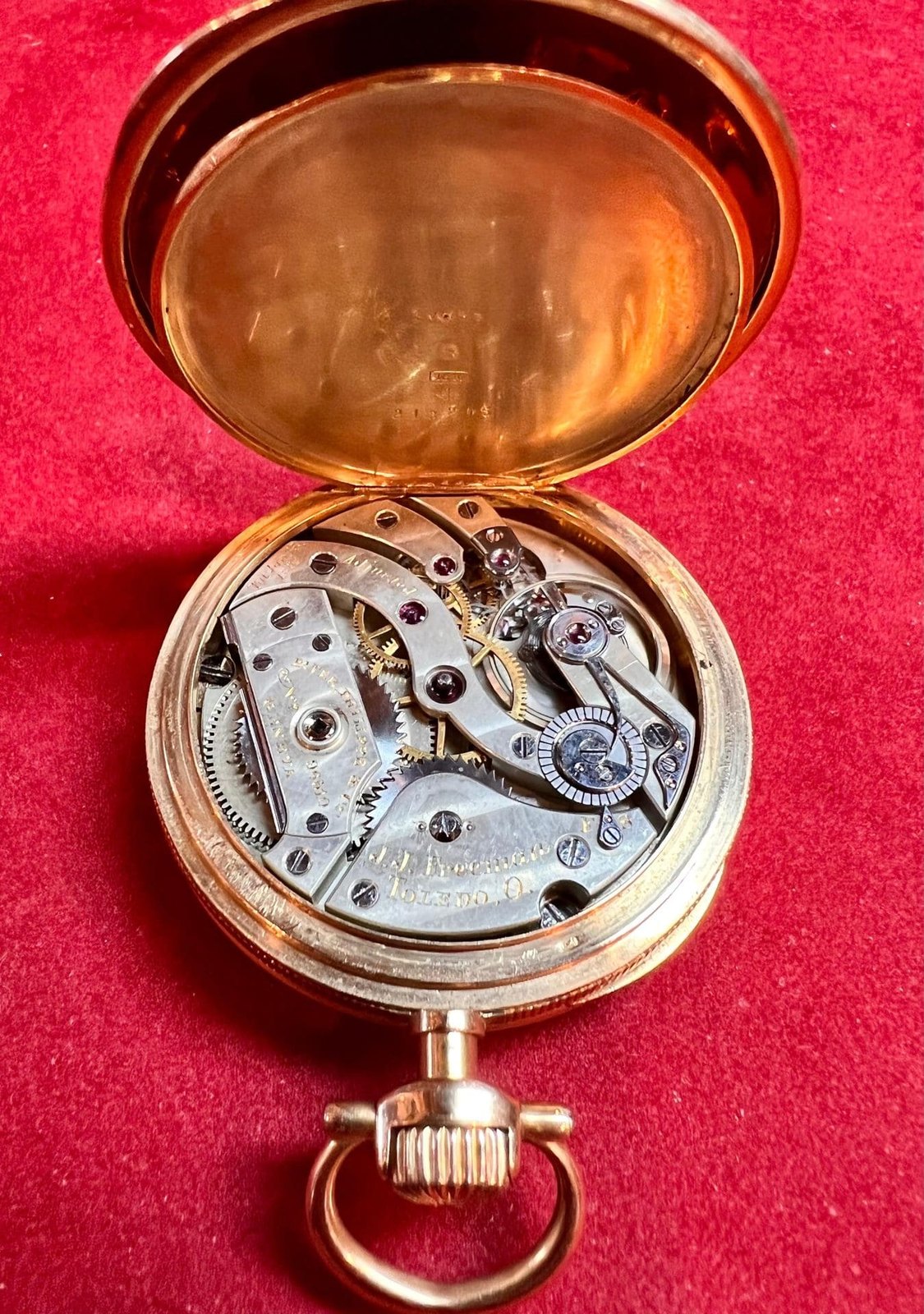
The movement of an 18-carat gold Patek Philippe pocket watch dated 1860, wound and set from the crown (WatchMuseum.org shop). Keyless winding of the kind Philippe patented in 1845 became standard on Patek watches in the following decades.
The movement of an 18-carat gold Patek Philippe pocket watch dated 1860, wound and set from the crown (WatchMuseum.org shop). Keyless winding of the kind Philippe patented in 1845 became standard on Patek watches in the following decades. — Patek Philippe 18k Gold Pocket Watch, 1860, WatchMuseum.org shop. © WatchMuseum.org — the publisher's own shop photographs. Source record (opens another website in a new tab)

The nineteenth century: complications and American customers

From the 1850s Patek Philippe built a reputation for precision and complication. Its watches won prizes at international exhibitions and at the observatory timing competitions in Geneva, and its workshops made chronographs, split-seconds chronographs, repeaters and perpetual calendars for wealthy customers in Europe and the Americas. Tiffany & Co. in New York was an important early retailer, and many Patek watches were sold under the names of jewellers such as Tiffany, Shreve, Crump & Low in Boston and Gübelin in Lucerne, whose names appear on their dials.
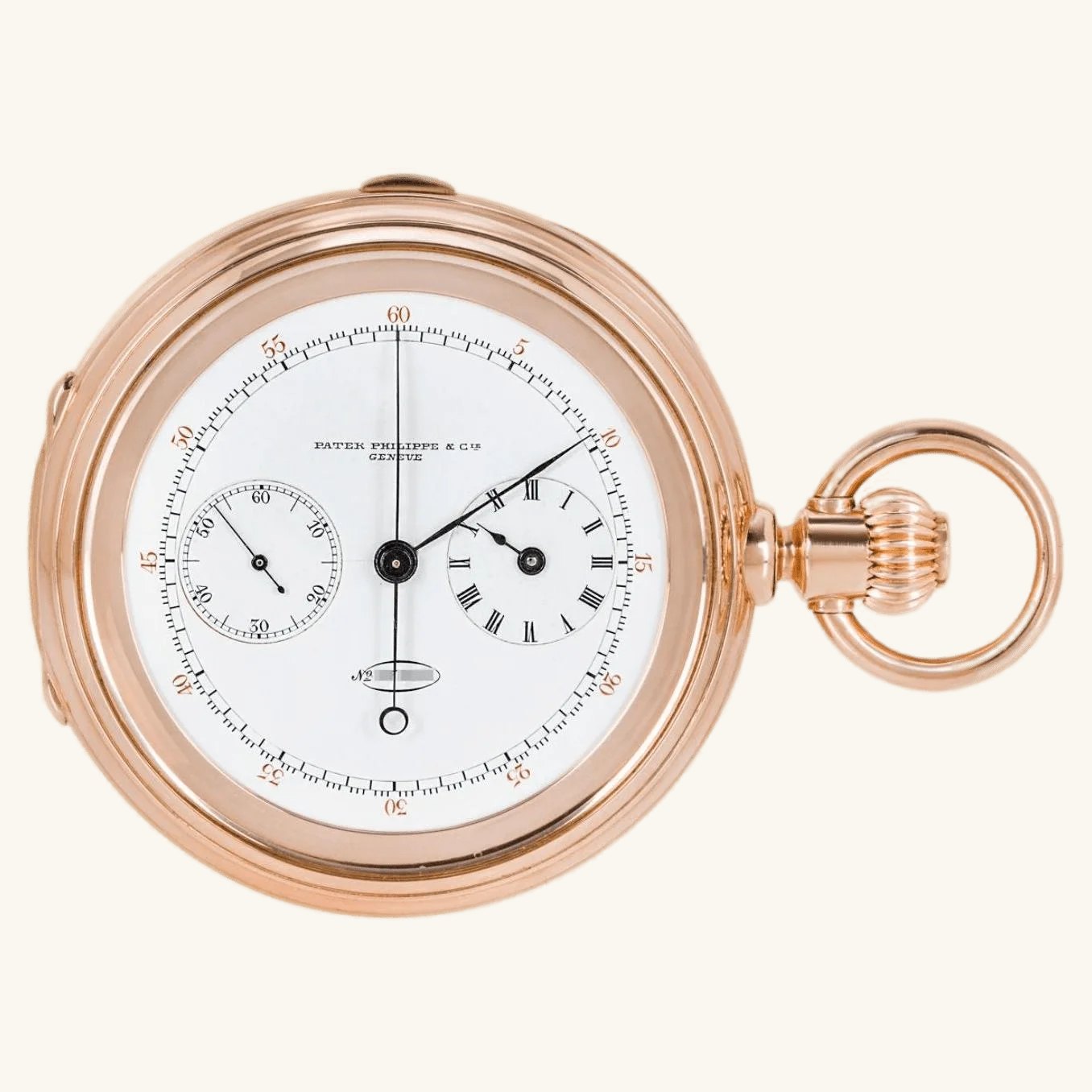
A Patek Philippe split-seconds chronograph pocket watch with a regulator-style dial, dated 1878 (WatchMuseum.org shop). A split-seconds chronograph has two centre hands that can be stopped separately to time two events.
A Patek Philippe split-seconds chronograph pocket watch with a regulator-style dial, dated 1878 (WatchMuseum.org shop). A split-seconds chronograph has two centre hands that can be stopped separately to time two events. — Patek Philippe Regulator Dial Split Second Chronograph, 1878, WatchMuseum.org shop. © WatchMuseum.org — the publisher's own shop photographs. Source record (opens another website in a new tab)
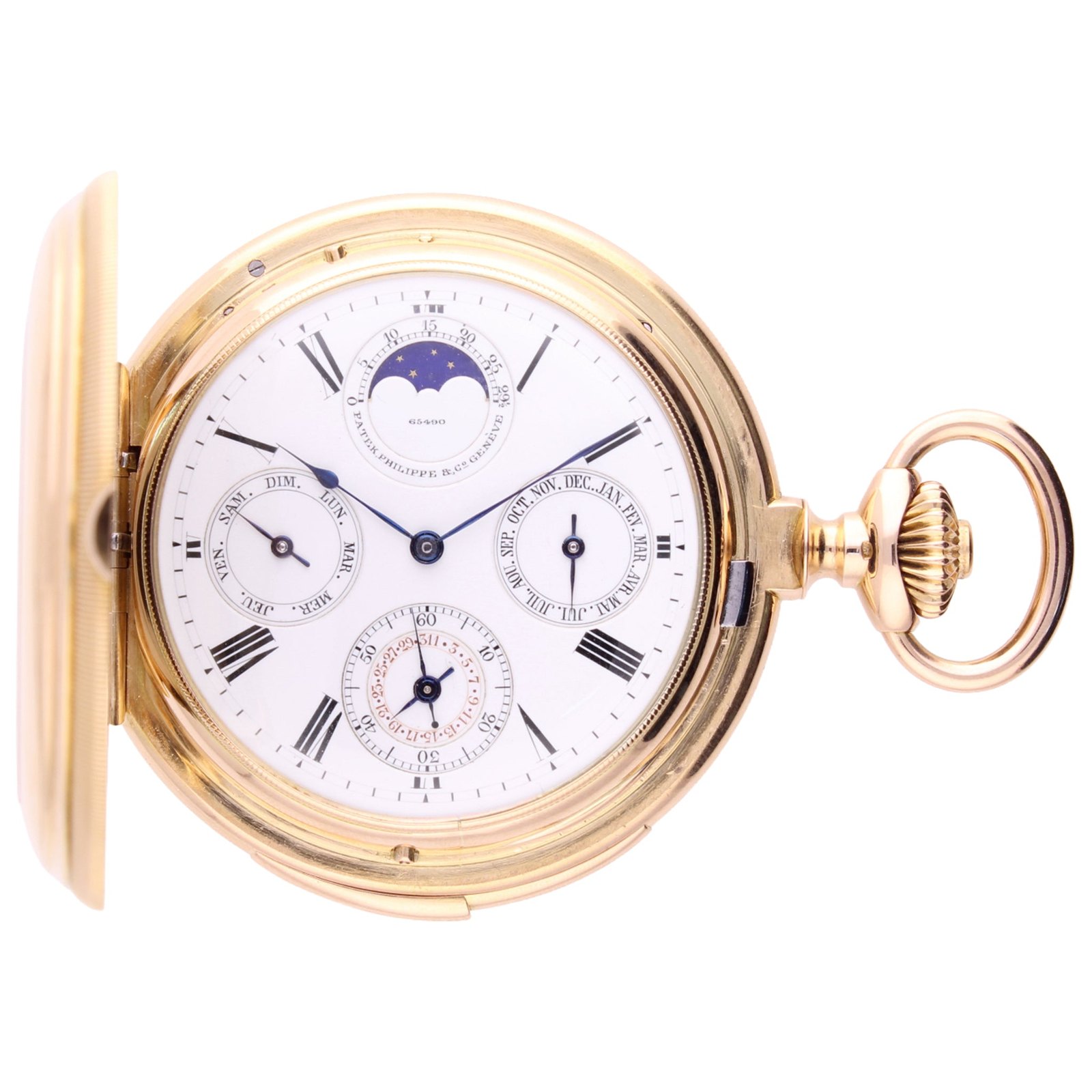
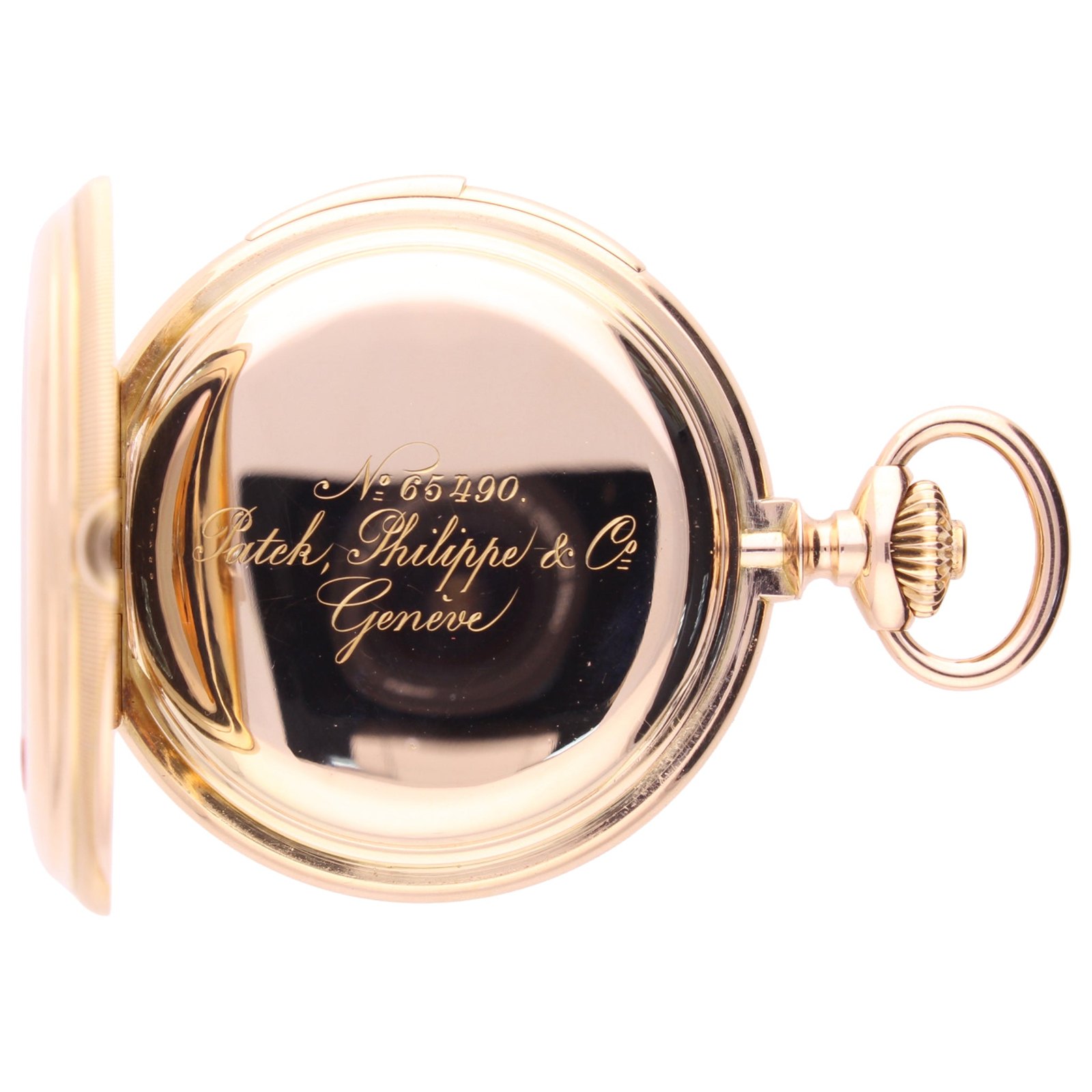
The engraved case of an 18-carat rose gold hunter-cased pocket watch of 1887 that combines a minute repeater, a perpetual calendar with moon phases and a chronograph (Somlo Antiques). The dealer notes that Patek Philippe patented a perpetual calendar mechanism in 1889.
The engraved case of an 18-carat rose gold hunter-cased pocket watch of 1887 that combines a minute repeater, a perpetual calendar with moon phases and a chronograph (Somlo Antiques). The dealer notes that Patek Philippe patented a perpetual calendar mechanism in 1889. — 18ct rose gold Patek Philippe Minute repeating perpetual calendar chronograph pocket watch with moon phases, 1887, Somlo Antiques (dealer), London. Somlo Antiques. © Somlo Antiques — dealer photographs; permission required. Source record (opens another website in a new tab)
A Patek Philippe 'Extra' quality chronometer pocket watch of about 1898, with matching case and movement numbers (106816). The auction record lists its observatory certificate of 1899 and later papers tracing its owners.
A Patek Philippe 'Extra' quality chronometer pocket watch of about 1898, with matching case and movement numbers (106816). The auction record lists its observatory certificate of 1899 and later papers tracing its owners. — Rare Patek Philippe Guillaume Balance Extra 18k Gold Chronometer Pocket Watch Original Case Matching, c. 1898, LiveAuctioneers auction archive. Hess Fine Auctions / LiveAuctioneers. © Hess Fine Auctions / LiveAuctioneers — permission required. Source record (opens another website in a new tab)
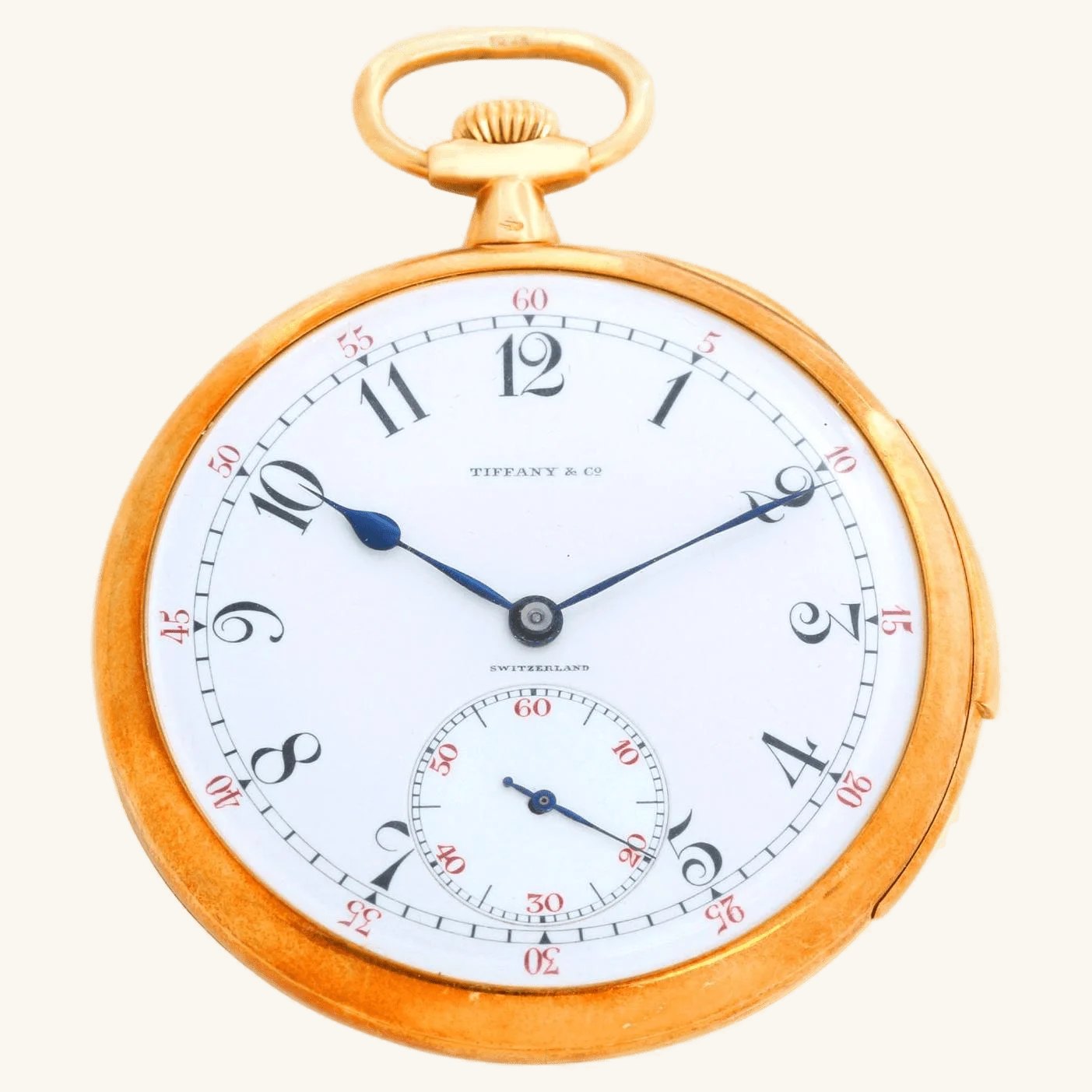
A minute-repeating pocket watch made by Patek Philippe for Tiffany & Co., 1905–1910, 48 mm, with Tiffany's name on the enamel dial and the movement signed for both firms (WatchMuseum.org shop).
A minute-repeating pocket watch made by Patek Philippe for Tiffany & Co., 1905–1910, 48 mm, with Tiffany's name on the enamel dial and the movement signed for both firms (WatchMuseum.org shop). — Patek Philippe minute-repeating pocket watch for Tiffany & Co., 'Extra' quality, WatchMuseum.org shop. © WatchMuseum.org — the publisher's own shop photographs. Source record (opens another website in a new tab)

Patek Philippe says it made the first Swiss wristwatch, a jewelled bracelet watch completed in 1868 for a Hungarian countess, Koscowicz; like most 'firsts' in watch history, it is the company's own account. For decades wristwatches remained a small, mostly feminine part of its production, and the firm's main business was pocket watches until the 1930s.

Wristwatches, the Depression and the Stern family, 1920–1940

In the 1920s Patek Philippe made rectangular and shaped wristwatches in the Art Deco taste, and its workshops produced the first perpetual calendar wristwatch known, No. 97975, completed in 1925 from a movement made earlier for a pendant watch. The firm's greatest work of the period, however, was a pocket watch: the Supercomplication made for the New York banker Henry Graves Jr. and delivered in 1933, with twenty-four complications, which remained the most complicated watch in the world for more than half a century.
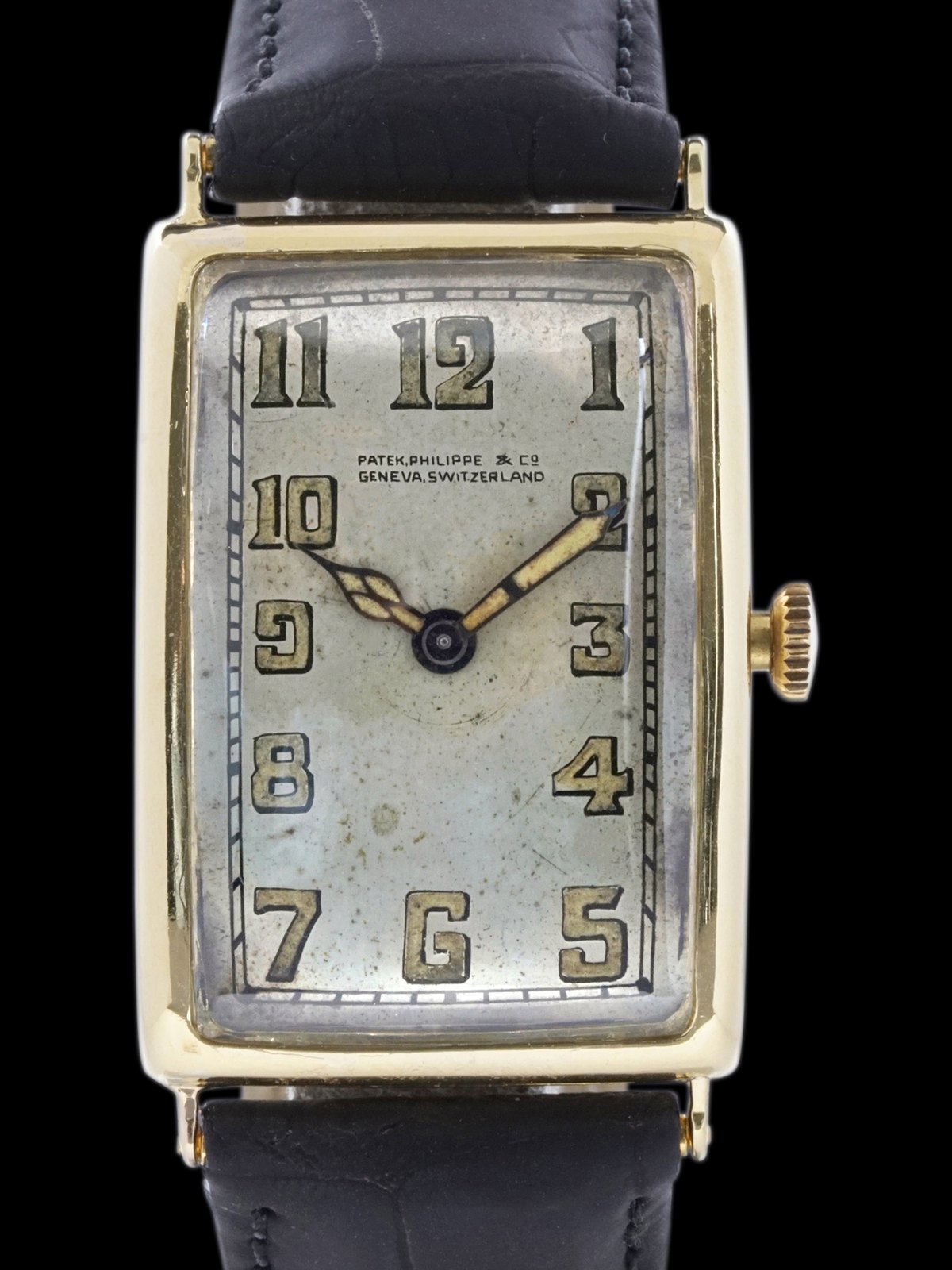
A rectangular 18-carat gold Patek Philippe wristwatch of 1924, 26 × 37 mm, with an extract from the archives (Craft & Tailored). Shaped cases like this were typical of the firm's wristwatches in the 1920s.
A rectangular 18-carat gold Patek Philippe wristwatch of 1924, 26 × 37 mm, with an extract from the archives (Craft & Tailored). Shaped cases like this were typical of the firm's wristwatches in the 1920s. — Patek Philippe Rectangular Case 18K YG, 1924, Craft & Tailored (dealer), Los Angeles. Craft & Tailored. © Craft & Tailored — dealer photographs; permission required. Source record (opens another website in a new tab)

The Depression nearly ended the firm. In 1932 it was bought by the brothers Charles and Jean Stern, who owned the Geneva dial-making firm Stern Frères and had supplied Patek's dials. Jean Stern's son Henri, his grandson Philippe and his great-grandson Thierry later led the company. In the same year Patek introduced a plain round wristwatch, reference 96, later known as the Calatrava. It became the pattern of the classic dress watch.
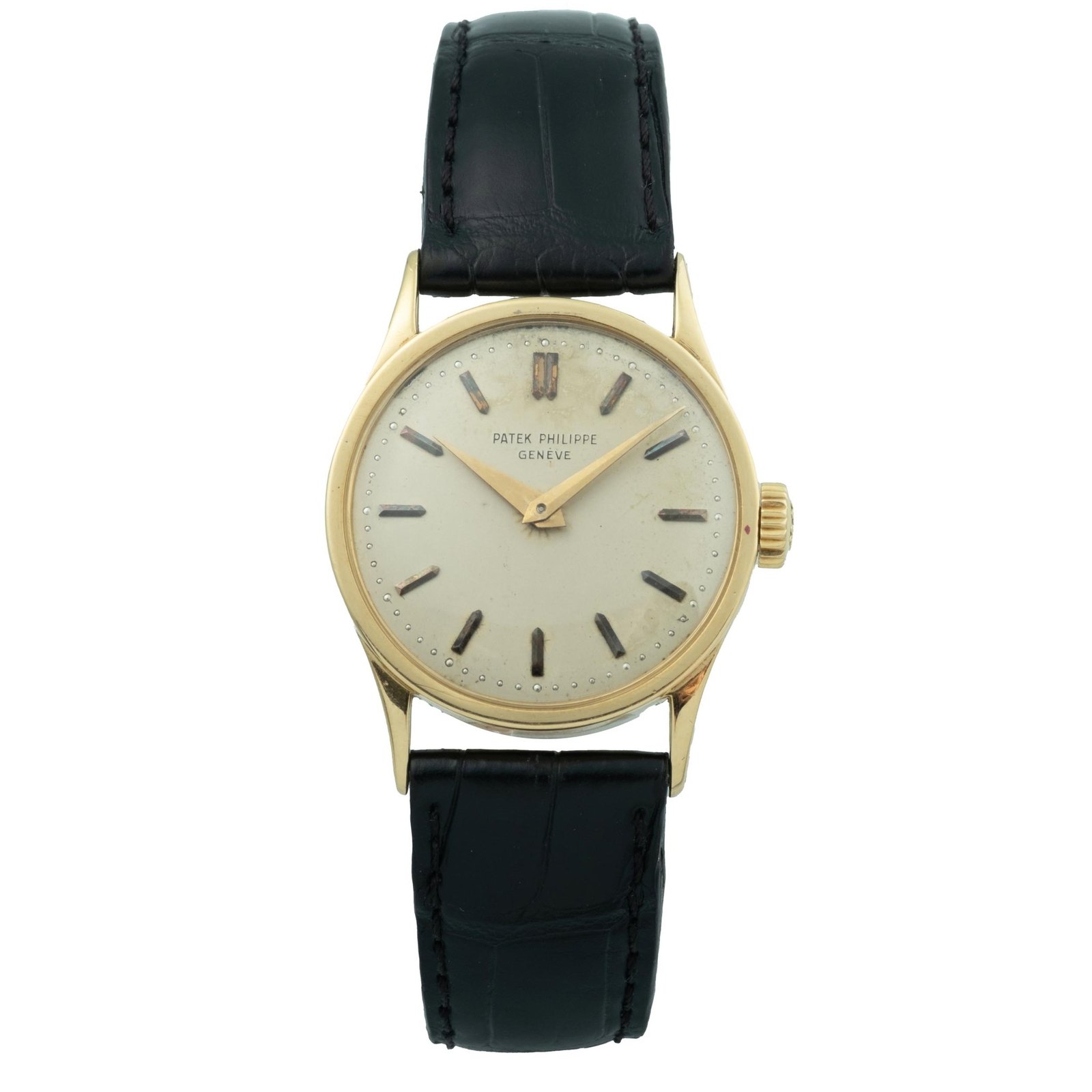
A Patek Philippe Calatrava, reference 96J, in yellow gold, dated 1932: 31 mm across, with a 12-ligne manual-winding movement (Antiquorum auction record). The 96 was made for more than forty years.
A Patek Philippe Calatrava, reference 96J, in yellow gold, dated 1932: 31 mm across, with a 12-ligne manual-winding movement (Antiquorum auction record). The 96 was made for more than forty years. — Patek Philippe wristwatch, ref. 96J, Calatrava, 1932, Antiquorum auction archive, Geneva. Antiquorum Genève SA. © Antiquorum Genève SA — permission required. Source record (opens another website in a new tab)

The classic period, 1940–1970

The decades after 1940 are the heart of the Patek collecting market. The firm made a small number of complicated wristwatches in series — the reference 1518 of 1941 was the first perpetual calendar chronograph wristwatch produced in a regular series — alongside chronographs, world-time watches and an enormous range of simple gold dress watches. In this period it did not make its own chronograph movements: its chronographs used ébauches from Valjoux and Victorin Piguet, finished to Patek's standards.
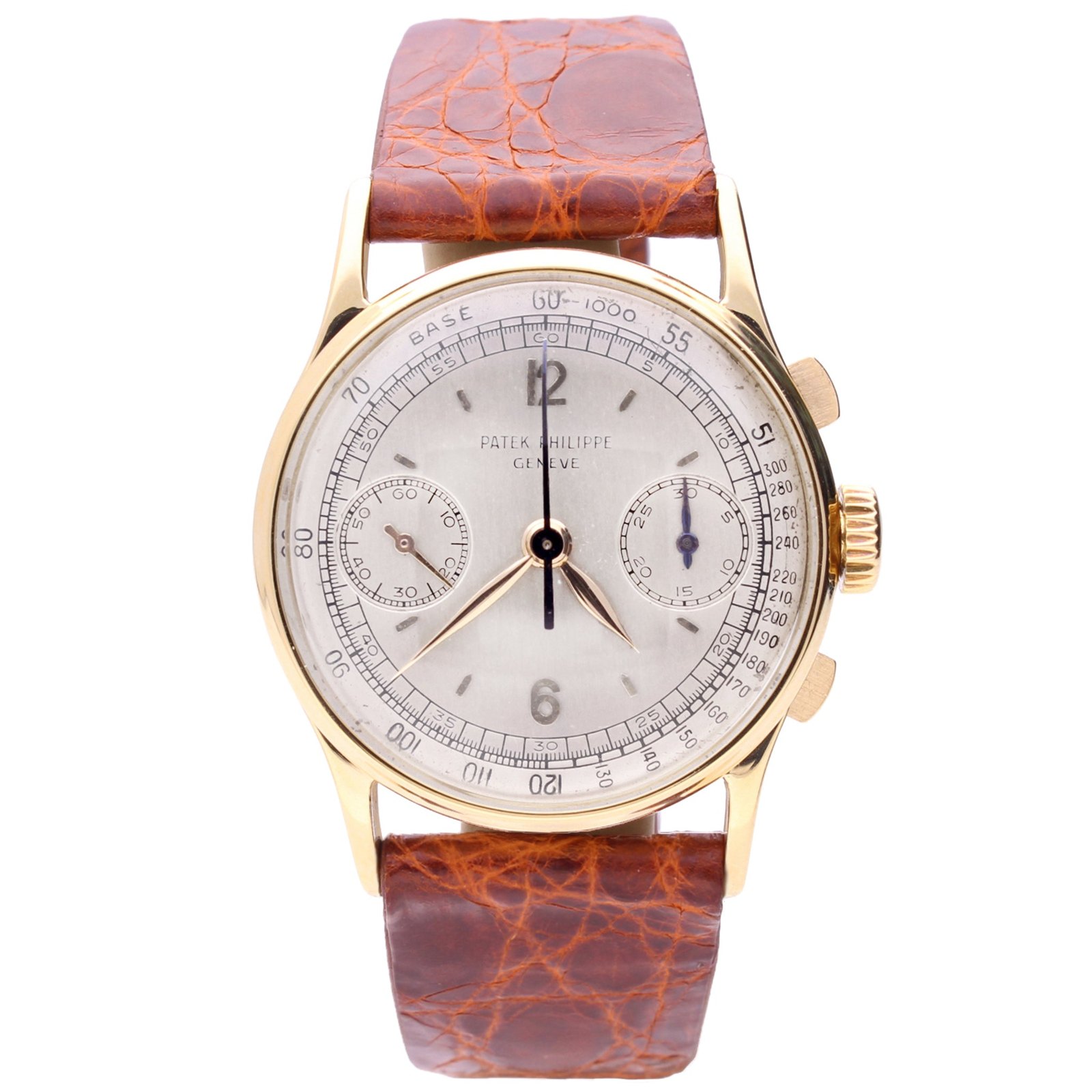
A Patek Philippe reference 130 chronograph in 18-carat gold, 1943. The dealer notes that the reference was made from 1934 until 1964 with a 13-ligne movement based on a Valjoux design (Somlo Antiques).
A Patek Philippe reference 130 chronograph in 18-carat gold, 1943. The dealer notes that the reference was made from 1934 until 1964 with a 13-ligne movement based on a Valjoux design (Somlo Antiques). — 18ct yellow gold Patek Philippe ref. 130 chronograph wristwatch, 1943, Somlo Antiques (dealer), London. Somlo Antiques. © Somlo Antiques — dealer photographs; permission required. Source record (opens another website in a new tab)
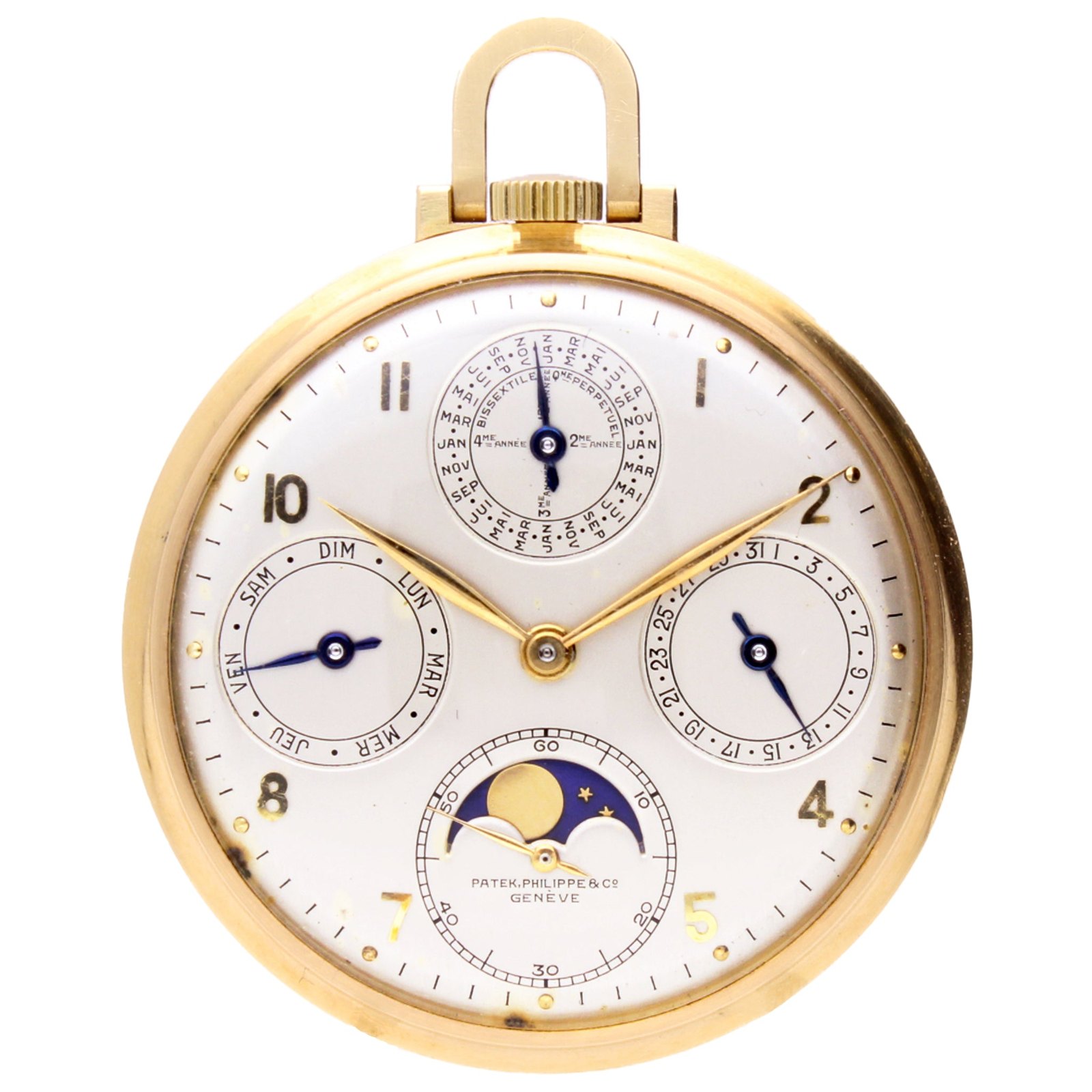
A Patek Philippe reference 725 open-faced pocket watch with a perpetual calendar and moon phases, 1941 (Somlo Antiques). Complicated pocket watches continued to be made alongside the new wristwatches.
A Patek Philippe reference 725 open-faced pocket watch with a perpetual calendar and moon phases, 1941 (Somlo Antiques). Complicated pocket watches continued to be made alongside the new wristwatches. — 18ct yellow gold Patek Philippe ref. 725 open face, perpetual calendar pocket watch with moon phases, 1941, Somlo Antiques (dealer), London. Somlo Antiques. © Somlo Antiques — dealer photographs; permission required. Source record (opens another website in a new tab)

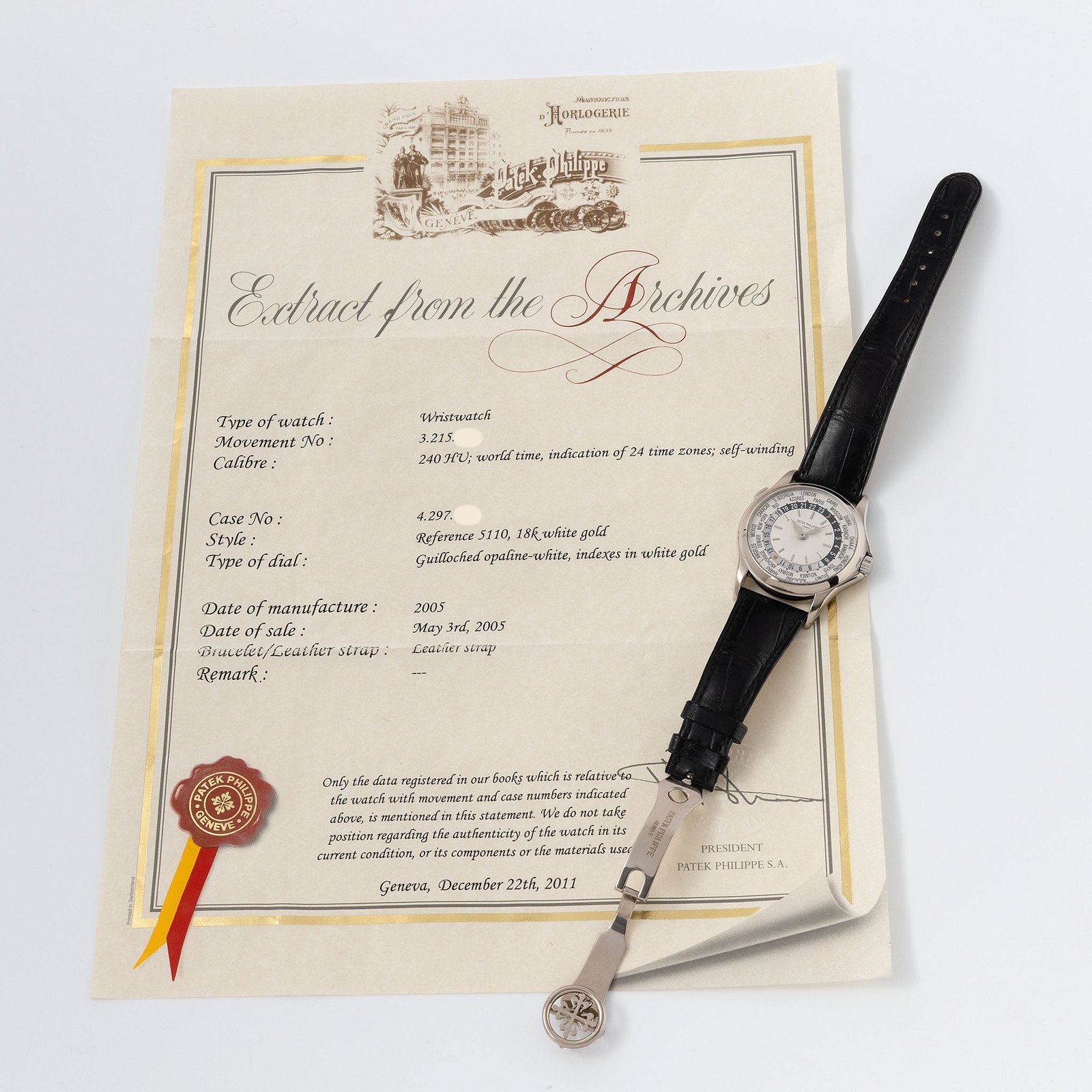
Patek's world-time watches used a system patented in 1931 by the Geneva watchmaker Louis Cottier, which shows the time in each of twenty-four zones on a rotating city ring. According to the dealer who sold the World Time watch shown below, Patek first fitted it to a reference 96 in 1937 and to the reference 1415 from 1939, and the design returned in the modern reference 5110 and its successors.
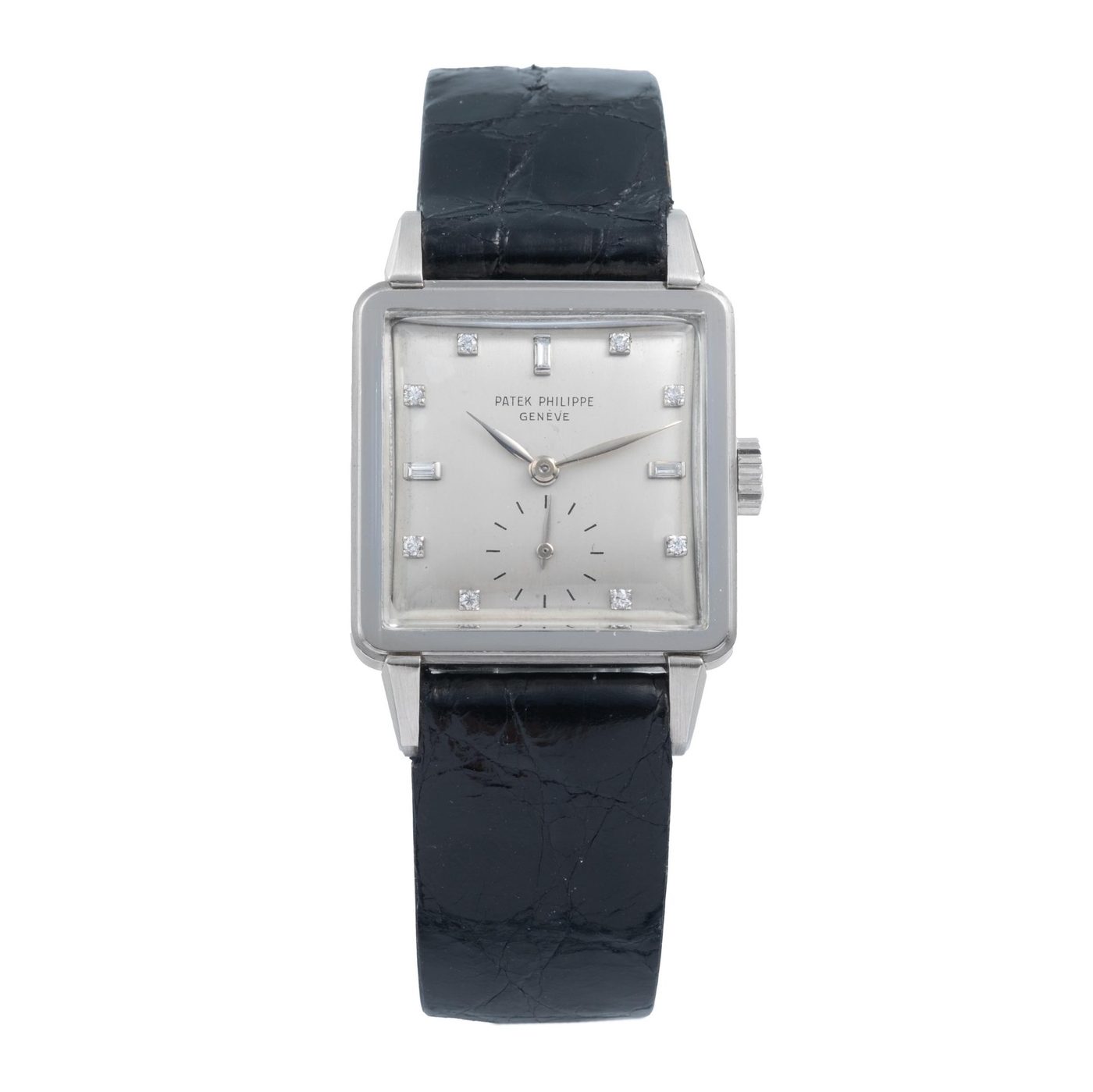
A square platinum Patek Philippe reference 2422 with diamond hour markers, made in 1950 and sold in May 1951, with an extract from the archives (Antiquorum auction record).
A square platinum Patek Philippe reference 2422 with diamond hour markers, made in 1950 and sold in May 1951, with an extract from the archives (Antiquorum auction record). — Patek Philippe wristwatch, ref. 2422, 1950, sold in May 1951, Antiquorum auction archive, Geneva. Antiquorum Genève SA. © Antiquorum Genève SA — permission required. Source record (opens another website in a new tab)
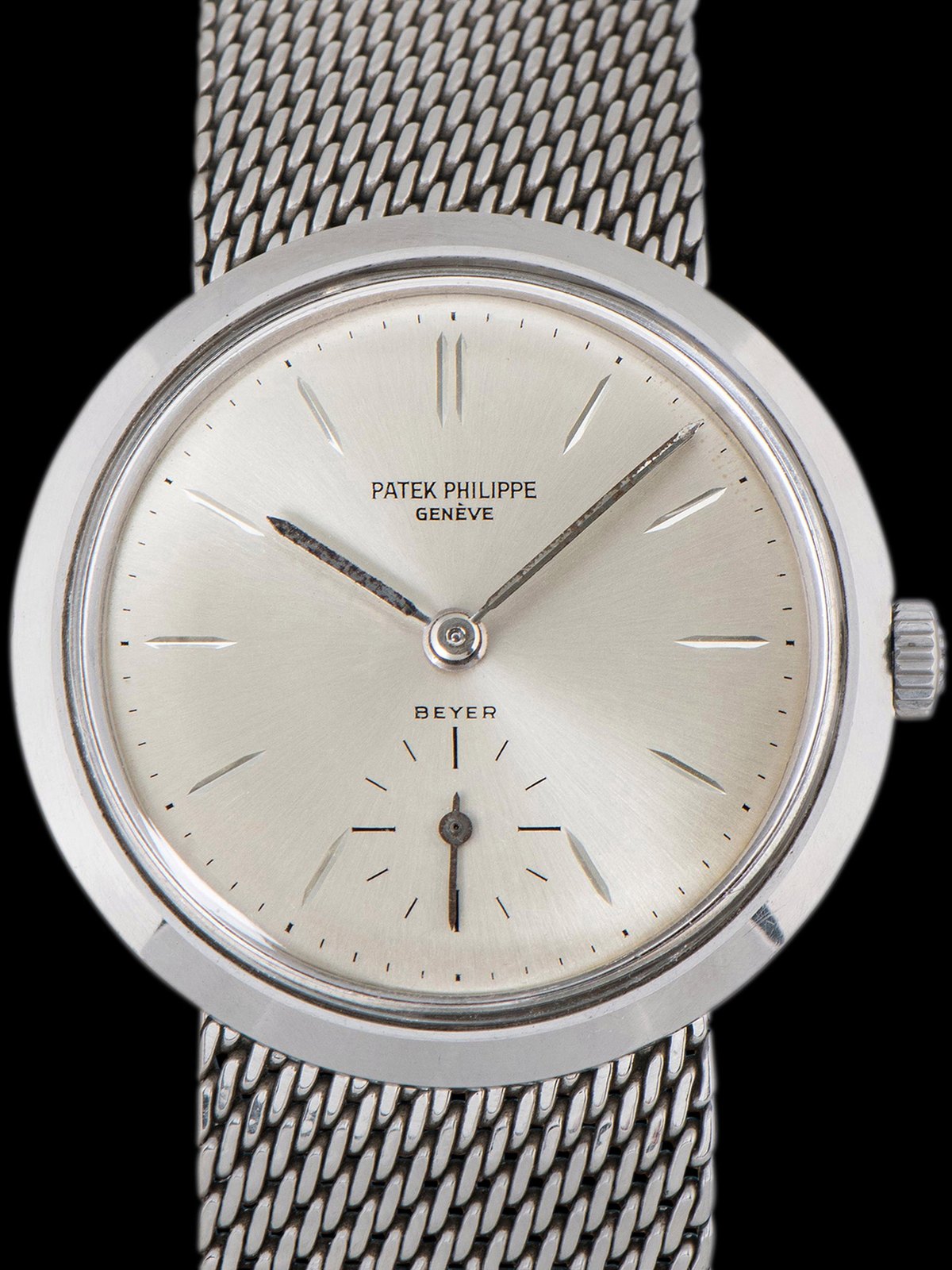
A stainless-steel Patek Philippe reference 3418 'Amagnetic' Calatrava of 1957, its dial signed by the Zurich retailer Beyer. The dealer describes it as one of the firm's first anti-magnetic wristwatches, made as the Swiss industry turned to professional watches in the 1950s (Craft & Tailored).
A stainless-steel Patek Philippe reference 3418 'Amagnetic' Calatrava of 1957, its dial signed by the Zurich retailer Beyer. The dealer describes it as one of the firm's first anti-magnetic wristwatches, made as the Swiss industry turned to professional watches in the 1950s (Craft & Tailored). — Patek Philippe Stainless Steel Calatrava Anti-Magnetic 'First Series' (Ref. 3418) Silver "Beyer" Dial, 1957, Craft & Tailored (dealer), Los Angeles. Craft & Tailored. © Craft & Tailored — dealer photographs; permission required. Source record (opens another website in a new tab)

Quartz, the Ellipse and the Nautilus, 1968–1985

The late 1960s brought two new directions. In 1968 Patek introduced the Golden Ellipse, a thin, oval-cushion watch whose proportions were based on the golden section; it became one of the firm's longest-lived designs. And when quartz arrived, Patek did not ignore it. It was among the Swiss firms that put the Beta 21, the first Swiss quartz wristwatch movement, developed by the Centre Électronique Horloger in Neuchâtel, into production cases around 1970, and it went on making quartz watches for several decades.
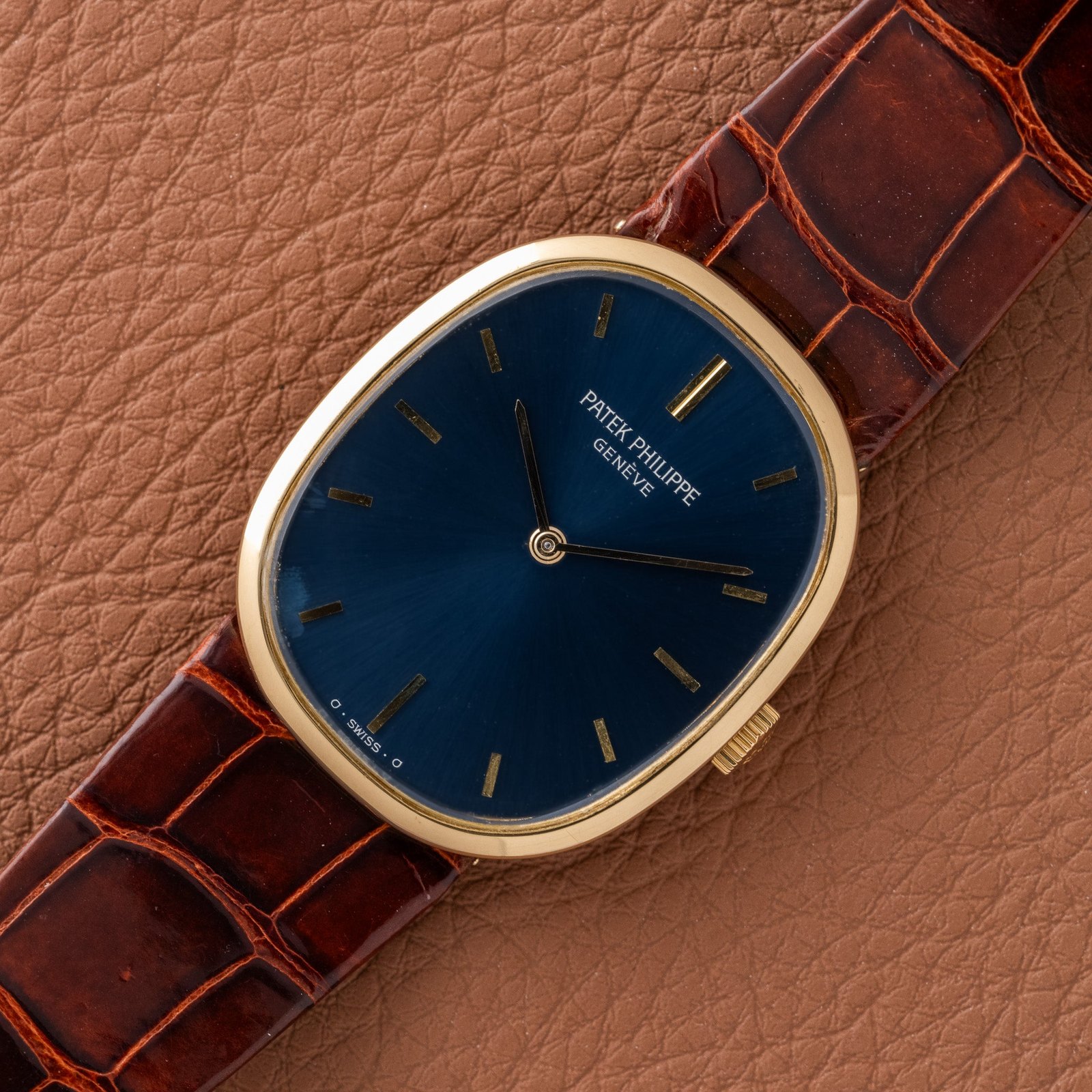
A Patek Philippe Ellipse, reference 3548, with a blue sunburst dial, from the 1970s. The dealer describes the 3548 as one of the earliest Ellipse references, introduced in the late 1960s, with a thin manual-winding movement (Huntington Company).
A Patek Philippe Ellipse, reference 3548, with a blue sunburst dial, from the 1970s. The dealer describes the 3548 as one of the earliest Ellipse references, introduced in the late 1960s, with a thin manual-winding movement (Huntington Company). — Patek Philippe Ellipse Blue Dial (Ref. 3548), 1970s, Huntington Company (dealer). Huntington Company. © Huntington Company — dealer photographs; permission required. Source record (opens another website in a new tab)
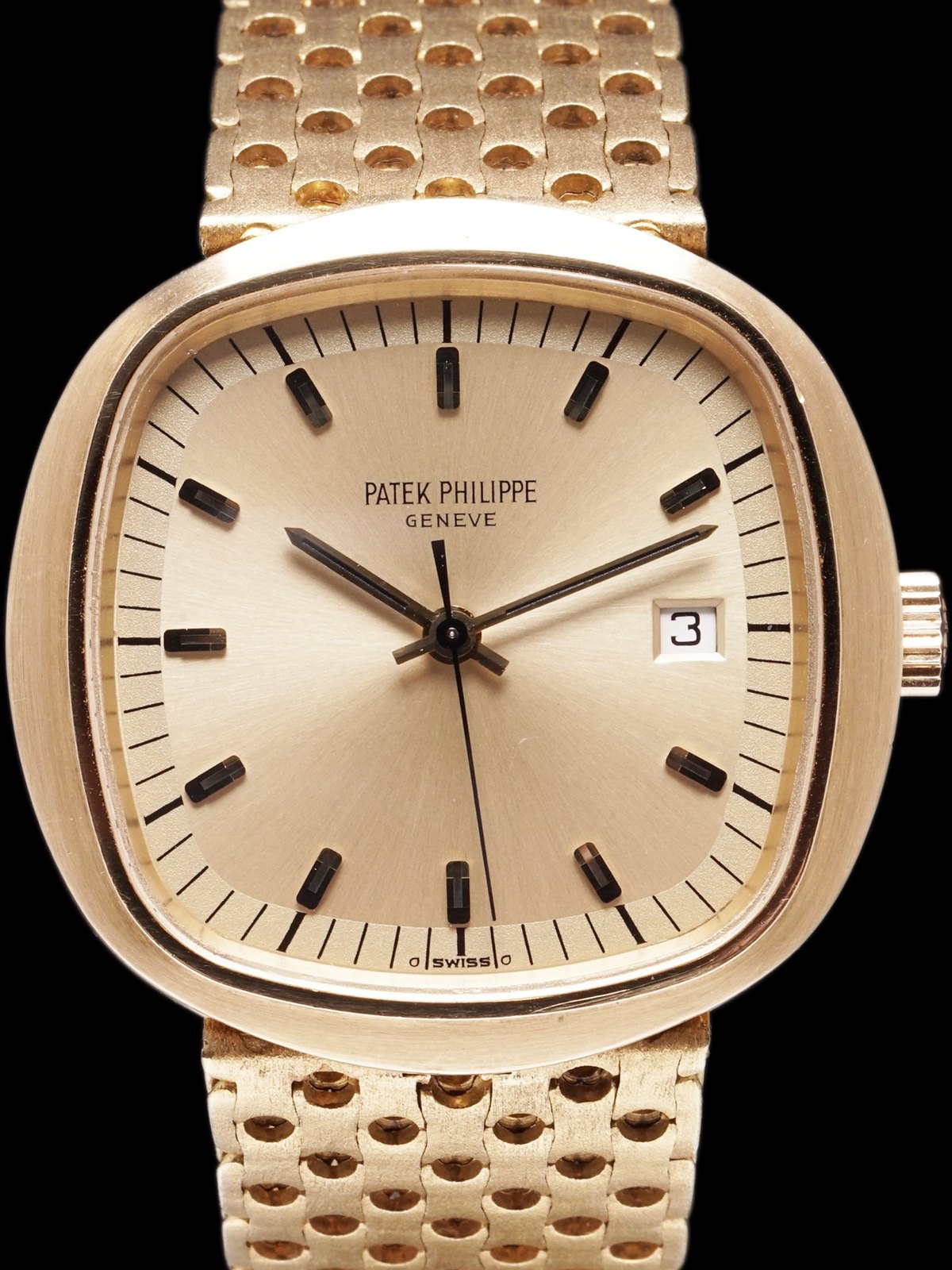
A Patek Philippe reference 3597/2 in yellow gold, powered by the Beta 21 quartz movement, 1970s (Craft & Tailored). The large cushion case was a new departure for the firm.
A Patek Philippe reference 3597/2 in yellow gold, powered by the Beta 21 quartz movement, 1970s (Craft & Tailored). The large cushion case was a new departure for the firm. — Patek Philippe Reference 3597/2 Beta 21, 1970s, Craft & Tailored (dealer), Los Angeles. Craft & Tailored. © Craft & Tailored — dealer photographs; permission required. Source record (opens another website in a new tab)

In 1976 Patek introduced the Nautilus, designed by Gérald Genta, who had drawn the Audemars Piguet Royal Oak four years earlier. Like the Royal Oak it was a luxury watch in steel with an integrated bracelet; its rounded octagonal bezel and the 'ears' at its sides were inspired by a ship's porthole. Its thin self-winding movement, calibre 28-255 C, was based on the Jaeger-LeCoultre 920 used in the Royal Oak. Slow to sell at first, the Nautilus became decades later the most sought-after watch the firm makes. A year later, in 1977, Patek introduced calibre 240, an ultra-thin automatic movement with a gold micro-rotor set into the plate.
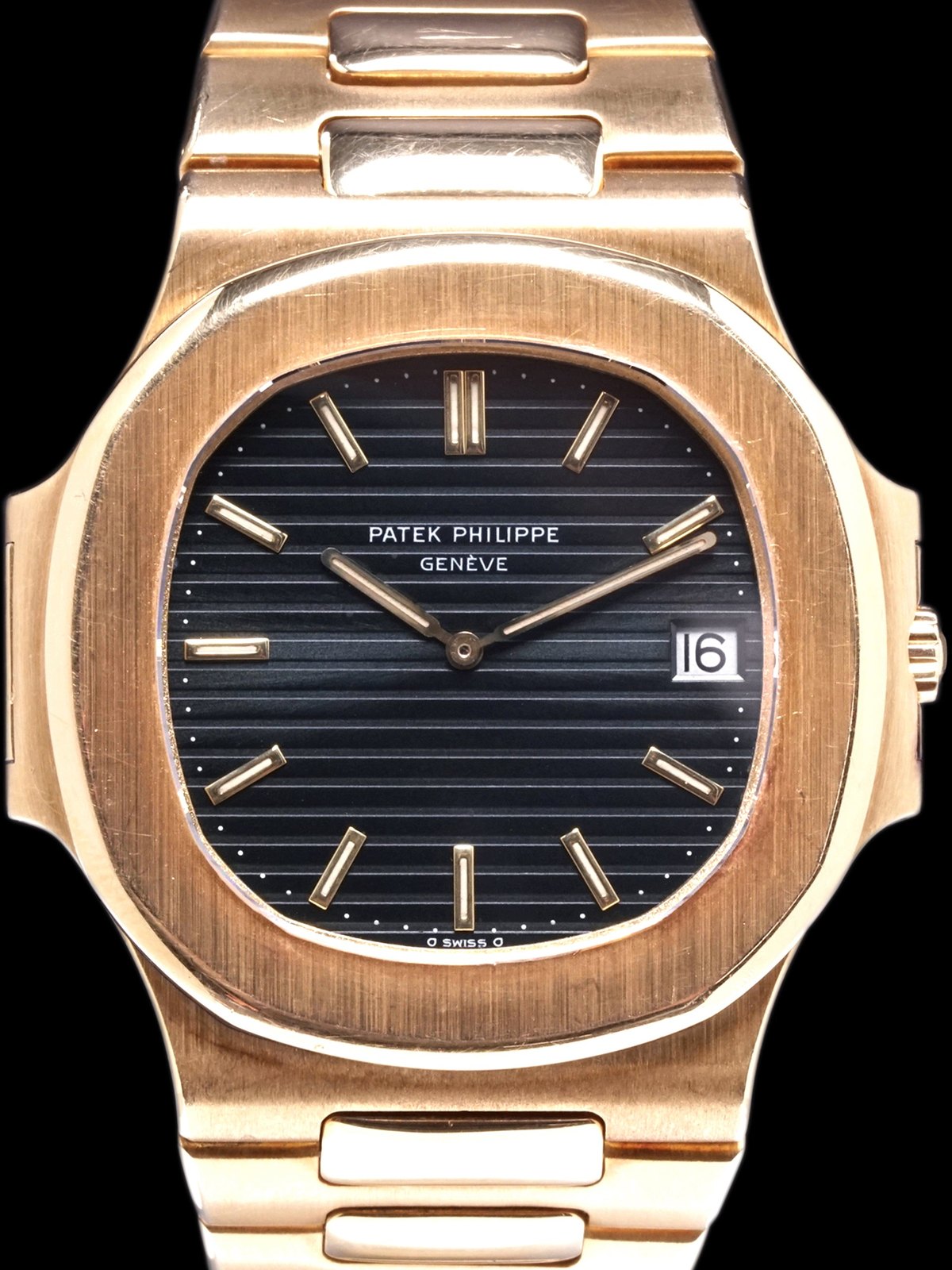
A Patek Philippe Nautilus 'Jumbo', reference 3700/1J, in 18-carat yellow gold, 1980, with an extract from the archives (Craft & Tailored). The first Nautilus of 1976 was made in steel; gold and two-tone versions followed.
A Patek Philippe Nautilus 'Jumbo', reference 3700/1J, in 18-carat yellow gold, 1980, with an extract from the archives (Craft & Tailored). The first Nautilus of 1976 was made in steel; gold and two-tone versions followed. — Patek Philippe Nautilus "Jumbo" (Ref. 3700/1J) 18K YG, 1980, Craft & Tailored (dealer), Los Angeles. Craft & Tailored. © Craft & Tailored — dealer photographs; permission required. Source record (opens another website in a new tab)

The 150th anniversary and the grand complications, 1985–2000

In the 1980s, as the Swiss industry recovered from the quartz crisis, Patek Philippe returned decisively to complication. The perpetual calendar reference 3940 of 1985 used a micro-rotor movement derived from calibre 240, and remained in production for two decades. For its 150th anniversary in 1989 the firm completed Calibre 89, a pocket watch with thirty-three complications that took the title of the world's most complicated watch from the Graves Supercomplication, and issued a range of commemorative watches.
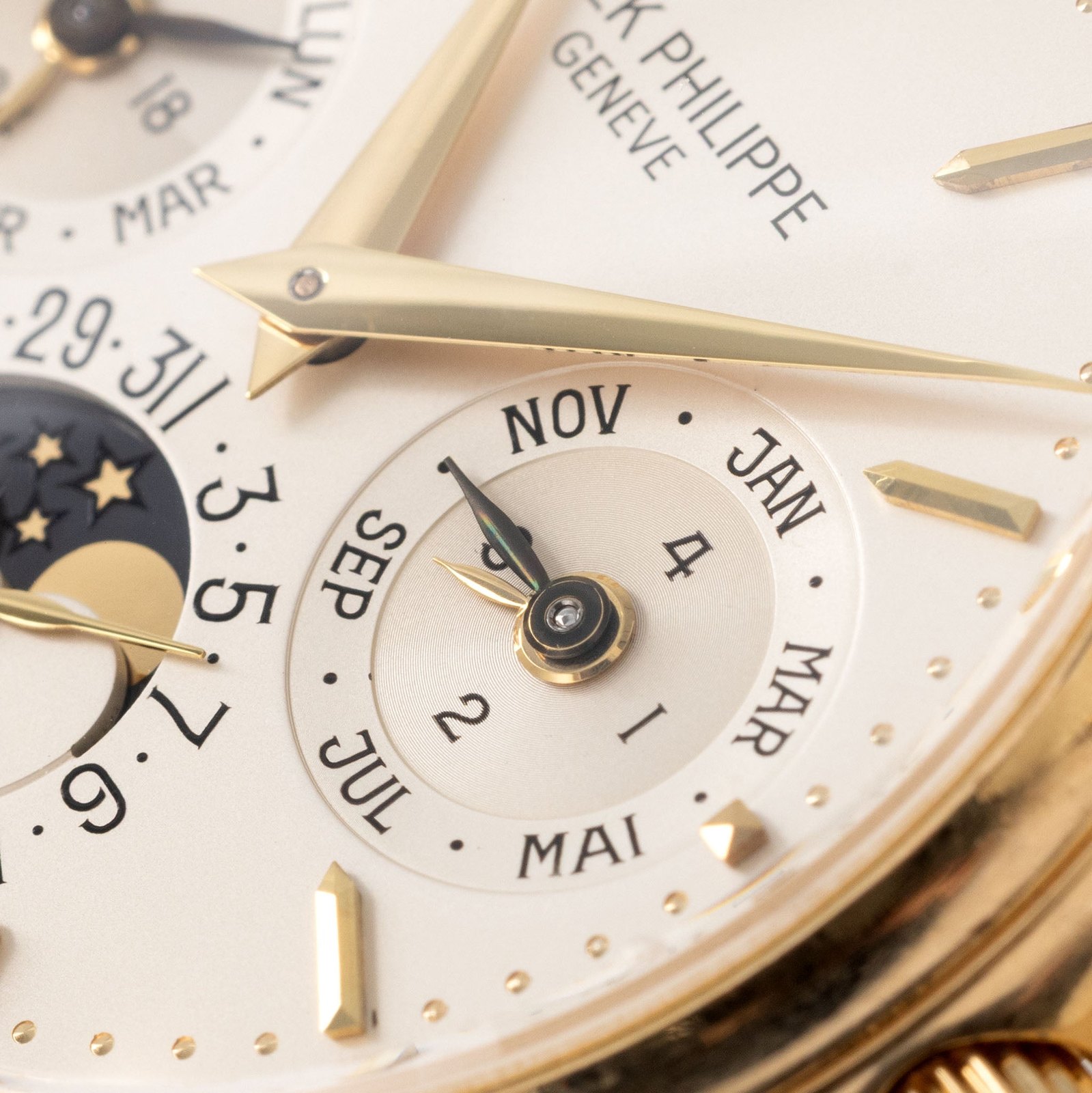
The dial of a Patek Philippe perpetual calendar, reference 3940J, of 1987, with day, date, month, leap-year cycle and moon phases. The dealer records that the reference was introduced in 1985 in a run of twenty-five pieces for the 225th anniversary of the Zurich retailer Beyer (Bulang & Sons).
The dial of a Patek Philippe perpetual calendar, reference 3940J, of 1987, with day, date, month, leap-year cycle and moon phases. The dealer records that the reference was introduced in 1985 in a run of twenty-five pieces for the 225th anniversary of the Zurich retailer Beyer (Bulang & Sons). — Patek Philippe Perpetual Calendar 3940J Early Second Series in 18k yellow gold with Box and Extract of the Archives, 1987, Bulang & Sons (dealer), Copenhagen. Bulang & Sons. © Bulang & Sons — dealer photographs; permission required. Source record (opens another website in a new tab)
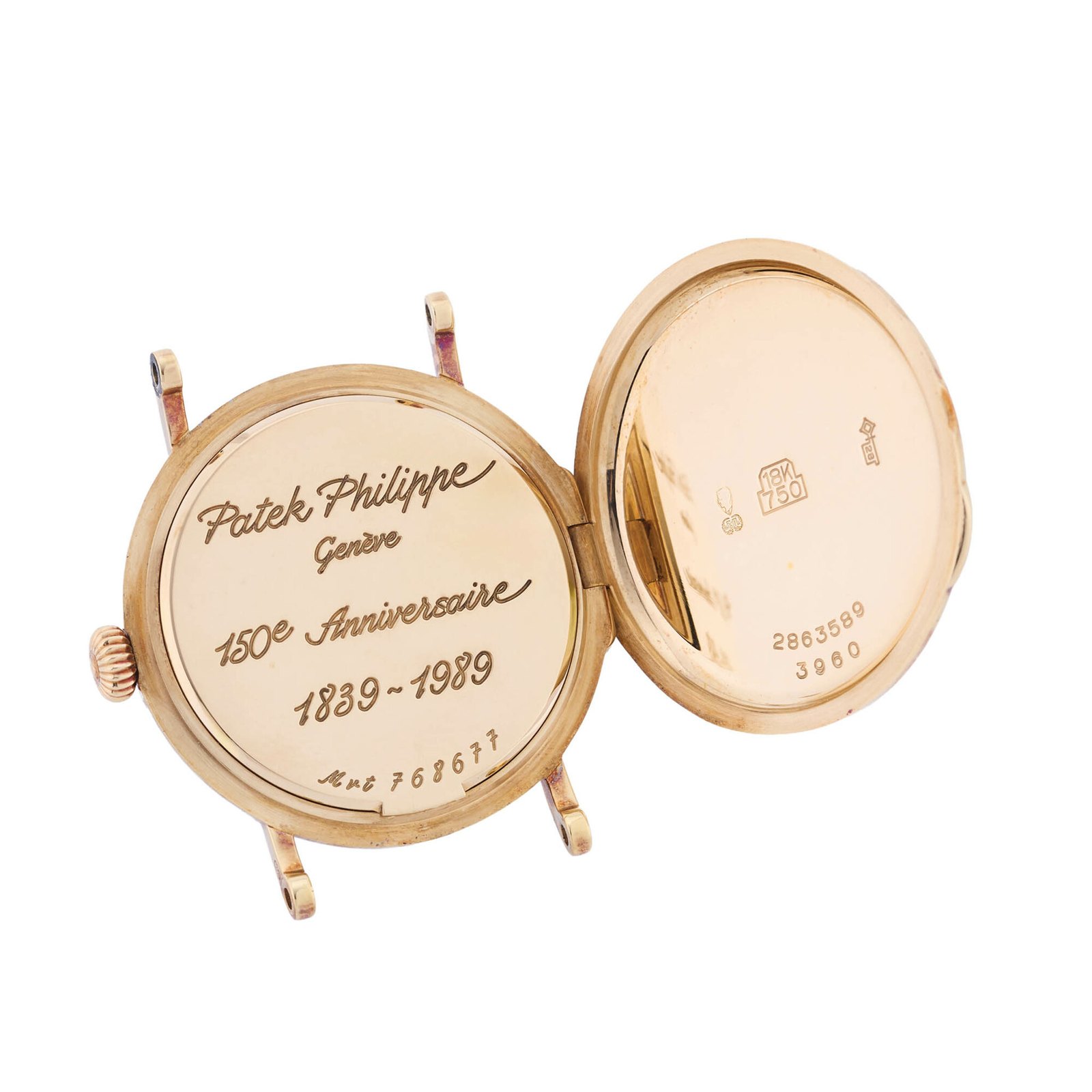
The hinged 'officer' case back of a Patek Philippe reference 3960J of 1989, engraved for the firm's 150th anniversary, 1839–1989. The auction house records a limited edition of 2,000 pieces, a Geneva Seal certificate and the original box and papers (Antiquorum).
The hinged 'officer' case back of a Patek Philippe reference 3960J of 1989, engraved for the firm's 150th anniversary, 1839–1989. The auction house records a limited edition of 2,000 pieces, a Geneva Seal certificate and the original box and papers (Antiquorum). — Patek Philippe wristwatch, ref. 3960J, Officier 150th Anniversary, originally sold on 9 November 1989, Antiquorum auction archive, Geneva. Antiquorum Genève SA. © Antiquorum Genève SA — permission required. Source record (opens another website in a new tab)

In 1996 Patek introduced the annual calendar, reference 5035: a calendar that knows which months have thirty or thirty-one days and needs correcting only once a year, at the end of February. It filled the space between the simple Calatrava and the costly perpetual calendar, and was soon imitated by other makers. In 1996 the firm also launched the advertising campaign that told readers 'You never actually own a Patek Philippe. You merely look after it for the next generation', and in 1997 the Aquanaut, a sports watch with a rubber strap, joined the Nautilus.
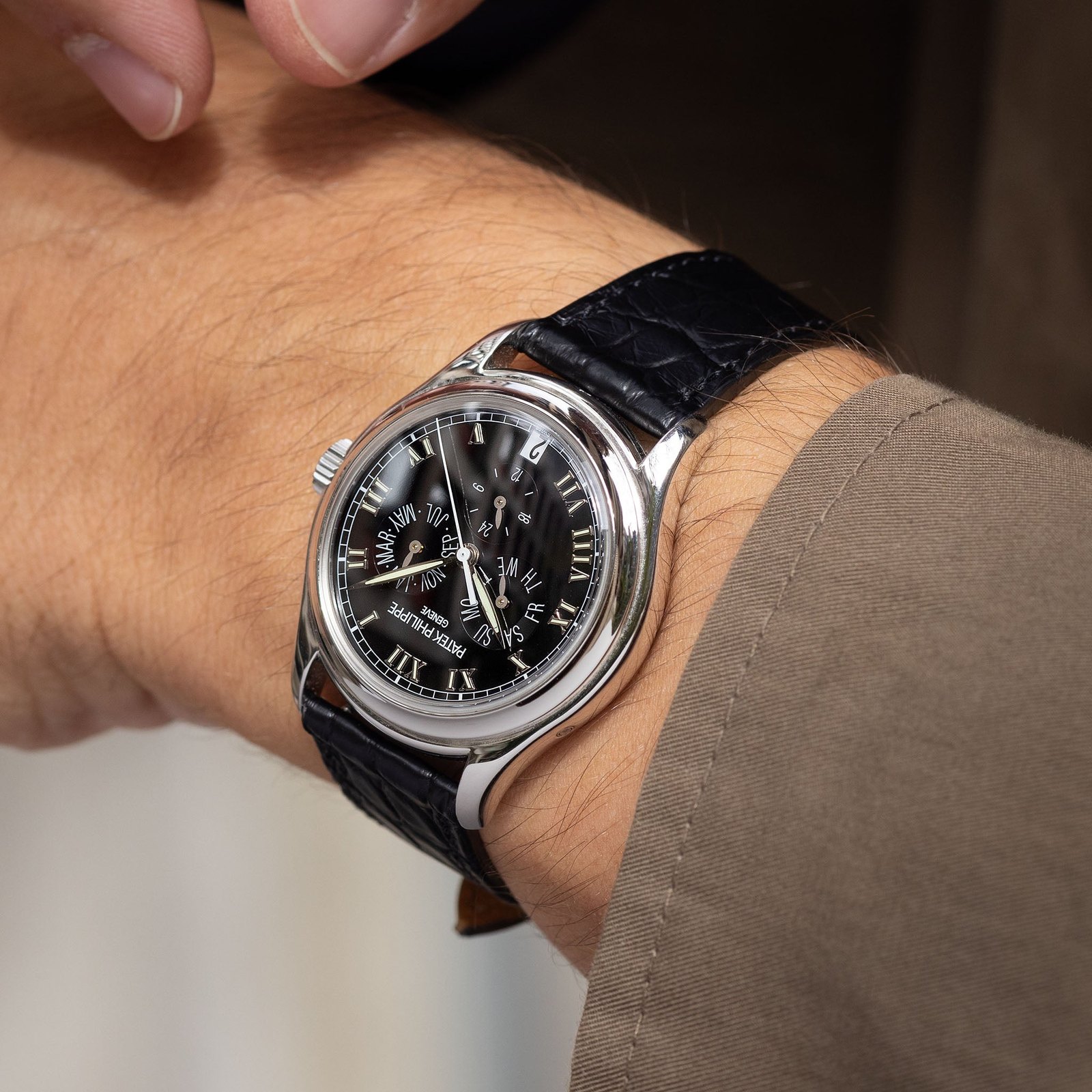
A Patek Philippe annual calendar, reference 5035P, in platinum with a black dial, 1997 — one of the first annual calendar wristwatches (Bulang & Sons).
A Patek Philippe annual calendar, reference 5035P, in platinum with a black dial, 1997 — one of the first annual calendar wristwatches (Bulang & Sons). — Patek Philippe Annual Calendar 5035P in Platinum Black Dial, 1997, Bulang & Sons (dealer), Copenhagen. Bulang & Sons. © Bulang & Sons — dealer photographs; permission required. Source record (opens another website in a new tab)
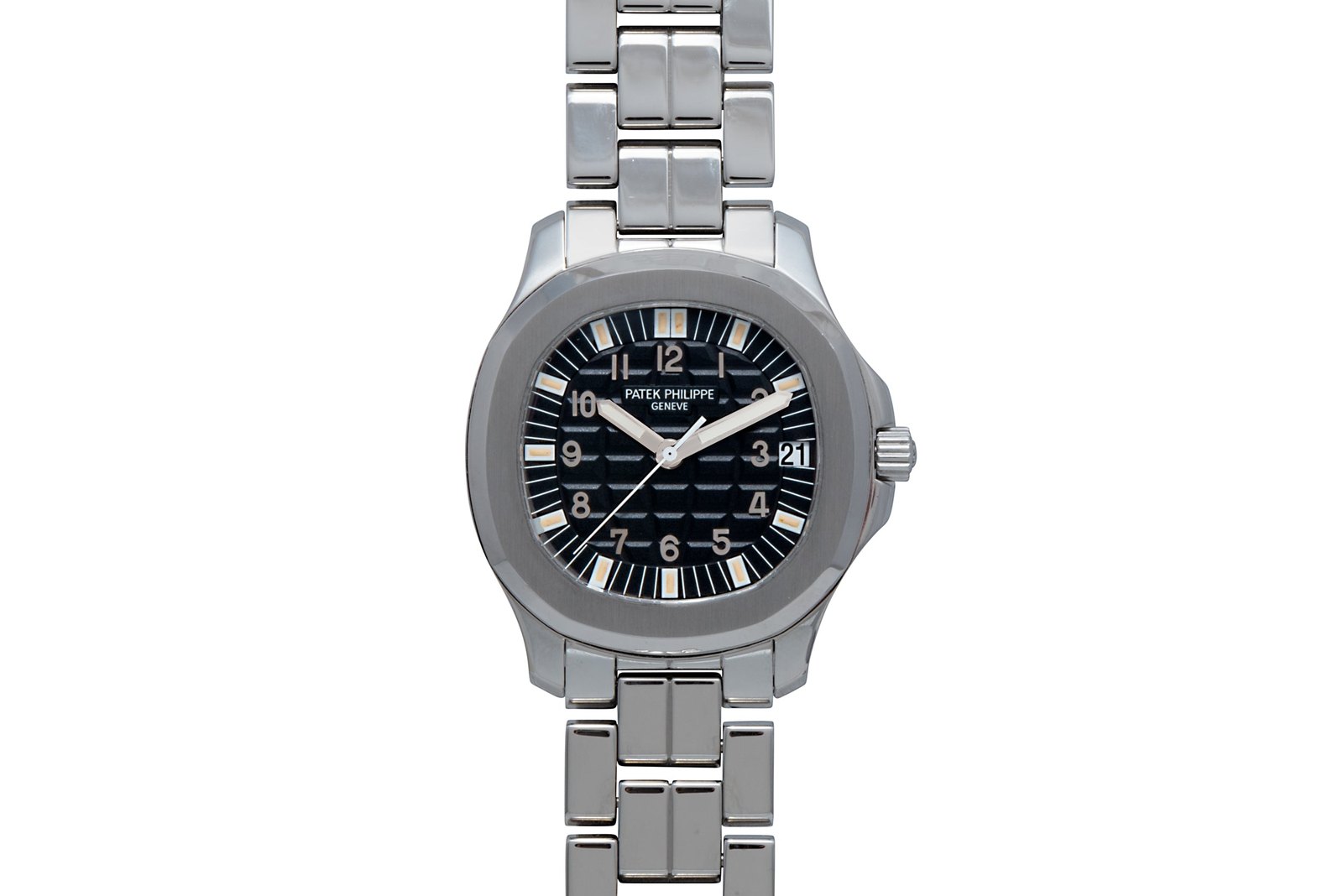
A Patek Philippe Aquanaut, reference 5065A, of 1999. The dealer explains that the gold reference 5060J of 1996 was followed in 1997 by the steel 5060A, the first watch to carry the Aquanaut name (Analog/Shift).
A Patek Philippe Aquanaut, reference 5065A, of 1999. The dealer explains that the gold reference 5060J of 1996 was followed in 1997 by the steel 5060A, the first watch to carry the Aquanaut name (Analog/Shift). — Patek Philippe Aquanaut, 1999, Analog/Shift (dealer), New York. Analog/Shift. © Analog/Shift — dealer photographs; permission required. Source record (opens another website in a new tab)

The twenty-first century

The firm moved its workshops to a new manufacture at Plan-les-Ouates outside Geneva in the late 1990s, and opened the Patek Philippe Museum in Geneva in 2001, with collections of its own watches and of earlier European watchmaking. Its catalogue since then has combined classic references with ever more complicated watches: astronomical displays, minute repeaters and grand complications in wristwatch form. In 2006 it introduced Spiromax, a balance spring of silicon, and in 2009 it replaced the Geneva Seal on its watches with its own standard, the Patek Philippe Seal. Thierry Stern succeeded his father Philippe as president in the same year.
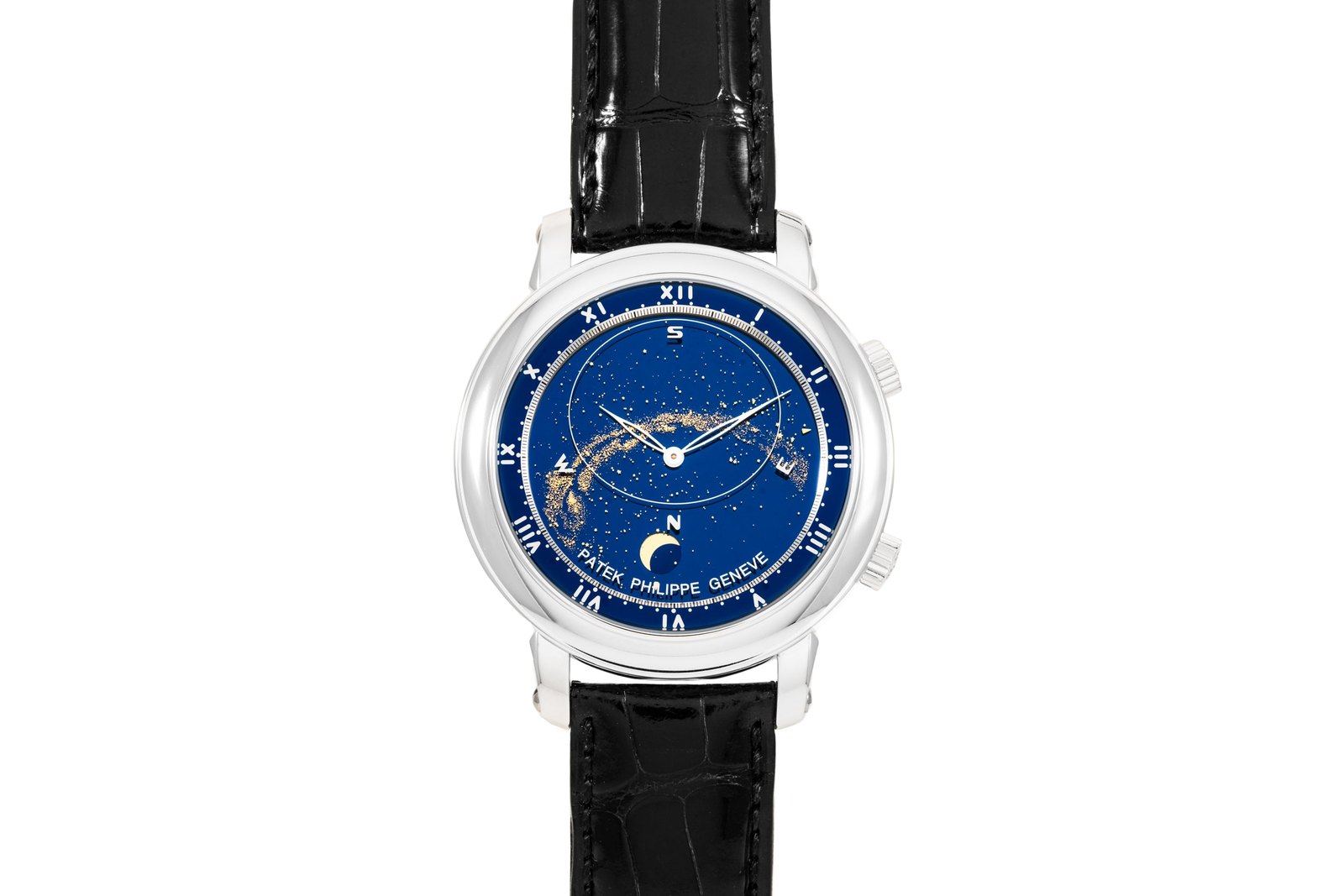
A Patek Philippe Celestial, reference 5102G, of 2004, in a 43 mm white gold case. The dealer describes three sapphire discs that show the hours, the part of the sky visible from Geneva and a revolving moon-phase display, set by a second crown (Analog/Shift).
A Patek Philippe Celestial, reference 5102G, of 2004, in a 43 mm white gold case. The dealer describes three sapphire discs that show the hours, the part of the sky visible from Geneva and a revolving moon-phase display, set by a second crown (Analog/Shift). — Patek Philippe Celestial Grand Complication, 2004, Analog/Shift (dealer), New York. Analog/Shift. © Analog/Shift — dealer photographs; permission required. Source record (opens another website in a new tab)
A Patek Philippe World Time, reference 5110G, in white gold, 2005, photographed with its extract from the archives — the document that confirms the date of manufacture and sale from the firm's own records (Bulang & Sons).
A Patek Philippe World Time, reference 5110G, in white gold, 2005, photographed with its extract from the archives — the document that confirms the date of manufacture and sale from the firm's own records (Bulang & Sons). — Patek Philippe World Time 5110G in 18k White Gold with Extract from the Archives, 2005, Bulang & Sons (dealer), Copenhagen. Bulang & Sons. © Bulang & Sons — dealer photographs; permission required. Source record (opens another website in a new tab)

Identifying and researching a Patek Philippe

  • Numbers: Patek movements and cases carry separate serial numbers, and the reference number is usually stamped inside the case back. The firm's archives can confirm from these numbers when a watch was made and sold.
  • Extract from the archives: Patek Philippe issues extracts for its older watches on request. An extract confirms the movement and case the firm recorded, but not later changes such as a refinished dial.
  • Retailers' names: dials signed Tiffany & Co., Gübelin, Beyer, Hausmann, Freccero and others were sold through those retailers; double-signed dials are prized but are also a target for forgers.
  • Movements: many early wristwatches used movements finished by Patek from ébauches by other makers, notably Victorin Piguet and Valjoux for chronographs and Jaeger-LeCoultre for the first Nautilus. That is normal, not a sign of a fake.
  • Condition: as with any vintage watch, originality of dial, hands and case, and the absence of heavy polishing, matter as much as the reference. Our lesson on buying a vintage watch explains what to check.
Main dates in Patek Philippe's history, as cited in this feature
DateEvent
1839Patek, Czapek & Cie founded in Geneva
1844–1845Patek meets Adrien Philippe in Paris; Czapek leaves; Philippe's keyless winding patent
1851The firm becomes Patek Philippe & Cie
1868First Swiss wristwatch, according to the firm
1925Perpetual calendar wristwatch No. 97975
1932Bought by Charles and Jean Stern; Calatrava reference 96 introduced
1933Graves Supercomplication delivered
1941Reference 1518 perpetual calendar chronograph in series
1968Golden Ellipse
c. 1970Beta 21 quartz watches
1976Nautilus, designed by Gérald Genta
1977Calibre 240 micro-rotor automatic
1985Perpetual calendar reference 3940
1989Calibre 89 for the 150th anniversary
1996–1997Annual calendar reference 5035; Aquanaut
2001Patek Philippe Museum opens in Geneva
2006Spiromax silicon balance spring
2009Patek Philippe Seal; Thierry Stern becomes president

Patek Philippe's history is often told as a sequence of record-breaking complications, but the watches in the catalogue tell a broader story: of a firm that sold through jewellers on several continents, adapted to the wristwatch and to quartz, and owed much of its later fame to plain gold Calatravas and to a steel sports watch it was unsure of in 1976. To explore further, browse the catalogue's Patek Philippe records, read the maker's profile and the calibre 240 page, or compare its watches with those of Vacheron Constantin and Audemars Piguet.

Sources & further reading

  • Revolution in Time: Clocks and the Making of the Modern World — David S. Landes, Harvard University Press, 1983.
  • Manufacturing Time: Global Competition in the Watch Industry, 1795–2000 — Amy K. Glasmeier, Guilford Press (New York), 2000.
  • A Business History of the Swatch Group — Pierre-Yves Donzé, Palgrave Macmillan, 2014.
  • Technique and History of the Swiss Watch — Eugène Jaquet and Alfred Chapuis, Urs Graf (Olten), 1945 (French); English editions from 1953.
  • Watches — David Thompson, British Museum Press (London), 2008.
  • Antiquarian Horology — Antiquarian Horological Society, AHS (London), 1953 – present.

← All features