
Wristwatches · Wristwatch
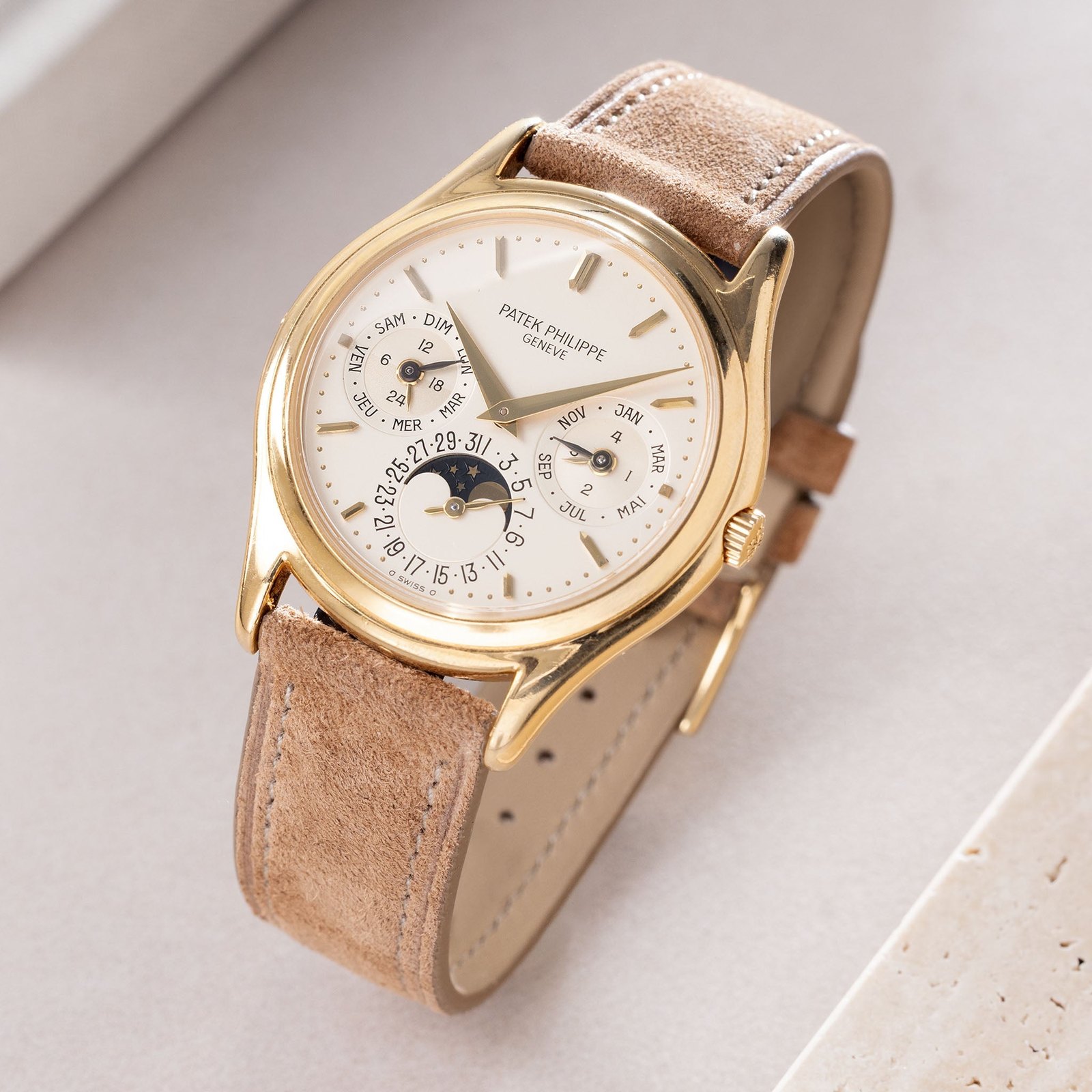
Patek Philippe Perpetual Calendar 3940J Early Second Series in 18k yellow gold with Box and Extract of the Archives, 1987
- Maker / attribution
- Patek Philippe (maker)
- Date
- 1987
- Historical period
- Quartz Revolution (1969 – 1990)
- Country of origin
- Switzerland
- Object type
- Wristwatch
- Materials / technique
- 18k yellow gold
- Dimensions
- Case 36 mm
- Stock no.
- W-3910
- Credit line
- Dealer listing, Bulang & Sons (W-3910)
- Catalogue title (original)
- Patek Philippe Perpetual Calendar 3940J Early Second Series in 18k yellow gold with Box and Extract of the Archives (English)
View the source record (dealer listing) ↗ (opens another website in a new tab)Suggest a correction
Record summary
Catalogued by Bulang & Sons (dealer), Copenhagen (stock number W-3910), this is a wristwatch by Patek Philippe, made in Switzerland, dated 1987. The Atlas places it in the Quartz Revolution period (1969 – 1990) of its Wristwatches collection. Materials and techniques recorded by the source: 18k yellow gold. Recorded dimensions: Case 36 mm. The record is illustrated with 6 photographs.
Assembled from the source record's structured fields. Dates and attributions are given as the source states them; where a field is missing the Atlas leaves it blank rather than estimating.
Catalogue description
Dealer description — Bulang & Sons
While watch trends may come and go, the perpetual calendar remains a timeless favourite among seasoned collectors. We are therefore delighted to offer one of the rarest variations of this modern classic—and a grail for many—the Patek Philippe reference 3940. The aesthetically balanced 3940 was originally introduced in 1985 in a limited run of just 25 pieces to celebrate the 225th anniversary of Beyer Chronometrie. Following this special edition, the reference was released to the wider public and went on to enjoy an impressive production run. Collectors often favour the earlier series, and this example is no exception. The early 3940 dials have a distinctive, more vintage-inspired layout that sets them apart from the later versions. This particular example, crafted in 18k yellow gold, features the highly collectible “early” second-series dial, which, in our opinion, is one of the most beautiful variations of the 3940. The “earlier” second-series dial is significantly rarer than the later versions and can be identified by several subtle yet important details. The day and month sub-dials feature distinctive double-step bevelled edges, giving them greater depth and visual presence, while the subsidiary seconds dial at 3 o’clock is notably free of the crosshair found on the later iterations. This transitional dial variant was produced for only a short period between 1987 and 1989 and in much more limited numbers, with approximately 800 examples believed to have been made. Its rarity, combined with these unique dial characteristics, makes it a particularly interesting configuration for collectors. The dial itself is a masterclass in balance and subtle sophistication, with plenty of character hidden in its smallest details. But the real star is beneath it: Patek Philippe’s calibre 240Q perpetual calendar movement. Introduced during the height of the quartz crisis—a period that threatened the future of traditional Swiss watchmaking—the 3940 was a bold statement from Patek Philippe. Its ultra-thin calibre 240Q allowed the brand to house a full perpetual calendar in a beautifully proportioned 36mm case, creating what would become one of the maison’s defining modern complications. The case remains beautifully balanced and is fitted with the correct solid case-back. The watch is accompanied by an official Extract from the Archives and Patek Philippe service papers from 2020. The calendar displays are in French—a charming and romantic detail and, for collectors, one of the absolute rarest configurations. Fitted with a supple Bulang and son's leather strap and its original Patek Philippe gold pin buckle, this 3940 ticks every box for the discerning collector. The watch has also been fully checked by our watchmaker. We have a real soft spot for the 3940. It remains one of the most underappreciated references in Patek Philippe’s storied catalogue, despite offering almost everything a serious collector could want: an iconic ultra-thin movement, perpetual calendar, timeless proportions and a fascinating place in modern watchmaking history. Interested? Let’s talk. This is one you’ll want to see in person! Specifications: Patek Philippe Perpetual calendar reference 3940J Rarer “Early 2nd Series” variant 36mm yellow 18k yellow gold case with solid case-back Case serial 283xxxx/Movement serial 770xxx, dating to 1987 Perpetual calendar three dial layout with moon phase, French language (very rare) Automatic movement Cal 240Q Leather strap with original Patek Philippe gold buckle Patek Philippe archive extract stating manufacturing and sale in 1987 2020 Patek Philippe service invoice Fully checked by our watchmaker
Historical context
Quartz Revolution (1969 – 1990)
Seiko's Astron begins mass quartz timekeeping; traditional industries contract sharply.
Quartz and digital watches transformed the market after 1969. Swiss employment collapsed, Japanese and Hong Kong production soared, and the Swatch (1983) helped the Swiss industry recover; mechanical watches survived as luxury goods.
Read the period in the timelineMore wristwatches from this periodEarlier: Modern Mechanical Horology
Atlas type guide
Calendar, moon-phase and perpetual calendar watches
Calendar complications range from a simple date to the perpetual calendar, which automatically allows for months of different lengths and leap years until 2100. Pocket watches with perpetual calendars were made in the eighteenth and nineteenth centuries; Patek Philippe made the first perpetual calendar wristwatch in 1925, and series production followed in 1941. The annual calendar (Patek Philippe, 1996) needs correction only once a year.
Moon-phase displays use a disc with two moons and 59 teeth advanced daily, approximating the 29.5-day lunation; more precise trains reduce the error to one day in over a century.
What to look for
- Apertures or subsidiary dials for day, date, month and leap year.
- Moon disc under a 'bosom' shaped aperture.
- Recessed correctors on the case band for setting the calendar.
Dating clues
- Triple-date wristwatches: popular c. 1940–1955.
- Perpetual calendar wristwatches: from 1925 (unique) and 1941 (series).
General guidance written by the Atlas editors about this kind of object. It is not a statement about this particular piece; for that, rely on the source record above and on physical examination.
Related records
Clocks · 1965–1975
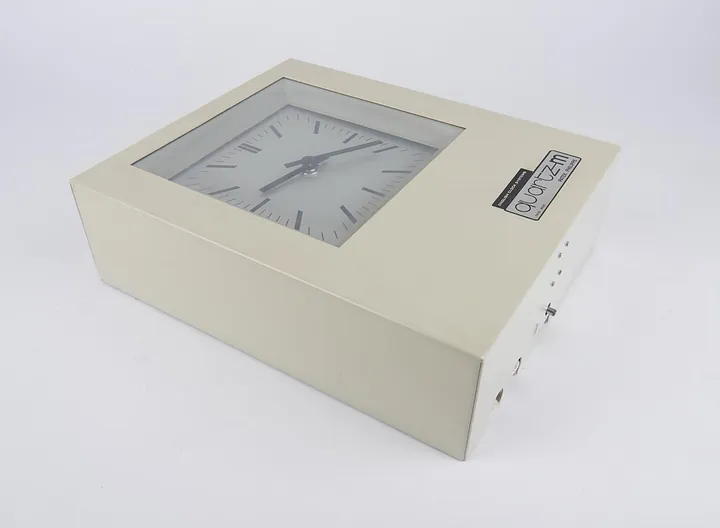
Quartz master clock QM 1, with movement by Patek Phillippe, Switzerland, 1965–1975. Supplied by English Clock Systems.
Science Museum Group, London
Instruments · 1965–1984
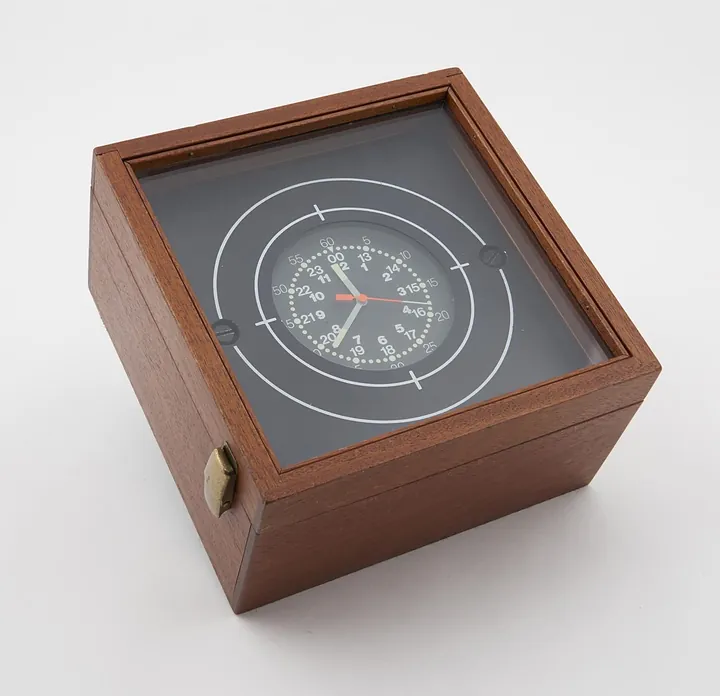
Chronometer by Patek Philippe and Kelvin Hughes, England, 1965–1984
Science Museum Group, London
Pocket Watches · c. 1895
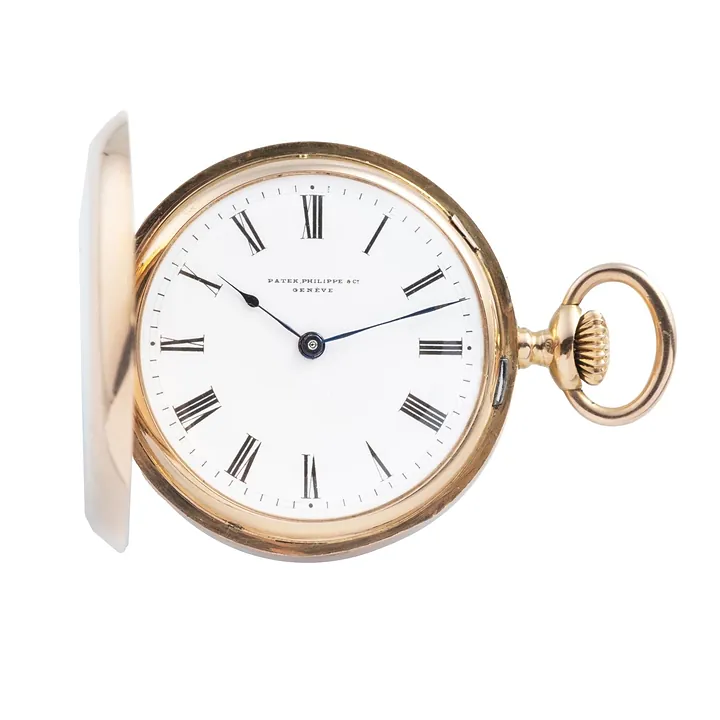
Patek Philippe pocket watch, c. 1895
Antiquorum auction archive, Geneva
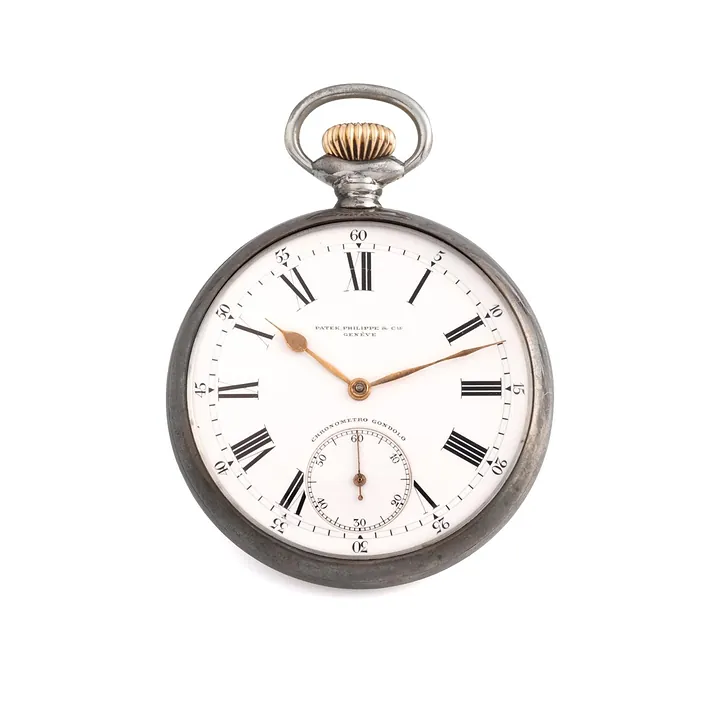
Pocket Watches · c. 1900
Patek Philippe Chronometro Gondolo, c. 1900
Antiquorum auction archive, Geneva

Wristwatches · 1970
Wristwatch by Heno, Switzerland, 1970
Museum Rotterdam

Wristwatches · 1960–1986
'Tri-Compax' calendar chronograph wristwatch in gold case, by Universal, Geneva, Switzerland, 1960–1986.
Science Museum Group, London

Wristwatches · 1969–1970
Beta 21 Quartz wristwatch movement, made in Switzerland, 1970.
Science Museum Group, London

Wristwatches · c. 1969
Omega Speedmaster Moonwatch, ref. 145022-69st, c. 1969
Antiquorum auction archive, Geneva