
Wristwatches · Wristwatch
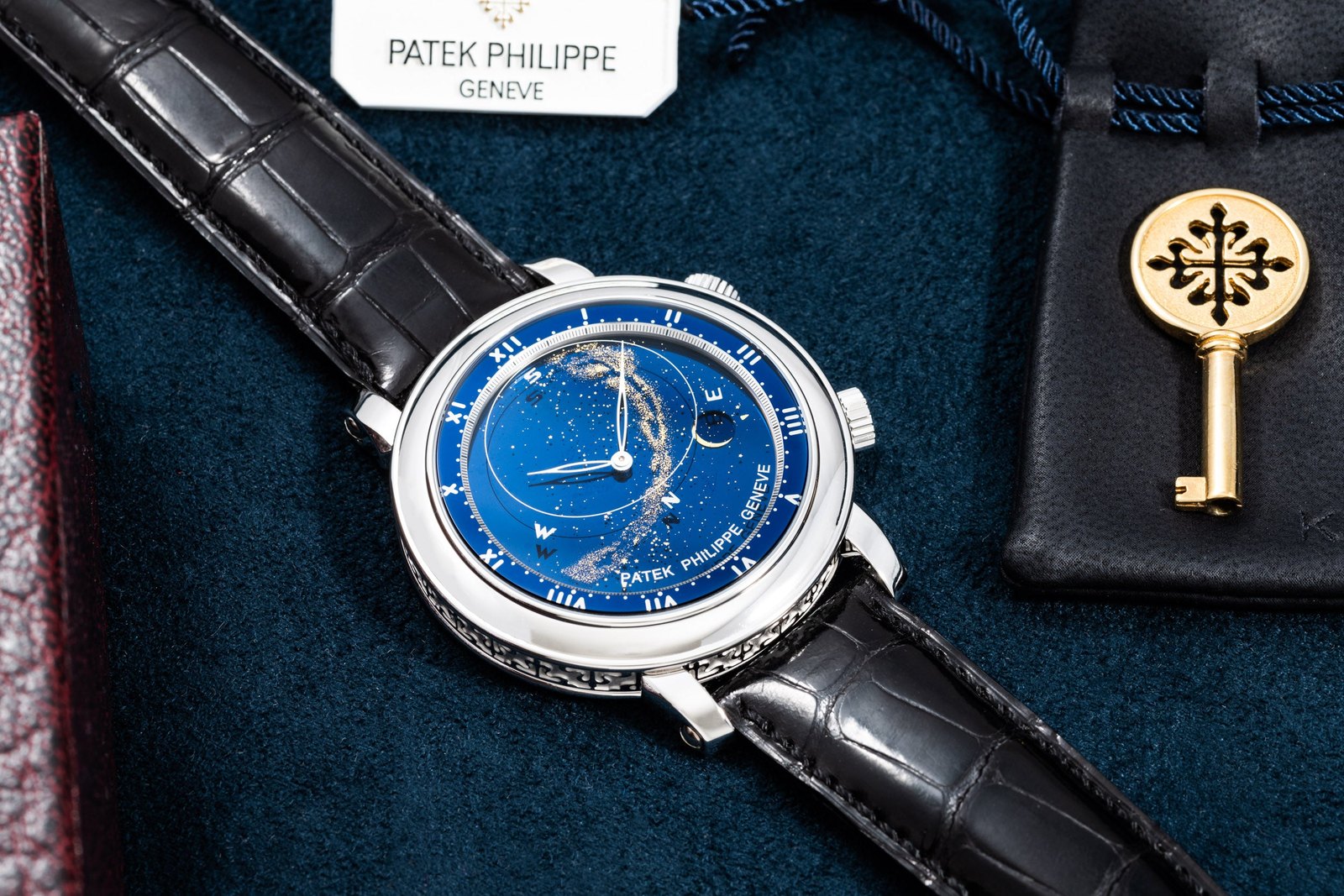
Patek Philippe Celestial Grand Complication, 2004
- Maker / attribution
- Patek Philippe (maker)
- Date
- 2004
- Historical period
- Mechanical Renaissance (1990 – 2010)
- Country of origin
- Switzerland
- Object type
- Wristwatch
- Dimensions
- Case 43 mm
- Stock no.
- 40930162
- Credit line
- Dealer listing, Analog/Shift (40930162)
- Catalogue title (original)
- Patek Philippe Celestial Grand Complication (English)
View the source record (dealer listing) ↗ (opens another website in a new tab)Suggest a correction
Record summary
Catalogued by Analog/Shift (dealer), New York (stock number 40930162), this is a wristwatch by Patek Philippe, made in Switzerland, dated 2004. The Atlas places it in the Mechanical Renaissance period (1990 – 2010) of its Wristwatches collection. Recorded dimensions: Case 43 mm. The record is illustrated with 6 photographs.
Assembled from the source record's structured fields. Dates and attributions are given as the source states them; where a field is missing the Atlas leaves it blank rather than estimating.
Catalogue description
Dealer description — Analog/Shift
If you’re searching for a superlative timepiece from the top manufacture in the world, there’s really only one name you need to know — and that’s Patek Philippe. Since 1839, Patek’s workshops have turned out the finest pocket and wristwatches on Earth, with their horological wares becoming a byword for quality, accuracy, and artistry. From simple, time-only Calatrava dress watches to some of the most complicated timepieces in the world, Patek Philippe remains supreme. Such is even more accurate when speaking of celestial complications — watches that display not only the time, but also the phase of the moon, sidereal time, lunation, and more. The Reference 5102G-001, one of the most exquisite examples of a celestial complication in contemporary watchmaking, is also one of the most impressive Patek Philippe timepieces ever constructed. Housed in a 43mm 18K white gold case with a magnificent, half-Calatrava Cross motif engraved as a band into the case flank, it features a sapphire crystal with a compass etching; dual, signed white gold winding/setting and complication setting crowns at 2 an 4 o’clock; a smooth polished bezel; and one of the most enchanting dials we’ve ever seen: three metallized sapphire crystal discs contain an outer hour scale with applied Roman indices; an inner, framed section of the sky as visible from Geneva; a white gold, 'skeletonized-feuille’ handset; compass bearings; and a revolving moon phase indicator. While the upper crown on this substantial, white gold beauty controls the time setting and winding, the lower crown controls the celestial complications — the moon phase, lunar day, lunation, and sidereal time. While this information can certainly be easily obtained via computer, the engineering and horological expertise needed to convey it via a wristwatch is remarkable, and simply needs to be seen to be fully appreciated. Powering this unique timepiece is the automatic-winding Patek Philippe Calibre 240 LU CL with 45 jewels and a power reserve of 48 hours. Composed of 315 separate parts, it features a Gyromax balance and the Patek Philippe Seal of accuracy. Meanwhile, paired to the watch’s artful lugs via screws is a thin, signed black crocodile leather strap with a signed, 18K white gold pin buckle, ensuring the watch looks just as elegant on-wrist as it does within its impressive presentation box, which is included upon sale along with other factory goodies. Dating to 2004, this remarkable timepiece is proof positive of Patek Philippe’s stature as the world’s foremost watchmaker. Don’t believe us? Then you haven’t seen this superlative watch in the flesh, and we happily invite you to do so!
Historical context
Mechanical Renaissance (1990 – 2010)
Mechanical watches return as cultural objects; independent watchmaking flourishes.
Mechanical watches returned as cultural and luxury objects. Complications, tourbillons and new materials proliferated; independent watchmakers such as George Daniels, F.P. Journe and Philippe Dufour revived artisanal watchmaking; collecting vintage watches became a major field.
Read the period in the timelineMore wristwatches from this periodEarlier: Quartz Revolution
Atlas type guide
Wristwatches
Bracelet watches were worn by women from the early nineteenth century — Breguet made one for Caroline Murat, Queen of Naples, in 1810–12 — but the wristwatch only became a man's instrument with military use and aviation in the early twentieth century. Between the World Wars it overtook the pocket watch; the 1920s and 1930s brought rectangular Art Deco cases, water-resistant cases and the first automatic winding systems.
After 1945 the wristwatch became a carrier of identity — dress watches, sports and dive watches, chronographs, calendars — produced by Swiss, American, Japanese, German, Soviet and Chinese industries. The quartz revolution after 1969 and the mechanical renaissance since the 1990s, including the rise of independent watchmakers, complete the story.
What to look for
- The reference number (between the lugs or inside the case back) and serial number, the starting point for dating.
- The calibre: its maker and number are often stamped under the dial or on the bridge.
- Originality of dial, hands and crown — refinished ('redial') dials are common.
- Case material marks: 18K/750, 14K/585, stainless steel, gold-filled, plated.
Dating clues
- Wire-lug cases: before c. 1925.
- Water-resistant screw-down cases: from 1926.
- Quartz movements: from 1969; sapphire crystals widespread after c. 1980.
General guidance written by the Atlas editors about this kind of object. It is not a statement about this particular piece; for that, rely on the source record above and on physical examination.
Related records
Clocks · 1965–1975
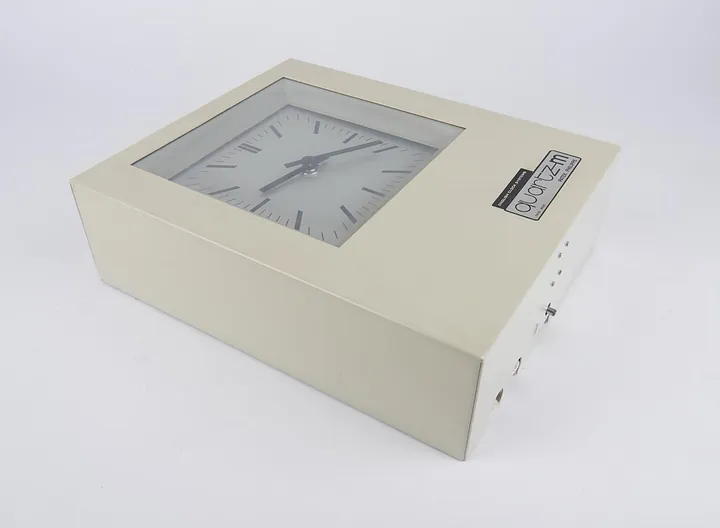
Quartz master clock QM 1, with movement by Patek Phillippe, Switzerland, 1965–1975. Supplied by English Clock Systems.
Science Museum Group, London
Instruments · 1965–1984
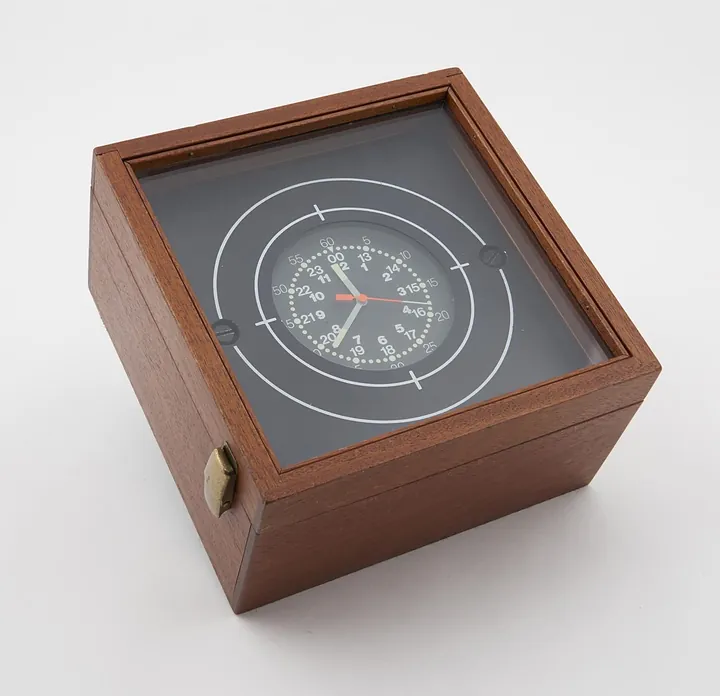
Chronometer by Patek Philippe and Kelvin Hughes, England, 1965–1984
Science Museum Group, London
Pocket Watches · c. 1895
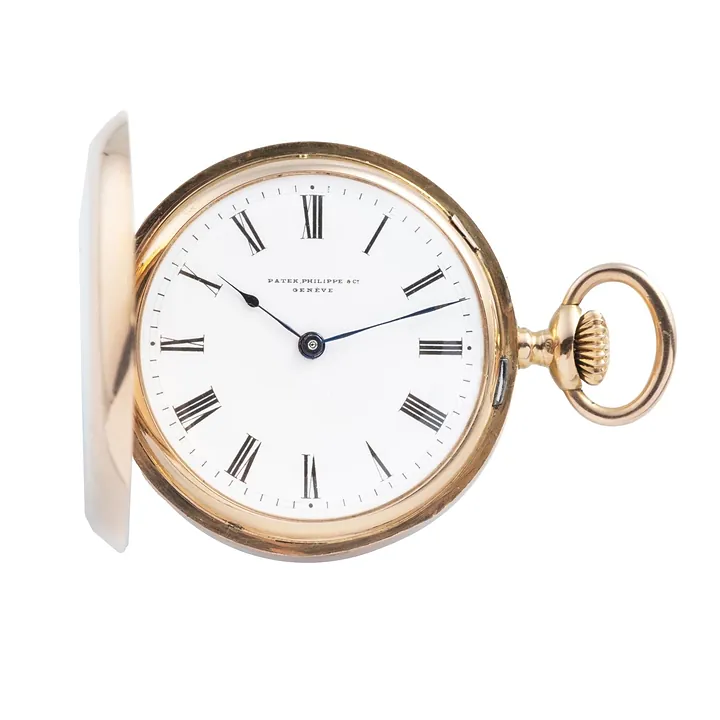
Patek Philippe pocket watch, c. 1895
Antiquorum auction archive, Geneva

Pocket Watches · c. 1900
Patek Philippe Chronometro Gondolo, c. 1900
Antiquorum auction archive, Geneva

Wristwatches · 2008
Wristwatch by Breitling?, 2008
Museum Rotterdam

Wristwatches · c. 1990s
Audemars Piguet Bamboo, c. 1990s
Antiquorum auction archive, Geneva

Wristwatches · c. 1990
Audemars Piguet Huitieme Perpetual Calendar, ref. 25696PT, c. 1990
Antiquorum auction archive, Geneva

Wristwatches · c. 1990
Breitling Chronomat, ref. b13050.1, c. 1990
Antiquorum auction archive, Geneva