
Wristwatches · Wristwatch
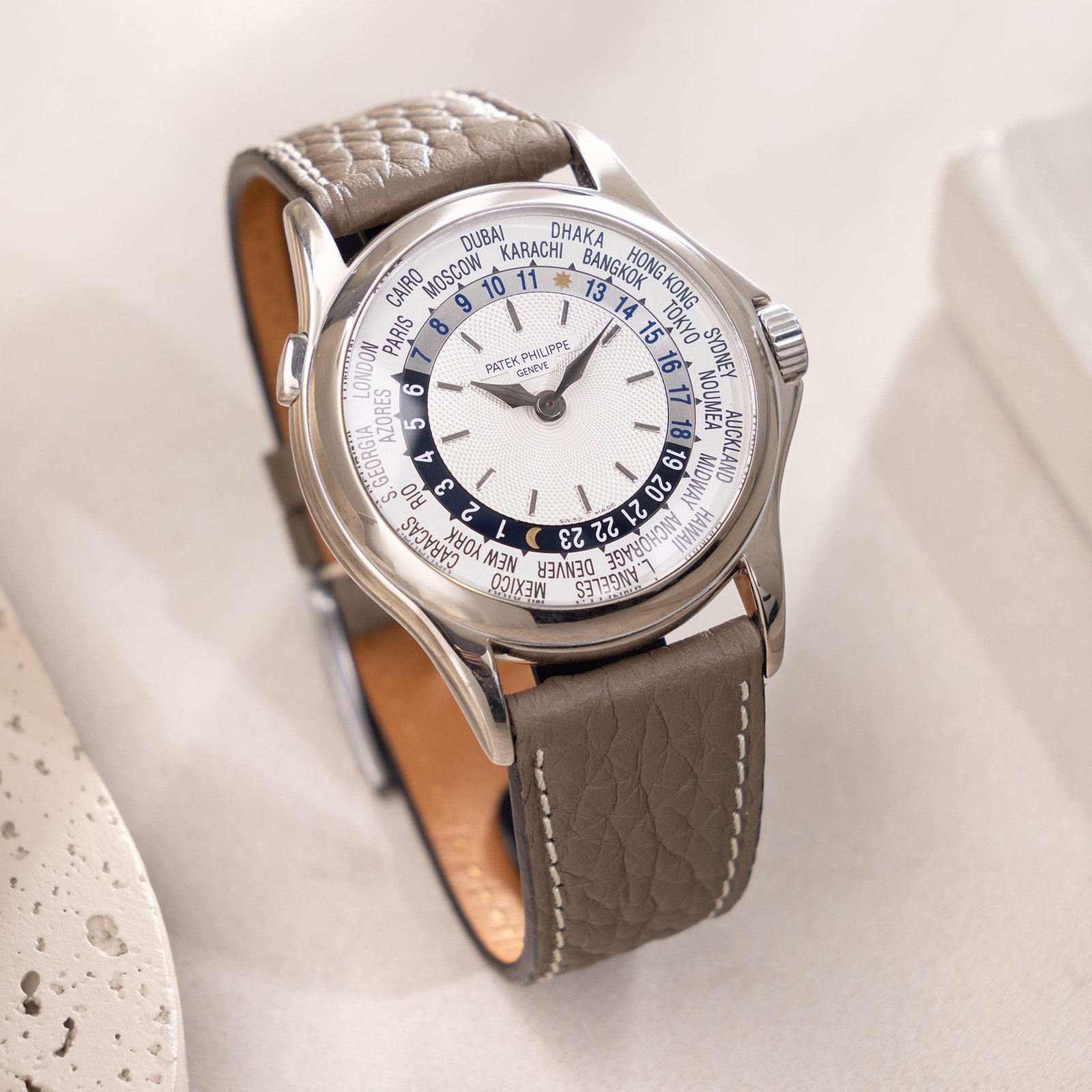
Patek Philippe World Time 5110G in 18k White Gold with Extract from the Archives, 2005
- Maker / attribution
- Patek Philippe (maker)
- Date
- 2005
- Historical period
- Mechanical Renaissance (1990 – 2010)
- Country of origin
- Switzerland
- Object type
- Wristwatch
- Materials / technique
- 18k white gold
- Dimensions
- Case 37 mm
- Stock no.
- W-3556
- Credit line
- Dealer listing, Bulang & Sons (W-3556)
- Catalogue title (original)
- Patek Philippe World Time 5110G in 18k White Gold with Extract from the Archives (English)
View the source record (dealer listing) ↗ (opens another website in a new tab)Suggest a correction
Record summary
Catalogued by Bulang & Sons (dealer), Copenhagen (stock number W-3556), this is a wristwatch by Patek Philippe, made in Switzerland, dated 2005. The Atlas places it in the Mechanical Renaissance period (1990 – 2010) of its Wristwatches collection. Materials and techniques recorded by the source: 18k white gold. Recorded dimensions: Case 37 mm. The record is illustrated with 6 photographs.
Assembled from the source record's structured fields. Dates and attributions are given as the source states them; where a field is missing the Atlas leaves it blank rather than estimating.
Catalogue description
Dealer description — Bulang & Sons
Patek Philippe’s World Time watch, known as the Heures Universelles ( or HU) has a rich history rooted in the innovative mechanical design of independent watchmaker Louis Cottier. Patek Philippe was the first company to produce a series of wristwatches using his system, which allows the wearer to view all 24 global time zones simultaneously. The concept originated with Cottier, who patented his world time mechanism in 1931. Patek Philippe quickly recognized its potential and collaborated with him, producing their first world time wristwatches in the late 1930s. The mechanism was first implemented in a Calatrava, reference 96, in 1937, and two years later, in 1939, it appeared in the reference 1415. This first serially produced world time model featured a manually rotating bezel engraved with city names. Pocket watches with the complication were also created during this era, including rare examples with elaborate cloisonné enamel dials depicting world maps—undoubtedly among the most beautiful watches ever made. In the 1950s, Patek introduced a significant improvement with a second crown at 9 o’clock, allowing independent adjustment of the inner city ring and 24-hour display. This more user-friendly system appeared in the reference 2523, making the watch ideal for travelers. By the 1960s, Patek Philippe stopped producing world time wristwatches, perhaps due to a perceived lack of demand or the passing of Louis Cottier. Whatever the reason, the complication was revived in 2000 with the introduction of the reference 5110 in various metals. This model featured a patented pusher at 10 o’clock, allowing the user to advance the hour hand, 24-hour disk, and city ring simultaneously with a single press. The example we have on offer is a reference 5110G, with the “G” denoting the 18k white gold variation. The 37 mm case has a slim, elegant profile, featuring the 10 o’clock pusher and a refined crown guard. A sapphire case back allows the wearer to admire the 22k gold micro-rotor of the automatic caliber 240HU pressing the pusher at 10 o’clock, the city disk can be aligned to the correct time zone. Next, pulling the crown to the first position allows you to set your local time. At the same time, the 24-hour disk would rotate counterclockwise, advancing one hour with each adjustment to display the correct time across all 24 of the world’s time zones. The true showstopper is the opaline, engine-turned (guilloché) central dial, surrounded by 24 cities rendered in a charming font. The hands are a clear nod to the vintage references, including the 2523, 1415, and the affiliated pocket watches. The tactile feel of the 10 o’clock pusher exemplifies Patek Philippe’s mechanical excellence. While it may be difficult to appreciate in words, pressing it immediately demonstrates the precision and quality of the mechanism, we promise! This world time is fitted with a slightly used original Patek Philippe leather strap and the original 18k white gold Patek Philippe folding clasp. Additionally, it comes with an Extract from the Archives confirming a sale in May 2005. This fine watch has been fully serviced by our watch maker; ready for years to enjoy. We think this is one of the most romantic watches in Patek’s more recent lineup—and a truly cool complication to own! Let’s get you this World Time. Specifications: Patek Philippe World Time reference 5110G 37 mm 18k white gold case with display case-back Opaline colored dial with center guilloché “Heures Universelles”, world time 24 time zones display complication Case no 3215xxx / movement no 4297xxx dating to 2005 Automatic cal 240 HU(Heures Universelles) with 22 k gold microrotor Patek Philippe leather trap with 18k white gold Patek' folding clasp Extract of the archives from Patek Philippe stating a sale in 2005 Fully serviced by our watch maker
Historical context
Mechanical Renaissance (1990 – 2010)
Mechanical watches return as cultural objects; independent watchmaking flourishes.
Mechanical watches returned as cultural and luxury objects. Complications, tourbillons and new materials proliferated; independent watchmakers such as George Daniels, F.P. Journe and Philippe Dufour revived artisanal watchmaking; collecting vintage watches became a major field.
Read the period in the timelineMore wristwatches from this periodEarlier: Quartz Revolution
Atlas type guide
Military, pilot and travel watches
The wristwatch owes much of its adoption by men to warfare and aviation. Wristlets — small pocket watches soldered with lugs and worn on a strap — were used in colonial campaigns and became standard equipment in the First World War, with protective grilles over the crystal ('shrapnel guards'). Louis Cartier's Santos (1904), designed for the aviator Alberto Santos-Dumont, is often cited as an early purpose-made pilot's watch.
In the Second World War governments specified watches in detail: the German B-Uhr observation watches, the American A-11, and the British 'W.W.W.' (the 'Dirty Dozen' set of 1945). After the war, jet travel brought GMT and world-time watches, which show two or more time zones at once — Louis Cottier's world-time mechanism and the Rolex GMT-Master (1955) are examples.
What to look for
- Military markings on the case back: broad arrow, issue numbers, 'W.W.W.', 'A.T.P.'
- High-legibility black dials with luminous Arabic numerals; oversized crowns for gloved hands.
- 24-hour hands and rotating 24-hour bezels or city rings on GMT/world-time watches.
- Wire lugs on early wristlets converted from pocket watches.
Dating clues
- Wire-lug wristlets: c. 1900–1925.
- Military specifications of the Second World War: 1939–1945.
- GMT and world-time wristwatches: mainly after 1950.
General guidance written by the Atlas editors about this kind of object. It is not a statement about this particular piece; for that, rely on the source record above and on physical examination.
Related records

Clocks · 1965–1975
Quartz master clock QM 1, with movement by Patek Phillippe, Switzerland, 1965–1975. Supplied by English Clock Systems.
Science Museum Group, London

Instruments · 1965–1984
Chronometer by Patek Philippe and Kelvin Hughes, England, 1965–1984
Science Museum Group, London

Pocket Watches · c. 1895
Patek Philippe pocket watch, c. 1895
Antiquorum auction archive, Geneva

Pocket Watches · c. 1900
Patek Philippe Chronometro Gondolo, c. 1900
Antiquorum auction archive, Geneva

Wristwatches · 2008
Wristwatch by Breitling?, 2008
Museum Rotterdam

Wristwatches · c. 1990s
Audemars Piguet Bamboo, c. 1990s
Antiquorum auction archive, Geneva

Wristwatches · c. 1990
Audemars Piguet Huitieme Perpetual Calendar, ref. 25696PT, c. 1990
Antiquorum auction archive, Geneva

Wristwatches · c. 1990
Breitling Chronomat, ref. b13050.1, c. 1990
Antiquorum auction archive, Geneva