
Collecting & Identification · Collector's guide
Vintage Watches: A Collector's Guide to the Classics, from the Cartier Tank to the Nautilus
Which vintage watches became classics, and why? Twenty-two landmark wristwatches from 1917 to 1976 — dress watches, pilots' and divers' watches, chronographs, electric watches and the first luxury steel sports watches — each shown from the Atlas catalogue, with what to look for when you meet one.
Atlas Editorial · · 15 min read
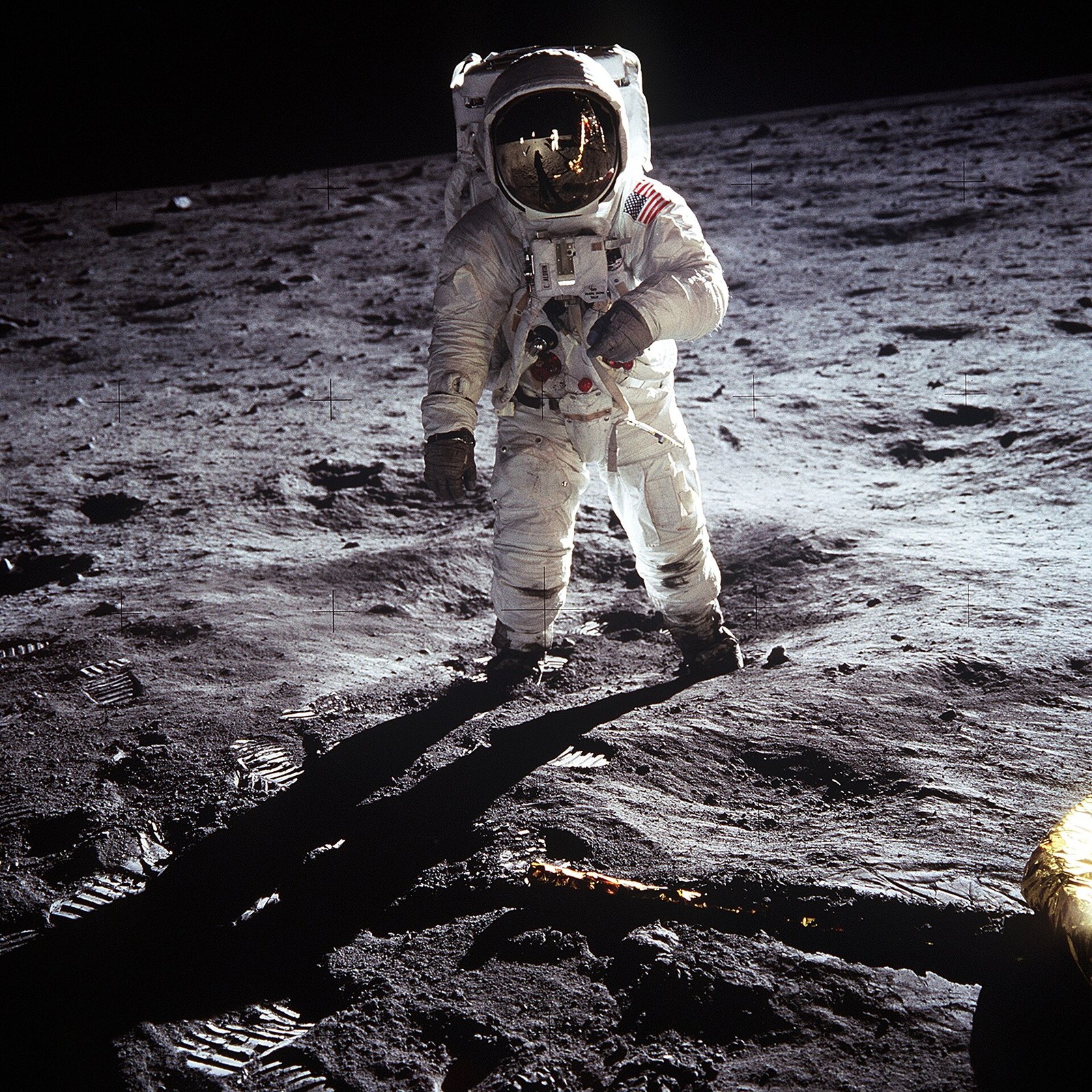
Neil A. Armstrong · Public domain · source (opens another website in a new tab)
A vintage watch, in the usual collectors' sense, is a watch at least thirty or forty years old — in practice most collectors mean wristwatches made between the 1920s and the 1980s. Millions survive, and most are pleasant, serviceable everyday watches. A few designs, though, became classics: watches that changed what a wristwatch could do or look like, that were made for a purpose and proved themselves in use, or that defined a type so completely that every later watch of that kind is compared with them. These are the watches collectors look for first, and the ones whose history is best documented.
This guide introduces twenty-two of them, from Cartier's Tank of 1917 to Patek Philippe's Nautilus of 1976, in roughly the order they appeared. Each is illustrated with an example from the Atlas catalogue — most from auction archives and specialist dealers — with notes on how to recognise it and what collectors check. It is a guide to history and identification, not to prices. For practical advice on buying, see the Academy lesson on buying a vintage watch; for the difference between vintage, neo-vintage and modern watches, see the lesson on that subject.
Before the war: the dress watch takes shape
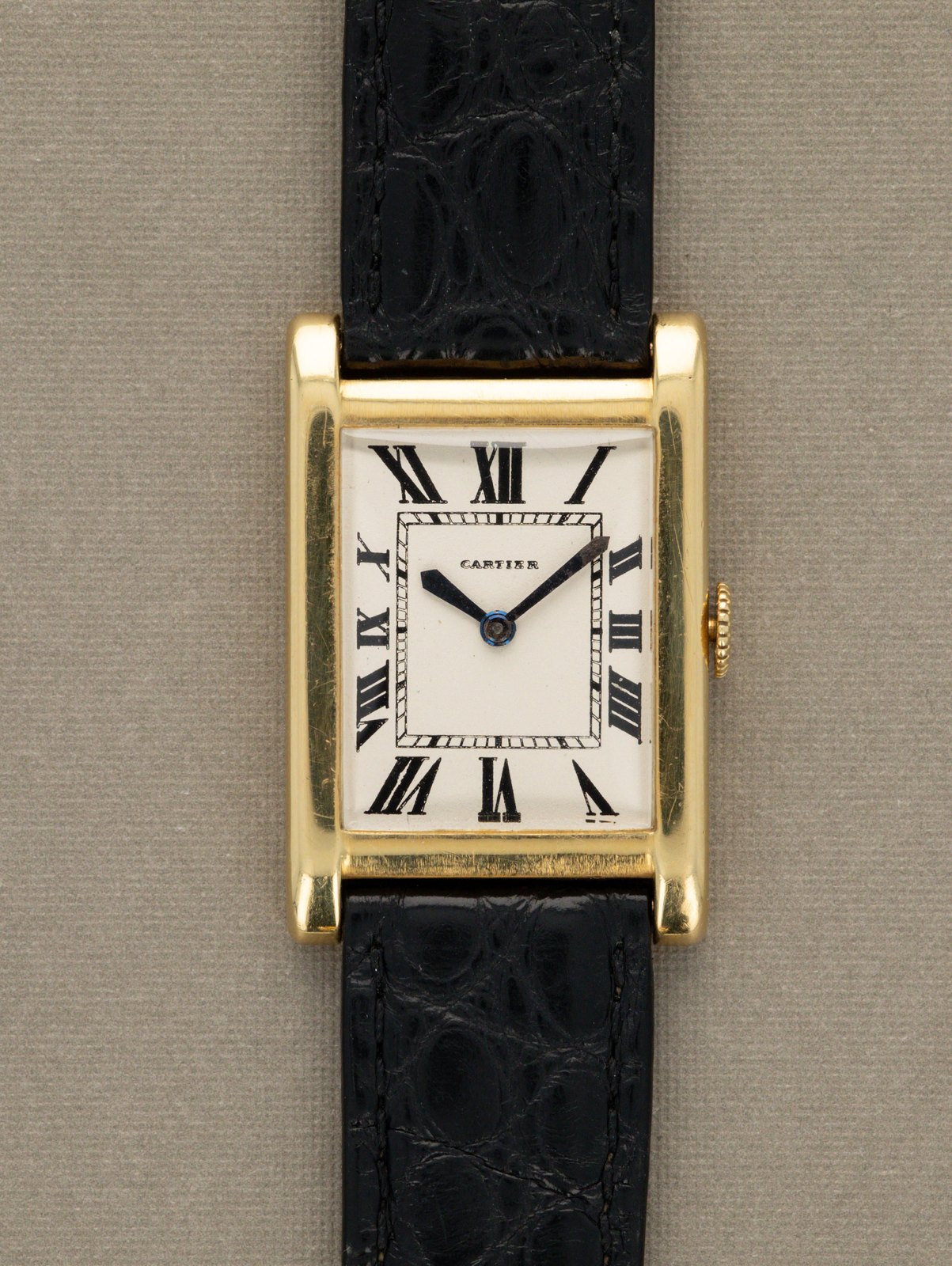
Cartier Tank (1917)
Louis Cartier designed the Tank in 1917, in the middle of the First World War, and it went on sale in 1919. Its name and form are usually explained by the outline of the Renault tanks of the war: the vertical side bars of the case, called brancards, run past the dial to become the lugs, so that case and strap attachment form one shape. The Tank set the pattern for the rectangular dress watch, and Cartier has made it in many variants since — the Normale, the Louis Cartier, the Chinoise, the elongated Allongée. Early Tanks often have movements supplied by other makers such as Jaeger-LeCoultre or European Watch & Clock Co., signed for Cartier.
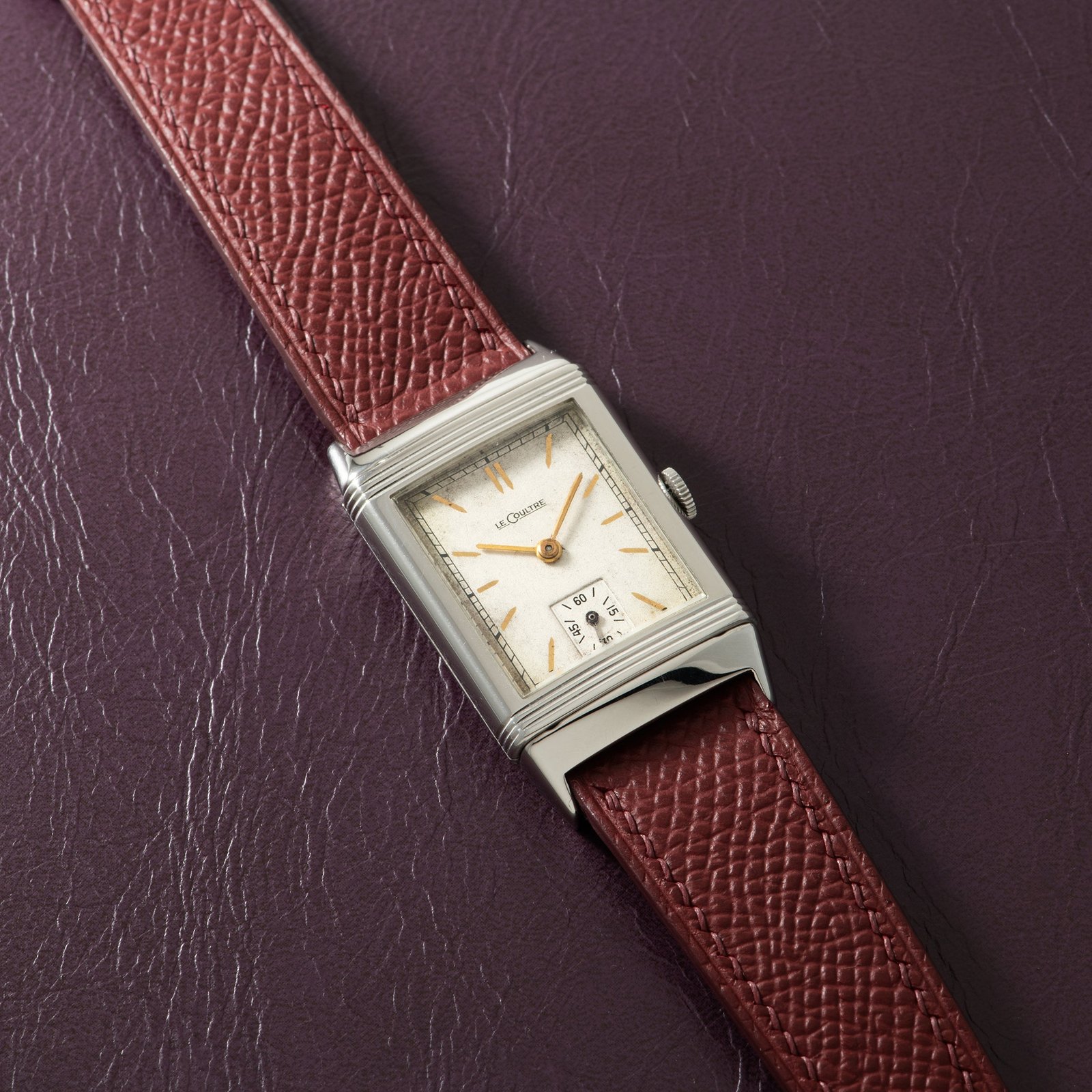
Jaeger-LeCoultre Reverso (1931)
The Reverso answered a practical problem. Its story, told by the company and repeated by dealers, is that British officers playing polo in India wanted a watch whose glass would survive the game. The solution, patented in Paris in March 1931, was a rectangular case that slides sideways in its cradle and flips over, turning a plain metal back outwards. The Art Deco case, with its horizontal gadroons above and below the dial, became one of the most recognisable designs of the century, and the blank back has often been engraved or enamelled.
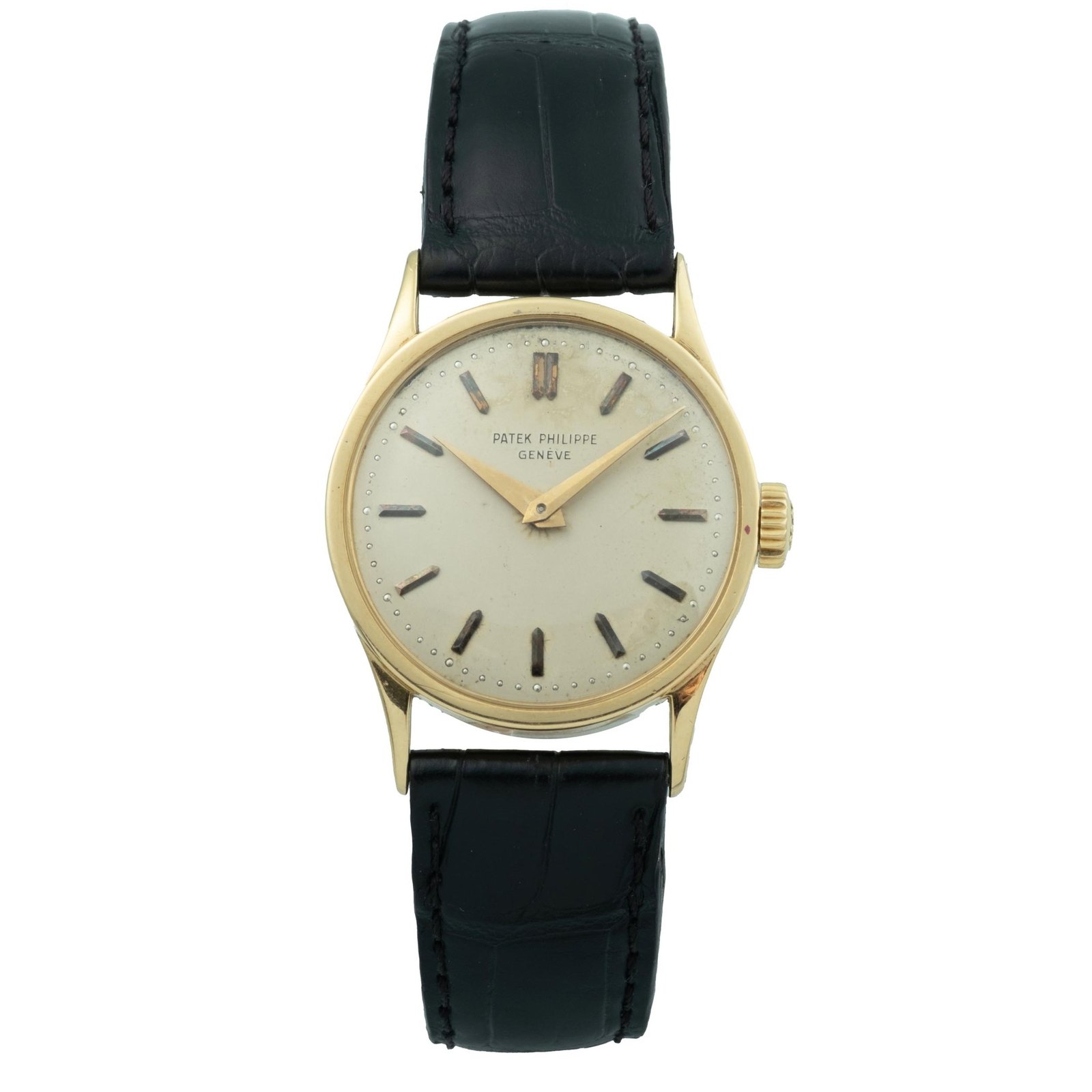
Patek Philippe Calatrava, reference 96 (1932)
In 1932, the year the Stern family took control of Patek Philippe, the company introduced the reference 96: a small round watch with a plain case, straight lugs and a simple dial, influenced by the clean lines of the Bauhaus. It became the model for the classic round dress watch, was made for decades, and gave its name — Calatrava, after the cross used as Patek Philippe's emblem — to a whole family of later references. Early 96s are small by modern standards, about 31 mm across, and collectors study their dials, case materials and archive extracts closely.
The 1940s: precision, the date and the alarm
Rolex Datejust (1945)
Rolex introduced the Datejust in 1945, its fortieth anniversary year. It combined the waterproof Oyster case of 1926 and the Perpetual self-winding rotor of 1931 with a chronometer-certified movement and a date shown in a window, changing automatically at midnight. The fluted bezel and the 'Jubilee' bracelet made for it became Rolex signatures, and the Cyclops magnifying lens over the date followed in the 1950s. The Datejust's mixture of precision and practicality made it the archetype of the everyday luxury watch; the Atlas feature on Rolex follows the company's history in more detail.
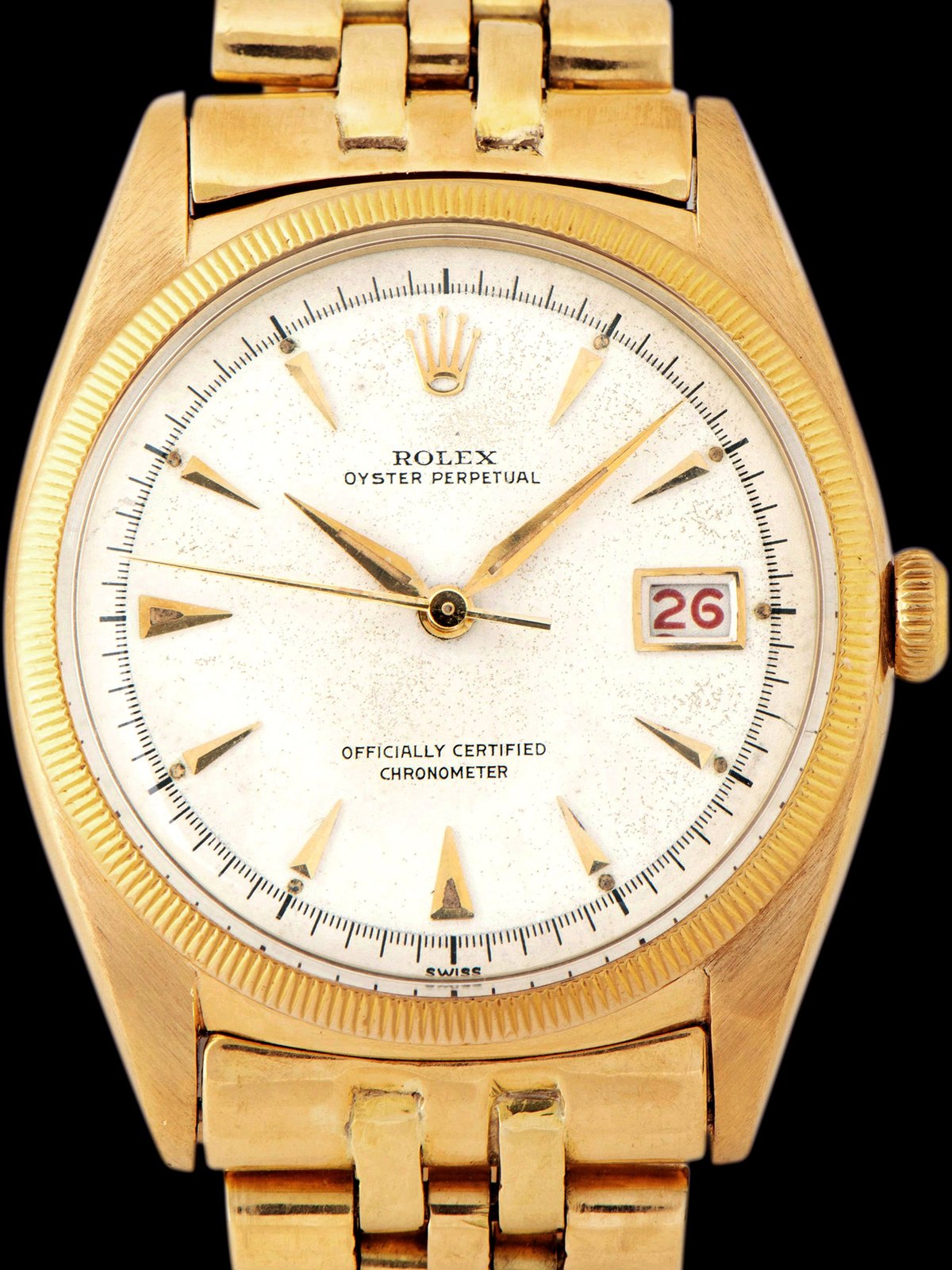
LeCoultre Memovox (1950)
Alarm wristwatches had been made before, but the Memovox ('voice of memory') of 1950 made the type a success. A second crown sets a central alarm hand, and a small hammer strikes the case to sound the alarm. An automatic version followed in 1956, and the Memovox was made in many forms, including a diver's 'Polaris' of the late 1960s.
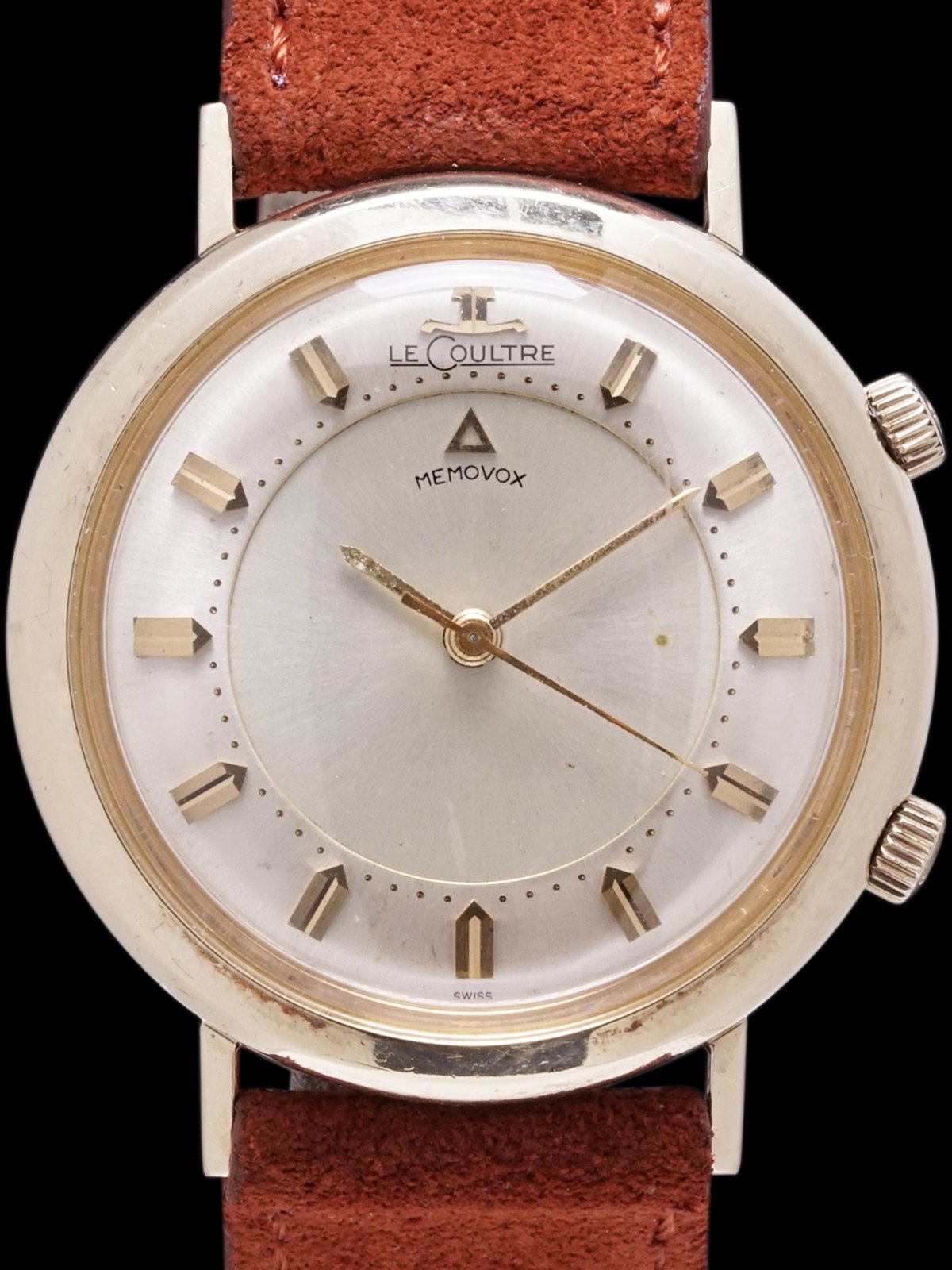
IWC Mark 11 (1948)
The Mark 11 (or Mark XI) was made for the British Ministry of Defence from 1948 as a navigator's watch for the Royal Air Force, and remained in service for decades. Built by IWC and Jaeger-LeCoultre to a demanding specification, it has a soft-iron inner case and dial that protect the movement from magnetic fields in the cockpit, a stop-seconds ('hacking') function for synchronising watches, a black dial with a triangle at twelve, and military markings on the case back. Its plain, legible dial became the model for later pilots' watches.
The 1950s: tool watches for air, sea and mountain
Omega Constellation (1952)
Omega launched the Constellation in 1952 as its line of automatic chronometers. The case back carries a medallion of an observatory under a sky of stars, and the early 'pie-pan' dials, with their faceted outer zone, and applied star are favourites with collectors. The Constellation shows how much the 1950s valued precision: chronometer certificates and observatory results were used in advertising, and the Atlas feature on Seiko describes the observatory trials in which manufacturers competed.
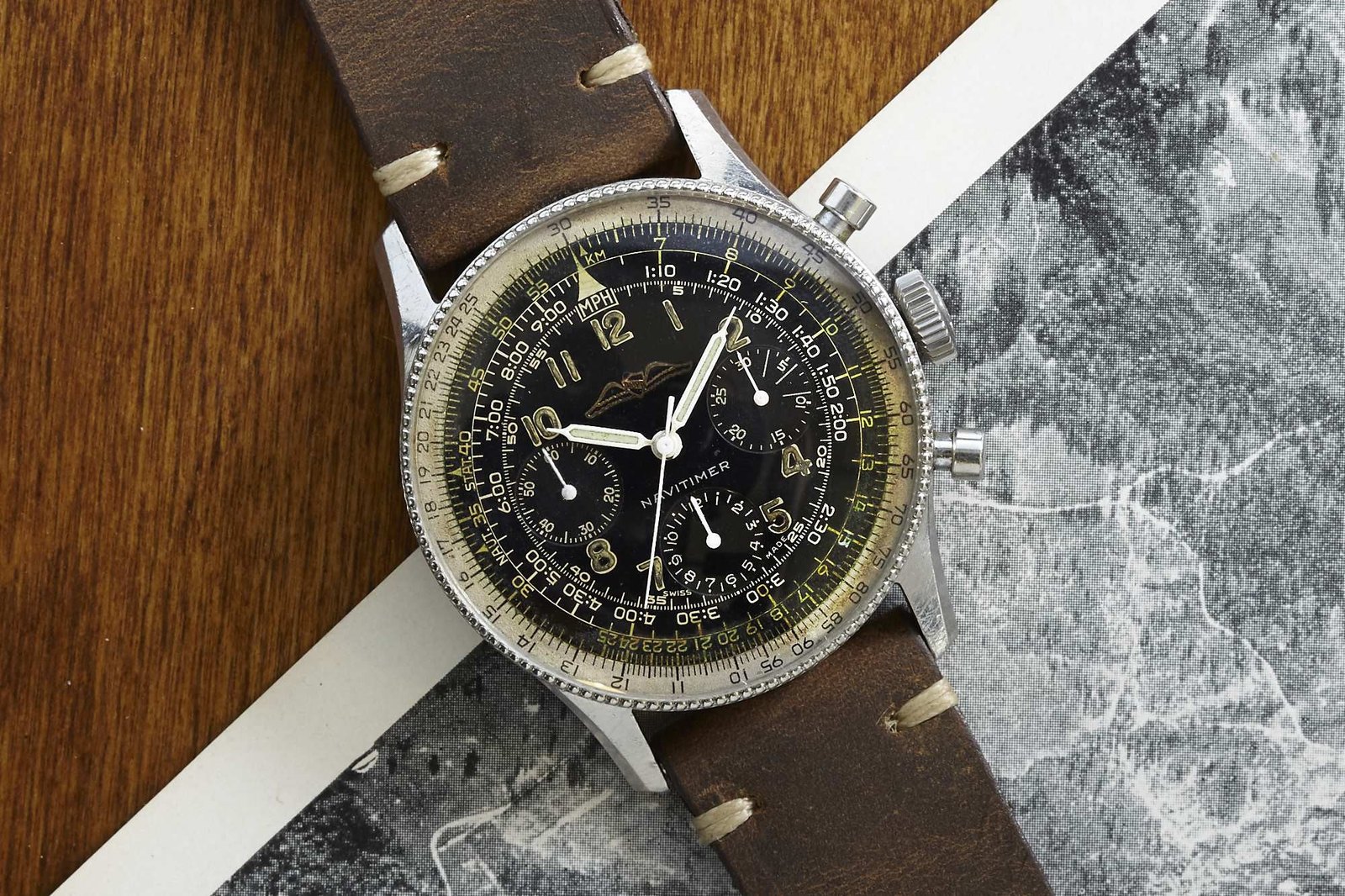
Breitling Navitimer (early 1950s)
Breitling had made chronographs with slide-rule bezels before the war. In the early 1950s it combined one with a chronograph in the Navitimer, a watch for pilots that could calculate speed, distance, fuel consumption and rate of climb. Early examples carry the winged emblem of the Aircraft Owners and Pilots Association (AOPA), with which the watch was closely associated. The crowded black dial and the bead-edged rotating bezel make the Navitimer instantly recognisable.
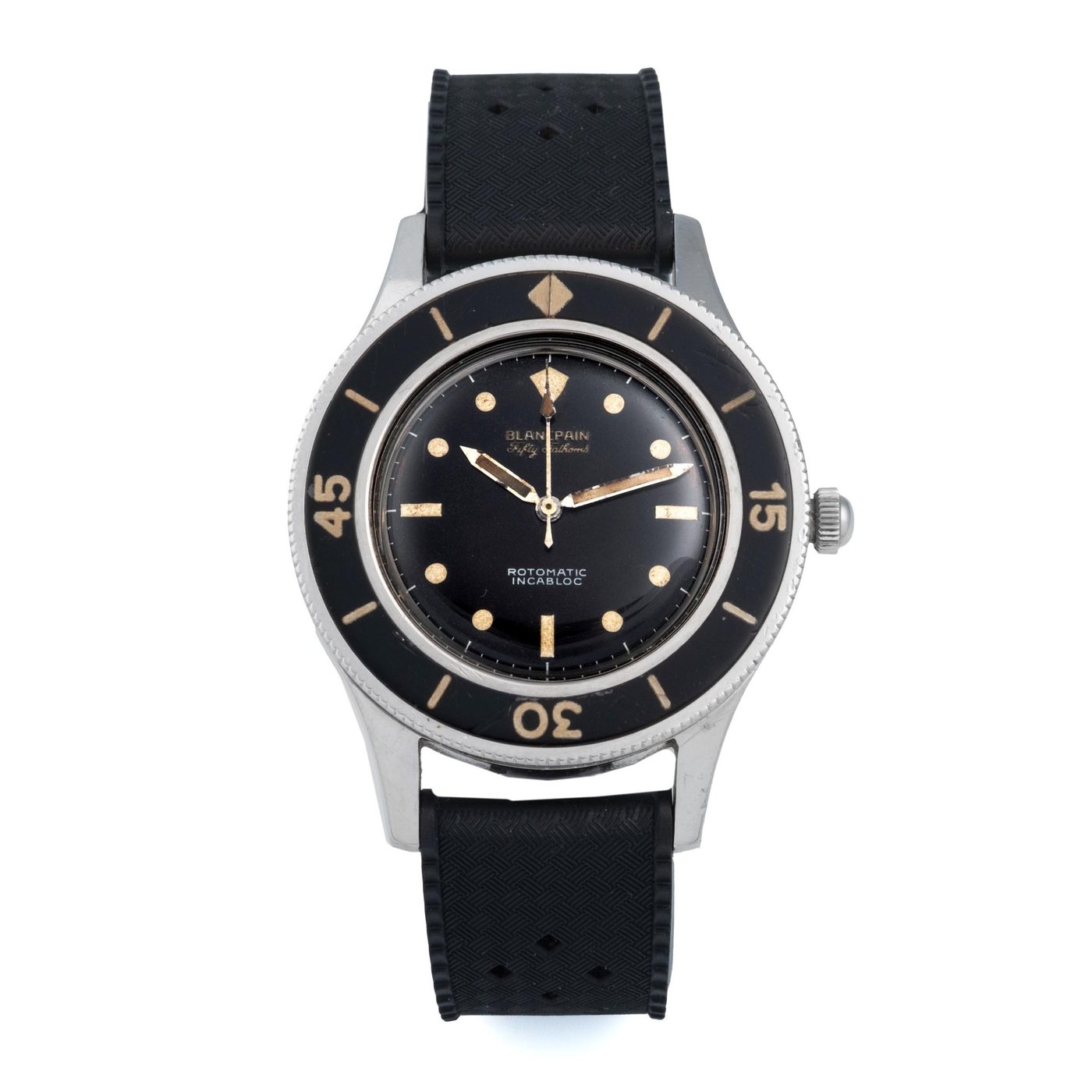
Blancpain Fifty Fathoms (1953)
The Fifty Fathoms was developed by Blancpain in 1953 for the French navy's new unit of combat divers, whose officers had specified a watch that was legible under water and could time a dive. Its name refers to a depth of fifty fathoms, about 91 metres. It had an automatic movement, a strong water-resistant case, large luminous markers and a rotating bezel to mark the start of a dive — the features that defined the modern diver's watch.
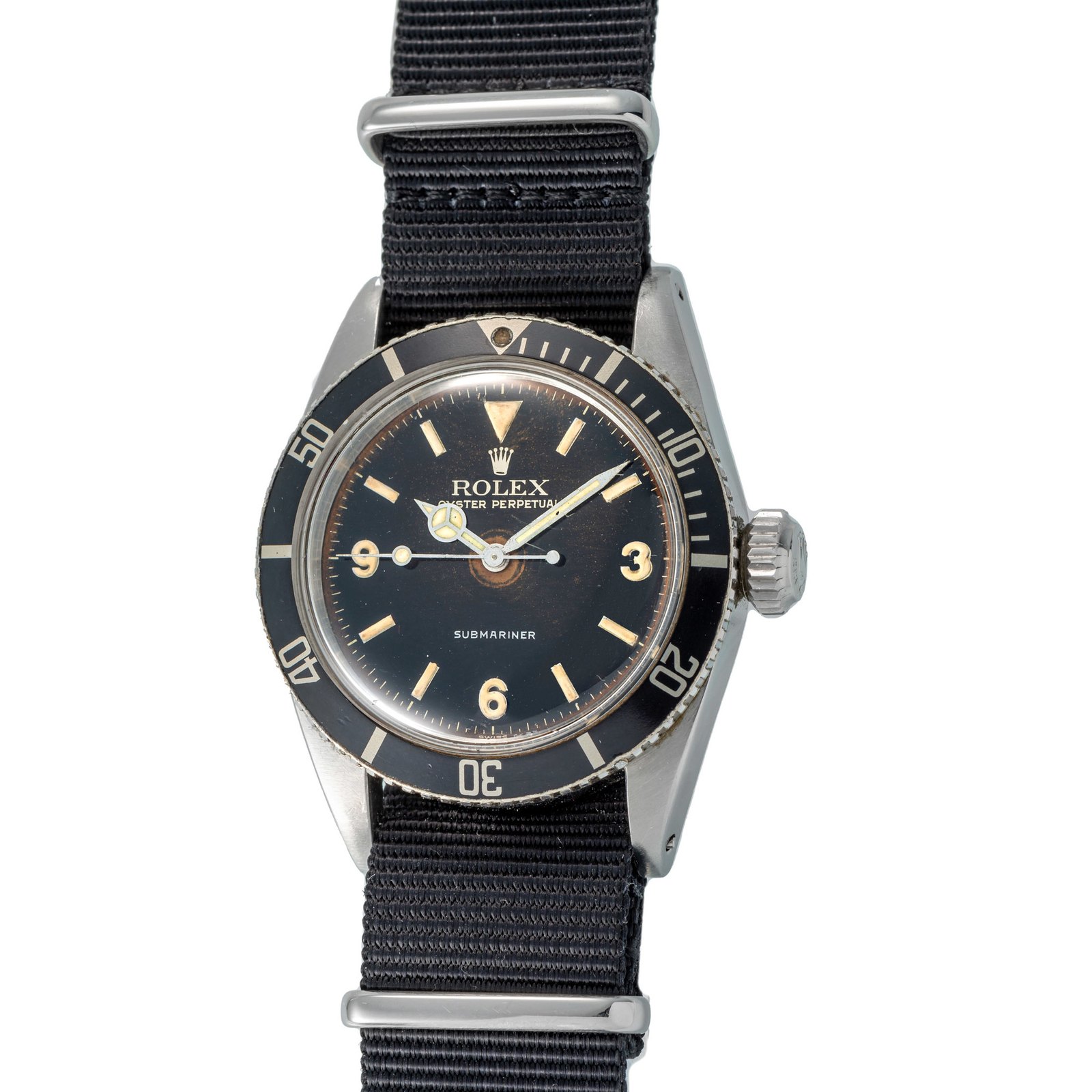
Rolex Submariner (1953–54)
Rolex's first Submariners appeared in 1953–54, at almost the same moment as the Fifty Fathoms. Based on the Oyster case, they were water-resistant to 100 metres at first and soon to 200 metres, and their rotating bezel, black dial and luminous 'Mercedes' hands established the look that most divers' watches still follow. The Submariner's film appearances helped make it the most imitated watch of the century.
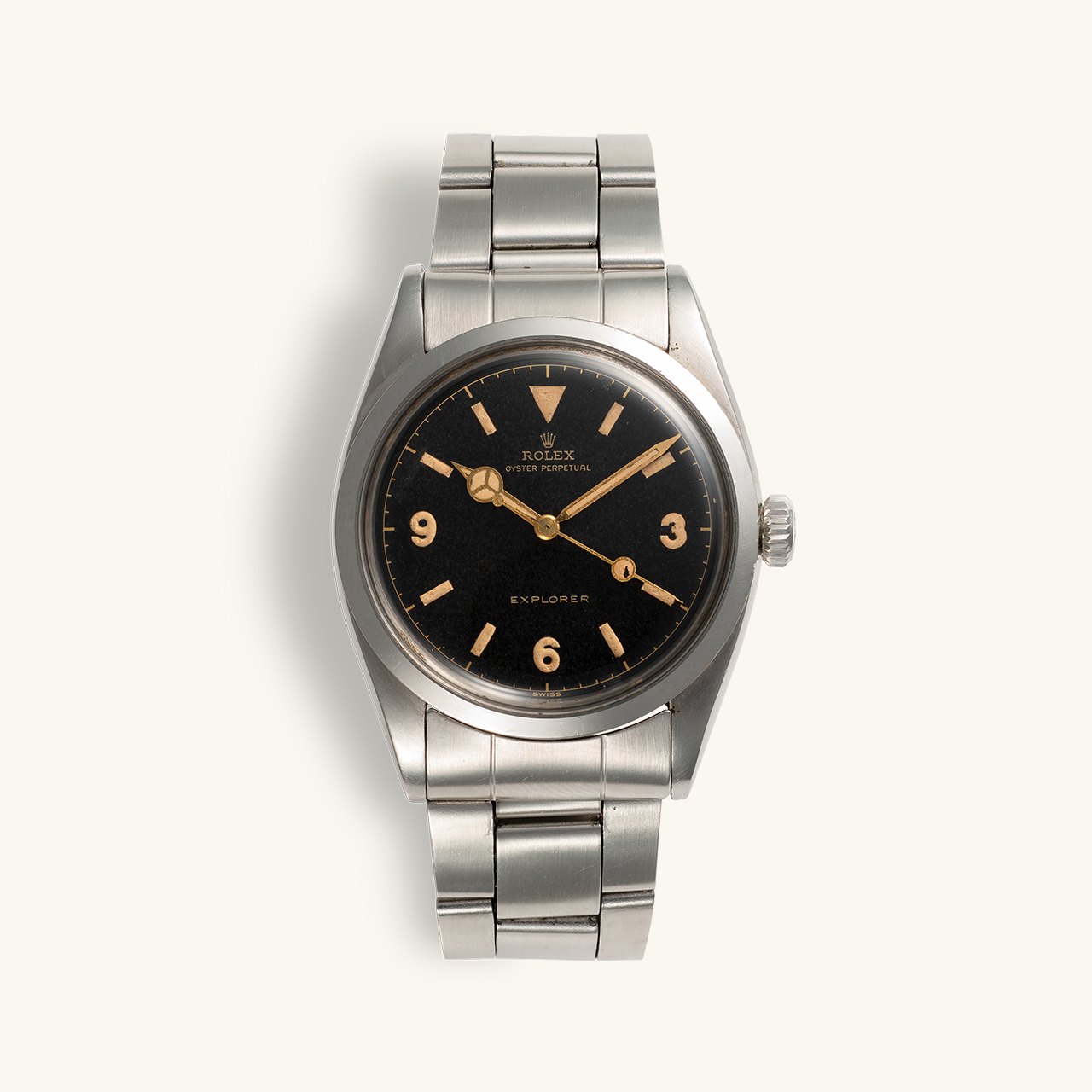
Rolex Explorer (1953)
The Explorer is named after the first ascent of Everest in 1953, for which Rolex supplied watches to the expedition; Edmund Hillary's own summit watch is generally said to have been a British Smiths. The Explorer's black dial with large luminous 3, 6 and 9 numerals became its trademark, a design kept, with variations, ever since.
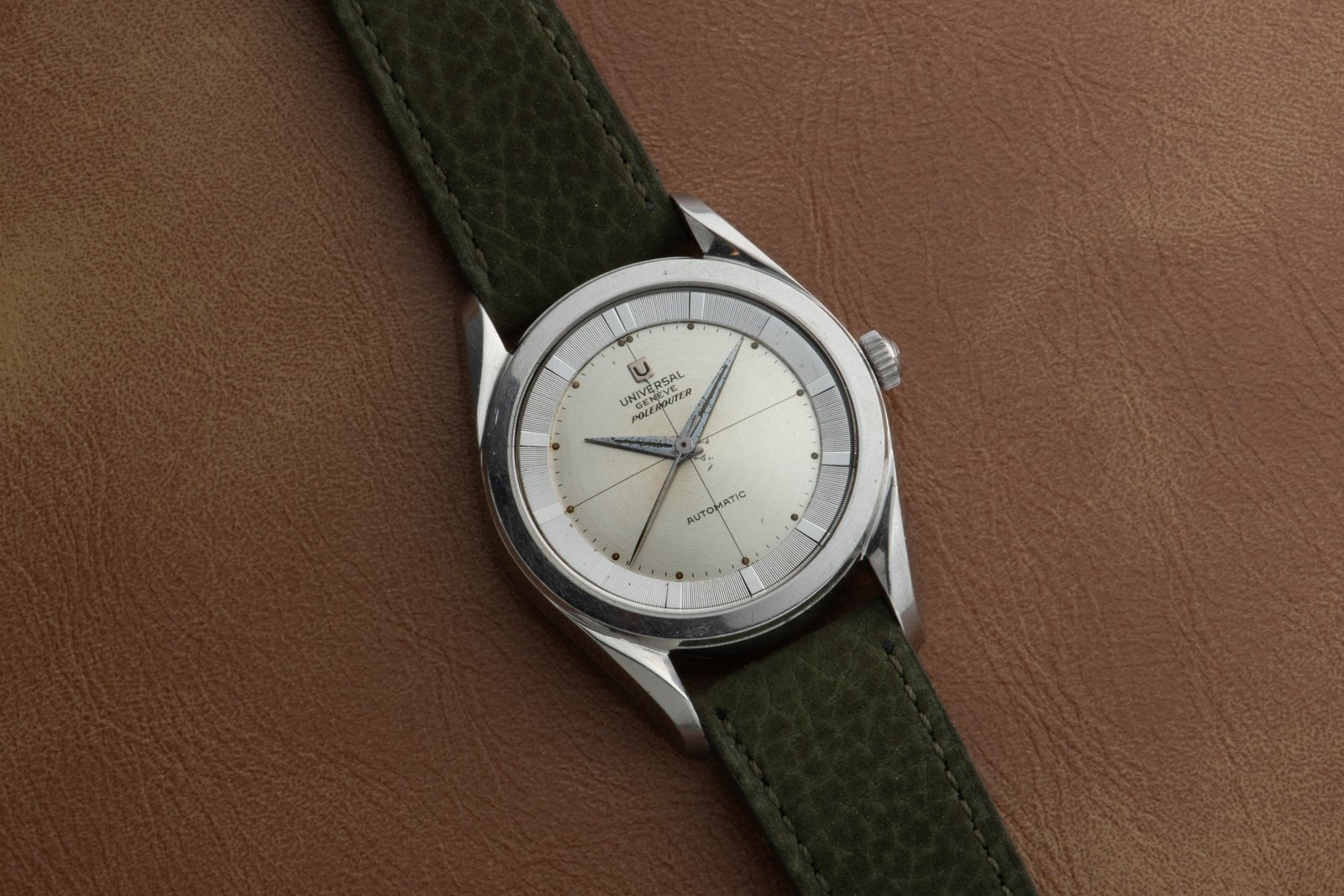
Universal Genève Polerouter (1954)
In 1954 Scandinavian Airlines began flights across the North Pole between Europe and North America, and Universal Genève made a watch for the occasion. The Polerouter was designed by the young Gérald Genta, later famous for the Royal Oak and the Nautilus; the dealer below notes that he was only 24 when he drew it. From the mid-1950s it carried Universal's 'micro-rotor' automatic movement, with a small rotor set into the movement rather than over it, which kept the watch thin.
Rolex GMT-Master (1954–55)
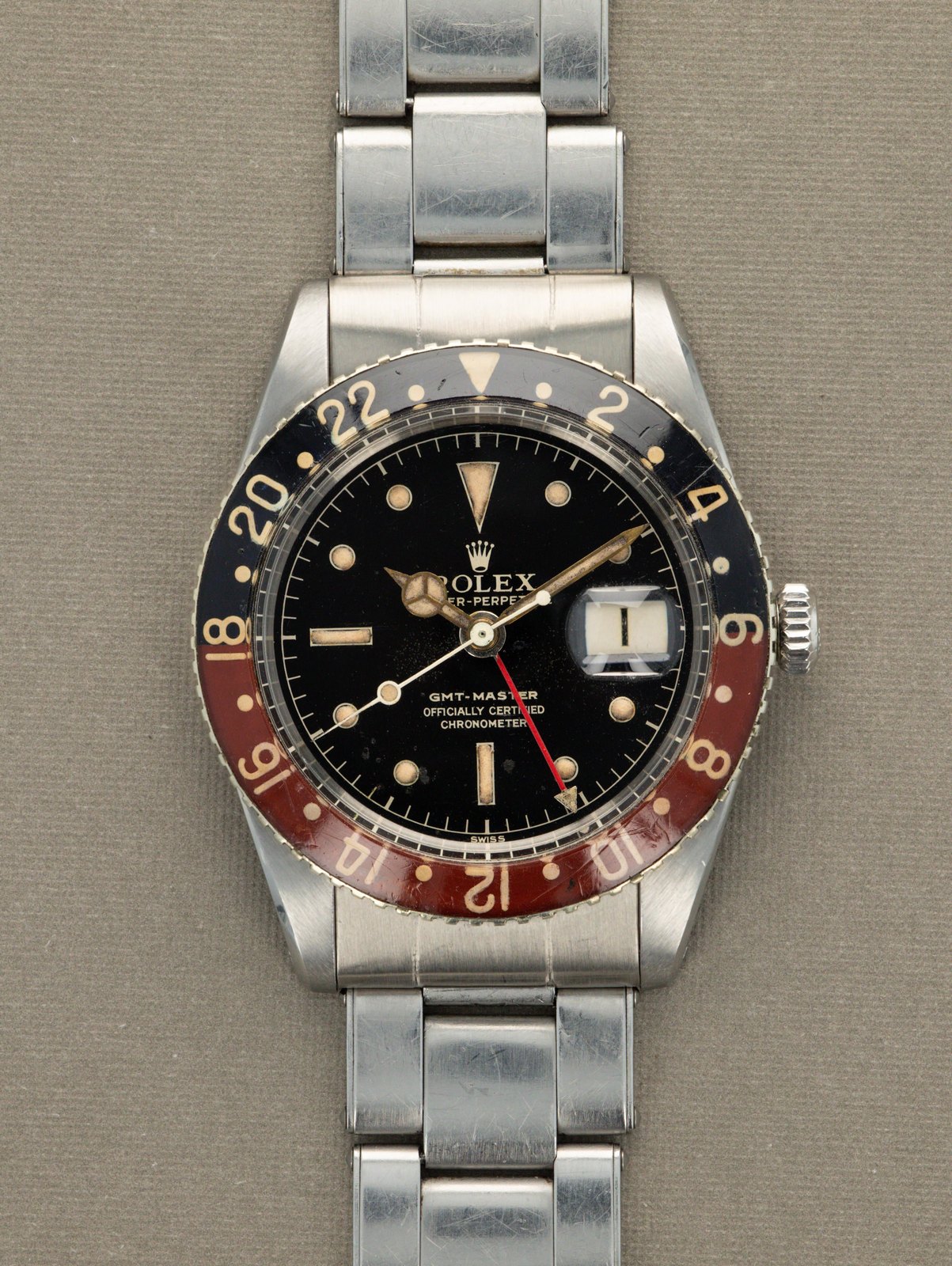
The GMT-Master was developed with Pan American World Airways for pilots crossing time zones. A fourth, 24-hour hand and a rotating 24-hour bezel, two-coloured to distinguish day and night, let the wearer read a second time zone. The first reference, 6542, had a bezel insert of Bakelite, later replaced by aluminium. The red and blue 'Pepsi' bezel became one of the best-known colour schemes in watchmaking.
Omega Speedmaster (1957)
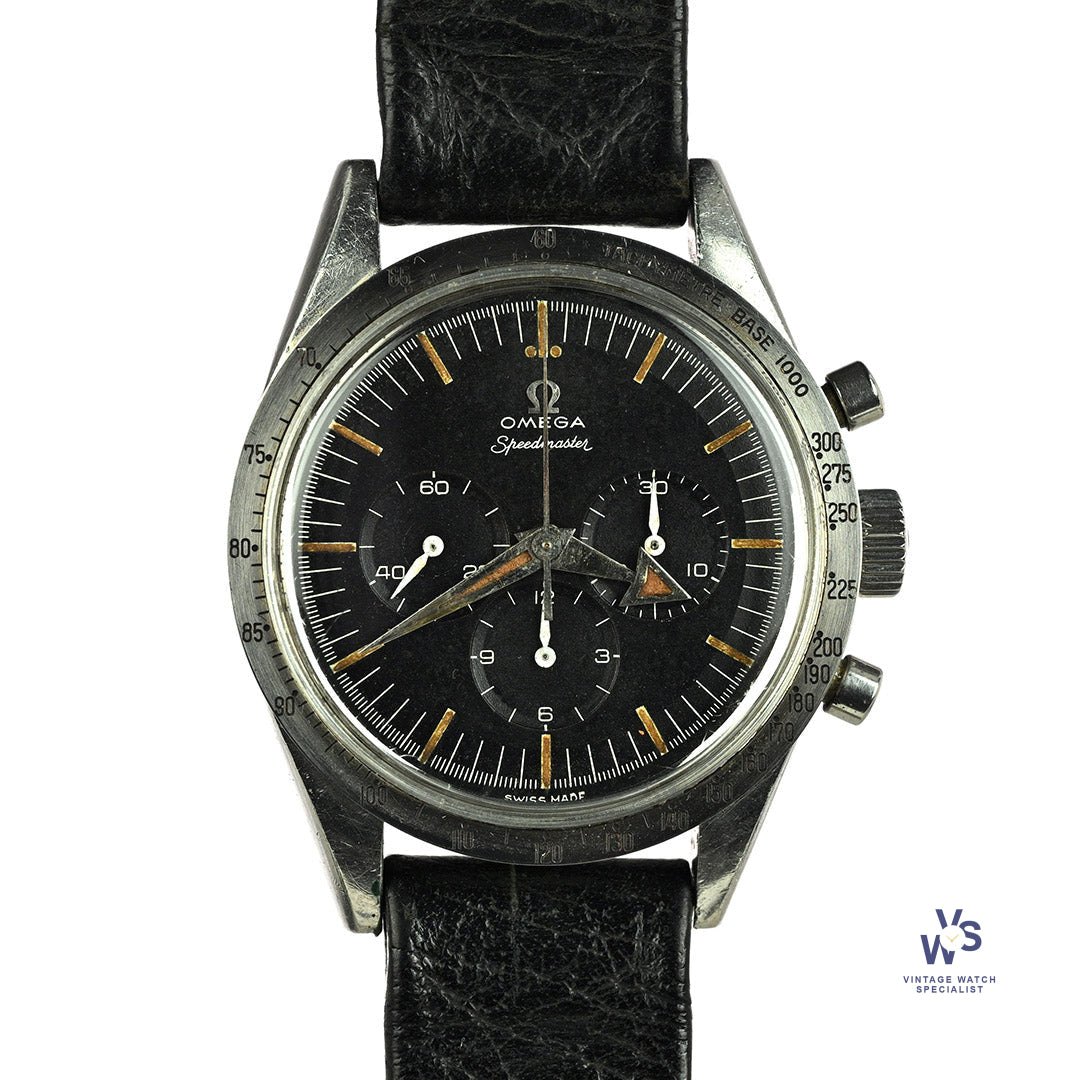
Omega introduced the Speedmaster in 1957 as a sports and racing chronograph, with the tachymeter scale on the bezel rather than the dial — an innovation at the time — and 'broad arrow' hands in the first reference, CK 2915. In 1965, after tests of several makes, NASA qualified the Speedmaster for its astronauts, and in July 1969 it was worn on the Moon during Apollo 11. The Speedmaster Professional is still made today, and the early references are among the most closely studied vintage watches.
Electric and electronic watches
Hamilton Ventura (1957)
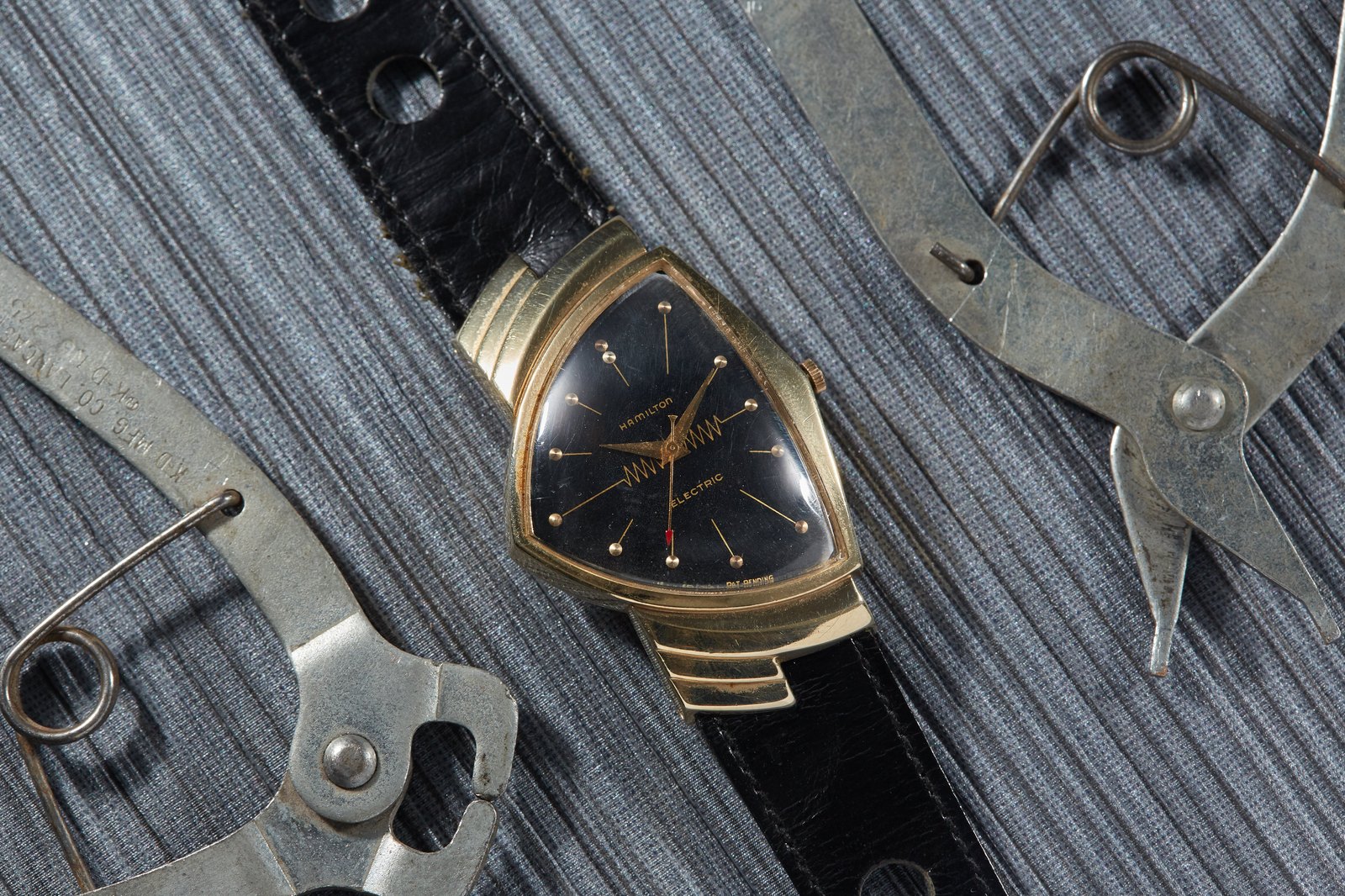
Hamilton of Lancaster, Pennsylvania, launched the first battery-powered wristwatch in 1957: the Hamilton Electric, whose balance is kept swinging by a battery and electrical contacts. Its most famous case was the asymmetrical, triangular Ventura designed by the industrial designer Richard Arbib. The dealer below recalls that Elvis Presley wore one in the 1961 film Blue Hawaii. The original electric movements are delicate and need a specialist.
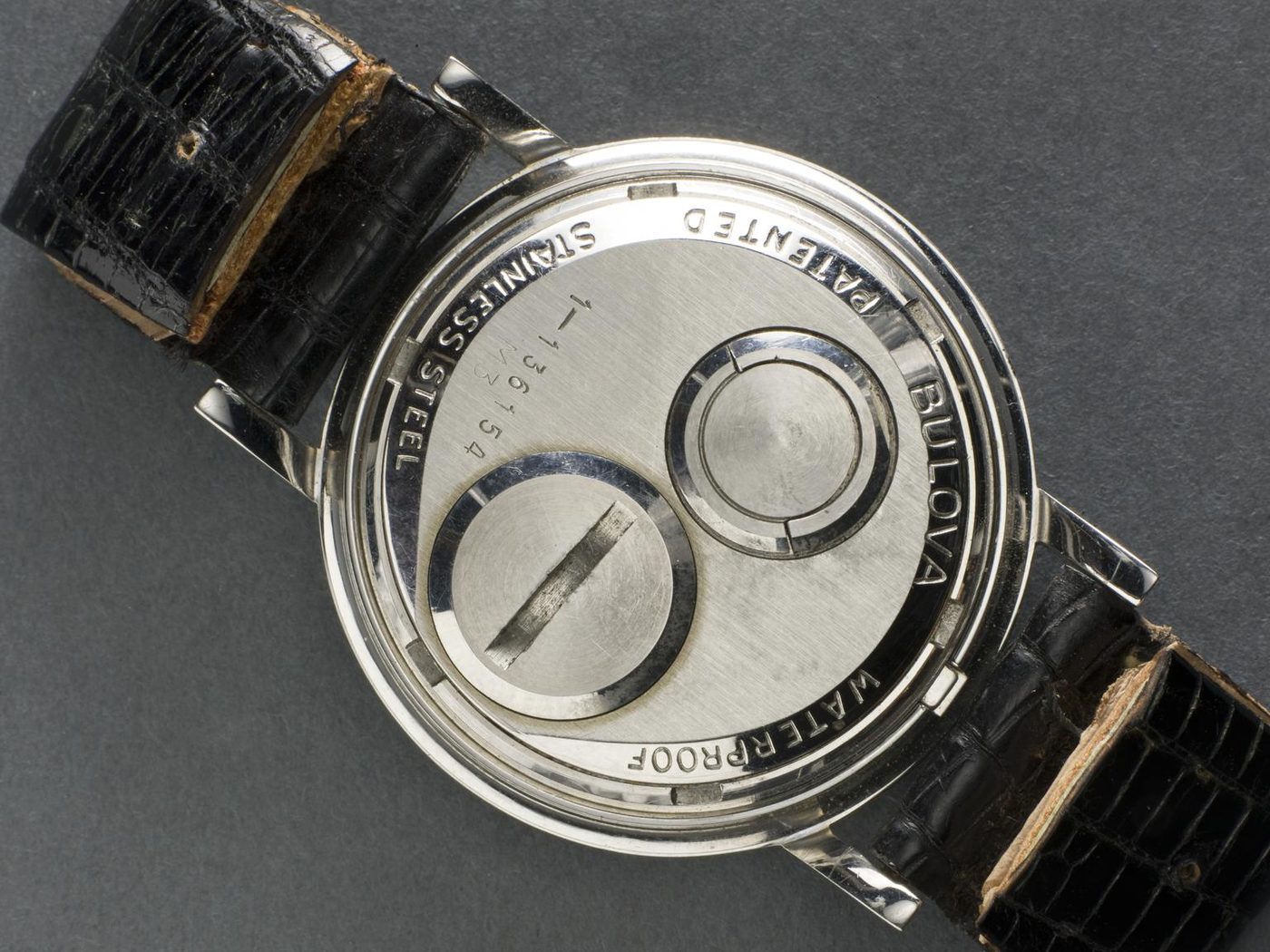
Bulova Accutron (1960)
Three years later Bulova introduced the Accutron, designed by the Swiss engineer Max Hetzel. Instead of a balance it uses a tiny tuning fork, kept vibrating 360 times a second by a transistor circuit, which drives the hands through a minute ratchet wheel. It hums rather than ticks, and it was guaranteed to keep time within a minute a month — far better than most mechanical watches. The 'Spaceview' versions with an open dial showing the mechanism are the collectors' favourites.
The 1960s: the great chronographs
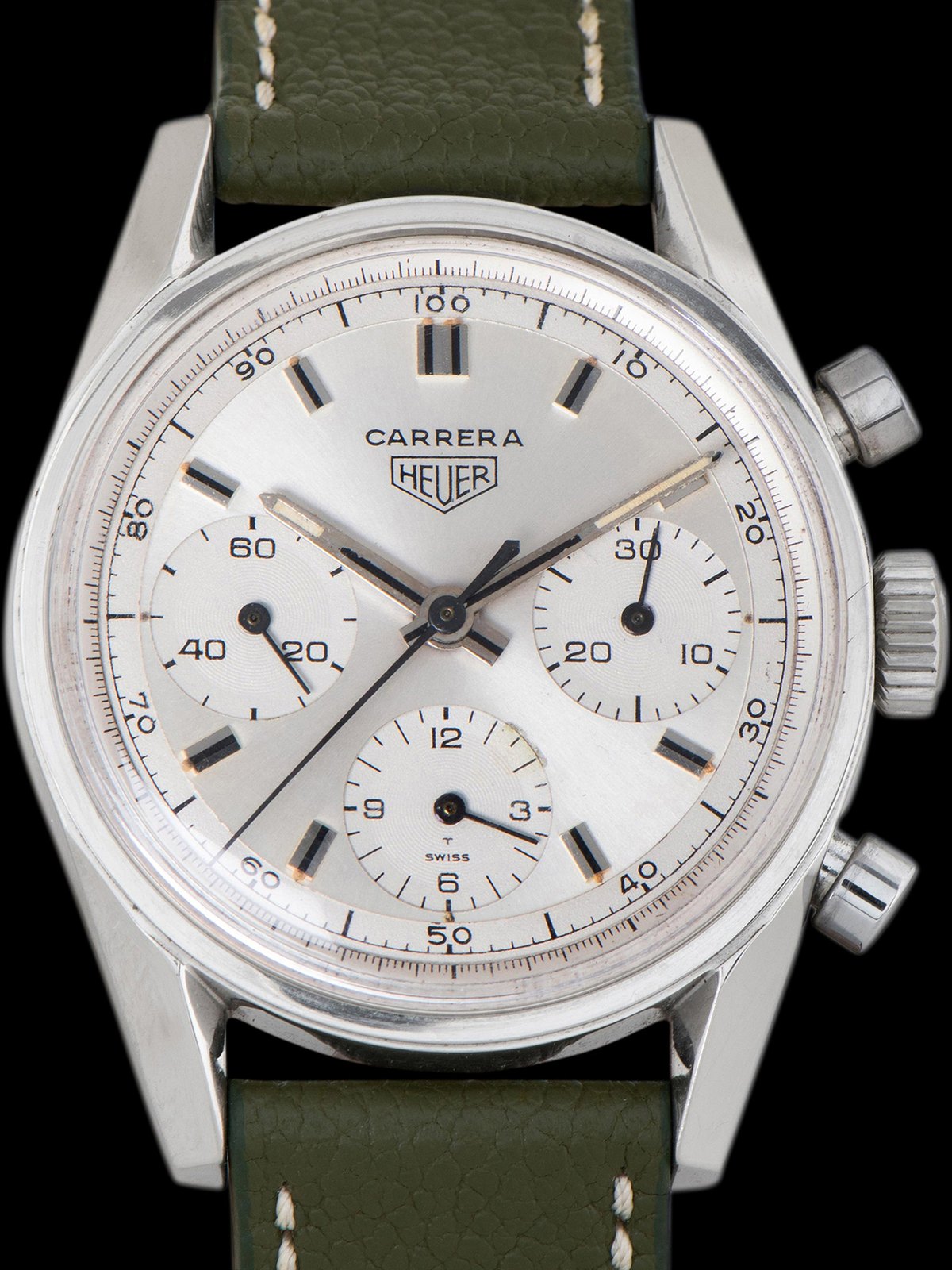
Heuer Carrera (1963)
Jack Heuer named the Carrera after the Carrera Panamericana, a dangerous road race in Mexico in the early 1950s. Launched in 1963, it was a deliberately clean chronograph for motorists, with a thin bezel and a tension ring inside the crystal carrying the minute or tachymeter scale, so that the dial stayed legible. Early Carreras use hand-wound Valjoux movements, and the many dial variants — decimal, tachymeter, pulsation — are carefully catalogued by collectors.
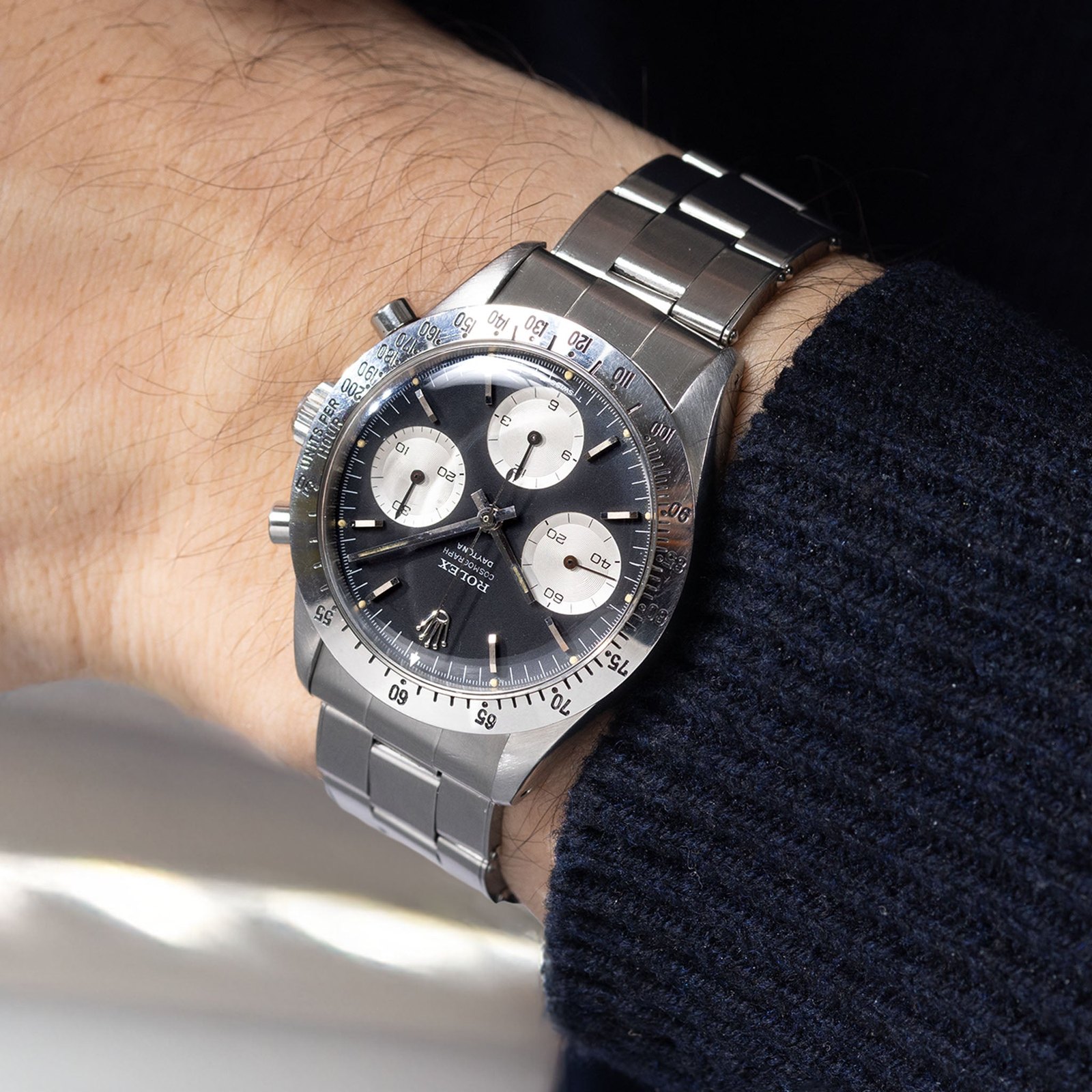
Rolex Cosmograph Daytona (1963)
Rolex's Cosmograph, later named after the Daytona race track in Florida, also appeared in 1963, with a tachymeter scale on the bezel and contrasting subdials. For years it sold slowly. Its fame came later, especially for the 'exotic' dials with Art Deco numerals now called 'Paul Newman' dials after the actor, whose own Daytona sold at auction in 2017 for a record price. The hand-wound references made until the late 1980s are the ones vintage collectors seek.
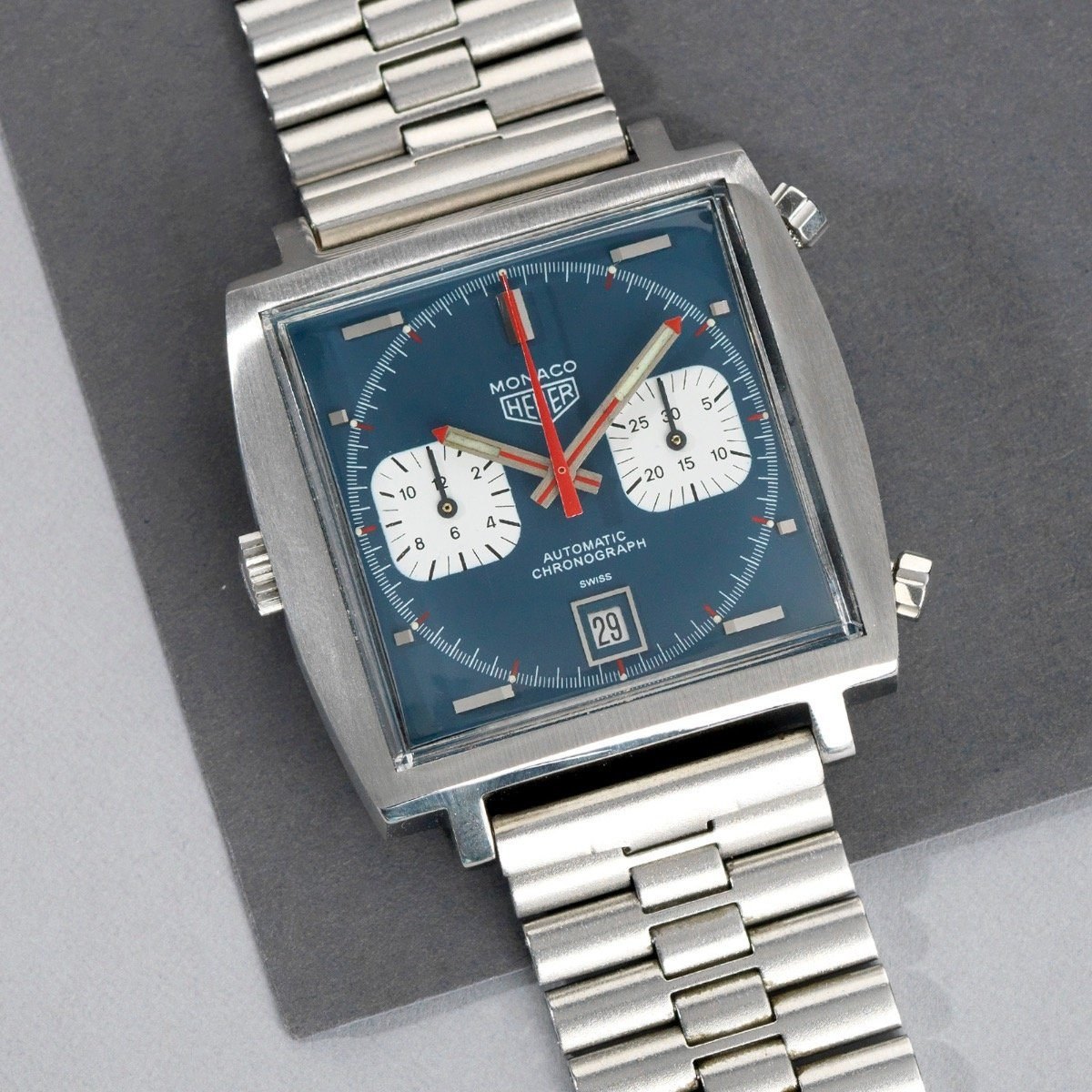
Heuer Monaco and the automatic chronograph (1969)
1969 was the year of the automatic chronograph. In March, Heuer, Breitling and Hamilton-Buren presented the jointly developed 'Calibre 11', a micro-rotor movement with a chronograph module, and Heuer used it in the Monaco, the first square water-resistant automatic chronograph. Steve McQueen wore a Monaco in the film Le Mans (1971), and it has been linked with him ever since. The Atlas movement guide to Calibre 11 explains how the movement was built.
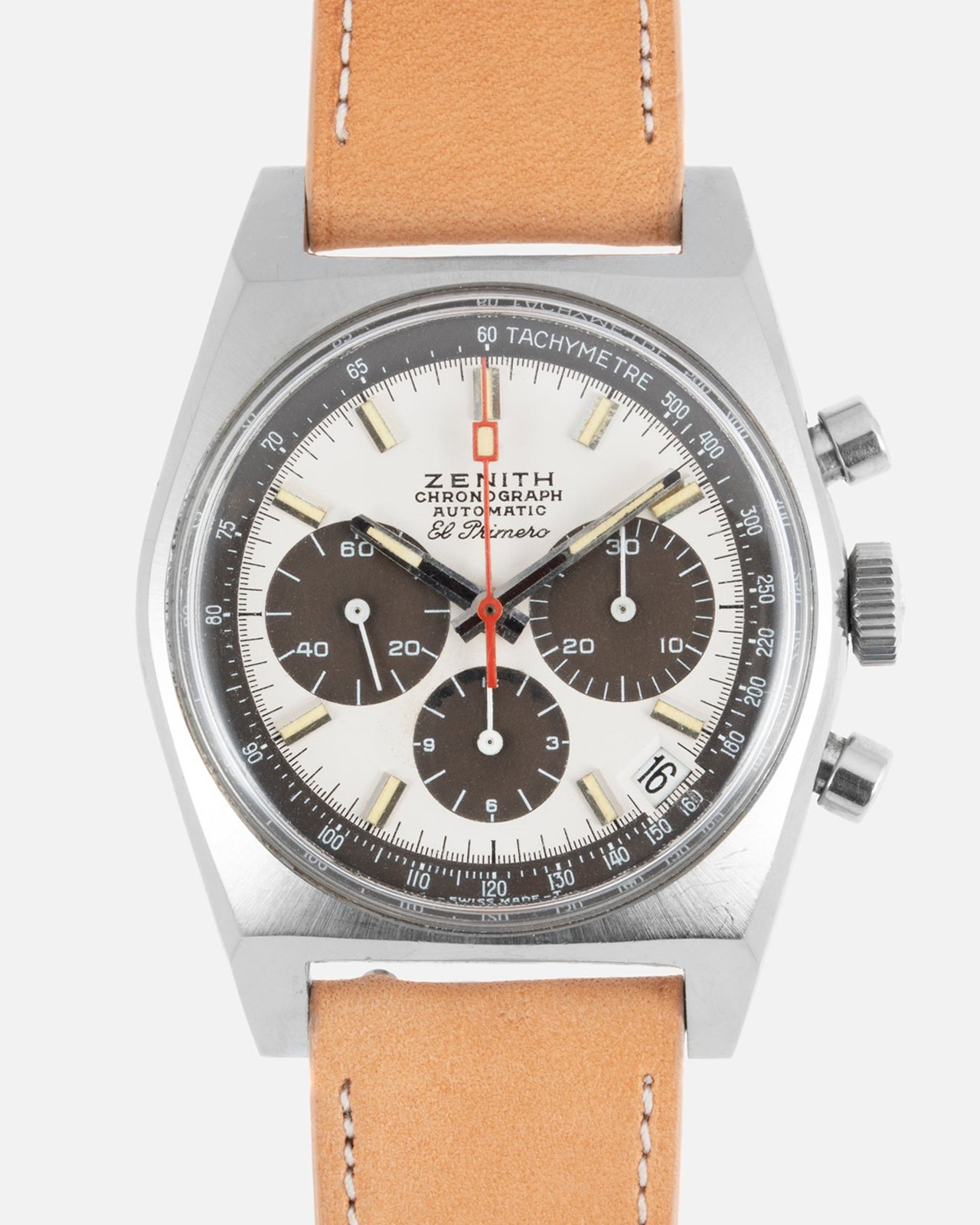
Zenith El Primero (1969)
In January 1969 Zenith announced the El Primero ('the first'), an integrated automatic chronograph movement running at 36,000 vibrations per hour, which allowed it to time to a tenth of a second. Together with the Calibre 11 and Seiko's calibre 6139, it was one of three automatic chronographs launched that year; each has supporters for the title of 'first'. The El Primero survived the quartz years and later powered the chronographs of other brands, including Rolex's Daytona from 1988.
The 1970s: the luxury steel sports watch
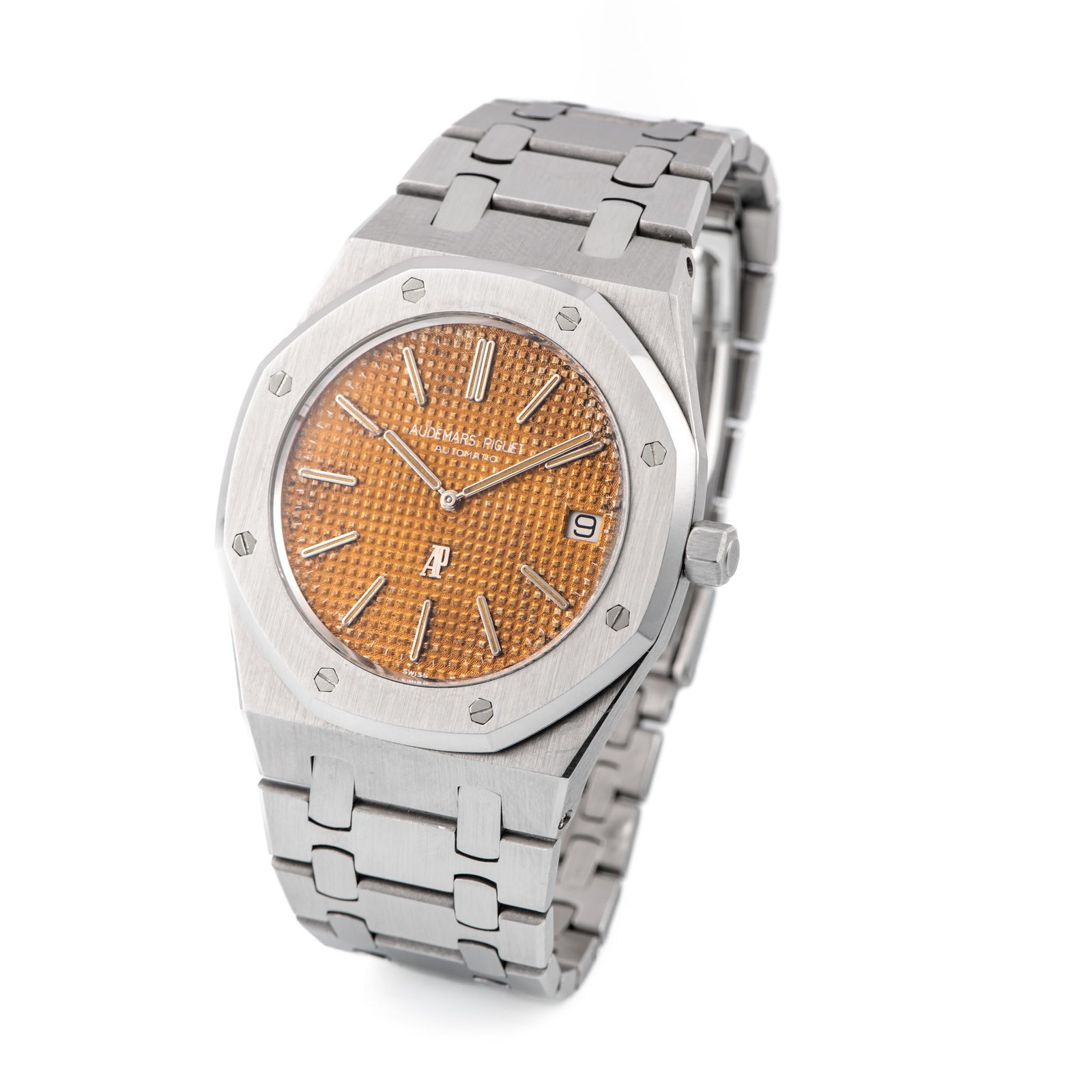
Audemars Piguet Royal Oak (1972)
In 1972, as cheap quartz watches began to threaten the Swiss industry, Audemars Piguet launched a luxury watch in steel. Designed by Gérald Genta, the Royal Oak has an octagonal bezel fixed by eight visible screws, an integrated bracelet and a 'tapisserie' patterned dial. At 39 mm it was large for its time — it is still called the 'Jumbo' — and it cost more than many gold watches. Its ultra-thin automatic calibre 2121 was based on a Jaeger-LeCoultre movement. The Royal Oak created the category of the luxury steel sports watch.
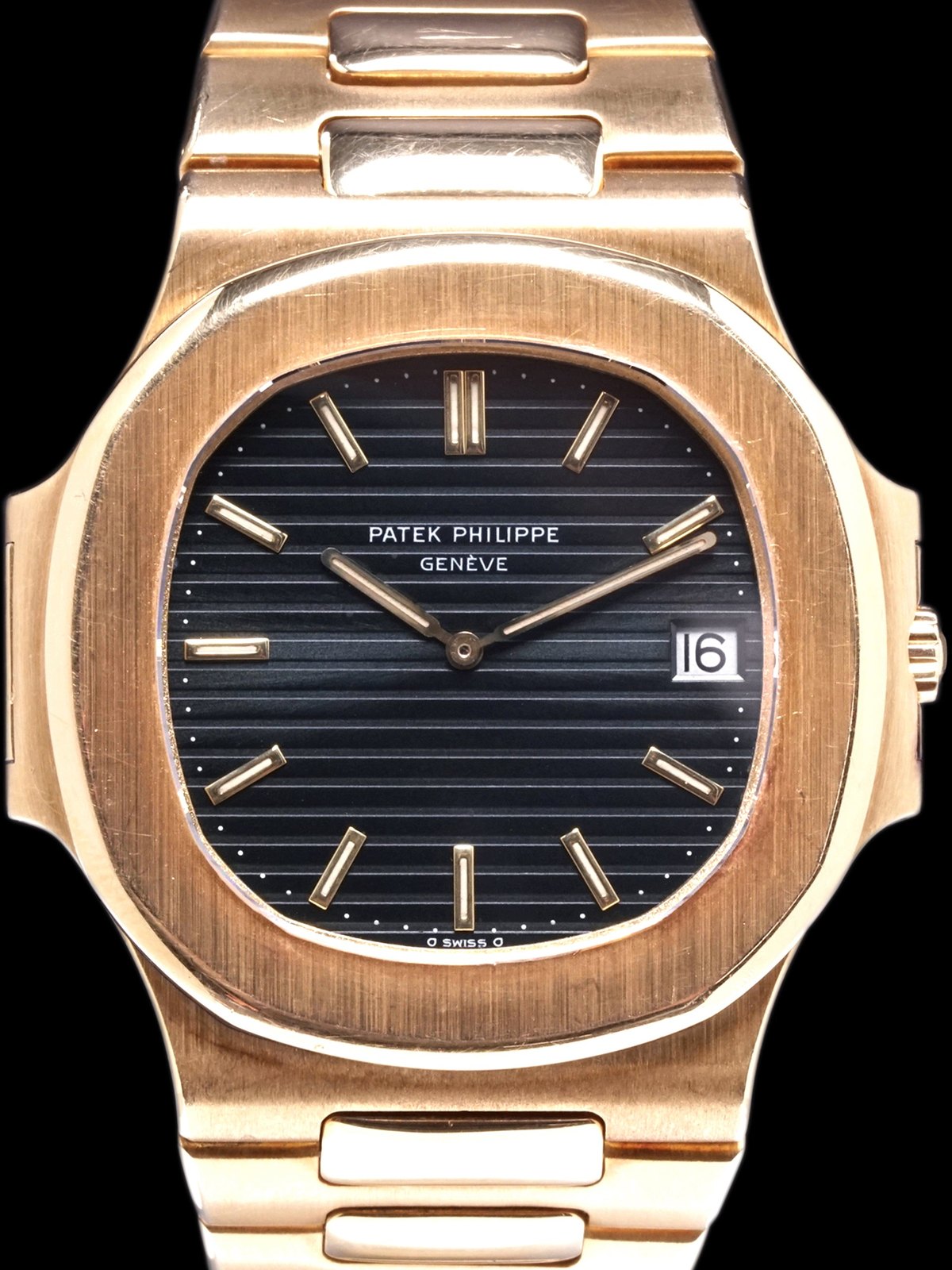
Patek Philippe Nautilus (1976)
Four years later Genta designed a steel sports watch for Patek Philippe. The Nautilus of 1976, reference 3700, takes its shape from a ship's porthole, with 'ears' at each side of a rounded octagonal bezel and a horizontally embossed dial. Like the Royal Oak it sold slowly at first; today it is one of the most sought-after watches made. Early 3700s are known as 'Jumbo' Nautiluses, and gold and two-tone versions were made alongside the steel.
The classics at a glance
| Watch | Introduced | Why it matters |
|---|---|---|
| Cartier Tank | 1917 (sold from 1919) | Defined the rectangular dress watch |
| Jaeger-LeCoultre Reverso | 1931 | Reversible case; Art Deco icon |
| Patek Philippe Calatrava 96 | 1932 | Template for the round dress watch |
| Rolex Datejust | 1945 | Self-winding chronometer with automatic date |
| IWC Mark 11 | 1948 | Anti-magnetic military navigator's watch |
| LeCoultre Memovox | 1950 | Successful alarm wristwatch; automatic from 1956 |
| Omega Constellation | 1952 | Automatic chronometers for everyday wear |
| Breitling Navitimer | Early 1950s | Slide-rule pilot's chronograph |
| Blancpain Fifty Fathoms | 1953 | Purpose-built diver's watch for French navy divers |
| Rolex Submariner | 1953–54 | Set the look of the modern diver's watch |
| Rolex Explorer | 1953 | Mountaineering watch named after Everest |
| Universal Genève Polerouter | 1954 | Genta design; micro-rotor automatic |
| Rolex GMT-Master | 1954–55 | Second time zone for airline pilots |
| Omega Speedmaster | 1957 | Bezel tachymeter; qualified by NASA, worn on the Moon |
| Hamilton Ventura | 1957 | First battery-powered wristwatch |
| Bulova Accutron | 1960 | Tuning-fork electronic watch |
| Seiko diver and 6139 | 1965 and 1969 | Japan's first diver; column-wheel automatic chronograph |
| Heuer Carrera | 1963 | Clean, legible racing chronograph |
| Rolex Cosmograph Daytona | 1963 | Bezel tachymeter; 'Paul Newman' dials |
| Heuer Monaco | 1969 | Square water-resistant automatic chronograph |
| Zenith El Primero | 1969 | Integrated 36,000 vph automatic chronograph |
| Audemars Piguet Royal Oak | 1972 | First luxury steel sports watch |
| Patek Philippe Nautilus | 1976 | Genta's porthole-shaped steel sports watch |
What collectors look for
Two watches of the same reference can be very different objects. Collectors judge a vintage watch above all by its originality and its condition, and the most important parts to check are the ones most often replaced.
- The dial: original dials, even with honest ageing, are preferred to refinished ('redialled') ones. Look for crisp printing, correct fonts and logos for the date, and luminous material that has aged evenly with the hands. Dials that have turned brown with age are called 'tropical' by collectors.
- The hands, crown, bezel and crystal: these were often replaced during servicing with later 'service' parts. A watch with service parts is still genuine, but it should be described as such.
- The case: sharp edges, bevels and engravings suggest a case that has not been heavily polished. Reference and serial numbers between the lugs or inside the case back should match the model and its period.
- The movement: the calibre should be correct for the reference, clean and complete, and signed by the maker. A movement from another watch is a serious fault.
- Papers and provenance: original guarantees, boxes, service records and archive extracts (offered by some makers, such as Patek Philippe) add to the story and help confirm the watch's history.
- 'Frankenwatches' and fakes: famous models are widely faked or assembled from parts of several watches. Compare with documented examples — such as the ones in this guide — and ask for clear photographs of the movement and case back.
Finally, a vintage watch is a machine that needs care. Have it serviced by a watchmaker who knows the calibre, treat any vintage watch as not water-resistant until it has been tested, and remember that the most interesting watches are not always the famous ones: many lesser-known makers produced watches of excellent quality, and the catalogue contains thousands of them.
Sources & further reading
- Technique and History of the Swiss Watch — Eugène Jaquet and Alfred Chapuis, Urs Graf (Olten), 1945 (French); English editions from 1953.
- Watches — David Thompson, British Museum Press (London), 2008.
- Manufacturing Time: Global Competition in the Watch Industry, 1795–2000 — Amy K. Glasmeier, Guilford Press (New York), 2000.
- A Business History of the Swatch Group — Pierre-Yves Donzé, Palgrave Macmillan, 2014.
- Revolution in Time: Clocks and the Making of the Modern World — David S. Landes, Harvard University Press, 1983.