
Wristwatches · Wristwatch
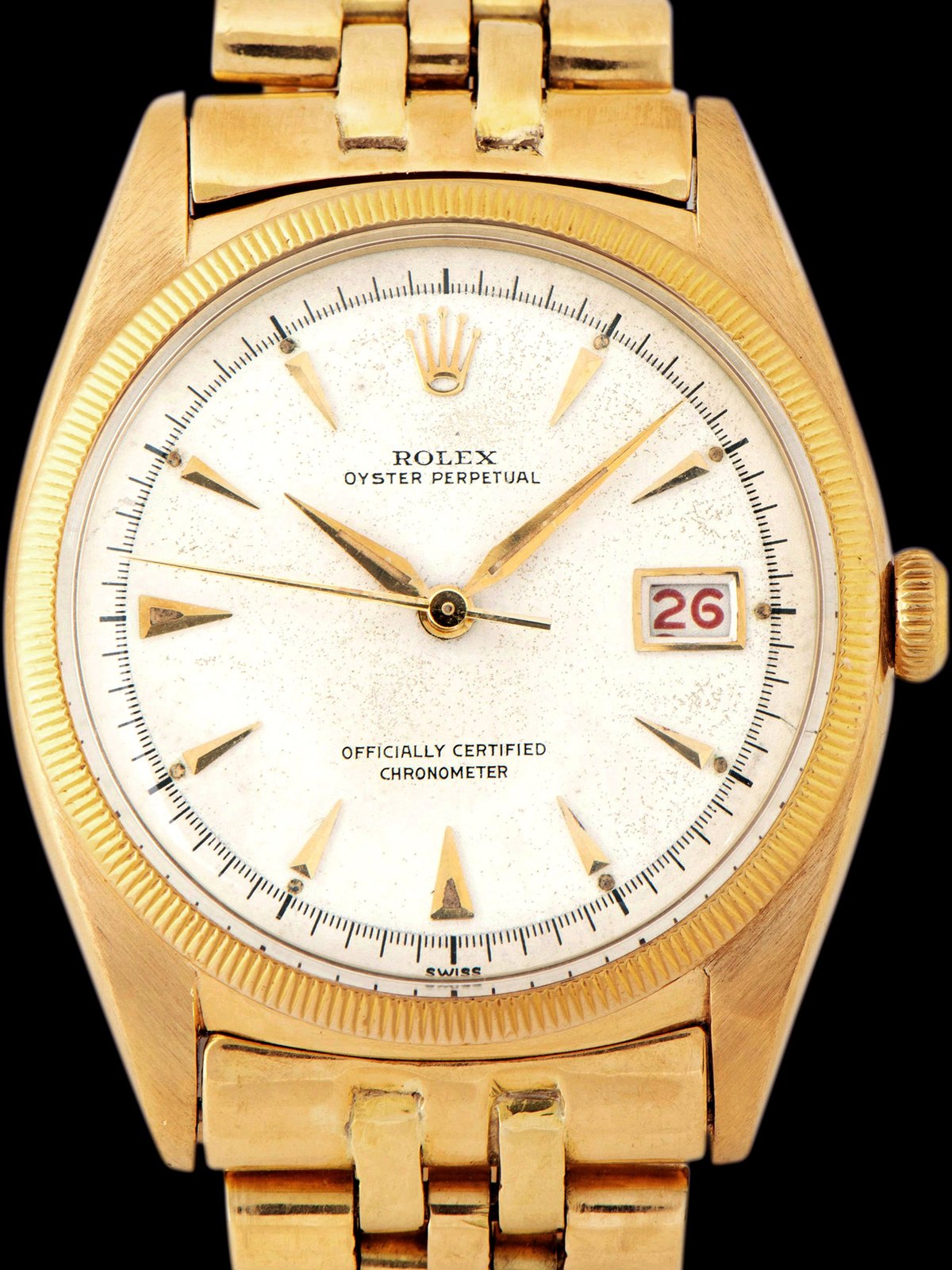
Rolex Datejust 18K YG (Ref. 6305) "Ovettone", 1953
- Maker / attribution
- Rolex (maker)
- Date
- 1953
- Historical period
- Modern Mechanical Horology (1945 – 1969)
- Country of origin
- Switzerland
- Object type
- Wristwatch
- Dimensions
- Case 36 mm
- Stock no.
- RLXDJ630518K
- Credit line
- Dealer listing, Craft & Tailored (RLXDJ630518K)
- Catalogue title (original)
- 1953 Rolex Datejust 18K YG (Ref. 6305) "Ovettone" (English)
View the source record (dealer listing) ↗ (opens another website in a new tab)Suggest a correction
Record summary
Catalogued by Craft & Tailored (dealer), Los Angeles (stock number RLXDJ630518K), this is a wristwatch by Rolex, made in Switzerland, dated 1953. The Atlas places it in the Modern Mechanical Horology period (1945 – 1969) of its Wristwatches collection. Recorded dimensions: Case 36 mm. The record is illustrated with 6 photographs.
Assembled from the source record's structured fields. Dates and attributions are given as the source states them; where a field is missing the Atlas leaves it blank rather than estimating.
Catalogue description
Dealer description — Craft & Tailored
The Rolex Datejust is one of the most iconic and beloved watches made by Rolex. Launched in 1945, it remains a timeless classic and is instantly recognizable as an item of superior quality and functional design. After Rolex introduced the Datejust in 1945, the brand entered a massive period of expansion that continued through the 1950s as they introduced model after model of now iconic timepieces, most of which still exist in some form today. Though this explosion in manufacturing resulted in impressive growth for the brand, it was also an extremely experimental time for Rolex as well which resulted in rapidly evolving designs. For each new improvement or design update Rolex introduced within a model, there was a new reference created to signify that change, thus resulting in numerous references created for a single model in a small timeframe with extremely small production periods. Making each new reference rare onto itself and for a specific reason. The earliest Datejust designs introduced had no "Datejust" branding on the dial, the model was only signified through the branding and advertising around the model itself. However, key design features have always been the pillars of the iconic Datejust, including the 36mm case, a fluted bezel, and of course the famous Jubilee bracelet. In the early 1950s, Rolex finally began to brand the Datejust dials which then became standard for the model, though a few examples made it off the production line still lacking the model name, and remain today as especially collectible and sought after among collectors for Rolex of this era specifically. "Ovettone" roughly translates from Italian as 'Big Egg' and is a term coined by collectors to represent early 36mm models that feature round case backs, more commonly seen in the smaller Bubble-Back Rolex model range, which is why "Ovettones" are also commonly referred to as "Big Bubble-Backs". SPECS Stock # RLXDJ630518K Brand Rolex Style Datejust Model 6305 Serial 98XXXX Size Men's Material 18K Yellow Gold Dial White "Aged" Millimeters 36 Bracelet Rolex "Swiss Made" 18K YG Jubilee Bracelet CASE & BRACELET The 18K yellow gold case is in genuinely impressive condition, especially when considering the age of the watch, showing extremely full and symmetrical lugs with only light signs of use while the original hallmark on the back of the case is fully present and intact. The original 18K yellow gold, coin-edge bezel also retains its original design integrity with minimal evidence of previous polishing present and crisp overall finishing throughout. The case retains its original "Rolex Oyster" Brevet screw-down crown. The early and well-preserved "Swiss Made" 18K yellow gold Rolex Jubilee bracelet dates to 1951 and is very likely orignial to the watch, the bracelet retains 18 links that show very mild stretch, especially when considering the age of the watch and will fit up to a 7-inch wrist. DIAL & HANDS The original, early, and impressively well-preserved white "pie-pan" dial is truly incredible, showing only subtle elements of age that add to the aesthetic charisma of the watch with no actually damage notably present. The radium lume plots around the dial and within the 6 and 9 o'clock markers all remain intact with expected yet only nominal in nature degradation present when inspected under UV light, and featuring and patina that varies in color between dark grey and brown. The orignial yellow gold alpha hands have aged more tan in color, under UV light inspection the minute hand features a missing portion of lume and remains stable while the hour hands remain fully intact. The all-red date wheel is original and era-correct for the reference. ACCESSORIES
Historical context
Modern Mechanical Horology (1945 – 1969)
Tool watches for divers, pilots and astronauts; electric watches anticipate the electronic age.
The classic era of the mechanical wristwatch: dive watches, chronographs for motor racing and space flight, GMT watches for jet travel, slim dress watches, automatic calendars, and the rise of Japanese manufacturers alongside Swiss, American, German and Soviet industries.
Read the period in the timelineMore wristwatches from this periodEarlier: Golden Age of Mechanical Watchmaking
Atlas type guide
Calendar, moon-phase and perpetual calendar watches
Calendar complications range from a simple date to the perpetual calendar, which automatically allows for months of different lengths and leap years until 2100. Pocket watches with perpetual calendars were made in the eighteenth and nineteenth centuries; Patek Philippe made the first perpetual calendar wristwatch in 1925, and series production followed in 1941. The annual calendar (Patek Philippe, 1996) needs correction only once a year.
Moon-phase displays use a disc with two moons and 59 teeth advanced daily, approximating the 29.5-day lunation; more precise trains reduce the error to one day in over a century.
What to look for
- Apertures or subsidiary dials for day, date, month and leap year.
- Moon disc under a 'bosom' shaped aperture.
- Recessed correctors on the case band for setting the calendar.
Dating clues
- Triple-date wristwatches: popular c. 1940–1955.
- Perpetual calendar wristwatches: from 1925 (unique) and 1941 (series).
General guidance written by the Atlas editors about this kind of object. It is not a statement about this particular piece; for that, rely on the source record above and on physical examination.
Related records

Movements & Components · c. 1970s
Rolex watch movement, c. 1970s
Antiquorum auction archive, Geneva

Pocket Watches · 1982
Fake Rolex watch, gold coloured metal, possibly made in Taiwan, 1982; part of a casual outfit, UK, 1982-84.
Victoria and Albert Museum, London

Wristwatches · c. 1920s
Rolex wristwatch, c. 1920s
Antiquorum auction archive, Geneva

Wristwatches · c. 1920s
Rolex wristwatch, ref. 6194, c. 1920s
Antiquorum auction archive, Geneva

Wristwatches · 1945
Wristwatch by Eterna, 1945
Museum Rotterdam

Wristwatches · c. 1945
Breitling Premier, ref. 790, c. 1945
Antiquorum auction archive, Geneva

Wristwatches · c. 1945
Universal Genève Uni-Compax, ref. 22492, c. 1945
Antiquorum auction archive, Geneva

Wristwatches · c. 1950s
Baume & Mercier wristwatch, c. 1950s
Antiquorum auction archive, Geneva