
Wristwatches · Wristwatch
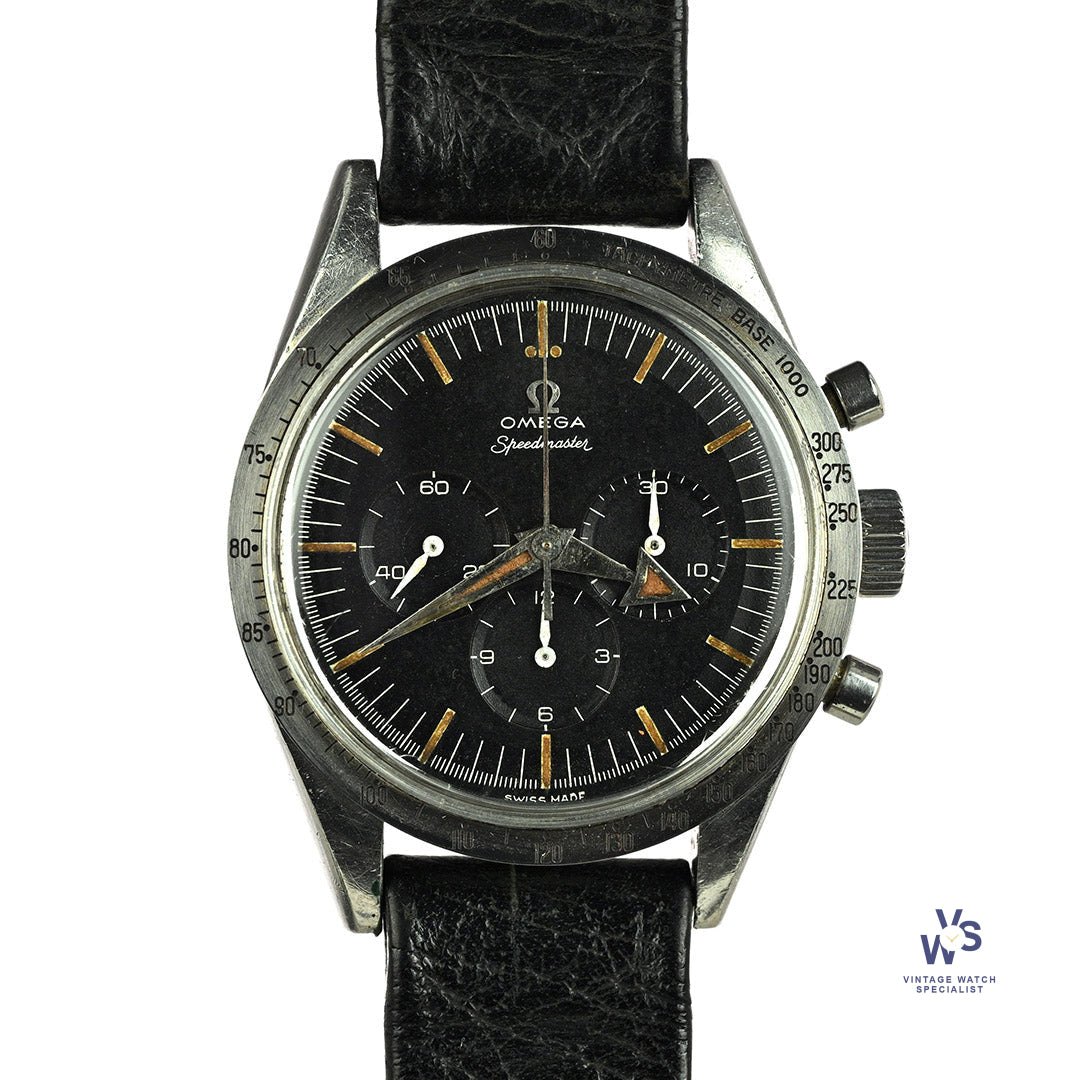
Omega Speedmaster CK 2915-1 Broad Arrow Chronograph, 1958
- Maker / attribution
- Omega (maker)
- Date
- 1958
- Historical period
- Modern Mechanical Horology (1945 – 1969)
- Country of origin
- Switzerland
- Object type
- Wristwatch
- Dimensions
- Case 38 mm
- Stock no.
- vws4054cs
- Credit line
- Dealer listing, Vintage Watch Specialist (vws4054cs)
- Catalogue title (original)
- Omega Speedmaster CK 2915-1 Broad Arrow Chronograph – 1958 (English)
View the source record (dealer listing) ↗ (opens another website in a new tab)Suggest a correction
Record summary
Catalogued by Vintage Watch Specialist (dealer), United Kingdom (stock number vws4054cs), this is a wristwatch by Omega, made in Switzerland, dated 1958. The Atlas places it in the Modern Mechanical Horology period (1945 – 1969) of its Wristwatches collection. Recorded dimensions: Case 38 mm. The record is illustrated with 6 photographs.
Assembled from the source record's structured fields. Dates and attributions are given as the source states them; where a field is missing the Atlas leaves it blank rather than estimating.
Catalogue description
Dealer description — Vintage Watch Specialist
An absolutely superb Omega Speedmaster Model Ref: CK 2915-1 in incredibly well-preserved condition with stunning pumpkin lume, sold with an Omega extract of archive and spare original waterproof crystal, issued 1958. The Omega Speedmaster, introduced in 1957 as a rugged racing chronograph, soon earned legendary status far beyond the track. By the mid-1960s it had become NASA’s official choice for manned spaceflight, surviving the agency’s notoriously brutal qualification tests. Worn on the Moon in 1969 by Buzz Aldrin, the Speedmaster became the first, and only, watch flight-certified for EVA. Today, it remains an icon of precision engineering, reliability, and true exploration heritage. What's on Offer We are delighted to present this exceptional Omega Speedmaster Reference CK 2915-1 , produced on 9 January 1958, as confirmed by its accompanying Omega Extract of the Archives. As the first version of the Speedmaster, the CK 2915-1 occupies an important position in the history of Omega chronographs. Its distinctive Broad Arrow hands, straight-lug stainless steel case and celebrated Calibre 321 movement immediately identify it with the earliest generation of the collection. The watch features a beautifully aged black dial with three recessed subsidiary registers, arranged in the familiar Speedmaster configuration. At 3 o'clock sits the 30-minute chronograph counter, with the 12-hour totaliser at 6 and the running seconds register at 9. The applied Omega symbol and traditional Speedmaster script are positioned beneath 12 o'clock, while the fine white minute track and contrasting subsidiary markings maintain the clean, functional appearance of the original design. Perhaps the most visually appealing feature is the wonderfully warm patina of the luminous hour markers and hands. The distinctive Broad Arrow hour hand and slender minute hand display rich orange-brown tones, complemented by the similarly aged hour markers. Against the black dial, the result is a particularly attractive example of the character collectors associate with early Speedmasters. The dial itself presents very well, retaining its strong contrast and distinctive vintage appearance. Case and Tachymeter Bezel The stainless steel case measures approximately 38mm across and features the straight lugs characteristic of the earliest Speedmaster references. Its proportions are noticeably different from the later asymmetrical Speedmaster Professional cases, giving the CK 2915 a more restrained appearance on the wrist. The case displays marks of wear consistent with its considerable age, while retaining its attractive overall profile. Surrounding the crystal is the distinctive steel tachymeter bezel, one of the defining design elements of the original Speedmaster. Importantly, the bezel fitted to this watch is a high-quality modern reproduction rather than the original component. This is clearly disclosed for collectors considering the watch's condition and configuration. The watch also features the characteristic chronograph pushers positioned above and below the winding crown. The Calibre 321 Movement Inside is Omega's legendary Calibre 321 , a manually wound, column-wheel chronograph movement with 17 jewels. This celebrated calibre powered the earliest Speedmasters and later accompanied the model into the space age, earning an enduring reputation among collectors. The movement has recently been serviced and is running well. Our watchmaker recorded a timegrapher reading of approximately +12 seconds per day, with an amplitude of 255 degrees at the time of testing. The watch is fitted with a black leather strap, which complements its understated appearance. Omega Extract of the Archives One of the most significant aspects of this particular example is its accompanying Omega Extract of the Archives , issued on 12 August 2008. The document records the watch as an Omega Speedmaster Pre-Moon chronograph, fitted with Calibre 321, and confirms its production date as 9 January 1958 . It also records a black dial with luminous hour markers and hands, together with the watch's original stainless steel bracelet specification. The extract states that the watch was delivered to Omega's official agent in Switzerland. This documentation provides valuable historical information about the watch's original production and delivery, adding considerable interest for collectors. The watch is also accompanied by a spare waterproof crystal with its ring, as described in the supplied inventory. An Important Early Speedmaster The CK 2915-1 represents the beginning of one of the most celebrated watch collections ever produced. With its distinctive Broad Arrow hands, beautifully aged black dial, serviced Calibre 321 movement and accompanying Omega archive documentation, this example has considerable historical and collector appeal. Although the replacement bezel is an important consideration, the watch remains a fascinating opportunity to acquire an early Speedmaster from the very first reference in the collection. For enthusiasts of vintage Omega, motorsport chronographs and the history of the Moonwatch, few models carry quite the same significance. Condition Report: Crystal: Excellent Dial: Very Good Bezel: Excellent Case: Very Good Movement: Serviced +12s/d 255° Overall: Excellent
Historical context
Modern Mechanical Horology (1945 – 1969)
Tool watches for divers, pilots and astronauts; electric watches anticipate the electronic age.
The classic era of the mechanical wristwatch: dive watches, chronographs for motor racing and space flight, GMT watches for jet travel, slim dress watches, automatic calendars, and the rise of Japanese manufacturers alongside Swiss, American, German and Soviet industries.
Read the period in the timelineMore wristwatches from this periodEarlier: Golden Age of Mechanical Watchmaking
Atlas type guide
Chronographs and split-seconds watches
A chronograph is a watch with an additional seconds hand that can be started, stopped and returned to zero independently of the timekeeping. Louis Moinet built an early example in 1816 and Nicolas Rieussec a recording 'chronographe' in 1821; Adolphe Nicole's heart-shaped reset cam (patented 1862) made the modern return-to-zero possible. Split-seconds (rattrapante) chronographs add a second hand that can be stopped for intermediate times; flyback chronographs restart instantly.
Chronographs were essential tools for doctors (pulsometer scales), artillery (telemeter), engineers and sport. In wristwatches, Valjoux, Venus, Lemania and later the automatic chronographs of 1969 (Zenith El Primero, the Chronomatic Calibre 11 group and Seiko 6139) are milestones.
What to look for
- Push-pieces on the case band or a single button in the crown (monopusher).
- Subsidiary registers for minutes and hours; tachymeter, telemeter or pulsometer scales.
- Column wheel versus cam control visible in the movement.
- Calibre markings of specialist makers (Valjoux, Lemania, Venus, Landeron).
Dating clues
- Pocket chronographs with heart cam reset: after 1862.
- Wrist chronographs: from c. 1910; two-button designs from the 1930s.
- Automatic chronographs: from 1969.
General guidance written by the Atlas editors about this kind of object. It is not a statement about this particular piece; for that, rely on the source record above and on physical examination.
Read next:Flyback chronographChronograph
Related records

Instruments · 1950–1976
Omega Megaquartz 2400 marine chronometer, 1950–1976
Science Museum Group, London

Instruments · 1960–1979
Stopwatch / timer by Omega, 1960–1979
Science Museum Group, London

Instruments · 1960–1979
Stopwatch / timer by Omega, Switzerland, 1960–1979
Science Museum Group, London

Instruments · 1960–1979
Stopwatch by Omega, Swiss made, single-button type reading 0 - 60 seconds in fifths and 0 - 5 minutes in minutes on subsidiary dial, 1960-79.
Science Museum Group, London

Wristwatches · 1945
Wristwatch by Eterna, 1945
Museum Rotterdam

Wristwatches · c. 1945
Breitling Premier, ref. 790, c. 1945
Antiquorum auction archive, Geneva

Wristwatches · c. 1945
Universal Genève Uni-Compax, ref. 22492, c. 1945
Antiquorum auction archive, Geneva

Wristwatches · c. 1950s
Baume & Mercier wristwatch, c. 1950s
Antiquorum auction archive, Geneva