
Wristwatches · Wristwatch
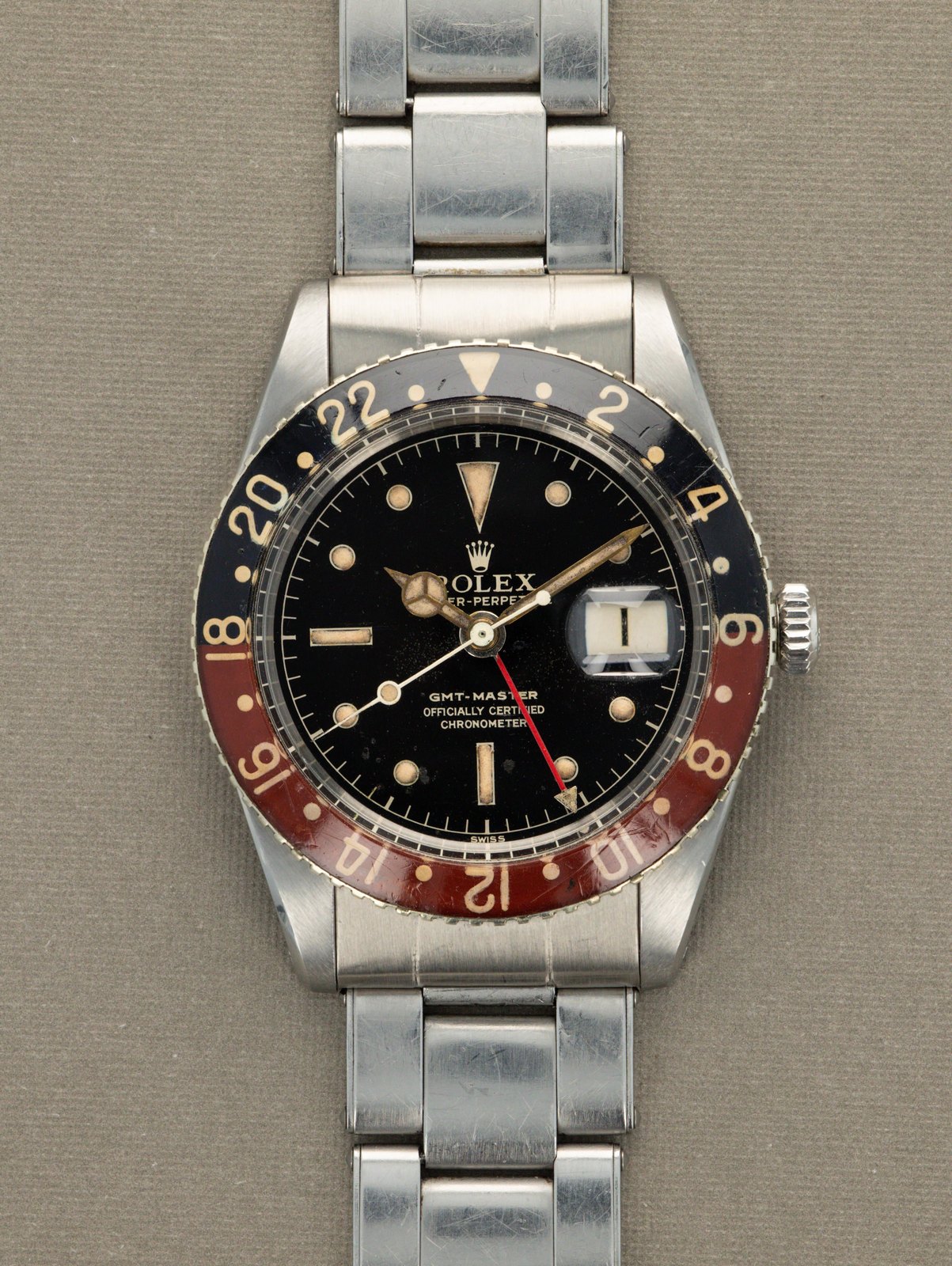
Rolex GMT-Master ref. 6542, 'Bakelite' Bezel
- Maker / attribution
- Rolex (maker)
- Date
- c. 1957
- Historical period
- Modern Mechanical Horology (1945 – 1969)
- Country of origin
- Switzerland
- Object type
- Wristwatch
- Dimensions
- Case 37 mm
- Stock no.
- OC2654
- Credit line
- Dealer listing, Oliver & Clarke (OC2654)
- Catalogue title (original)
- Rolex GMT-Master Ref. 6542 - 'Bakelite' Bezel (English)
View the source record (dealer listing) ↗ (opens another website in a new tab)Suggest a correction
Record summary
Catalogued by Oliver & Clarke (dealer), United Kingdom (stock number OC2654), this is a wristwatch by Rolex, made in Switzerland, dated c. 1957. The Atlas places it in the Modern Mechanical Horology period (1945 – 1969) of its Wristwatches collection. Recorded dimensions: Case 37 mm. The record is illustrated with 6 photographs.
Assembled from the source record's structured fields. Dates and attributions are given as the source states them; where a field is missing the Atlas leaves it blank rather than estimating.
Catalogue description
Dealer description — Oliver & Clarke
The Rolex GMT-Master is one of the most historic and iconic watches the brand ever produced. Its origin dates back to a commission request by Pan American World Airways in the early 50’s for their fleet of pilots who needed access to different time zones. These pieces would feature a similar design to another watch that Rolex was developing around that time, the Submariner, but would include a fourth hand running on 24-hr time, and a bi-colored bezel insert to represent AM/PM times. Those colors, naturally, would be the PanAm colors: Red & Blue. Thus, in 1954, the Ref. 6542 GMT-Master was born. While wold-time watches and even GMTs were not a new invention, the way Rolex chose to answer the request by PanAm was incredibly novel while also being simple and an elegant. A useful feature integrated into a watch that could be worn everyday, rather than a purpose built design strictly for a specific use-case. The example that we have here dates to circa 1957 and comes to us in strong overall condition. The 37mm Oyster case has been professionally restored to factory specification, with gorgeous lug chamfers visible throughout and a thick, symmetrical lug profile. Inside, the black 'gilt' dial with the attractive outer 'chapter ring' retains much of its glossy surface, with some minor wear and 'stippling' on the lower half. The luminous plots are even in color throughout and the gilt text is nicely preserved. The handset with the correct 'small' GMT hand matches the dial nicely. This piece also comes fitted to its correct 'rivet' Oyster bracelet with a 'big logo' clasp. An incredibly rare find these days. And then, of course, there is the [truly] iconic bezel insert. As the story goes, the very earliest Radium 'bakelite' inserts were actually recalled by Rolex and swapped out within just a few years of production for the units that we have here, which are considered to be accepted as 'original.' Thankfully, this example retains its period 'bakelite' insert with Tritium luminous material within. When it comes to 6542s, the largest factor of pricing and value hinges on this sole component. 6542s offer a wearing experience different than any modern GMT-Master. The slightly smaller case diameter, the glossy nature of the bezel insert combined with the depth of the colors, and the glossy 'gilt' dial inside all amount to something very special that only this reference can deliver. This is a strong, well-rounded piece and we are always thrilled to have one offered here on the site.
Historical context
Modern Mechanical Horology (1945 – 1969)
Tool watches for divers, pilots and astronauts; electric watches anticipate the electronic age.
The classic era of the mechanical wristwatch: dive watches, chronographs for motor racing and space flight, GMT watches for jet travel, slim dress watches, automatic calendars, and the rise of Japanese manufacturers alongside Swiss, American, German and Soviet industries.
Read the period in the timelineMore wristwatches from this periodEarlier: Golden Age of Mechanical Watchmaking
Atlas type guide
Military, pilot and travel watches
The wristwatch owes much of its adoption by men to warfare and aviation. Wristlets — small pocket watches soldered with lugs and worn on a strap — were used in colonial campaigns and became standard equipment in the First World War, with protective grilles over the crystal ('shrapnel guards'). Louis Cartier's Santos (1904), designed for the aviator Alberto Santos-Dumont, is often cited as an early purpose-made pilot's watch.
In the Second World War governments specified watches in detail: the German B-Uhr observation watches, the American A-11, and the British 'W.W.W.' (the 'Dirty Dozen' set of 1945). After the war, jet travel brought GMT and world-time watches, which show two or more time zones at once — Louis Cottier's world-time mechanism and the Rolex GMT-Master (1955) are examples.
What to look for
- Military markings on the case back: broad arrow, issue numbers, 'W.W.W.', 'A.T.P.'
- High-legibility black dials with luminous Arabic numerals; oversized crowns for gloved hands.
- 24-hour hands and rotating 24-hour bezels or city rings on GMT/world-time watches.
- Wire lugs on early wristlets converted from pocket watches.
Dating clues
- Wire-lug wristlets: c. 1900–1925.
- Military specifications of the Second World War: 1939–1945.
- GMT and world-time wristwatches: mainly after 1950.
General guidance written by the Atlas editors about this kind of object. It is not a statement about this particular piece; for that, rely on the source record above and on physical examination.
Related records

Movements & Components · c. 1970s
Rolex watch movement, c. 1970s
Antiquorum auction archive, Geneva

Pocket Watches · 1982
Fake Rolex watch, gold coloured metal, possibly made in Taiwan, 1982; part of a casual outfit, UK, 1982-84.
Victoria and Albert Museum, London

Wristwatches · c. 1920s
Rolex wristwatch, c. 1920s
Antiquorum auction archive, Geneva

Wristwatches · c. 1920s
Rolex wristwatch, ref. 6194, c. 1920s
Antiquorum auction archive, Geneva

Wristwatches · 1945
Wristwatch by Eterna, 1945
Museum Rotterdam

Wristwatches · c. 1945
Breitling Premier, ref. 790, c. 1945
Antiquorum auction archive, Geneva

Wristwatches · c. 1945
Universal Genève Uni-Compax, ref. 22492, c. 1945
Antiquorum auction archive, Geneva

Wristwatches · c. 1950s
Baume & Mercier wristwatch, c. 1950s
Antiquorum auction archive, Geneva