
Wristwatches · Wristwatch
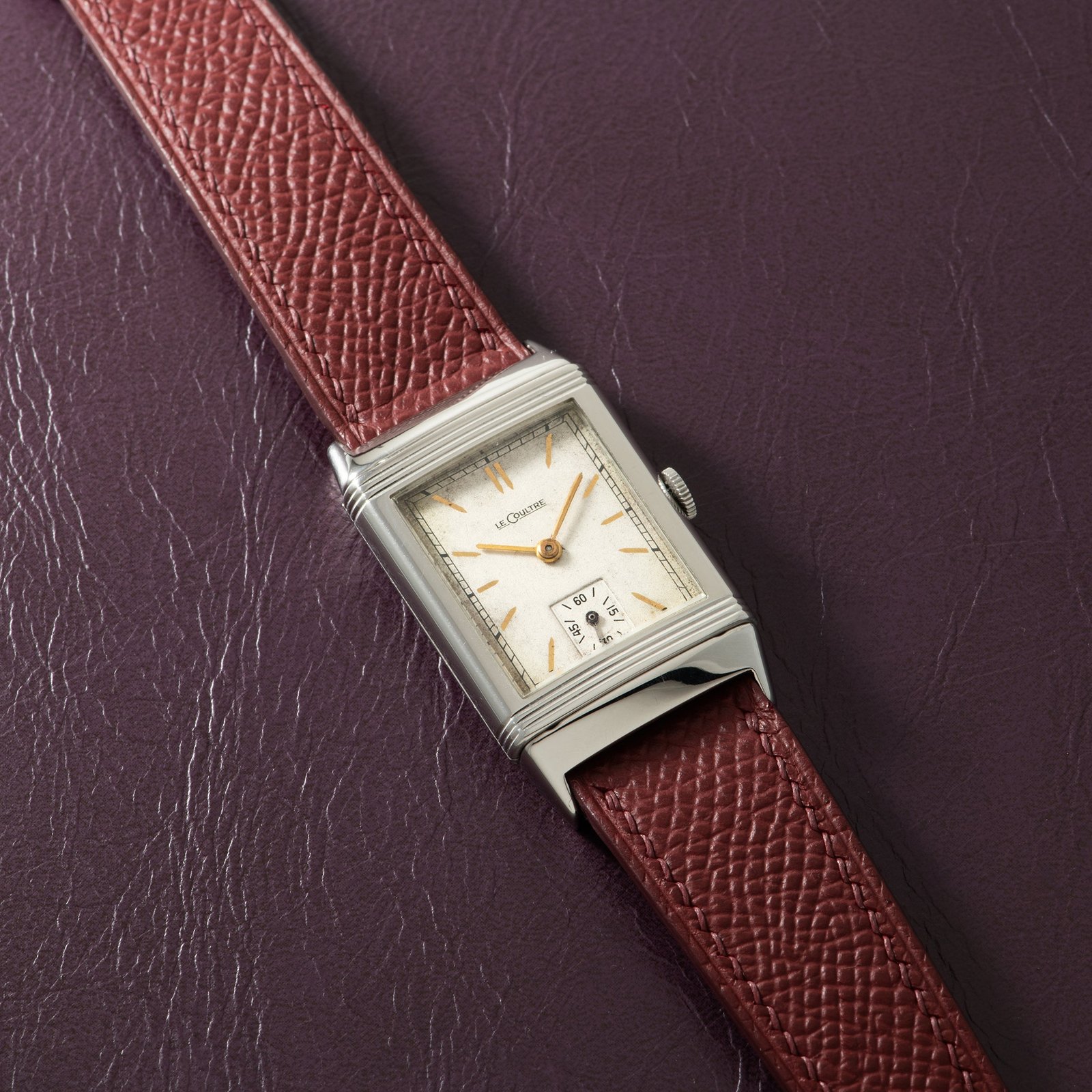
Jaeger-LeCoultre Reverso 1935
- Maker / attribution
- Jaeger LeCoultre (maker)
- Date
- c. 1935
- Historical period
- Golden Age of Mechanical Watchmaking (1900 – 1945)
- Country of origin
- Unrecorded in source
- Object type
- Wristwatch
- Stock no.
- 40980175
- Credit line
- Dealer listing, Analog/Shift (40980175)
- Catalogue title (original)
- Jaeger-LeCoultre Reverso 1935 (English)
View the source record (dealer listing) ↗ (opens another website in a new tab)Suggest a correction
Record summary
Catalogued by Analog/Shift (dealer), New York (stock number 40980175), this is a wristwatch by Jaeger LeCoultre, dated c. 1935. The Atlas places it in the Golden Age of Mechanical Watchmaking period (1900 – 1945) of its Wristwatches collection. The record is illustrated with 6 photographs.
Assembled from the source record's structured fields. Dates and attributions are given as the source states them; where a field is missing the Atlas leaves it blank rather than estimating.
Catalogue description
Dealer description — Analog/Shift
Some vintage watches come with boxes and papers. Occasionally, one comes with a life story. This extraordinary LeCoultre Reverso, dating to circa 1935, comes from the first few years of one of the most important wristwatch designs of the 20th century. The Reverso had been patented only in 1931, famously conceived as a solution for British officers in India who needed a watch capable of surviving the rigors of polo. Its ingenious answer was a rectangular case that could slide from its cradle, rotate, and turn its metal back outward to protect the crystal. What began as a piece of sporting ingenuity became an Art Deco icon. This example captures the design in beautifully pure early form. Its rectangular case features the signature horizontal gadroons above and below the dial, while the wonderfully aged silvered dial has developed a warm patina across more than 90 years. Applied baton indexes, slender hands, a geometric minute track, and a distinctive rectangular small-seconds display at 6 o’clock create a design that feels almost architectural. The dial is signed simply LeCoultre, appropriate for a watch produced before the Jaeger and LeCoultre names were formally united as Jaeger-LeCoultre in 1937. But flip this Reverso over, and the story becomes personal. The reverse is engraved with the initials “AK,” and unusually, we know something about the person behind them. Accompanying the watch are its original British bill of sale from the Goldsmiths & Silversmiths Company, a period photograph of the original owner, and a written family provenance tracing the watch back to Archibald Kelso. According to the accompanying history, the watch was a wedding gift from Lilian Simpson, his future wife. Simpson had worked as a ladies’ companion to Lady Bluckstein of the J. Lyons & Co. family. At the same time, Kelso was a Glasgow master confectioner and, reportedly, a baking tutor or supplier to Lyons. Suddenly those two engraved letters mean considerably more. The best vintage watches are objects that somehow survive after the people who originally owned them are gone. With an early Reverso, that history is especially poignant: the blank reverse of the case was conceived from the beginning as a place for initials, inscriptions, and personal expression. Here, the initials are still present, and remarkably, so is the story behind them.
Historical context
Golden Age of Mechanical Watchmaking (1900 – 1945)
The wristwatch displaces the pocket watch; waterproof cases, self-winding and grand complications.
The wristwatch overtook the pocket watch. Military use in the First World War, aviation, water-resistant cases (1926), automatic winding (1923–31), rectangular Art Deco designs and early chronographs and calendars defined the period.
Read the period in the timelineMore wristwatches from this periodEarlier: Industrial Revolution
Atlas type guide
Wristwatches
Bracelet watches were worn by women from the early nineteenth century — Breguet made one for Caroline Murat, Queen of Naples, in 1810–12 — but the wristwatch only became a man's instrument with military use and aviation in the early twentieth century. Between the World Wars it overtook the pocket watch; the 1920s and 1930s brought rectangular Art Deco cases, water-resistant cases and the first automatic winding systems.
After 1945 the wristwatch became a carrier of identity — dress watches, sports and dive watches, chronographs, calendars — produced by Swiss, American, Japanese, German, Soviet and Chinese industries. The quartz revolution after 1969 and the mechanical renaissance since the 1990s, including the rise of independent watchmakers, complete the story.
What to look for
- The reference number (between the lugs or inside the case back) and serial number, the starting point for dating.
- The calibre: its maker and number are often stamped under the dial or on the bridge.
- Originality of dial, hands and crown — refinished ('redial') dials are common.
- Case material marks: 18K/750, 14K/585, stainless steel, gold-filled, plated.
Dating clues
- Wire-lug cases: before c. 1925.
- Water-resistant screw-down cases: from 1926.
- Quartz movements: from 1969; sapphire crystals widespread after c. 1980.
General guidance written by the Atlas editors about this kind of object. It is not a statement about this particular piece; for that, rely on the source record above and on physical examination.
Related records
Wristwatches · 1953–1956
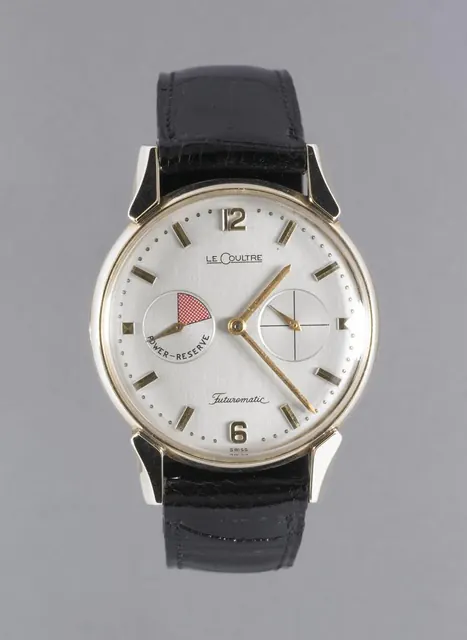
Automatic wristwatch with subsidiary seconds and power-reserve dial
British Museum
Wristwatches · mid 1960s
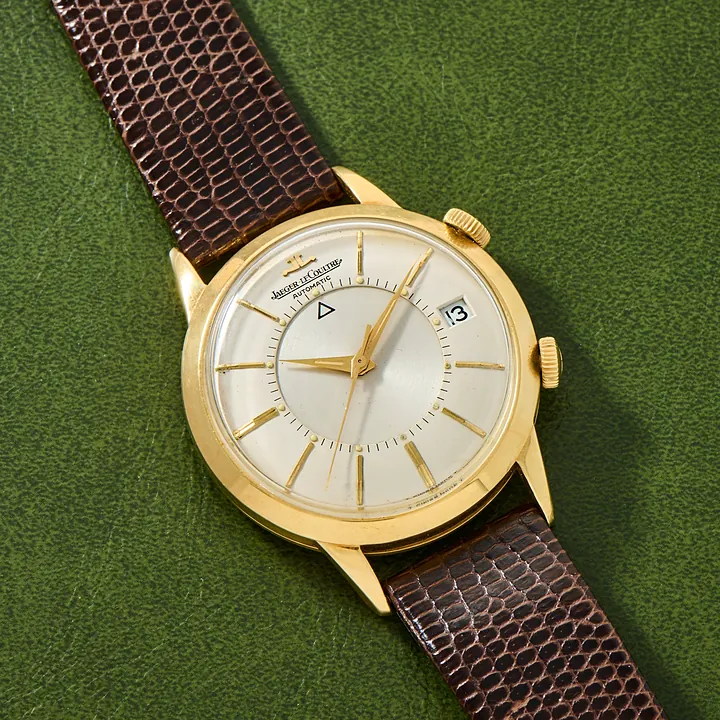
Jaeger-LeCoultre Memovox, mid 1960s
Analog/Shift (dealer), New York
Wristwatches · 1960
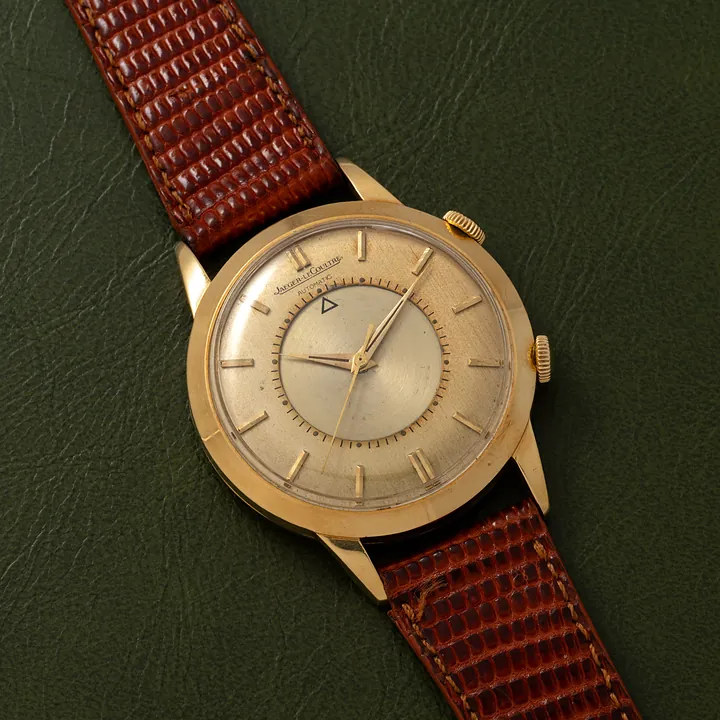
Jaeger-LeCoultre 'European Market' Memovox, 1960
Analog/Shift (dealer), New York
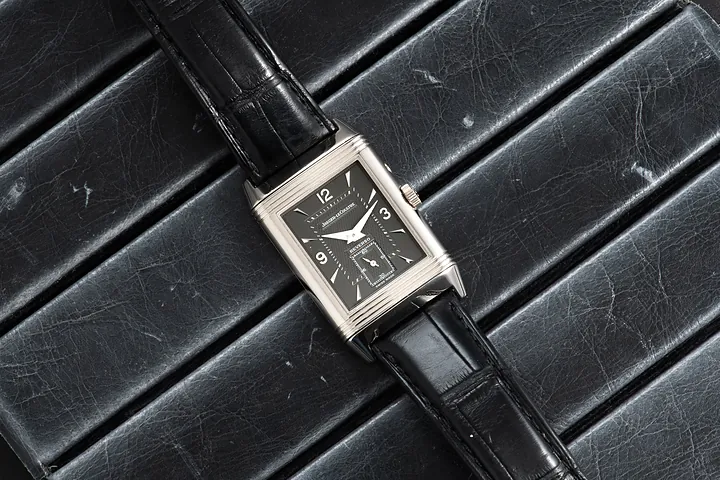
Wristwatches · 2010s
Jaeger-LeCoultre Reverso Duoface Day/Night, 2010s
Analog/Shift (dealer), New York
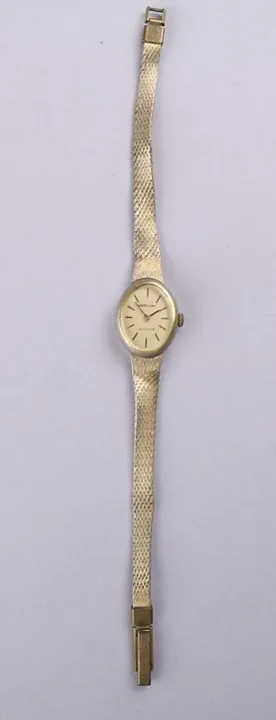
Wristwatches · 1900–1999
Wristwatch by Mercury, 1900–1999
Modemuseum Hasselt
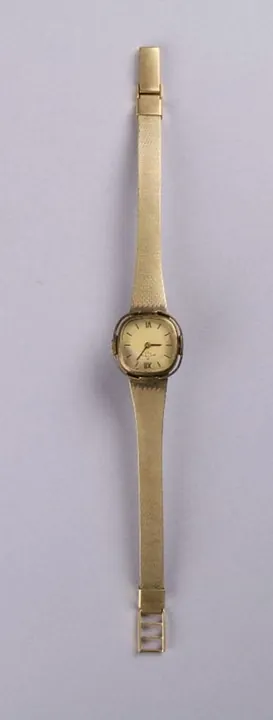
Wristwatches · 1900–1999
Wristwatch by Nutrix, 1900–1999
Modemuseum Hasselt

Wristwatches · 1920
Wristwatch, 1920
Modemuseum Hasselt

Wristwatches · 1931
Rolex 'Oyster Perpetual' rotor self-winding wrist-watch, lever escapement, in steel case with glass in back, Montres Rolex SA, Geneva, Switzerland, 1931
Science Museum Group, London