
Wristwatches · Self-winding watch
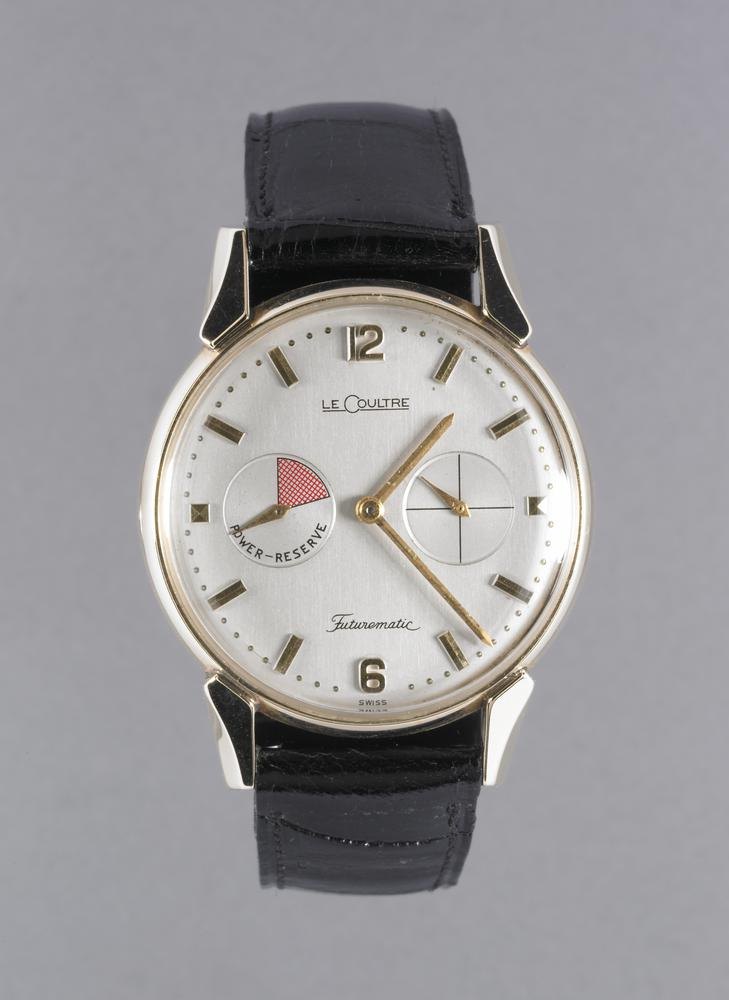
Automatic wristwatch with subsidiary seconds and power-reserve dial
- Maker / attribution
- Jaeger LeCoultre (Made by)
- Date
- 1953–1956
- Historical period
- Modern Mechanical Horology (1945 – 1969)
- Country of origin
- Switzerland
- Place
- Sentier, Le, United States
- Object type
- Self-winding watch
- Dimensions
- Diameter: 35 millimetres Height: 31.50 millimetres Length: 162 millimetres (presentation box) Width: 110 millimetres
- Holding institution
- British Museum
- Accession / object no.
- 1988,0409.3
- Credit line
- British Museum, London
- Catalogue title (original)
- Automatic wristwatch with subsidiary seconds and power-reserve dial (English)
View the source record ↗ (opens another website in a new tab)Suggest a correction
Record summary
Held and catalogued by British Museum (object number 1988,0409.3), this is a self-winding watch by Jaeger LeCoultre, made in Sentier, Le, United States, Switzerland, dated 1953–1956. The Atlas places it in the Modern Mechanical Horology period (1945 – 1969) of its Wristwatches collection. Recorded dimensions: Diameter: 35 millimetres Height: 31.50 millimetres Length: 162 millimetres (presentation box) Width: 110 millimetres. The record is illustrated with 3 photographs.
Assembled from the source record's structured fields. Dates and attributions are given as the source states them; where a field is missing the Atlas leaves it blank rather than estimating.
Catalogue description
Description — British Museum
Automatic wristwatch with subsidiary seconds and power-reserve dial. Movement with club-tooth lever escapement and automatic winding. Silvered-metal dial with raised gold hour numerals; 12 and 6 in Arabic and batons for remainder; subsidiary dials for seconds and state of wind. Hand setting button mounted on the back of the case. 14ct gold case with snap-on back. Black leather wrist-strap. Complete with presentation box and guarantee etc.
Curator's comments — British Museum
Text from 'Watches', by David Thompson, London, 2008, p. 152-153. Jaeger-LeCoultre AUTOMATIC WRISTWATCH LE SENTIER, SWITZERLAND, 1953 SIGNED: 'LECOULTRE Futurematic' The name LeCoultre is well known in the world of watches and has a history dating back to the nineteenth century. The origins of the company are quite complex,… involving a number of changes of partnerships and financial arrangements with other firms that developed fine-quality steels for the watch industry and manufactured watch components and the machinery for making them. The partnership between LeCoultre and Jaeger began in 1915, when Jacques-David LeCoultre, in collaboration with the Parisian watchmaker Edmond Jaeger, designed a revolution counter for use in aircraft. Just two years later the alliance was cemented in a venture to sell high-quality watches. The company Jaeger-LeCoultre was formalized in 1926 and production began of new and innovatory watches such as the 'Duoplan', in which the movement was arranged on two separate levels, allowing a normal-sized man's wristwatch to be compressed to about one third of its size. Jaeger-LeCoultre is also renowned for producing very small watches. Its calibre 101 watch measured just 14 mm in diameter and 4.85 mm thick, and was described in 1940 as the smallest watch in the world. Following the successful introduction by John Harwood of the first automatic winding wristwatch in 1929 (see registration no. 1958,1201.1179), it became clear that there were still problems to be overcome. One was to reduce the wear on the pivots of the winding weight, and another was to find a suitable method of stopping the winding mechanism when the mainspring was fully wound. The 'Futurematic' watch, first developed by Jaeger-LeCoultre in 1952, has some unique features. The movement used is LeCoultre's calibre 497, a 17-jewelled watch with lever escapement and automatic winding. An oscillating winding weight, centrally mounted on the back of the movement, provides automatic winding while the watch is worn. In rotation, the movement of the weight in both directions is transferred to the mainspring barrel to wind the spring. There is also a state-of-wind indicator to inform the wearer how much reserve is left in the mainspring. The system relies on a pinion that is turned as the mainspring is wound by the moving weight. As the mainspring is wound, a small lever is turned by the winding action. This lever carries a pin, which eventually comes into the path of the winding weight, on which is mounted a hook. The pin catches the hook and holds the weight in a locked position so that no more winding can take place. As the watch runs, the mainspring runs down. In doing so, the pin moves out of the hook's way and allows the winding weight to move freely again to wind up the mainspring. Very little motion is necessary to start the watch going as the mainspring is 'set up', meaning that it is partially wound even when the watch has run down. A peculiar feature of this watch is the lack of a winding button and stem in the usual position at 3 o'clock in the edge of the case. Instead there is a sliding button on the back of the case for setting the time. When the button is moved across to the hand-set position, it causes a detent to intercept the oscillating balance while the hands are being set, so that precise setting can be achieved. As soon as the button is moved out of its hand-setting position, the watch begins to tick again at a rate of 18,000 beats per hour, a standard for modern wristwatches. View more about curator's comments Comment from Richard Good, Catalogue of Watches in the British Museum. Vol. V (Unpublished manuscript) Made by Le Coultre Switzerland, c. 1950 Gold cased self winding wrist watch with power reserve indication and with a club tooth lever escapement. Signature: On the dial "LECOULTRE Futurematic SWISS". On the winding weight 'LECOULTRE UNADJUSTED SWISS 497' in a rectangle. On the front plate 497/1 1069218 and on the cock an import 'VXN'. Case: A 14ct gold case two piece. Stamped inside the snap on back is 'CASED AND TIMED IN THE USA BY LECOULTRE 14 K GOLD' and the Le Coultre trade mark. The button on the back of the case is stamped 'DO NOT LIFT SLIDE'. This button carries a hand set wheel which is within the case and is mounted on a circlip, which is on a boss on the inside of the case back. Dial & Hands: A silvered and grained dial with raised gilt numerals 6 and 12 and batons at the other hours. Two sunk subsidiary dials, one for the power reserve and the other for the seconds, this has just 4 lines for the 15, 30, 45 and 60 seconds. The up-and-down dial is marked 'POWER RESERVE' and has a red segment for the last eight hours of available running time, see section on the up-and-down work. Gilt hands the hour and minute baton type with the other two hands of lozenge design. The dial is held on by a small side clamp which also positions it. This clamp fits a notch in the dial edge. On the dial side of the weight when it is as far in the clockwise direction as it will travel, a part seconds scale printed on it in the appropriate position may be used to time the watch to the second. Movement: Ebauche Marks: On the front plate is the number 1069218 and the calibre number 497/1. Frame: A nickel silver movement of complex construction. Under the barrel bridge is scratched very neatly 'VIII'. Letting down the mainspring is carried out before working on the movement. The screw with the triple slotted head is held by the screwdriver as the ratchet which appears through a hole in the balance cock is released. The mainspring can then be let down in a controlled fashion by means of the screwdriver. Barrel and Mainspring: There is stopwork on the going barrel which is fundamentally of the differential screw type.(1) A disc is mounted on a thread on the barrel arbor. This disc is prevented from turning by two screws which are mounted on the barrel cover. These screws pass through holes in th.
Inscriptions & marks
inscription; CASED AND TIMED IN USA BY LE COULTRE 14K GOLD [case back]; inscription; LE COULTRE Futurematic Swiss [dial]; inscription; SEVENTEEN 17 JEWELS LE COULTRE Co UNADJUSTED SWISS 497 [winding weight]; mark; 497/1 1069218 [front plate]; mark; VXn [balance cock]; inscription; LE COULTRE [wrist-strap]
Provenance
Purchased from:, James Dowling
Historical context
Modern Mechanical Horology (1945 – 1969)
Tool watches for divers, pilots and astronauts; electric watches anticipate the electronic age.
The classic era of the mechanical wristwatch: dive watches, chronographs for motor racing and space flight, GMT watches for jet travel, slim dress watches, automatic calendars, and the rise of Japanese manufacturers alongside Swiss, American, German and Soviet industries.
Read the period in the timelineMore wristwatches from this periodEarlier: Golden Age of Mechanical Watchmaking
Atlas type guide
Automatic (self-winding) watches
Self-winding watches use the wearer's motion to wind the mainspring. Abraham-Louis Perrelet and Breguet made 'perpétuelle' pocket watches with oscillating weights in the late eighteenth century, but the principle only became practical in the wristwatch. John Harwood patented a bumper automatic in 1923; Rolex's Perpetual rotor (1931) winding in one direction, and later bidirectional rotors (Eterna, Felsa Bidynator), established the modern form. Micro-rotors (Universal Genève, Buren) and peripheral rotors made automatic watches thinner.
What to look for
- A semicircular rotor turning 360° over the movement, or a 'bumper' weight that rebounds between springs.
- 'Automatic', 'Perpetual' or 'Self-winding' on the dial.
- A sealed screw-back case, since automatic watches are wound less often by the crown.
Dating clues
- Bumper automatics: 1923–c. 1955.
- Full rotors: from 1931 (Rolex); widespread after c. 1950.
- Micro-rotors: from 1954–1958.
General guidance written by the Atlas editors about this kind of object. It is not a statement about this particular piece; for that, rely on the source record above and on physical examination.
Related records
Wristwatches · mid 1960s
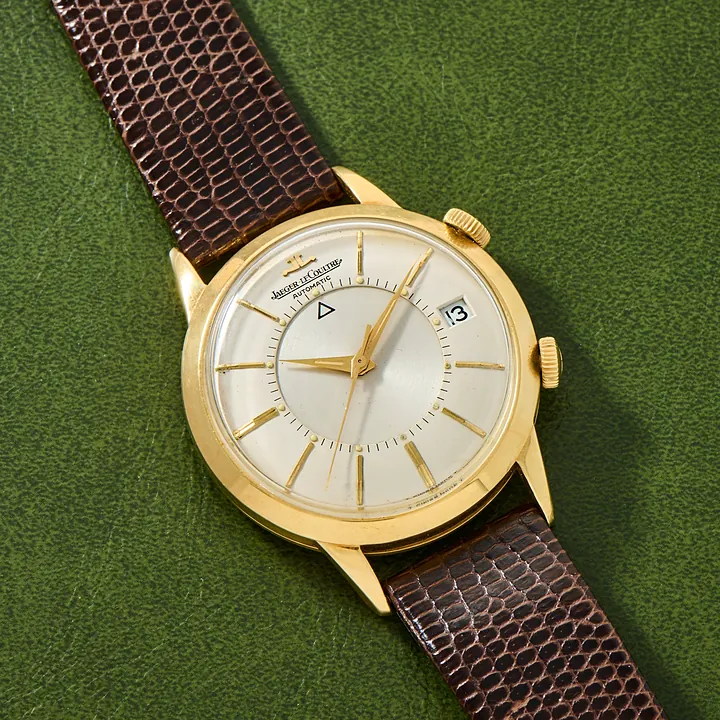
Jaeger-LeCoultre Memovox, mid 1960s
Analog/Shift (dealer), New York
Wristwatches · 1960
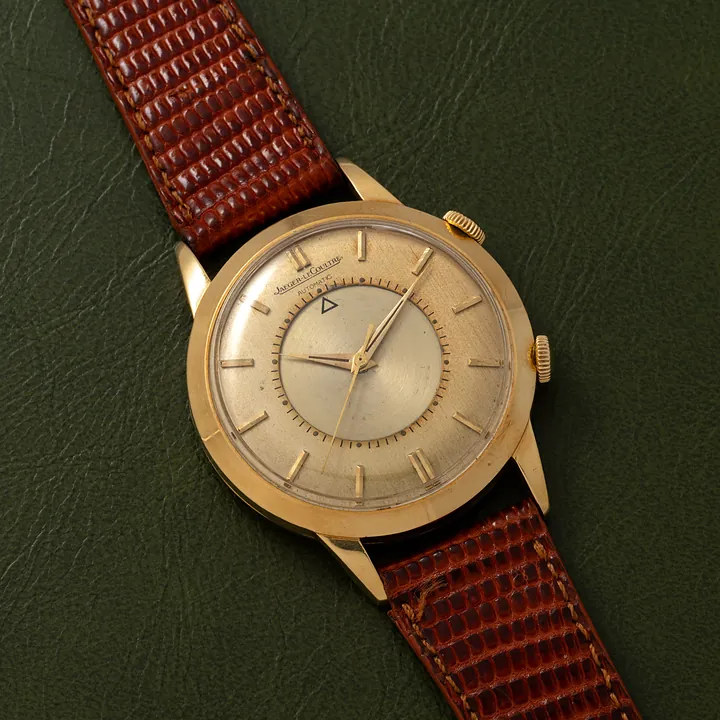
Jaeger-LeCoultre 'European Market' Memovox, 1960
Analog/Shift (dealer), New York
Wristwatches · 2010s
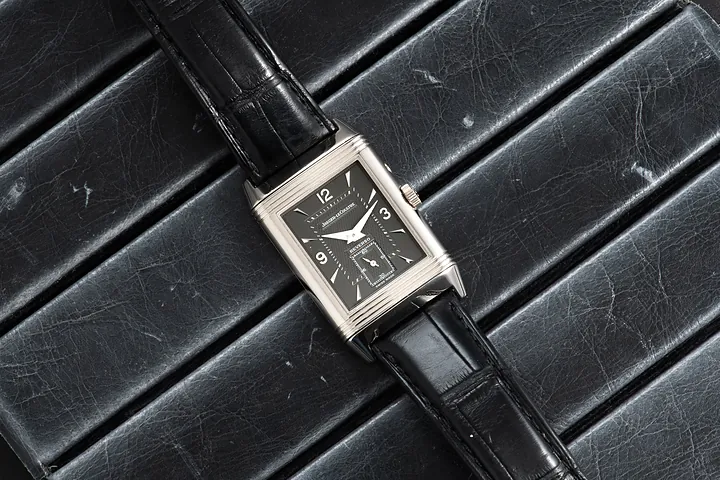
Jaeger-LeCoultre Reverso Duoface Day/Night, 2010s
Analog/Shift (dealer), New York
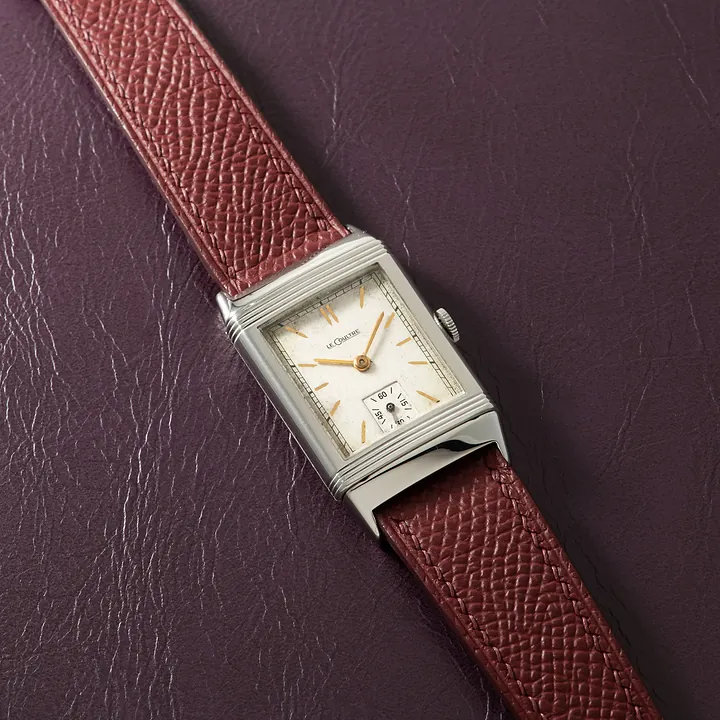
Wristwatches · c. 1935
Jaeger-LeCoultre Reverso 1935
Analog/Shift (dealer), New York

Wristwatches · 1945
Wristwatch by Eterna, 1945
Museum Rotterdam

Wristwatches · c. 1945
Breitling Premier, ref. 790, c. 1945
Antiquorum auction archive, Geneva

Wristwatches · c. 1945
Universal Genève Uni-Compax, ref. 22492, c. 1945
Antiquorum auction archive, Geneva

Wristwatches · c. 1950s
Baume & Mercier wristwatch, c. 1950s
Antiquorum auction archive, Geneva