
Wristwatches · Wristwatch
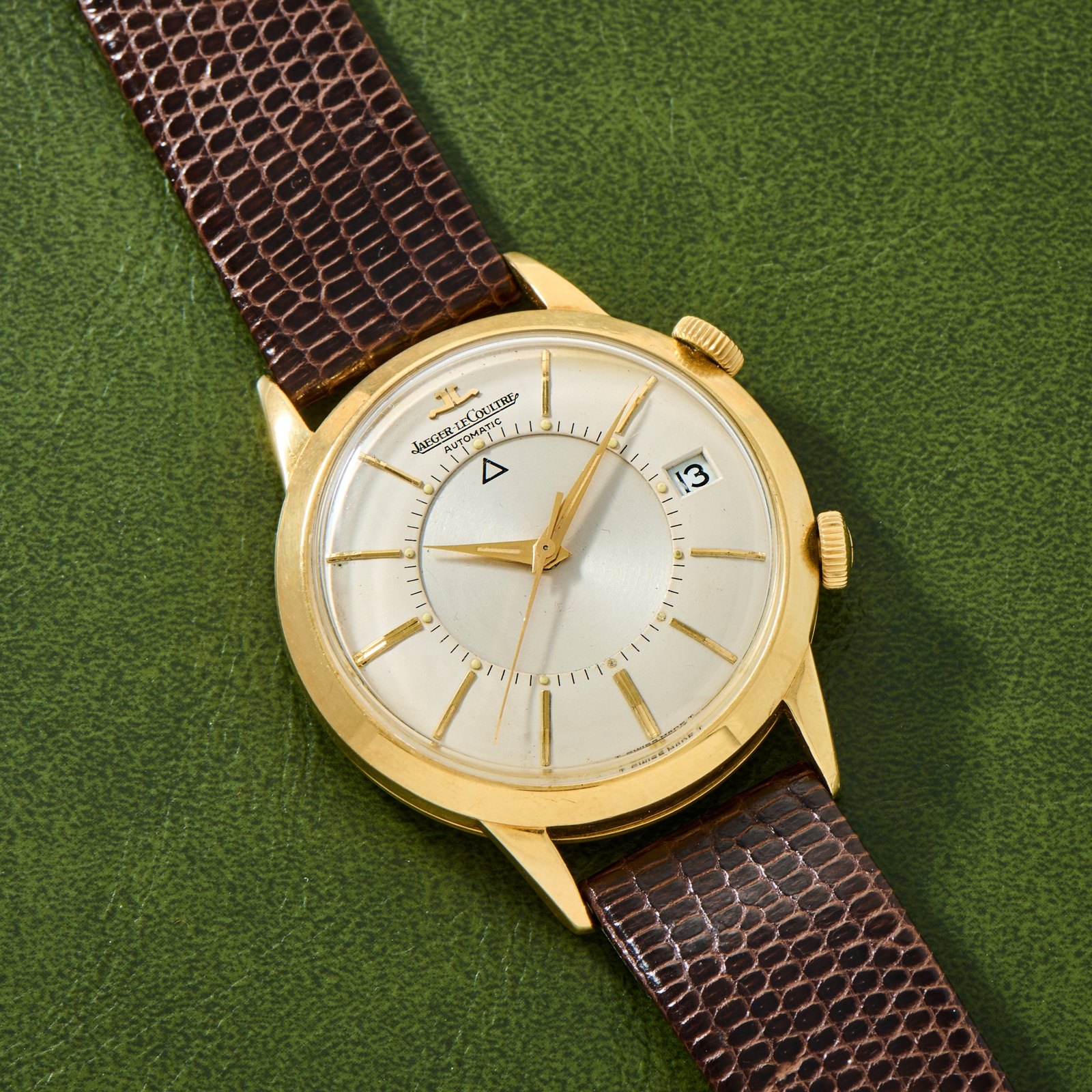
Jaeger-LeCoultre Memovox, mid 1960s
- Maker / attribution
- Jaeger LeCoultre (maker)
- Date
- mid 1960s
- Historical period
- Modern Mechanical Horology (1945 – 1969)
- Country of origin
- Unrecorded in source
- Object type
- Wristwatch
- Dimensions
- Case 37 mm
- Stock no.
- 40980124
- Credit line
- Dealer listing, Analog/Shift (40980124)
- Catalogue title (original)
- Jaeger-LeCoultre Memovox (English)
View the source record (dealer listing) ↗ (opens another website in a new tab)Suggest a correction
Record summary
Catalogued by Analog/Shift (dealer), New York (stock number 40980124), this is a wristwatch by Jaeger LeCoultre, dated mid 1960s. The Atlas places it in the Modern Mechanical Horology period (1945 – 1969) of its Wristwatches collection. Recorded dimensions: Case 37 mm. The record is illustrated with 6 photographs.
Assembled from the source record's structured fields. Dates and attributions are given as the source states them; where a field is missing the Atlas leaves it blank rather than estimating.
Catalogue description
Dealer description — Analog/Shift
The first time one hears a mechanical alarm is a moment few watch collectors will ever forget. For a generation that has only ever known the annoying buzz of an smartphone, the mechanical ring seems wholly other-worldly — a lost sound from a forgotten era. While the mechanical alarm was produced by myriad brands in an array of designs and executions, Jaeger-LeCoultre's Memovox is generally considered the benchmark of the category. Though it was introduced in 1950 as a manually-wound watch — the upper crown wound the spring for the alarm function while the lower crown wound the timekeeping mainspring — automatic models quickly became the norm beginning in 1959. By the early 1960s, the Memovox had become a mainstay in JLC's lineup, adept at mixing innovation, style, and utility. Operation of the alarm function simple, and is controlled via the top crown: Winding it charges a spring and holds it under tension until the alarm goes off. Pulling the same crown out allows one to rotate the inner dial and align the triangle on the inner ring with the time at which one desires the alarm to activate. Once activated, simply pulling the top crown out will silence the alarm, allowing the user to set a new time in the manner of a snooze button. JLC offered the Memovox in many expressions, some of which were sold in the European market, and some of which were sold in the American market. This Reference E855 is of the former variety and is notable for its oversized, waterproof 37mm case and luxurious 18K yellow gold construction. Boasting dual signed crowns, thick lugs, a smooth bezel, and an acrylic crystal, it features a handsome, two-tone champagne dial with applied 'stick' indices; an inner alarm dial with luminous 'dot' five-minute indices; a luminous 'dauphine' handset; and a date display at 3 o'clock. Powered by the automatic Jaeger-LeCoultre cal. K825 movement and paired to a brown leather alligator strap with a yellow gold pin buckle, this early Memovox dating to the mid-1960s is in splendid condition, with even patination to the luminous elements, a sharp case, and scant signs of wear. Over 70 years old, it's ready to enjoy a second life on the wrist of an appreciative owner — preferably one who needs a break from his or her smartphone! This spectacular piece comes from the collection of Zaf Basha, a noted authority on Jaeger-LeCoultre who has published two books: Vintage Military Watches: A Guide for the Collector and Jaeger-LeCoultre: The Ultimate Guide for the Collector. Over the years, Basha put together one of the most impressive assemblages of vintage JLC timepieces in the world, and we're thrilled and honor to offer many of them for sale on Analog:Shift.
Historical context
Modern Mechanical Horology (1945 – 1969)
Tool watches for divers, pilots and astronauts; electric watches anticipate the electronic age.
The classic era of the mechanical wristwatch: dive watches, chronographs for motor racing and space flight, GMT watches for jet travel, slim dress watches, automatic calendars, and the rise of Japanese manufacturers alongside Swiss, American, German and Soviet industries.
Read the period in the timelineMore wristwatches from this periodEarlier: Golden Age of Mechanical Watchmaking
Atlas type guide
Wristwatches
Bracelet watches were worn by women from the early nineteenth century — Breguet made one for Caroline Murat, Queen of Naples, in 1810–12 — but the wristwatch only became a man's instrument with military use and aviation in the early twentieth century. Between the World Wars it overtook the pocket watch; the 1920s and 1930s brought rectangular Art Deco cases, water-resistant cases and the first automatic winding systems.
After 1945 the wristwatch became a carrier of identity — dress watches, sports and dive watches, chronographs, calendars — produced by Swiss, American, Japanese, German, Soviet and Chinese industries. The quartz revolution after 1969 and the mechanical renaissance since the 1990s, including the rise of independent watchmakers, complete the story.
What to look for
- The reference number (between the lugs or inside the case back) and serial number, the starting point for dating.
- The calibre: its maker and number are often stamped under the dial or on the bridge.
- Originality of dial, hands and crown — refinished ('redial') dials are common.
- Case material marks: 18K/750, 14K/585, stainless steel, gold-filled, plated.
Dating clues
- Wire-lug cases: before c. 1925.
- Water-resistant screw-down cases: from 1926.
- Quartz movements: from 1969; sapphire crystals widespread after c. 1980.
General guidance written by the Atlas editors about this kind of object. It is not a statement about this particular piece; for that, rely on the source record above and on physical examination.
Related records
Wristwatches · 1953–1956
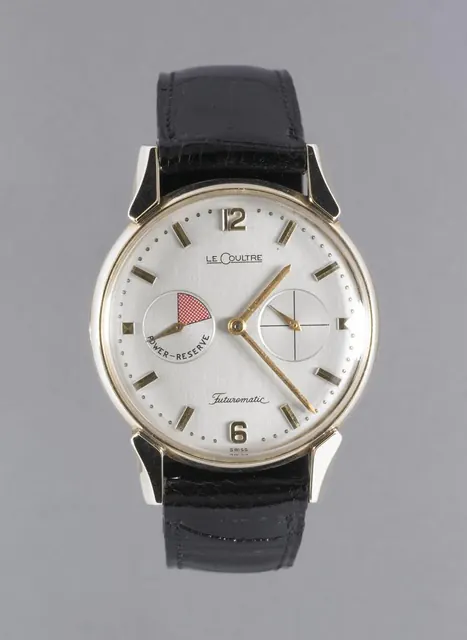
Automatic wristwatch with subsidiary seconds and power-reserve dial
British Museum
Wristwatches · 1960
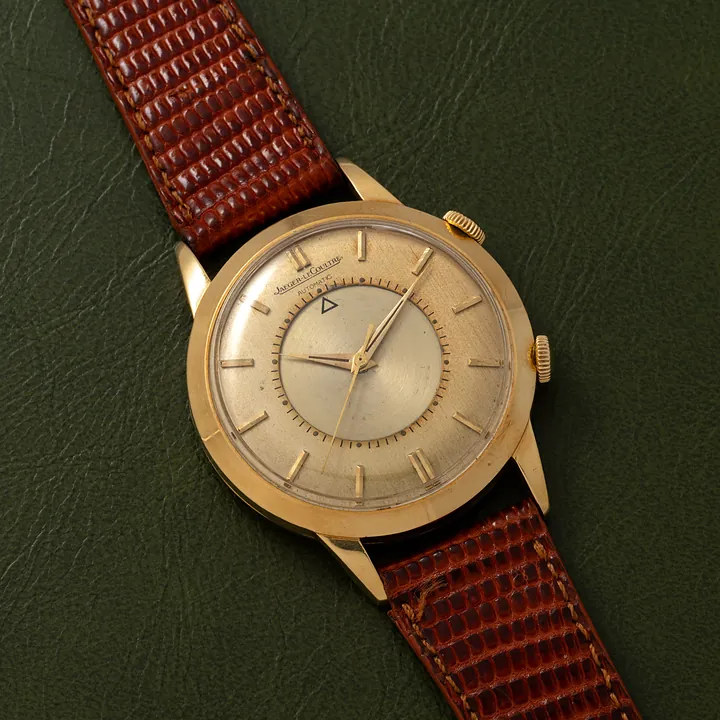
Jaeger-LeCoultre 'European Market' Memovox, 1960
Analog/Shift (dealer), New York
Wristwatches · 2010s
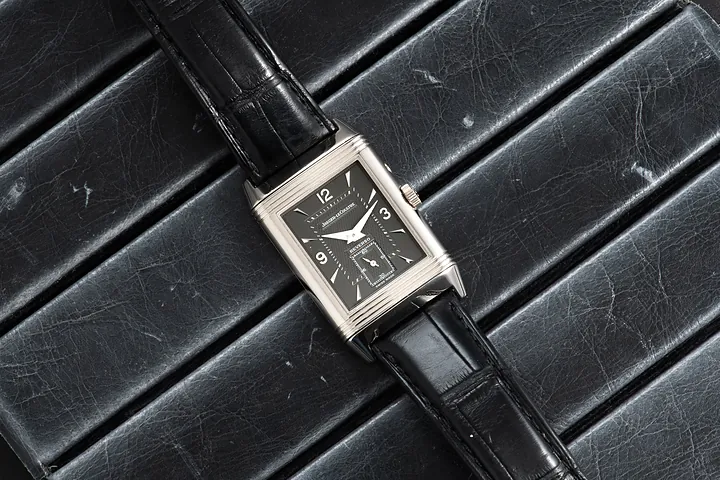
Jaeger-LeCoultre Reverso Duoface Day/Night, 2010s
Analog/Shift (dealer), New York
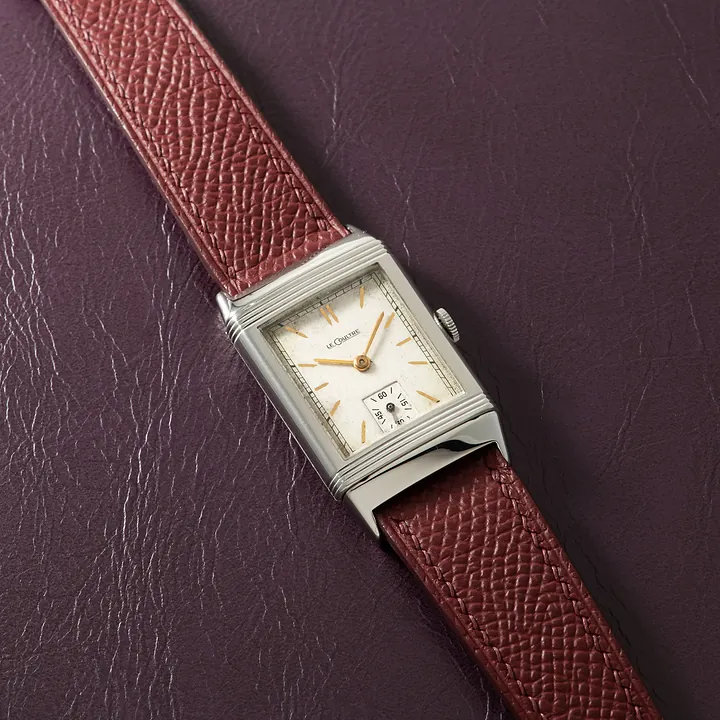
Wristwatches · c. 1935
Jaeger-LeCoultre Reverso 1935
Analog/Shift (dealer), New York

Wristwatches · 1945
Wristwatch by Eterna, 1945
Museum Rotterdam

Wristwatches · c. 1945
Breitling Premier, ref. 790, c. 1945
Antiquorum auction archive, Geneva

Wristwatches · c. 1945
Universal Genève Uni-Compax, ref. 22492, c. 1945
Antiquorum auction archive, Geneva
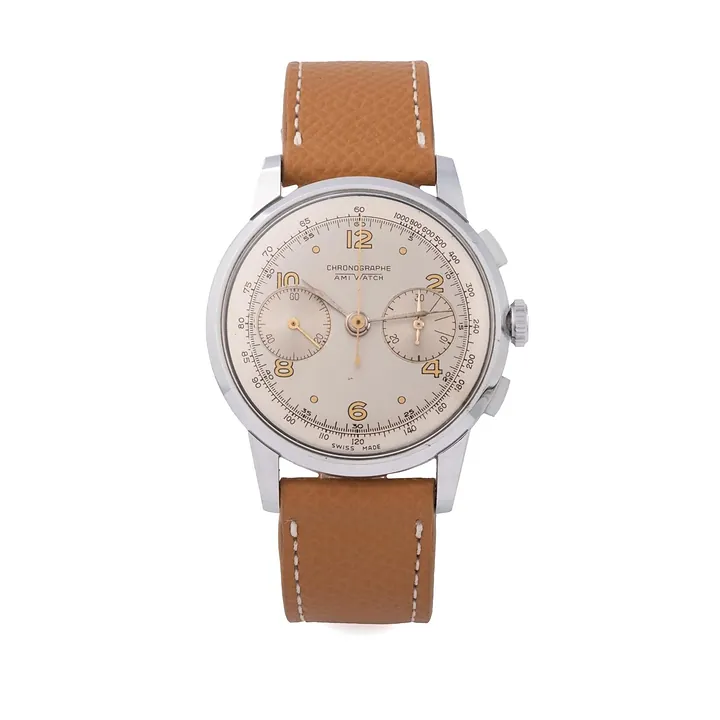
Wristwatches · c. 1950s
Ami Watch Chronographe, c. 1950s
Antiquorum auction archive, Geneva