
Wristwatches · Wristwatch
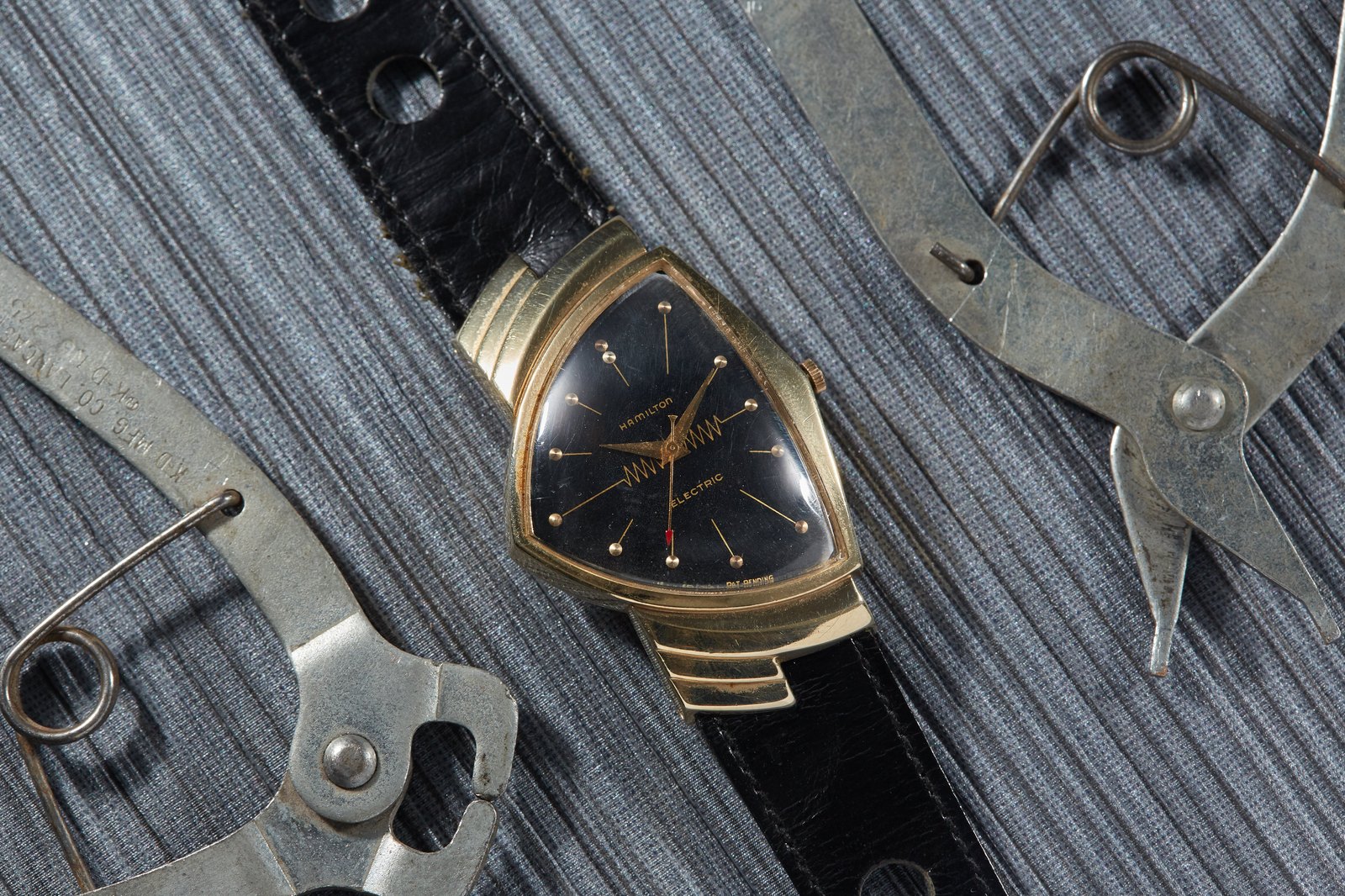
Hamilton Ventura 14k, c. 1957
- Maker / attribution
- Hamilton (maker)
- Date
- c. 1957
- Historical period
- Modern Mechanical Horology (1945 – 1969)
- Country of origin
- Switzerland
- Object type
- Wristwatch
- Stock no.
- Product 4397046890583
- Credit line
- Dealer listing, Analog/Shift (product 4397046890583)
- Catalogue title (original)
- Hamilton Ventura 14k (English)
View the source record (dealer listing) ↗ (opens another website in a new tab)Suggest a correction
Record summary
Catalogued by Analog/Shift (dealer), New York (stock number Product 4397046890583), this is a wristwatch by Hamilton, made in Switzerland, dated c. 1957. The Atlas places it in the Modern Mechanical Horology period (1945 – 1969) of its Wristwatches collection. The record is illustrated with 6 photographs.
Assembled from the source record's structured fields. Dates and attributions are given as the source states them; where a field is missing the Atlas leaves it blank rather than estimating.
Catalogue description
Dealer description — Analog/Shift
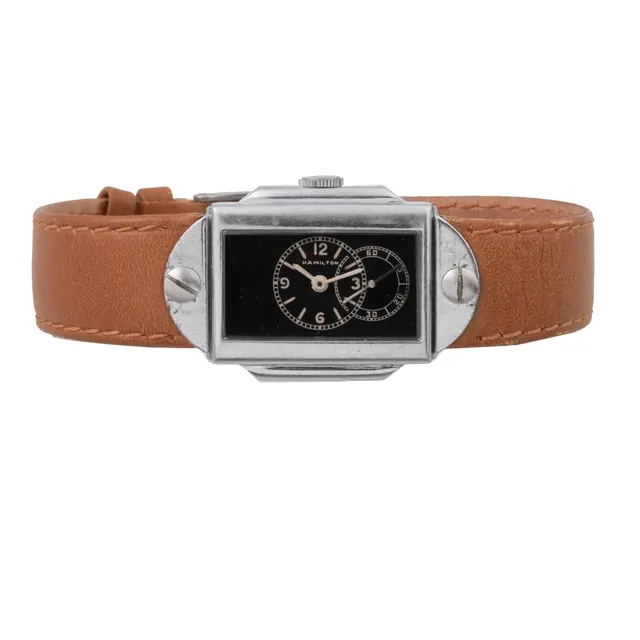
Why We Love It Hamilton was known partially for having extremely funky design language for some of their pieces. This bold design language is never more present than can be on the iconic Ventura. A glossy black dial, signed patent pending, lays within a stunning asymmetrical 14k Yellow Gold case. This particular piece dates to circa 1957 - the first year that Hamilton produced the Ventura. It's avant-garde case design was thought of by Richard Arbib, the legendary American Industrial designer, and later caught the eye of none other than Elvis Presley, who famously wore one in 1961's 'Blue Hawaii'. Even more special is the fact that this piece was a gift from General Electric to a loyal employee. The Story Hamilton is an inseparable strand of the tapestry of American horological history. The brand is perhaps best known to modern collectors for their historically significant tool watches: robust field watches issued to the U.S. military from the Vietnam War to the 1980s, bulky precision chronographs , or divers in EPSA SuperCompressor cases. But during the Golden Age of American watchmaking, Hamilton was master of all trades, from railroad timers to dress watches fit for kings. Their catalogs from the 1930s and 1940s were filled with elegant and innovative watches that have all but faded to obscurity.
Historical context
Modern Mechanical Horology (1945 – 1969)
Tool watches for divers, pilots and astronauts; electric watches anticipate the electronic age.
The classic era of the mechanical wristwatch: dive watches, chronographs for motor racing and space flight, GMT watches for jet travel, slim dress watches, automatic calendars, and the rise of Japanese manufacturers alongside Swiss, American, German and Soviet industries.
Read the period in the timelineMore wristwatches from this periodEarlier: Golden Age of Mechanical Watchmaking
Atlas type guide
Quartz, digital and electronic watches
Electronic watches arrived in three steps. The Hamilton Electric 500 (1957) was the first battery-powered wristwatch, still with a balance; Bulova's Accutron (1960) used a tuning fork. On 25 December 1969 Seiko released the Astron 35SQ, the first quartz wristwatch, closely followed by the Swiss Beta 21 group. In 1972 Hamilton's Pulsar introduced the LED digital watch, and LCD displays soon made digital watches cheap.
The 'Quartz Crisis' that followed devastated the Swiss mechanical industry, which lost two-thirds of its workforce between 1970 and 1984 before recovering with the Swatch (1983) and the luxury mechanical revival. Solar, radio-controlled, kinetic and connected smartwatches continue the electronic line.
What to look for
- Battery hatch in the case back and calibre markings with 'Quartz' or a crystal frequency.
- Display technology: LED (red, push-button) versus LCD (always-on).
- Tuning-fork hum and a smoothly sweeping seconds hand on Accutrons.
- Model and reference numbers, often printed on the back.
Dating clues
- Electric balance watches: from 1957.
- Tuning-fork watches: 1960–c. 1977.
- Quartz analogue: from December 1969; LED digital: 1972–c. 1978; LCD from 1973.
General guidance written by the Atlas editors about this kind of object. It is not a statement about this particular piece; for that, rely on the source record above and on physical examination.
Read next:Seiko calibre 35A (Astron)
Related records
Pocket Watches · c. 1943
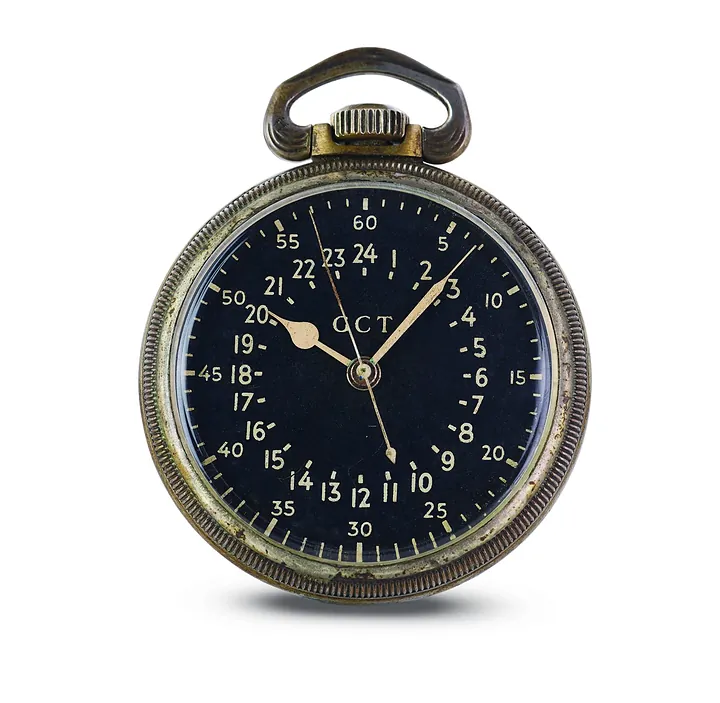
Hamilton 4992B, GCT Navigation U.S Air Force, c. 1943
Antiquorum auction archive, Geneva
Wristwatches · c. 1940s
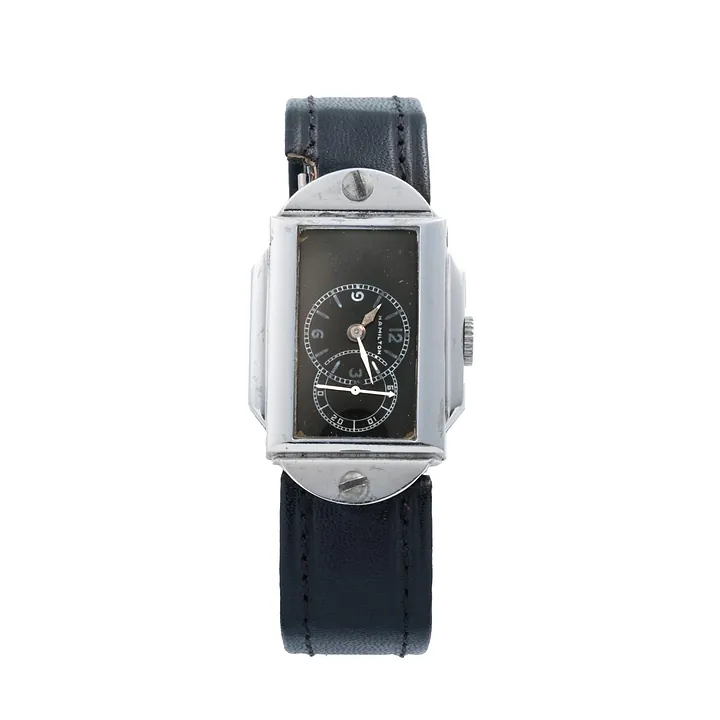
Hamilton Bomb Timer, c. 1940s
Antiquorum auction archive, Geneva
Wristwatches · originally sold in February 2025 (per the lot record)
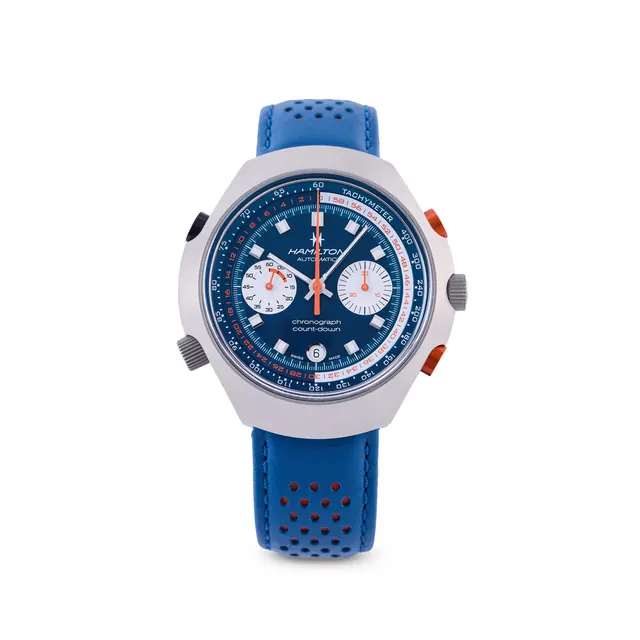
Hamilton wristwatch, ref. H51606640, American Classic Chrono-Matic 50 Limited Edition, originally sold in February 2025 (per the lot record)
Antiquorum auction archive, Geneva
Wristwatches · c. 1940s
Hamilton wristwatch, Bomb Timer Watch, circa 1940's
Antiquorum auction archive, Geneva

Wristwatches · 1945
Wristwatch by Eterna, 1945
Museum Rotterdam

Wristwatches · c. 1945
Breitling Premier, ref. 790, c. 1945
Antiquorum auction archive, Geneva

Wristwatches · c. 1945
Universal Genève Uni-Compax, ref. 22492, c. 1945
Antiquorum auction archive, Geneva

Wristwatches · c. 1950s
Baume & Mercier wristwatch, c. 1950s
Antiquorum auction archive, Geneva