
Horological History · Identification feature
Pendulum Clocks: History, Types and How to Identify an Antique Pendulum Clock
From Galileo's unfinished design and Huygens's first clock of 1657 to the Vienna regulator on the parlour wall and the free pendulum that kept the world's time. How a pendulum clock works, why it was the most accurate machine on earth for 270 years, and how to recognise and date the main types.
Atlas Editorial · · 24 min read
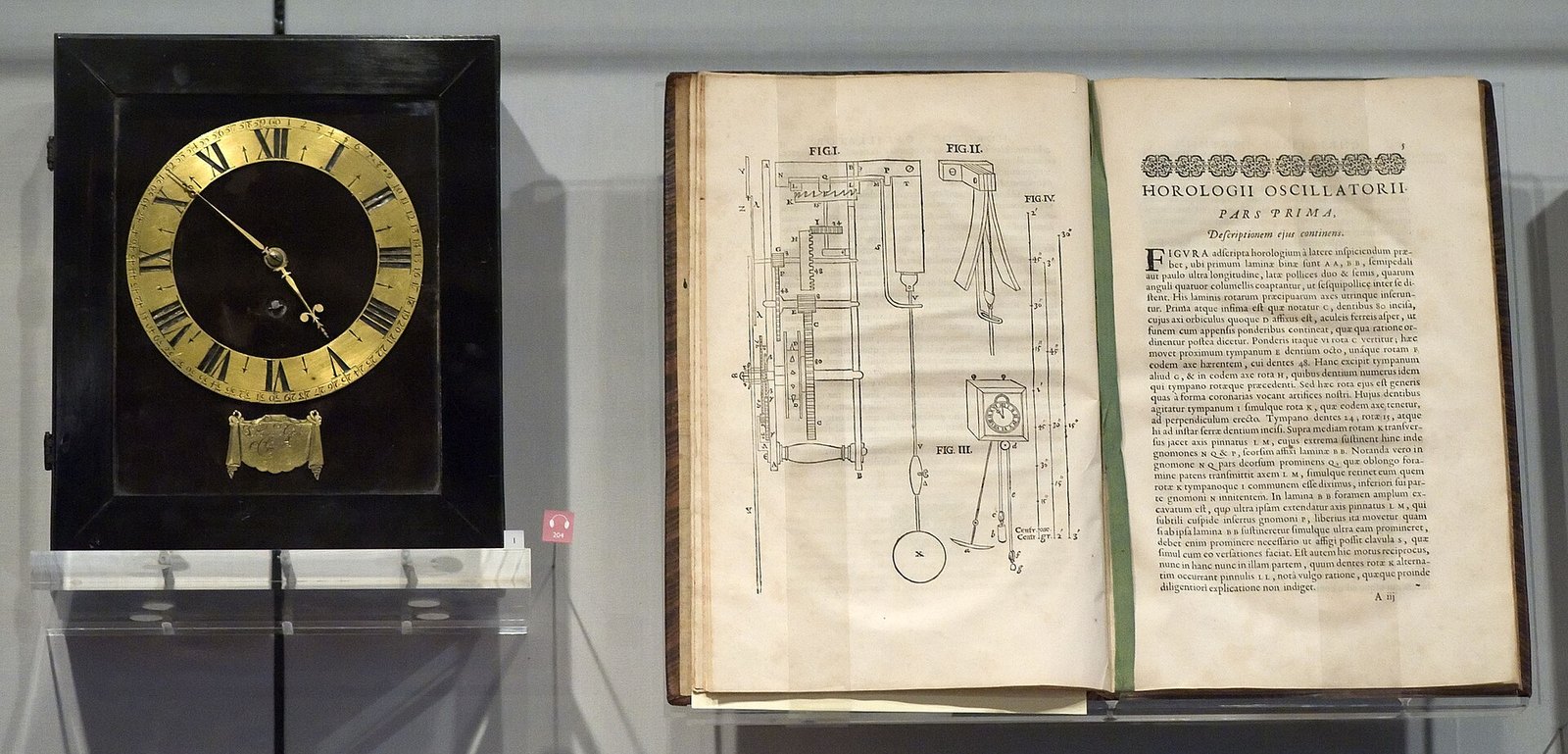
Rob Koopman (Flickr profile) · CC BY-SA 1.0 · source (opens another website in a new tab)
A pendulum clock is a clock whose rate is controlled by a swinging weight. Every swing lets the clock's wheels move on by one step, and because a pendulum of a given length always takes almost exactly the same time to swing, the clock counts time evenly. The idea sounds simple, but it transformed timekeeping. Before the pendulum, the best mechanical clocks could drift by a quarter of an hour in a day; within a few years of the first pendulum clock of 1657, good domestic clocks kept time to within a minute or so a day, and for the next 270 years the pendulum was the most accurate timekeeper people had. Observatories, railways and telegraph time services all ran on pendulum clocks until quartz clocks replaced them in the 1940s.
This guide follows the pendulum clock from Galileo's idea and Christiaan Huygens's invention to the London longcase, the precision regulator, the Vienna regulator that hung in millions of homes, and the free-pendulum clocks of the twentieth century. It explains the physics in plain terms, shows how clockmakers overcame the pendulum's weaknesses, and ends with a practical guide to recognising, dating and looking after an antique pendulum clock. Each step is illustrated with clocks from museum collections and dealers' archives in the Atlas catalogue.
What's in a name?
The words for pendulum clocks vary from language to language and can be confusing. In German a pendulum clock is a Pendeluhr, and a wall clock with a long pendulum in a glazed case is usually called a Regulator, whether or not it is a precision clock. In French the pendulum is le balancier, but the word pendule on its own means a mantel or table clock, pendulum or not; a pendulum clock is an horloge à balancier, and a floor-standing one an horloge de parquet. In Italian the term is orologio a pendolo, and in Spanish reloj de péndulo, while an antique wall clock with a pendulum — the Spanish reloj de pared antiguo — is very often a German or American factory clock of around 1900. In English, collectors speak of 'regulators' only for precision clocks, while dealers use 'Vienna regulator' for a whole family of wall clocks. This guide uses the English collectors' meanings and points out the differences where they matter.
Before the pendulum
The first mechanical clocks, which appeared in Europe around 1300, were regulated by a verge escapement and a foliot — a horizontal bar with adjustable weights that swung back and forth. The foliot has no natural period of its own: it swings faster or slower depending on how hard the clock's weight or spring drives it, and on dirt, wear and thickening oil. The same was true of the early balance wheel without a spring. Clocks of the fifteenth and sixteenth centuries were often beautiful and ingenious, with astronomical dials and automata, but as timekeepers they had to be reset regularly against a sundial. Many had only an hour hand, because a minute hand would have shown an accuracy they did not have.
Astronomers felt this weakness most. To measure the positions of stars, or to find longitude at sea by comparing local time with the time at a home port, they needed a clock that kept an even rate for hours and days. That was the problem the pendulum solved.
Galileo's idea
Galileo Galilei (1564–1642) noticed that a pendulum's swing takes about the same time whether it swings widely or narrowly — the property called isochronism. His pupil and biographer Vincenzo Viviani told the story that the young Galileo first saw this by timing a swinging lamp in the cathedral of Pisa against his pulse; the anecdote may be embellished, but Galileo did use pendulums to time experiments and wrote about them. In a letter of 1637 to the Dutch admiral Laurens Reael about finding longitude, he proposed a timekeeper based on the pendulum.
In 1641, blind and confined to his house at Arcetri, Galileo described to his son Vincenzio a mechanism in which a pendulum would control the wheels of a clock. According to Viviani's account, Vincenzio began to build it in 1649 but died before it was finished. A drawing of the design made by Viviani and Vincenzio survives in Florence, and the Museo Galileo explains that the discovery of the application of the pendulum to the clock was claimed in 1658 by Christiaan Huygens, whose claim Viviani vigorously challenged. Working models were built from the drawing in the nineteenth century.
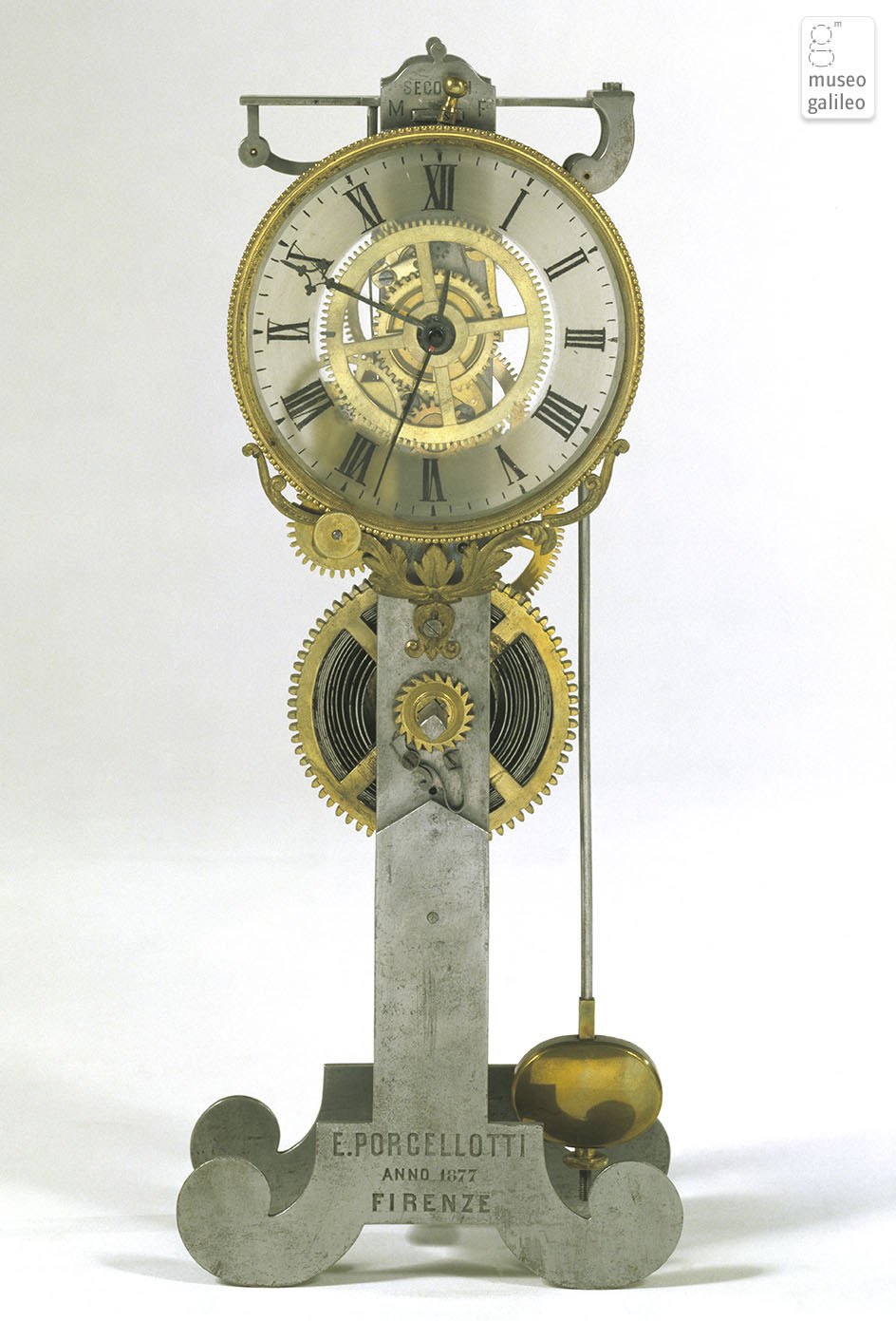
The Galileo design was a free-swinging pendulum with an unusual escapement: according to the Museo Galileo's description of an 1860 model, the escape wheel has twelve teeth on its rim and twelve pegs set crosswise, and two curved pallets fixed to the pendulum's pivot do the work — one releases a locking lever, the other receives the impulse. It was a clever, if delicate, solution. But the clock was not built in Galileo's lifetime and had no influence on the clocks that followed. The practical pendulum clock came from the Netherlands.
Huygens and Coster: the first pendulum clocks, 1656–1657
Christiaan Huygens (1629–1695), a Dutch mathematician and astronomer, designed his pendulum clock at the end of 1656. Instead of a foliot, a light pendulum hung from a thread swung between two curved metal 'cheeks', and a crutch linked it to the verge of a conventional escapement turned on its side. Huygens did not make clocks himself. He gave the work to Salomon Coster, a clockmaker in The Hague, who received a patent (a 'privilege') from the States General on 16 June 1657. In 1658 Huygens published a short description of the clock, Horologium.
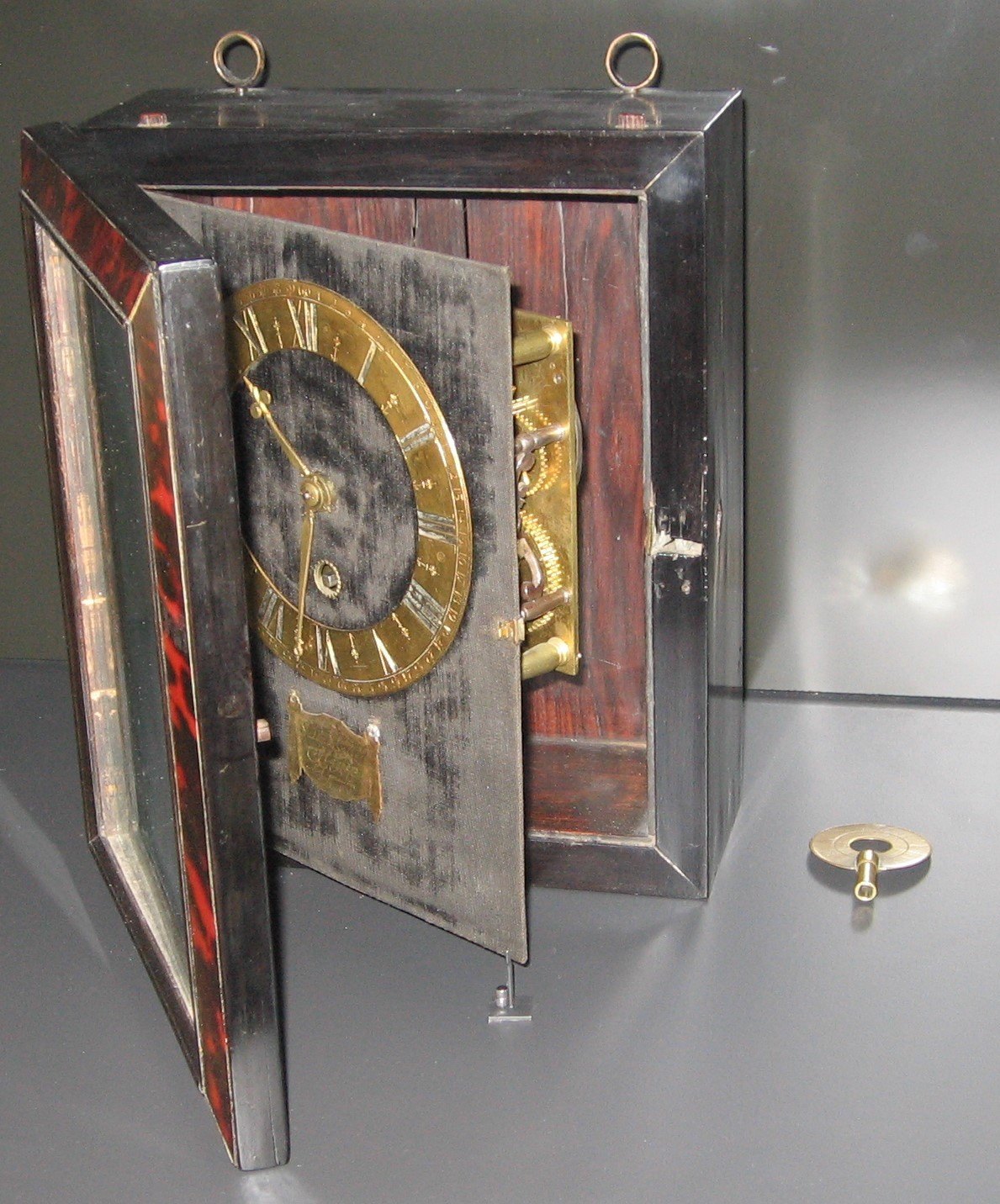
The result was a revolution in accuracy. A clock that had lost or gained many minutes a day could now keep time to well under a minute, and soon to seconds. Existing clocks were quickly converted: many surviving turret clocks, lantern clocks and table clocks of the sixteenth and early seventeenth centuries had their foliots or balances replaced by pendulums in the following decades, which is why a clock of 1600 with a pendulum is not necessarily a fake, but has almost certainly been altered.
Huygens continued to work on the theory. He found that a pendulum swinging in a circular arc is not perfectly isochronous — wide swings take slightly longer than narrow ones — and showed mathematically that a weight moving along a curve called a cycloid would be. The curved cheeks of his clocks bent the suspension thread so that the bob followed a near-cycloidal path. He set out this work, with the mathematics of the pendulum and the first correct formula for its period, in Horologium Oscillatorium, published in Paris in 1673. Cycloidal cheeks were soon abandoned in practice, because a small swing makes the error negligible, but Huygens's book founded the science of the pendulum.
The pendulum crosses to England
The news travelled fast. The London clockmaker Ahasuerus Fromanteel, from a family of Flemish origin, sent his son John to work with Salomon Coster in The Hague in 1657, and late in 1658 Fromanteel advertised pendulum clocks for sale in London — the first in England. Fromanteel and his contemporaries made two forms: spring-driven table clocks in architectural ebony cases, and weight-driven clocks hung on the wall under a hood or standing on the floor in a tall case to protect the weights and pendulum.
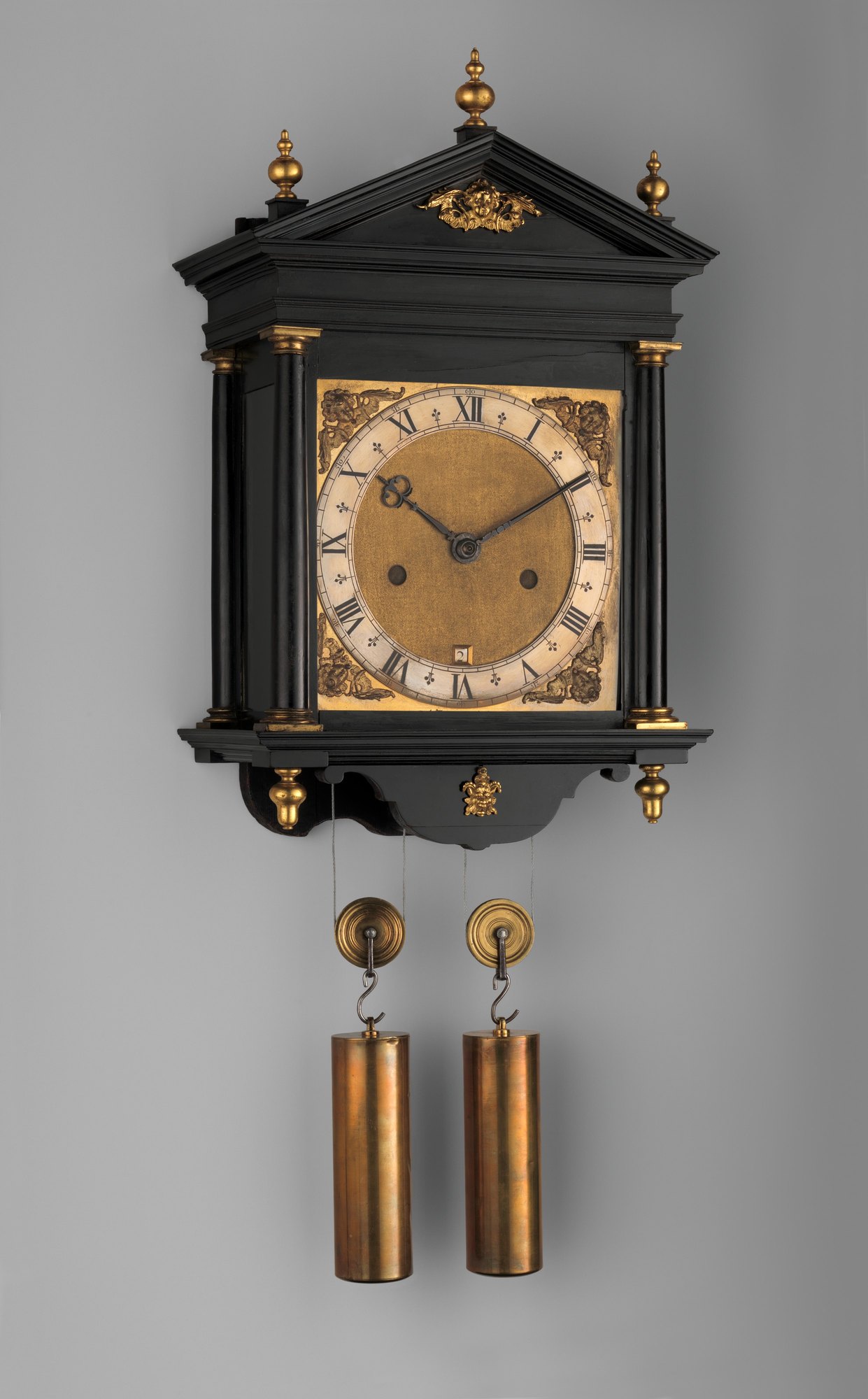
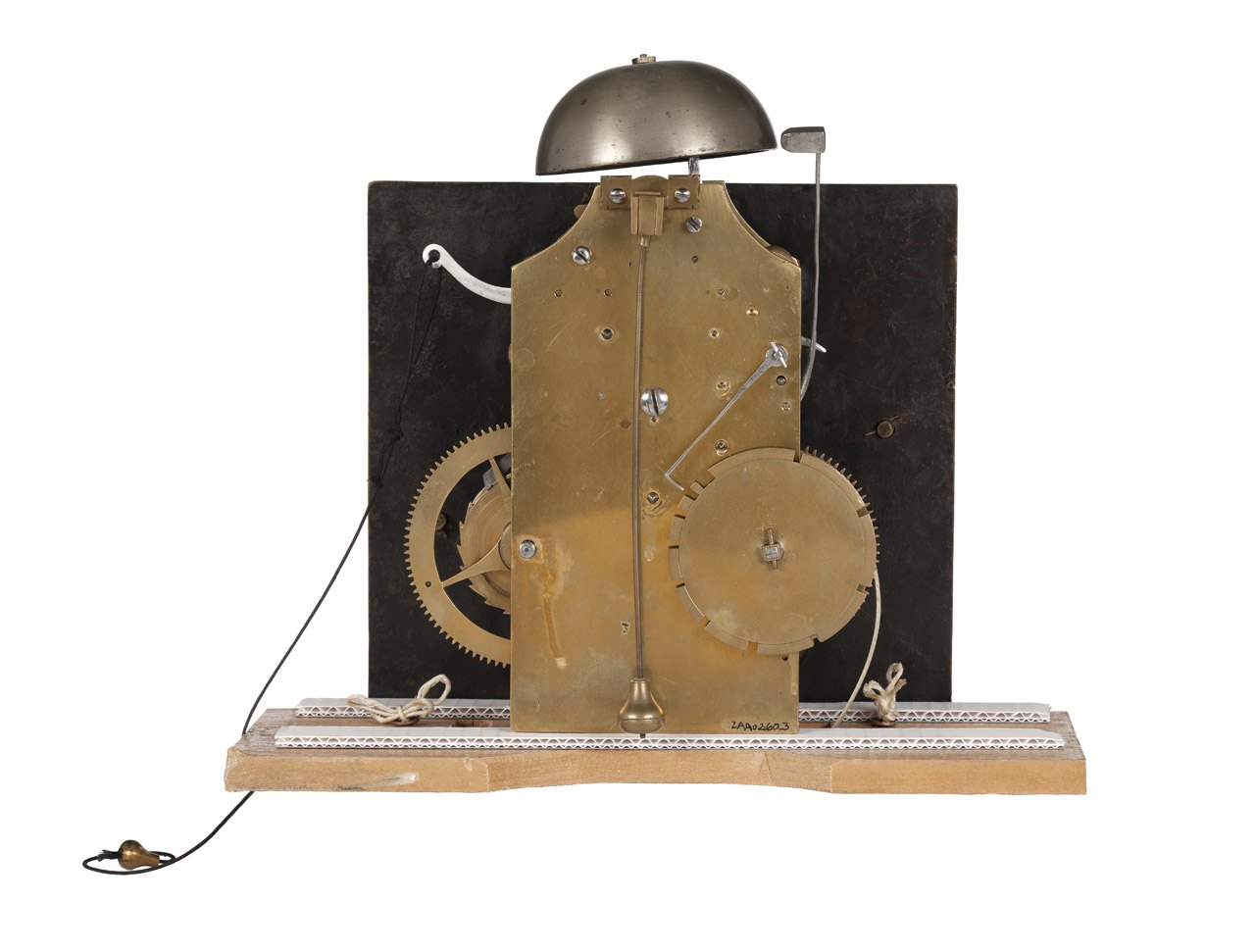
These first English pendulum clocks still used the verge escapement, which needs the pendulum to swing through a wide arc of 40 degrees or more. A wide swing means a short pendulum — usually about 15–25 cm — and makes the clock sensitive to changes in driving force. The next step was an escapement that would let the pendulum swing gently.
The anchor escapement and the long pendulum
Around 1670 London clockmakers introduced the anchor escapement, in which an anchor-shaped piece rocks above the escape wheel and catches its teeth on two pallets. The anchor needs a swing of only a few degrees. Who invented it is disputed: the clockmaker William Clement, who made a turret clock with an anchor escapement for King's College, Cambridge, dated 1671, is often credited, and so is the scientist Robert Hooke. Either way, the anchor made it possible to use a long, heavy pendulum swinging through a small arc — and the smaller the arc, the closer the pendulum comes to Huygens's ideal of perfect isochronism.
The favourite length became the seconds pendulum, about 0.994 metres (39.1 inches) long, which takes exactly one second for each swing and lets a seconds hand tick round a dial once a minute. It was too long to hang unprotected from a table clock, and so the tall-case or longcase clock — later called the grandfather clock — became the standard English domestic clock. In 1676 Thomas Tompion made two clocks for the new Royal Observatory at Greenwich with pendulums about four metres long, beating two seconds, which ran for a year at a winding. The story of the longcase clock is told in more detail in the Atlas feature on the longcase clock; this guide follows the pendulum itself.
The anchor escapement has one flaw. As each tooth lands on a pallet, the pendulum's continuing swing pushes the escape wheel slightly backwards — the recoil that makes the seconds hand of an old longcase shudder backwards a little at each tick. Recoil ties the pendulum to the train, so changes in the power reaching the escapement still affect the rate. The cure came from George Graham, Tompion's successor, around 1715: the deadbeat escapement, whose pallets have locking faces shaped as arcs around the anchor's pivot, so that the escape wheel stands dead still between impulses. The deadbeat became the escapement of nearly every precision pendulum clock for the next two centuries.
How a pendulum keeps time: the physics in plain words
For small swings, the time a pendulum takes depends almost only on its length and on the pull of gravity, not on the weight of the bob or (very nearly) on how far it swings. Double the length and the swing takes about 1.4 times as long; to double the time, the pendulum must be four times as long. Strictly, the length that matters is the distance from the point of suspension to the bob's centre of oscillation, which in a real pendulum with a heavy bob is close to the centre of the bob. The table gives the approximate lengths for common beats.
| Beat (one swing) | Approximate length | Where you find it |
|---|---|---|
| 2 seconds | 3.98 m (13 ft) | Tompion's year-going clocks at Greenwich (1676); some turret clocks |
| 1¼ seconds | 1.55 m (61 in) | Some turret clocks and large longcase clocks |
| 1 second | 0.994 m (39.1 in) | Standard longcase clocks, regulators and most observatory clocks |
| ¾ second | 0.56 m (22 in) | Some wall clocks and smaller longcases |
| ½ second | 0.25 m (9.8 in) | Bracket clocks, many wall and mantel clocks |
| ⅓ second | 0.11 m (4.3 in) | Small mantel and carriage-size pendulum clocks |
Three things upset a pendulum. First, gravity varies slightly from place to place, so a clock regulated in London runs differently in Paris or at the equator; in 1672 the French astronomer Jean Richer found that his pendulum clock lost time at Cayenne near the equator, one of the first clues that the earth is not a perfect sphere. Second, a wider swing takes slightly longer — the 'circular error' that Huygens tried to cure with cycloidal cheeks — so anything that changes the arc, such as a weakening mainspring or thickening oil, changes the rate. Third, and most important in practice, the pendulum rod expands when it is warm and contracts when it is cold.
| Rod material | Expansion per °C (approx.) | Rate change per °C (approx.) |
|---|---|---|
| Brass | 19 millionths | loses about 0.8 s a day |
| Steel | 11–12 millionths | loses about 0.5 s a day |
| Wood (straight-grained, along the grain) | 3–5 millionths | loses about 0.2 s a day |
| Invar nickel-steel (from 1896) | about 1 millionth | loses about 0.05 s a day |
Half a second a day for each degree may sound small, but a room that is 10 °C warmer in summer than in winter makes a plain steel pendulum clock lose about five seconds a day — over a minute in a fortnight. For a household clock that hardly matters; for an astronomer timing the passage of stars, it was intolerable. That is why the wooden pendulum rods of many Vienna regulators and English longcases are not a sign of cheapness: straight-grained, varnished wood expands much less than metal with temperature, although it can be affected by damp.
Taming temperature: mercury and gridiron pendulums
George Graham tried several metals and in 1721 hit on a solution: a pendulum whose bob was a glass jar of mercury. As the steel rod lengthens in the warmth and lowers the bob, the mercury expands upwards in its jar and raises the centre of oscillation by the same amount. He published the idea in 1726. John Harrison, the self-taught Lincolnshire carpenter who later solved the longitude problem, found another answer around 1726: the gridiron pendulum, a frame of alternating brass and steel rods arranged so that the greater expansion of the brass, acting upwards, cancels the expansion of the steel acting downwards. The glittering gridiron became a decorative feature in its own right, and later factories made imitation gridirons that compensate for nothing.
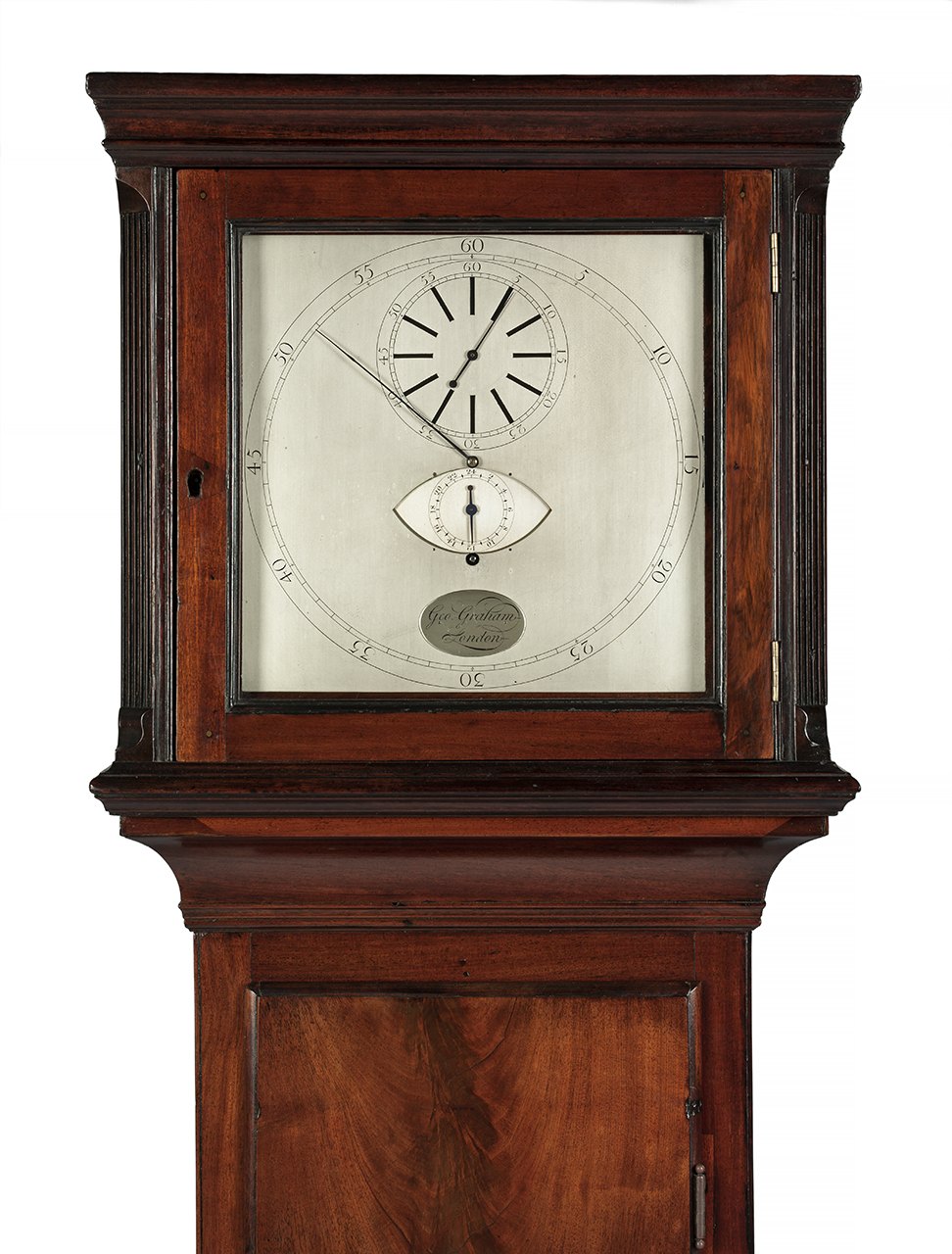
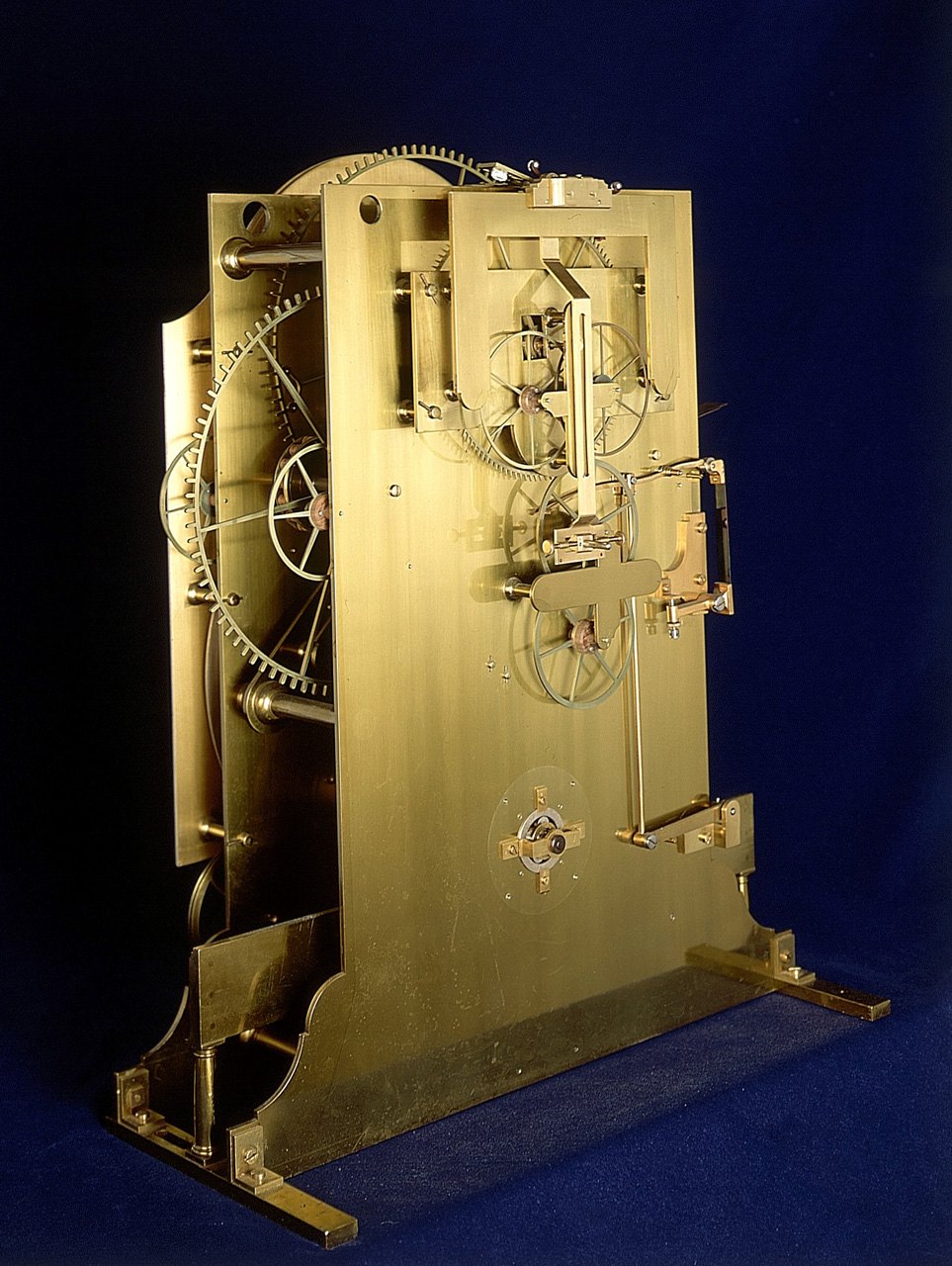
Harrison's precision pendulum clocks took friction as seriously as temperature. His grasshopper escapement needs no oil, and he used rollers and anti-friction wheels throughout. When Benjamin Vulliamy made a regulator in 1780 for the King's Observatory at Kew, he combined Harrison's grasshopper escapement and gridiron pendulum with rollers acting as bearings for the wheelwork, according to the Science Museum. The mercury pendulum, meanwhile, became the standard for observatory regulators in the nineteenth century, because its compensation can be adjusted by adding or removing mercury.
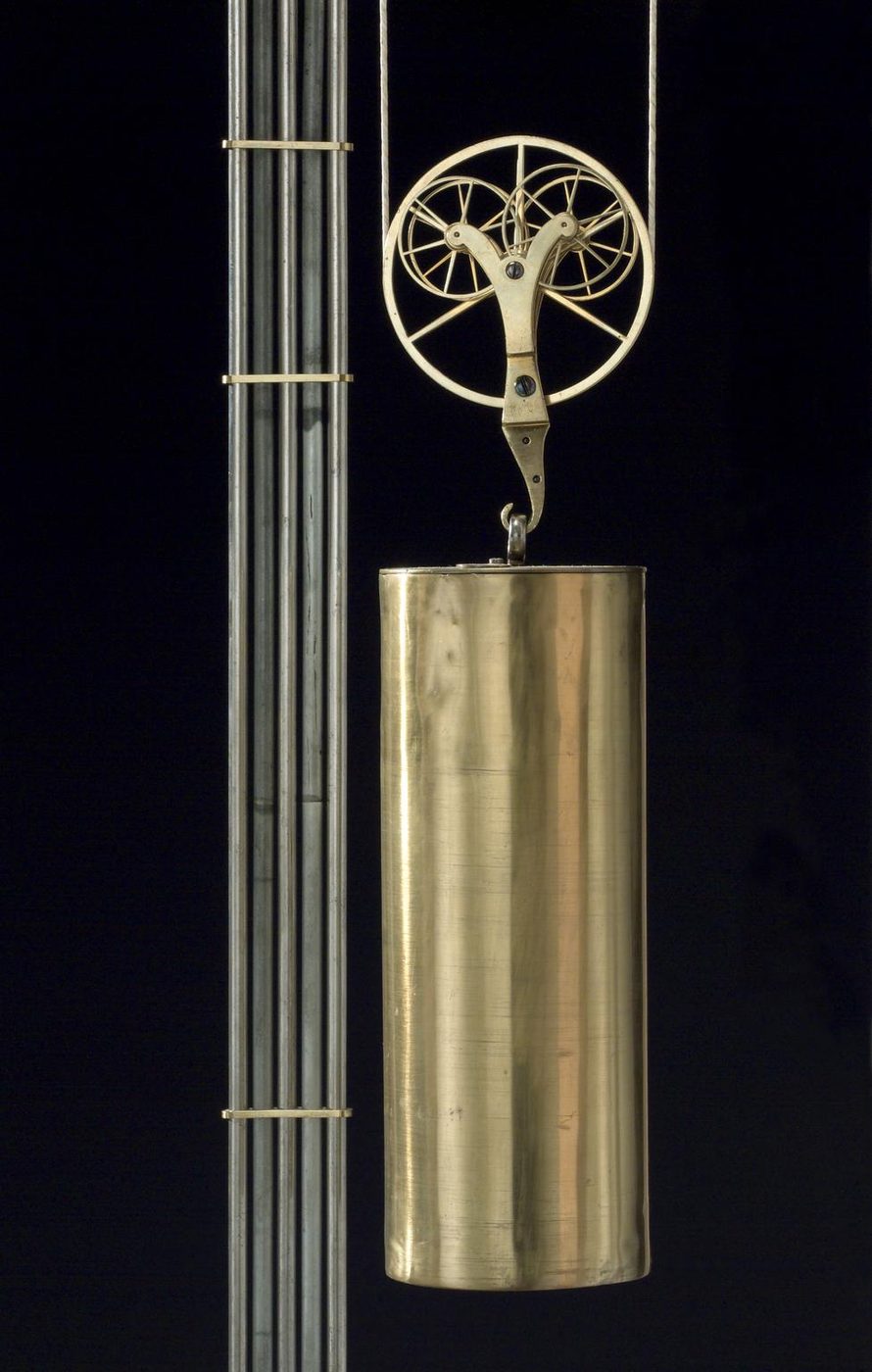
At the end of the nineteenth century the Swiss physicist Charles-Édouard Guillaume found Invar, a nickel-steel alloy that hardly expands at all; it won him the Nobel Prize in Physics in 1920. Invar rods made compensation much simpler and were adopted for the best precision pendulums.
What makes a clock a regulator?
A regulator, in the strict sense, is a clock built for accuracy alone, used as the standard against which other clocks and watches are set. Observatories used them to time astronomical observations; watchmakers and jewellers hung one in the workshop to regulate the watches they repaired and sold, and railway companies and post offices used them to keep their networks on time. Because nothing must disturb the pendulum, a true regulator has no striking train, and everything about it is designed to keep its rate steady.
The regulator dial is the best-known feature but the least reliable on its own: it was copied on decorative clocks, while some genuine precision clocks have ordinary dials with a seconds hand. The pendulum, escapement and maintaining power tell you more than the dial does.
Vienna regulators: elegance from the Biedermeier city
In Vienna, clockmakers developed their own form of weight-driven wall clock with a long pendulum in a slender glazed case. According to Rick Ortenburger's survey of the type, Vienna regulators were first made in Vienna about 1780, and the classic early and late Viennese styles lasted until about 1860, followed by 'transitional' and 'serpentine' designs in the 1860s and factory-made regulators from about 1870 to 1930. The finest were made in the first half of the nineteenth century, in the Biedermeier period, when Viennese cabinetmaking favoured clean architectural lines, figured mahogany or walnut veneers and light stringing.
Two forms are especially admired. The Laterndluhr ('lantern clock') has a tall, narrow case glazed on three sides, a lift-off hood and a separately shaped base, often with a white enamel dial in a wide engine-turned gilt bezel. The Dachluhr ('roof clock') has a triangular pediment like a roof. Both normally have a deadbeat escapement, a wooden pendulum rod with a large brass bob, and a high-quality movement; the best run for a month, six months or even a year at a winding, with a small driving barrel and extra wheels in the train.
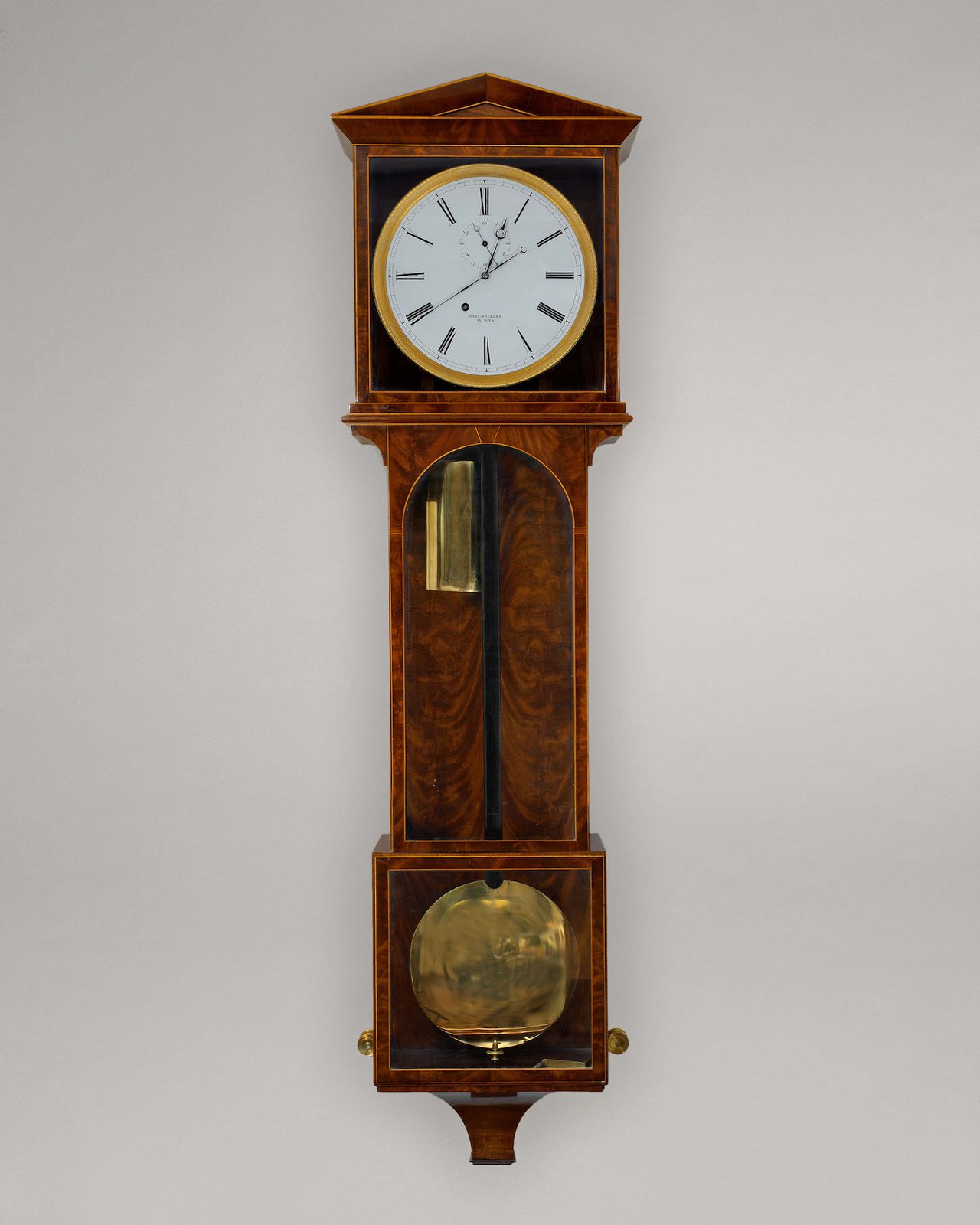
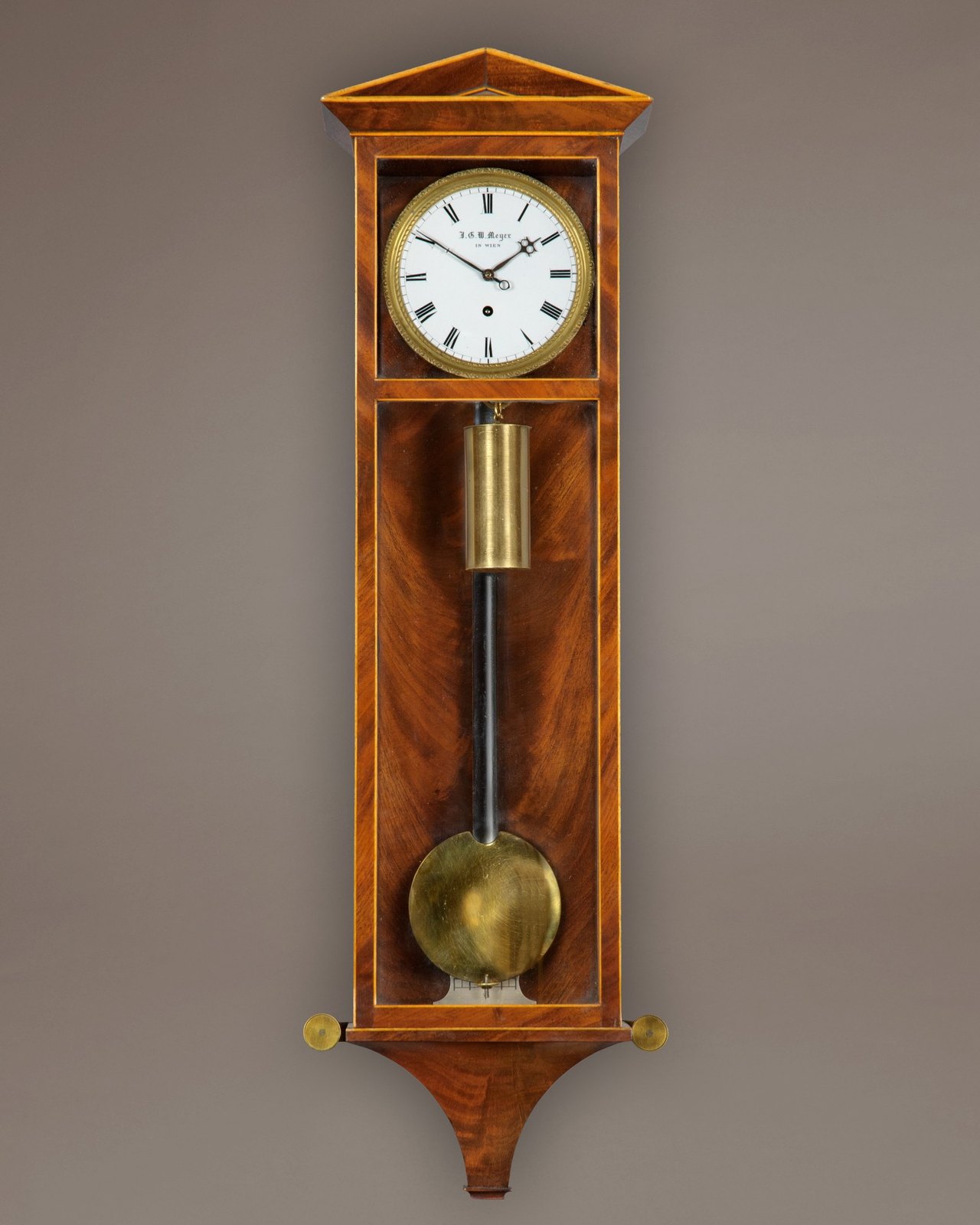
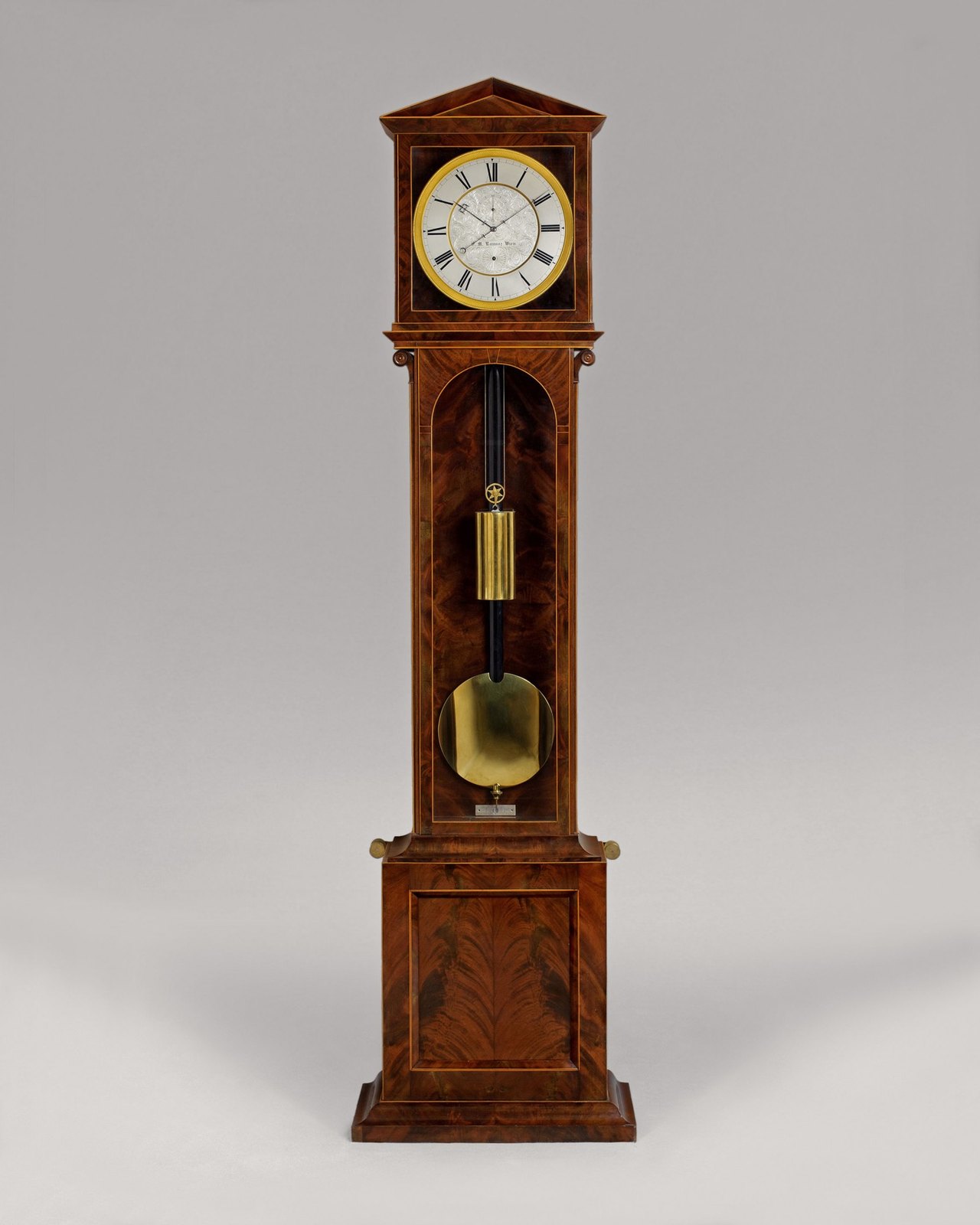
Early Vienna regulators were made by many small workshops, and most were signed on the dial with the maker's name and 'in Wien'. Some movements were made with a time train only; others strike the hours, or the quarters as well. The cases, dials and movements of these early clocks are delicate and frequently restored, and their value depends heavily on originality.
The factory 'Vienna regulator'
From the middle of the nineteenth century the Viennese form was taken up by factories in Germany, and it became one of the most common household clocks in Europe. Gustav Becker, who had trained as a clockmaker partly in Vienna, opened a workshop in Freiburg in Silesia (today Świebodzice in Poland) in 1847 making weight-driven wall regulators in the Viennese style; the business grew into one of the largest clock factories in Germany. The Lenzkirch factory in the Black Forest, founded in 1851, made fine regulator movements, and Junghans, the Hamburg-Amerikanische Uhrenfabrik and many others followed with cheaper versions.
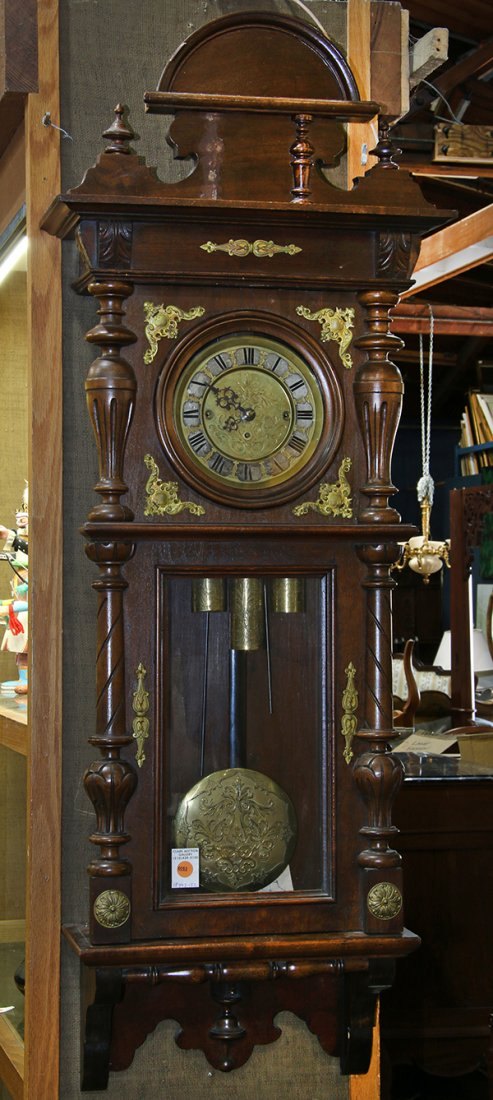
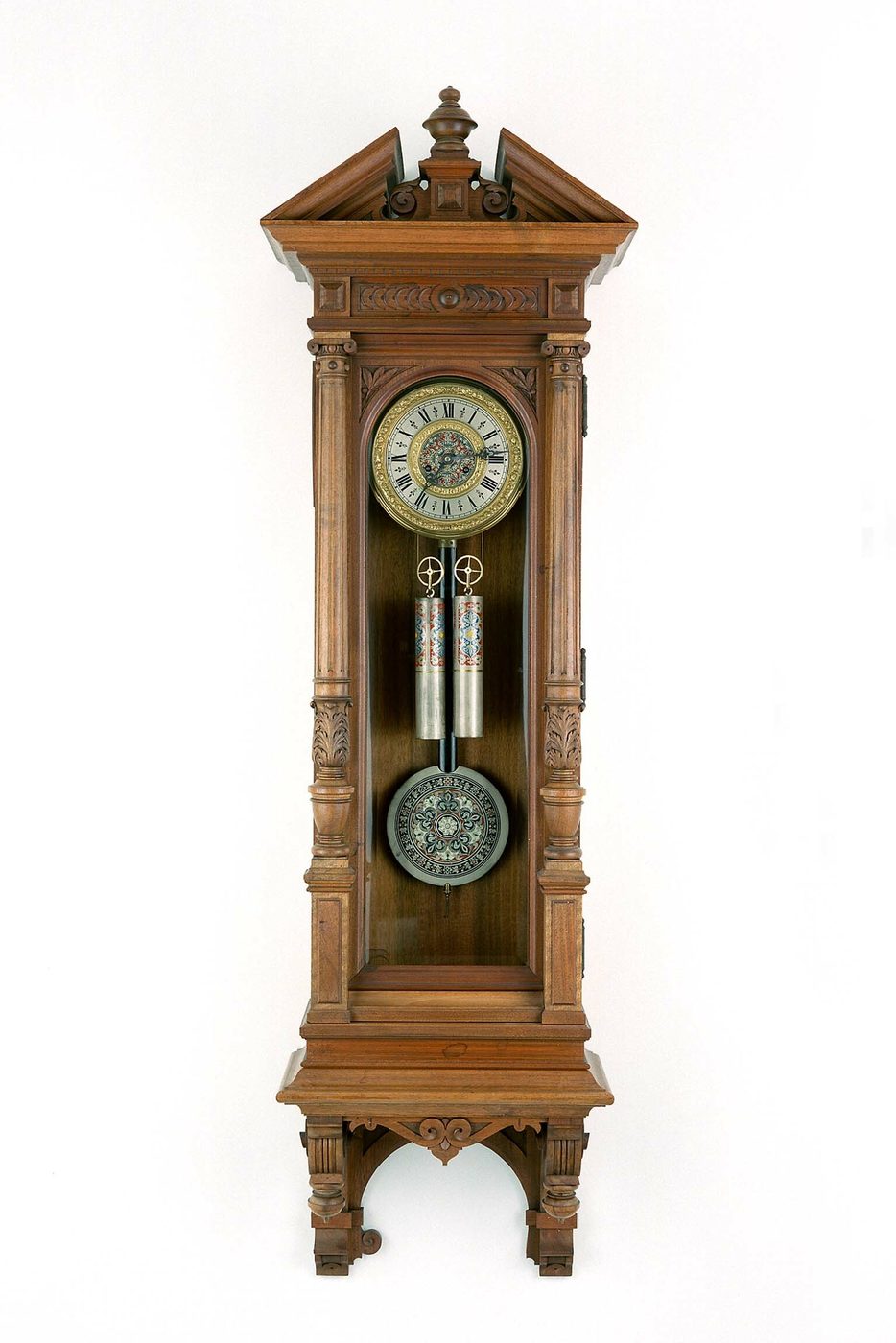
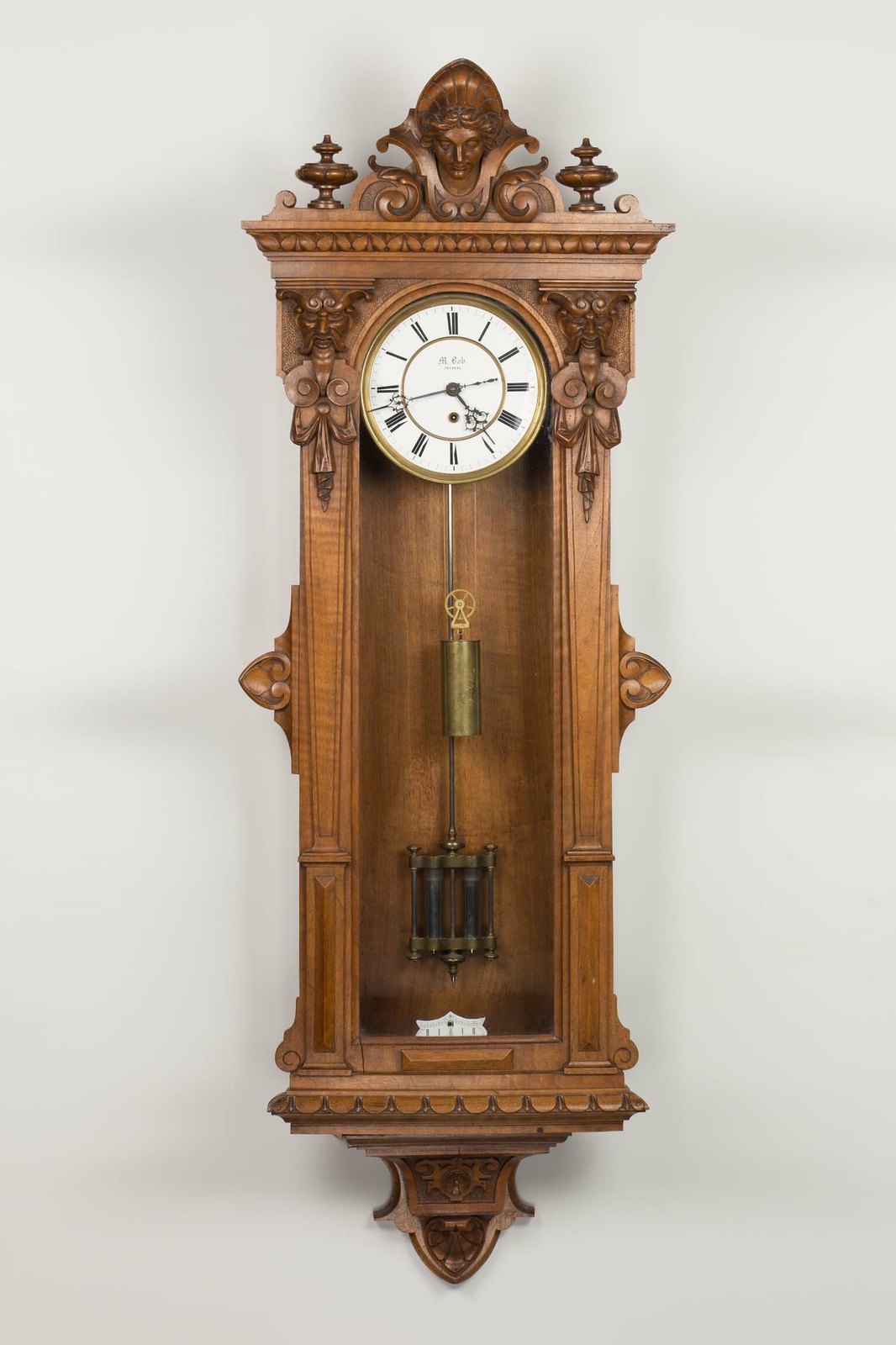
Factory regulators changed with taste. The slim Biedermeier cases gave way in the 1870s and 1880s to large, heavily carved historicist cases in the 'Altdeutsch' (old German) or neo-Baroque manner, with turned finials, carved crests — eagles, horses' heads or female heads — and applied mouldings. Spring-driven versions, cheaper to make and easier to set up, spread alongside the weight-driven ones, and many struck the hours and half-hours on a coiled wire gong rather than a bell. Around 1900 cases became simpler again, sometimes with Art Nouveau carving. Dealers describe these clocks by the number of weights, which is a quick guide to what the movement does.
| Description | Movement | What you hear |
|---|---|---|
| One-weight (Gehwerk) | Time only | Ticking, no strike; often the most accurate and the closest to a true regulator |
| Two-weight | Time and strike | Strikes the hours, usually with a single blow at the half-hour |
| Three-weight | Time, quarter strike and hour strike | Strikes the quarters, often on two gongs or bells, as well as the hours; some repeat the hour after each quarter |
| Spring-driven ('Federzug') | Time and strike from mainsprings | Usually hours and half-hours on a gong; no weights hang in the case |
Many factory clocks can be dated more closely than their style suggests. Gustav Becker and Lenzkirch movements carry serial numbers that collectors use for dating, although the published serial tables differ. Trademarks changed over time, and clocks exported to Britain and America from the late 1880s and 1890s often carry 'Germany' or 'Made in Germany', which helps to place them after those dates. A brand name alone is not enough: the Becker name was used after the firm merged with other Freiburg factories in 1899, and it came under Junghans control around 1930.
Precision pendulums: Riefler and the free pendulum
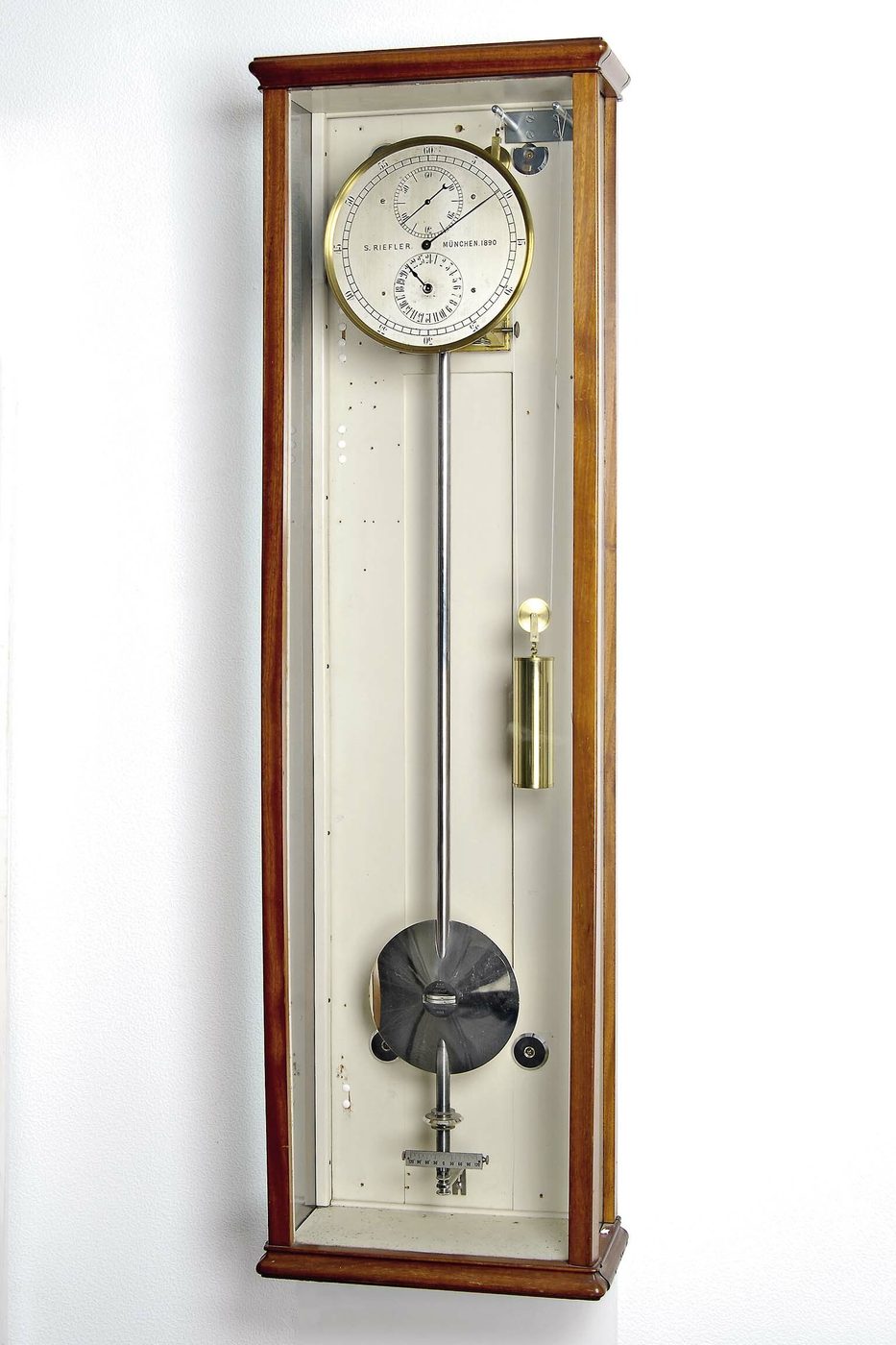
By the 1880s the deadbeat escapement and mercury pendulum had been refined about as far as they could go. The remaining errors came from the escapement itself: every time the escape wheel pushed the pendulum, it disturbed it slightly. In 1889 Sigmund Riefler of the Munich firm founded by his father Clemens Riefler patented an escapement in which the impulse is given to the pendulum through its suspension spring, so that the pendulum is almost free of the train (German patent 50739). Riefler precision clocks, often housed in sealed, partly evacuated cases to remove the effect of changing air pressure, became the standard clocks of observatories around the world from the 1890s.
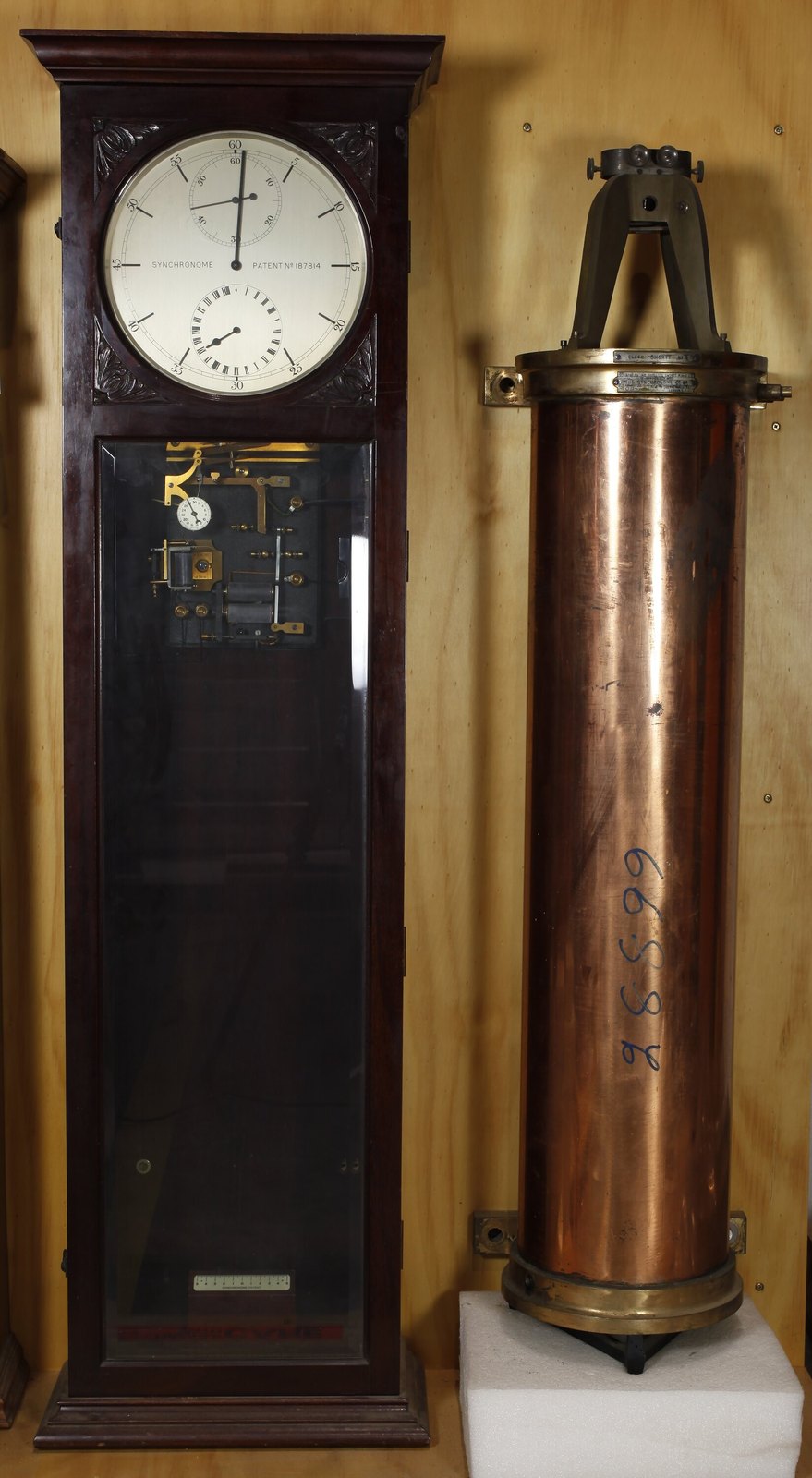
The last great step separated timekeeping from counting entirely. In 1921 the railway engineer William Hamilton Shortt, working with the Synchronome Company of Frank Hope-Jones in London, produced the free-pendulum clock. A master pendulum swings in an evacuated tank and does no work except to receive a small impulse from a falling gravity arm every half-minute; a second, 'slave' clock does the counting and is kept in step with the master by an electrical link. Shortt clocks were the most accurate pendulum clocks ever made and were installed in observatories and time services around the world.
The pendulum's reign ended with quartz. Warren Marrison and J. W. Horton built a quartz-crystal clock at Bell Laboratories in 1927, and by the 1940s observatories were turning to quartz clocks for their time standards; atomic clocks followed in the 1950s. Pendulum clocks did not disappear — they remained the household clock of much of the world well into the twentieth century — but they were no longer the measure of time itself.
Identifying an antique pendulum clock
Most antique pendulum clocks can be placed in a family, and a rough date range, from a few features: the case, the way the clock is driven (weights or springs), the length of the pendulum, the escapement and the dial. The table summarises the main types. Dates are tendencies rather than rules: styles lasted longer in the countryside than in capitals, and many clocks have been altered, re-cased or restored.
| Type | Where and when | Pendulum and escapement | Recognise it by |
|---|---|---|---|
| Hague clock | Netherlands, from 1657 to about 1680 | Short pendulum, verge escapement, often cycloidal cheeks | Small spring-driven clock in a wooden case with a velvet-covered dial; signed by makers such as Coster |
| Converted lantern or table clock | England and Europe, conversions from about 1660 | Pendulum added to an older balance or foliot clock | Signs of alteration: filled holes, a later escapement, a pendulum hung behind the movement |
| English longcase | From about 1660; anchor from about 1670 | Seconds pendulum, anchor (recoil) or deadbeat escapement | Tall case, brass or (from about 1770) painted dial, 30-hour or eight-day movement |
| Bracket clock | England, from about 1660 | Short pendulum, verge then anchor escapement | Spring-driven table clock with a carrying handle; verge clocks have a pendulum with a fixed bob |
| French mantel clock (pendule) | France, especially 19th century | Short pendulum with silk-thread or spring suspension, often a Brocot escapement | Round movement with a serial number and maker's stamp, marble, gilt-bronze or slate case |
| Comtoise | Haut-Jura, France, late 17th to early 20th century | Long pendulum, verge or recoil anchor | Iron-cage movement, enamel dial under a brass crest, hour repeated after two minutes |
| Black Forest wall clock | Southern Germany, 18th–19th century | Short or long pendulum, verge or anchor, wooden plates in early clocks | Painted shield dial, wooden or brass movement, cuckoo or trumpeter in some |
| Precision regulator | From the 1720s | Seconds pendulum, deadbeat, compensated rod | Plain case, regulator dial, maintaining power, no strike |
| Vienna regulator | Vienna from about 1780; factories from about 1870 to 1930 | Long wooden-rod pendulum, deadbeat | Slim glazed case, enamel dial, brass weights; factory clocks larger and carved |
| American shelf and wall clock | USA, from the 1810s | Short pendulum, recoil escapement, stamped plates from mid-century | Pillar-and-scroll, ogee or 'school-house' cases, printed paper labels inside |
Look closely at the pendulum itself. A long wooden rod with a large brass-faced bob suggests a Vienna regulator or a good longcase; a steel rod with a lenticular (lens-shaped) bob is the general case; a glass jar of mercury or a grid of rods indicates temperature compensation, but check whether the 'gridiron' actually has working rods or is a decorative stamping. A pendulum with a beat scale behind its tip suggests a regulator. Replacement pendulums are common, so the pendulum must match the clock: the length should give the right number of beats for the train, and the rod should hang cleanly through the crutch without signs of new holes or bending.
- Signature: a name on the dial is often the retailer's. Check it against the movement, which may carry a different maker's stamp or serial number.
- Weights and pulleys: a weight-driven clock should have weights of the right size and number, and pulleys that match. Brass-cased weights suggest a Vienna regulator or quality longcase.
- Seconds hand: a seconds hand directly below XII on a long-pendulum clock usually means a seconds pendulum; a seconds hand on a short-pendulum clock is rarer and needs a different train.
- Case fit: the movement should sit squarely in the case, the dial should fit the hood or bezel, and the pendulum should swing freely without touching the back or the weights.
- Marriages: dials, movements and cases were often combined from different clocks. A marriage is common in old clocks but should be declared by an honest seller and is reflected in the price.
- Reproductions: many 'Vienna regulators' were made in the late twentieth century, often with stamped movements, printed dials and machine-carved cases. Bright, even finishes and modern screws are clues.
Setting up and caring for a pendulum clock
A pendulum clock needs to be level and firmly fixed. A wall clock should hang from a strong screw and, if it has locating spikes or adjusting screws at the bottom of the case, be steadied against the wall so that it cannot rock. Listen to the tick: the clock should be 'in beat', with the tick and the tock evenly spaced. An uneven beat is the most common reason a pendulum clock stops after a few minutes. Many clocks can be put in beat by gently bending the crutch, or on better clocks by turning a beat-adjustment screw; the Atlas clock troubleshooter in Tools explains how to diagnose the problem by ear.
To regulate the clock, raise or lower the pendulum bob with the rating nut under it: raising the bob shortens the pendulum and makes the clock gain; lowering it makes the clock lose. On a seconds pendulum, shortening it by about one millimetre makes the clock gain about 43 seconds a day, so adjustments should be small and made over several days. Regulators and some Vienna clocks have a scale or a numbered nut to make this easier.
Before moving a pendulum clock, stop it, take off the pendulum (or secure it) and remove the weights, carrying the movement upright; a pendulum left hanging while a clock is moved can break its suspension spring. Wind the clock regularly and gently, keep it away from radiators and direct sunlight, and have it cleaned and oiled by a clock restorer every few years, rather than spraying it with household oil, which attracts dust and accelerates wear.
Why the pendulum clock matters
The pendulum turned the clock from a mechanical marvel into a scientific instrument and an everyday object. It let astronomers measure the sky with new precision, made the minute hand worthwhile, gave rise to the longcase clock and the regulator, and — in the factory Vienna regulators and American shelf clocks of the nineteenth century — brought accurate time into ordinary homes. It is one of the few technologies whose basic principle, discovered in the seventeenth century, remained the world's best for almost three hundred years.
In the Atlas catalogue you can follow that story object by object: from the reconstructions of Galileo's design and the first Fromanteel clocks to Graham's and Harrison's regulators, the Biedermeier clocks of Vienna, the factory regulators of the Black Forest and Silesia, and the precision clocks of Riefler and Shortt. The encyclopedia entries on the pendulum, the anchor and deadbeat escapements, and the gridiron, mercury and free pendulums explain each mechanism in more detail, and the Lab lets you experiment with pendulum length and escapements yourself.
Sources & further reading
- Horologium Oscillatorium — Christiaan Huygens, F. Muguet (Paris), 1673.
- Old Clocks and Watches and Their Makers — F. J. Britten, B. T. Batsford (London), 1899 (first edition).
- Time & Timekeepers — Willis I. Milham, Macmillan (New York), 1923.
- A Rudimentary Treatise on Clocks, Watches and Bells — Edmund Beckett Denison (later Lord Grimthorpe), John Weale (London), 1850 (first edition).
- Harrison — Jonathan Betts, National Maritime Museum (London), 1993.
- Vienna Regulators and Factory Clocks — Rick Ortenburger, Schiffer Publishing (Pennsylvania), 1990.
- Riefler-Präzisionspendeluhren 1890–1965 — Dieter Riefler, Callwey (Munich), 1981; enlarged edition 1991.
- Electrical Timekeeping — Frank Hope-Jones, N.A.G. Press (London), 1940; 2nd edition 1949.
- The Evolution of the Quartz Crystal Clock — Warren A. Marrison, Bell System Technical Journal 27 (3): 510–588, 1948.
- Revolution in Time: Clocks and the Making of the Modern World — David S. Landes, Harvard University Press, 1983.