
Instruments · Marine chronometer
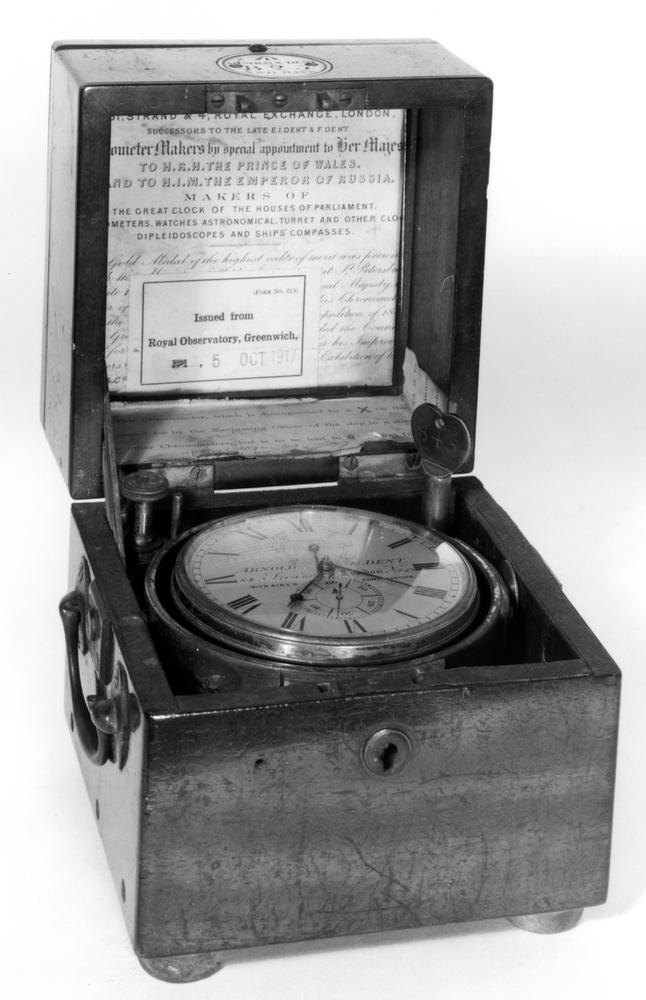
Marine chronometer by Arnold & Dent
- Maker / attribution
- Arnold & Dent (Made by); W Smith (fusee) (Movement made by); TCW (Ebauche maker)
- Date
- 1830–1835
- Historical period
- Precision & Scientific Horology (1750 – 1850)
- Country of origin
- England
- Place
- London (England) (84 Strand)
- Object type
- Marine chronometer
- Materials / technique
- brass, mahogany
- Holding institution
- British Museum
- Accession / object no.
- 1958,1006.1929
- Credit line
- British Museum, London
- Catalogue title (original)
- Marine chronometer by Arnold & Dent (English)
View the source record ↗ (opens another website in a new tab)Suggest a correction
Record summary
Held and catalogued by British Museum (object number 1958,1006.1929), this is a marine chronometer by Arnold & Dent, made in London (England) (84 Strand), dated 1830–1835. The Atlas places it in the Precision & Scientific Horology period (1750 – 1850) of its Instruments collection. Materials and techniques recorded by the source: brass, mahogany. The record is illustrated with 1 photograph.
Assembled from the source record's structured fields. Dates and attributions are given as the source states them; where a field is missing the Atlas leaves it blank rather than estimating.
Catalogue description
Description — British Museum
Marine chronometer; ratchet-toothed single roller lever escapement; Harrison's maintaining power; blued steel hands; later bimetallic balance; movement in gimballed brass drum and square mahogany bow; engraved silvered brass dial; tipsy key.
Curator's comments — British Museum
Comment from Richard Good, Catalogue of Watches in the British Museum. Vol. V (Unpublished manuscript) Made by John Roger Arnold & Edward John Dent London, 1833 Mahogany boxed 2-day marine chronometer with ratchet tooth lever escapement Signature: 'ARNOLD & DENT, 84. Strand, London No: 823 WITH AIRY'S COMPENSATION' on the dial.… The British Government Property Mark is engraved both on the seconds dial and the back plate. In the front of the upper part of the box is an ivory disc inscribed 'ARNOLD & DENT 823 TWO DAYS' and with the British Government Property Mark inside the lid. Box: A square mahogany box with a glazed top and hinged solid lid, supported by four white-painted mahogany round feet added at a later date. The box is fitted with handles at the sides and a lock at the front. The sides are butted together at 45- and glued. At a later date, the side-bottom joints have been strengthened on the inside by mahogany quadrants secured by screws inserted from the outside of the sides and base. The hinges for the lid are either replacements or have been crudely refixed at some point. The bottom still covered with old material with the addition of 4 later rubber feet. The top edge of the lower part of the box is lined with felt to act as a dust seal. The bottom of the box is covered in a dark brown woven fabric. A brass cross is let into the lid. Inside the lid is a printed paper advertisement for E Dent and Co, 61, Strand and 4, Royal Exchange, London. This label is overlaid with a pasted-on paper label printed with the inscription '(FORM NO. 213) Issued from Royal Observatory, Greenwich 191__, 5 OCT 1917'. In the back of the lid is the following label 'This Chronometer which is distinguished by an X in the lid is to be accounted for by the Navigation Officer of the ship in a similar manner to the other Chronometers but is to be lent to the Naval Instructor who will take entire charge of it'. The movement is contained in a brass drum with a threaded bezel and domed glass, all gimbal mounted in the box. The drum is numbered 823 In the rear left corner of the box is a locking device, now partly missing. In the base of the drum is a spring loaded pivoted arm with a linen cover for the winding hole. The brackets which retain the drum are adjustable allowing the drum to be rotated slightly. There are plugged holed in the wall of the drum which suggest that the drum has been relocated, probably during manufacture. There is also a ratchet winding key numbered '843' housed in a gusset in the rear right corner of the box. Dial & hands: Silvered brass dial with two subsidiary dials, one for up-and-down indication, inscribed 'UP 0 8 16 24 32 40 48 WIND', and one for seconds. The back of the dial is numbered 823. Blued-steel spade-pattern hour and minute hands and blued-steel up-and-down and seconds hands, the latter with a gold boss. Dial-plate: None intended, the dial is attached directly to the movement by three turned dial-feet retained by screws in the edge of the movement front plate. Movement: Ebauche Marks: Inside the front plate is punched TCW.(1) Frame: The full plate movement has polished plates and is small in relation to the dial and case. Four turned pillars support the back plate which is secured by screws. The dust excluding sleeve over the winding square is a later addition. The frame parts and underside of the dial are numbered 823. There are potences for both the pallet arbor and the balance. The balance cock is plain. Fusee, Barrel and Mainspring: Fusee: eight-turn fusee with Harrison's maintaining power with a brass maintaining ratchet wheel. Barrel: flanged, internal diameter 26.2 mm, height 10.2 mm. Mainspring: height 10.0 mm, thickness 0.28 mm. The mainspring is signed 'W. Smith Dec 7 1833'. Barrel Arbor: diameter 8.0 mm, not snailed. Hooking: square. Train: polished brass wheels, the centre wheel solid, the third and fourth wheels have five crossings. Jewelling: Jewelled bearings for the front fourth wheel pivot and the escapement, the latter with ruby endstones except for a diamond in the balance cock. Escapement: A right-angle layout ratchet tooth lever escapement with gold lever, single roller and D-shaped impulse pin. The enclosed pallet stones have flat acting faces. The escape wheel is steel with V shaped nicks in the tips for oil retention and with four crossings. No. of teeth embraced 32. Balance & Spring: A later split bimetallic two-arm balance secured by two screws to a brass collet on the balance staff. Two other screw holes in this collet at a different radius from the others are used for two more screws securing an Airy's bar under a brass disc.(2) The bimetallic rim sections are each drilled and tapped for a number of screws towards their free ends. However, brass weights are fitted instead of screws since screws are not suitable in conjunction with an Airy's bar. Two timing screws for mean time adjustment are set in the rim at the ends of the arms. Balance rim diameter 23.8 mm, thickness 3.5 mm. A polished steel helical balance spring with ten turns and terminal curves. The brass stud, screwed to the balance cock, has an adjustment screw for lateral displacement. Means of Regulation: The balance is free sprung so that the two timing screws at the ends of the arms must be used for regulation. Train Counts and Beat Rate: Great wheel 84 (fusee) Centre wheel 80 pinion 12 Third wheel 75 pinion 10 Fourth wheel 80 pinion 10 Escape wheel 15 pinion 10 Beat rate: 14,400 Motion work: cannon pinion 14 minute wheel 56, minute pinion 18 hour wheel 54 Up-and-Down-Work: a pinion of 10 on the fusee arbor drives a wheel of 90 which carries the indicator hand. Winding System: Key wound Dimensions: Box: 142.0 mm square, height 145.0 mm, not including the feet. Dial: diameter 87.9 mm. Movement: diameter 58.2 mm, height 44.5mm, pillar height 11.5 mm. Provenance: This chronometer saw Admiralty service: According to the Chronometer Ledgers preserved at the National Maritime Museum,.
Inscriptions & marks
signature; Arnold and Dent, 84 Strand London No 823 WITH AIRY'S COMPENSATION [dial]; ebauche mark; T.C.W.; signature; W.Smith Dec 7 1833 [fusee]
Provenance
Previous owner/ex-collection:, Courtenay Adrian Ilbert; Donated by:, Gilbert Edgar; Acquired 1958
Historical context
Precision & Scientific Horology (1750 – 1850)
Harrison solves longitude; Mudge invents the lever; Breguet's Paris workshop defines the modern watch.
The longitude problem was solved by the marine chronometer and lunar distance methods; dividing engines made precision scales possible, and observatories set time by transit instruments.
Read the period in the timelineMore instruments from this periodEarlier: Early Modern Horology
Atlas type guide
Marine chronometers
A marine chronometer is a precision timekeeper carried at sea to find longitude: the navigator compares local noon, observed with a sextant, with the time at a reference meridian kept by the chronometer. Each hour of difference corresponds to fifteen degrees of longitude. John Harrison proved the method in the 1760s; Pierre Le Roy, Ferdinand Berthoud, John Arnold and Thomas Earnshaw then developed the detent escapement and the compensation balance that made chronometers practical to manufacture.
By the nineteenth century London, Liverpool, Le Locle and Glashütte supplied navies and merchant fleets. A typical box chronometer has a spring-detent escapement, a fusee to equalise mainspring torque, a bimetallic compensation balance with a helical balance spring, and is mounted in gimbals inside a wooden box so that it stays level.
What to look for
- Gimbals and a three-tier wooden box with a glazed inner lid.
- A power-reserve ('up and down') indicator on the dial, usually showing 56 hours on two-day instruments.
- Spring-detent escapement and a cylindrical (helical) balance spring visible through the movement.
- Admiralty or navy marks (broad arrow), and rating certificates from observatories.
- The maker's number on the dial and movement; many makers' registers survive, allowing dating.
Dating clues
- Earnshaw-type spring-detent chronometers became standard after about 1800.
- Auxiliary compensation devices on the balance appear from the mid-nineteenth century.
- Quartz and radio time signals ended routine use of mechanical chronometers in the 1970s and 1980s.
General guidance written by the Atlas editors about this kind of object. It is not a statement about this particular piece; for that, rely on the source record above and on physical examination.
Read next:Spring detent (chronometer) escapementDetent escapement
Related records
Instruments · c. 1835
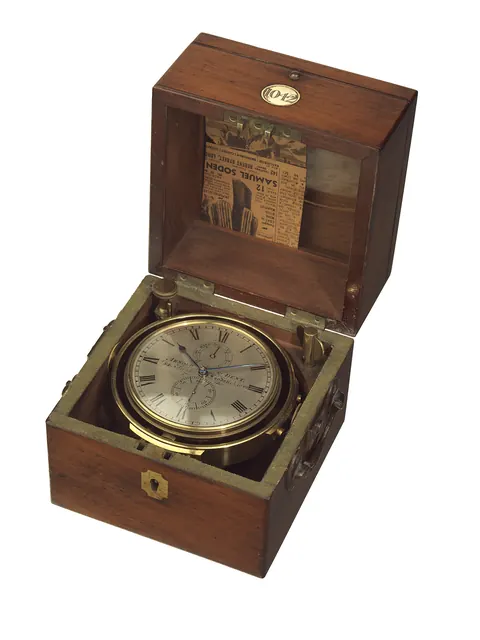
Marine chronometer no. 1042 by Arnold & Dent
Royal Museums Greenwich
Clocks · c. 1830
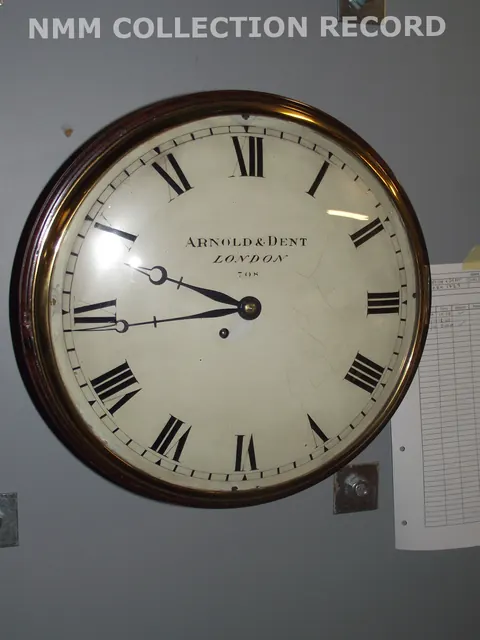
Dial Clock, 708 by Arnold & Dent
Royal Museums Greenwich
Pocket Watches · 1836 (hallmarked London)
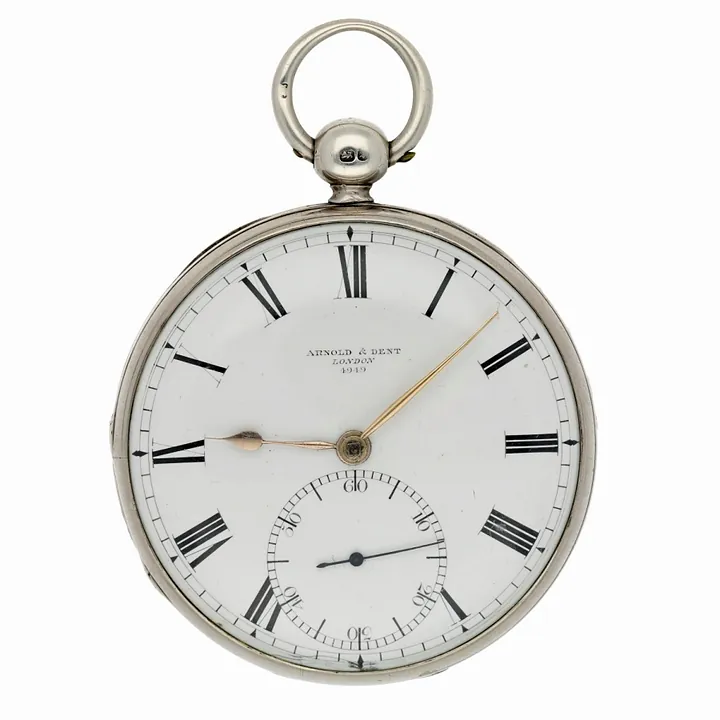
Silver fusee lever pocket watch by Arnold & Dent, London, hallmarked London 1836
Gardiner Houlgate (auction house), Corsham
Pocket Watches · 1839 (hallmarked London)
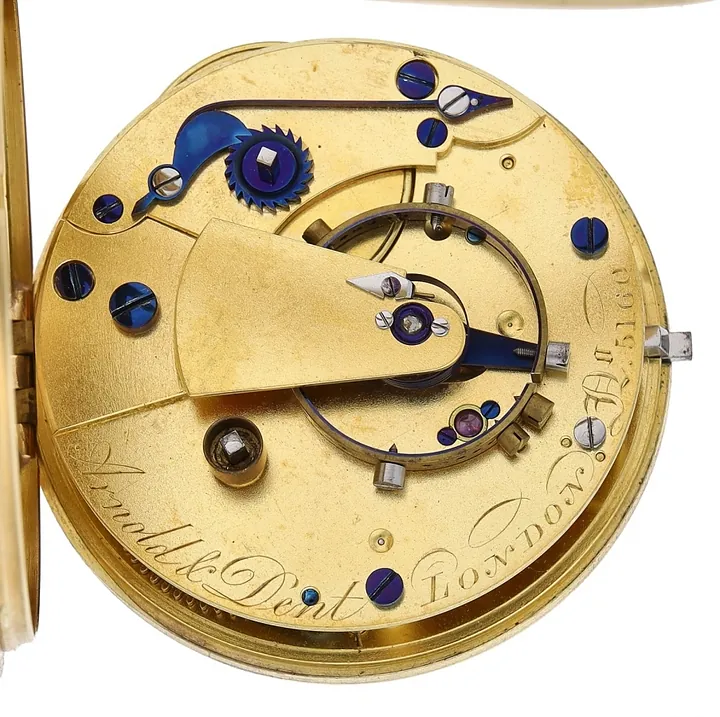
18ct pocket chronometer by Arnold & Dent, London, hallmarked London 1839
Gardiner Houlgate (auction house), Corsham
Instruments · 1731–1776
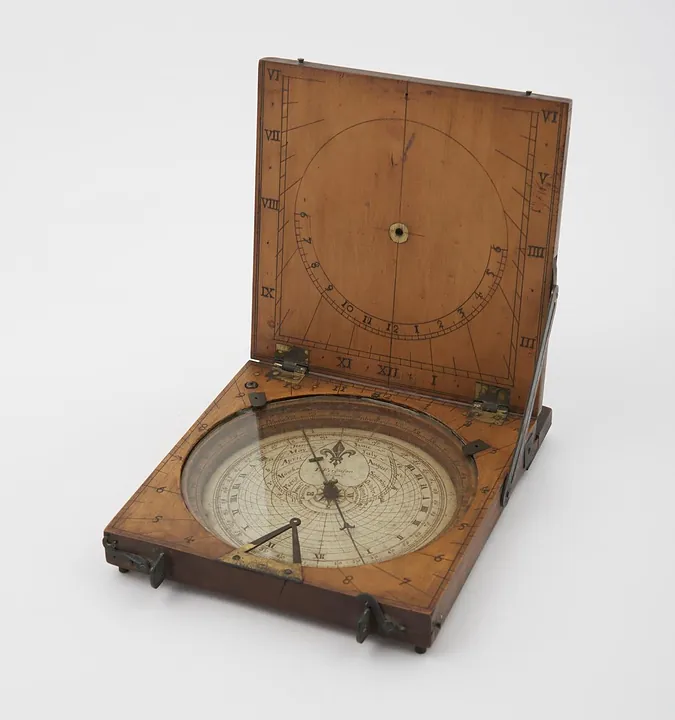
Azimuth compass sundial by James Ferguson, London, England, 1731–1776. Could also be used as a tablet sundial - string gnomon is missing (see note).
Science Museum Group, London
Instruments · 1738–1777
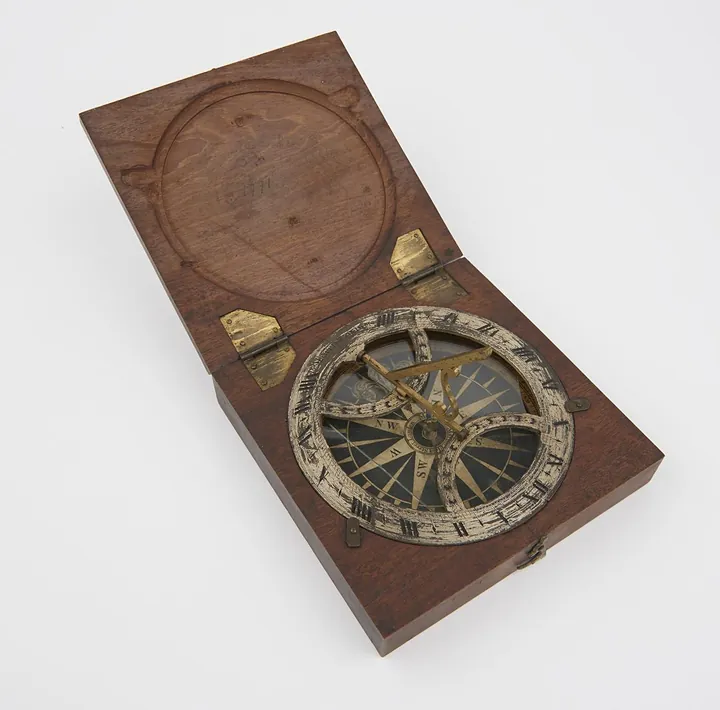
Azimuth sundial 4 3/8" diam, with folding gnomon fitted in mahogany case, made by B. Martin
Science Museum Group, London
Instruments · 1750–1800
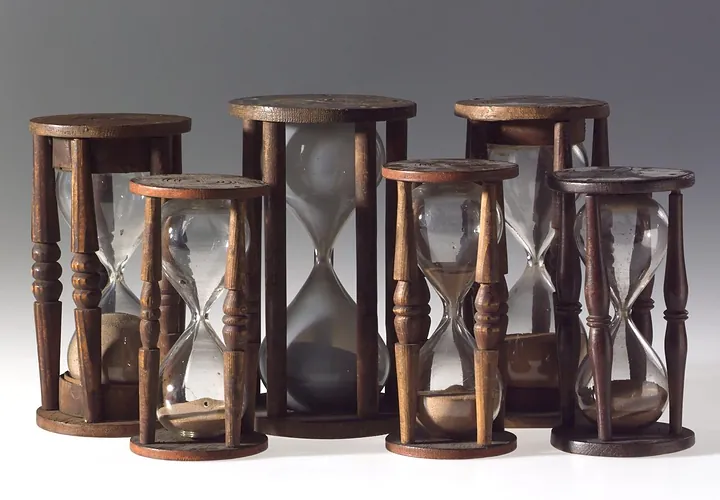
Single sand glass in four pillared wooden mount. 17 minutes. Horne Type B. Second half of the 18th century
Science Museum Group, London
Instruments · 1751–1825
Sundial, by Troughton, in case. Invented and made by Troughton
Science Museum Group, London