
Instruments · Marine chronometer
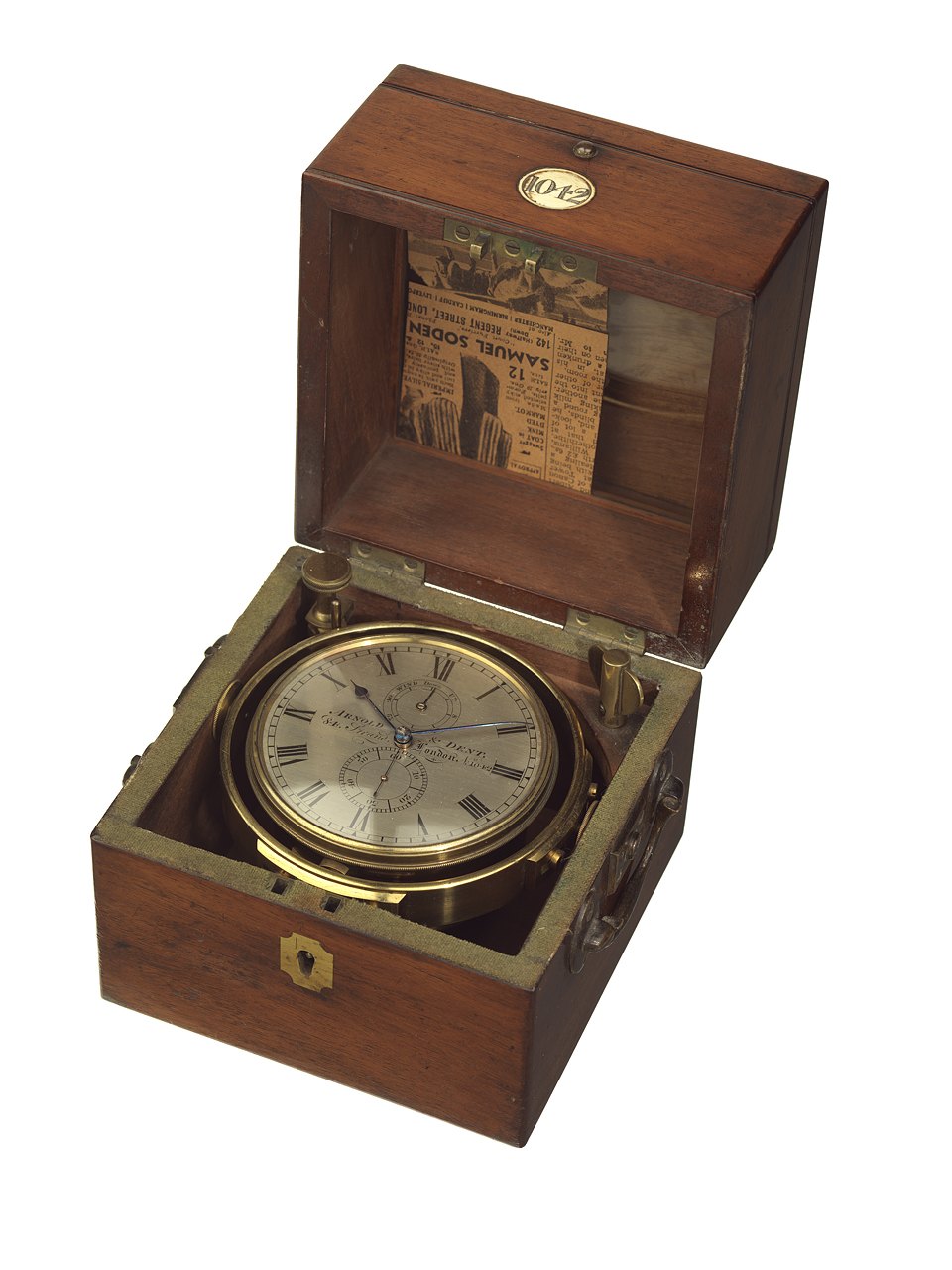
Marine chronometer no. 1042 by Arnold & Dent
- Maker / attribution
- Arnold & Dent (maker)
- Date
- c. 1835
- Historical period
- Precision & Scientific Horology (1750 – 1850)
- Country of origin
- England
- Object type
- Marine chronometer
- Materials / technique
- mahogany; brass; steel
- Dimensions
- Overall: 150 x 155 x 150 mm
- Holding institution
- Royal Museums Greenwich
- Accession / object no.
- ZAA0062
- Credit line
- National Maritime Museum, Greenwich, London
- Catalogue title (original)
- 1042 (English)
View the source record ↗ (opens another website in a new tab)Suggest a correction
Record summary
Held and catalogued by Royal Museums Greenwich (object number ZAA0062), this is a marine chronometer by Arnold & Dent, made in England, dated c. 1835. The Atlas places it in the Precision & Scientific Horology period (1750 – 1850) of its Instruments collection. Materials and techniques recorded by the source: mahogany; brass; steel. Recorded dimensions: Overall: 150 x 155 x 150 mm. The record is illustrated with 2 photographs.
Assembled from the source record's structured fields. Dates and attributions are given as the source states them; where a field is missing the Atlas leaves it blank rather than estimating.
Catalogue description
Catalogue description — Royal Museums Greenwich
Arnold & Dent, London c.1836 No.1042 2 day marine chronometer in mahogany box Arnold & Dent,…………… Box/Mounting Three-tier plain mahogany box measuring 150mm high, 160mm wide, and 148mm deep. The lid has a large oval lacquered-brass plate inlaid in the top, engraved: “To E.W.Vansittart / from / Lord Bexley”. brass butt- hinges, opening to 90° to reveal a glazed panel retained with narrow wooden beading. The front of the upper half has a brass push-button lid catch and a small circular ivory tablet, engraved :”1042”, below. Pasted on the inside of the glass is a newspaper cutting relating to the Vansittart family. The lock on the lower half has an inlaid brass ‘hollow-corner’ lozenge escutcheon. The box is of fine, concealed dovetailed construction at all four corners, and the upper half has butt-hinges, the opening limited to 90°. There is a baize covering running round the upper edge of the lower half, and forming a dust seal when closed. The box fittings are of the standard layout except that the gimbal lock is mounted at the rear left. There are brass drop handles on the sides, the gimbal screws threaded into bevelled brass blocks on the outsides of the box and secured with knurled brass locking discs on the inside. The narrow, close-fitting lacquered brass gimbal ring has an adjustable curved plate for supporting the front gimbal pivot and adjustable curved plates on the bowl for the fixing the front and back pivot blocks themselves. The cast brass bowl has an upper part sweeping out to a larger diameter, threaded for the bezel. The inside of the bowl is stamped: “1042” (the 2 smaller than the others), and has a ‘percussion cap’-type brass winding shutter on the base, swinging out to provide access to the winding hole, and faced with a chamois leather plug to seal the hole when closed. Narrow brass screwed bezel (3 ½ turns) with a thin convex glass over the dial, and scratched:”1042” on the underside. A&D-type rising ratchet winding key,. The underside of the box has a green baize covering. Dial and hands The 88.2 mm Ø, engraved and wax-filled, silvered-brass dial has three small riveted feet which fix to the pillar plate with side screws and the dial itself seats in the recess in the bowl, a pin at XII and a notch in the bowl orientating it correctly. The dial has roman hour numerals and the seconds dial, below the centre, has arabic ten-second figures with straight batons at alternate five-second intervals. An up and down dial below XII is marked in 8 hour intervals and has “UP” instead of 1, “WIND” instead of 48 and “Down” at the top of the dial. The main dial is signed across the centre: “ARNOLD & DENT, / 84, Strand, London No: 1042”. The dial back is stamped “1042”, has “GS” (?) scratched on it and is marked with the triangular dots. Blued steel spade and poker-hands with a fine, blued steel pointer seconds hand with a counter-poised tail, and blued steel pointer up and down hand. Movement Full-plate fusee movement with four pillars with flanges and fins at either end and one fin in the lower middle, screwed to the potence plate with blued steel screws. The blued steel set up ratchet wheel is dot marked for position against a nick on the edge of the square. There is a small drilled dot on the barrel bar by the ratchet wheel to mark set-up positions against the nick on one edge of the square. The inside of the pillar plate (under the barrel) is stamped: “TCW”. The inside of the potence plate, the outside of the train bar, and the undersides of the pillar plate, the barrel bar, the barrel, the balance cock foot and the potence, are marked with: “1042”. The underside of the potence plate, and the insides of the great wheel and the maintaining power wheel are marked with three mis-shapen dots. The underside of the pillar plate, the barrel bar, the potence, the set-up ratchet wheel and set up ratchet click, are marked with three triangular dots. The underside of the set-up click also has two polishing points. The fusee cap is dot marked for the pin entry hole (though now opposite). The underside of the maintaining power spring is marked: “V”. The fusee ratchet appewars to have something scratched on it, but indecipherable. The later, signed blued steel mainspring has a steel square hooking in the barrel. There is a five-wheel train including great wheel, the fusee with Harrison’s maintaining power and with a straight-sided fusee pipe push-fitted to the square. The train wheels are brass with the third, fourth and escape wheels run on a bar on the pillar plate. All train holes have been plugged and re-pitched from new, as well as the maintaining power detent. Escapement, balance, spring and jewelling Earnshaw-type spring detent escapement, the fine grey-finished foot detent with gold passing spring screwed to the side, and sapphire locking stone in a pipe. The detent banks against a small brass banking piece, fixed alongside on the potence plate. grey-finished impulse roller with polished edge and clear impulse jewel, and discharge roller also with a clear stone inset. The J.R.Arnold patent bimetal-arm, oversprung balance, has brass posts projecting up from the bimetal arm, with brass compensation nuts mounted on threaded ends of the brass posts, and brass meantime nuts screwed onto threads at the ends of the arm and at 90° to the arm on the upstanding ends of a separate cranked brass arm. The bimetal arm combines steel as the upper element, with a whitish alloy, probably the same as Arnold’s ‘platina’ alloy, as the lower. The blued steel helical balance spring has terminals on both ends, the upper terminal pinned to a brass stud on the balance cock, the stud having a blued steel side screw for isochronal adjustments. The jewelling, which is all in clear stones (except a facetted diamond in a blued steel setting in the balance cock) mounted in brass settings, extends to the balance and escape wheel only, and the escapement parts as mentioned. Alterations/condition The box is in sound a
Historical context
Precision & Scientific Horology (1750 – 1850)
Harrison solves longitude; Mudge invents the lever; Breguet's Paris workshop defines the modern watch.
The longitude problem was solved by the marine chronometer and lunar distance methods; dividing engines made precision scales possible, and observatories set time by transit instruments.
Read the period in the timelineMore instruments from this periodEarlier: Early Modern Horology
Atlas type guide
Marine chronometers
A marine chronometer is a precision timekeeper carried at sea to find longitude: the navigator compares local noon, observed with a sextant, with the time at a reference meridian kept by the chronometer. Each hour of difference corresponds to fifteen degrees of longitude. John Harrison proved the method in the 1760s; Pierre Le Roy, Ferdinand Berthoud, John Arnold and Thomas Earnshaw then developed the detent escapement and the compensation balance that made chronometers practical to manufacture.
By the nineteenth century London, Liverpool, Le Locle and Glashütte supplied navies and merchant fleets. A typical box chronometer has a spring-detent escapement, a fusee to equalise mainspring torque, a bimetallic compensation balance with a helical balance spring, and is mounted in gimbals inside a wooden box so that it stays level.
What to look for
- Gimbals and a three-tier wooden box with a glazed inner lid.
- A power-reserve ('up and down') indicator on the dial, usually showing 56 hours on two-day instruments.
- Spring-detent escapement and a cylindrical (helical) balance spring visible through the movement.
- Admiralty or navy marks (broad arrow), and rating certificates from observatories.
- The maker's number on the dial and movement; many makers' registers survive, allowing dating.
Dating clues
- Earnshaw-type spring-detent chronometers became standard after about 1800.
- Auxiliary compensation devices on the balance appear from the mid-nineteenth century.
- Quartz and radio time signals ended routine use of mechanical chronometers in the 1970s and 1980s.
General guidance written by the Atlas editors about this kind of object. It is not a statement about this particular piece; for that, rely on the source record above and on physical examination.
Read next:Detent escapement
Related records
Clocks · c. 1830
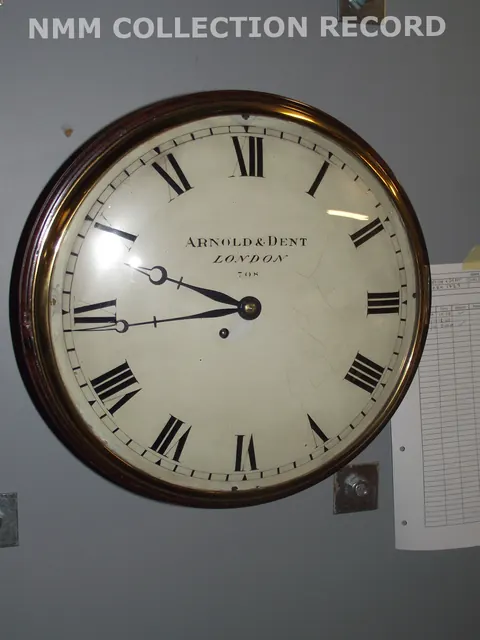
Dial Clock, 708 by Arnold & Dent
Royal Museums Greenwich
Instruments · 1830–1835
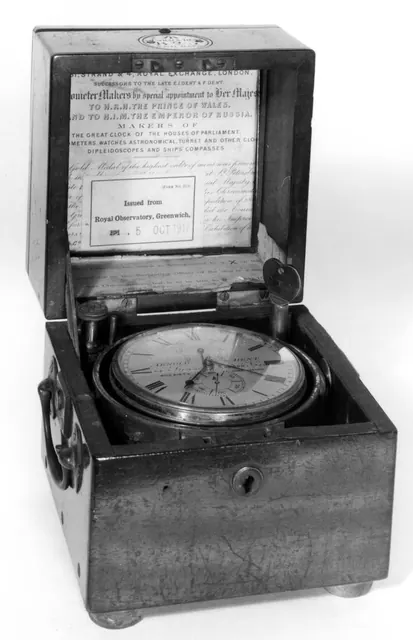
Marine chronometer by Arnold & Dent
British Museum
Pocket Watches · 1836 (hallmarked London)
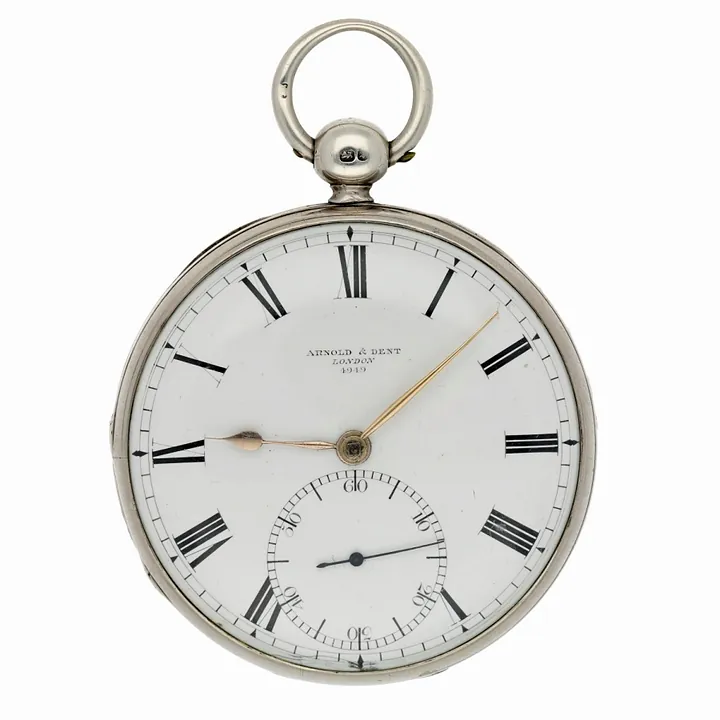
Silver fusee lever pocket watch by Arnold & Dent, London, hallmarked London 1836
Gardiner Houlgate (auction house), Corsham
Pocket Watches · 1839 (hallmarked London)
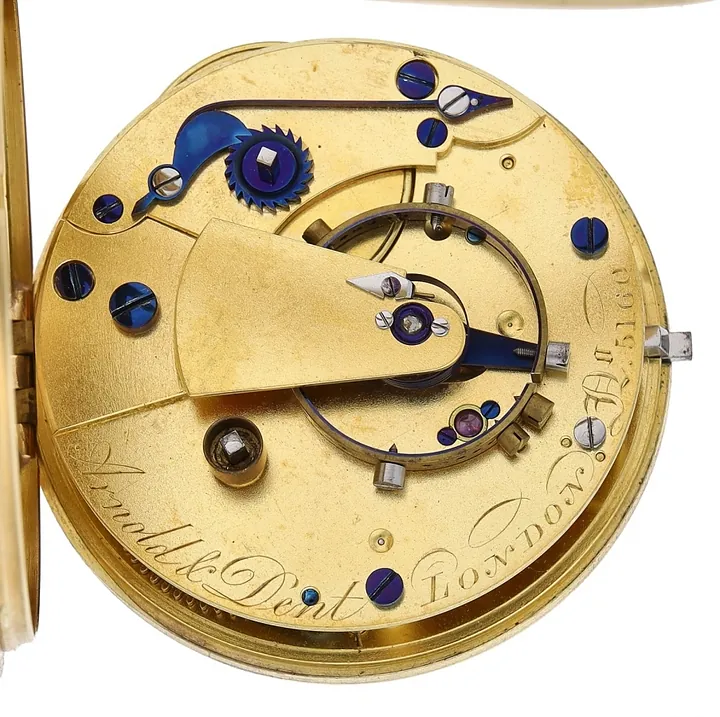
18ct pocket chronometer by Arnold & Dent, London, hallmarked London 1839
Gardiner Houlgate (auction house), Corsham
Instruments · 1731–1776
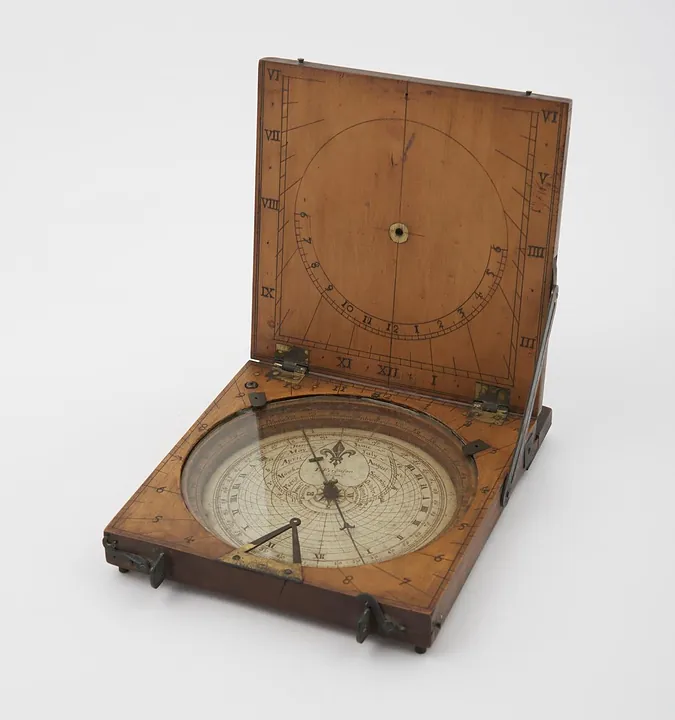
Azimuth compass sundial by James Ferguson, London, England, 1731–1776. Could also be used as a tablet sundial - string gnomon is missing (see note).
Science Museum Group, London
Instruments · 1738–1777
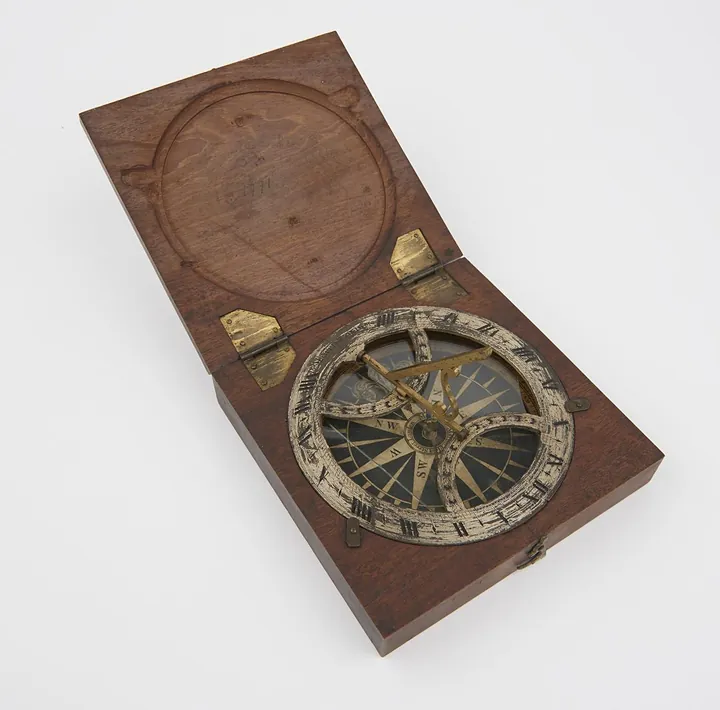
Azimuth sundial 4 3/8" diam, with folding gnomon fitted in mahogany case, made by B. Martin
Science Museum Group, London
Instruments · 1750–1800
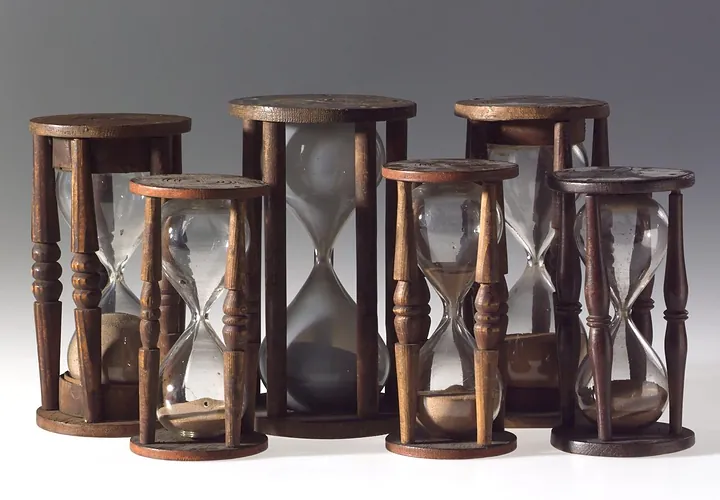
Single sand glass in four pillared wooden mount. 17 minutes. Horne Type B. Second half of the 18th century
Science Museum Group, London
Instruments · 1751–1825
Sundial, by Troughton, in case. Invented and made by Troughton
Science Museum Group, London