
Clocks · Carriage clock
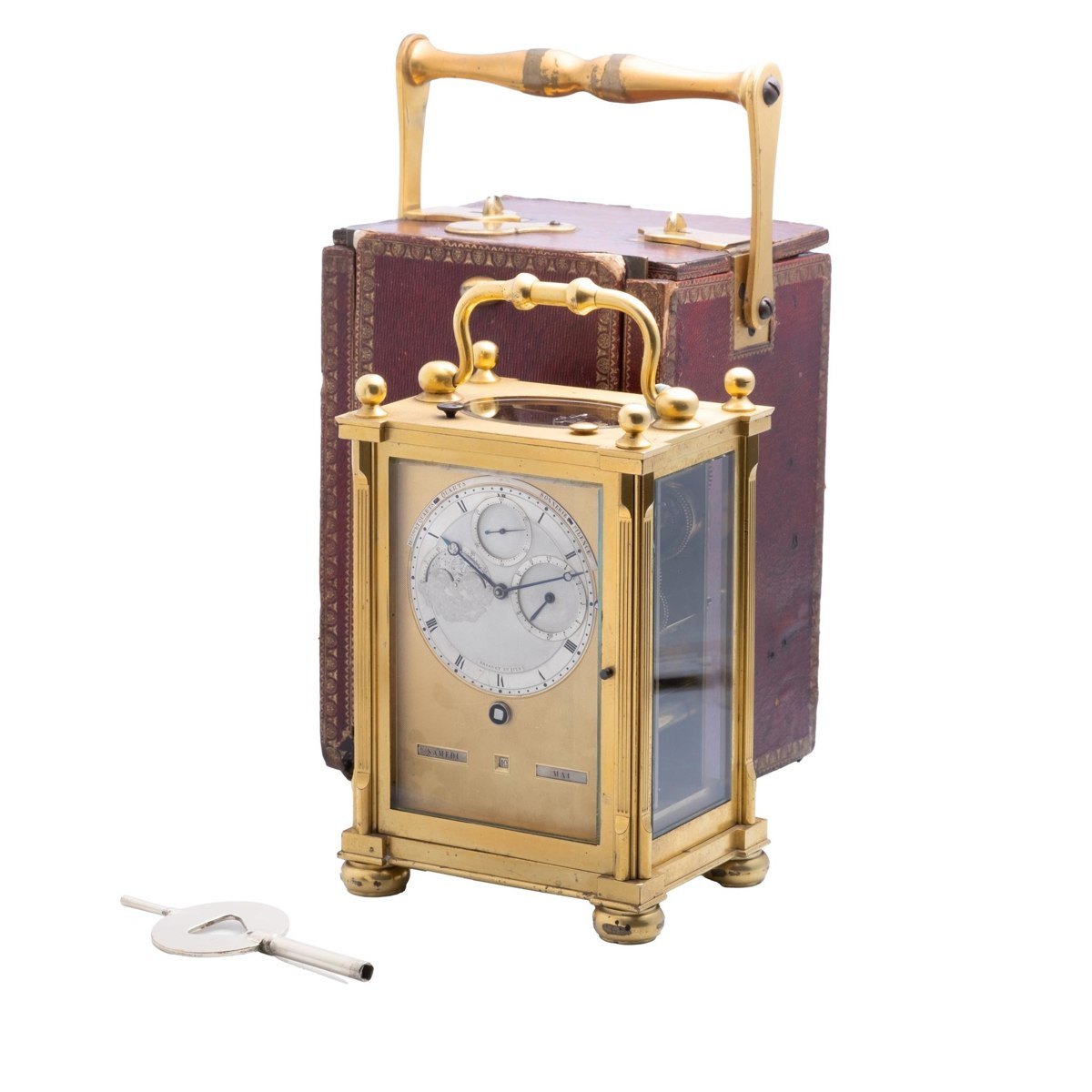
Breguet & Fils \"Pendule à Almanach\" carriage clock no. 3414
- Maker / attribution
- Breguet & Fils (source attribution)
- Date
- Sold January 18, 1826
- Historical period
- Precision & Scientific Horology (1750 – 1850)
- Country of origin
- France
- Object type
- Carriage clock
- Holding institution
- Antiquorum
- Accession / object no.
- 615
- Credit line
- Antiquorum
- Catalogue title (original)
- BREGUET & FILS, FRANCE, \"PENDULE A ALMANACH\", ASTRONOMICAL EIGHT-DAY CARRIAGE CLOCK, BUILT ON THE PRINCIPLES OF THE \"GARDE TEMPS\", WITH JEWELED LEVER ESCAPEMENT, \"GRANDE\" AND \" PETITE SONNERIE\ (English)
View the source record ↗ (opens another website in a new tab)Suggest a correction
Record summary
Held and catalogued by Antiquorum (object number 615), this is a carriage clock attributed to Breguet & Fils, made in France, dated Sold January 18, 1826. The Atlas places it in the Precision & Scientific Horology period (1750 – 1850) of its Clocks collection. The record is illustrated with 1 photograph.
Assembled from the source record's structured fields. Dates and attributions are given as the source states them; where a field is missing the Atlas leaves it blank rather than estimating.
Catalogue description
Original object description
This French carriage clock, documented under number 3414 and recorded in auction archives as sold on January 18, 1826, represents a Breguet & Fils "Pendule à Almanach." The timepiece is encased in an Empire-style gilt-bronze housing with five glazed facets, corner-mounted Doric columns, and four gilded feet. Both the front and rear panels open on hinges, while upper push-pieces control the alarm alongside repeating functions for petite or grande sonnerie. Inside, the 117 x 79 mm rectangular movement of gilded brass relies on a solitary mainspring barrel powering the strike and time trains. Mechanically, it integrates a lateral lever escapement inset with sapphire pallets, a cut bimetallic balance with two arms, a pare-chute shock protector on the top pivot, and a Breguet overcoil hairspring carrying an adjustable platinum poise piece. The engine-turned silver primary dial bears the signature "Breguet et Fils" and displays blued-steel hands pointing to Roman numerals arranged on a polished chapter ring, flanked by secondary registers for alarm adjustment and running seconds. Beneath it, an engine-turned gilt-brass faceplate reveals digital calendar readouts and a lunar aperture framed by markings for the moon's age. The clock is accompanied by a custom-fitted travelling box bound in red morocco leather.
Inscriptions & marks
3414
Historical context
Precision & Scientific Horology (1750 – 1850)
Harrison solves longitude; Mudge invents the lever; Breguet's Paris workshop defines the modern watch.
The age of the deadbeat escapement, compensated pendulums and observatory regulators. Domestic clocks spread through the middle classes: English longcase and bracket clocks, French gilt-bronze mantel clocks, Viennese Biedermeier wall clocks, Black Forest painted-shield clocks, and the first American shelf clocks.
Read the period in the timelineMore clocks from this periodEarlier: Early Modern Horology
Atlas type guide
Carriage and travel clocks
The carriage clock is a portable spring clock with a balance-wheel escapement and a brass case with glass panels and a carrying handle. Abraham-Louis Breguet made early examples around 1800, and from the 1830s Paul Garnier and other French makers industrialised production, with the small towns of Saint-Nicolas-d'Aliermont and the Franche-Comté supplying movements for retailers worldwide.
Typical features include a platform escapement mounted horizontally on top of the movement (usually a lever, sometimes cylinder or Garnier's chaff-cutter), striking or repeating work, and alarms. English carriage clocks, generally larger and with fusees, were made by firms such as Frodsham and Dent. Travel clocks in folding leather cases became popular in the twentieth century.
What to look for
- A platform escapement visible through the top glass.
- Case styles: corniche, gorge, anglaise, obis or engraved cases.
- Repeat buttons on top and strike/silent levers.
- Stamps of movement makers (e.g. Drocourt, Jacot, Margaine, Richard & Co.) on the backplate.
Dating clues
- Early carriage clocks with Breguet or Garnier features: c. 1800–1850.
- Mass-produced French carriage clocks: c. 1850–1914.
- Folding travel clocks and alarm travel clocks: mostly 1920–1970.
General guidance written by the Atlas editors about this kind of object. It is not a statement about this particular piece; for that, rely on the source record above and on physical examination.
Related records
Pocket Watches · Sold to the Russian Consul the 25 August 1817 Mr Hercevanoff
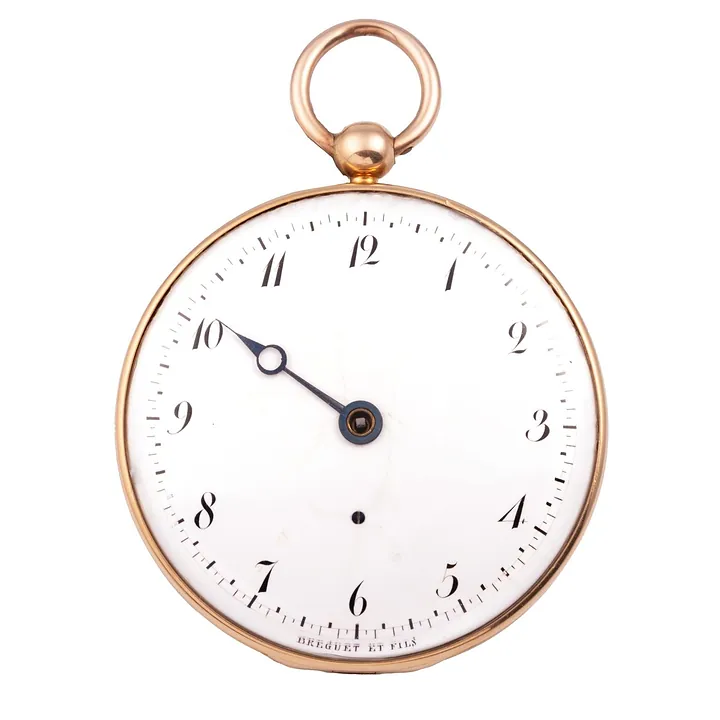
Breguet & Fils pocket watch, Sold to the Russian Consul the 25 August 1817 Mr Hercevanoff
Antiquorum auction archive, Geneva
Pocket Watches · Delivered to Jousselin & Brasch the 19 April 1823.
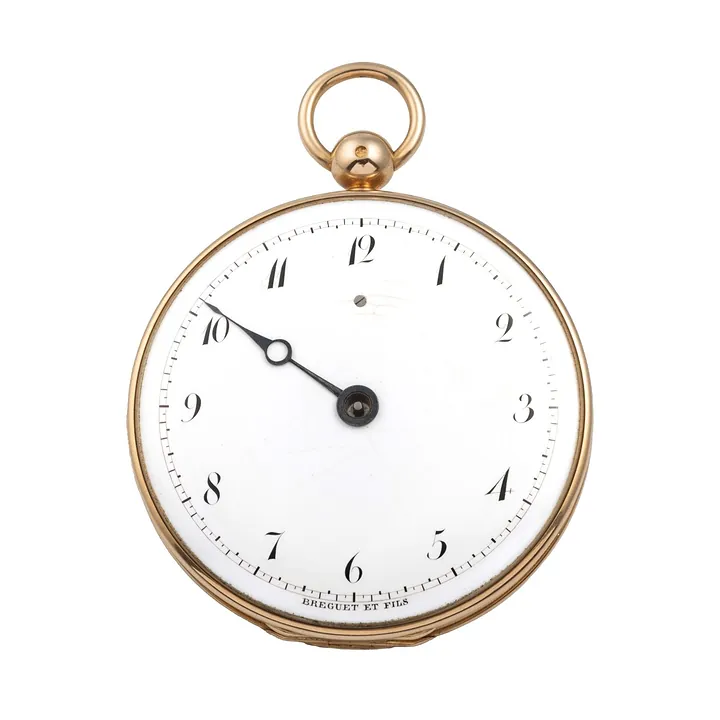
Breguet & Fils pocket watch, Delivered to Jousselin & Brasch the 19 April 1823.
Antiquorum auction archive, Geneva
Pocket Watches · c. 1800-1810
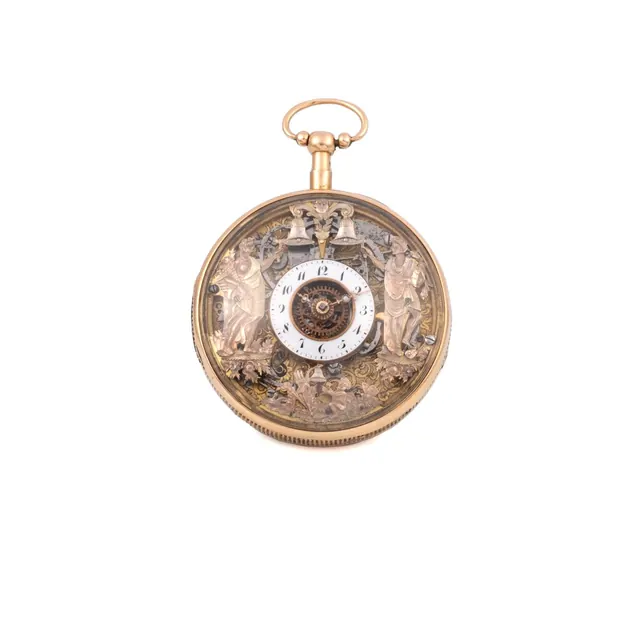
Breguet & Fils pocket watch, skeleton quarter-repeater, circa 1800-1810
Antiquorum auction archive, Geneva
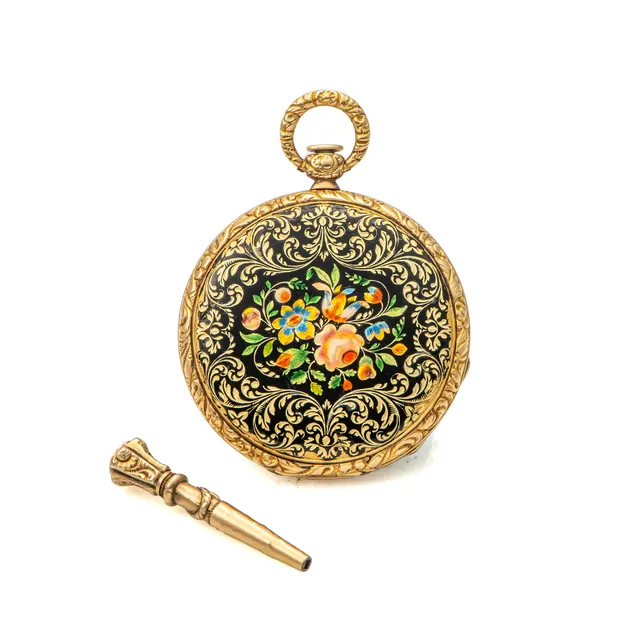
Pocket Watches · c. 1850
Breguet & Fils pocket watch, circa 1850
Antiquorum auction archive, Geneva
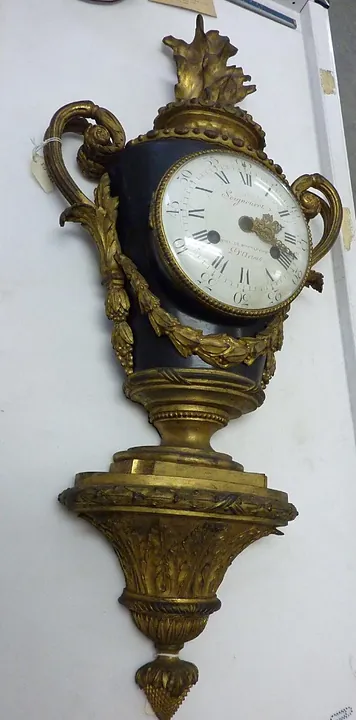
Clocks · 1750–1800
Bracket clock in metal case with scroll handles and flamed-shaped top signed by Pierre Seignoret, Clockmaket to the the Comte d'Artois
Victoria and Albert Museum, London
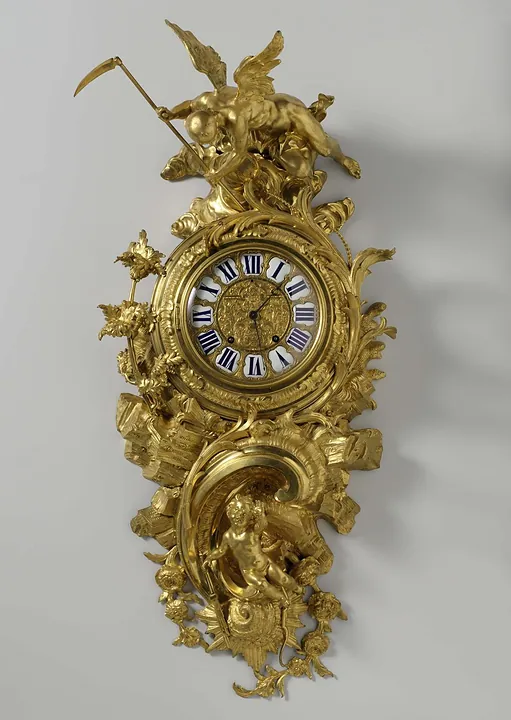
Clocks · 1756
Mantel clock, France, 1756
Rijksmuseum
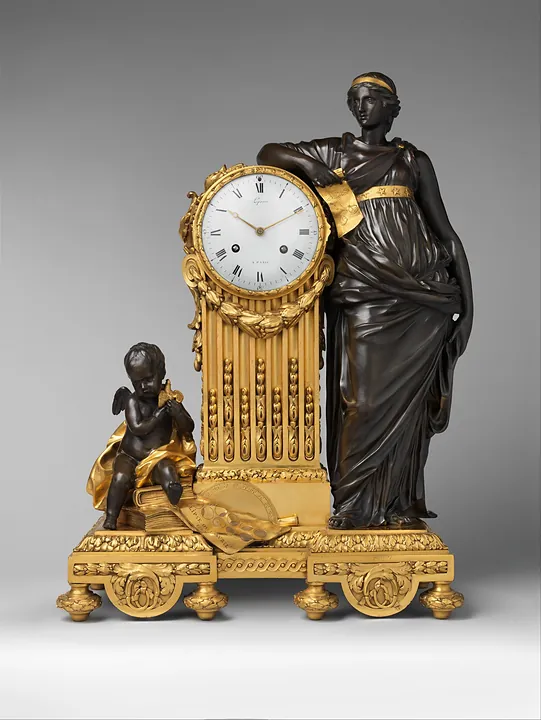
Clocks · c. 1764–70
Mantel clock by Jean-André Lepaute, France, c. 1764–70
The Metropolitan Museum of Art, New York
Clocks · 1760–1860
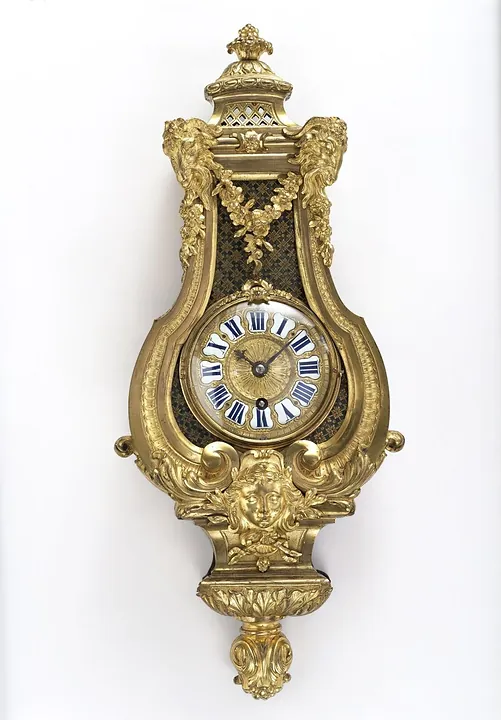
'Pendule d'alcove' wall clock, gilt-bronze and boulle marquetry, Paris, 1760-1860
Victoria and Albert Museum, London